
A mirrored bean in Chicago swallows the skyline. A red membrane stretches 150 meters through London’s Tate Modern. A void absorbs light so completely it looks like a hole in reality.
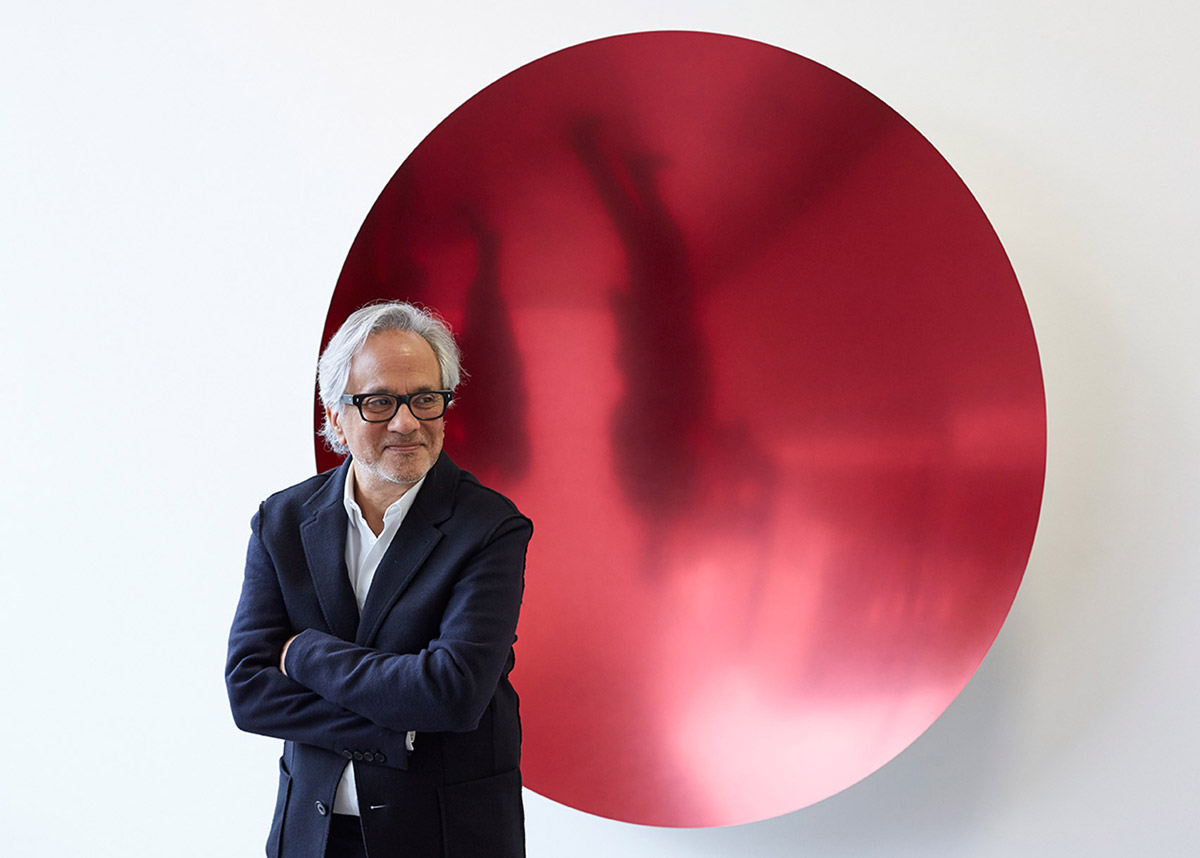
Anish Kapoor doesn’t make sculpture you walk around. He creates spaces that pull you in, flip you upside down, or make you question what’s solid and what’s illusion.
Born in Mumbai and working between London and Venice, Kapoor transformed contemporary sculpture by treating industrial materials like philosophical questions. His polished stainless steel doesn’t just reflect. His voids don’t just sit empty.
This article explores how a British-Indian artist became one of the most influential sculptors alive. You’ll discover his breakthrough pigment works, his engineering feats with PVC and mirror-polished steel, and why he sparked controversy over the world’s blackest black.
From Cloud Gate to Vantablack, here’s the story of perception made physical.
Identity Snapshot
Anish Mikhail Kapoor CBE RA
Born: March 12, 1954, Mumbai (Bombay), India
Primary roles: Sculptor, installation artist, painter
Nationality: British-Indian
Movements: New British Sculpture, contemporary art
Primary mediums: Polished stainless steel, PVC membrane, pigment powder, sandstone, marble, granite, alabaster, fiberglass, wax
Signature traits: Mirror-polished surfaces, concave/convex distortions, void exploration, monochromatic intensity, biomorphic abstraction
Iconography/motifs: Voids, negative space, reflective ellipses, membrane forms, abysses
Geographic anchors: Mumbai (birthplace), London (primary studio), Venice (studio), Chicago (Cloud Gate)
Education: Hornsey College of Art (1973-1977), Chelsea School of Art (1977-1978)
Mentor: Paul Neagu
Collections: MoMA New York, Tate London, Guggenheim (Bilbao, Venice, Abu Dhabi), Prada Foundation Milan, Museo Reina Sofia Madrid
Market signals: Record auction £1.7M (alabaster Untitled, 2003), typical range £1,000-£5,000 for prints, £200,000-£1.3M for major sculptures
Awards: Turner Prize (1991), Premio Duemila Venice Biennale (1990), Praemium Imperiale (2011), Padma Bhushan (2012), CBE (2003), Knighthood (2013), Genesis Prize (2017)
What Sets The Artist Apart

Kapoor makes sculpture behave like painting. His polished steel surfaces don’t just reflect but actively swallow and reconstitute space around them, creating what he calls “non-objects.”
The void isn’t empty in his work. It pulls.
Where Richard Serra used Cor-Ten steel’s weight and rust, Kapoor transformed industrial materials into optical phenomena. While Tony Cragg assembled found objects and Richard Deacon shaped curves, Kapoor dissolved edges entirely through pigment saturation and reflective manipulation.
His 1980s pigment pieces made geometric forms appear to float or sink into floors. By the 1990s, he’d moved to stainless steel mirrors that distorted viewers into grotesque, beautiful inversions of themselves.
Then came the monumental public commissions. Cloud Gate. ArcelorMittal Orbit. Marsyas.
Kapoor doesn’t make sculpture you walk around. He makes sculpture you enter, reflect in, or stand beneath while it warps your perception of sky, city, self.
Origins & Formation
Early Years (1954-1973)
Born to an Indian Punjabi Hindu father (hydrographer, Indian Navy) and Iraqi Jewish mother in Mumbai.
Attended The Doon School, elite boarding institution in Dehradun where European history mixed with Indian curriculum. Felt like an outsider in both cultures.
Breaking Point & Departure (1971-1973)
Moved to Israel at 17, lived on kibbutz. Attempted electrical engineering but quit after six months due to math difficulties.
Decided to become an artist.
Moved to London in 1973, enrolled at Hornsey College of Art.
Art School Formation (1973-1978)
Studied under Paul Neagu, Romanian-born British artist who became crucial mentor.
Neagu helped articulate Kapoor’s cross-cultural artistic vision.
Created performance-based, ritualistic pieces involving symbolic interactions between two people. Non-narrative, process-focused work.
Completed MA at Chelsea School of Art (1977-1978).
Breakthrough Moment (1979-1980)
Returned to India in 1979. Epiphany: his art had direct relationship to Indian ritual objects and attitudes toward “doing.”
Saw pigment everywhere. Market stalls. Temple offerings. Ground powders defining sacred spaces.
First significant works emerged: pigment pieces using bright powdered color on geometric forms.
First solo exhibition at Patrice Alexandre’s Paris studio (1980). Displayed pigment sculptures on wooden floors where color boundaries dissolved beyond object edges.
Movement & Context
New British Sculpture Positioning

Kapoor emerged alongside Tony Cragg and Richard Deacon in late 1970s/early 1980s British sculpture scene. But where they assembled or shaped, he dematerialized.
Broke from minimalism‘s “truth to materials” ethos. His materials lied beautifully.
Comparative Analysis: Kapoor vs. Contemporaries
vs. Richard Serra:
- Serra: Cor-Ten steel, 1-2 inch thick plates, vertical lean, rust patina, weight as presence
- Kapoor: Polished stainless steel, mirror finish, concave warping, reflection as absence
vs. James Turrell:
- Turrell: Light itself, apertures in walls/ceilings, soft atmospheric gradations
- Kapoor: Solid materials made to feel immaterial, hard-edge voids, pigment saturation
vs. Olafur Eliasson:
- Eliasson: Weather phenomena (fog, sun, ice), installation environments, Nordic palette
- Kapoor: Biological/geological reference (membrane, abyss, womb), monochromatic intensity, Indian/Jewish symbolism
Stylistic Position

Kapoor occupies space between abstract and phenomenological. His forms register as both geometric precision and organic inevitability.
His work sits at intersection of Eastern philosophy (void, Maya, illusion) and Western modernism (material investigation, viewer activation).
Materials, Techniques, and Process
Early Period: Pigment Works (1979-1989)
Support: Floor-based installations, wall-mounted protrusions
Materials: Limestone, marble, sandstone, granite, plaster forms coated in pure powdered pigment
Application: Pigment applied so densely it appears to radiate outward, dissolving object boundaries. Forms seem partially submerged like icebergs.
Palette: Saturated primaries, especially red and blue. Yellow ochres. Intense monochromes.
Key technique: Pigment powder defines floor surface around object, creating ambiguous spatial reading
Void Period (Mid-1980s-1990s)
Materials: Sandstone, slate, fiberglass with interior pigment
Process: Hollowing stone, creating deep cavities, filling with dark pigment (often black or deep blue)
Effect: Interior depth becomes imperceptible. Viewer sees only darkness, not bottom of cavity.
Notable innovation: Making holes that read as non-space, “transitional space” between presence and absence
Reflective Period (1995-Present)
Primary material: Highly polished stainless steel
Fabrication: Industrial-grade polishing to mirror finish. Collaboration with engineering firms (Cecil Balmond/Arup for structural calculations).
Form types: Concave discs, convex bulges, elliptical volumes
Optical properties:
- Concave surfaces invert and compress reflected space
- Convex surfaces expand and distort
- Seamless welds create continuous reflective skin
Scale range: Intimate gallery works (40cm diameter) to monumental public installations (10+ meters)
PVC Membrane Works (2000s)
Material: 2mm thick PVC membrane, typically red
Structural system: Tensioned between steel rings or architectural supports
Engineering: Computer modeling for non-linear forms. Material stretched to create skin-like surfaces.
Color: Predominantly red (referencing flesh, blood, interior body)
Key example: Marsyas (2002) – 150m long, 35m high, spanning entire Tate Modern Turbine Hall
Studio Practice
Working method: Collaborative. Large team of fabricators, engineers, assistants.
Scale approach: Maquettes and computer modeling precede full-scale realization.
Site relationship: Major works respond to specific architectural or landscape contexts.
Finishing standards: Obsessive polishing. Seamless joins. No visible fasteners on reflective works.
Themes, Subjects, and Iconography
The Void
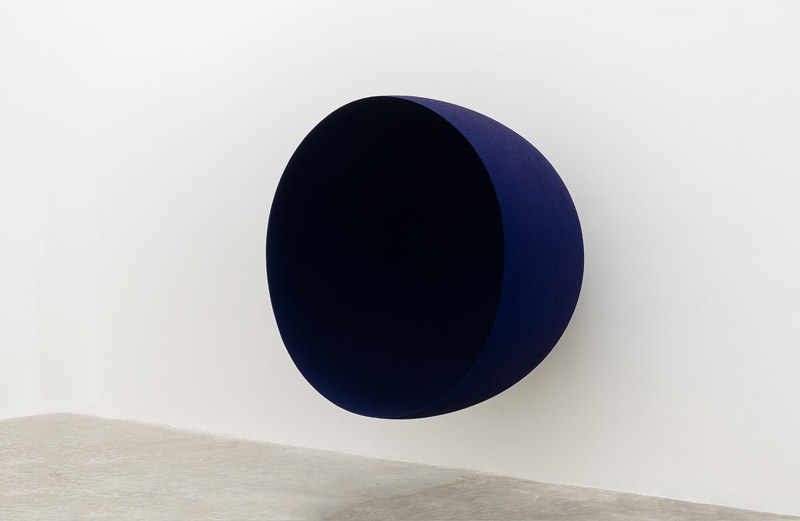
Central preoccupation. Not emptiness but pregnant absence.
References: Hindu concept of Shunya (zero, void), Jewish mysticism’s Ein Sof (infinite nothingness), Western philosophical nothing.
Formal manifestations: deep cavities in stone, black pigment absorbing light, concave mirrors creating optical abysses.
Interiority/Exteriority
Womb-like concavities. Biological references without literal anatomy.
Membranes suggesting skin, organs, body interiors turned inside out.
Reflection & Distortion
Mirrors that don’t faithfully reproduce. Concave surfaces invert viewer, making head appear below feet.
Funhouse effects deployed for philosophical purpose: destabilizing fixed identity, questioning perception.
Color Symbolism
Red: Blood, flesh, interior body, vitality, violence, passion. Indian ritual significance.
Blue: Infinity, sky, water, Krishna’s skin, spiritual transcendence.
Black: Absence, death, mystery. Recent Vantablack works absorb 99.96% of light.
Yellow/ochre: Earth, pigment materiality, Indian market spices.
Compositional Schemes
Geometric primacy: Circles, ellipses, rectangles dominate. Rarely irregular shapes.
Horizon relationship: Floor-based works subvert traditional vertical sculpture.
Scale manipulation: Objects appear smaller when close, larger from distance (or vice versa). Confounds expected spatial relationships.
Cultural/Philosophical Triggers
Indian influences: Temple rituals, market pigments, philosophical concepts of Maya (illusion), meditation practices.
Jewish heritage: Mystical traditions, iconoclasm, relationship to the unknowable.
Psychological exploration: 15 years of psychoanalysis during young adulthood. Interest in shadow, unconscious, interior space.
Notable Works
Cloud Gate (2004-2006)
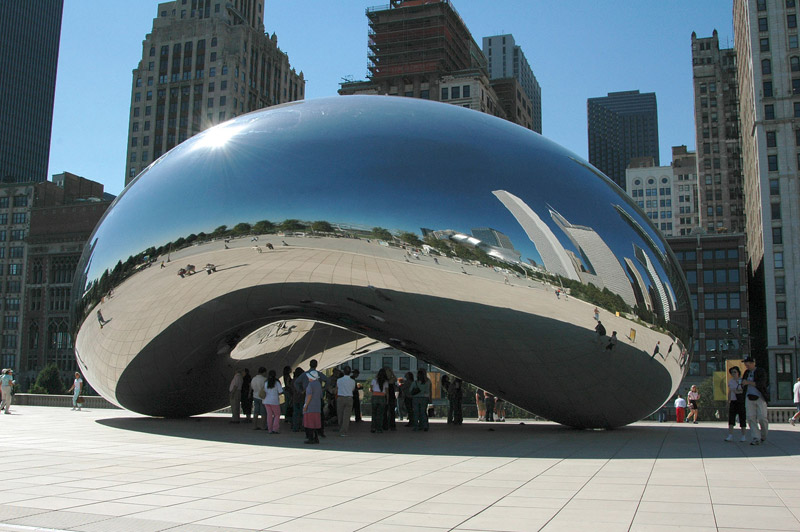
Medium: Polished stainless steel
Dimensions: 10m x 20m x 13m, 110 tons
Location: Millennium Park, Chicago (permanent)
Visual signature: Seamless mirror finish (168 steel plates welded and polished), elliptical form, concave underside creating “omphalos” (navel) where viewers stand beneath distorted reflection of themselves and sky
Why it matters: First major outdoor commission. Became instant icon, most photographed sculpture in Chicago. Designed to last 1000 years. Democratized contemporary sculpture through public accessibility and selfie culture.
Related works: Sky Mirror series (2001-2018), various locations
Marsyas (2002)
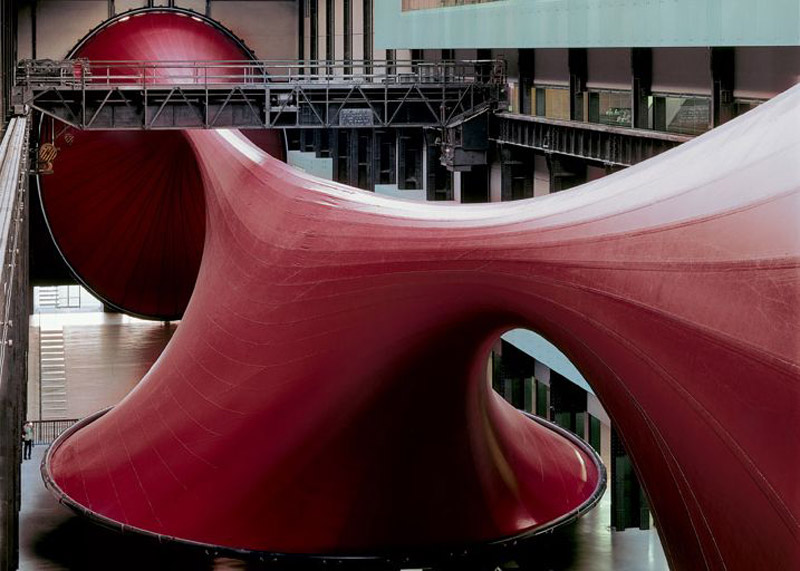
Medium: PVC membrane (red), steel rings
Dimensions: 150m long, 35m high
Location: Tate Modern Turbine Hall commission
Visual signature: Three steel rings (two vertical, one horizontal) connected by single continuous red membrane. Trumpet-like or organic orifice-like form. Impossible to view entirely from single position.
Why it matters: Unilever Commission breakthrough. Demonstrated Kapoor’s shift to architectural scale. Engineering feat (collaboration with Cecil Balmond/Arup). Biological reference through color and stretched skin-like material.
Related works: Leviathan (2011), Monumenta, Grand Palais Paris
To Reflect an Intimate Part of the Red (1981)
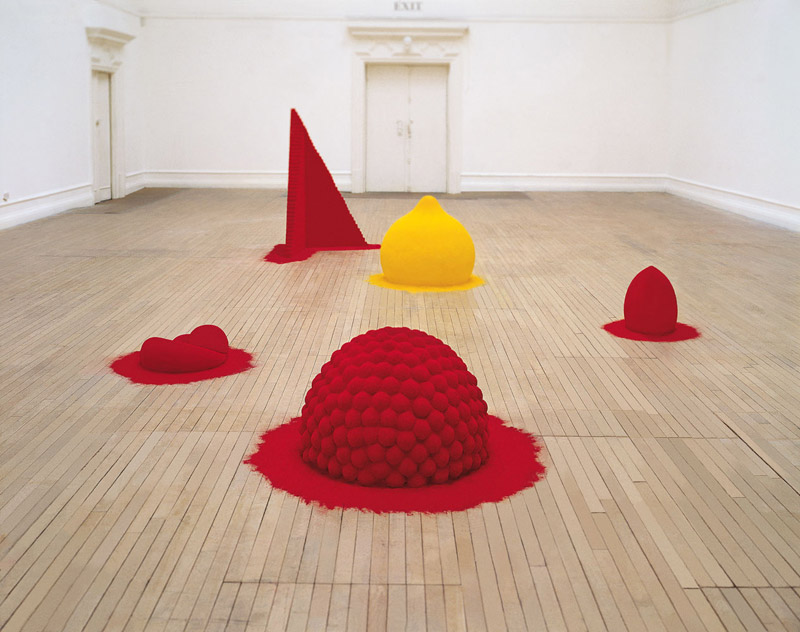
Medium: Mixed media, pigment
Dimensions: 200 x 800 x 800 cm
Location: Various collections
Visual signature: Red pigment-covered forms, ground-based installation, color bleeding beyond object edges
Why it matters: Definitive early work establishing pigment vocabulary. Part of “1000 Names” series. Showed at Hayward Gallery’s New Sculpture exhibition (1978).
When I Am Pregnant (1992/2016)
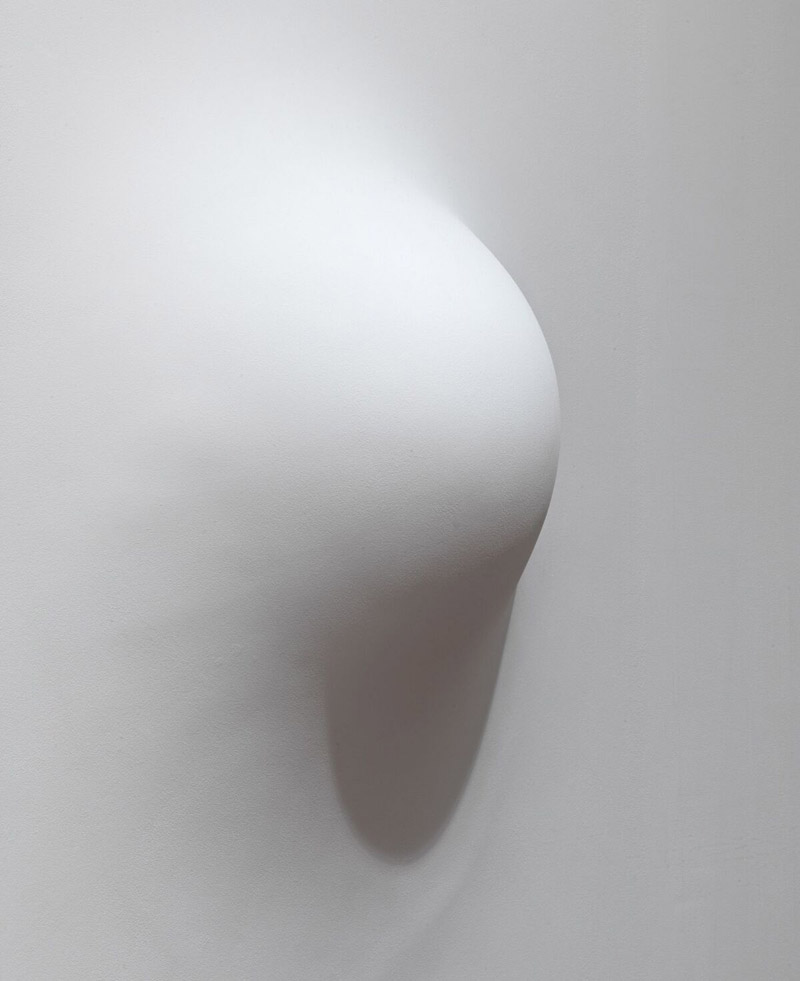
Medium: Fiberglass, wood, paint
Dimensions: 600 x 600 x 150 cm
Location: Traveling installations
Visual signature: Cream/white convex protrusion emerging from wall like pregnant belly. Smooth, organic bulge against flat architectural plane.
Why it matters: Biological reference without literal anatomy. Architectural intervention. Humor and vulnerability in title vs. abstract form.
Descension (2014-present)
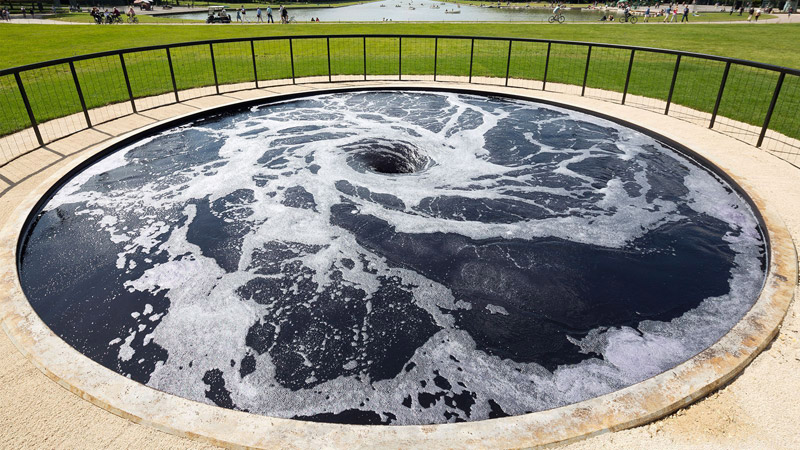
Medium: Steel, water, motor
Dimensions: 500 x 500 cm (varies by installation)
Location: Multiple sites (Brooklyn Bridge Park 2017, others)
Visual signature: Circular pool with water spiraling into central vortex, appears bottomless, hypnotic rotation
Why it matters: References Robert Smithson’s Spiral Jetty, primordial symbols, birth/death cycle, political commentary (descent, falling, crisis). Activated by mechanical system but appears naturally occurring.
My Red Homeland (2003)
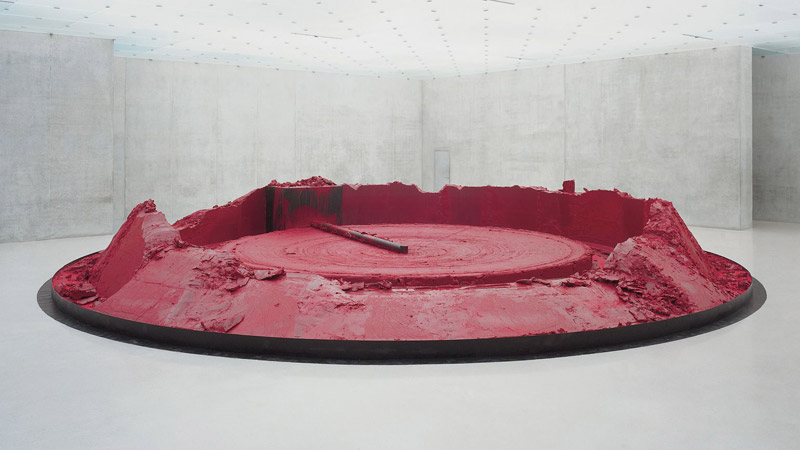
Medium: Wax, steel, motor
Dimensions: 12m diameter
Location: Various exhibitions
Visual signature: Massive mound of red wax moved continuously by mechanical arm across floor, creating ever-changing landscape
Why it matters: Introduces movement and time. References war, bloodshed, territory. Title’s irony (homeland made of shifting, unstable material). Performative element.
Vantablack Works (2016-present)
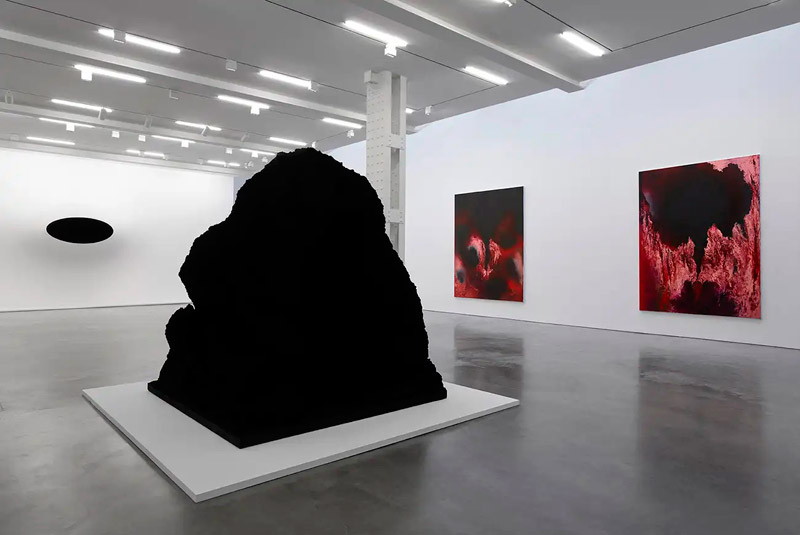
Medium: Carbon nanotube coating on various forms
Dimensions: Variable
Location: Venice Biennale debut 2022
Visual signature: Forms coated in material absorbing 99.96% of light. Appear as flat black voids regardless of three-dimensional form beneath.
Why it matters: Controversial exclusive license. Pushes void concept to material extreme. Draws criticism from art community (Stuart Semple’s “pinkest pink” retaliation).
Exhibitions, Collections, and Provenance Highlights
Major Solo Exhibitions

- Patrice Alexandre, Paris (1980) – first solo show
- Walker Art Gallery, Liverpool (1982) – Artist in Residence
- Venice Biennale, British Pavilion (1990) – Premio Duemila winner
- Tate Modern, Marsyas commission (2002)
- Royal Academy of Arts, London (2009) – first living artist major retrospective
- Guggenheim Bilbao (2010)
- Leviathan, Monumenta, Grand Palais Paris (2011)
- Museum of Contemporary Art, Sydney (2012)
- Chateau de Versailles (2015) – controversial Dirty Corner vandalized multiple times
- Brooklyn Bridge Park, Descension (2017)
- Gallerie dell’Accademia Venice & Palazzo Manfrin (2022) – first British artist honored at Accademia
- Palazzo Strozzi, Florence, “Untrue Unreal” (2023-2024)
- ARKEN Museum, Denmark (2024)
Museum Collections with Depth
Tate (London): Multiple void works, pigment pieces, Marsyas documentation
MoMA (New York): Early pigment sculptures, recent paintings
Guggenheim (multiple locations): Bilbao, Venice, Abu Dhabi holdings
Prada Foundation (Milan): Significant contemporary works
Museo Reina Sofia (Madrid): 1980s-1990s pieces
Public Commissions
- Cloud Gate (2004), Millennium Park, Chicago – permanent
- Sky Mirror (2001), Nottingham Playhouse – permanent
- Sky Mirror (2006), Rockefeller Center NYC – temporary
- Sky Mirror (2010), Kensington Gardens London – temporary
- Temenos (ongoing), Middlehaven, Middlesbrough
- ArcelorMittal Orbit (2012), Queen Elizabeth Olympic Park London – permanent, tallest sculpture in UK
- Ark Nova (2013), inflatable concert hall, Lucerne Festival Japan
Representation
Primary galleries: Lisson Gallery (London), Gladstone Gallery (New York), Galleria Continua, Kamel Mennour (Paris), Regen Projects (Los Angeles), Kukje Gallery (Seoul)
Foundation
Anish Kapoor Foundation established 2017, London. Purchased Palazzo Priuli Manfrin, Venice (2018), currently converting to exhibition venue/studio/repository.
Market & Reception
Auction Records
Sculpture record: £1.7M for alabaster Untitled (2003), Sotheby’s London
Major sales:
- Turning The World Upside Down (2011): £1.3M
- Blood Mirror stainless steel works: £800,000-£1.3M range
- Reflective discs (1990s-2000s): £200,000-£600,000
Print market:
- Shadow III portfolio (complete): £15,000-£33,000
- Individual etchings: £1,500-£5,000
- 12 Etchings series: £1,000-£4,000 per print
- Print market peaked 2018 (£104,536 total sales)
Price Bands by Period
Early pigment works (1979-1989): Rarely at auction, museum holdings
Void period (1985-1995): £50,000-£400,000 depending on material/size
Reflective mature works (1996-2004): £200,000-£1.7M, highest values
Recent PVC/membrane works: Institutional commissions, rarely at secondary market
Paintings (2010s-present): £100,000-£300,000 range
Authentication & Signature
Signs prints typically in pencil, lower margin or reverse.
Large sculptures rarely signed (fabricated works with studio oversight).
Studio authentication certificates standard for major pieces.
Condition Considerations
Polished steel: Scratches, fingerprints diminish value significantly. Restoration possible but expensive.
Pigment works: Powder can be disturbed, requires museum-grade display.
PVC membranes: Material degradation over time, tension systems require maintenance.
Prints: Light fading major concern, especially early editions with lower-quality inks.
Provenance Patterns
Strong institutional buying (museums acquire directly from exhibitions).
Private collectors include prominent Japanese buyers, European collectors.
Public commissions funded by civic/corporate partnerships (Sara Lee CEO John Bryan for Cloud Gate).
Influence & Legacy
Upstream Influences
Yves Klein: Pure pigment, void concept, International Klein Blue
Barnett Newman: Vertical zips creating spatial division, sublime experience
Minimalism: Donald Judd’s geometric forms, Carl Andre’s floor pieces (which Kapoor subverted)
Paul Neagu: Mentor’s ritual-based practice, cross-cultural methodology
Indian temple architecture: Interior darkness, threshold experiences, ritual objects
Baroque illusion: Trompe-l’oeil effects, perspective manipulation
Downstream Influence
Architecture: Parametric design adoption (Zaha Hadid’s fluid forms parallel Kapoor’s biomorphic geometry)
Public sculpture: Normalized ambitious scale and reflective materials for civic commissions
Phenomenological installation: Olafur Eliasson, Carsten Holler, Tomas Saraceno’s experiential works extend Kapoor’s viewer-activation strategies
Material innovation: Artists pursuing exclusive or rare materials (following Vantablack controversy)
Engineering collaboration: Established model for artist-engineer partnerships on impossible geometries
Direct Lineage Artists
Tomás Saraceno: Membrane structures, architectural interventions, phenomenological experience
Antony Gormley: Body reference, public sculpture scale, viewer relationship
Olafur Eliasson: Weather phenomena, institutional interventions, democratic access
Ernesto Neto: Membrane/fabric works, biomorphic forms, participatory installations
Cross-Domain Impact
Photography: Instagram/selfie culture transformed by Cloud Gate’s reflective surface
Design: Parametric architecture software development parallels Kapoor’s engineering needs
Fashion: Iris van Herpen’s collaboration with Kapoor on Vantablack dress
Opera/theater: Stage designs for Glyndebourne’s Idomeneo (2003), Pelleas et Melisande, collaborations with Akram Khan
Controversy as Influence
Vantablack exclusivity sparked broader conversations about:
- Material ownership in art
- Corporate partnerships and artistic freedom
- Accessibility vs. exclusivity in contemporary practice
Stuart Semple’s counter-movement (“pinkest pink” available to everyone except Kapoor) became performance art in itself, extending Kapoor’s influence through opposition.
How to Recognize a Kapoor at a Glance
Mirror finish obsession: Polished to perfection, no visible welds or fasteners
Monochromatic intensity: Single colors pushed to extremes (blood red, void black, sky blue)
Concave warping: Reflective dishes that invert and compress space
Geometric primacy: Circles, ellipses, rectangles. Rarely irregular organic shapes.
Floor relationship: Early works often floor-based rather than pedestal-mounted
Pigment saturation: When color present, it radiates outward beyond object edges
Void presence: Deep blacks that refuse to reveal depth, holes that read as non-space
Seamless fabrication: Industrial perfection hiding construction process
Biomorphic reference: Forms suggest body interiors (womb, orifice, organ) without literal anatomy
Optical impossibility: Objects that appear solid from one angle, permeable from another
Material contradiction: Heavy materials (steel) appearing weightless, solid forms reading as void
Scale extremes: Either intimate (40cm) or monumental (10m+), rarely middle-ground
Signature red: Specific cadmium/vermillion red appears across decades (PVC membranes, wax works, paintings)
Architectural intervention: Works that puncture, protrude from, or respond to surrounding architecture
FAQ on Anish Kapoor
What is Anish Kapoor famous for?
Anish Kapoor is renowned for Cloud Gate in Chicago’s Millennium Park and large-scale public sculptures using polished stainless steel. His work explores voids, negative space, and perception through reflective surfaces and monumental installations.
Where was Anish Kapoor born?
Born March 12, 1954, in Mumbai, India. His father was an Indian Punjabi Hindu hydrographer; his mother was of Iraqi Jewish origin. He moved to London in 1973 to study art.
What materials does Anish Kapoor use?
Kapoor works with polished stainless steel, PVC membrane, pure pigment powder, sandstone, marble, alabaster, fiberglass, and wax. Recently, he gained exclusive rights to Vantablack, the world’s blackest material absorbing 99.96% of light.
Why is Anish Kapoor controversial?
Kapoor secured exclusive artistic rights to Vantablack in 2016, preventing other artists from using it. Stuart Semple retaliated by creating “pinkest pink” available to everyone except Kapoor, sparking debates about material ownership.
What is Cloud Gate made of?
Cloud Gate consists of 168 stainless steel plates welded together and polished to a seamless mirror finish. Weighing 110 tons and measuring 66 feet long, it was designed to last 1,000 years.
Did Anish Kapoor win the Turner Prize?
Yes. Kapoor won the Turner Prize in 1991. He previously received the Premio Duemila at the 44th Venice Biennale in 1990, representing Britain at age 36. He was knighted in 2013.
What is Anish Kapoor’s most expensive artwork?
His auction record stands at £1.7 million for an alabaster Untitled sculpture from 2003. Reflective stainless steel works like Turning The World Upside Down have achieved £1.3 million at auction.
What art movement is Anish Kapoor associated with?
Kapoor emerged from New British Sculpture in the 1980s alongside Tony Cragg and Richard Deacon. His work transcends movements, blending contemporary installation art with phenomenological exploration and Eastern philosophy.
Where can I see Anish Kapoor’s work?
Major works reside at MoMA New York, Tate London, Guggenheim Museums (Bilbao, Venice, Abu Dhabi), and Chicago’s Millennium Park. Public installations include ArcelorMittal Orbit in London’s Olympic Park.
What inspired Anish Kapoor’s void sculptures?
Returning to India in 1979, Kapoor observed ritual objects and pigment use in temples and markets. This epiphany connected his art to Indian concepts of void, Maya (illusion), and transitional space between presence and absence.
Conclusion
Anish Kapoor redefined what sculpture could accomplish by making materials behave like optical phenomena. His journey from pigment-covered geometric forms to mirror-polished public installations demonstrates how one artist can bridge Eastern philosophy and Western modernism.
The British-Indian sculptor’s influence extends beyond museums into civic spaces worldwide. ArcelorMittal Orbit towers over London’s Olympic Park. Marsyas stretched across Tate Modern’s Turbine Hall. His void paintings and reflective discs challenge perception at gallery scale.
Whether you encounter his work through Chicago’s beloved Bean or controversial Vantablack experiments, Kapoor forces a simple question: what happens when sculpture stops being object and becomes experience?
His legacy isn’t just form. It’s transformation.