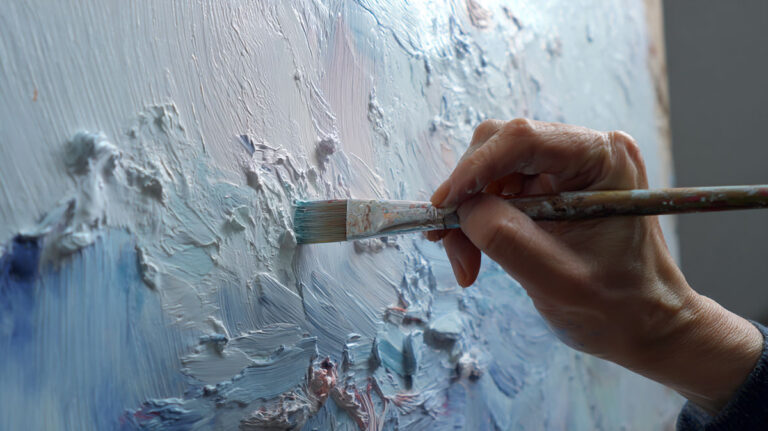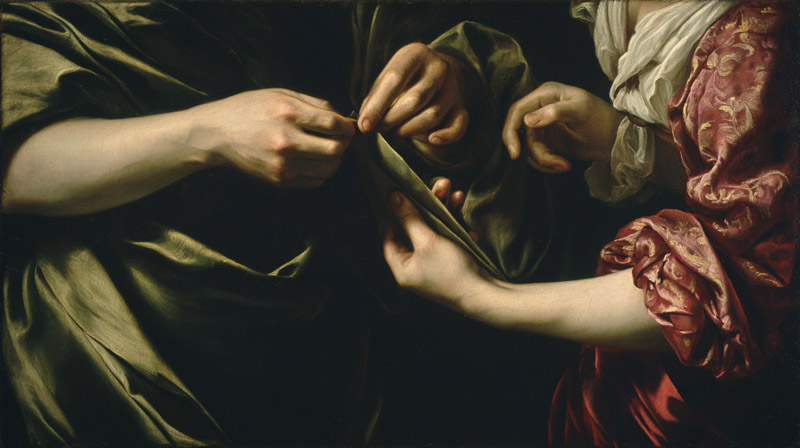

Caravaggio painted darkness like nobody before him. Figures pulled from Roman streets, lit by a single overhead beam, built on a warm reddish-brown ground that did half the work before a brush touched it.
Learning how to paint like Caravaggio is not about copying a style. It is about understanding a specific technical system: tenebrism, dark ground preparation, alla prima oil application, and a two-value approach that eliminates mid-tone confusion entirely.
This guide covers every layer of that system, from pigment selection and imprimatura to flesh painting, drapery, and the 5 mistakes that collapse most attempts at Baroque chiaroscuro before they start.
What Is Caravaggio’s Painting Technique?

Caravaggio’s painting technique is a direct oil painting method built on 3 interlocking principles: a dark reddish-brown ground that functions as the mid-tone, a single raking light source that carves form from darkness, and alla prima paint application straight onto the prepared canvas without full preparatory drawings.
This approach broke sharply from the Renaissance tradition. Leonardo and Raphael built form through careful drawing, then colour. Caravaggio reversed the process, constructing composition and lighting simultaneously from live models.
The result is what art historians now call tenebrism: figures emerging from near-total darkness, lit by a hard concentrated beam. Tenebrism is a more extreme form of chiaroscuro, pushing contrast past modelling and into drama.
His influence on Baroque art was immediate. By 1605, artists across Rome, Naples, Utrecht and Seville were adapting his method. Rubens, Rembrandt, Velazquez and Artemisia Gentileschi all show direct traces of his approach (Wikipedia, Caravaggio).
Only 21 works have been definitively attributed to him (TheArtStory), yet that body produced one of the most widely copied sets of techniques in Western painting history.
| Principle | What It Means in Practice | Why It Matters |
|---|---|---|
| Dark ground (imprimatura) | Red-brown earth layer left visible in mid-tones | Reduces value range and unifies the canvas tonally |
| Tenebrism | Figures lit against a near-black background | Directs viewer focus and creates dramatic depth |
| Alla prima method | Paint applied directly without a full underdrawing | Maintains freshness and expressive edge quality |
| Single light source | One raking overhead beam with hard-edged shadows | Keeps lighting and value structure visually consistent |
What Materials Did Caravaggio Use?
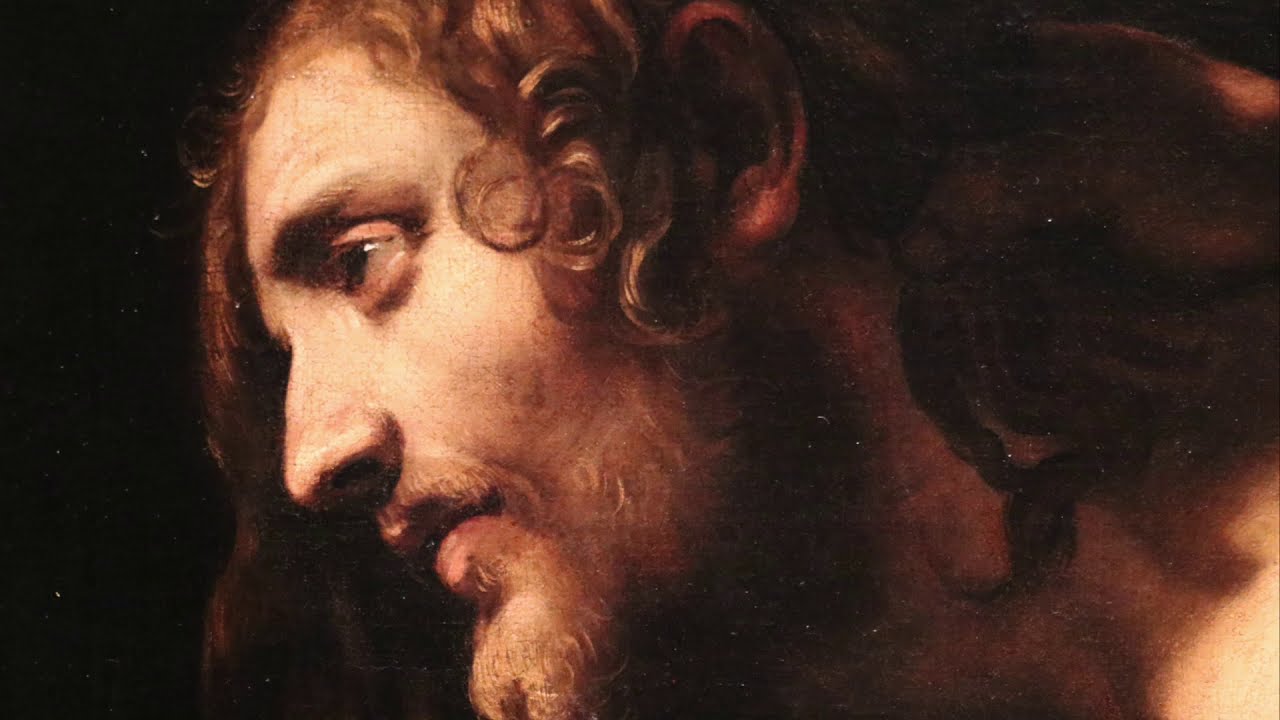
X-ray fluorescence analysis of Caravaggio-school works confirmed his core pigment palette: lead white, vermilion, verdigris, yellow ochre, bone black, and red lake, all consistent across multiple documented works (Diocesan Museum of Huesca study, ResearchGate).
Scientific micro-destructive investigations published in Caravaggio: Works in Rome, Technique and Style (Silvana Editoriale, 2016) found that flesh tones were built from red earths, cinnabar, and lake diluted in lead white, then corrected with lead-tin yellow or yellow earths (Positano et al., 2016).
Support and Ground
Canvas: Roman linen, regular medium weave, approximately 12 x 15 threads per square centimetre (ARTEnet). He occasionally painted over other artists’ used canvases, including the Basket of Fruit in Milan’s Biblioteca Ambrosiana.
The ground is a reddish-brown earth layer in linseed oil (called mestica), thin and flexible. Raman spectroscopy identified red ochre (hematite), yellow ochre (goethite), and green earth (celadonite) as the primary ground components (Positano et al., 2016).
Crucially, the ground was left exposed in the half-tones. Art historian Giovanni Bellori noted: “he left the imprimatur of the canvas for the middle tones.” This eliminates one entire paint layer from the process.
Pigments and Mediums
Binding medium: linseed oil for most layers, walnut oil in thinner glazes. Final highlights in some works were applied in egg tempera, not oil (ARTEnet, Caravaggio technique breakdown).
His palette was deliberately narrow. Colour in his work is always subordinate to value. Saturated hues appear only in lit areas; shadow zones collapse to near-neutral, transparent darks.
| Pigment | Primary Use | Notes |
|---|---|---|
| Lead white | Highlights, flesh lights, impasto peaks | Mixed into nearly every illuminated color mixture |
| Bone black / ivory black | Backgrounds and deep shadow passages | Often applied thinly and transparently in dark zones |
| Vermilion (cinnabar) | Warm flesh mid-tones and red drapery | Highly opaque; used carefully in shadow mixtures |
| Yellow ochre | Flesh correction and warm light passages | Keeps skin tones warm without turning overly orange |
| Red lake | Transparent red glazes and shadow flesh | Layered over darker grounds for depth and richness |
| Verdigris | Green fabrics and shadow adjustment | Frequently paired with copper resinate in dark passages |
How Did Caravaggio Use Light as a Compositional Tool?
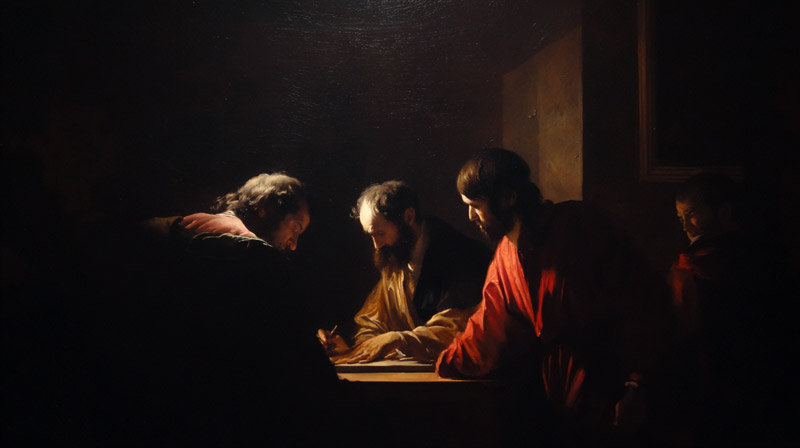
Light was not decoration. It was the structure. Caravaggio positioned a single overhead light source at roughly 45-60 degrees above and to one side of the subject, then built the entire figure arrangement around where that beam fell.
Computer graphics modelling of The Calling of Saint Matthew (1599-1600) found the visual evidence consistent with either artificial local illumination or distant solar light entering through a restricted aperture (ResearchGate, 2012 study). Either way: one source, one direction, no fill.
Hard vs Soft Shadow Edges
The defining quality of Caravaggio’s light is its hardness. Shadow edges are sharp at the terminator line and lost only where forms recede into darkness.
This differs completely from Leonardo’s sfumato, which blurs edges to create gradual atmospheric transitions. Caravaggio’s edges are found at the light boundary and lost in shadow, the exact opposite logic.
Setting Up a Caravaggio-Style Studio Lighting Rig
Blackout the room completely. Ambient fill light destroys the effect. One controlled source does all the work.
- Use a single tungsten or daylight spot, no diffusion modifier
- Position it overhead and to one side at 45-60 degrees from the subject’s face
- Distance affects edge sharpness: closer source = slightly softer edge; farther source = harder edge
- North-facing window with a blackout curtain blocking secondary light works for natural light setups
The goal is to replicate the overhead skylight Caravaggio is documented as using in his Roman studio (art historian Hall, cited in ResearchGate, 2023). All other light is eliminated.
How Do You Prepare a Dark Ground Like Caravaggio?
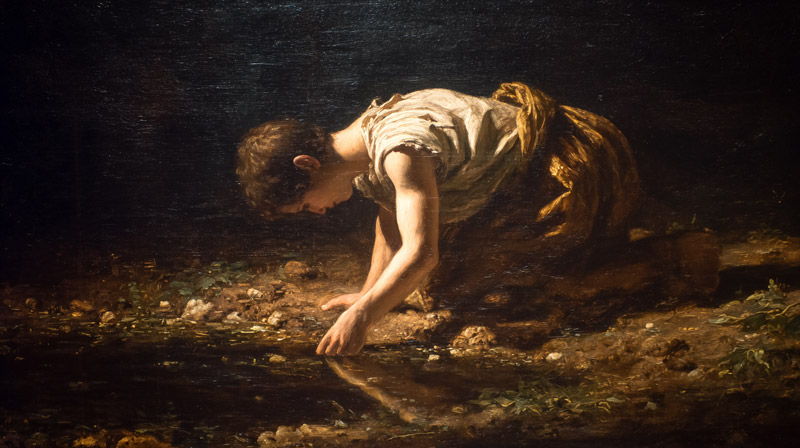
The dark ground is the foundation that makes everything else possible. Getting this wrong produces a painting that looks competent but never achieves the tonal unity Caravaggio’s work has.
Key insight from Mathieson Fine Art’s documented master copy of Caravaggio’s Narcissus (2024): the ground itself acts as the mid-tone throughout the composition. Narcissus’s kneeling earth and hair both show the ground directly, with minimal additional paint over it.
Applying the Imprimatura
Mix red bole (red earth), burnt umber, and a small amount of bone black in linseed oil, diluted thin enough to be transparent. The goal is a warm red-brown tone that reads as a mid-value, not dark and not light.
Apply over a sized, lead-white-primed canvas in a single thin, even wash. Let it set for 24-48 hours before painting. It should remain visible in the final work.
White Ground vs Dark Ground
Working on a white ground forces you to build darks from scratch, layering transparent glazes over a bright surface. This is closer to the Flemish method used by van Eyck.
Caravaggio’s dark ground reverses the problem: darks are already present. You paint upward into the lights. Shadows require no work at all. This is the most direct path to his look, and it is also what makes the method deceptively fast.
How Did Caravaggio Build Up Paint Layers?

He built paintings in 4 distinct phases, documented at ARTEnet from the Silvana Editoriale technical research: ground, incised composition marks, loose colour draft, and final lights in impasto or egg tempera highlights.
The Incision Step
Rather than drawing with charcoal or brush, Caravaggio scratched incised lines into the still-wet ground using a stylus or the wooden handle of a brush (called abozzo). These marks fixed the key compositional positions freehand.
X-ray analysis confirmed the absence of full preparatory drawings. Instead, these freehand scratched lines provided schematic position guides (Artble, citing x-ray evidence). Some art historians debate whether Caravaggio also used drawn studies separately; the canvas itself carries only incisions, not chalk or charcoal underdrawing.
The Two-Value System
This is where most painters go wrong when attempting to replicate his method.
Caravaggio avoided the full value scale. His system operates with 2 dominant zones: the lit area (opaque, warm, lead-white-rich) and the shadow (thin, transparent, dark ground visible or lightly glazed). The mid-tone is the ground itself, not a mixed paint layer.
- Lit zones: opaque, thickly loaded, lead white mixed into every colour
- Shadow zones: transparent glazes or bare ground, never opaque
- Mid-tone: the imprimatura, left exposed
Final highlights, particularly on skin and fabric peaks, were sometimes applied in egg tempera over the oil layers, adding a sharp, non-blending quality to the topmost lights (ARTEnet, Caravaggio technique stages).
How Did Caravaggio Paint Skin?
Flesh painting in Caravaggio’s work follows a specific 3-zone logic: warm opaque lights, transparent shadow, and a narrow warm-to-cool transition at the terminator edge where the ground shows through.
Micro-destructive pigment analysis (Positano et al., 2016) confirmed: “flesh tones are produced with red pigments (earths, cinnabar and lake) diluted in lead white, corrected with lead-tin yellow and/or yellow earths.”
Flesh in the Lit Zones
Lead white is the dominant pigment. Vermilion and yellow ochre push the mix toward warm skin, with the ratio shifting based on the model’s colouring. The paint here is opaque and thickly loaded.
The Boy with a Basket of Fruit (c. 1594-1596, Borghese Gallery) shows this clearly. The lit shoulder and face carry heavy impasto in warm whites. The brushwork is direct and unhesitating.
Flesh in Shadow
Raw umber and red lake, kept thin and transparent. No lead white enters the shadow zones except as a very minor reflected light correction, and even then, kept cool and subtle.
Overworking shadow flesh is the most common error when painting in this style. Shadow should read as a continuation of the dark ground. If you can see thick opaque paint in the shadows, you have applied too much.
The Terminator Edge
At the light-shadow boundary, Caravaggio let the warm ground show through a thin glaze, creating a natural transition without blending. Value shifts sharply here. The edge reads as found (visible) on the lit side and lost (blended into darkness) on the shadow side.
How Did Caravaggio Handle Drapery and Fabric?
Drapery in Caravaggio’s paintings is treated as a geometric form: each fold is a flat plane, not a curve. This is the critical difference between his fabric and the soft, gradated drapery of Raphael or Titian.
Structure and Light on Fabric
Peak highlight: heavy impasto in lead white, placed directly on the apex of each fold. The transition to shadow is abrupt, not graduated.
Shadow on fabric: transparent glaze of the local colour mixed with bone black. No mid-tone blending between the highlight and the dark.
The red drapery in The Calling of Saint Matthew (Contarelli Chapel, 1599-1600) is the clearest example. Flat planes of saturated red in the light, near-black transparent red in the shadow, with no soft gradation between them.
Colour Saturation Logic
Lit fabric areas carry the highest colour saturation in the entire painting. Shadow zones desaturate toward near-neutral, consistent with the two-value system applied to everything else.
This is the opposite of a common mistake in oil painting technique generally: adding colour richness to shadows. In Caravaggio’s approach, saturation is a property of light, not darkness.
Fabric and drapery folds also serve a compositional function. The direction of fabric planes guides the viewer’s eye toward the focal figure, reinforcing the single-light logic throughout the composition.
How Did Caravaggio Achieve Realism in His Figures?
Caravaggio hired models directly from the streets of Rome. Beggars, criminals, prostitutes, and studio apprentices became apostles, saints, and angels. Giovanni Baglione, his contemporary and rival, recorded this practice in the first biography of Caravaggio, noting his figures were “portrayed from nature very well” (Metropolitan Museum of Art, The Musicians notes).
Unidealized naturalism was the primary characteristic early biographers identified in his work. The terms they used were naturalezza, del naturale, and da vivo (from life) (Varriano, Caravaggio: The Art of Realism, Penn State Press).
Working Directly from Life
No geometry construction. No proportional grids. Direct transcription of observed anatomy under controlled lighting, with all imperfections intact.
His figures included dirty feet, worn hands, wrinkled skin, and bruised fruit. A Cardinal’s secretary described the Madonna dei Palafrenieri as containing “but vulgarity, sacrilege, impiousness and disgust” (Artble). That kind of outrage is actually useful evidence of how completely he committed to observation over idealization.
For contemporary painters, this means working from a live model under controlled single-source lighting, not from a photo. Portrait painting built from photographs tends to flatten the value relationships that Caravaggio’s method depends on.
Foreshortening Through Observation
Foreshortening in Caravaggio’s work was solved by looking, not by geometric construction.
The foreshortened halo in The Calling of Saint Matthew and the outstretched arm of the apostle in The Supper at Emmaus were worked out directly from a posed model. TheArtStory notes that Caravaggio’s figures break into the viewer’s space, arms extending toward the picture plane, in a way that only works if the spatial illusion comes from direct observation.
Practising foreshortening by drawing or painting the live model from multiple angles before attempting a full Baroque figure composition reduces the risk of the spatial collapse that most beginners experience.
What Are the Most Common Mistakes When Painting in Caravaggio’s Style?
Most attempts to replicate this method fail at the same 5 points. None of them are about skill. They are all about misunderstanding the logic of the system.
| Mistake | Why It Fails | Fix |
|---|---|---|
| White ground instead of dark | Breaks tonal unity and forces shadows to be rebuilt artificially | Start with a reddish-brown imprimatura or mestica layer |
| Opaque paint in shadows | Removes transparency and flattens depth | Use thin glazes and transparent shadow passages |
| Soft, diffuse lighting | Weakens the sharp shadow structure central to tenebrism | Use a single hard light source with no fill light |
| Excessive mid-tone blending | Reduces the dramatic value separation Caravaggio relied on | Let the dark ground supply mid-tones; paint mainly lights and darks |
| Overworked highlights | Too many bright accents dilute the focal emphasis | Restrict impasto highlights to only a few key points per figure |
The White Ground Problem
Starting on a white-primed canvas is the single most common error. It produces a version of the method that looks technically correct but never achieves the warmth or tonal cohesion of the original works.
The dark ground functions as both a neutral mid-tone and a warm base that unifies every colour saturation decision in the painting. Without it, every mid-tone and shadow zone has to be invented from scratch rather than revealed.
Overworking the Shadow Zones
Prominent Painting’s 2024 technique guide identifies overworking as one of the most damaging habits when attempting tenebrism: “Too much gradient loses drama. Harder edges between light and dark. No blending unless necessary.”
In practice: once the shadow zone is painted with a transparent glaze and the ground is visible underneath, stop. Do not add reflected lights, secondary tones, or detail. Empty shadow is the point. Caravaggio’s backgrounds are often close to black with virtually no internal modelling at all.
Using Diffuse Studio Light
A softbox or ring light produces even illumination with no hard shadow edge. That setup is fundamentally incompatible with single-source light composition.
The hard shadow edge at the terminator line is what creates the three-dimensional pop in Caravaggio’s figures. Lose the hard edge and the figure flattens, regardless of how accurate the value mixing is.
Which Caravaggio Paintings Are Best to Study for Technique?
5 specific works show distinct aspects of his method most clearly. Studying them in sequence, from early to late, also shows how his technique grew more extreme over time.
His late-period grounds became significantly darker than his early Roman work, and his palette narrowed further (Natural Pigments, 2025). The paintings are not interchangeable as study references.
The Calling of Saint Matthew (1599-1600)

Best for: light composition, figure grouping, and how a single beam structures an entire multi-figure scene.
Located in the Contarelli Chapel, San Luigi dei Francesi, Rome. Computer modelling studies analysed the falloff of brightness along the rear wall and the variation in shadow sharpness to reconstruct his exact lighting setup (ResearchGate, 2012). The hand of Christ pointing across the darkness is the clearest example of how light direction replaces compositional line.
Judith Beheading Holofernes (1598-1599)

Palazzo Barberini, Rome. This is the primary reference for flesh painting in oil and impasto highlight technique.
Study it for: the sharp light-shadow boundary on Judith’s arm, the transparency of shadow flesh on Holofernes, and the contrast between Judith’s lit face and the maid’s dark background figure.
Timothy Joseph Allen’s multi-year technical study of this work at the Palazzo Barberini (American University of Rome, 2025) used x-ray, infrared, and UV imaging to map the exact paint layer sequence, providing the most detailed public account of how Caravaggio built up the flesh zones.
Boy with a Basket of Fruit (c. 1594-1596)
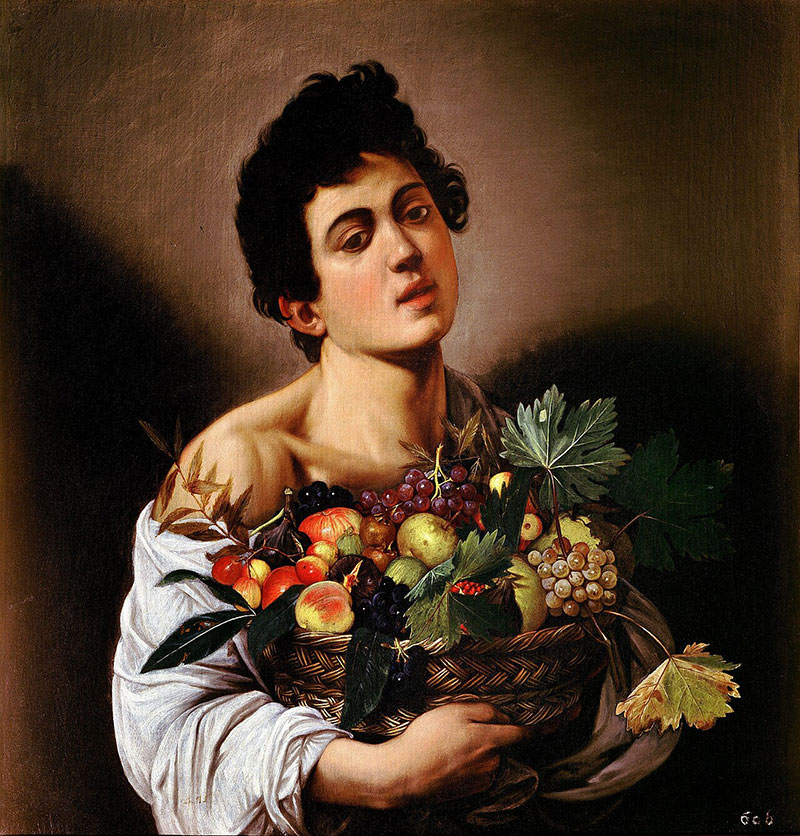
Borghese Gallery, Rome. An early work, and useful precisely because the technique is slightly less extreme. The still life fruit in the basket is documented as showing bruises, wormholes, and wilting leaves.
What it teaches: how to handle flesh against fabric against organic still life, all under the same light, without any element becoming the dominant study problem.
The Supper at Emmaus (1601)

National Gallery, London. Best for drapery, foreshortening, and multi-figure lighting logic.
The outstretched arm of the right-hand apostle breaks into the viewer’s space, demonstrating observation-based foreshortening. X-ray analysis of this work revealed incised compositional lines in the imprimatura and provided some of the key evidence for Caravaggio’s working method (ARTEnet, citing Silvana Editoriale research).
David with the Head of Goliath (1610)
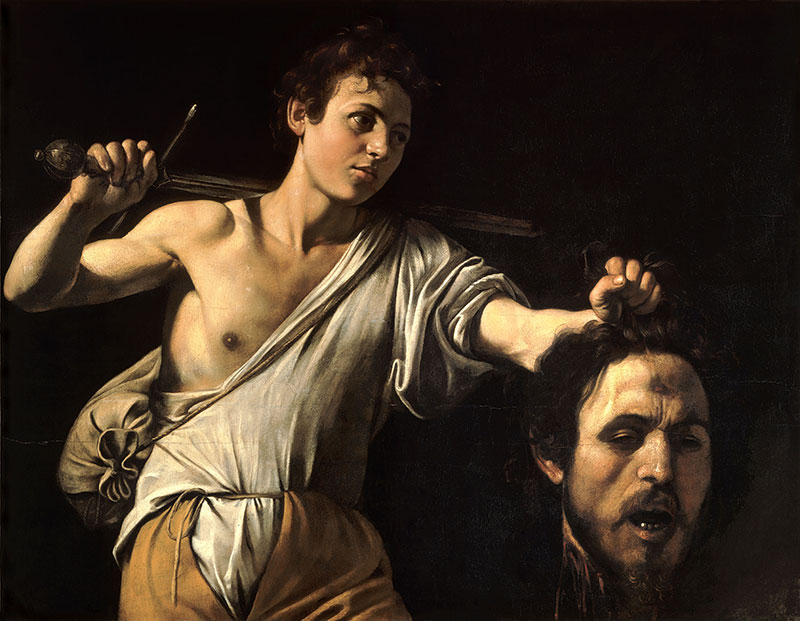
Borghese Gallery, Rome. The last major work. Maximum tenebrism, minimum palette.
The ground is dramatically darker than earlier works (Mathieson Fine Art, 2024 master copy study). The background is almost pure black with no modelling. The lit zones on David’s arm and face carry the full weight of the composition against near-total darkness. This painting is the most useful reference for understanding what the method looks like when taken to its logical conclusion.
Art historian Jeremy Caniglia spent 5 years completing a technical master copy of this work, studying it as a reference for historical painting techniques (Issuu, 2023). That level of commitment to a single painting is a fair indication of how much it contains.
FAQ on How To Paint Like Caravaggio
What is the most important technique in Caravaggio’s painting method?
Tenebrism is the foundation. A single overhead light source, a dark reddish-brown ground, and transparent shadow zones work together as one system. Remove any element and the method collapses. All three must be present simultaneously.
Do I need to use historical pigments to paint like Caravaggio?
Not strictly. Modern equivalents work: titanium white replaces lead white, ivory black replaces bone black. Match the pigment behaviour, not the chemistry. Transparency in shadows and opacity in lights matter more than period accuracy.
What color should the ground be?
A warm reddish-brown, mixed from red ochre, burnt umber, and a small amount of bone black in linseed oil. Apply it thin and transparent. The imprimatura must read as a mid-value, not dark. It functions as your mid-tone throughout.
Can I paint like Caravaggio using acrylic paint?
Yes, with limitations. Acrylics dry faster and behave differently in shadow glazes. The wet-into-wet edge quality that defines Caravaggio’s lost shadow edges is harder to achieve. Oil paint gives more working time and closer tonal results.
How do I set up Caravaggio-style lighting?
One unmodified light source, positioned overhead at roughly 45-60 degrees to one side. Blackout all other light completely. No fill, no bounce, no diffusion. Hard shadow edges only appear when ambient light is fully eliminated from the room.
Did Caravaggio use preparatory drawings?
Not in the conventional sense. X-ray analysis confirmed he used incised lines scratched into the wet ground with a stylus or brush handle to fix key compositional positions. No chalk underdrawing. No cartoons transferred to canvas.
How did Caravaggio paint realistic skin tones?
Lit flesh zones used lead white, vermilion, and yellow ochre mixed opaquely. Shadow flesh used red lake and raw umber, kept thin and transparent. The dark ground showed through shadow areas, functioning as the base skin tone in darkness.
What is the difference between chiaroscuro and tenebrism?
Chiaroscuro uses light and dark contrast to model three-dimensional form, as practised by Leonardo and Raphael. Tenebrism is more extreme: figures sit against near-total darkness, lit by a single hard source. Caravaggio pushed chiaroscuro into tenebrism deliberately.
Which Caravaggio painting should I study first?
The Calling of Saint Matthew (1599-1600) in the Contarelli Chapel. It shows his lighting logic, figure grouping, and alla prima method more completely than any other single work. Study the light falloff along the rear wall specifically.
How do I avoid overworking shadows when painting in Caravaggio’s style?
Apply one thin transparent glaze, let the imprimatura show through, then stop. No reflected lights, no secondary tones, no detail. Empty shadow is intentional. Adding more paint to dark zones is the most common mistake in Baroque oil painting.
Conclusion
This conclusion is for an article presenting how to paint like Caravaggio as a complete technical system, not a surface imitation.
The dark ground preparation, single-source raking light, and two-value paint structure are not separate tips. They are interdependent. One without the others produces results that look wrong without a clear reason why.
Study the 5 works covered here in person where possible. The Supper at Emmaus at the National Gallery and Judith Beheading Holofernes at the Palazzo Barberini reward close reading of impasto highlights and shadow transparency in ways reproductions cannot replicate.
Master the ground. Control the light. Keep the shadows empty. That is the whole method.