No country this small has produced this many painters who changed everything. From Rembrandt’s dramatic portraits to Van Gogh’s swirling skies, famous Dutch painters shaped the course of Western art across centuries.
The Netherlands gave us Golden Age masterpieces, groundbreaking abstract art, and some of the most recognized oil paintings on the planet. These artists didn’t just reflect their time. They pushed technique, color, and composition into places nobody had gone before.
This article covers the most important Dutch painters in art history, their signature styles, key works, and where you can see their paintings today. Whether you’re studying European old masters or just trying to figure out why Vermeer’s light looks like that, you’ll find what you need here.
Famous Dutch Painters
Rembrandt van Rijn
Early Life and Background
Rembrandt van Rijn was born on July 15, 1606, in Leiden, Netherlands. His father was a miller. His mother, a baker’s daughter.
He enrolled at the University of Leiden but dropped out quickly. Painting pulled him away from academics. He apprenticed under Jacob van Swanenburgh for three years, then studied briefly with Pieter Lastman in Amsterdam.
By 18, he had opened his own studio back in Leiden. By 21, he was already teaching students. That kind of confidence at such a young age is pretty rare, even for the Dutch Golden Age.
Artistic Style and Techniques
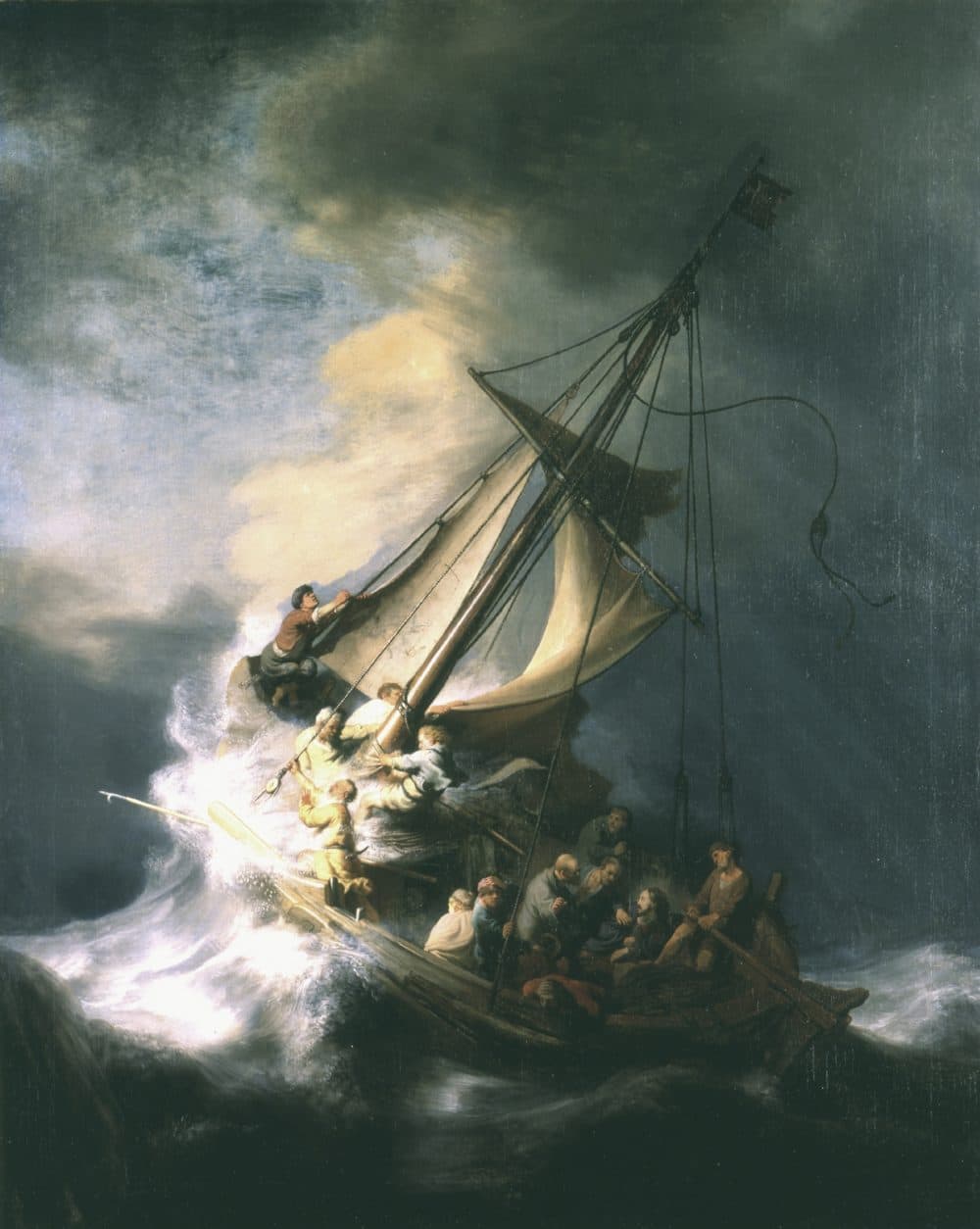
Rembrandt’s work sits firmly in the Baroque tradition, but he pushed it further than most. His signature technique was chiaroscuro, the sharp play between light and dark areas that gives his paintings their dramatic tension.
He applied thick layers of paint with both brush and palette knife, building up texture so the lit areas almost jump off the canvas. Darker sections got thinner, more transparent paint. The result is a sense of depth that still catches people off guard centuries later.
His subjects ranged from portraits and self-portraits to biblical scenes, landscapes, and still life compositions. He painted real people with real flaws. No idealizing.
Most Famous Paintings
- The Night Watch (1642) – A massive group portrait of Captain Banninck Cocq’s militia, full of motion and controlled light
- The Anatomy Lesson of Dr. Nicolaes Tulp (1632) – The painting that made his reputation in Amsterdam
- The Jewish Bride (c. 1666) – One of the most emotionally affecting portrayals of love in Western art
- Self-Portrait with Two Circles (c. 1665) – Among roughly 40 self-portraits he completed over his career
Influence on Art History
Rembrandt taught a generation of Dutch Golden Age painters, including Gerrit Dou, Carel Fabritius, and Ferdinand Bol. His ability to capture human emotion through gesture and expression changed what people expected from portrait painting.
Artists like Vincent van Gogh, Edgar Degas, and Pablo Picasso all acknowledged his influence. Van Gogh once sat in front of The Jewish Bride at the Rijksmuseum and said he’d give ten years of his life to keep staring at it.
Where to See Their Work
The Rijksmuseum in Amsterdam holds the largest collection, including The Night Watch. The Mauritshuis in The Hague has The Anatomy Lesson. Other works are spread across the Met in New York, the National Gallery in London, and the Louvre in Paris.
Johannes Vermeer
Early Life and Background
Johannes Vermeer was born in October 1632 in Delft, a prosperous Dutch trade center. His father worked as a silk weaver and also dealt in art.
Vermeer registered as a master painter with the Delft Guild of Saint Luke in 1653. Nobody knows for certain who trained him. Some speculate it was Carel Fabritius, a former Rembrandt student. Others point to Leonard Bramer as a mentor.
He married Catharina Bolnes, had 15 children, and spent most of his career working from two small rooms in his Delft home. He died heavily in debt in 1675 at just 43.
Artistic Style and Techniques
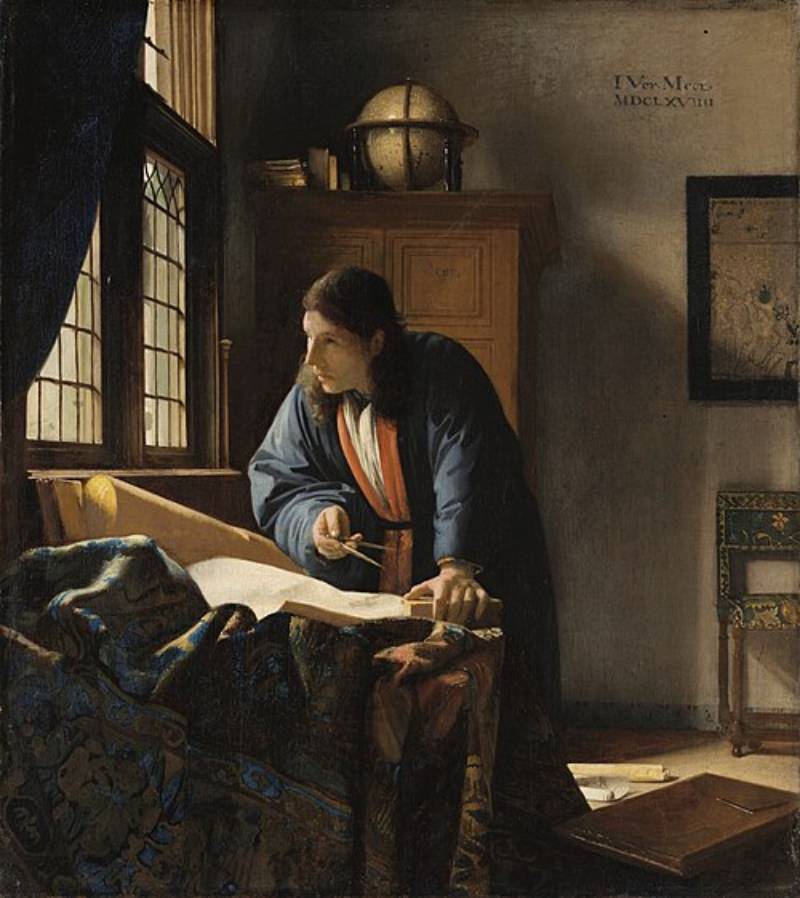
Vermeer was called the “Master of Light” for good reason. He had an extraordinary ability to render how light falls on surfaces, skin, fabric, and objects like pearls.
He likely used a camera obscura to study light effects, which explains the photographic quality of many paintings. You can see the evidence in works like The Lacemaker, where the foreground is slightly blurred, mimicking a shallow depth of field.
His palette relied on expensive pigments, particularly lapis lazuli for his signature ultramarine blues. He worked very slowly and produced only about 36 known paintings in his entire career. Each one meticulously constructed with thin glazes layered over ground coats to build luminous color.
Most Famous Paintings
- Girl with a Pearl Earring (c. 1665) – Often called the “Mona Lisa of the North”
- The Milkmaid (c. 1658) – A kitchen servant pouring milk, transformed into something quietly monumental
- View of Delft (c. 1660) – One of the finest cityscapes in European art
- The Art of Painting (c. 1666) – Considered his most ambitious and complex work
Influence on Art History
Vermeer was almost forgotten after his death. It took nearly two centuries before French critic Theophile Thore-Burger rediscovered him in the 1860s. Since then, his reputation has only grown.
His treatment of domestic interior scenes and his obsession with light influenced later Impressionist painters. The 2003 film adaptation of Girl with a Pearl Earring introduced his work to millions who’d never set foot in a museum.
Where to See Their Work
The Mauritshuis in The Hague holds Girl with a Pearl Earring. The Rijksmuseum in Amsterdam has The Milkmaid and several others. The Met in New York and the National Gallery of Art in Washington also have key pieces.
Vincent van Gogh
Early Life and Background
Born March 30, 1853, in Zundert, Netherlands. The son of a pastor. Before picking up a brush, Van Gogh tried being an art dealer, teacher, bookseller, and missionary. None of it stuck.
He didn’t start painting seriously until age 27. His brother Theo supported him financially for most of his career, and their letters (over 600 from Vincent to Theo) remain one of the most detailed records any artist has left behind.
His entire painting career lasted just 10 years. He died on July 29, 1890, at 37. Only one painting sold during his lifetime.
Artistic Style and Techniques
Van Gogh’s early work used dark, earthy tones influenced by Dutch masters. Everything changed when he moved to Paris in 1886 and discovered Impressionism and Japanese prints.
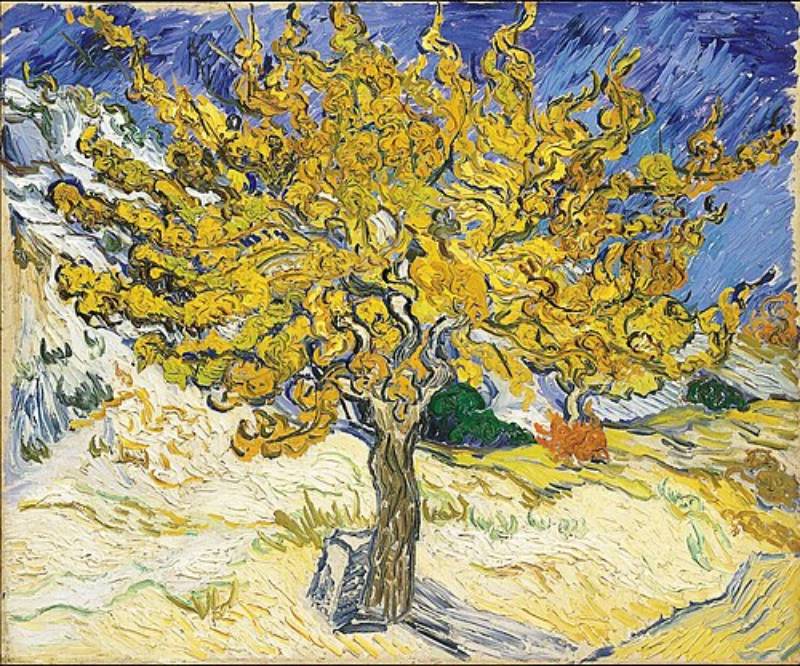
His mature style is defined by bold, saturated colors, thick impasto application (often straight from the tube), and energetic brushstrokes that pulse with movement. He used color to express emotion rather than describe reality.
He produced roughly 2,100 artworks in a decade. About 860 oil paintings. Most of them in the last two years of his life. That’s a pace that borders on unbelievable.
Most Famous Paintings
- The Starry Night (1889) – Painted from his room at the Saint-Remy asylum, probably the most reproduced painting worldwide
- Sunflowers (1888) – A series of still lifes done to decorate his house in Arles for Paul Gauguin’s visit
- The Potato Eaters (1885) – His first large-scale work, dark and raw
- Bedroom in Arles (1888) – Three versions exist, each showing his personal space in the Yellow House
Influence on Art History
Van Gogh’s impact on modern art is enormous. His expressive use of color directly influenced Fauvism (think Henri Matisse) and Expressionism. The Abstract Expressionists of the mid-20th century borrowed from his gestural brushwork too.
He is now considered the greatest Dutch painter since Rembrandt and Vermeer. The Van Gogh Museum in Amsterdam is the most visited museum in the Netherlands.
Where to See Their Work
The Van Gogh Museum in Amsterdam has the largest collection. The Starry Night hangs at MoMA in New York. Key works are also at the Musee d’Orsay in Paris, the National Gallery in London, and the Art Institute of Chicago.
Hieronymus Bosch

Early Life and Background
Hieronymus Bosch was born around 1450 in ‘s-Hertogenbosch, Brabant. His real name was Jheronimus van Aken. He took his artist name from his hometown.
His family had a painting background, and he likely trained under relatives. He joined the Brotherhood of Our Lady, a religious organization that shaped much of his artistic worldview. Little else is known about his personal life.
He spent most of his career in ‘s-Hertogenbosch and died there in 1516. Only about 25 paintings are confidently attributed to him today.
Artistic Style and Techniques
Bosch’s work doesn’t look like anything else from the late medieval period. His paintings are packed with bizarre, fantastical creatures, moral allegories, and religious symbolism.
Unlike contemporaries such as Jan van Eyck, whose brushwork was smooth and precise, Bosch painted with energetic, varied strokes. Bright, unusual colors were another hallmark. His style sits somewhere between late Gothic art and the early Renaissance.
The grotesque imagery in his work drew from religious manuscripts, folklore, and alchemy. But there’s real intellectual depth behind the strangeness. A Spanish monk wrote in 1605 that Bosch’s paintings were “books of great wisdom.”
Most Famous Paintings
- The Garden of Earthly Delights (c. 1490-1510) – A triptych showing Paradise, earthly pleasures, and Hell
- The Temptation of St. Anthony – Multiple versions exploring sin and temptation
- The Last Judgment – Another triptych with Bosch’s trademark hellscapes
- Christ Carrying the Cross (c. 1510) – A claustrophobic composition of grotesque faces
Influence on Art History
Pieter Bruegel the Elder was his most direct follower, nicknamed the “Second Hieronymus.” Centuries later, the Surrealists claimed Bosch as a predecessor. Salvador Dali called him “the first modern artist.”
Where to See Their Work
The Garden of Earthly Delights is at the Museo del Prado in Madrid. The Noordbrabants Museum in ‘s-Hertogenbosch has a dedicated exhibition. Other works are at the Kunsthistorisches Museum in Vienna and the Musee du Louvre.
Pieter Bruegel the Elder
Early Life and Background
Pieter Bruegel the Elder was born around 1525, possibly in Breda or the village of Breugel. Details about his early life are scarce.
He trained under Pieter Coecke van Aelst in Antwerp and later traveled to Italy. But unlike most Northern European artists who came back obsessed with Italian styles, Bruegel stayed committed to painting everyday Dutch and Flemish life.
He settled in Brussels, married his teacher’s daughter, and died in 1569 at around 44.
Artistic Style and Techniques
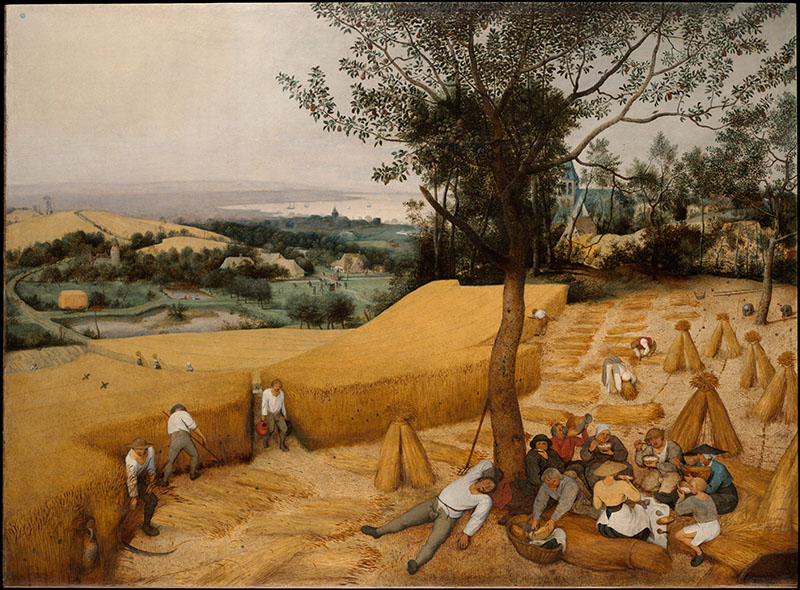
Bruegel broke from the tradition of painting biblical and mythological scenes exclusively. He focused on peasant life, village celebrations, and landscapes filled with ordinary people doing ordinary things.
His compositions are busy but carefully organized. Look at Netherlandish Proverbs, where over 100 Dutch and Flemish proverbs are illustrated in a single chaotic village scene. That takes serious planning.
He used oil on panel for most works, with fine detail and vibrant color that owed something to Bosch’s influence, especially in his more fantastical pieces.
Most Famous Paintings
- The Tower of Babel (1563) – A massive spiral structure, part architecture study, part moral warning
- Hunters in the Snow (1565) – Part of a series depicting months of the year, probably his most recognized work
- Netherlandish Proverbs (1559) – Over 100 proverbs crammed into one scene
- The Peasant Wedding (c. 1567) – A warm, lively depiction of rural celebration
Influence on Art History
Bruegel essentially pioneered genre painting in Northern Europe. His focus on real life over religious subjects paved the way for the entire Dutch Golden Age tradition of everyday scenes.
His sons, Pieter Brueghel the Younger and Jan Brueghel the Elder, continued his legacy. The landscape painting tradition he helped establish influenced generations of Dutch and Flemish artists.
Where to See Their Work
The Kunsthistorisches Museum in Vienna has the largest collection, including Hunters in the Snow and The Tower of Babel. The Museum Boijmans Van Beuningen in Rotterdam and the Royal Museums of Fine Arts in Brussels also hold key works.
Frans Hals

Early Life and Background
Frans Hals was born around 1582 in Antwerp. His family moved north to Haarlem after the city fell to Spain in 1584. He trained under Karel van Mander and spent his entire career in Haarlem.
Despite constant demand for his portraits, Hals struggled financially throughout his life. His later paintings used cheaper black and white pigments, likely because he couldn’t afford color. He died in 1666.
Artistic Style and Techniques
Hals was a portrait specialist. What set him apart was his ability to capture fleeting expressions, laughter, and spontaneous moments. His loose, quick brushstrokes gave his subjects a sense of life that more polished painters couldn’t match.
He worked almost exclusively in oil, and his technique got progressively freer as he aged. The late group portraits are especially striking with their limited palette and bold, visible strokes.
Most Famous Paintings
- The Laughing Cavalier (1624) – Not actually laughing, but the smirk is unforgettable
- The Merry Drinker (c. 1628) – Captures the spirit of Dutch tavern culture
- Banquet of the Officers of the St George Militia (1627) – One of several group portraits of Haarlem’s civic guards
- Regentesses of the Old Men’s Almshouse (1664) – A somber, late-career masterpiece
Influence on Art History
Hals’ loose brushwork prefigured Impressionism by two centuries. Edouard Manet, Claude Monet, and Pierre-Auguste Renoir all studied his technique. His approach to portraiture influenced every Dutch Golden Age painter who came after him.
Where to See Their Work
The Frans Hals Museum in Haarlem is the obvious starting point. The Wallace Collection in London has The Laughing Cavalier. Other works are at the Rijksmuseum, the Met, and the National Gallery in London.
Piet Mondrian
Early Life and Background
Piet Mondrian was born March 7, 1872, in Amersfoort, Netherlands. He studied at the Amsterdam Royal Academy of Art and started his career painting realistic Dutch landscapes.
After encountering Cubism in Paris around 1911, everything shifted. He moved progressively toward abstraction, stripping away representational elements until only geometric essentials remained.
He lived and worked in Paris, London, and New York before dying in Manhattan in 1944.
Artistic Style and Techniques
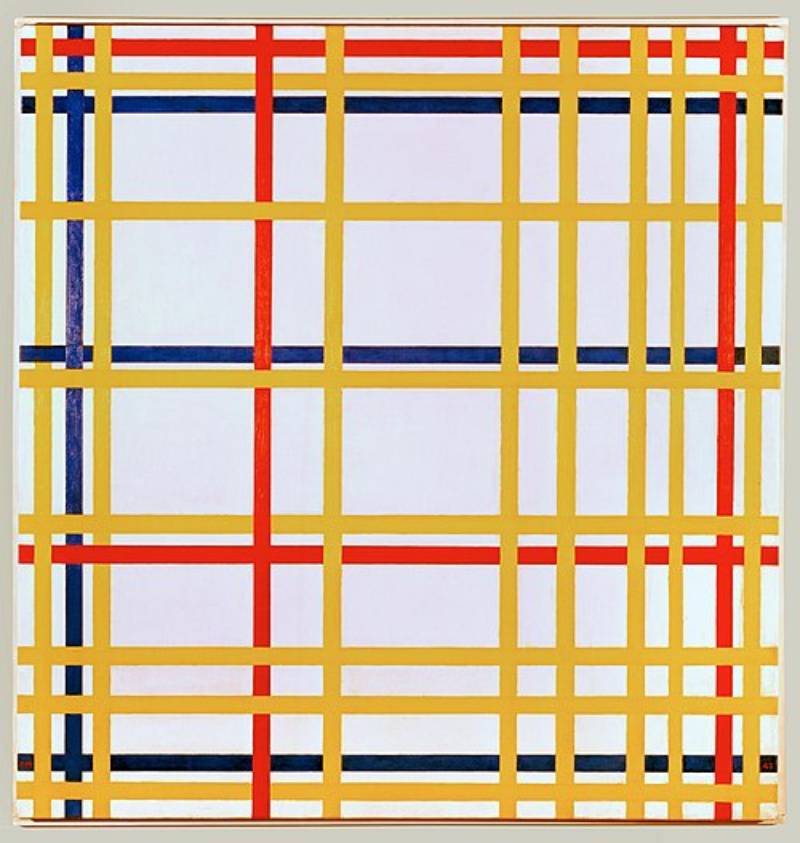
Mondrian co-founded the De Stijl movement and developed what he called “Neoplasticism.” The rules were strict: horizontal and vertical black lines, primary colors (red, blue, yellow), and neutral tones (white, gray, black).
It sounds simple. It isn’t. The balance and harmony in his grid compositions took serious precision. Each rectangle’s size, position, and color was calculated to create visual equilibrium through asymmetrical balance.
Most Famous Paintings
- Composition II in Red, Blue, and Yellow (1930) – The quintessential Mondrian
- Broadway Boogie Woogie (1942-43) – Inspired by New York City’s grid and jazz music
- Victory Boogie Woogie (1942-44) – His final, unfinished work
- Gray Tree (1911) – Shows his transition from realism to abstraction
Influence on Art History
Mondrian’s ideas spread far beyond painting. Architects, graphic designers, and fashion designers (Yves Saint Laurent’s 1965 “Mondrian dress”) all borrowed from his visual language. He helped lay the groundwork for Minimalism and geometric abstraction.
Where to See Their Work
The Gemeentemuseum (Kunstmuseum Den Haag) in The Hague has the world’s largest Mondrian collection, including Victory Boogie Woogie. MoMA in New York holds Broadway Boogie Woogie. The Tate Modern in London and the Centre Pompidou in Paris also have strong holdings.
Jan van Eyck
Early Life and Background
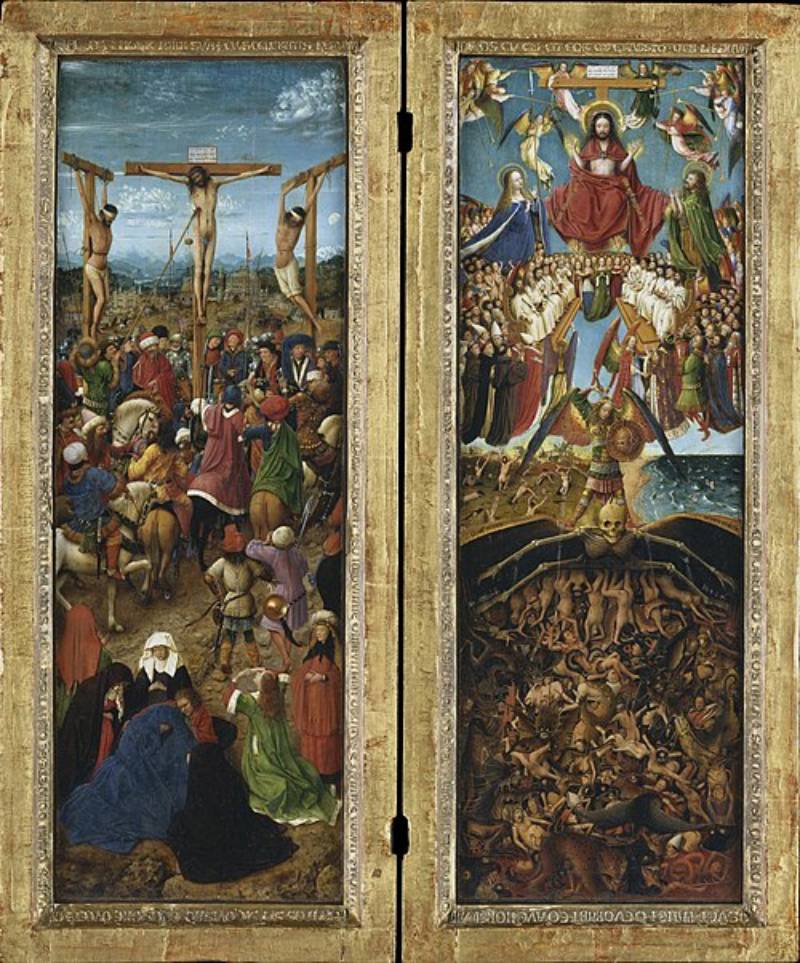
Jan van Eyck was born around 1390, likely in Maaseik in the Bishopric of Liege. He became one of the most successful painters of his era, serving as court painter to Philip the Good, Duke of Burgundy.
His life was comfortable by artist standards. The pay was good, the patronage steady, and he interacted daily with European elites. He died in 1441 in Bruges.
Artistic Style and Techniques
Van Eyck didn’t invent oil painting, but he’s often credited as its greatest early innovator. He perfected layered glazing techniques that gave his works an almost jewel-like glow.
His attention to detail is unreal. Reflections in mirrors, individual threads in fabric, light hitting polished metal. He was working at a level of realism that nobody else in Northern Europe could touch at the time. His work marks the transition from late Gothic styles into Dutch naturalism.
Most Famous Paintings
- The Ghent Altarpiece (completed 1432) – A massive polyptych, one of the most significant artworks in European history
- Arnolfini Portrait (1434) – Packed with symbolic detail, including a convex mirror reflecting the entire room
- Madonna of Chancellor Rolin (c. 1435) – Extraordinary landscape seen through arched windows
Influence on Art History
Van Eyck and the Flemish Primitives put the Netherlands on the artistic map. His oil painting innovations spread rapidly across Europe, influencing Italian Renaissance masters like Leonardo da Vinci. Without Van Eyck, the entire trajectory of European painting would look different.
Where to See Their Work
The Ghent Altarpiece is at St Bavo’s Cathedral in Ghent, Belgium. The Arnolfini Portrait hangs in the National Gallery, London. Other works are at the Louvre, the Kunsthistorisches Museum in Vienna, and the Groeningemuseum in Bruges.
Jan Steen
Early Life and Background
Jan Steen was born around 1626 in Leiden. Like Rembrandt, he attended the Latin School there. He studied painting under several masters, including Adriaen van Ostade and Jan van Goyen (who became his father-in-law).
Steen also ran a tavern at one point, which makes perfect sense when you look at his paintings. He died in Leiden in 1679.
Artistic Style and Techniques
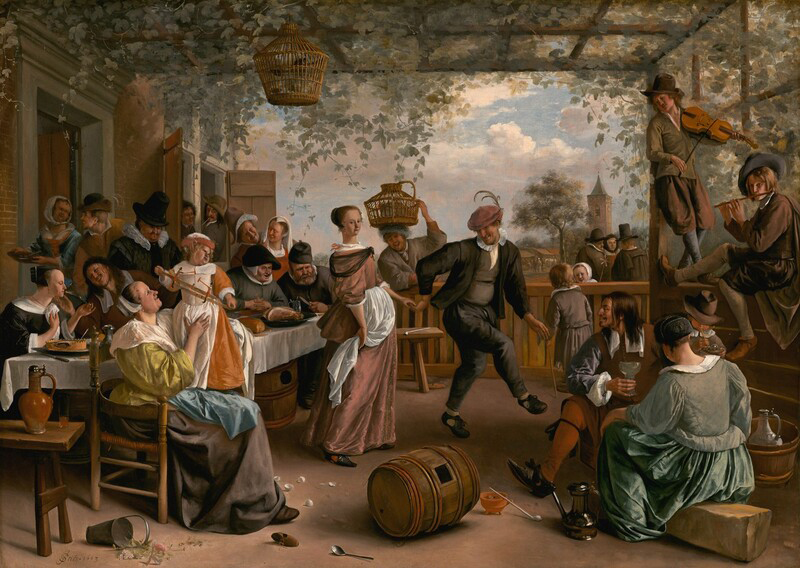
Steen was the comedian of Dutch Golden Age painting. His genre scenes are crowded, chaotic, and full of humor. Ordinary people drinking, celebrating, arguing, and generally making a mess of things.
But don’t mistake the fun for sloppiness. His compositions are tight, his color use vibrant, and there’s usually a moral lesson hiding in the chaos. The Dutch phrase “a Jan Steen household” still means a messy, noisy home.
Most Famous Paintings
- The Feast of Saint Nicholas (c. 1665-68) – A chaotic family celebration full of detail
- The Merry Family (1668) – Rowdy domestic scene with the proverb “As the old sing, so pipe the young”
- The Doctor’s Visit (various versions) – A comedic look at quack medicine
- The Effects of Intemperance (c. 1663-65) – The consequences of excess, painted with a wink
Influence on Art History
Steen’s work defined the genre painting tradition of the Dutch Golden Age. His lively, narrative-driven scenes influenced later painters interested in everyday life, from English painters like William Hogarth to 19th-century genre artists across Europe.
Where to See Their Work
The Rijksmuseum in Amsterdam has a strong collection. The Mauritshuis in The Hague, the National Gallery in London, and the Gemaldegalerie in Berlin also hold key pieces.
Willem de Kooning
Early Life and Background
Willem de Kooning was born on April 24, 1904, in Rotterdam. He studied at the Rotterdam Academy of Fine Art before stowing away on a ship to America in 1926.
He settled in New York and spent years as a struggling artist before gaining recognition in the 1940s. In 1980, he was diagnosed with Alzheimer’s disease. He died in 1997.
Artistic Style and Techniques
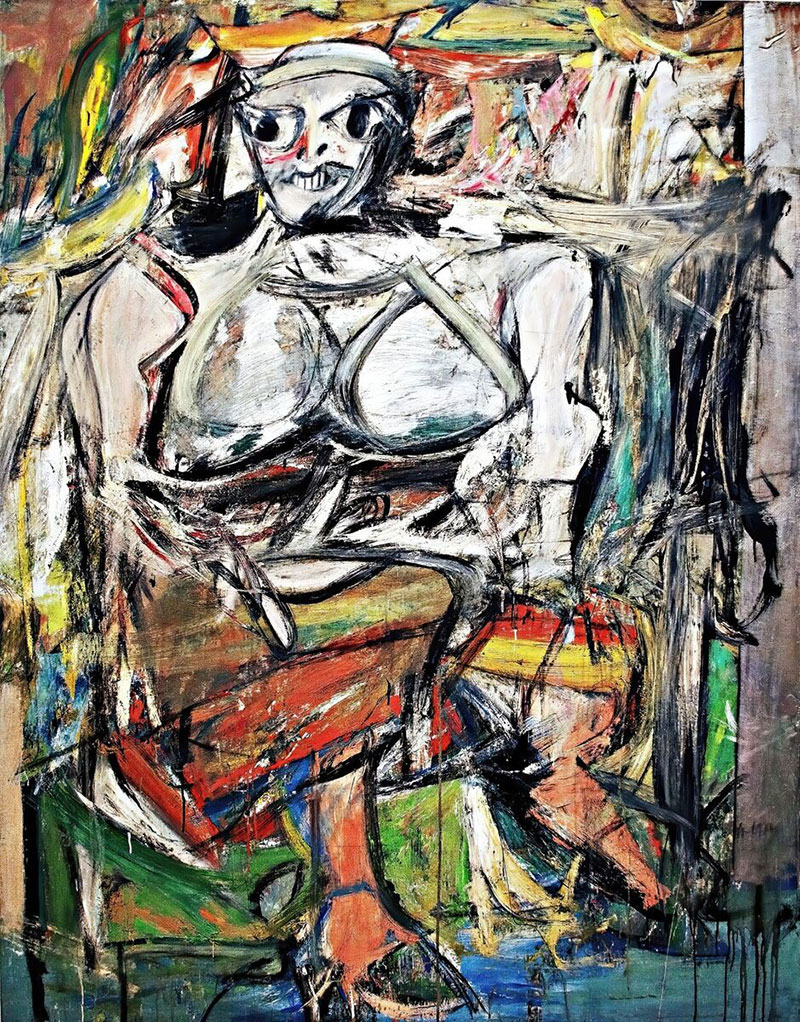
De Kooning was a leading figure in Abstract Expressionism. His paintings are frenetic, full of energy, with aggressive brushwork and bold color.
He worked in what’s called “action painting,” where the physical act of applying paint becomes part of the artwork itself. His most famous series, the Women paintings, combined abstraction with figurative elements in a way that was controversial but undeniably powerful.
He was influenced by Picasso, Mondrian, and Joan Miro. But the final product was entirely his own.
Most Famous Paintings
- Woman I (1950-52) – The painting that divided the art world
- Excavation (1950) – A dense, interlocking mass of abstract forms
- Interchange (1955) – Sold for $300 million in 2015, making it one of the most expensive paintings ever sold
- Untitled XXV (1977) – From his later, more lyrical abstract period
Influence on Art History
De Kooning bridged European modernism and American Abstract Expressionism. For years he was known as a “painter’s painter,” someone other artists looked up to even before the public caught on.
His work influenced Neo-Expressionists in the 1980s, and his combination of figurative and abstract elements opened doors for artists like Jean-Michel Basquiat and Cecily Brown.
Where to See Their Work
MoMA in New York has several major pieces, including Woman I. The Art Institute of Chicago holds Excavation. The Hirshhorn Museum in Washington D.C. and the Stedelijk Museum in Amsterdam also have strong collections.
FAQ on Famous Dutch Painters
Who is the most famous Dutch painter of all time?
Vincent van Gogh is widely considered the most famous. His bold colors and expressive brushwork made him a global icon. Rembrandt van Rijn follows closely, especially for his mastery of light and portraiture during the Dutch Golden Age.
What was the Dutch Golden Age in art?
The Dutch Golden Age spanned the 17th century. It was a period of extraordinary wealth and cultural output in the Netherlands. Painters like Rembrandt, Vermeer, and Frans Hals produced some of the finest oil paintings in European art history.
How many paintings did Vermeer create?
Only about 36 paintings are attributed to Johannes Vermeer today. He worked slowly, used expensive pigments like lapis lazuli, and focused on domestic interior scenes. His small output makes each surviving work extremely valuable.
Why did Van Gogh only sell one painting during his lifetime?
Van Gogh’s Post-Impressionist style was too ahead of its time. Galleries and collectors preferred more conventional work. His brother Theo supported him financially. Recognition came only after his death in 1890 at age 37.
What painting techniques are Dutch masters known for?
Dutch masters are best known for chiaroscuro, the dramatic contrast of light and shadow. They also used layered oil glazes, precise detail work, and careful composition. Vermeer likely used a camera obscura to study light effects.
Where can I see famous Dutch paintings?
The Rijksmuseum in Amsterdam holds the largest collection, including Rembrandt’s The Night Watch. The Mauritshuis in The Hague has Vermeer’s Girl with a Pearl Earring. The Van Gogh Museum in Amsterdam is dedicated entirely to Van Gogh.
What is Rembrandt’s most famous painting?
The Night Watch (1642) is his best-known work. It’s a massive group portrait of a militia company, celebrated for its dramatic use of light and sense of movement. It hangs in the Rijksmuseum in Amsterdam.
Did Dutch painters only work in oil?
Oil painting was dominant, but not exclusive. Dutch artists also produced drawings, etchings, and watercolors. Rembrandt was a master printmaker. Still, oil on canvas and oil on panel remained the primary painting mediums throughout the Golden Age.
What makes Dutch painting different from Italian Renaissance art?
Dutch painters focused on everyday life, landscapes, and portraits rather than religious or mythological scenes. They favored realism over idealism. Italian Renaissance artists prioritized classical proportion and grand narrative subjects.
Who was the first famous Dutch painter?
Jan van Eyck (c. 1390-1441) is often considered the earliest. He perfected oil painting techniques and helped establish the Flemish Primitives movement. His innovations spread across Europe and put the Netherlands on the artistic map.
Conclusion
The famous Dutch painters covered here didn’t just make beautiful artwork. They redefined what painting could do, from Rembrandt’s emotional depth to Mondrian’s geometric precision.
Each artist brought something different. Bosch gave us nightmarish moral allegories. Vermeer turned quiet domestic moments into something timeless. Van Gogh proved that raw feeling and thick impasto could carry more weight than technical perfection.
Their collective influence stretches from Baroque portraiture to modern abstract art and beyond. Museums like the Rijksmuseum, Mauritshuis, and Van Gogh Museum keep their legacy accessible to anyone willing to look.
If one thing connects all these Dutch masters, it’s this: they painted what they saw, felt, and believed. That honesty is why their work still hits centuries later.