Russia produced some of the most influential painters in art history, yet many of them remain surprisingly unknown outside of Moscow and St. Petersburg gallery circles.
From Ilya Repin’s gut-wrenching realist canvases to Kazimir Malevich’s Black Square that broke painting wide open, famous Russian painters shaped entire art movements. Some built their legacy through the Tretyakov Gallery. Others changed Western art forever from exile in Paris or Munich.
This guide covers ten artists whose work defined Russian art across the 19th and 20th centuries. You’ll find their key paintings, the techniques behind them, and where to actually see the originals today.
Whether you’re drawn to Aivazovsky’s dramatic seascapes, Kandinsky’s abstract experiments, or Chagall’s floating dreamscapes, each painter on this list earned their place for a specific reason.
Famous Russian Painters
Russian art history produced some of the most recognized painters in the world. From 19th century realist masters to avant-garde pioneers who broke every rule in the book, these artists shaped not just Russian culture but global visual art.
Some stayed committed to figurative tradition. Others blew it apart entirely.
Below are ten painters whose work still hangs in the Tretyakov Gallery, the Hermitage Museum, and major collections worldwide. Each one left a mark that’s hard to overstate.
Ilya Repin
Early Life and Background
Born in 1844 in Chuguev (then part of the Russian Empire, now Ukraine), Repin came from a poor military family. His father traded horses. Not exactly an art dynasty.
He started painting icons at sixteen. Failed his first attempt at the Imperial Academy of Arts in St. Petersburg. Went anyway, audited classes, and eventually won admission plus a gold medal.
A scholarship took him to France and Italy in the 1870s. He studied the Impressionists in Paris but didn’t adopt their style. Took me a while to understand why, actually. It depends on what you think painting should do. For Repin, it was always about Russian life and its people.
Artistic Style and Movement
Repin was the leading figure of the Peredvizhniki (the Wanderers), a group of realist painters who rejected the formal Academic tradition. They wanted art rooted in everyday Russian experience, not mythological scenes nobody could relate to.
His approach sat firmly in realism, though calling it just “realism” undersells the emotional intensity. Every face in a Repin crowd scene feels individually alive. His portrait work captures psychological states most painters can only hint at.
He did study impressionist techniques abroad but chose to stay true to Russian social commentary. The color in his work is powerful without being decorative.
Most Famous Paintings
- Barge Haulers on the Volga (1873) – the painting that made him famous. Exhausted workers hauling a boat while carefree townspeople walk past. A gut punch of social inequality.
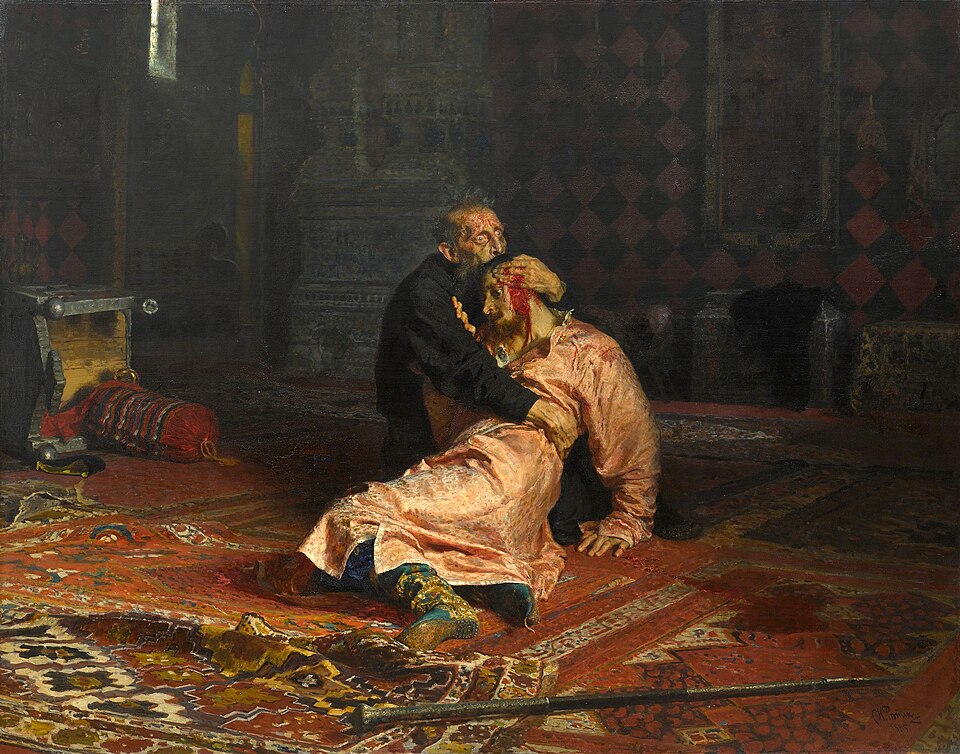
- Ivan the Terrible and His Son Ivan (1885) – one of the most emotionally devastating paintings ever made. A father holding his dying son. Caused a scandal and was briefly removed from exhibition.
- Reply of the Zaporozhian Cossacks (1880-1891) – took over ten years to complete. Pure energy and defiance.
- Religious Procession in Kursk Province (1880-1883) – over 70 individual characters, each one distinct.
Techniques and Mediums
Repin worked almost exclusively in oil painting. He was a brilliant colorist with strong dramatic form and characterization. Hundreds of preparatory sketches went into his major canvases.
His portraits captured the physical and spiritual life of his sitters. The portrait of composer Modest Mussorgsky, painted in just four days while Mussorgsky lay dying in a hospital, is considered one of the finest portraits in Russian art.
Where to See Their Work
The Tretyakov Gallery in Moscow holds the largest collection. The State Russian Museum in St. Petersburg has significant pieces too. His former home in Kuokkala, Finland (now Repino) is a museum and UNESCO World Heritage Site.
Legacy and Influence
Repin was the first Russian artist to gain major European recognition through specifically Russian subjects. After his death in 1930, the Soviet government held him up as the ideal template for Socialist Realism, though his work runs far deeper than any political label.
In a 2017 Russian poll, he ranked third among the country’s most beloved artists.
Wassily Kandinsky
Early Life and Background
Born in Moscow in 1866 to a well-off family with mixed ethnic roots. His father was from Siberia near the Mongolian border, his mother a Muscovite, his grandmother from the Baltic German community.
Here’s what makes Kandinsky unusual. He didn’t start painting until he was 30. Before that? A law professor at the University of Moscow with a promising academic career.
Two things changed everything: seeing Monet’s Haystacks at an exhibition in Moscow and hearing Wagner’s Lohengrin at the Bolshoi Theatre. He packed up and moved to Munich in 1896 to study art.
Artistic Style and Movement
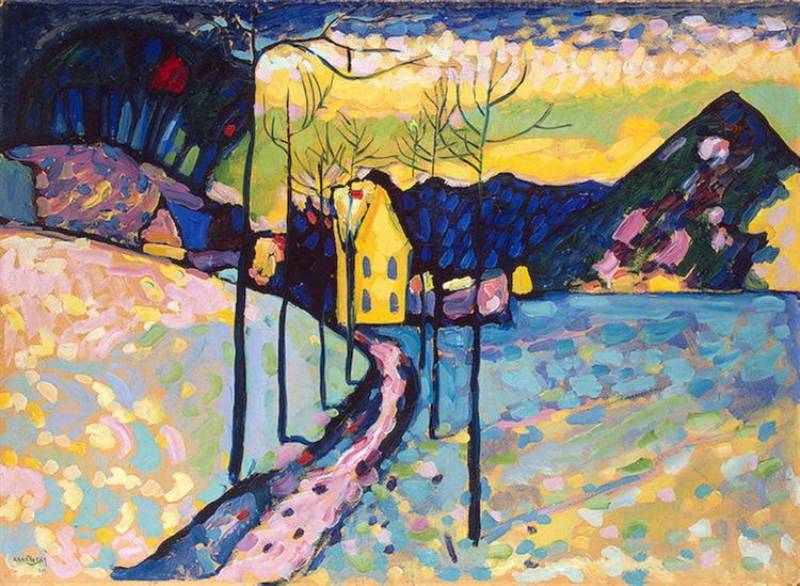
Kandinsky is credited as one of the first creators of pure abstract art in the Western tradition. That’s a big claim, but it holds up.
He experienced synesthesia. He heard colors and saw sounds. This drove his entire artistic philosophy, connecting painting to music in a way nobody had before.
His style evolved through distinct phases:
- Munich period – fluid, organic forms with intense color influenced by Fauvism and Russian folk art
- Bauhaus period – geometric shapes, more structured compositions
- Paris period – amoeba-like biomorphic forms blending earlier approaches
He co-founded the Blue Rider (Der Blaue Reiter) group in 1911 with Franz Marc. Published Concerning the Spiritual in Art (1911), one of the most influential art theory texts of the 20th century.
Most Famous Paintings
- Composition VII (1913) – widely regarded as his masterpiece. Three days to paint it, six months of preparation.
- The Blue Rider (1903) – early work bridging expressionism and abstraction
- Yellow-Red-Blue (1925) – a key Bauhaus-era piece
- Composition X (1939) – bright shapes on dark background, one of his final major works
Techniques and Mediums
Oil on canvas was his primary medium, though he also worked in watercolor. His 1910 untitled watercolor is considered by many experts to be his first truly abstract work.
Kandinsky grouped his paintings into three categories: Impressions (based on external nature), Improvisations (spontaneous emotional reactions), and Compositions (the most complex, deliberately planned works). Color was his keyboard, he said. The eyes were hammers. The soul was the piano with many strings.
Where to See Their Work
The Solomon R. Guggenheim Museum in New York has a major collection. Also the Lenbachhaus in Munich, the Centre Pompidou in Paris, and the Hermitage Museum in St. Petersburg.
Legacy and Influence
Without Kandinsky, the trajectory of 20th century art looks completely different. Jackson Pollock studied his late paintings. Mark Rothko built on his color theory ideas. Even Neo-Expressionists in the 1980s drew from his concepts of inner expression.
The Kandinsky Award, established in his honor, gives promising Russian artists a 55,000 euro prize.
Kazimir Malevich

Early Life and Background
Born in 1879 in Kyiv to a family of Polish origin. His father ran a sugar refinery. Not the typical origin story for someone who would redefine painting itself.
Malevich was largely self-taught. He studied briefly at the Moscow School of Painting, Sculpture, and Architecture, but drew most of his early inspiration from European avant-garde movements he encountered through reproductions and exhibitions.
His early work was figurative, cycling through styles the way some people change apartments. He absorbed cubism, futurism, and post-impressionism before arriving at something entirely his own.
Artistic Style and Movement
Malevich founded Suprematism, an art movement focused on basic geometric forms and a limited range of colors. The name comes from “supremus,” meaning the supremacy of pure artistic feeling over representation.
He wanted to strip painting down to absolute zero. No objects. No narrative. No perspective. Just shape, color, and feeling.
Look, most people still find it strange. And that’s kind of the point. Malevich believed viewers should feel the painting, not understand it.
Most Famous Paintings
- Black Square (1915) – first shown at the “0.10” exhibition in Petrograd, hung in the sacred icon corner of the room. A deliberate provocation and a new beginning. X-rays later revealed two earlier paintings hidden beneath it.
- White on White (1918) – took Suprematist ideas to their logical extreme
- Suprematist Composition (1916) – floating geometric forms on white ground
- The Reaper (1912-13) – earlier figurative work showing his transition
Techniques and Mediums
Oil on canvas, primarily. The original Black Square is now badly cracked, revealing fingerprints and brushstrokes underneath. Under magnification, you can see subtleties that reproductions miss completely.
In his later years, when Soviet politics turned against modern art, Malevich returned to figurative painting. He signed many of these late works with a small black square. A quiet protest.
Where to See Their Work
The Tretyakov Gallery in Moscow has the original Black Square and other key pieces. The State Russian Museum in St. Petersburg holds Red Square and Black Circle. MoMA in New York owns White on White.
Legacy and Influence
Malevich died in 1935, marginalized and poor. His work disappeared from public view in Russia for decades under Stalin. But starting in the 1960s, the West rediscovered him. His influence runs through minimalism, constructivism, and into modern design and architecture.
At his funeral, mourners carried flags with black squares. A black square was fixed above his coffin. It marked his grave.
Ivan Aivazovsky
Early Life and Background
Born in 1817 in Feodosia, a Black Sea port in Crimea, to an Armenian family. Baptized as Hovhannes Aivazian. Growing up beside the sea gave him a lifelong obsession that never faded.
He showed early talent in both music (self-taught violin) and drawing. A local architect named Jacob Koch taught him the basics. By 1833, he was at the Imperial Academy of Arts in St. Petersburg, where he graduated with a gold medal two years early.
Artistic Style and Movement
Aivazovsky was a Romantic painter, though calling him simply a Romantic undersells his technical range. He was the greatest marine artist Russia ever produced, and arguably one of the best in world art history.
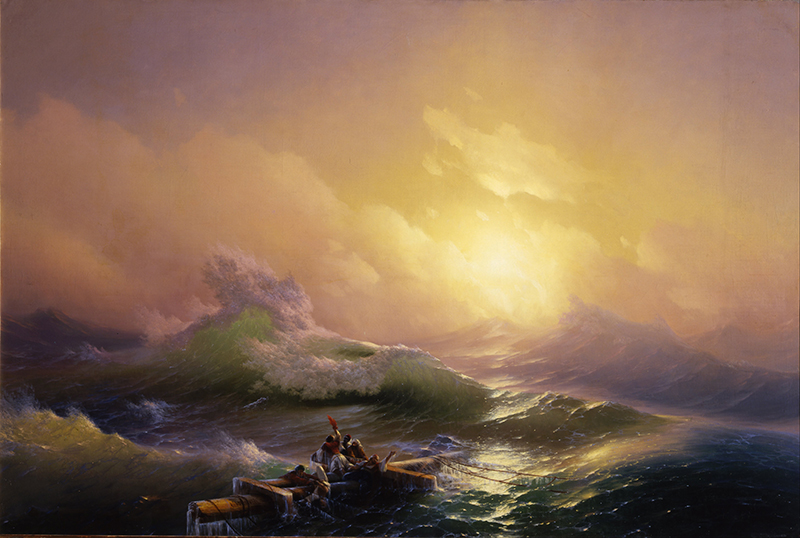
His ability to render light on water is still unmatched by most standards. Moonlight diffusing through fog. Sunlight cracking through storm clouds. The translucent green of a cresting wave. He could paint it all, often from memory.
He produced roughly 6,000 paintings over his career. That number sounds impossible until you realize the man just never stopped working.
Most Famous Paintings
- The Ninth Wave (1850) – his most iconic work. Sailors clinging to wreckage after a storm, with dawn breaking through. The title references a legend that the ninth wave is the most destructive.
- Among the Waves (1898) – painted at age 81. Pure ocean with no ships or figures. Just raw power.
- The Black Sea (1881) – considered by critics to be his finest technical achievement
- The Battle of Sinop (1853) – one of many naval battle scenes that earned him official recognition
Techniques and Mediums
Oil on canvas, almost exclusively. Aivazovsky’s technique centered on rendering realistic shimmer of water against various light sources. He was especially good at value control and atmospheric effects.
He often painted seascapes from memory rather than from life. His studio method involved long periods of careful observation followed by rapid execution. Anton Chekhov coined the phrase “worthy of Aivazovsky’s brush” to describe something beautiful, and the saying stuck in Russian culture.
Where to See Their Work
The Aivazovsky National Art Gallery in Feodosia (which he founded in 1880) holds the largest collection. Major works also hang in the State Russian Museum, the Tretyakov Gallery, the National Gallery of Armenia in Yerevan (about 100 works), and the Metropolitan Museum of Art in New York.
Legacy and Influence
In a 2017 Russian poll, Aivazovsky was voted the country’s favorite painter with 27% of the vote. His face appears on the 20,000 Armenian dram banknote.
He remains less known in the West than he deserves. But within Russia and Armenia, his name is practically synonymous with painting itself. His influence on Russian landscape painting is hard to overstate, especially for artists like Arkhip Kuindzhi who followed.
Marc Chagall

Early Life and Background
Born Moishe Shagal in 1887 in Vitebsk, then part of the Russian Empire (now Belarus). Grew up in a Hasidic Jewish family. His father worked at a herring warehouse.
Vitebsk appears in nearly everything he painted. The small-town streets, the wooden houses, the fiddlers on rooftops. Even decades after leaving, the place haunted his canvases.
He studied at the Imperial Society for the Protection of Fine Arts in St. Petersburg under Leon Bakst, then moved to Paris in 1910 where he encountered cubism and fauvism firsthand.
Artistic Style and Movement
Chagall never fit neatly into any movement. He absorbed cubist structure and fauvist color but filtered everything through a deeply personal, dreamlike vision rooted in Jewish folklore and Russian village life.
His paintings float. Literally. Lovers hover above towns. Fiddlers sit on rooftops. Goats fly. The logic is emotional, not rational.
Some call his work proto-surrealist, and Salvador Dali even admired his dream imagery. But Chagall always insisted his paintings came from memory, not the unconscious.
Most Famous Paintings
- I and the Village (1911) – a cubist-inflected dreamscape of Russian rural life
- The Birthday (1915) – a floating kiss with his wife Bella. Pure joy on canvas.
- Over the Town (1918) – lovers flying above Vitebsk rooftops
- White Crucifixion (1938) – a response to the horrors of Kristallnacht
Techniques and Mediums
Chagall worked across many painting mediums, including oil, gouache, and watercolor. He was also a prolific printmaker and stained glass designer. His ceiling painting at the Paris Opera (1964) and stained glass windows at the United Nations headquarters show his range beyond canvas.
His color use is instinctive and bold, often pairing unexpected hues that shouldn’t work together but somehow do.
Where to See Their Work
The Musee National Marc Chagall in Nice, France is dedicated entirely to his work. Major pieces also hang at MoMA, the Art Institute of Chicago, the Tretyakov Gallery, and the Centre Pompidou.
Legacy and Influence
Chagall lived to 97, dying in 1985 in France. His career spanned nearly eight decades. He influenced generations of artists with his proof that personal mythology and emotion could drive serious painting just as well as theory or technique.
Picasso reportedly said that after Matisse died, Chagall was the only painter left who truly understood color.
Early Life and Background
Born in 1832 in Yelabuga, a small town in the Vyatka Governorate. His father was a merchant with an interest in local history and archaeology, which gave young Ivan an appreciation for the Russian countryside early on.
Studied at the Moscow School of Painting, Sculpture and Architecture, then at the Imperial Academy of Arts in St. Petersburg. Won the Academy’s gold medal, which funded travel to Europe.
Artistic Style and Movement
Shishkin was Russia’s supreme landscape painter. Where Aivazovsky owned the sea, Shishkin owned the forest.
His style combined scientific precision with emotional depth. He studied trees the way a botanist would, then painted them with a painter’s soul. Every pine needle, every shaft of light through branches, every patch of moss.
He was also a member of the Peredvizhniki, sharing their commitment to depicting authentic Russian life and nature rather than idealized Academic subjects. His painting style leaned heavily into detailed naturalism.
Most Famous Paintings
- Morning in a Pine Forest (1889) – possibly the most recognized Russian painting ever. Four bears playing in a misty forest. Fun fact: the bears were actually painted by Konstantin Savitsky, not Shishkin. Printed on millions of “Clumsy Bear” chocolate wrappers during the Soviet era.
- A Rye Field (1878) – considered the “ultimate Russian landscape.” Kids wrote mandatory school essays about it.
- Oak Grove (1887) – sunlight filtering through ancient oaks
Techniques and Mediums
Oil on canvas for his major works. Some specialists consider him an even better graphic artist than painter, and his pen-and-ink forest studies are remarkably detailed.
Shishkin left about 600 paintings. His mastery of texture in foliage and bark remains a reference point for landscape painters today.
Where to See Their Work
The Tretyakov Gallery in Moscow holds Morning in a Pine Forest and most major works. The State Russian Museum in St. Petersburg also has a significant collection.
Legacy and Influence
Shishkin defined what “Russian landscape” means in the popular imagination. In the same 2017 poll where Aivazovsky took first place, Shishkin came second with 26%. His work became so embedded in Russian culture that separating the paintings from national identity is basically impossible.
Isaac Levitan
Early Life and Background
Born in 1860 in Kibarty (now Lithuania) to a poor Jewish family. Moved to Moscow as a child. Studied at the Moscow School of Painting, Sculpture and Architecture alongside Konstantin Korovin and Valentin Serov.
His life was marked by poverty, depression, and antisemitic discrimination. He was expelled from Moscow twice under laws restricting Jewish residency. Despite this, he became arguably the most beloved landscape painter in Russian art.
Artistic Style and Movement
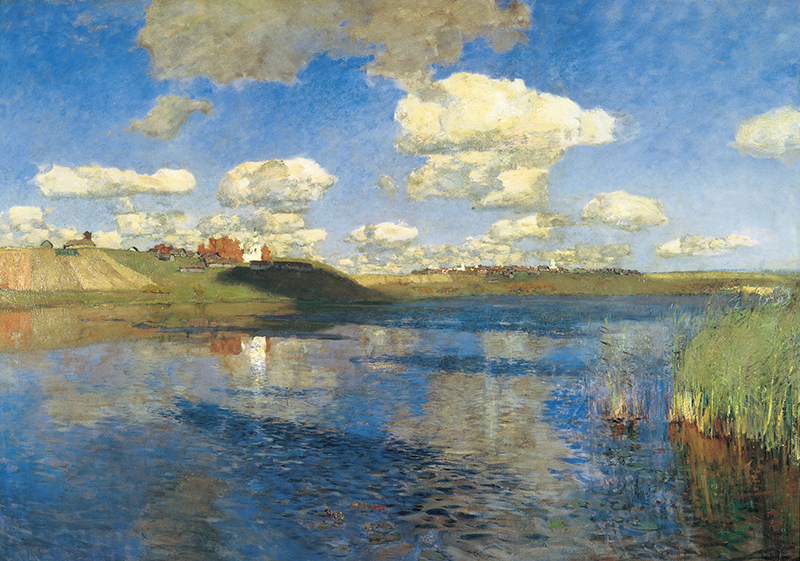
Levitan is often called the master of the “mood landscape.” His paintings don’t just show places. They make you feel something specific about those places.
His technique was astonishing up close. Impasto laid down, then glazed, then lightly wiped so darker pigment stayed in the valleys of the brushwork. It sounds gimmicky. In his hands it was anything but.
He painted with a sensitivity to light and atmosphere that puts him in conversation with Claude Monet, though his emotional register runs more melancholy.
Most Famous Paintings
- Above Eternal Peace (1894) – a vast sky over a lake with a tiny church on a promontory. Existential scale.
- March (1895) – the exact feeling of late winter turning to spring. Snowmelt and birch trees.
- Golden Autumn (1895) – birch trees in full fall color beside a river
- Vladimirka (1892) – the road prisoners walked to Siberian exile. Quiet devastation.
Techniques and Mediums
Oil on canvas. Levitan was a master of atmospheric perspective and subtle tonal shifts. He could convey an entire season’s mood with a few carefully placed strokes.
Where to See Their Work
The Tretyakov Gallery has the richest collection. The Levitan House-Museum in Plyos (where he spent productive summers) is also worth visiting.
Legacy and Influence
Levitan died young at 39 in 1900. Anton Chekhov was a close friend, and the two shared a sensibility. Both found profound meaning in ordinary Russian landscapes and quiet moments. Levitan proved that a birch tree and a grey sky could hold as much emotional weight as any historical drama.
Valentin Serov
Early Life and Background
Born in 1865 in St. Petersburg. His father was the composer Alexander Serov, his mother a pianist. Art and music surrounded him from birth.
He studied under Ilya Repin as a teenager (yes, that Repin) and then at the Imperial Academy of Arts. Spent time in Paris and Munich. By his early twenties, he was already producing masterworks.
Artistic Style and Movement
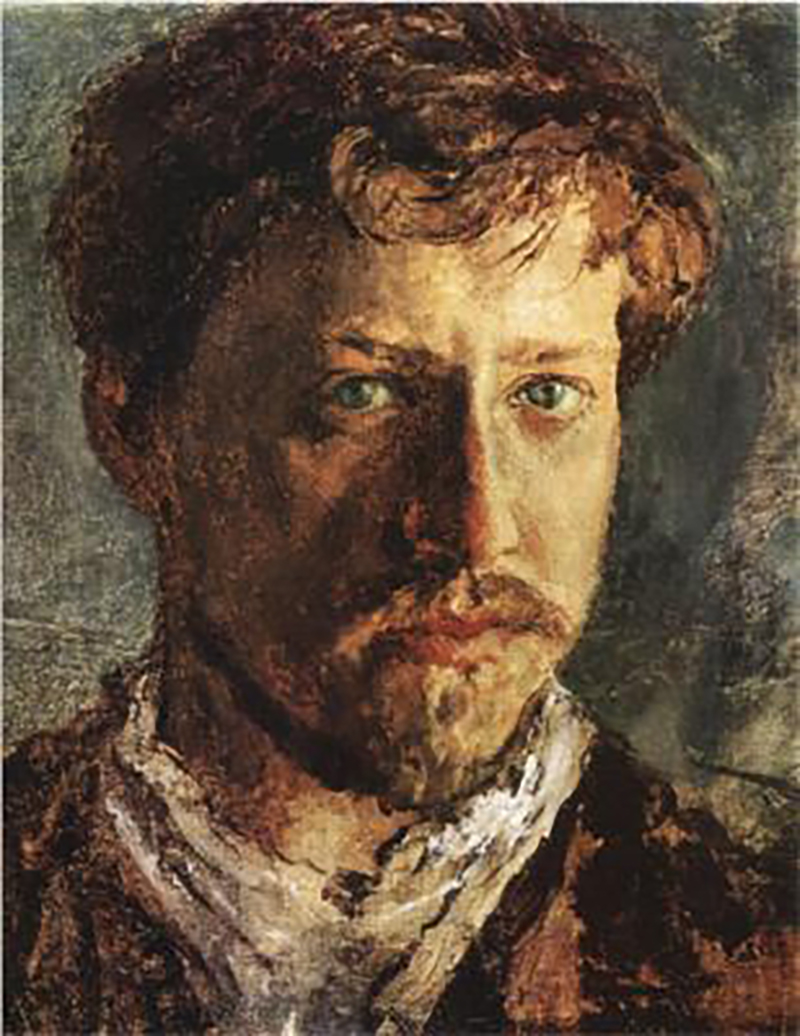
Serov was Russia’s greatest portrait painter. Full stop. His early work has a fresh, spontaneous quality close to impressionism. Later, his portraits became more psychologically penetrating, with simplified forms and bolder design.
He could capture a person’s character in a way that felt immediate and alive. Not flattering. Not cruel. Just truthful.
Most Famous Paintings
- Girl with Peaches (1887) – painted when he was just 22. A portrait of Vera Mamontova bathed in warm light. One of the most loved paintings in Russian art.
- Girl in Sunlight (1888) – his cousin Maria Simonovich in dappled garden light
- Portrait of Ida Rubinstein (1910) – a striking late work showing his move toward modernism
- Portrait of Nicholas II (1900) – official but surprisingly intimate
Techniques and Mediums
Oil and watercolor. Serov’s handling of natural light in Girl with Peaches remains a benchmark for portrait painters. His later work experimented with flatter planes and stronger line work.
Where to See Their Work
Tretyakov Gallery (Girl with Peaches is there) and the State Russian Museum.
Legacy and Influence
Serov died at just 46 in 1911. Despite his short life, he bridged Russian realism and modernism in a way few others managed. His portraits set a standard that Russian painters have measured themselves against ever since.
Karl Bryullov
Early Life and Background
Born in 1799 in St. Petersburg to a family of French Huguenot descent (originally Brulleau). His father was an academic sculptor and ornamental carver. Art was the family business.
He entered the Imperial Academy of Arts at age ten. Ten. Graduated with honors and received a scholarship to study in Italy, where he spent over a decade.
Artistic Style and Movement
Bryullov worked in Romanticism with strong Neoclassical training underneath. His paintings combine dramatic action with precise academic skill. Think theatrical staging meets technical perfection.
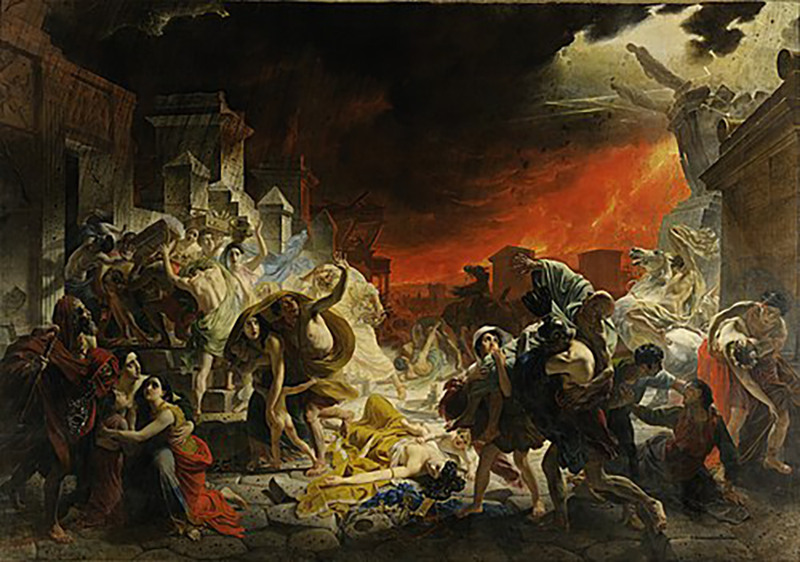
He visited the excavations of Pompeii in 1827 and the experience changed his career direction entirely.
Most Famous Paintings
- The Last Day of Pompeii (1830-1833) – a massive canvas depicting the eruption of Vesuvius. When exhibited in Rome, the entire city came to see it. Six years of work. The painting brought Russian art to European attention for the first time.
- The Horseback Rider (1832) – elegant equestrian portrait
- Portrait of Countess Yulia Samoilova – multiple versions showing his skill as a portraitist
Techniques and Mediums
Oil on canvas. Bryullov’s large-scale history paintings show exceptional command of chiaroscuro and dramatic contrast. The Last Day of Pompeii measures roughly 4.5 by 6.5 meters.
Where to See Their Work
The State Russian Museum in St. Petersburg houses The Last Day of Pompeii. The Tretyakov Gallery has significant portrait works.
Legacy and Influence
Bryullov proved that Russian painters could compete on the European stage. Alexander Pushkin and Nikolai Gogol both praised The Last Day of Pompeii publicly. He paved the way for every Russian artist who came after him to think internationally.
Early Life and Background
Born in 1856 in Omsk, Siberia. His father was a military officer who moved the family frequently. Vrubel studied law at St. Petersburg University before switching to the Imperial Academy of Arts in 1880.
In 1884, he was invited to Kyiv to restore medieval frescoes at the Church of St. Cyril. This encounter with Byzantine and medieval art deeply shaped his visual imagination.
Artistic Style and Movement
Vrubel doesn’t fit any single movement. He’s sometimes grouped with Symbolism and Art Nouveau, but his fractured, crystalline forms are entirely his own invention.
His paintings look like mosaics made of gemstones. Surfaces break into angular facets of intense color. Some art historians see him as a precursor to cubism, though he arrived at his style through completely different means.
Most Famous Paintings
- The Demon Seated (1890) – a brooding, muscular figure from Lermontov’s poem. The crystalline texture and emotional depth make it one of the most striking paintings in Russian art.
- The Demon Downcast (1902) – a shattered, fallen figure. Vrubel repainted it obsessively, even after it was hung in exhibitions.
- The Swan Princess (1900) – based on Rimsky-Korsakov’s opera
- Pan (1899) – a Slavic nature spirit with piercing blue eyes
Techniques and Mediums
Oil on canvas, along with monumental murals and decorative panels. Vrubel used a palette knife extensively, building up thick, faceted surfaces that catch light like cut stone. His approach to creating texture was completely unique for his time.
Where to See Their Work
The Tretyakov Gallery holds The Demon Seated and The Swan Princess. The State Russian Museum has other significant works. His murals remain in situ at churches in Kyiv.
Legacy and Influence
Vrubel spent his final years in psychiatric hospitals, going blind and eventually dying in 1910 at age 54. His work was ahead of its time by decades. The fragmented, almost cubist quality of his surfaces anticipated developments that wouldn’t become mainstream for another ten to fifteen years.
He’s sometimes called the Russian Van Gogh, and the comparison isn’t just about the tragic biography. Both artists created intensely personal visual languages that transcended their era.
FAQ on Famous Russian Painters
Who is the most famous Russian painter of all time?
Ilya Repin is widely considered the greatest Russian painter. His realist masterpieces like Barge Haulers on the Volga defined 19th century Russian art. Wassily Kandinsky and Kazimir Malevich rival him in global influence through their abstract work.
What art movements did Russian painters create?
Russian artists founded Suprematism (Malevich) and Constructivism (Rodchenko, El Lissitzky). They also led the Peredvizhniki realist movement and contributed significantly to abstract art through Kandinsky’s pioneering non-objective paintings in Munich.
Where can I see famous Russian paintings?
The Tretyakov Gallery in Moscow and the State Russian Museum in St. Petersburg hold the largest collections. The Hermitage Museum also displays key works. Internationally, MoMA, the Guggenheim, and Centre Pompidou have major pieces.
Why is Kandinsky considered important in art history?
Kandinsky is credited as one of the first painters to create purely abstract art. His 1911 book Concerning the Spiritual in Art established a theoretical framework connecting color, form, and emotion that influenced generations of artists.
What is Malevich’s Black Square and why does it matter?
Black Square (1915) is a painting of exactly what the title says. Malevich used it to launch Suprematism, declaring the supremacy of pure feeling over representation. It’s considered a turning point in modern art history.
Who painted The Ninth Wave?
Ivan Aivazovsky painted The Ninth Wave in 1850. It shows shipwreck survivors clinging to debris at dawn. Aivazovsky produced roughly 6,000 seascapes during his career and remains Russia’s most celebrated marine artist.
Was Marc Chagall a Russian painter?
Yes. Chagall was born in Vitebsk (now Belarus, then the Russian Empire) in 1887. He later lived in Paris and the United States. His dreamlike paintings blend Russian Jewish folklore with cubist and fauvist influences.
What painting techniques did famous Russian artists use?
Most 19th century Russian painters worked in oil on canvas. Repin used detailed preparatory sketches. Aivazovsky painted seascapes from memory. Vrubel built crystalline surfaces with a palette knife. Kandinsky later experimented with watercolor and mixed media.
Who are the famous Russian landscape painters?
Ivan Shishkin and Isaac Levitan are the two greatest Russian landscape painters. Shishkin specialized in forests with botanical precision. Levitan painted “mood landscapes” capturing the emotional atmosphere of the Russian countryside.
Did Russian painters influence Western art?
Absolutely. Kandinsky’s abstractions directly influenced Jackson Pollock and Mark Rothko. Malevich’s Suprematism shaped minimalism and modern design. Chagall’s dreamlike imagery impacted surrealism. Russian avant-garde ideas spread globally through emigration and exhibitions.
Conclusion
These famous Russian painters didn’t just make great art for gallery walls. They reshaped how the world thinks about painting itself.
Repin and the Peredvizhniki brought social truth to canvas. Aivazovsky turned the sea into something spiritual. Malevich and Kandinsky tore down representation entirely and built something new from scratch.
What connects them is ambition. Every artist on this list pushed past the boundaries of their era, whether through technical mastery of oil painting or radical experiments in geometric abstraction.
Their work still fills the Hermitage, the State Russian Museum, and collections from New York to Paris. If you haven’t spent time with these painters yet, start with one that grabs you. Go see the originals if you can.
Reproductions don’t do them justice. They never do.