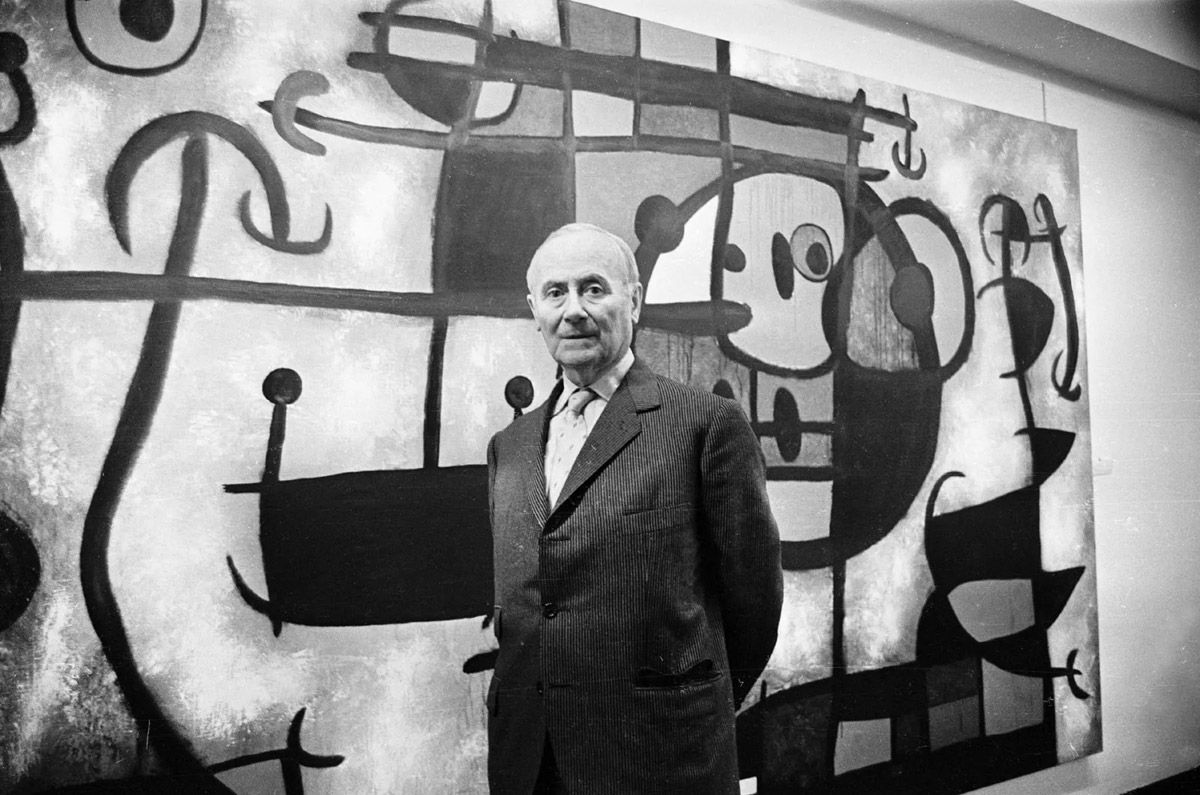

Most people recognize Joan Miró from those floating shapes and primary colors that look like a child’s dream notebook. But calling his work “simple” misses the point entirely.
This Catalan painter spent seven decades dismantling what painting meant, starting with starvation hallucinations in a Paris studio and ending with 22-meter sculptures that redefined public art. His journey from detailed Catalan landscapes to pure abstraction influenced everyone from Jackson Pollock to modern graphic designers.
You’ll discover how Miró developed his signature visual language, why André Breton called him “the most Surrealist of us all” (despite Miró refusing to join the movement), and what makes his work instantly recognizable across museum walls worldwide.
We’ll examine his materials and techniques, decode his symbolic vocabulary of stars and ladders, and explore the major paintings that changed modern art’s trajectory.
Identity Snapshot
Joan Miró i Ferrà (Catalan: Joan Miró i Ferrà)
Also known as: Joan Miro (anglicized)
Lifespan: 1893-1983
Primary roles: Painter, Printmaker, Sculptor, Ceramicist
Nationality/Schools: Spanish (Catalan), École de Paris association
Movements: Surrealism, Automatism, Abstract Art, Catalan Fauvism (early period)
Mediums: Oil painting, gouache, watercolor painting, lithography, etching, bronze, ceramic, tapestry
Signature traits: Biomorphic forms, flat backgrounds with mild gradation, spontaneous brushwork, limited primary colors palette, childlike spontaneity
Iconography/Motifs: Stars (cosmic awareness), ladders (escape/elevation), birds (freedom), eyes, moons, suns, women, Catalan peasants, musical notes
Geographic anchors: Barcelona (birthplace), Mont-roig del Camp (family farm), Paris (Rue Blomet studio), Palma de Mallorca (final residence)
Mentors/Students/Patrons: Francesc Galí (teacher), André Breton (theorist), Pablo Picasso (influence), Josep Llorens Artigas (ceramics collaborator), Pierre Matisse (dealer/patron), Ernest Hemingway (collector)
Collections & Museums: Fundació Joan Miró (Barcelona), MoMA (New York), Albright-Knox Art Gallery, Reina Sofía (Madrid), Centre Pompidou (Paris), UNESCO headquarters (murals)
Market signals: Record auction prices for constellation series works; standard formats ranged from small gouaches (12×16 inches) to monumental murals (8+ feet); 1920s Catalan landscapes highly sought
What Sets Joan Miró Apart

Most Catalan surrealists leaned hard into political fury or pure automatism. Miró carved out something else entirely.
His work pulls from Catalan folk art, strips it to biomorphic bones, then rebuilds it with color decisions that feel both primitive and razor-sharp. Where Salvador Dalí obsessed over meticulous detail and René Magritte over conceptual riddles, Miró went minimal. He painted hallucinations caused by hunger, not Freudian theatrics.
The paintings float. Literally.
Forms hang in vast empty fields without atmospheric perspective tricks or depth cues. Just shape against ground. This isn’t naivety, it’s refusal.
Miró’s brushwork shifts violently within a single canvas. Thick impasto slabs next to thin washes. Controlled calligraphic line beside dripped accidents. He called it “assassinating painting” because bourgeois technique bored him.
His primary colors hit harder than anyone else’s in Paris during the 1920s. Red, blue, yellow, black. That’s it. But he knew exactly where to drop each one.
Origins & Formation
Early Training (1907-1915)
Enrolled at Barcelona School of Fine Arts at 14 while attending business school. Parents pushed commerce. He clerked for two years, then suffered a nervous breakdown that ended the charade.
Recovered at the family farm in Mont-roig del Camp. This place would anchor his visual vocabulary for life.
Switched to Francesc Galí’s Escola d’Art in 1912. Galí taught him to draw blindfolded, by touch alone. The exercise rewired how he understood form and space.
First Stylistic Shifts (1915-1920)
Early work borrowed from Vincent van Gogh‘s intensity and Paul Cézanne‘s structured planes. Critics dubbed it Catalan Fauvism because the color saturation screamed louder than realism allowed.
Portrait of Enric Cristòfol Ricart (1917) showed German Expressionism brushwork filtered through Mediterranean light. Angular, gestural, packed with energy.
The Farm (1921-1922) marked the pivot point. Obsessive detail (every pebble, every tool, every chicken) combined with flattened space that denied linear perspective. Hemingway bought it and never let it go.
Pivotal Travel: Paris (1919 onwards)
First Paris trip in 1919 opened the floodgates. Met Dadaists, attended manifestos, saw what Cubism really meant beyond Barcelona’s echo chamber.
Rented a studio at 45 Rue Blomet in 1920. Neighbor André Masson introduced him to Surrealist poets. Miró later said poets mattered more to him than painters. He gorged on their discussions all night.
Hunger shaped this period literally. He couldn’t afford food. The hallucinations became paintings.
First Exhibitions & Reception
Solo debut at Galeries Dalmau, Barcelona, February 1918. Critics defaced his work. Public laughed.
Pierre Matisse Gallery in New York became his American champion from 1932 onward, ensuring U.S. collectors saw his output consistently.
By 1925, after exhibiting with Surrealists at Galerie Pierre, Paris took notice. André Breton called him “the most Surrealist of us all.” Miró never signed the manifesto. He wanted out from under any “-ism.”
Movement & Context
Position Within Surrealism

Miró orbited Surrealism without surrendering to it. He showed up at the exhibitions, collaborated with the poets, absorbed automatism techniques. But he refused membership because movements felt like cages.
Where orthodox Surrealists like Max Ernst built dreamscapes through meticulous collage and trompe-l’oeil illusions, Miró stripped everything bare. No Renaissance tricks. No sfumato softness. Just contrast and shape.
Comparative Attributes
vs. Salvador Dalí:
- Edge hardness: Miró’s edges fluctuate wildly (soft biomorphic curves next to knife-sharp black boundaries). Dalí maintained jeweler-level precision throughout.
- Tonal range: Miró worked with flat, unmodulated color fields. Dalí built full value scales with chiaroscuro modeling.
- Spatial logic: Miró abandoned depth cues entirely. Dalí constructed hyper-real spatial illusions before breaking them.
vs. Wassily Kandinsky:
- Stroke length: Kandinsky used sustained, flowing curves. Miró interrupted his own line constantly with dots, dashes, staccato marks.
- Composition density: Kandinsky filled the canvas edge-to-edge. Miró left huge voids, sometimes 70% empty space.
- Color temperature: Both loved primary colors, but Kandinsky mixed warmer earth tones throughout. Miró stayed cooler, blues dominating.
vs. Paul Klee:
- Subject framing: Klee built grids and contained compartments. Miró let forms float without anchoring structure.
- Canvas aspect ratios: Klee worked small, often square. Miró pushed toward larger horizontal formats by the 1940s.
- Symbolic density: Both trafficked in symbols, but Klee’s were Germanic, architectural. Miró’s pulled from Mediterranean folklore and cosmic observation.
Rejection of Orthodoxy
By 1929, Miró grew frustrated with Breton’s rigid Surrealist rules. Started “assassinating painting” through experimental techniques. Mixed sand, tar, rope into paint surfaces. Used sandpaper as ground. Incorporated mirror fragments.
This wasn’t rebellion for show. He genuinely wanted to dismantle bourgeois art expectations and start over.
Materials, Techniques, and Process
Supports
Early period (1915-1923): Linen canvas, tightly woven, commercially prepared Mid-period (1924-1940): Cotton canvas, often sporadically primed, leaving raw fabric visible Late period (1940s+): Wood panels (Masonite), canvas boards, Belgian linen for major works, paper (especially for Constellations series)
Preferred medium to large formats but didn’t shy from intimate scales when the concept demanded it.
Grounds & Primers
Applied gesso unevenly or skipped it altogether. The Birth of the World (1925) shows bare canvas with thin color stains applied directly. The tooth of unprimed fabric grabs pigment differently, creates unpredictable textures.
For more controlled work, used traditional rabbit-skin glue sizing with chalk ground, but never polished it smooth.
Mediums & Binders
- Oil: Thinned with turpentine for translucent washes. Sometimes mixed with stand oil for slower drying when layering.
- Gouache: Heavily used in the Constellations series (1940-1941). Allowed for opaque matte surfaces on paper.
- Unconventional additives: Sand, tar, rope fibers, collage elements. These created physical texture that broke the picture plane.
Brushwork Taxonomy
Spontaneous drips: Allowed paint to run, then built forms around the accidents Calligraphic strokes: Thin, controlled line drawing executed with a rigger or liner brush, often in black Flat washes: Large areas of unmodulated color applied with wide brushes or palette knives Stippling: Rare, but present in constellation works where small dots build cosmic fields Impasto dabs: Thick paint applied directly from tube or with palette knife, usually for emphasis points
No sfumato. No blending. If two colors met, they collided.
Palette Archetype
Dominant hues: Prussian blue (sky/spiritual realm), cadmium red (passion/vitality), cadmium yellow (solar energy), lamp black (structure/definition) Temperature bias: Cool-leaning overall, with blue dominating roughly 60% of major works Value distribution: High contrast between pure whites, saturated mid-tone colors, and deep blacks. Avoided muddy middle values. Earthy additions (late work): Ochres, siennas, umbers crept in during 1930s political paintings and 1940s war period.
He said: “I try to apply colors like words that shape poems, like notes that shape music.”
Studio Practice
Automatism foundation: Started with empty mind, let subconscious guide initial marks. Drew blindly, then identified forms afterward. Layered development: Despite the spontaneous appearance, Miró worked methodically. Underdrawing present in early work, abandoned by 1925. Collage-to-painting process (1933): Created collages from catalog clippings, machinery ads, newspaper photos. Used these as “sparks” to generate large-scale paintings. The Painting (1933) series demonstrates this assembly-line experiment. Alla prima vs. glazing: Mostly direct painting in single sessions for smaller works. Larger pieces built up over weeks with thin layers allowed to dry between applications. Scraping & erasure: Frequently scraped back wet paint to reveal underlayers or raw canvas. This created ghosted forms, added depth through subtraction.
His 1978 statement: “I painted these paintings in a frenzy, with real violence so that people will know that I am alive, that I’m breathing.”
Themes, Subjects, and Iconography
Recurring Motifs
Stars: Cosmic awareness, connection to universe, navigation through darkness. Became dominant in Constellations series during WWII blackouts.
Ladders: Escape from confinement, elevation beyond earthly concerns, transcendence. Always diagonal, never stable. Eye and ear often attached (escape requires sensing the way).
Birds: Freedom, spiritual flight, communication between realms. Simplified to crescent shapes with single eye.
Women: Fertility, life force, connection to earth. Reduced to ovoid bodies with sexual symbols, wavy lines emanating.
Eyes: Consciousness, witnessing, surveillance. Floated independently or attached to objects (seeing tree, seeing ladder).
Catalan peasants: Cultural pride, rootedness in native soil. Appeared in early work as recognizable figures, evolved into abstract signs by mid-1920s.
Musical notes: Synesthesia between painting and sound. Miró saw no difference between visual and verbal poetry.
Compositional Schemes
All-over composition: No single focal point. Forms distributed across entire canvas with equal weight. Predicted Jackson Pollock’s approach by two decades.
Horizon-less voids: Abandoned traditional ground-sky division. Forms float in undefined space without gravitational logic.
Asymmetrical balance: Heavy cluster of forms on one side counterbalanced by single strong element opposite. Never symmetrical.
Serpentine flow: Despite apparent randomness, careful rhythm guides eye movement through interlocking curves and directional lines.
Symbol Sets with Meanings
| Symbol | Meaning | Visual Form |
|---|---|---|
| Star | Dream, cosmic connection | Simple four or five points, often white on blue |
| Ladder | Escape, elevation, fear of entrapment | Diagonal bars, sometimes with sensory organs |
| Bird | Freedom, transformation | Crescent with eye, minimal detail |
| Moon | Night, imagination, feminine | Crescent or full circle, often yellow |
| Sun | Life force, masculine energy | Circle with radiating lines |
| Eye | Consciousness, observation | Single dot with radiating lashes |
| Woman | Life, sexuality, earth | Ovoid body with wavy emanations |
Socio-Historical Triggers
Spanish Civil War (1936-1939): Commissioned mural The Reaper for Spanish Republican Pavilion at 1937 Paris Exhibition. First overtly political work. Lost to history.
WWII exile (1939-1940): Fled to Normandy, then back to Spain. Blackout curtains prevented his nightly sky-watching. Painted windows blue, began Constellations series as psychological escape from surrounding violence.
Franco dictatorship: Catalan identity suppressed. Miró’s use of Catalan symbols became quiet resistance. Never explicit propaganda, but cultural assertion through form.
Post-war optimism (1950s): Large-scale public commissions (Harvard mural, UNESCO ceramic walls) reflected belief in art’s social function. Wanted work accessible beyond gallery walls.
Notable Works
The Farm (1921-1922)
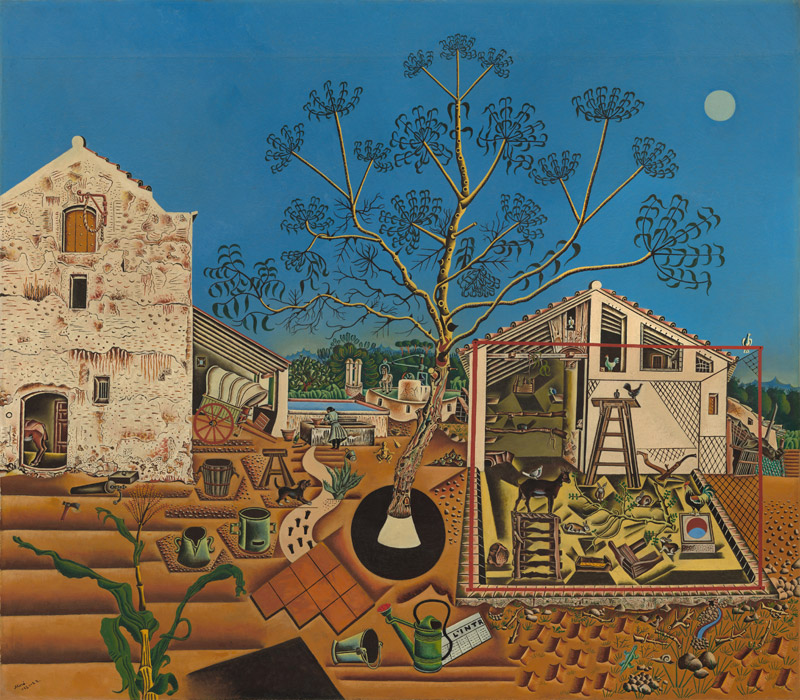
Medium: Oil on canvas Size: 48 7/8 x 55 7/8 inches (124.1 x 141.9 cm) Location: National Gallery of Art, Washington D.C.
Visual signature: Obsessive detail meets flattened pictorial space. Every object (tools, animals, plants, stones) rendered with equal intensity. No atmospheric perspective despite outdoor setting. Bright, unmodulated local colors.
Why it matters: Transition piece between realism and abstract language. Contains seeds of future symbolic vocabulary (simplified animals, geometric plants). Hemingway’s favorite painting, kept it his entire life.
Related works: Mont-roig series (1916-1917), Vines Olive Trees, Tarragona (1919)
Harlequin’s Carnival (1924-1925)
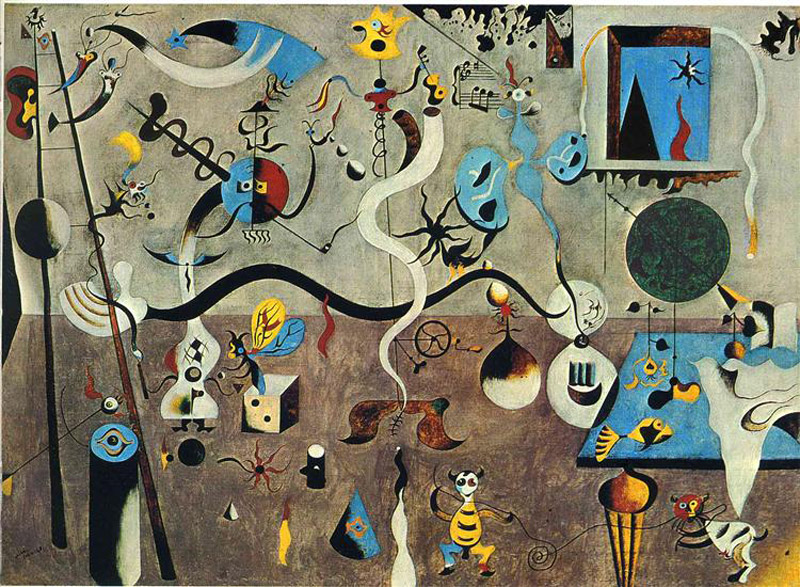
Medium: Oil on canvas Size: 26 x 36 5/8 inches (66 x 93 cm) Location: Albright-Knox Art Gallery, Buffalo, New York
Visual signature: Dense network of biomorphic forms, hybrid creatures, floating symbols. Harlequin rendered as guitar with diamond-patterned torso. Black calligraphic lines define edges. Primary colors (red, blue, yellow) punctuate neutral tan ground.
Why it matters: Peak Surrealism achievement. Painted during extreme poverty (hunger hallucinations). Introduced many signature motifs: ladder with eye/ear (left side), musical notes, anthropomorphized objects. Breton considered it proof of Miró’s Surrealist supremacy.
Related works: The Hunter (Catalan Landscape) (1923-1924), dream picture series (1925-1927)
The Birth of the World (1925)
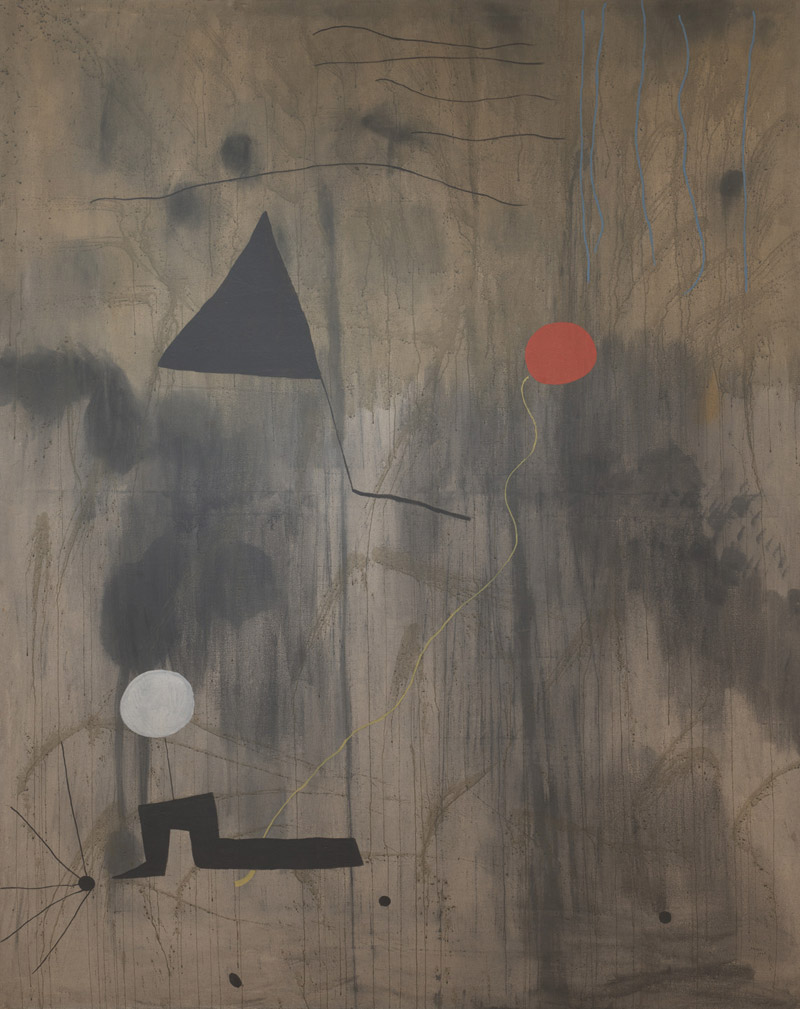
Medium: Oil on canvas Size: 98 3/4 x 78 3/4 inches (250.8 x 200 cm) Location: Museum of Modern Art, New York
Visual signature: Sporadically primed canvas with thin washes creating bruise-like palette. Murky greens, browns, grays stained directly into fabric. Sparse biomorphic forms emerge: red sphere with yellow tail, white sphere on spindle, asymmetrical U-shape. Breakthrough into pure abstraction.
Why it matters: First fully realized Miró. Abandoned recognizable imagery completely. Influenced Abstract Expressionists’ stain painting techniques. Miró called it “a sort of genesis.”
Related works: Dutch Interior series (1928), anti-painting experiments (1929-1930)
Constellations Series (1940-1941)
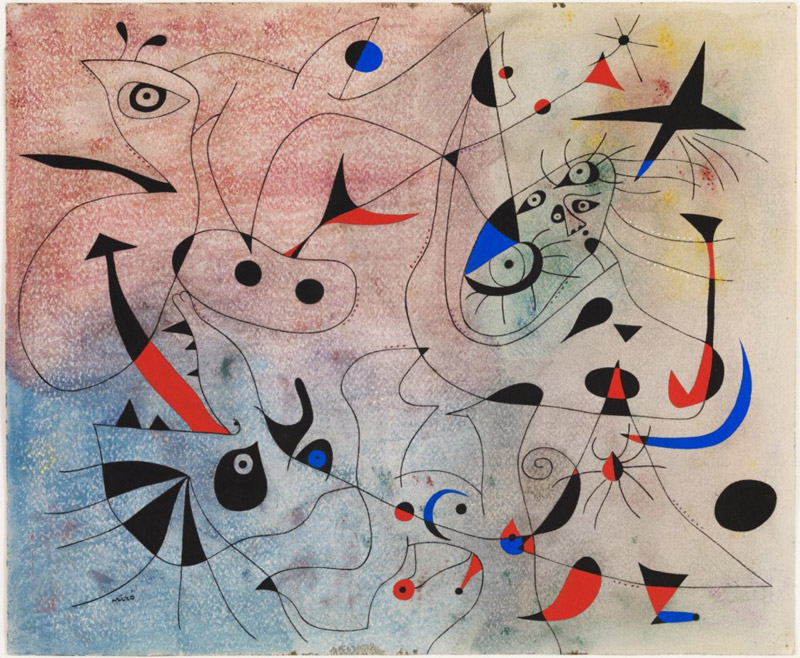
Medium: Gouache and oil wash on paper Size: Various, typically around 15 x 18 inches Location: Scattered across major collections (MoMA, Reina Sofía, private collections)
Visual signature: Dense networks of small forms (stars, birds, women) interconnected by fine black lines. Every inch activated. Opaque gouache creates matte surface. Palette shifts to include more earth tones alongside primary colors.
Why it matters: Painted during WWII as psychological escape from violence. Miró considered them his most important works. Direct influence on Jackson Pollock, Mark Rothko, Abstract Expressionists. Example: The Beautiful Bird Revealing the Unknown to a Pair of Lovers (1941).
Related works: All 24 paintings in series maintain stylistic consistency while varying compositional density.
Blue II (1961)
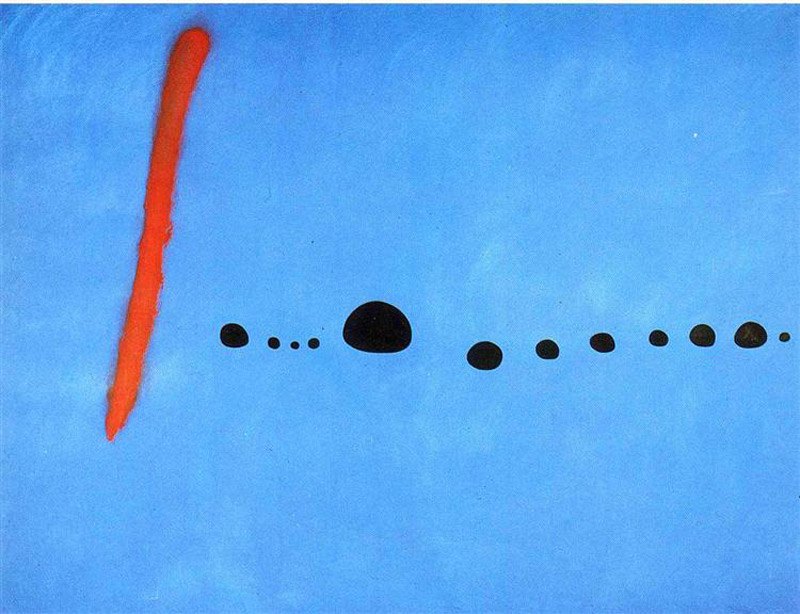
Medium: Oil on canvas Size: 106 1/4 x 138 3/4 inches (270 x 355 cm) Location: Centre Pompidou, Paris
Visual signature: Monumental blue field (Prussian blue) interrupted by single thin black line and red dot. Minimal composition pushed to extreme. Field painting technique with slight gradation in blue wash.
Why it matters: Late-career minimalism. Shows Color Field painting influence flowing back to Miró from American artists he’d inspired. Part of Blue series (Blue I, Blue II, Blue III) exploring vastness and emptiness.
Related works: Blue I (1961), Blue III (1961), monumental single-color canvases from 1960s
Exhibitions, Collections, and Provenance Highlights
Premiere Shows & Turning Points
1918: Solo debut, Galeries Dalmau, Barcelona (hostile reception) 1925: First group show with Surrealists, Galerie Pierre, Paris (breakthrough moment) 1941: Major retrospective, Museum of Modern Art, New York (international recognition solidified) 1954: Grand Prize for Graphic Work, Venice Biennale 1959: Second major MoMA retrospective 2011: The Ladder of Escape, Tate Modern (traveled to Fundació Joan Miró, National Gallery D.C.)
Museums with Depth (3+ works)
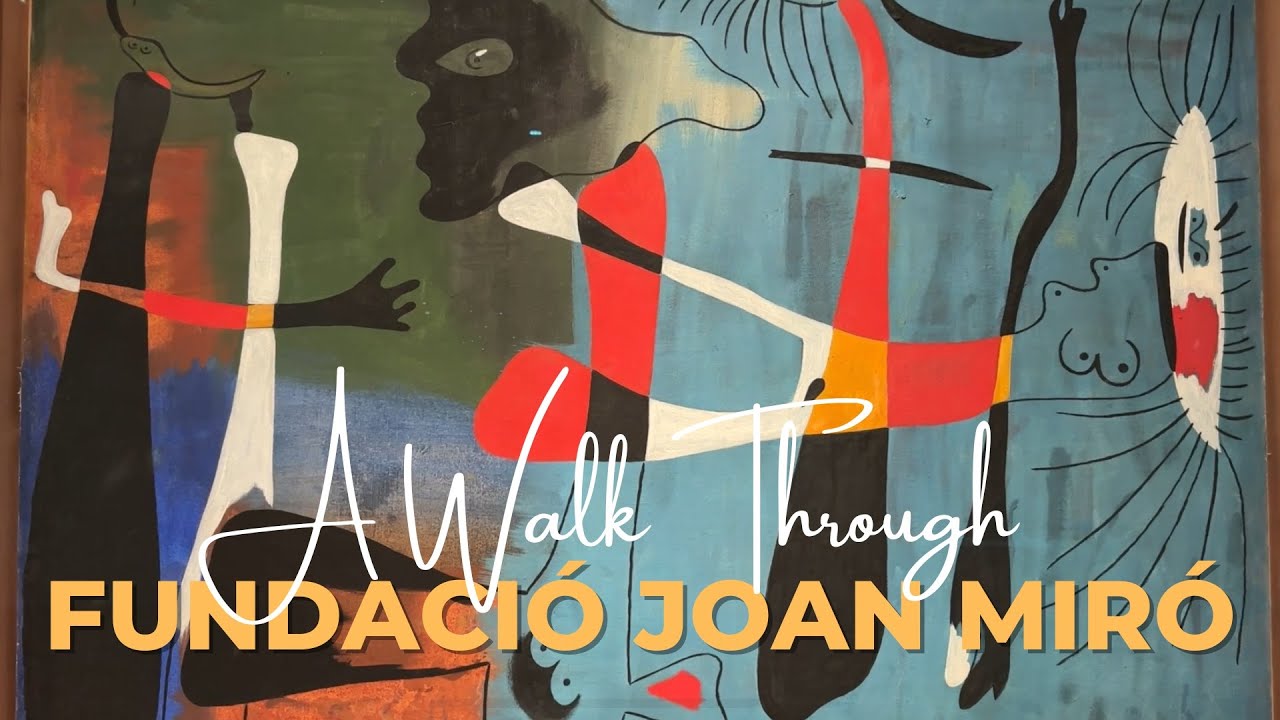
Fundació Joan Miró, Barcelona: Over 200 paintings, 150 sculptures, complete graphic work. Purpose-built museum designed by Josep Lluís Sert, opened 1975.
Museum of Modern Art, New York: 14 major paintings including The Birth of the World, significant print collection.
Centre Pompidou, Paris: Blue series, major 1930s works, sculpture collection.
Reina Sofía, Madrid: Constellation series works, Civil War period paintings.
Albright-Knox Art Gallery, Buffalo: Harlequin’s Carnival (crown jewel), supporting works from 1920s.
Philadelphia Museum of Art: Dog Barking at the Moon, significant 1920s holdings.
Provenance Patterns
Pierre Matisse Gallery (New York): Primary American dealer from 1932-1989. Introduced Miró to U.S. collectors systematically.
Ernest Hemingway: Purchased The Farm at Miró’s first Paris exhibition. Kept it through Cuban years, Ketchum period. Eventually donated to National Gallery.
A. E. Gallatin & Walter/Louise Arensberg: Major American collectors. Their gifts form core of museum holdings.
Estate management: Successió Miró controls authentication, licensing. Based in Mallorca, manages intellectual property rights strictly.
Catalogues Raisonnés & Numbering
Jacques Dupin: Published definitive catalogue raisonné covering paintings, graphics. Multiple volumes, updated through 1980s.
Margit Rowell: Documented drawings, preparatory works, ephemera.
No universal numbering system like some artists. Works identified by title, year, medium, size.
Market & Reception
Record Auctions
Painting (Peinture – Étoile Bleue) (1927): Sold for $36.9 million, Sotheby’s London, 2012. Blue-period work with characteristic star motif.
Constellation series works: Individual pieces from the 23-painting series regularly achieve $5-15 million at auction. Complete series remains split across collections.
Early Catalan landscapes (1915-1920): Strong market, $2-8 million range depending on size and provenance.
Prints & multiples: Lithographs widely available, $1,000-50,000 depending on edition size, date, subject.
Price Bands by Medium/Period
Oil on canvas, 1920s Surrealist peak: $10-40 million Gouaches, Constellation period: $5-15 million Sculptures, bronze editions: $500,000-3 million Ceramics (collaboration with Artigas): $50,000-500,000 Prints, lithographs: $1,000-50,000 Tapestries: $100,000-1 million
Authentication Risks
Signature variants: Early work often unsigned. Later added signatures to older pieces, creates confusion. Signature style evolved (early tight script vs. late loose flourish).
Print edition numbering: Some lithograph editions exceeded stated numbers. Verify edition information against catalogue raisonné.
Ceramic forgeries: Collaborative ceramics with Artigas sometimes falsely attributed. Look for both signatures, documented provenance.
Drawing authenticity: Preparatory sketches frequently forged. Paper analysis, ink testing necessary for verification.
Authentication Resources
Successió Miró (Mallorca) maintains official authentication committee. Submit high-resolution photos, provenance documentation, condition reports. Fee-based service, 6-12 month wait typical.
Cross-reference against Dupin catalogue raisonné before purchase.
Condition Patterns
Unprimed canvas deterioration: Early works on raw fabric show fiber weakening, foxing. Climate control critical.
Gouache flaking: Constellations series vulnerable to humidity fluctuations. Paper-based works require museum-standard framing.
Bronze patina variations: Outdoor sculptures (Barcelona public works) show weathering. Indoor examples retain original surface better.
Collage element separation: 1930s mixed-media works (sandpaper, mirror fragments, rope) experience adhesive failure. Specialized conservation needed.
Influence & Legacy
Upstream Influences
Paul Cézanne: Structured planes, flattened space, refusal of atmospheric depth
Vincent van Gogh: Expressive color, emotional intensity, Mediterranean light
Henri Matisse: Fauvism color liberation, decorative patterning, simplified form
Catalan folk art: Romanesque frescoes (9th-12th century churches), naive figuration, earth-based iconography
Surrealist poets: André Breton, Tristan Tzara, Pierre Reverdy. Verbal-visual synesthesia.
Dutch Golden Age (counterpoint): 1928 trip to Netherlands. Studied Vermeer, Jan Steen, Hendrick Sorgh. Responded by stripping their detailed realism to flat, bold forms. Created Dutch Interior series as artistic counterargument.
Downstream Influence
Abstract Expressionists:
- Jackson Pollock: All-over composition, automatism, denial of focal point
- Mark Rothko: Color field exploration, spiritual dimension through color
- Arshile Gorky: Biomorphic abstraction, organic form
- Robert Motherwell: Spontaneous gesture, poetry-painting connection
Color Field Painters:
- Helen Frankenthaler: Stain technique, unprimed canvas, chromatic exploration. Directly credited Miró.
- Piet Mondrian (late work): Broadway Boogie-Woogie (1947) shares Miró’s visual movement, dancing squares
Sculpture:
- Alexander Calder: Close friendship. Shared biomorphic vocabulary, cosmic themes, primary colors. Calder’s mobiles echo Miró’s floating forms.
Contemporary Artists:
- Josh Smith: Appropriation of Miró’s visual language
- Chris Martin: Spontaneous gesture, bold color, anti-refinement stance
Design & Commercial:
- Paul Rand: Graphic design simplification
- Lucienne Day: Textile patterns
- Julian Hatton: Interior design motifs
Cross-Domain Echoes
Typography & Graphic Design: Miró’s calligraphic line work influenced mid-century modern logo design, poster art.
Children’s Book Illustration: Liberation of form, playful spontaneity normalized childlike expression in serious art.
Public Art Movement: UNESCO murals, Barcelona airport installations. Demonstrated art’s social function beyond gallery walls.
Textile & Fashion: Biomorphic patterns, bold color blocking influenced 1960s-70s fabric design.
How to Recognize a Miró at a Glance

Diagnostic checklist:
- Horizon placement: Usually absent. Forms float without ground line or skyline division.
- Edge control: Fluctuates dramatically within single work. Soft biomorphic curves adjacent to hard-edge black boundaries. No consistency.
- Canvas size clues: Early work (1915-1925): 20×24 to 48×55 inches. Mid-career (1930s-40s): Smaller works on paper, 15×18 inch range. Late period (1950s-70s): Monumental, 8+ feet for major statements.
- Habitual pigments: Prussian blue (dominant), cadmium red, cadmium yellow, lamp black, titanium white. Earthy additions (ochre, sienna) post-1935.
- Signature placement: Early: Often unsigned. Mid-period: Lower right corner, tight script. Late: More prominent, looser hand. Sometimes added signatures to early work decades later (authentication complexity).
- Black line weight: Thin, calligraphic line drawn with rigger brush defines most forms. Variable pressure creates organic rhythm.
- Empty space ratio: Frequently 50-70% empty ground, especially after 1925. Vastness deliberate, not lazy composition.
- Primary colors in isolation: Red, blue, yellow used unmixed, unmodulated. No tints, shades, or tone variations within single color area.
- Star motifs: Four or five-pointed stars, often white on blue field. Cosmic awareness signature.
- Biomorphic shapes: Amoeba-like, cell-like, organ-like forms. Never geometric. Always suggest living organisms without depicting them.
- Asymmetric balance: Heavy cluster one side counterweighted by single strong element opposite. Never centered, never symmetrical.
Surface clues:
- Uneven priming visible (raw canvas patches)
- Mixed media (sand, tar, collage) in 1930s works
- Matte gouache finish (Constellations series)
- Thin staining (early breakthrough works like Birth of the World)
Period tells:
- 1915-1923: Detailed, Fauvist-influenced, recognizable subjects
- 1924-1929: Peak Surrealism, biomorphic explosion, dream pictures
- 1930s: Rougher surfaces, political undertones, experimental materials
- 1940-1941: Dense Constellations, gouache on paper, cosmic themes
- 1950s-1970s: Large-scale, minimal, Color Field influence, monumental public works
If you see vast blue emptiness punctuated by primary colors, floating organic forms without perspective logic, and calligraphic black lines that seem both controlled and wild – you’re looking at Miró.
FAQ on Joan Miró
What is Joan Miró known for?
Joan Miró is known for biomorphic abstract paintings featuring primary colors, floating shapes, and symbolic motifs like stars and ladders. His automatism technique and rejection of traditional painting conventions made him a Surrealism pioneer who influenced Abstract Expressionism.
What painting style did Joan Miró use?
Miró combined Surrealism with abstract art, developing a unique visual language using spontaneous brushwork, flat color fields, and childlike forms. Early work showed Catalan Fauvism influences before evolving into pure abstraction with biomorphic shapes and calligraphic lines.
What techniques did Joan Miró use?
Miró employed automatism (spontaneous subconscious drawing), mixed unconventional materials like sand and tar with paint, used thin washes on unprimed canvas, and created collages as sparks for large-scale paintings. His process alternated between controlled calligraphy and violent gestural marks.
What is Joan Miró’s most famous painting?
Harlequin’s Carnival (1924-1925) ranks as his most iconic work, depicting dreamlike carnival creatures in primary colors. The Farm (1921-1922), owned by Hemingway, and the Constellations series (1940-1941) are equally significant in his artistic evolution.
Why did Joan Miró paint the way he did?
Miró wanted to “assassinate painting” and escape bourgeois art conventions. Hunger hallucinations, Catalan cultural pride, and influence from Surrealist poets drove his spontaneous approach. He painted subconscious imagery to express inner life beyond rational representation.
Where can I see Joan Miró paintings?
Fundació Joan Miró in Barcelona houses over 200 paintings. Major collections exist at MoMA New York, Centre Pompidou Paris, Reina Sofía Madrid, and Albright-Knox Art Gallery Buffalo. His UNESCO murals and Barcelona public sculptures remain accessible worldwide.
What do the symbols in Miró’s paintings mean?
Stars represent cosmic awareness and dreams. Ladders symbolize escape and elevation from confinement. Birds signify freedom and transformation. Eyes indicate consciousness. Women embody fertility and earth connection. Miró assigned personal meanings drawn from Catalan folk art and Mediterranean observation.
How much are Joan Miró paintings worth?
Major oil paintings from the 1920s Surrealist period sell for $10-40 million at auction. Constellation series gouaches reach $5-15 million. Prints and lithographs range $1,000-50,000. His 1927 painting Peinture (Étoile Bleue) sold for $36.9 million in 2012.
Did Joan Miró sign his paintings?
Early works often remained unsigned. Mid-period signatures appear lower right in tight script. Late career signatures became looser and more prominent. Miró sometimes added signatures to older works decades later, creating authentication complexity for collectors and museums.
How did Joan Miró influence modern art?
Miró’s all-over composition and automatism directly influenced Jackson Pollock and Abstract Expressionists. His color field explorations inspired Helen Frankenthaler and Mark Rothko. The biomorphic vocabulary affected Alexander Calder’s sculptures and numerous contemporary artists working in abstract visual language.
Conclusion
Joan Miró refused every artistic boundary placed in front of him. From Catalan folk art to cosmic abstraction, he built a visual vocabulary that still speaks decades after his death in Palma de Mallorca.
His automatism techniques opened doors for Abstract Expressionists. The biomorphic forms influenced sculpture and graphic design equally. Those sparse blue canvases with single red dots changed how painters thought about empty space.
Walk into Fundació Joan Miró in Barcelona and you’ll see seven decades of relentless experimentation. Oil paintings next to bronze sculptures next to ceramic murals. Each medium treated as another chance to assassinate convention.
The Spanish painter’s legacy isn’t in any single masterpiece. It’s in the permission he granted every artist after him to paint like children while thinking like revolutionaries.