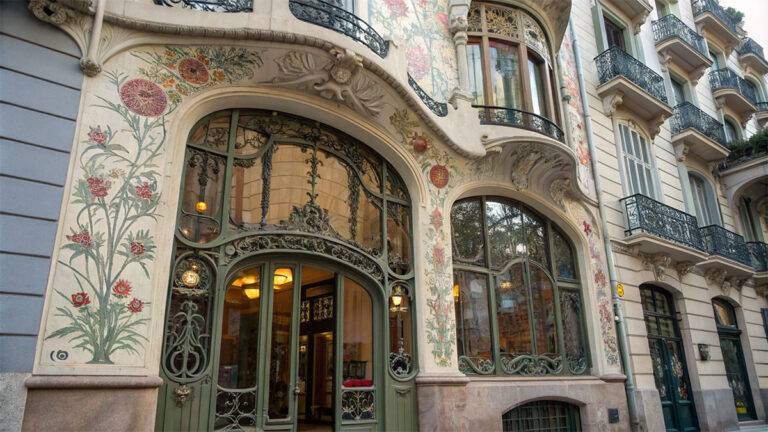
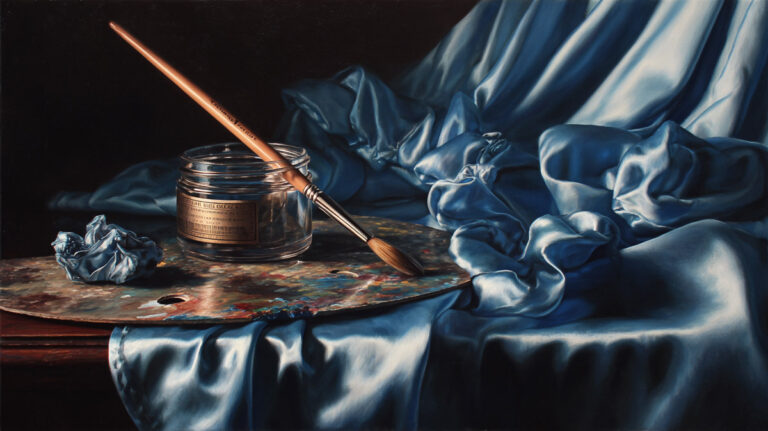
A boy climbs out of his picture frame. Birds peck at painted grapes. A ceiling opens onto a sky that doesn’t exist. These are all examples of trompe-l’oeil, a painting technique designed to fool your eyes into seeing three-dimensional reality on a flat surface.
The French term translates to “deceive the eye,” and painters have been doing exactly that for over two thousand years. From ancient Roman wall frescoes to Baroque church ceilings to chalk drawings on city sidewalks, the technique has never stopped evolving.
This guide covers what trompe-l’oeil is, how it works technically, its history across major art periods, the artists who defined it, and why it still matters today.
What is Trompe-l’Oeil

Trompe-l’oeil is a painting technique that creates the optical illusion of three-dimensional objects on a flat surface. The French term translates to “deceive the eye,” which is exactly what this method does. It tricks viewers into believing that painted elements, whether a bowl of fruit, a violin hanging on a door, or an entire architectural space, are physically real.
The term itself didn’t appear until 1800, when French painter Louis-Leopold Boilly used it as a title for one of his works exhibited at the Paris Salon. But the technique is thousands of years older than the name.
What separates trompe-l’oeil from general realism or precise rendering is the intent. A realistic portrait wants you to appreciate how lifelike it looks. Trompe-l’oeil wants you to reach out and touch it, or step back because you think something might fall on your head. The goal is genuine deception, not admiration of skill (though the skill involved is considerable).
This depends heavily on a few specific technical conditions. Objects need to be painted at life-size scale. Shadow placement must be precise. And the painting usually works best from one fixed viewing angle. Move to the side, and the illusion starts to crack.
According to the Art Basel and UBS Art Market Report, the global art market was valued at $65 billion in 2023. Within that, techniques rooted in optical illusion and illusionistic painting continue to draw institutional and collector interest. The Metropolitan Museum of Art’s 2022 exhibition “Cubism and the Trompe l’Oeil Tradition” brought together over 100 works connecting trompe-l’oeil traditions to modern art movements, showing that the technique remains a serious subject for major museums.
Origins and Early Examples of Trompe-l’Oeil

The Greek Legend That Started It All
The earliest recorded reference to trompe-l’oeil comes from Pliny the Elder’s “Natural History,” written around 77 AD. He tells the story of two Greek painters, Zeuxis and Parrhasius, locked in a contest of skill.
Zeuxis painted grapes so convincingly that birds flew down to peck at them. Impressive enough. But Parrhasius won the competition by painting a curtain so realistic that Zeuxis himself asked for it to be pulled aside to see the painting behind it. There was no painting behind it. The curtain was the painting.
That story gets repeated constantly in art history texts, and for good reason. It sets up the core idea behind trompe-l’oeil perfectly. The greatest illusion isn’t one that fools animals. It’s one that fools another painter.
Roman Wall Paintings and Pompeii
The technique passed directly from Greek tradition into Roman practice. Frescoes uncovered in Pompeii and Herculaneum (buried under volcanic ash since 79 AD) show painted windows, arches, and columns that were designed to visually extend the actual rooms they decorated.
Second Style Roman painting is where trompe-l’oeil really took hold. Artists painted false doorways and receding colonnades onto flat walls, making cramped rooms feel larger. The Villa of the Mysteries near Pompeii has some of the best surviving examples.
And then there’s the mosaic. Sosus of Pergamon created a famous floor mosaic called the Asarotos Oikos, or “unswept floor.” It depicted food scraps, fish bones, and shells scattered across the ground as if someone had just finished a meal. The illusion was meant to amuse dinner guests, an early example of trompe-l’oeil used for entertainment rather than architectural extension.
These Roman examples demonstrate something that stayed true for centuries. Trompe-l’oeil has always been partly practical (making spaces look bigger) and partly playful (making people question what’s real).
Trompe-l’Oeil in Renaissance and Baroque Painting

Andrea Mantegna and the Painted Ceiling
The Renaissance gave painters the mathematical tools to take trompe-l’oeil to a completely different level. Linear perspective, developed by Filippo Brunelleschi and codified by Leon Battista Alberti in the 15th century, turned illusionistic painting from intuitive guesswork into a precise system.
Andrea Mantegna’s ceiling in the Camera degli Sposi at the Ducal Palace in Mantua (painted between 1465 and 1474) is the landmark moment. He painted a fake oculus, roughly 270 cm in diameter, that appears to open onto blue sky. Figures lean over a painted balustrade looking down at you. A potted plant sits precariously on a wooden beam, looking like it might crash onto anyone standing below.
The room itself is only about 8 by 8 meters. But the ceiling illusion, painted using foreshortening in a technique called di sotto in su (from below, looking up), makes the space feel dramatically taller. This single ceiling opened the door for every illusionistic ceiling that followed, from Correggio to Michelangelo to the full-blown Baroque tradition.
Baroque Ceilings and Quadratura
The Baroque period took Mantegna’s breakthrough and turned it into an entire genre. Andrea Pozzo’s ceiling fresco at the Church of Sant’Ignazio in Rome (completed around 1694) is probably the most extreme example. Standing in the right spot on the church floor, the flat ceiling appears to extend upward into a massive open structure filled with hundreds of figures ascending into heaven.
Step off that viewing spot, though, and the columns start to lean at absurd angles. The whole thing collapses into distortion. That’s the catch with quadratura (the technique of painting architecture that continues the real architecture of a building). It only works from one position.
Pozzo also painted a trompe-l’oeil dome in the Jesuit Church in Vienna, which is entirely flat but reads as a full three-dimensional cupola from the floor. It’s a ceiling that doesn’t exist, built entirely out of paint and math.
Dutch Golden Age Still Life
While Italian and Central European painters were working at architectural scale, Dutch painters during the Golden Age brought trompe-l’oeil down to the tabletop.
Samuel van Hoogstraten, who studied under Rembrandt van Rijn, became one of the technique’s great theorists and practitioners. His perspective boxes (peepshow devices) created convincing three-dimensional interior scenes when viewed through a small hole. He also painted flat letter racks, quodlibets featuring scissors, combs, and ribbons pinned to boards, that were so convincing they reportedly fooled Holy Roman Emperor Ferdinand III.
Van Hoogstraten published his ideas in a 1678 book, Introduction to the Academy of Painting, arguing that art’s highest goal was the lifelike imitation of nature. His contemporary Cornelius Gijsbrechts pushed things even further with his painting The Reverse of a Framed Painting, which looks like a canvas turned backward on the wall. It only reveals itself as a trompe-l’oeil when you realize there’s nothing to flip over.
| Period | Technical Logic | Trompe-l’Oeil Application | Key Takeaway |
| Ancient Greece/Rome | Mimesis: Perfect imitation of nature to prove artistic skill. | Wall frescoes (Garden rooms), floor mosaics (The “Unswept Floor”). | Materiality: Focus on realistic textures and cast shadows. |
| Renaissance | Di Sotto in Sù: “Seen from below” perspective to open up ceilings. | Oculi (Mantegna’s Camera degli Sposi), false architectural niches. | Structural Extension: Using math to “puncture” the ceiling. |
| Baroque | Quadratura: Blending real architecture with painted “infinite” skies. | Fake domes (Andrea Pozzo), ceiling apotheosis. | Theatricality: Overwhelming the viewer with impossible scale. |
| Dutch Golden Age | Object Substitution: Creating a shallow depth that mimics a wall. | Still life panels, letter racks, “Peepshow” boxes. | Intimacy: Forcing the viewer to try and “grab” the painted object. |
Techniques That Make Trompe-l’Oeil Work

The illusion isn’t magic. It’s a stack of very specific technical decisions, each one doing something measurable to your perception of space.
Perspective and Vanishing Points
Single-point calibration is what makes or breaks a trompe-l’oeil. The vanishing point has to be calculated for one specific viewing position. Get it wrong, and the painted column that should look round starts looking like it’s melting sideways.
This is why linear perspective was such a game-changer for Renaissance painters. Before Brunelleschi’s system, painters could approximate depth. After it, they could engineer depth to match a viewer’s exact eye level from a specific distance.
Light, Shadow, and Chiaroscuro
Nothing sells three-dimensional form on a flat surface like accurate shadow placement. Chiaroscuro, the controlled use of strong light against deep shadow, gives painted objects weight and volume.
In trompe-l’oeil, the light source in the painting has to match the actual light source in the room. If a window throws light from the left, the painted shadows need to fall to the right. Miss this detail and the illusion breaks instantly, even if everything else is perfect. Caravaggio didn’t paint trompe-l’oeil specifically, but his mastery of dramatic lighting influenced generations of painters who did.
Scale, Texture, and Color Temperature

Life-size rendering: Objects painted at their actual dimensions are far more convincing than scaled-down versions. A painted apple the size of a real apple confuses the eye. A painted apple the size of a watermelon just looks like a big painting.
Surface imitation: Wood grain, marble veining, the weave of linen, the patina on brass. Reproducing texture accurately is one of the hardest parts. It requires layered paint application and often the use of glazing techniques to build up translucent depth.
Color temperature shifts: Warm colors advance toward the viewer and cool colors recede. Trompe-l’oeil painters exploit this principle from color theory aggressively, pushing background elements into cooler tones and pulling foreground objects forward with warmer ones. Even small temperature shifts make a difference.
The Role of Viewing Angle
Most trompe-l’oeil works are designed for a single optimal vantage point. Mantegna’s oculus works from directly below. Pozzo’s ceiling in Sant’Ignazio has a specific marble disc on the floor marking where you should stand.
Anamorphic painting takes this idea to its extreme, producing images that only resolve into recognizable forms from one very precise angle. But standard trompe-l’oeil is more forgiving. It just needs you to be roughly in the right zone.
Trompe-l’Oeil in Architecture and Interior Design

Painted Domes and Church Ceilings
The Palazzo Salis in Tirano, Italy, used trompe-l’oeil over centuries as a practical alternative to expensive real stonework. Painted balconies, staircases, and draperies replaced their physical counterparts throughout the palace, creating the look of luxury at a fraction of the cost.
European churches from the 17th and 18th centuries are full of this kind of thing. Flat ceilings painted to look like open sky. Shallow niches made to look like deep alcoves. Sometimes the Rococo approach combined playful decorative excess with architectural tricks that made modest churches feel palatial.
Grand View Research reports that the global wall art market is expected to reach $80.96 billion by 2030, growing at a 5.4% annual rate. Decorative wall treatments, including mural art and faux finishes that borrow from trompe-l’oeil traditions, represent a growing segment of this market.
Exterior Murals on Building Facades

The technique moved outdoors in a big way during the late 20th century. Richard Haas became known for painting entire building exteriors in trompe-l’oeil, primarily in Chicago and New York City. In 1986, he painted a Miami wall to look like a massive archway opening onto the ocean, with the Fontainebleau Hotel visible in the distance.
Cincinnati’s nonprofit ArtWorks has commissioned nearly 300 public murals since 2007. USA Today named Cincinnati the top U.S. city for street art in 2024. The city’s BLINK festival drew over 2 million visitors in 2022, showing how mural art drives real tourism dollars.
Contemporary Interior Applications
German artist Rainer Maria Latzke began combining classical fresco techniques with contemporary content in the early 1980s, bringing trompe-l’oeil interior murals into modern homes and commercial spaces. What started as a specialized fine art practice has filtered into mainstream interior design.
Today, trompe-l’oeil shows up in restaurants (false windows painted to show Tuscan landscapes), hotel lobbies (painted archways extending corridors), and residential accent walls. The principle is the same one the Romans used in Pompeii. Paint a convincing opening and the room feels bigger.
Skilled execution still requires an understanding of atmospheric perspective and accurate light source placement. Without these, painted architectural extensions look flat and wrong.
Trompe-l’Oeil vs. Photorealism and Hyperrealism

People confuse these three things constantly. They’re related but they serve completely different purposes.
| Technique | Technical Logic | Primary Goal | Viewer Relationship |
| Trompe-l’oeil | Spatial Manipulation: Uses precise perspective and shadows to break the 2D plane. | Deceive the eye into seeing a 3D object. | Deception: “Is that actually there?” |
| Photorealism | Optical Replication: Mimics the camera lens (depth of field, lens flare, film grain). | Reproduce the photograph’s specific aesthetic. | Admiration: “That looks exactly like a photo.” |
| Hyperrealism | Detail Intensification: Captures micro-textures (pores, hair, grit) that the naked eye often misses. | Push detail beyond photographic limits for an “Eerie” clarity. | Intensity: “This feels more real than reality.” |
Where the Lines Blur
Trompe-l’oeil is about spatial deception. It wants you to believe, even for a second, that the painted object occupies real physical space. A painted nail casting a shadow on a wooden board. A painted curtain you want to push aside.
Photorealism, which emerged in the late 1960s and 1970s with painters like Chuck Close and Richard Estes, reproduces photographs with mechanical precision. But nobody walks up to a photorealist painting and tries to touch the subject. You know it’s a painting. You’re just impressed by how much it looks like a photo.
Hyperrealism goes further still, exaggerating detail to a degree that surpasses both photography and human vision. Artists like CJ Hendry produce work where pores, reflections, and micro-textures are amplified. The effect is overwhelming rather than deceptive.
Why the Distinction Matters

Scale is the giveaway. Trompe-l’oeil almost always uses 1:1 scale because that’s the only ratio that genuinely fools the eye. Photorealist and hyperrealist paintings regularly scale up or down.
And there’s a conceptual difference too. Trompe-l’oeil asks “is this real?” Photorealism asks “is this a photo or a painting?” Hyperrealism asks “can you see more than reality?” Three different questions. Three different traditions. They share technical DNA (all three demand extreme control of value, contrast, and surface rendering) but the experience of looking at each one is distinct.
The Metropolitan Museum’s 2022 exhibition actually addressed this overlap directly. It paired Pablo Picasso‘s Cubist collages with centuries-old trompe-l’oeil works to show that even movements we think of as anti-realistic (like Cubism) borrowed heavily from the trompe-l’oeil playbook. The flat picture plane, the mimicry of materials, the intrusion of real-world objects into painted space. All trompe-l’oeil DNA.
Notable Trompe-l’Oeil Artists and Works
Some painters made trompe-l’oeil their entire identity. Others dipped into it for a single famous piece. Either way, the artists below shaped how we understand the technique across centuries.
Pere Borrell del Caso
His 1874 painting “Escaping Criticism” remains one of the most recognized trompe-l’oeil works ever made. It shows a barefoot boy climbing out of a picture frame, his hands gripping the painted wood as if breaking into the viewer’s world.
Borrell was a Catalan painter who rejected the Romanticism dominating Spanish academies at the time. He founded his own art school, the Sociedad de Bellas Artes, where students worked en plein air. The title of the painting likely referenced his frustration with conservative critics who valued idealized subjects over direct observation.
The painting now belongs to the Banco de Espana in Madrid.
William Harnett, John Frederick Peto, and John Haberle
These three American painters formed the backbone of 19th-century trompe-l’oeil still life painting in the United States. Each brought something different:
Harnett: Precision and compositional balance. His “After the Hunt” series and “The Old Violin” (1886) drew such crowds at the Cincinnati Industrial Exposition that a police officer was stationed beside the painting to stop viewers from trying to remove the violin.
Peto: Mood and tone. He gravitated toward worn, used-up objects with a sense of melancholy that set him apart from Harnett’s polished arrangements.
Haberle: Wit and provocation. He painted U.S. currency so convincingly that the Secret Service investigated him for counterfeiting. Unlike Harnett (who stopped painting money after being warned), Haberle kept going, cleverly titling one piece “Imitation.”
Contemporary Practitioners
Julian Beever has been creating three-dimensional chalk drawings on sidewalks since the mid-1990s. Using anamorphic distortion, his work only resolves into a convincing illusion from one specific viewpoint, typically through a camera or phone screen. He’s worked across Europe, the US, and Australia.
Alexa Meade takes a different approach entirely. She paints directly onto human bodies and real objects using acrylic paint, flattening three-dimensional subjects into what looks like a two-dimensional painting. It’s trompe-l’oeil in reverse.
| Artist | Technical Logic | Signature Approach | Strategic Takeaway |
| P. Borrell del Caso | Frame Breach: Using “Overlapping” to suggest physical escape from 2D. | Figures “Escaping the Frame” (e.g., Escaping Criticism). | Depth: A single hand over a border creates instant 3D life. |
| William Harnett | Tactile Verisimilitude: Matching the value and texture of real wood/metal. | Precise Still Life (The “Old Violin” style). | Materiality: Mastery of “Cast Shadows” anchors objects to reality. |
| John Haberle | Flat-Plane Deception: Painting “Flat” objects to remove perspective clues. | Satirical Currency and “Scrapbook” boards. | The Lie: It is easier to fool the eye if the depth is only 1 inch. |
| Julian Beever | Anamorphosis: Extreme mathematical distortion that resolves from one angle. | 3D Pavement/Chalk Art. | Perspective: Viewing height (Eye Level) dictates the entire illusion. |
| Alexa Meade | Reverse Trompe-l’oeil: Turning 3D humans into “Flat” paintings. | Painting directly onto live models and environments. | Flattening: Using “Hard Contours” to erase depth in a 3D space. |
Trompe-l’Oeil in Street Art and Public Murals

3D Pavement Art and Anamorphic Drawings
Pavement trompe-l’oeil uses the same anamorphic principles that Renaissance painters applied to ceilings, just flipped onto the ground. Artists like Edgar Mueller and Leon Keer create drawings that appear to crack open the sidewalk, revealing chasms, underwater scenes, or glass marbles spilling from buildings.
These works are temporary. Rain washes them away. The art exists primarily through photographs taken from the correct angle, which is partly why social media turned this niche into a global phenomenon.
According to Dataintelo research, the global street art market reached $7.2 billion in 2024, with murals representing the largest segment. Europe led the market at roughly $2.6 billion, followed by North America at $2.1 billion.
Large-Scale Building Murals
The Fresque des Lyonnais in Lyon, France, covers an entire building facade with painted figures appearing to stand on balconies, lean out of windows, and occupy real architectural space. It was completed in 1994-1995 by the CitéCreation collective and remains one of the most visited examples of French mural art.
Mural Arts Philadelphia has created over 3,600 murals on building exteriors since 1984. Many incorporate illusionistic elements borrowed from trompe-l’oeil traditions, including painted architectural details that extend the visual footprint of buildings.
Social Media and the Photography Factor
The viewing angle problem that has always defined trompe-l’oeil actually works in favor of street art on social media. A phone camera naturally flattens depth cues, making 3D pavement illusions look even more convincing in photos than they do in person.
Dataintelo estimates the street art tourism market reached $6.2 billion in 2024, growing at 9.1% annually. Individual travelers account for about 52% of that revenue, many of them discovering locations through Instagram and TikTok posts.
Banksy has used trompe-l’oeil elements in several pieces, painting figures that appear to interact with the physical walls and surfaces they occupy. The French street artist JR takes it further with massive photographic collages and murals that distort and extend architectural reality at building scale.
Why Trompe-l’Oeil Still Matters in Contemporary Art

Advertising, Set Design, and Film
Forced perspective has been standard practice in filmmaking since the earliest days of cinema. The Teatro Olimpico in Vicenza (1585) used Vincenzo Scamozzi’s seven forced-perspective streets to simulate deep space on a shallow stage. Hollywood borrowed this directly.
The global VR market is forecasted to grow from $54.24 billion in 2023 to $163.82 billion by 2028, according to industry projections. Virtual and augmented reality applications rely on the same perceptual principles that trompe-l’oeil painters have used for centuries: manipulating depth cues to make flat or digital surfaces feel three-dimensional.
Digital Environments and Virtual Reality
Researchers at institutions like Boston University are drawing direct connections between trompe-l’oeil and augmented reality. Both techniques superimpose images onto real environments. Both aim to make the artificial look natural. The difference is the medium, not the goal.
Japanese filmmaker Isao Takahata described a similar ambition for animation, stating that an animated world should feel as if it existed right there, making viewers believe in characters that nobody has ever actually seen.
Trick Art Museums have opened across Asia (including the Trickeye Museum chain and Hong Kong 3D Museum), creating walk-through trompe-l’oeil environments where visitors photograph themselves interacting with illusionistic scenes. These tourist attractions draw directly from the same visual deception techniques used by Mantegna and Pozzo centuries ago.
The Ongoing Question of Perception
Trompe-l’oeil has never gone away because the question it asks never gets old. What’s real? What’s painted? Can you trust what you see?
The Metropolitan Museum’s 2022 exhibition “Cubism and the Trompe l’Oeil Tradition” made exactly this point, showing how even Picasso, Cubism’s leading figure, and Georges Braque spent years engaging with trompe-l’oeil motifs: painted nails casting shadows, faux wood grain, still life objects appearing to project forward from the canvas.
Whether someone is standing in a Roman villa looking at painted columns, viewing a Baroque ceiling that opens onto a nonexistent sky, or pointing a phone at a chalk drawing on a London sidewalk, the core experience hasn’t changed. The painted surface asks you to believe, just for a second, that it’s something more than paint.
That tension between knowing and seeing is what keeps famous trompe-l’oeil paintings in museum collections, on building walls, and on city sidewalks around the world. And it’s why artists keep returning to a technique that’s been around for over two thousand years.
FAQ on What Is Trompe-L’Oeil
What does trompe-l’oeil mean in English?
It translates from French as “deceive the eye.” The term describes any painting technique that creates the optical illusion of three-dimensional objects on a flat surface, tricking viewers into believing painted elements are physically real.
When was trompe-l’oeil first used in art?
The technique dates back to ancient Greece and Rome. Pliny the Elder recorded the famous contest between painters Zeuxis and Parrhasius around 77 AD, and Roman frescoes in Pompeii used painted architecture to extend interior spaces.
What is the difference between trompe-l’oeil and realism?
Realism aims for accurate visual representation. Trompe-l’oeil goes further by actively trying to deceive the viewer into thinking the painted object is real. Scale, shadow placement, and a fixed viewing angle are what make the deception work.
Who are the most famous trompe-l’oeil artists?
Andrea Mantegna, Andrea Pozzo, Samuel van Hoogstraten, William Harnett, Pere Borrell del Caso, and Julian Beever. Each worked in different periods and formats, from Renaissance ceiling frescoes to 19th-century still life panels to contemporary sidewalk chalk.
What techniques make trompe-l’oeil convincing?
Linear perspective calibrated to a single viewpoint, precise chiaroscuro shadow placement, life-size scale rendering, accurate surface texture imitation, and color temperature shifts that push or pull objects in perceived space.
Is trompe-l’oeil the same as photorealism?
No. Photorealism reproduces photographs on canvas without trying to fool anyone. Trompe-l’oeil specifically aims to make viewers believe the painted object occupies real physical space. The intent behind each technique is fundamentally different.
Where can you see trompe-l’oeil in architecture?
European churches with painted domes (like Sant’Ignazio in Rome), palace interiors like the Palazzo Salis in Tirano, and building facades with painted false windows and balconies. Many cities also feature large-scale exterior trompe-l’oeil murals.
How is trompe-l’oeil used in street art today?
Artists like Julian Beever and Edgar Mueller create anamorphic chalk drawings on sidewalks that appear three-dimensional from one specific angle. These temporary works are designed to be photographed and shared on social media.
What materials are used for trompe-l’oeil painting?
Oil paint has traditionally been the preferred medium because of its slow drying time and blending ability. Contemporary artists also use acrylics for murals and chalk pastels for pavement work. The choice depends on the surface and setting.
Why is trompe-l’oeil still relevant today?
Its core principles, manipulating depth perception on flat surfaces, directly inform virtual reality, augmented reality, film set design, and advertising. The perceptual questions trompe-l’oeil raises about what looks real remain as current as ever.
Conclusion
Understanding what is trompe-l’oeil means recognizing a tradition that has tested the limits of visual perception for over two millennia. From the painted oculus in Mantegna’s Camera degli Sposi to anamorphic street drawings photographed on smartphones, the purpose stays the same: make a flat surface feel real.
The technique sits at the crossroads of art and science. Perspective geometry, shadow rendering, color temperature control, and life-size scale all work together to produce a momentary deception that no other painting method attempts.
Whether applied to a Dutch Golden Age letter rack, a quadratura ceiling in a Roman church, or an augmented reality overlay on a phone screen, trompe-l’oeil keeps asking the same question. Can you trust what you see?
After thousands of years, the answer is still no. And that’s exactly why painters, muralists, and digital artists keep coming back to it.