A stenciled rat appears on a London wall overnight, and by morning, the entire art world is watching.
Banksy turned anonymity into a weapon. While most contemporary artists chase fame, this Bristol-born street artist built a career on invisibility, creating politically charged graffiti that critiques war, capitalism, and surveillance from the shadows.
His work sits in an impossible space. Museums want it. Cities paint over it. Collectors pay millions for pieces that started as illegal vandalism.
This article examines Banksy’s stencil techniques, notorious artworks like Girl with Balloon and Devolved Parliament, major exhibitions from Dismaland to The Walled Off Hotel, and how one anonymous graffiti artist became the most recognized name in contemporary art.
You’ll understand what makes his urban art distinct, why his identity remains hidden, and how street art moved from subway cars to Sotheby’s auction rooms.
Identity Snapshot
Entity name: Banksy (identity unconfirmed)
Also known as: Possibly “Robbie,” Robin Gunningham (unconfirmed), Robert Banks (unconfirmed)
Lifespan: Born circa 1973-1974 (exact date unknown) – present
Primary roles: Street artist, graffiti artist, political activist, film director, painter
Nationality: British (likely Bristol, England)
Movements: Street art, urban art, guerrilla art, stencil art, pop art, contemporary art
Mediums: Spray paint, stencil work, oil painting, installation art, mixed media, performance art
Signature traits: Multi-layered stencil technique, rapid execution, black spray paint dominance, satirical imagery, rats and policemen motifs, political messaging
Iconography / motifs: Rats, policemen, children with balloons, chimpanzees, heart shapes, protest figures, flower throwers, surveillance cameras
Geographic anchors: Bristol (origin), London (primary base since 2000), Shoreditch, Bethlehem, New York, Los Angeles, Paris
Mentors / influences: Blek le Rat, 3D (Robert Del Naja), DryBreadZ Crew (DBZ), Bristol underground scene
Collections & museums: Tate Britain, Museum of Modern Art (MoMA – unauthorized), Bristol Museum, private collections worldwide
Market signals: Record auction £9.9 million (Devolved Parliament, 2019), Girl with Balloon voted UK’s favorite artwork (2017), self-destructing artwork at Sotheby’s (2018)
Authentication body: Pest Control Office (official authentication service)
What Sets This Artist Apart
Banksy weaponized anonymity.
While most contemporary artists build careers on personal brands, this Bristol native turned invisibility into cultural power. The stencil technique isn’t new, borrowed directly from Blek le Rat, but Banksy perfected the speed-to-impact ratio. Cut cardboard templates. Spray in seconds. Disappear. His work exists in the tension between illegal vandalism and million-pound auction pieces, between anti-establishment protest and art market phenomenon.
What separates him from thousands of street artists? Timing and wit.
Each piece lands with journalistic precision. A migrant child appears on the French embassy wall during the refugee crisis. Chimpanzees debate in Parliament as Brexit implodes. The messages aren’t subtle, they’re direct punches wrapped in dark humor. And the delivery system, stencil art, gives him what traditional graffiti can’t offer.
Consistency across continents.
Origins & Formation
Early Bristol Years (1980s-1990s)
Born in Bristol around 1973-1974. Possibly in Yate, 12 miles from the city center.
Started as a freehand graffiti artist around age 14. Expelled from school. Did time for petty crime, which he later said taught him to work fast and stay alert.
The DryBreadZ Crew
Joined Bristol’s DryBreadZ Crew (DBZ) in the early 1990s alongside Kato and Tes. Tagged “Banx” and later “Banksy” across bus stops, phone booths, shop windows.
Met photographer Steve Lazarides during this period. Lazarides would become his first agent, selling early works and documenting the Bristol underground scene.
The Stencil Pivot (circa 2000)
The origin story: hiding under a garbage truck from police, noticed stenciled numbers on the bumper. Realized stencils could cut execution time from hours to minutes.
By 2000, abandoned freehand almost entirely. Moved from Bristol to London, settling in Hackney.
First Major Recognition
Early 2000s pieces in Shoreditch and East London gained attention. Started appearing in magazines, art blogs, underground publications.
Created unauthorized museum “installations” by sneaking his own work into MoMA, Tate Britain, British Museum, Metropolitan Museum of Art. Each piece hung undetected for days.
Movement & Context
Street Art’s Commercial Paradox
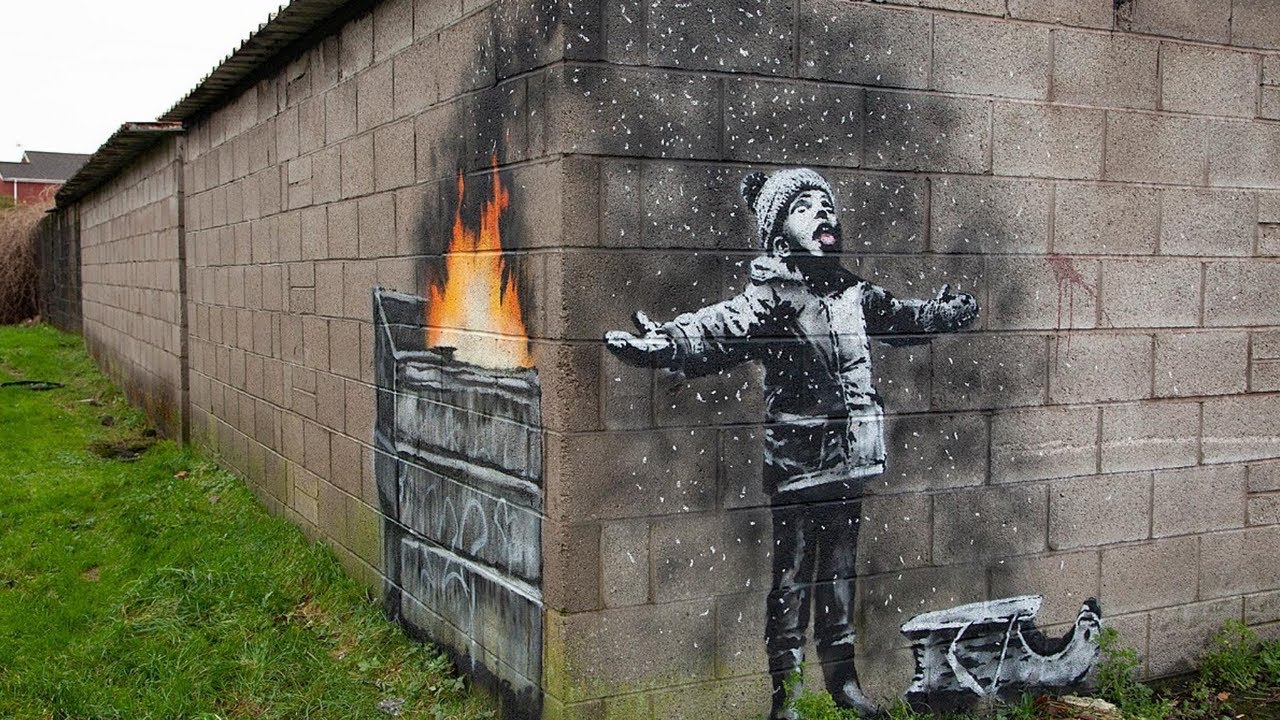
Banksy sits at the uncomfortable intersection where underground art meets institutional validation. He emerged from Bristol’s 1990s graffiti scene, but unlike peers who stayed in the streets or transitioned to galleries, he built a third path. One foot in illegal vandalism. One foot in Sotheby’s auction rooms.
This contradiction defines him more than any single work.
Comparative Positioning
Vs. Blek le Rat: The French pioneer invented stencil street art in the 1980s. His rats came first. Banksy admits the debt but added sharper political bite and faster global distribution. Blek worked in poetic whispers. Banksy shouts.

Vs. Shepard Fairey: Both use stencils and repetition. Fairey’s “OBEY” campaign and Obama “Hope” poster made him a brand. But Fairey embraced commercial work openly. Banksy maintains the illegal-artist facade while selling work for millions. The difference? Fairey’s transparency versus Banksy’s strategic opacity.

Vs. Jean-Michel Basquiat: Both used urban surfaces and anti-establishment messaging. Basquiat moved from SAMO tags to gallery paintings, never hiding his identity. He painted with raw, gestural energy. Banksy cuts templates with precision. Basquiat exploded with expressionism. Banksy operates with calculated restraint.
Technical Distinctions
Edge quality: Banksy’s stencils produce hard-edge graphics. No drips. No gestural marks. Compare this to traditional graffiti’s fluid letterforms or Basquiat’s expressive brushwork.
Tonal range: Limited. Usually black spray paint on light surfaces or white on dark. Occasional red (heart balloons, blood). No complex color harmony or gradient work.
Canvas aspect ratios: When working on traditional supports, favors horizontal formats for narrative compositions. Street work adapts to whatever surface appears, building facades, bridges, walls.
Stroke vocabulary: None visible. The stencil erases the hand. This separates him from painters who celebrate touch and gesture.
Materials, Techniques, and Process
Support Selection
Urban surfaces: Concrete walls, brick facades, building sides, bridge abutments. Prioritizes high-visibility locations over aesthetic surface quality.
Traditional supports: Canvas (cotton, occasionally linen), wood panels for studio works. Uses stretched canvas for major paintings like Devolved Parliament.
Found objects: Incorporates existing street furniture. Fire hydrants become part of compositions. Road signs get stenciled additions.
Grounds and Preparation
For street work: none. Sprays directly onto whatever surface exists.
For studio paintings: standard acrylic gesso on canvas. Nothing revolutionary here.
The Stencil Process
Material: Cardboard (early work, disposable), plastic sheets (reusable), acetate.
Cutting: Hand-cut with utility knives or scalpels. Multi-layer stencils for complex images, cutting separate templates for each element.
Bridges: Maintains structural integrity by leaving connecting pieces between isolated shapes. These create the characteristic stencil aesthetic, negative space interrupting positive forms.
Application: Quick bursts from spray paint cans. Holds stencil flat against wall. Applies paint in seconds. Removes template. Moves to next layer.
Speed matters. The technique developed specifically to avoid arrest.
Spray Paint Technique
Distance: 8-12 inches from surface. Closer risks overspray bleeding under stencil edges. Farther loses coverage density.
Pressure: Short bursts, not continuous spray. Prevents pooling and drips.
Color palette: Predominantly black. Occasionally white. Red for emphasis (balloons, blood, roses). Rare use of other colors.
Studio Practice for Oil Paintings
Works like Devolved Parliament show traditional painting skills.
Builds up forms with layered brushwork. Uses atmospheric perspective to create depth. Employs chiaroscuro for dramatic lighting.
But even here, the imagery often derives from stenciled figures or photos, then painted in oils. The conceptual approach remains graphic design thinking rather than painting styles rooted in observation.
Installation Work
Dismaland (2015) and The Walled Off Hotel (2017) expanded beyond flat surfaces.
Used construction crews to build environments. Incorporated animatronics, found objects, architectural interventions. These projects blur lines between street art, installation, and performance.
Themes, Subjects, and Iconography
Anti-Authoritarianism
Policemen appear constantly. Kissing. Frisking Dorothy from Oz. Snorting cocaine. Each image undercuts authority through absurdity.
The message: those who enforce rules are hypocrites.
Capitalism Critique

Fake currency with Princess Diana’s face instead of the Queen. “I Can’t Believe You Morons Actually Buy This Shit” printed on canvas, then sold at auction.
Shopping bags say “I Shop Therefore I Am.”
The contradiction? He profits massively from this critique. Acknowledged but never resolved.
War and Militarism

Flower thrower hurls a bouquet instead of a molotov cocktail. Peace signs made from military aircraft.
West Bank barrier paintings showing children escaping through imagined holes to tropical beaches.
Childhood Innocence vs. Reality
Girl reaching for (or releasing) heart-shaped balloon. Children playing with bombs.
Boy checking military officer’s bag at checkpoint.
Recurring motif: kids encountering adult world’s violence and corruption.
Surveillance State
“One Nation Under CCTV” painted in view of security cameras. Repeated images of surveillance equipment turned into art.
Animal Symbolism
Rats: “The only free animals in the city.” Appear parachuting, painting, holding signs. Represent the artist himself, operating in margins, unwanted but everywhere.
Chimpanzees: Stand in for politicians in Devolved Parliament. Suggest primal behavior beneath civilized facades. Reference earlier work “Laugh Now, but one day we’ll be in charge.”
Compositional Schemes
Simple, graphic layouts. Usually asymmetric.
Often uses negative shape strategically, letting wall color or texture become part of composition.
Figures typically in profile or three-quarter view, never straight-on. Creates narrative directionality.
Notable Works
Girl with Balloon (2002-present)

Medium: Multiple versions – original stencil mural, screenprints, spray paint on canvas
Size: Varies by version – screenprints typically 70 x 50 cm
Current locations: Original Shoreditch version removed and sold. Waterloo Bridge version painted over. Multiple prints in private collections.
Visual signature: Black silhouette of young girl reaching toward red heart-shaped balloon. Wind blows her hair and dress. Balloon floats just beyond reach. Sometimes accompanied by text “There is Always Hope.”
Why it matters: Voted UK’s favorite artwork in 2017 poll. The 2018 Sotheby’s incident, where a framed version self-destructed via hidden shredder immediately after selling for £1.04 million, created art history’s first work created during live auction. Retitled “Love Is in the Bin,” later resold for £18 million in 2021.
Interpretation ambiguity: Unclear whether girl releases balloon or tries catching it. Represents either loss of innocence or enduring hope.
Related works: Syrian refugee version (2014) with headscarf added. Brexit version (2017) with Union Jack balloon.
Devolved Parliament (2009, reworked 2019)

Medium: Oil on canvas
Size: 2.5 x 4.2 meters (8 ft 2 in x 13 ft 9 in)
Current location: Private collection (sold at auction)
Visual signature: Realistic depiction of House of Commons interior. Every seat occupied by chimpanzees instead of MPs. Detailed architectural rendering with ornate moldings, green benches, gothic windows. Chimpanzees in various poses – debating, gesturing, holding bananas.
Why it matters: Largest known Banksy canvas. Originally titled “Question Time” for 2009 Bristol Museum show. Reworked and retitled for Brexit Day, March 29, 2019. Sold at Sotheby’s London for £9.9 million ($12.2 million) in October 2019, setting artist’s auction record. The timing, one year after Girl with Balloon shredding incident, created perfect narrative symmetry.
Political context: Direct satire of British parliamentary dysfunction. Premiered as Brexit negotiations descended into chaos. Chimpanzee motif echoes 2002 work “Laugh Now” which showed apes wearing aprons with text “Laugh now, but one day we’ll be in charge.”
Technical notes: Demonstrates oil painting skills often overlooked in discussions of his stencil work. Uses traditional techniques including gradation, perspective, and careful attention to architectural detail.
Love Is in the Bin (2018)

Medium: Spray paint on canvas, half-shredded, in artist-modified frame
Size: 101 x 78 cm (original), extended by shredding
Current location: Private collection
Visual signature: Upper half shows Girl with Balloon image intact. Lower half shredded into vertical strips hanging below frame. Industrial paper shredder built into bottom of ornate frame.
Why it matters: Created during live Sotheby’s auction on October 5, 2018. Moments after hammer fell at £1.04 million, hidden mechanism activated. Stunned auction room watched canvas shred itself. Banksy posted video on Instagram: “Going, going, gone…” Later revealed shredder malfunctioned, intended to destroy entire piece. Pest Control authenticated the “new” work. Collector proceeded with purchase. Resold October 2021 for £18 million, nearly 20x the original price.

Cultural impact: Generated global headlines. Raised questions about authenticity, value, performance. Did the stunt increase value by making piece more famous? Or decrease it by partial destruction? Market answered: massive increase.
Conceptual significance: Ultimate critique of art market from inside the system. Created art history’s first work born during auction. Impossible to separate the performance from the object.
Flower Thrower (2003)

Medium: Stencil, spray paint on wall
Size: Life-sized figure
Original location: Garage wall, Beit Sahour, near Bethlehem, West Bank
Visual signature: Masked figure in throwing stance, arm cocked back. Instead of rock or molotov cocktail, hurls bouquet of colorful flowers. Black silhouette figure, multi-color flower stencil creates contrast. Dynamic diagonal composition suggests violent action subverted by peaceful object.
Why it matters: Perfectly encapsulates Banksy’s approach. Violence transformed to beauty. Protest becomes peace offering. Image reproduced globally on t-shirts, posters, tattoos. Became shorthand for non-violent resistance.
Technical execution: Multi-layer stencil. Black layer for figure. Separate layers for flower colors. Demonstrates how stencil technique can create complex color relationships while maintaining speed of execution.
Related works: Part of nine-piece series on West Bank barrier (2005). Other pieces included children floating with balloons over wall, ladder against wall, window view to tropical paradise.
Napalm (1994-2004)

Medium: Screenprint editions
Visual signature: Recreates iconic Vietnam War photograph of naked girl fleeing napalm strike. Flanked by Mickey Mouse and Ronald McDonald holding her hands. All three figures run toward viewer. High contrast black and white photography style.
Why it matters: Controversial image mixing historical tragedy with corporate mascots. Critiques American cultural imperialism, commercialization of trauma, corporate complicity in violence. Limited edition prints highly sought by collectors.
Legal complications: Use of copyrighted corporate characters created potential legal issues. Demonstrates Banksy’s willingness to appropriate and remix protected imagery for satirical purposes.
Exhibitions, Collections, and Provenance Highlights
Major Solo Exhibitions

Turf War (2003, London) Warehouse show featuring live painted animals (declared humane by RSPCA despite protests). Mixed paintings, sculptures, installations. First large-scale London exhibition announcing arrival as major figure.
Crude Oils (2005, London) Remixed masterworks by Monet, Van Gogh, Warhol. Added riot police, shopping carts, traffic cones to classical paintings. Showed ability to work across art historical references.
Barely Legal (2006, Los Angeles) “Three-day vandalised warehouse extravaganza.” Featured live elephant painted with pink and gold floral wallpaper pattern. Drew celebrity attendance including Brad Pitt, Angelina Jolie. Marked US breakthrough moment.
Village Pet Store and Charcoal Grill (2008, New York) Animatronic sculptures. Mother hen watching Chicken McNuggets peck barbecue sauce packet. Rabbit applying makeup. Fish fingers swimming in bowls. Critique of consumer culture and industrial food production packaged as quirky pet shop.
Banksy vs Bristol Museum (2009, Bristol) Summer residency taking over entire Bristol Museum. 100+ works, 78 previously unseen. Mixed original pieces with interventions in permanent collection. Placed rat specimens in natural history displays. Fish fingers in aquarium tanks. Attracted 300,000 visitors, one of 2009’s most-visited exhibitions globally.
Better Out Than In (October 2013, New York) Month-long street residency. New piece daily, announced via website. Included controversial works like “The Sirens of the Lambs,” a truck full of stuffed animals circling meatpacking district. Day 13: sold original signed canvases for $60 from street vendor stand in Central Park. Only 8 pieces sold. Authenticated later on website. One piece resold at Bonhams in 2014 for £56,250.
Dismaland (August-September 2015, Weston-super-Mare) “Bemusement park unsuitable for children.” Five-week temporary installation in abandoned seaside lido. 58 artists including Damien Hirst, Jenny Holzer, Jimmy Cauty. 10 new Banksy works. Crashed Cinderella carriage surrounded by paparazzi. Grim reaper on bumper cars. Deliberately rude staff. 150,000 visitors. £3 admission. Generated £20 million for local economy. After closing, materials donated to build refugee shelters in Calais.
The Walled Off Hotel (March 2017-present, Bethlehem) Boutique hotel overlooking West Bank barrier. “The worst view in the world.” 10 rooms, museum, gallery. Features 20+ original Banksy works. Gallery space for Palestinian artists. Permanent installation, still operating. Combines accommodation, art exhibition, political statement.
Gross Domestic Product (October 2019, Croydon) Pop-up shop selling merchandise featuring Banksy imagery. Created to defend trademark registrations. Items included house brick handbags, welcome mats, homeware. Stormzy’s custom stab vest from 2019 Glastonbury performance. Designed to prove active commercial use of trademarks without selling through traditional art market channels.
CUT & RUN (June-August 2023, Glasgow) First major solo museum show in 14 years. Gallery of Modern Art. Retrospective featuring stencils, original templates, prints. Emphasized materiality and technique. Showed actual cut cardboard and acetate stencils used for famous works.
Museums with Depth
Bristol Museum: Partnership since 2009 exhibition. Occasional displays of works.
Tate Britain: Acquired pieces through private donations. Not officially collected but present in collection.
Most Banksy pieces remain in private collections. Major collectors prefer anonymity.
Provenance Patterns
Street removals: Building owners removing sections of walls with Banksy pieces. Mobile Lovers (2014) in Bristol cut from wall, created ownership dispute between building owner and city. Eventually auctioned for £403,000.
Authentication crisis: Pest Control Office, established by Banksy, issues Certificates of Authenticity. Only recognized verification system. Refuses to authenticate street pieces removed from original locations. Creates complex secondary market dynamics.
Forgery prevalence: Massive market for fakes. Unauthorized exhibitions touring globally. Pest Control actively combats fraudulent works.
Notable Sales
- Devolved Parliament: £9.9 million (Sotheby’s, 2019)
- Love Is in the Bin: £18 million (Sotheby’s, 2021)
- Girl with Balloon screenprints: £500,000+ for rare color variants
- Keep It Spotless (Damien Hirst collaboration): $1.9 million (2008)
Market & Reception
Auction Records & Price Bands
Peak prices: £18 million (Love Is in the Bin), £9.9 million (Devolved Parliament)
Screenprints: £100,000-£500,000 depending on edition, rarity, color variant
Canvases: £200,000-£2 million for smaller original spray paint works
Street pieces (removed): £400,000-£1 million depending on size, iconography, condition
Price trajectory only moves upward. Market appetite seems limitless despite high supply through print editions.
Authentication & Forgery
The Pest Control problem: Only authority that matters. No certificate, no sale at major auction houses. But Pest Control refuses to authenticate removed street works, creating gray market.
Signature variants: Early works often unsigned. Later prints signed and numbered. Some street works tagged with small “Banksy” mark. Inconsistent signing practices complicate authentication.
Forgery epidemic: Fake screenprints flood online markets. Unauthorized exhibitions tour globally displaying reproductions. Some collectors knowingly buy fakes as affordable alternatives to authenticated works.
Copyright battles: Banksy lost EU trademark registrations (2020-2021) because he refused to reveal identity to defend them. Court ruled applications made in bad faith. Created vulnerability for commercial use of imagery.
Condition Patterns
Street work degradation: Weather, vandalism, paint-overs destroy original works within months or years. Very few early street pieces survive.
Removed sections: Walls cut from buildings often show deterioration at edges. Concrete backs heavy, expensive to display.
Print condition: Screenprints on quality paper maintain condition well. Light exposure main concern for colors.
Canvas works: Standard contemporary painting condition issues. No unique technical problems.
Critical Reception
Divide: Art establishment often dismisses work as shallow, derivative. Critics cite borrowed techniques (Blek le Rat’s stencils), obvious messages, celebrity appeal.
Popular embrace: Public loves him. UK poll ranked Girl with Balloon as favorite artwork over Turner, Constable. Massive social media following.
Street art legitimization: Whether critics approve or not, Banksy opened museum doors for street artists. Paved commercial path for urban art movement.
The authenticity question: Does anonymous artist critiquing capitalism while selling work for millions represent ultimate hypocrisy or brilliant meta-commentary? Depends who you ask.
Influence & Legacy
Who Influenced Him (Upstream)
Blek le Rat: French pioneer of stencil graffiti. Created rat imagery in 1980s. Banksy openly acknowledges debt. The technical foundation comes directly from Blek’s innovations.
3D (Robert Del Naja): Massive Attack member, graffiti artist in 1980s Bristol. Part of same underground scene. Speculation about collaboration or shared identity persists.
Bristol Underground Scene: DryBreadZ Crew, Nick Walker, Inkie. The collaborative environment that shaped his early work. Bristol’s particular mix of music culture (trip-hop) and street art created unique aesthetic.
Situationism: Guy Debord’s theories about spectacle. Culture jamming tactics. Détournement of commercial imagery. Banksy’s interventions mirror situationist strategies even if never explicitly acknowledged.
Pop Art: Warhol’s repetition, commercial techniques, celebrity engagement. The precedent for fine art using mechanical reproduction.
Who He Influenced (Downstream)
Mr. Brainwash (Thierry Guetta): Subject of Exit Through the Gift Shop. Adopted Banksy’s techniques, aesthetic, even marketing strategies. Debate continues whether real artist or elaborate prank.
Alec Monopoly: Adapted stencil techniques, corporate mascot imagery. Built career directly in Banksy’s wake.
Mainstream street art acceptance: Galleries worldwide now show urban art. Cities commission murals. What was vandalism became sanctioned public art. Banksy’s market success opened these doors.
Instagram street art culture: Documenting illegal work for social media followers. Turning temporary interventions into permanent digital records. Banksy didn’t invent this but perfected it as strategy.
Political art accessibility: Showed that overtly political art could reach mass audience without dumbing down message. Made activism visually appealing.
Cross-Domain Echoes
Film: Exit Through the Gift Shop (2010) nominated for Academy Award. Documentary about street art, art market, authenticity. Or mockumentary about those same subjects. The ambiguity is intentional.
Music: Album art for Blur’s Think Tank (2003). Visual identity work for bands. Influence on music video aesthetics.
Fashion: Unauthorized reproductions on streetwear. Official merchandise through Gross Domestic Product. Supreme collaborations (complicated relationship).
Graphic design: Stencil aesthetic adopted by designers worldwide. Political poster style influenced by his approach to imagery and text.
Activism: Raised profile for Palestinian cause through West Bank works. Walled Off Hotel. Syrian refugee campaign. Environmental messaging. Art as activist tool.
The “Banksy Effect”
Term for how his presence in neighborhood raises property values, attracts tourism, changes local economy. Gentrification accelerator. The irony: anti-capitalist artist becomes economic catalyst.
Also: phenomenon where any urban intervention gets attributed to him. Creates false market for fake works.
How to Recognize a Banksy at a Glance

Stencil precision: Clean, hard edges. No drips. No overspray. Multi-layer stencils for complex images.
Limited palette: Predominantly black spray paint. Occasional red for symbolic elements (hearts, blood). Rare use of other colors.
Rats: If there’s a stenciled rat, consider Banksy. Not guaranteed (he popularized technique others copied), but strong indicator.
Political/satirical content: Direct message. No abstract exploration. Clear narrative or joke.
Child figures: Often includes children in scenarios contrasting innocence with adult world (war, surveillance, consumerism).
Uniform spray application: Even tone across stenciled areas. Professional execution.
Urban context: Appears in public spaces, not commissioned. Location often enhances meaning (West Bank barrier, bridges, contested spaces).
No visible brushstrokes: Exception for oil paintings like Devolved Parliament. Street work shows zero hand gesture.
Instagram documentation: If real, Banksy usually posts on official account within days. No post, probably not authentic (though he doesn’t document everything).
Pest Control certification: For works entering market, only legitimate authentication. No certificate means either fake or Banksy refuses to verify (common for removed street pieces).
Typical dimensions: Screenprints often 70 x 50 cm. Life-size figures in street work. Paintings range widely but Devolved Parliament’s 2.5 x 4.2 meters represents upper limit.
Signature placement: When signed, usually bottom right corner. Small, simple “Banksy” in marker or spray paint. Many pieces unsigned.
Found object integration: Uses existing elements (fire hydrants, signs) as compositional components. Doesn’t just cover surface, interacts with it.
Speed-optimized design: Everything about technique prioritizes fast execution. No unnecessary complexity. Each element serves message.
The identity stays hidden. The work keeps appearing. And the market keeps buying what it claims to critique.
That’s the Banksy paradox, and it’s never getting resolved.
FAQ on Banksy
Who is Banksy?
Banksy is an anonymous British street artist from Bristol who creates politically charged stencil graffiti. His identity remains unconfirmed despite speculation about names like Robin Gunningham or Robert Banks. He emerged from Bristol’s underground scene in the 1990s and now creates urban art, installations, and oil paintings worldwide while maintaining complete anonymity.
What is Banksy famous for?
Girl with Balloon, voted the UK’s favorite artwork, and Devolved Parliament, which sold for £9.9 million. His self-destructing painting at Sotheby’s made headlines globally. The stencil technique, anti-establishment messaging, and works on the West Bank barrier established him as contemporary art’s most recognized anonymous artist.
Why does Banksy hide his identity?
Anonymity protects him from arrest since graffiti remains illegal. As he stated, you can’t be a street artist and go public simultaneously. The mystery also amplifies his cultural impact, turning each new piece into a global guessing game. His parents reportedly still think he’s a painter and decorator.
What techniques does Banksy use?
Multi-layered stencils cut from cardboard or plastic, applied with spray paint in seconds. He developed this approach around 2000 after hiding from police under a garbage truck and noticing stenciled numbers. For studio works like Devolved Parliament, he uses traditional oil painting techniques alongside his signature stencil aesthetic.
Where can you see Banksy’s art?
Street pieces appear globally but most get painted over or removed within months. The Walled Off Hotel in Bethlehem displays permanent works. Bristol Museum occasionally exhibits pieces. Major auction houses sell authenticated prints and canvases. However, unauthorized touring exhibitions showing reproductions operate worldwide without his approval.
How much is Banksy’s art worth?
Love Is in the Bin sold for £18 million in 2021. Devolved Parliament reached £9.9 million in 2019. Signed screenprints range from £100,000 to £500,000 depending on rarity and color variant. Street pieces removed from walls sell for £400,000 to £1 million. Pest Control authentication significantly impacts value.
What is Banksy’s most expensive artwork?
Love Is in the Bin holds the record at £18 million, sold at Sotheby’s in October 2021. This was the Girl with Balloon canvas that partially shredded itself during the 2018 auction. Devolved Parliament previously held the record at £9.9 million before the shredded piece resold for nearly double.
What is the Banksy Effect?
The economic and cultural phenomenon where his work transforms neighborhoods, raising property values and attracting tourism. Also refers to how he legitimized street art commercially, opening gallery doors for urban artists. The term captures the irony of an anti-capitalist artist becoming a gentrification catalyst and economic driver.
How do you authenticate a Banksy?
Only Pest Control Office, established by the artist, issues legitimate Certificates of Authenticity. They refuse to authenticate street pieces removed from original locations. Without certification, major auction houses won’t accept works. This creates problems for building owners who remove walls with his art, as Pest Control considers removal theft.
What is Dismaland?
Banksy’s 2015 temporary “bemusement park” in Weston-super-Mare, England. A dystopian parody of Disneyland featuring 58 artists, crashed Cinderella carriage, grim reaper bumper cars, and deliberately rude staff. Ran five weeks, drew 150,000 visitors at £3 admission. After closing, materials were donated to build refugee shelters in Calais.
Conclusion
Banksy weaponized invisibility to become the world’s most famous anonymous artist. His stencil art transformed graffiti from subway vandalism into auction house spectacle, selling works for millions while maintaining the illegal street artist facade.
The contradiction never resolves. Anti-capitalist messages sell at Sotheby’s. Critique of consumerism becomes merchandise. Protest art hangs in private collections.
But maybe that’s the point. The West Bank barrier pieces, Dismaland’s dystopian carnival, and The Walled Off Hotel prove his political activism extends beyond spray paint and clever slogans.
His influence on contemporary street art remains undeniable. He opened museum doors, legitimized urban art, and showed that satirical social commentary could reach mass audiences without compromising message.
The identity stays hidden. The work keeps appearing. And somehow, that mystery amplifies every piece.