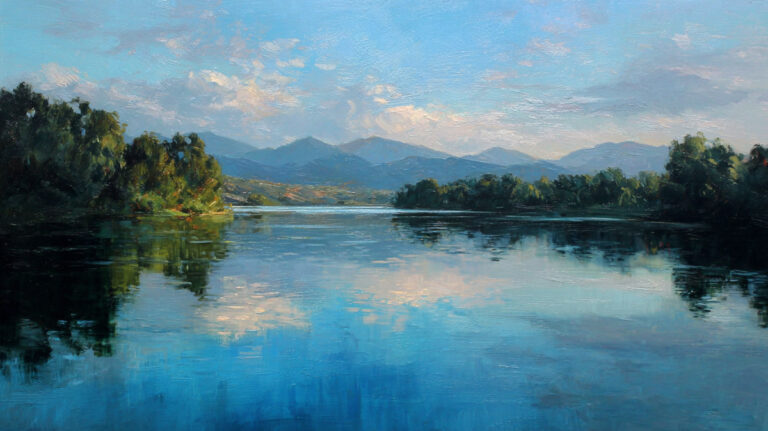
Most paintings you’ve seen in museums weren’t made in a studio. They started outside, with an artist standing in front of the actual scene, racing to get the light down before it shifted. That practice has a name: en plein air painting.
The French term translates to “in the open air,” and the method goes back centuries. But it picked up real momentum in the 1800s when portable paint tubes and folding easels made outdoor oil painting practical for the first time.
This guide covers what plein air painting actually involves, where it came from, how it connects to Impressionism, what equipment painters use in the field, and why so many artists still choose to paint from life instead of working from photographs.
What Is En Plein Air Painting

En plein air painting is the practice of painting outdoors, directly in front of the subject being depicted. The French term translates literally to “in the open air.”
This is not just setting up a canvas outside. The whole point is responding to a specific scene’s conditions as they shift, capturing natural light, weather, and atmosphere in real time. Studio work, by comparison, relies on sketches, photographs, or memory. Plein air demands direct observation.
Before portable paint tubes existed, most painters mixed pigments with linseed oil in small amounts and stored extras in pig bladders tied with string. It was messy. Colors dried out. The logistics alone kept serious oil painting tethered to the studio for centuries.
Then John Goffe Rand patented the collapsible tin paint tube in 1841. According to the Smithsonian’s Archives of American Art, Rand’s invention let unused paint be stored and reused without drying out. Pierre-Auguste Renoir reportedly said that without paints in tubes, there would have been no Cezanne, no Monet, no Sisley or Pissarro.
That small invention cracked everything open.
P&S Intelligence reports the U.S. art supplies market hit $3.7 billion in 2024, with painting supplies accounting for 65% of that figure. The interest in outdoor painting is part of that larger growth story. Plein air specifically is seeing increased participation through organized events, workshops, and conventions across North America and Europe.
What Separates Plein Air From Painting Outdoors Casually

There’s a difference between bringing a sketchbook to a park bench and doing real plein air work.
Intent matters. Plein air painters commit to a specific light condition, typically within the first 20 minutes of arriving at a location. They lock in their value structure and stick with it, even as the sun moves. The goal is a finished (or near-finished) painting completed on site, not a preliminary study.
Most sessions last between 2 and 3 hours. After that, the light has changed too much.
Working wet-on-wet (alla prima) is common because there’s no time for layers to dry between sessions. The painting has to come together fast, which forces a kind of confident brushwork that’s hard to fake.
Origins of En Plein Air Painting

Outdoor painting didn’t begin with the Impressionists, even though most people assume it did.
Landscape sketching outdoors goes back to the 17th century. Claude Lorrain made detailed drawings from nature in the Roman countryside. Pierre-Henri de Valenciennes, a French academician, pushed the practice further in the late 1700s. He produced small oil sketches outdoors and even wrote a treatise arguing that landscape painters should study nature directly.
But those were studies. Preparatory work. Nobody was finishing paintings outside.
The Barbizon School

The shift happened in the 1830s and 1840s with the Barbizon School, a group of French painters who set up in the village of Barbizon near the Forest of Fontainebleau.
Theodore Rousseau and Jean-Francois Millet painted directly from nature, though they still typically finished major works in the studio. What changed was attitude. These painters rejected the classical approach of composing idealized landscapes from imagination. They wanted what was actually in front of them.
According to The Metropolitan Museum of Art, the Barbizon painters set up their easels in the Fontainebleau Forest and extended their commitment to close observation and naturalistic representation. Their work laid the groundwork for everything that followed.
The Technology That Made It Possible
Two practical inventions made sustained outdoor painting realistic:
- Collapsible paint tubes (1841): Rand’s tin tubes replaced pig bladders and glass syringes. Squeeze, paint, cap, done.
- Portable easels: The French box easel (or half-box easel) combined an easel, palette, and paint storage into one carry-able unit.
The Linda Hall Library notes that portable easels and paint boxes were likely just as important as the paint tube in allowing painters access to the countryside. The combination of both technologies, not one alone, made plein air a viable regular practice rather than an occasional experiment.
The Impressionists and En Plein Air

Impressionism and plein air painting are so tightly connected that people often treat them as the same thing. They’re not. But one couldn’t have existed without the other.
Claude Monet was introduced to outdoor painting by Eugene Boudin on the Normandy coast around 1858. That experience changed everything for him. Monet later said his only merit was “having painted directly in front of nature, seeking to render my impressions of the most fleeting effects.”
By the 1870s, Monet, Paul Cezanne, Camille Pissarro, and Alfred Sisley were all working outdoors regularly. Their focus on changing light conditions, broken brushwork, and color over drawing came directly from what they observed outside, not from theory.
The name “Impressionism” itself came from Monet’s 1872 painting Impression, Sunrise, shown at the first independent Impressionist exhibition in 1874. A critic used the title as an insult. The painters kept it.
| Feature | Technical Logic | Plein Air Approach | Academic Studio Approach |
| Light Source | Consistency vs. Flux: Managing the “Life Span” of a shadow. | Natural / Changing: The “Sun Dial” effect; shadows move every 15 minutes. | Controlled / Artificial: North-facing windows or consistent “Cool” LEDs. |
| Brushwork | Optical Shorthand: Using economy of mark to capture time. | Loose / Gestural: High-energy, visible strokes to capture a “Moment.” | Smooth / Blended: Meticulous “Licking” of the paint to erase brush marks. |
| Palette | Chromatic Response: Dealing with high-UV environments vs. neutral interiors. | Limited / High-Key: Prioritizes “Temperature” and vibrating light. | Full / Tonal: Utilizes darker grounds and a wider range of “Earth” values. |
| Completion | Execution Velocity: Determining the “Archive” vs. the “Impression.” | Alla Prima: “All at once” while the paint is wet and light is active. | Layered / Indirect: Built over weeks using glazes, scumbles, and “Dead Layers.” |
Monet’s Serial Paintings as Plein Air Studies
Monet took outdoor painting to a systematic extreme that nobody expected.
He painted the same subject repeatedly under different light conditions. The Haystacks series (1890-91), the Rouen Cathedral paintings (1892-94), and over 250 Water Lilies canvases in the last decades of his life, according to Sotheby’s. He would work on multiple canvases simultaneously during a single session, switching between them as the light shifted.
This wasn’t spontaneous. It was methodical. He rented an apartment across from Rouen Cathedral specifically to capture the facade at different times of day. He wrote daily instructions to his gardener at Giverny detailing precise layouts for plantings so he could control exactly what he’d paint.
Monet produced nearly 2,000 catalogued paintings over his career, according to art historian Daniel Wildenstein. The majority of those started outdoors. That volume alone proves plein air was not a casual hobby for him. It was the whole method.
How En Plein Air Painting Differs from Studio Work

The differences go beyond “one is outside and one is inside.” Every aspect of the painting process changes when you leave the studio.
Time Pressure
Studio painters can work on a single piece for weeks. Plein air painters typically have a window of 2 to 3 hours before the light shifts enough to make the original composition inaccurate.
That pressure forces decisions. You can’t second-guess every color mix or fiddle with edges. The painting either comes together fast or it doesn’t come together at all.
Color and Value Decisions

In a studio, you control the light. A north-facing window gives consistent, cool illumination all day. You can set up a still life and come back to it tomorrow with nearly identical conditions.
Outside? Forget it. The color temperature of sunlight shifts constantly. Warm morning light produces cool blue-violet shadows. Overcast skies flatten values. A passing cloud can change the entire contrast pattern of a scene in seconds.
Plein air painters learn to read these shifts quickly. That skill, reading color temperature under natural conditions, is the single biggest thing studio painters struggle with when they first go outside.
Scale and Materials
Typical plein air panel sizes: 6×8 inches, 8×10 inches, 9×12 inches, occasionally 12×16 inches. Anything bigger becomes impractical to carry, set up, and transport while wet.
Studio canvases: No size limit. Monet’s later Water Lilies panels measured over 6 feet wide.
Most plein air painters work with a limited palette of 5 to 8 colors maximum. Fewer tubes means less weight, faster setup, and (this part is actually tricky) better color harmony because everything is mixed from the same base pigments.
Materials and Equipment for En Plein Air Painting

You can spend hundreds on a full plein air setup, or you can grab a panel, a few tubes of paint, and a cardboard palette. Both approaches work. But certain gear has become standard for good reasons.
Easels and Pochade Boxes
Pochade boxes are the most popular choice for serious plein air painters. These compact units hold a palette, wet panels, and paint all in one case. The Guerrilla Painter, Open Box M, and En Plein Air Pro are the three names you’ll hear most often.
The French half-box easel (the Julian-style) is the traditional option. It’s bulkier, with telescoping legs and a built-in drawer for supplies. Heavy to carry on a long hike, but stable in wind. Some painters still prefer them to any pochade box because the setup feels more like a real studio.
An industry resource on types of painting easels can help compare field easels with studio options side by side.
Paint and Medium Choices
Oil paint remains the most common medium for plein air work. Slow drying time gives painters the flexibility to push color around on the panel for the full session. Alla prima (wet-on-wet) technique depends on this.
Watercolor is the lightest option. No solvents, no mediums, minimal cleanup. But watercolor is less forgiving. You can’t easily paint over a mistake the way you can with oils.
Gouache has been gaining popularity in plein air circles because it dries fast, is opaque (unlike watercolor), and travels light. Several contemporary plein air painters now use gouache for quick color studies before committing to a larger oil painting.
| Medium | Technical Logic | Dry Time | Forgiving? | Best For |
| Oil | Oxidative Drying: Allows for “wet-in-wet” blending for hours. | Hours / Days | Very: Easy to scrape off or blend out. | Extended sessions, subtle atmospheric gradients. |
| Watercolor | Evaporative Drying: Uses the paper’s “white” for the highest key. | Minutes | Less: Hard to correct once a dark wash is set. | Quick studies, travel, capturing fleeting light. |
| Gouache | Re-soluble Matte: Opaque like oil but dries fast like watercolor. | Minutes | Moderate: Can be reactivated with water. | Color studies, flat graphic shapes, sketches. |
| Acrylic | Polymerization: Dries to a permanent plastic film. | Minutes | Moderate: Must be layered; cannot be reactivated. | Fast work in high-heat or windy conditions. |
When comparing different painting mediums, oils give you the most working time outside. That matters more than you’d think when you’re fighting changing light.
Practical Accessories
A few things that seem minor until you’ve stood in a field for two hours without them:
- Umbrella: Not for rain. For blocking glare on your panel so you can actually see your colors accurately.
- Viewfinder: A simple cardboard frame that helps isolate your composition from the chaos of a full 360-degree landscape.
- Wet panel carrier: Two panels face each other with spacers between them. Without this, your wet painting gets smeared on the walk back to the car.
Techniques Used in En Plein Air Painting

Plein air technique is about speed and accuracy under pressure. The methods differ enough from studio practice that many painters describe going outside for the first time as feeling like they’re starting over.
Blocking In and Value Structure
The first move is almost always blocking in large shapes with broad strokes. No details. Just big masses of dark, middle, and light value.
Squinting helps. It sounds ridiculous until you try it. Squinting eliminates detail and reduces the scene to its basic value relationships, exactly what you need to get down first.
Many painters start with a notan study before touching their main panel. A notan is a small thumbnail (often 2×3 inches) done in just two or three values. It takes 5 minutes and saves you from committing to a bad composition on your actual painting.
Dealing with Changing Light
This is the biggest challenge, and honestly the part that separates experienced plein air painters from beginners.
The rule: Commit to the light from the first 20 minutes. After that, don’t chase it. The shadows will move. The tonal relationships will shift. If you keep adjusting to match what you see “right now,” the painting will look confused because no single moment is represented accurately.
Experienced painters solve this by working in consistent time blocks. Early morning, midday, and the golden hour before sunset each offer predictable, repeatable conditions. Some painters return to the same spot at the same time across multiple days to finish a single piece.
Monet did exactly this with his series paintings. He’d set up six or eight canvases and rotate between them as the light changed. Each canvas captured a specific 30 to 45-minute window of illumination.
Color Temperature and Edge Control

Warm light produces cool shadows. Cool light produces warm shadows. That relationship holds true across nearly every outdoor lighting situation, and getting it wrong is the fastest way to make a plein air painting look “off.”
Understanding complementary color relationships is critical here. A warm orange sunset will push shadows toward blue-violet. A cool overcast sky shifts everything toward muted, neutral tones with warmer reflected light in the shadows.
Edges work differently outdoors too. Studio painters often sharpen every edge. Plein air painters keep most edges soft, losing them into the atmosphere. A hard edge draws the eye, so you save those for your focal point. Everything else gets softer.
This approach connects to atmospheric perspective, where objects in the distance appear lighter, bluer, and less defined. It’s physics, not style. And it’s one of those things that’s easier to observe outdoors than to fake in a studio.
En Plein Air Painting Today

Eric Rhoads, publisher of PleinAir Magazine, has called plein air painting “the largest movement in art history.” That’s a big claim. But the numbers back it up.
Plein Air Easton in Maryland selects 58 juried artists each year for what’s become the largest juried plein air competition in the United States. The Plein Air Convention and Expo (PACE), organized by Streamline Publishing, draws hundreds of painters annually and reported a record number of non-painting guests in 2025.
Dozens of festivals now run across North America every month. The Wayne Art Center Plein Air Festival offers over $20,000 in cash awards. The North Carolina Plein Air Art Festival in New Bern showcases 35 nationally acclaimed artists across an eight-day event. Red Wing Arts in Minnesota is celebrating its 20th annual plein air event in 2026, with over 1,000 paintings created of the town since the event began.
Organized Events and Competitions
Major competitions: Laguna Beach Plein Air Painting Invitational, Easton Plein Air, Door County Plein Air Festival, and the Eagle Plein Air Festival (which brings together over 80 artists in Southwest Idaho).
Convention circuit: The PACE convention runs for five days and includes demos, workshops, and the world’s largest paint-out, where all attendees paint together at iconic locations.
Salon competitions: The PleinAir Salon Online Art Competition awards a $15,000 grand prize and features the winning painting on the cover of PleinAir Magazine.
Online Communities and Instruction

PleinAir Magazine, published by Streamline Publishing, remains the main print and digital resource for outdoor painters. OutdoorPainter.com serves as the companion website with monthly event guides, artist profiles, and technique articles.
Workshop instruction has expanded significantly. Painters like Marc Hanson, Scott Christensen, and Lori Putnam teach multi-day workshops at locations ranging from coastal Maine to the mountains of Colorado. These workshops typically cost between $400 and $1,200 and sell out months in advance.
The U.S. Bureau of Labor Statistics projects overall employment in crafts and fine arts to grow by 6% from 2021 to 2031, according to Fortune Business Insights. That steady demand keeps the workshop pipeline full.
Urban Plein Air as a Growing Subcategory
Cityscapes, street scenes, and architecture have become a significant subcategory of plein air work.
Urban sketching and plein air overlap more than most people realize. Both involve painting or drawing from direct observation on location. The difference, as OutdoorPainter notes, is focus. Plein air painters prioritize light, color saturation, and shape design. Urban sketchers lean more toward storytelling and documenting a moment.
Both communities are growing. And many painters now move between the two freely.
Common Subjects in En Plein Air Painting

Some subjects work better outdoors than others. The practical limits of plein air, limited time, changing light, portability, naturally push painters toward certain subjects.
| Subject | Technical Logic | Why It Works Outdoors | Challenge Level |
| Landscapes | Value Masses: Reliable grouping of earth, sky, and foliage. | Static forms; large, predictable light patterns. | Moderate: Requires managing vast scale and depth. |
| Seascapes | Refractive Dynamics: Light interacting with transparent, moving volumes. | Dramatic light; provides “The Ultimate” value contrast study. | High: Water is never still; requires a “Memorized” light logic. |
| Cityscapes | Structural Rigidity: Clear vanishing points and geometric shadows. | Architectural structure; sharp, readable angles. | Moderate: High detail can lead to “Over-painting” without subordination. |
| Gardens | Chromatic Density: Concentrated areas of high-saturation color. | Contained scenes; manageable depth of field. | Lower: Ideal for focusing on color temperature over complex perspective. |
| Harbors | Mirror Symmetry: Complex reflections and interlocking mechanical shapes. | Dynamic mix of boats, water, and rigid structures. | High: Requires perfect perspective and handling of reflective surfaces. |
Landscapes and Seascapes
These are the traditional bread and butter of plein air work.
Landscapes offer static structures (mountains, trees, fields) that don’t move while the light shifts around them. Painting a landscape outdoors means reading aerial perspective firsthand, watching how distant hills lose saturation and shift toward blue.
Seascapes are harder. Moving water, spray, and rapidly shifting reflections demand fast decision-making. But the payoff is that water painted from life has a quality that’s almost impossible to capture from a photo. The painter Edward Hopper spent summers in Truro, Massachusetts, painting coastal light directly from observation, and his work shows that firsthand connection to the scene.
Urban Subjects and Architecture
Buildings don’t move. That’s the biggest advantage.
Architecture gives plein air painters strong linear perspective lines, clear light and shadow patterns, and a subject that holds still long enough to develop a more detailed painting than a fleeting cloud formation would allow.
Street scenes add figures, vehicles, and movement. Most plein air painters treat people as quick gesture marks rather than detailed portraits, which keeps the focus on the overall scene rather than individual faces.
Gardens and Rural Scenes
Monet painted his Giverny gardens obsessively for good reason. Gardens offer contained compositions with intense color variety packed into a small visual area.
For painters who want to practice color harmony and warm-cool relationships, a garden in full bloom is about as good as it gets. The contained space means less decision-making about what to include and what to leave out compared to a wide-open landscape.
Rural subjects like barns, fences, and farmland have been plein air staples since the Barbizon School. They’re popular because they combine architecture (static) with landscape (atmospheric) in a single composition.
Why Painters Choose En Plein Air Over Photographs
Cameras lie. Not on purpose, but they do. And painters who work from life know exactly where the distortions happen.
Dynamic Range and Color Accuracy
Cambridge in Colour estimates the human eye can perceive anywhere from 10 to 14 f-stops of dynamic range at any given moment. With the eye’s ability to adjust across a scene, that range extends far beyond what cameras capture in a single exposure.
Most digital cameras top out around 14-15 stops, according to photography researcher James Lorentson. But here’s the thing: our eyes dynamically adjust as we scan a scene, dedicating their full range to each area. The brain then composites all of it into one seamless perception.
A camera freezes a single moment with fixed settings. That means blown-out highlights in the sky or crushed shadows in the foreground, or both. A painter standing in the same spot sees detail in both areas simultaneously and can paint what they actually perceive.
Depth Perception and Spatial Information
A photograph is flat. Two eyes give you stereoscopic vision, depth cues, and peripheral awareness that no lens replicates.
When you build depth into a painting from life, you’re working with real spatial information. You can feel how far away that tree line is. You sense the gap between the foreground rock and the middle-ground hillside. That physical understanding of space translates into more convincing pictorial space on the canvas.
Painting from a photo flattens all of that into a single plane. You’re working from a 2D reference to create a 2D image, and the loss of spatial data shows up as paintings that feel “flat” even when the technique is technically solid.
Sensory Experience and Artistic Decision-Making
Wind. Temperature. Sound. The smell of cut grass or salt air. None of that shows up in a photograph, but all of it affects how a painter responds to a scene.
Plein air painter Jill Wagner put it well: when painting from a photo, you capture a place in a specific moment in time. When painting from life, you capture a place over time. The experience becomes part of the painting.
Many working artists use plein air studies as starting points for larger studio pieces. The outdoor study captures the light, color, and atmosphere. The studio painting refines composition and detail. Painters like Clyde Aspevig use this combined approach, producing field studies outdoors and then developing them into finished works back in the studio. Both methods feed each other.
As Streamline Publishing notes, Renoir himself was clear on this point: the real skill is knowing when to use a photo and when to put the camera away and actually look at what’s in front of you.
FAQ on What Is En Plein Air Painting
What does en plein air mean?
It’s a French phrase meaning “in the open air.” It refers to the practice of painting outdoors, directly in front of the subject. The artist works from life rather than from photographs or memory in a studio.
What is the difference between plein air and studio painting?
Plein air painters work under natural, changing light with limited time. Studio painters control their lighting and can spend weeks on a single piece. The brushwork, palette size, and canvas scale all differ significantly between the two.
What supplies do you need for plein air painting?
A portable easel or pochade box, a limited palette of 5 to 8 paint colors, small panels (typically 6×8 to 12×16 inches), brushes, solvent, and a wet panel carrier. An umbrella for glare control is also common.
Is plein air painting only done with oils?
No. While oils are the most popular medium because of their slow drying time, painters also work in watercolor, gouache, acrylic, and pastel outdoors. Each medium has trade-offs for field conditions.
Who started plein air painting?
Outdoor sketching dates back to the 1600s with artists like Claude Lorrain. The Barbizon School formalized it in the 1830s. The Impressionists, especially Claude Monet, made it the foundation of an entire movement.
Why is plein air painting so hard?
The light changes constantly. You have roughly 2 to 3 hours before the shadows shift too much. Wind, insects, weather, and the pressure to make fast decisions about color and value all add difficulty compared to studio work.
How long does a plein air painting take?
Most sessions run 2 to 3 hours for a single lighting condition. Some painters return to the same spot at the same time over multiple days. Quick studies or pochade sketches can take as little as 30 minutes.
Can beginners do plein air painting?
Yes. Many plein air conventions offer basics courses for new painters. Starting with small panels and a limited palette keeps things manageable. The key is committing to the light early and not chasing every change you see.
What is a pochade box?
A compact, portable painting station that holds a palette, wet panels, and paint in one case. Popular brands include Guerrilla Painter, Open Box M, and En Plein Air Pro. It’s the most common field setup for serious outdoor painters.
Is plein air painting still popular today?
More than ever. Hundreds of plein air festivals and competitions run annually across North America. The Plein Air Convention and Expo draws painters worldwide. Eric Rhoads has called it the largest movement in art history.
Conclusion
En plein air painting is more than a technique. It’s a way of training your eye to see color temperature, value relationships, and natural light as they actually exist, not as a camera interprets them.
The practice stretches from Pierre-Henri de Valenciennes sketching in 18th-century Rome to thousands of painters gathering at modern festivals across North America. The tools have improved. Pochade boxes replaced pig bladders. But the core idea hasn’t changed.
Go outside. Look at something real. Put paint down before the light moves.
Whether you work in oils, watercolors, or gouache, the discipline of painting from direct observation will sharpen every other part of your practice. Studio work gets better when you’ve spent time in the field. That’s not opinion. Ask Monet.