
Stanley Whitney spent 30 years painting grids that nobody wanted to buy. Then, at 68, the art world finally looked.
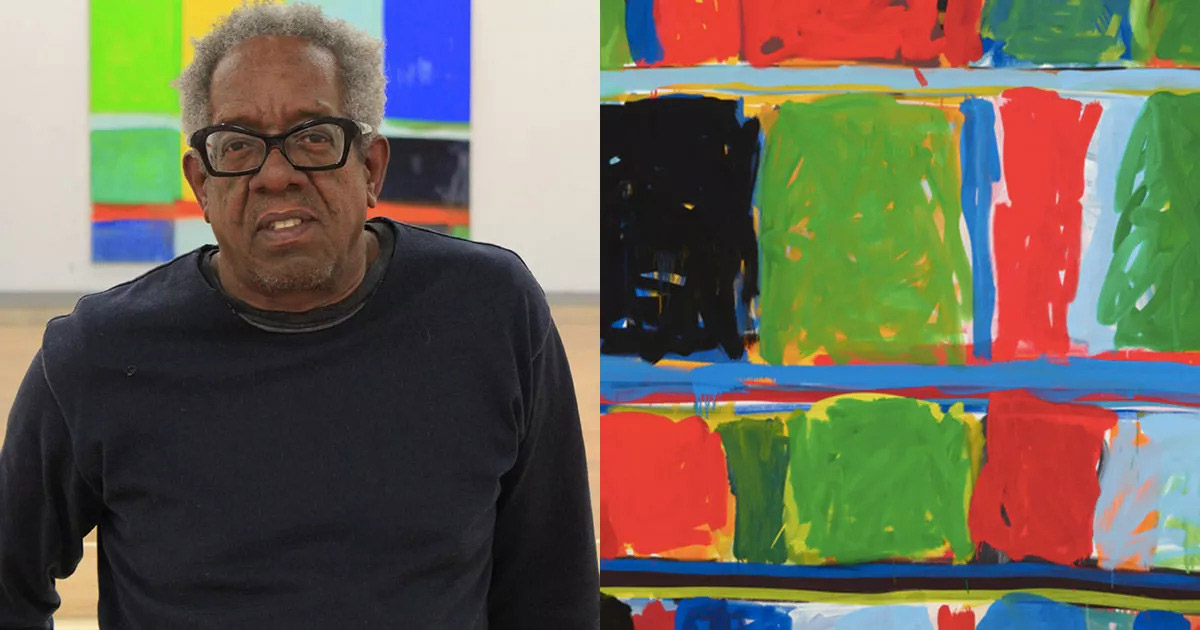
His abstract paintings transform the rigid geometry of minimalism into something warm, improvisational, alive. Four rows of hand-painted color blocks, each one responding to the last like a conversation. No tape. No rulers. Just oil paint and decades of looking.
This guide examines Whitney’s artistic evolution from his Philadelphia roots through his transformative years in Rome to his current status as a leading contemporary abstract painter. You’ll discover how Roman architecture reshaped his approach to color and composition, why jazz music drives his studio practice, and what makes his grid paintings different from every other grid you’ve seen.
Recognition arrived late, but the work was always there.
Identity Snapshot
Stanley Whitney (born November 11, 1946) is an American abstract painter working primarily in oil painting and printmaking.
Lifespan: 1946–present
Primary roles: Painter, printmaker, draughtsman
Nationality: American
Movements: Abstract painting, Color Field painting, geometric abstraction, contemporary American painting
Mediums: Oil on linen, oil on canvas, acrylic, watercolor, crayon, monotype, silkscreen
Signature traits: Thinly applied oil paint with visible brushwork, four-row grid structure, freehand geometric blocks, chromatic intensity, transparent overlapping edges
Iconography/motifs: Stacked rectangular forms, horizontal registers, chromatic call-and-response, musical titles
Geographic anchors:
- Born: Bryn Mawr, Pennsylvania
- Studied: Kansas City Art Institute, Yale School of Art
- Studios: Bridgehampton (New York), Solignano (Italy)
- Formative residence: Rome (1990s)
Mentors/students/patrons: Philip Guston (early mentor), Robert Reed (Yale faculty mentor), Marina Adams (wife, fellow painter)
Collections & museums: Metropolitan Museum of Art, Whitney Museum of American Art, Studio Museum in Harlem, Philadelphia Museum of Art, Solomon R. Guggenheim Museum, Buffalo AKG Art Museum, Nelson-Atkins Museum of Art, Baltimore Museum of Art, Yale University Art Gallery
Market signals: First solo museum show at age 68 (2015). Represented by Gagosian, Lisson Gallery, Galerie Nordenhake. Square formats range from 40 x 40 inches to 96 x 96 inches.
What Sets Stanley Whitney Apart

Whitney makes grids sing.
Where Piet Mondrian locked color into right angles and Wassily Kandinsky let it float free, Whitney found a third way. His signature approach divides square canvases into four horizontal bands of irregular blocks, each one painted freehand, each one responding to the last. The structure stays consistent. The color never repeats.
He works top to bottom in a call-and-response method borrowed from jazz. One hue dictates the next. Orange might demand purple. Yellow calls for brown. The blocks tilt and waver because he paints them without tape or rulers, just a loaded brush and decades of looking.
That’s the technical part.
The deeper distinction? Whitney spent 30 years working in relative obscurity before the art world noticed. He refused to make explicitly political work about Black identity when that was the expectation for African American artists in the 1970s and 1980s. Instead, he committed to pure abstract painting at a time when abstraction felt exhausted. Then Rome happened. The stacked stones of the Colosseum, the shelved urns at the Museo Nazionale Etrusco. Those architectural masses taught him how to collapse space and stack color with density.
By the time critical acclaim arrived in 2015, Whitney had already painted thousands of grids. Each one different. Each one necessary.
Origins & Formation
Early Training
1946–1964: Philadelphia Roots
Born in Bryn Mawr, Pennsylvania, outside Philadelphia. Third of four children in a working-class Black family. Father ran a store. Mother worked for the board of education.
Knew he wanted to paint from a young age. House filled with music.
1964–1968: Kansas City Art Institute
Started at Columbus College of Art and Design, transferred to Kansas City Art Institute.
Summer 1968: Attended Skidmore College arts program. Met Philip Guston, who became an early mentor and encouraged Whitney’s painting ambitions.
1968–1972: New York and Yale
Moved to New York City in 1968.
Enrolled at Yale School of Art at the urging of Robert Reed, another mentor from Skidmore who taught at Yale. Earned MFA in 1972.
First Stylistic Inflections
Early works (1971–72) used acrylic on canvas. Patches of color surrounded by empty space. Whitney struggled to combine gesture and color theory while feeling out of place in New York’s art scene.
Felt pressure to make work about racial identity. Resisted. Wanted to develop an abstract visual language instead.
Through the 1970s and 1980s, Whitney’s paintings featured amorphous forms floating in “landscape air.” No grid yet. Just colored shapes suspended in space, responding to each other with gestural marks.
Pivotal Travels
1980s: American West
Travels west influenced his sense of space in visual art and light.
Early 1990s: Rome
Moved to Rome with wife Marina Adams. Transformational period.
Roman architecture reshaped everything. The Colosseum’s stacked arches. The Palazzo Farnese facade. The Museo Nazionale Etrusco’s shelves of funerary urns, all lined up, all dense and horizontal.
Whitney saw how to collapse the space in his paintings. Started stacking color blocks more tightly. Introduced horizontal dividing lines that would become his signature structure.
Early 1990s: Egypt
Traveled to Egypt. Pyramids and hieroglyphs reinforced ideas about density and pictorial compression. Called it “the last piece of the puzzle.”
First Exhibitions and Reception
1970s–2000s: Working in Obscurity
Exhibited work since the early 1970s but remained largely unknown.
Struggled to sell paintings. Taught at University of Rhode Island, Stanford, UC Berkeley, then Temple University’s Tyler School of Art for over 20 years.
2002: Breakthrough Format
Began making square-format gridded canvases. This became his signature approach.
2015: Recognition
First solo museum exhibition at age 68: “Dance the Orange” at Studio Museum in Harlem. The show changed everything.
New York Times called it a revelation. Critics praised how Whitney “quietly and firmly expanded abstraction’s possibilities.”
By 2023, The Guardian named him “the greatest abstract artist in America.
Movement & Context
Position Within Abstract Painting

Whitney sits between generations and movements, borrowing from Color Field painting, minimalism, and geometric abstraction while remaining distinct from all three.
He came of age when abstract expressionism was fading and Minimalist grids were ascendant. But Whitney’s grids reject Minimalism’s industrial precision. His blocks wobble. His edges bleed. His color saturation pulses with feeling.
Comparative Analysis
vs. Piet Mondrian
Mondrian: Perfect right angles, primary colors, black grid lines, machine-like precision.
Whitney: Freehand rectangles, full chromatic spectrum, no black (usually), hand-painted borders that leak and overlap.
Both use grids. Mondrian’s grid controls. Whitney’s grid liberates.
vs. Mark Rothko
Rothko: Stacked horizontal fields, soft edges, atmospheric depth, somber late palette.
Whitney: Stacked horizontal blocks, harder edges (but not hard), flatter picture plane, jubilant color range.
Rothko dissolves boundaries. Whitney defines them, then challenges them through color contrast.
vs. Josef Albers
Albers: Nested squares, systematic color relationships, scientific approach to color interaction.
Whitney: Multiple blocks per register, intuitive color relationships, improvisational method.
Albers theorized. Whitney feels his way through.
Unique Attributes

Brushwork: Visible, active, fast. You can see the painter’s hand moving across the canvas.
Edge control: Deliberate imprecision. Blocks don’t align perfectly. Edges overlap, creating transparency at borders.
Tonal range: Uses the full spectrum, from electric brights to muddy neutrals, often in the same painting.
Canvas format: Square canvases create balance without hierarchy. No top, bottom, left, or right dominance.
Aspect ratio: Horizontal registers always outnumber vertical divisions, creating rhythm without predictability.
Materials, Techniques, and Process
Supports
Primary: Oil-primed linen, stretched on square formats.
Sizes: Range from intimate 40 x 40 inches to imposing 96 x 96 inches (8 feet square).
Format consistency: Almost exclusively square since 2002. This constraint frees him to focus entirely on color relationships.
Grounds and Primers
Works on oil-primed linen canvases. The primed surface allows his thin paint application to retain texture while maintaining luminosity.
Painting Medium
Primary medium: Oil paint, thinned enough to show brushwork and allow transparency at overlapping edges.
Application: Paint goes on thin. No impasto. The oil painting technique emphasizes speed and directness over layering.
Brushwork Taxonomy
Whitney uses loaded brushes with confidence. His stroke is neither scumbled nor blended.
Application method: Direct, wet-into-wet at times, but mostly sequential block-by-block.
Each rectangle gets painted as a distinct gesture. Brush travels horizontally, filling the block with decisive strokes. The paint stays wet enough that edges blur slightly where blocks meet.
No sfumato here. No glazing. Just thinned oil applied with conviction.
Palette Archetype
Temperature: Equal parts warm and cool within most paintings. Hot oranges next to icy blues. Warm ochres beside cool greens.
Hue distribution: Uses secondary colors and tertiary colors as readily as primaries. Oranges, purples, teals, ochres, and mauves appear frequently.
Value distribution: Mid-range values dominate, but Whitney punctuates with darks and lights for contrast.
Palette bias: No single color preference. His color harmony comes from relationships, not from favoring a particular hue family.
Studio Practice
Method: Works from top to bottom, left to right. Paints the first block, then responds. “One color calls forth another.”
No preparatory drawings: Whitney doesn’t sketch or plan his paintings. The structure is predetermined (four rows, multiple blocks), but the color choices happen in real time.
Working speed: Some paintings finish in one sitting. Others take multiple sessions. He doesn’t know if a painting works until the oil dries and he can see it fresh the next day.
Titles: Often reference jazz musicians, songs, places, or poets. “Dance the Orange,” “How High the Moon,” “By the Love of Those Unloved.”
Music in studio: Listens to jazz while painting. Charlie Parker, Miles Davis, Ornette Coleman. The improvisational structure of bebop and free jazz mirrors his painting process.
Decision-making: Once he commits to a color placement, changing it risks destroying the entire painting. He stops when the thought isn’t done but the painting is.
Self-control: Marina Adams, his wife and fellow painter, sometimes helps him know when to stop.
Themes, Subjects, and Iconography
Recurring Motifs
The Grid: Not a true grid in the Minimalist sense. More like a scaffold or armature. Four horizontal rows, always. Vertical divisions vary by painting.
Stacked Blocks: Rectangular forms that recall architecture, masonry, books on shelves, quilts, urban windows, hieroglyphs.
Horizontal Lines: Three dividing lines separate the four rows. Painted quickly, often with slight variations in thickness and opacity.
Compositional Schemes
Four-row structure: Top to bottom, four registers of color blocks.
Asymmetry within symmetry: The overall format is symmetrical (square canvas, four equal rows). The individual blocks within each row are asymmetrical, irregular, hand-drawn.
No focal point: The eye moves across the entire surface. No single block dominates. This creates unity without hierarchy.
Edge activation: The painting’s edges matter as much as its center. Whitney distributes visual weight evenly across the square.
Symbol Sets and Meanings
Whitney doesn’t use symbols in a traditional iconographic sense. His paintings are non-representational. But the blocks carry associations:
- Architecture: Roman monuments, stacked stones, building facades
- Music: Visual equivalent of jazz improvisation, call-and-response structure
- Quilts: American quilting traditions, especially patterns made by Black quilters
- Books: Spines lined up on shelves, stacked knowledge
- Windows: Urban architecture, New York City tenement buildings
Socio-Historical Triggers
1970s–1980s: Pressure on African American artists to make explicitly political work. Whitney resisted. His commitment to abstraction was itself a political act.
1990s Italy: Roman architecture and Etruscan artifacts showed him how ancient cultures used stacked forms to create density and power.
2000s–Present: As the art world reconsidered abstraction’s possibilities and recognized overlooked Black abstract painters, Whitney’s work gained overdue attention.
Titles reference: Jazz musicians (James Brown, Ornette Coleman), literary figures, political moments (“No to Prison Life” drawing series from 2020).
Notable Works
“Sixteen Songs” (1984)
Medium: Acrylic on canvas
Current location: Private collection
Visual signature: Floating colored forms suspended in space, pre-grid period, gestural marks, “landscape air”
Why it matters: Shows Whitney’s work before his breakthrough grid format. The painting demonstrates his early interest in color relationships and spatial arrangement without the horizontal structure that would later define his mature style.
Related works: Other 1980s paintings with floating forms and atmospheric space
“By the Love of Those Unloved” (1994)
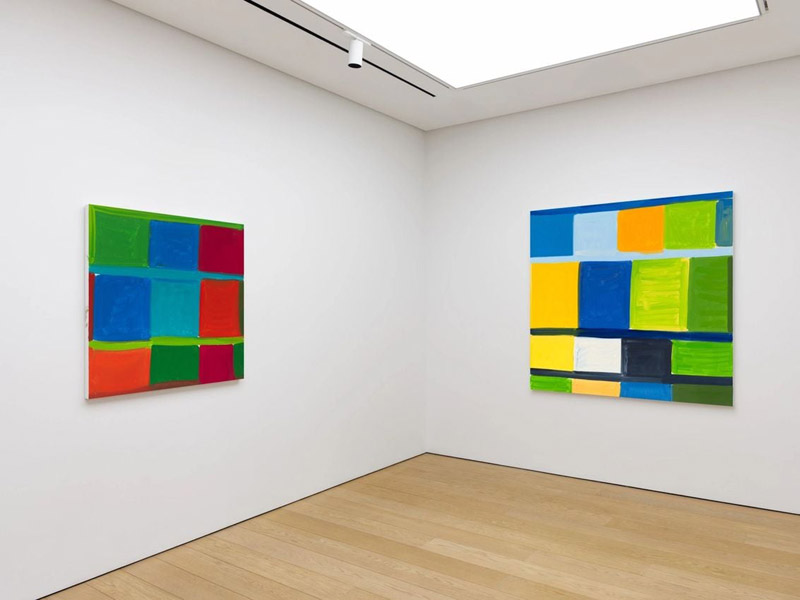
Medium: Oil on linen
Current location: Private collection
Visual signature: Early appearance of horizontal organizing lines, blocks beginning to stack, transition between floating forms and structured grid
Why it matters: Marks Whitney’s shift toward the stacked format after his time in Rome. The horizontal lines that became his signature structure appear here, still loose but clearly moving toward the dense arrangements of his mature work.
Related works: Other mid-1990s transitional paintings showing the influence of Italian architecture
“Color Bar” (1997)
Medium: Oil on linen, 72 x 84 inches (6 x 7 feet)
Current location: Private collection
Visual signature: Layered blocks with colors underneath visible through thin paint, exploration of covering and revelation
Why it matters: Demonstrates Whitney’s interest in transparency and depth within the grid structure. Red over orange, brown over yellow, black over blue. The painting asks what lies beneath surface impressions.
Related works: Other late 1990s works exploring transparency and layering
“Undestructable Hymn” (2001)
Medium: Oil on linen
Current location: Private collection
Visual signature: Fully realized four-row grid structure, bold chromatic relationships, stacked rectangular blocks
Why it matters: One of the earliest paintings to demonstrate Whitney’s mature signature style. Shows the format that would define his work for the next two decades.
Related works: “Secret of Black Song and Laughter” (2003), other early 2000s grid paintings
“Secret of Black Song and Laughter” (2003)
Medium: Oil on linen, 36 x 36 inches (3 feet square)
Current location: Private collection
Visual signature: Bright pulsating yellows, morning light quality, chromatic intensity, perfect square format
Why it matters: Exemplifies Whitney’s ability to create optical vibration through color relationships alone. The painting seems to emit light despite being made with opaque materials.
Related works: Other small-scale square paintings from the mid-2000s
“James Brown Sacrifices to Apollo” (2008)
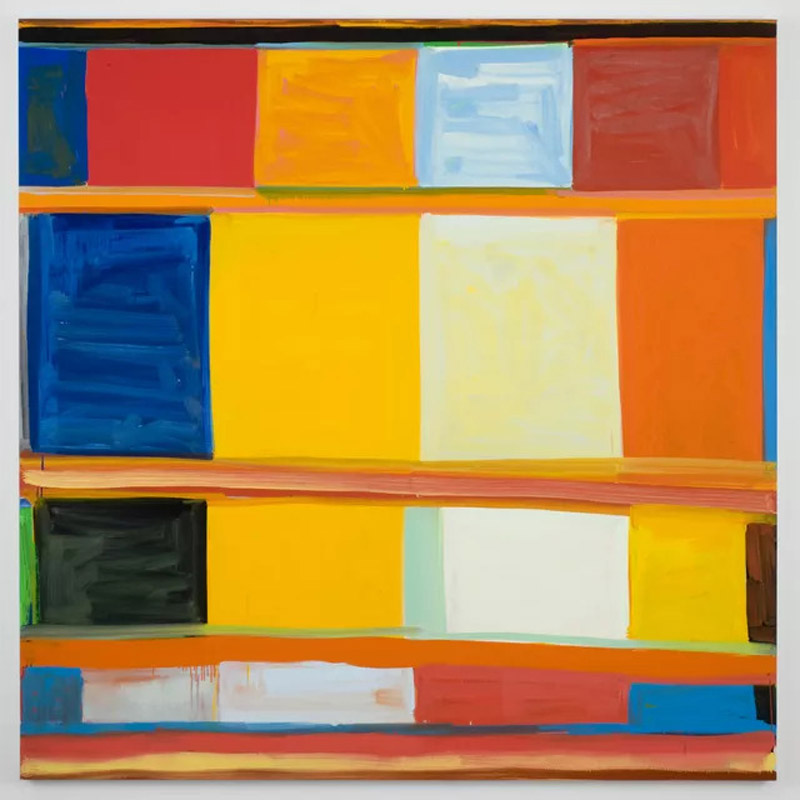
Medium: Oil on linen, 72 x 72 inches (6 feet square)
Current location: Museum collection
Visual signature: Orange blocks that seem to swell and move, visible brushwork showing speed and sureness, transitions between color zones create optical effects
Why it matters: Named for James Brown, the painting captures the improvisational energy of soul and funk music. The surface appears to wobble when viewed, encouraging a wandering eye and demonstrating Whitney’s ability to create movement within a static grid.
Related works: Other paintings with musical titles referencing specific artists
“Love in the Time of War” (2016)
Medium: Oil on linen, 96 x 96 inches (8 feet square)
Current location: Private collection
Visual signature: Large-scale format, full chromatic range, irregular geometric lattices, vibrant stacked color blocks
Why it matters: Demonstrates Whitney’s work at monumental scale. The 8-foot square format creates an immersive viewing experience. Title references both literary tradition (Garcia Marquez) and contemporary politics.
Related works: Other large-scale paintings from the 2010s showing mature command of format
“Bird Call” (2024)
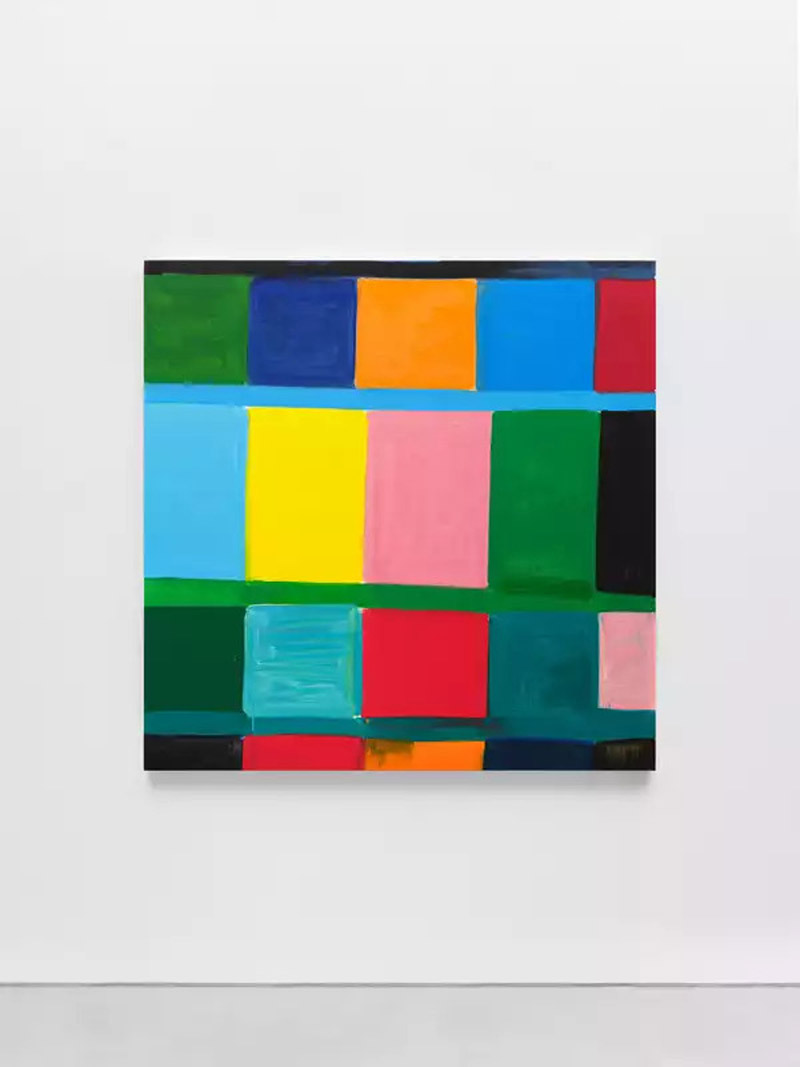
Medium: Oil on linen, 60 x 60 inches
Current location: Part of “How High the Moon” retrospective
Visual signature: Recent work showing continued experimentation within established format, chromatic intensity, freehand geometric blocks
Why it matters: Proves Whitney continues to find new possibilities within his signature structure after 20+ years. Each painting remains distinct despite format consistency.
Related works: Other paintings from 2023-2024 showing latest developments in his practice
Exhibitions, Collections, and Provenance Highlights
Major Solo Exhibitions
2015: “Dance the Orange,” Studio Museum in Harlem, New York (first solo museum exhibition at age 68)
2017: “FOCUS: Stanley Whitney,” Modern Art Museum of Fort Worth, Texas
2022: “The Italian Paintings,” Palazzo Tiepolo Passi, Venice (official collateral event, 59th Venice Biennale, presented by Buffalo AKG Art Museum)
2022: “Dance with Me Henri,” Baltimore Museum of Art (included unveiling of Whitney’s stained-glass windows for the Ruth R. Marder Center for Matisse Studies)
2024: “How High the Moon,” Buffalo AKG Art Museum (first major retrospective, traveled to Walker Art Center and Institute of Contemporary Art, Boston)
Gallery exhibitions: Gagosian (Rome, Paris, New York), Lisson Gallery (London, New York), Galerie Nordenhake (Berlin, Stockholm, Mexico City)
Significant Group Exhibitions
2002: “Quiet as it’s Kept,” Christine Konig Gallery (curated by David Hammons, influential exhibition of Black American abstract artists)
2003: “Utopia Station,” 50th Venice Biennale
2013: “Reinventing Abstraction: New York Painting in the 1980s,” Cheim & Read, New York
2014: “Outside the Lines: Black in the Abstract,” Contemporary Art Museum Houston
2017: documenta 14, Athens, Greece and Kassel, Germany
2018: “Inherent Structure,” Wexner Center for the Arts, Columbus, Ohio
Museums with Depth (3+ works)
- Buffalo AKG Art Museum
- Studio Museum in Harlem
- Whitney Museum of American Art
- Philadelphia Museum of Art
- Nelson-Atkins Museum of Art, Kansas City
- Solomon R. Guggenheim Museum, New York
- Metropolitan Museum of Art, New York
- Baltimore Museum of Art
- Yale University Art Gallery
Other Notable Collections
Moderna Museet (Stockholm), Magazzino d’Arte Moderna (Rome), Smithsonian Museum (Washington DC), High Museum of Art (Atlanta), National Gallery of Canada (Ottawa), Art Gallery of New South Wales (Sydney), He Art Museum (Foshan), Guggenheim Abu Dhabi
Gallery Representation
Current: Gagosian, Lisson Gallery, Galerie Nordenhake (since 2012)
Previous: Team Gallery (New York)
Provenance Patterns
Work entered major museum collections slowly over decades, then accelerated after 2015 recognition.
Private collectors initially supported Whitney when institutional recognition was absent.
Prices increased significantly after “Dance the Orange” exhibition.
Printmaking Practice
Whitney has made monotypes and editions at Two Palms since 2016. Works in silkscreen, monotype, linocut, and etching. His prints are held in major collections including Whitney Museum of American Art.
Printmaking practice runs parallel to painting. Whitney’s drawings and prints constitute their own significant body of work, not studies for paintings but independent explorations.
Market & Reception
Critical Reception Timeline
1970s–2000s: Worked in relative obscurity. Rarely sold paintings. Supported himself through teaching.
2015: Breakthrough with “Dance the Orange” exhibition. Roberta Smith’s New York Times review praised paintings for “quietly and firmly expanding abstraction’s possibilities.” Peter Schjeldahl in The New Yorker called the exhibition revelatory.
2017: Inducted as member of American Academy of Arts and Letters.
2019–Present: Growing recognition as major figure in contemporary abstraction.
2023: The Guardian named him “the greatest abstract artist in America.”
2024: First major retrospective, “How High the Moon,” confirms his position in American art history.
Honors and Prizes
- 1996: Guggenheim Fellowship
- 2010: American Academy of Arts and Letters Art Award
- 2011: Robert De Niro Sr. Prize in Painting (inaugural award)
- 2017: American Academy of Arts and Letters member
- Pollock-Krasner Foundation Fellowship
Auction Results and Price Bands
Market information limited due to Whitney’s late recognition and career spent outside commercial mainstream.
Prices increased significantly post-2015 as major collectors and institutions recognized his work.
Square format paintings range from intimate 40 x 40 inches to monumental 96 x 96 inches, with prices corresponding to scale and date.
Authentication
No major forgery issues reported.
Works documented through gallery records (Gagosian, Lisson, Nordenhake).
Studio maintains records of paintings.
Condition Patterns
Oil on linen works from 2000s onward generally in good condition.
Thin paint application means less risk of craquelure or ground failure compared to heavily impasted works.
Earlier acrylic paintings from 1970s-80s would require standard acrylic conservation practices.
Influence & Legacy
Upstream Influences (Who Influenced Whitney)
Painters:
- Piet Mondrian (grid structure, though Whitney loosened it)
- Giorgio Morandi (subtle color relationships, meditative repetition)
- Philip Guston (early mentor, encouraged Whitney to trust his vision)
- Titian (studied Renaissance composition during Italian sojourns)
- Diego Velazquez (compositional arrangements)
- Mark Rothko (stacked horizontal fields, though Whitney’s are denser)
- Bob Thompson (referenced as influence on Whitney’s approach to color)
Movements:
- Color Field painting (but rejected its mechanical precision)
- Minimalism (the grid, but humanized it)
- Abstract Expressionism (gesture and improvisation)
Other Sources:
- American quilting (especially Black quilting traditions, irregular blocks, pattern making)
- Jazz music (Charlie Parker, Miles Davis, Ornette Coleman’s “The Shape of Jazz to Come”)
- Roman architecture (Colosseum, Palazzo Farnese)
- Etruscan funerary urns (stacked density at Museo Nazionale Etrusco)
- Egyptian hieroglyphs and pyramids (density, compression)
Downstream Influence (Who Whitney Influenced)
Teaching Career: Taught at Tyler School of Art, Temple University for over 20 years. Influenced generations of painting students, though specific protégés not widely documented.
Contemporary Abstract Painters: Whitney’s success in his 70s inspired younger and mid-career abstract painters to continue working outside commercial trends.
Conversations About Black Abstract Art: Whitney’s career demonstrates that African American artists can work in pure abstraction without making explicitly political content about race. His resistance to categorization opened space for others.
Color and Structure Dialogue: Contemporary painters exploring grid structures with expressive color cite Whitney as proving the format still has possibilities.
Cross-Domain Echoes
Design: Whitney’s color block arrangements influenced contemporary graphic design and textile patterns.
Architecture: His work resonates with architects interested in modular systems and chromatic relationships in facades.
Music: Though Whitney takes from jazz, his visual structures have influenced musicians and composers thinking about improvisational frameworks.
Critical Legacy
Whitney’s late recognition raises questions about art world gatekeeping, the overlooking of Black abstract artists, and the value of sustained practice over decades regardless of commercial success.
David Hammons asked about Whitney’s work: “How could something be so quiet and have so much to say?”
That question captures Whitney’s achievement. His paintings don’t shout. They accumulate. They persist. They prove that abstraction can still surprise us.
How to Recognize a Stanley Whitney at a Glance
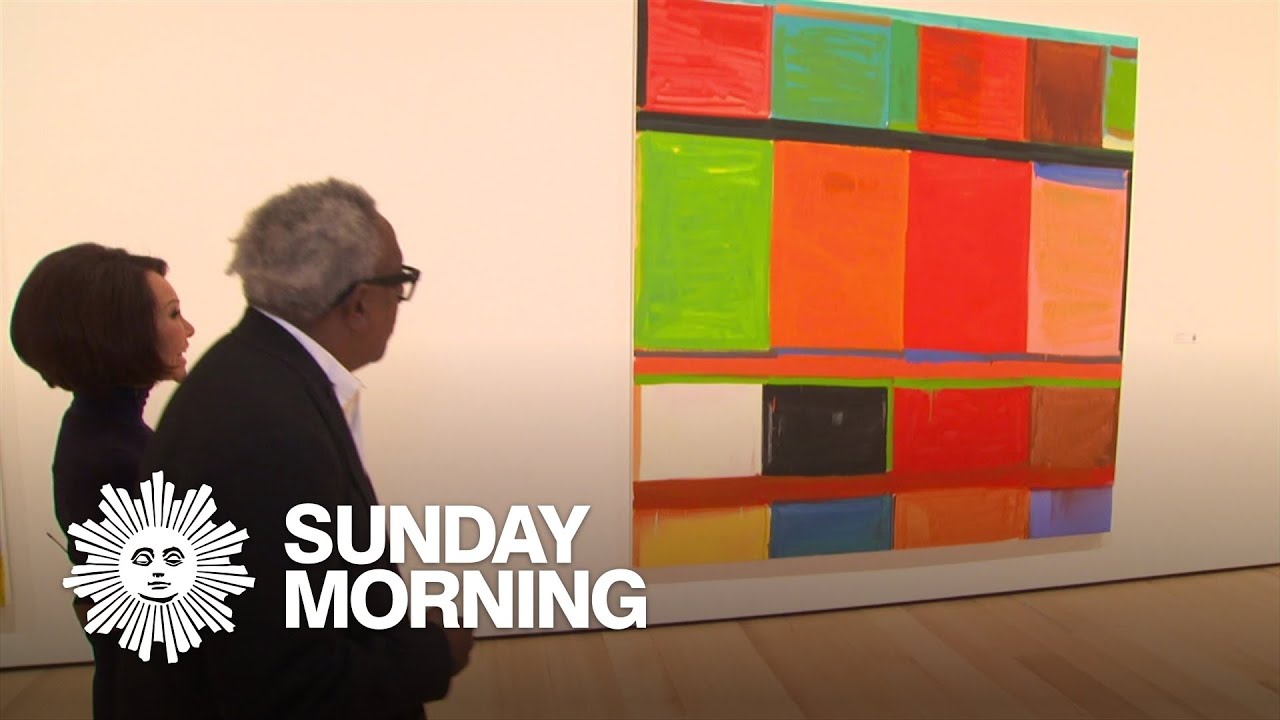
Diagnostic Checklist:
- Square canvas format – Nearly always square, ranging from 40 x 40 inches to 96 x 96 inches
- Four horizontal rows – Divided by three painted horizontal lines, creating four distinct registers
- Freehand rectangular blocks – Irregular, hand-painted blocks within each row (not measured or taped)
- Thinly applied oil paint – No impasto, paint thin enough to show brushwork and allow slight transparency at edges
- Visible brushstrokes – Active, directional brushwork showing the painter’s hand moving quickly
- Blocks don’t align vertically – Vertical divisions are irregular and don’t line up from row to row
- Chromatic intensity – High color saturation with full spectrum represented, often unusual color pairings
- Overlapping transparent edges – Where blocks meet, slight bleeding or transparency creates optical mixing
- No true grid – Structure is more like stacked shelves than a Minimalist grid (horizontal lines consistent, vertical divisions variable)
- Musical or poetic titles – Often references jazz musicians, songs, places, or literary sources rather than “Untitled”
If you see: A square canvas with four loose horizontal rows of colorful, hand-painted rectangular blocks in oil paint with visible brushwork and no perfect edges, you’re looking at a Stanley Whitney.
Common in Whitney, rare in others: The combination of chromatic maximalism with structural consistency. Most grid painters go either fully systematic (Albers, Mondrian) or fully expressive (some Abstract Expressionists). Whitney holds both impulses in balance.
FAQ on Stanley Whitney
What is Stanley Whitney known for?
Stanley Whitney is known for his abstract grid paintings featuring four horizontal rows of hand-painted color blocks. He works primarily in oil on linen, creating chromatic compositions inspired by jazz improvisation and Roman architecture.
How does Stanley Whitney create his paintings?
Whitney paints from top to bottom without preparatory sketches. He applies thinly diluted oil paint in a call-and-response method where each color dictates the next. His freehand blocks create irregular grids with visible brushwork and transparent overlapping edges.
When did Stanley Whitney become famous?
Whitney gained recognition at age 68 with his 2015 exhibition “Dance the Orange” at the Studio Museum in Harlem. He worked in relative obscurity for decades before the art world acknowledged his contribution to contemporary abstract painting.
What inspires Stanley Whitney’s art?
Whitney draws inspiration from jazz music (especially Charlie Parker and Ornette Coleman), Roman architecture, Etruscan funerary urns, American quilting traditions, and painters like Piet Mondrian and Giorgio Morandi. His travels to Rome and Egypt transformed his artistic approach.
Where does Stanley Whitney live and work?
Whitney maintains studios in Bridgehampton, New York, and Solignano, Italy. He splits time between both locations. His summers in Italy continue the connection to Roman architecture that shaped his mature painting style in the 1990s.
What size canvases does Stanley Whitney use?
Whitney works almost exclusively on square canvases ranging from 40 x 40 inches to 96 x 96 inches (8 feet square). The square format creates balance without hierarchy, allowing him to focus entirely on color relationships.
How much do Stanley Whitney paintings cost?
Prices increased significantly after 2015 when major galleries began representing him. Market values correspond to canvas size and date. Whitney is represented by Gagosian, Lisson Gallery, and Galerie Nordenhake. Auction results show growing collector interest.
What museums own Stanley Whitney paintings?
Major collections include the Metropolitan Museum of Art, Whitney Museum of American Art, Guggenheim Museum, Studio Museum in Harlem, Philadelphia Museum of Art, Buffalo AKG Art Museum, Baltimore Museum of Art, and Nelson-Atkins Museum of Art in Kansas City.
Did Stanley Whitney study art formally?
Whitney earned his BFA from Kansas City Art Institute in 1968 and his MFA from Yale School of Art in 1972. Early mentors included Philip Guston and Robert Reed. He later taught at Temple University’s Tyler School of Art for over 20 years.
What painting technique does Stanley Whitney use?
Whitney uses direct oil painting with thin paint application on oil-primed linen. He paints wet-into-wet sequentially, creating each block as a distinct gesture. His visible brushwork shows speed and confidence. No glazing, no impasto, just decisive color placement.
Conclusion
Stanley Whitney proves that sustained commitment to abstract painting eventually finds its audience. His grid-based approach transformed geometric abstraction by injecting it with improvisation, chromatic intensity, and human touch.
The journey from obscurity to recognition took decades. But those years weren’t wasted.
Every painting built on the last. Rome taught him about stacked density. Jazz showed him call-and-response. Egyptian hieroglyphs revealed compression. American quilts demonstrated pattern-making without rigid systems.
Whitney’s oil on linen canvases now hang in major museums worldwide. His influence extends to younger painters exploring color relationships within structured formats.
The grid became his liberation, not his limitation. That’s the lesson worth remembering.