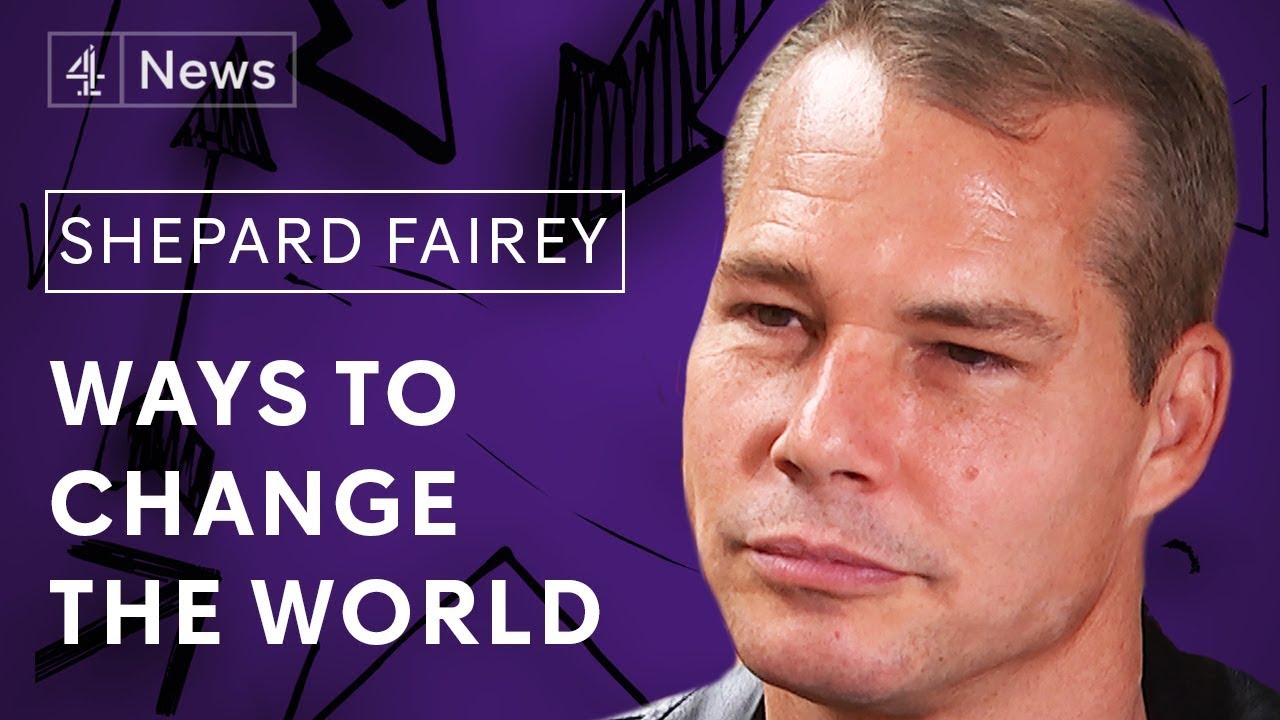
Shepard Fairey is an American contemporary street artist, graphic designer, and activist who transformed guerrilla art into a global visual language. His work sits at the crossroads of propaganda, punk rock aesthetics, and commercial design.
Born in 1970 in Charleston, South Carolina, Fairey emerged from skateboard culture and became one of the most influential figures in the street art movement. The Institute of Contemporary Art in Boston called him one of the best known street artists of the 21st century.
His signature style borrows heavily from Soviet-era poster art and pop art traditions, using bold iconography to question authority, consumer culture, and political systems. Works by Fairey now hang in permanent collections at the Smithsonian, MoMA, and the Victoria and Albert Museum.
Identity Snapshot
Full Name: Frank Shepard Fairey
Also Known As: Obey, OBEY Giant
Lifespan: Born February 15, 1970 (active)
Primary Roles: Street artist, graphic designer, muralist, printmaker, activist, entrepreneur
Nationality: American
Movements: Street Art, Urban Art, Contemporary Art, Political Art
Mediums: Screen printing, stencil art, wheat paste, vinyl stickers, mixed media collage, acrylic on canvas, murals
Signature Traits: High-contrast stencil technique, limited color palette (red, black, white, cream), bold typography, propaganda-style imagery, appropriated photographs
Recurring Motifs: Andre the Giant face, OBEY text, peace symbols, political figures, flowers with fists, revolutionary imagery
Geographic Anchors: Charleston (birthplace), Providence (RISD years), San Diego (early career), Los Angeles (current studio)
Key Influences: Barbara Kruger, Andy Warhol, Russian Constructivism, Alexander Rodchenko, punk album covers, skateboard graphics
Students/Collaborators: Amanda Fairey (wife/collaborator), Studio Number One team
Major Collections: Smithsonian National Portrait Gallery, MoMA, LACMA, Victoria and Albert Museum, Museum of Contemporary Art San Diego, San Francisco Museum of Modern Art
Market Signals: Auction record of $950,000 (Hope poster, 2023). Standard screen print editions typically range from $50 to $5,000. Original mixed media works fetch $10,000 to $700,000+.
What Sets Shepard Fairey Apart
Most street artists stay underground. Fairey built an empire.
He operates simultaneously as a gallery artist, commercial designer, fashion brand owner, and political activist. This crossover annoys purists. It also made his message reach millions who would never visit a gallery.
His visual vocabulary reads instantly. The flat color planes. The halftone dots borrowed from newsprint. The staring faces that demand you look back.
Where Banksy hides, Fairey shows his face. He signs his work. He takes the arrests (18 and counting) as proof he is doing something right.
The OBEY campaign confused people on purpose. It was not selling anything, at first. Just a wrestler’s face and a command. This confusion became the point. He wanted you to stop and wonder why you follow instructions at all.
Fairey recycles the aesthetics of totalitarian propaganda to criticize the systems that originally used them. The irony is intentional. So is the power.

Origins and Formation
Early Years
Frank Shepard Fairey grew up in conservative Charleston, South Carolina. His mother taught English. His father worked as a doctor.
The environment felt restrictive. He described his parents as the head cheerleader and football captain types. Fairey wanted something else.
Skateboarding became his escape. By 1984, at fourteen years old, he was designing and selling hand-decorated boards and T-shirts. The DIY ethos stuck with him.
Art School Formation
Fairey graduated from Idyllwild Arts Academy in Palm Springs in 1988. He then enrolled at Rhode Island School of Design (RISD) in Providence.
RISD exposed him to formal art education. He studied illustration. More importantly, he discovered stencil making and screen printing techniques.
The punk rock scene shaped his thinking. Album covers by Winston Smith for Dead Kennedys and Raymond Pettibon for Black Flag showed him that graphics could carry political weight.
Andre the Giant Has a Posse (1989)
The origin story sounds almost accidental. A friend asked Fairey to demonstrate how to make a stencil. He grabbed a newspaper and spotted an ad featuring wrestler Andre Rene Roussimoff.
The image became “Andre the Giant Has a Posse.” Fairey made stickers. He plastered them around Providence using a fake ID to get into clubs.
What started as a joke turned into something larger. The stickers spread. People asked questions. That was exactly the response Fairey wanted.
The OBEY Evolution
The Andre face morphed into the OBEY Giant campaign. Fairey wrote a manifesto linking his work to phenomenology, citing Heidegger’s idea of “letting things manifest themselves.”
The word “OBEY” came from John Carpenter’s 1988 film They Live. In the movie, special glasses reveal hidden commands in advertisements. Fairey borrowed the concept and ran with it.
After graduation in 1992, he founded Alternate Graphics in Providence. The small print shop let him fund his own work while building a client base.
Movement and Context
Street Art Positioning

Fairey occupies a peculiar space in street art. He is both insider and outsider.
Unlike Jean-Michel Basquiat, who came from New York graffiti culture, Fairey emerged from skateboard graphics and design school. His background shows in the polish of his work.
Banksy once said that when Fairey comes to a city, every graffiti writer gets nervous. Not because of rivalry. Because Fairey produces more “reaches” (street placements) than any writer in history.
Comparative Analysis
Versus Keith Haring: Haring used fluid, organic lines. Fairey uses rigid geometry and photographic sources. Haring’s work feels spontaneous. Fairey’s feels calculated and deliberate.
Versus Mr. Brainwash: Both appropriate existing imagery. Fairey maintains a consistent political message. Mr. Brainwash leans toward pop culture celebration without the same critique.
Versus Robbie Conal: Conal influenced Fairey directly. Both use guerrilla poster tactics. Conal’s portraits are grotesque caricatures. Fairey’s subjects look more heroic, even when he criticizes them.
Constructivist Debt
The Russian Constructivist influence became more pronounced during Fairey’s San Diego years in the late 1990s. Former collaborators recall him studying Soviet propaganda posters obsessively.
Alexander Rodchenko’s diagonal compositions appear throughout Fairey’s work. So do the radiating lines meant to focus attention on central figures. The color contrast of red against black and white comes directly from agitprop traditions.
Materials, Techniques, and Process
Print Production
Primary Medium: Screen printing on Speckletone cream paper (most editions)
Alternative Supports: Wood panels, metal sheets, canvas, found materials like album covers and newspaper collages
Edition Sizes: Typically 300-550 for standard releases. Smaller runs of 50-100 for special editions.
Stencil Technique
Fairey builds images through layered stencils. He starts with a photographic source, often found online or from collaborating photographers.
The photo gets reduced to high-contrast zones. Details disappear. What remains are flat planes of tone that read clearly from a distance.
Halftone dots add the illusion of gradation without actual blending. This technique references commercial printing while keeping production fast.
Color Architecture
The palette stays limited. Red, black, white, and cream dominate most work.
Red carries the weight of urgency and political association. Black provides structure. White (or cream) creates breathing room.
When Fairey adds other colors, they serve specific purposes. The Hope poster’s blue referenced patriotism. His environmental pieces sometimes use green.
Street Application Methods
Wheat Paste: Flour-based adhesive for paper posters. Cheap, effective, biodegradable. Applied quickly at night.
Vinyl Stickers: Mass-produced through partners like Stickerobot. Distributed globally to supporters who place them.
Spray Stencils: For fast applications on rough surfaces. Requires pre-cut stencils carried to location.
Studio Practice
Fairey runs Studio Number One in Los Angeles with a full staff. The operation handles commercial clients alongside art production.
Mixed media originals combine screen printing with hand-painted elements. He adds collaged paper, including newspapers and found documents, as base layers.
The repetition in his artwork is intentional. Like Warhol’s multiples, the repeated image gains power through saturation.
Themes, Subjects, and Iconography
Power and Authority
The word OBEY appears constantly. It functions as reverse psychology. Seeing the command makes people question why they follow orders.
Fairey depicts political leaders, revolutionaries, and activists. The same visual treatment applies to heroes and villains. He claims neutrality, presenting subjects worth investigating rather than worshipping.
Peace and Anti-War
Peace symbols recur throughout his catalog. Flowers grow from fists. Guns sprout roses.
The Iraq War prompted direct responses. Fairey created posters criticizing Bush administration policies. He supported Occupy Wall Street. Gun control advocacy followed.
Environmental Concerns
Climate imagery became prominent after 2015. His “Earth Crisis” installation at the Eiffel Tower addressed environmental destruction.
Recent editions include titles like “Environmental Justice” and works addressing fossil fuel dependency.
Social Justice
The “We the People” series for the 2017 Women’s March featured Muslim, Latina, and African-American women in his signature style. The images spread globally during protests.
Works addressing police brutality use dark humor to make difficult topics approachable. Fairey references the history of dogs used against civil rights protesters while commenting on modern policing.
Compositional Patterns
Central figures dominate most compositions. Radiating lines draw the eye inward. Text anchors the bottom edge.
The format echoes Soviet posters, wartime propaganda, and concert flyers simultaneously. This hybrid structure makes the work recognizable across contexts.
Notable Works
Andre the Giant Has a Posse (1989)

Medium: Screen printed sticker
Size: Various small formats
Location: Originally distributed in Providence, RI; now globally dispersed
Significance: The origin of everything. A crude stencil of wrestler Andre Rene Roussimoff became Fairey’s calling card. The campaign spread virally before viral was a concept.
Visual Signature: High contrast face, bold sans-serif text, no background detail
Hope (2008)

Medium: Hand-finished collage, stencil, and acrylic on paper
Size: Approximately 60 x 44 inches (original version)
Location: Smithsonian National Portrait Gallery (donated version); private collections hold the three originals
Significance: The most recognized political poster of the 21st century. Created in a single day for Barack Obama’s presidential campaign. Over 300,000 posters and one million stickers distributed.
Visual Signature: Red, white, and blue palette. Stylized portrait with upward gaze. Single word caption. Based on a Mannie Garcia photograph for the Associated Press, which led to a settled copyright lawsuit.
Market Record: $950,000 at Santa Monica Auctions (2023)
We the People Series (2017)

Medium: Screen print on paper
Size: Multiple formats including posters and large-scale prints
Location: Distributed during Women’s March protests worldwide
Significance: Created in response to xenophobic rhetoric. Featured diverse women in patriotic color scheme. Downloaded millions of times for protest use.
Liberte, Egalite, Fraternite (2016)

Medium: Screen print and mural
Location: Mural in Paris; poster gifted to French President Emmanuel Macron (displayed in his office)
Significance: Created after the 2015 Paris attacks. Features Marianne, the French national symbol, surrounded by the national motto. Demonstrates Fairey’s international political engagement.
Supply and Demand Retrospective Works (2009)
Medium: Mixed exhibition including screen prints, stencils, stickers, collages, works on wood and metal
Location: Institute of Contemporary Art, Boston (premiered); traveled to Warhol Museum, Pittsburgh
Significance: First major museum retrospective. Over 250 works spanning 20 years. Established Fairey’s position in contemporary art history beyond street art circles.
Exhibitions, Collections, and Provenance
Major Solo Exhibitions
Supply and Demand (2009): ICA Boston. The breakthrough museum show that legitimized his practice.
May Day (2010): Deitch Projects, New York. Expanded his gallery presence on the East Coast.
Facing the Giant: Three Decades of Dissent (2019-ongoing): Traveling retrospective shown in Grenoble, New York, Paris, Vancouver, London, Providence, and Los Angeles.
Out of Print (2025): Beyond the Streets, Los Angeles. Over 400 screen prints examining his printmaking practice.
Permanent Collections
Smithsonian National Portrait Gallery (Washington, D.C.)
Museum of Modern Art (New York)
Los Angeles County Museum of Art
Museum of Contemporary Art San Diego
San Francisco Museum of Modern Art
Victoria and Albert Museum (London)
Virginia Museum of Fine Arts (Richmond)
Museum of Fine Arts Boston
Gallery Representation

Fairey shows through multiple galleries internationally including Opera Gallery and his own Subliminal Projects in Los Angeles, which he co-founded. This space functions as both gallery and community hub for street art.
Market and Reception
Auction Performance
Record Sale: $950,000 for Hope (2008) at Santa Monica Auctions, May 2023
Secondary Sales Range: $1 to $950,000 depending on work type
Average Screen Print Price (2024): $1,500 to $3,000 for standard editions
Original Mixed Media: $10,000 to $150,000 for typical works; iconic pieces significantly higher
Edition Economics
Standard editions of 300-550 prints keep prices accessible. Fairey explicitly aims to democratize art ownership.
Hand-finished pieces (HPM) command premiums. These include additional painting, collage, or unique elements beyond the base screen print.
Authentication Concerns
Signature placement typically lower right on paper works. Editions numbered lower left.
Given the high volume of legitimate prints, forgery risk remains relatively low compared to scarcity-driven markets. The real concern is bootleg reproductions sold as originals.
Critical Reception
Critics remain divided. Robert Pincus of the San Diego Union-Tribune praised the balance of seriousness, irony, and wit. Others, like Erick Lyle, accused Fairey of turning graffiti into self-promotion.
The appropriation debate follows Fairey constantly. He uses photographs by others, sometimes without permission. The Associated Press lawsuit over the Hope poster ended in settlement and a criminal contempt conviction for destroyed evidence.
Despite controversy, institutional acceptance continues growing. The comparison to Warhol appears frequently. Both blurred commercial and fine art boundaries. Both faced accusations of being more businessman than artist.
Influence and Legacy
Upstream Influences
Andy Warhol’s repetition and commercial techniques. Barbara Kruger’s text-image combinations and Futura typeface. Russian Constructivist poster aesthetics. Punk rock DIY ethics. Skateboard graphic culture.
Downstream Impact
A generation of street artists followed Fairey’s path from illegal paste-ups to gallery walls. Franky Aguilar, Jack Devereux, and Hungry Castle cite him directly.
The OBEY clothing brand normalized artist-owned streetwear companies. Supreme and similar brands owe something to his model.
Political poster design changed after Hope. Campaigns now actively seek street art aesthetics. The visual language of protest absorbed his approach.
Cross-Medium Echoes
Documentary film: Subject of Hulu’s “Obey Giant” (2017)
Television: Guest appearance in The Simpsons episode “Exit Through the Kwik-E-Mart”
Film: Appeared in Banksy’s “Exit Through the Gift Shop” (2010)
Music: Album artwork for Led Zeppelin, DJ Shadow, Interpol, Black Eyed Peas, and numerous others
Fashion: OBEY Clothing continues as a major streetwear brand founded in 2001
Real Estate Effect
An unintended legacy: Fairey murals increase property values. A Costa Mesa apartment sold for double average price in 2019 specifically because of a Fairey mural on the building.
How to Recognize a Shepard Fairey at a Glance

Look for flat color planes without gradation, unless using halftone dots to simulate tone.
The palette stays tight. Red, black, white, cream. Sometimes blue for patriotic themes.
Faces stare directly at you or gaze upward with determination.
Typography appears bold, often in Futura or similar sans-serif fonts.
Decorative borders reference Art Nouveau or Soviet poster design.
Radiating lines focus attention on central figures.
The word OBEY or the Andre face appears somewhere, often in corners.
Subjects include political figures, activists, musicians, or symbolic imagery like flowers and peace signs.
Screen printed editions show on Speckletone cream paper.
Mixed media originals include newspaper collage as base layers visible under screen printing.
Signature placement is lower right with edition numbers lower left on prints.
Standard print sizes run 18 x 24 inches or 24 x 36 inches for most editions.
FAQ on Shepard Fairey
Who is Shepard Fairey?
Shepard Fairey is an American contemporary street artist, graphic designer, and activist born in 1970 in Charleston, South Carolina. He founded OBEY Clothing and Studio Number One. His work appears in major museums including the Smithsonian and MoMA.
What is Shepard Fairey best known for?
Fairey created the iconic Hope poster for Barack Obama’s 2008 presidential campaign. He also launched the OBEY Giant sticker campaign featuring wrestler Andre the Giant. Both became defining images of contemporary visual culture.
What is the OBEY Giant campaign?
OBEY Giant started in 1989 as a sticker featuring Andre the Giant’s face with the word “OBEY.” Fairey designed it while studying at Rhode Island School of Design. The campaign questions authority and consumer obedience through guerrilla street art.
What art style does Shepard Fairey use?
Fairey blends Soviet propaganda aesthetics with graphic design and punk rock influences. His work features bold lines, limited color palettes, and high-contrast stencil imagery. The style draws from Roy Lichtenstein’s halftone techniques.
What techniques does Shepard Fairey use?
Screen printing forms the foundation of his practice. He also uses stencil art, wheat paste for street installations, and mixed media collage. Many works layer newspaper clippings beneath printed imagery to add texture.
How much is Shepard Fairey’s artwork worth?
Prices range widely. Standard screen print editions sell for $50 to $5,000. Original mixed media works fetch $10,000 to $150,000. His auction record stands at $950,000 for a Hope poster sold in 2023.
Where did Shepard Fairey study art?
Fairey attended Idyllwild Arts Academy in Palm Springs, graduating in 1988. He earned his Bachelor of Fine Arts in illustration from Rhode Island School of Design in 1992. RISD is where he created the Andre sticker.
Where can I see Shepard Fairey’s work?
Permanent collections include the Smithsonian National Portrait Gallery, Victoria and Albert Museum, and Los Angeles County Museum of Art. His murals appear on buildings worldwide. Subliminal Projects gallery in Los Angeles regularly shows his pieces.
Has Shepard Fairey faced legal issues?
Yes. The Associated Press sued over the Hope poster’s source photograph. Fairey settled in 2011 but received criminal contempt charges for destroying evidence. He has also been arrested over 18 times for illegal wheat pasting.
Is Shepard Fairey still creating art?
Absolutely. Fairey remains prolific with new screen print editions, murals, and gallery exhibitions. His 2025 show “Out of Print” at Beyond the Streets features over 400 works. He continues producing political art and commercial collaborations.
Conclusion
Shepard Fairey redefined what public art could accomplish. From wheat paste posters on lamp posts to murals spanning entire buildings, his visual communication reaches audiences who never set foot in galleries.
The OBEY campaign proved that limited edition prints and vinyl stickers could carry serious social commentary. His work with the We the People series showed art activism at global scale.
Whether you admire his methods or question his appropriation practices, the impact remains undeniable. Fairey turned counterculture graphics into a lasting artistic vocabulary that continues shaping how we see political imagery today.