A crawling baby radiating energy. A barking dog with a rectangular snout. Dancing figures linked in endless chains.
Keith Haring transformed New York City subways into an underground gallery during the 1980s, creating a visual language that anyone could understand. His white chalk drawings on black advertisement paper made contemporary art accessible to commuters who’d never stepped inside a museum.
But Haring was more than a street artist with bold lines. He was an AIDS activist, a social commentator, and a believer that art belonged to everyone, not just collectors.
This article explores Haring’s distinctive techniques, his signature motifs from the Radiant Baby to “Crack Is Wack,” and how he collapsed the distance between pop art galleries and public walls. You’ll discover what made his continuous line work so recognizable, why he opened a merchandise shop that critics called “selling out,” and how his legacy shaped everything from graffiti culture to contemporary graphic design.
Identity Snapshot
Keith Allen Haring (May 4, 1958 – February 16, 1990)
Primary roles: Painter, graphic artist, street artist, muralist, printmaker
Nationality: American
Movement: Pop art, street art, graffiti art, New York downtown scene
Mediums: Chalk, acrylic paint, spray paint, sumi ink, vinyl ink on tarpaulin, markers, lithography, silkscreen printing
Signature traits: Continuous flowing lines, bold black outlines, flat areas of primary colors, no preliminary sketches, rapid execution
Iconography: Radiant Baby (crawling infant with energy lines), barking dog, dancing figures, flying saucers, hearts, crosses, pyramids
Geographic anchors: Reading, Pennsylvania (birthplace); Kutztown, Pennsylvania (childhood); New York City (career center, 1978-1990); School of Visual Arts
Key collaborators: Andy Warhol (mentor), Jean-Michel Basquiat (peer), Kenny Scharf (peer), Angel “LA II” Ortiz (collaborator), Bill T. Jones (choreographer), Grace Jones (performer), Madonna, Tseng Kwong Chi (photographer)
Dealer representation: Tony Shafrazi Gallery (primary dealer 1982-1990), Leo Castelli Gallery
Major collections: Museum of Modern Art (MoMA) New York, Whitney Museum, Art Institute of Chicago, Centre Georges Pompidou Paris, Los Angeles County Museum of Art, Smithsonian American Art Museum
Notable venues: Club 57, Paradise Garage, Mudd Club, Pop Shop (1986-2005)
Market signals: Record auction $6.5 million (2017, Untitled 1982); typical canvas sizes 60×60″, 48×48″; prolific output with over 50 solo exhibitions during lifetime
What Sets Haring Apart

Haring collapsed the distance between high art and public space through an instantly readable visual vocabulary. His thick, flowing black lines created figures that moved with kinetic energy across subway walls, museum canvases, and merchandise with equal conviction.
Where most graffiti artists worked in coded tags, Haring developed a universal symbolic language. The Radiant Baby, barking dogs, and dancing figures spoke without words.
His work fused cartoon simplicity with urgent political messaging about AIDS, apartheid, and drug addiction. Speed defined his practice: he could execute a 60-foot mural in hours without underdrawing or revision, maintaining the same graphic clarity whether working in white chalk on black advertisement paper or vibrant acrylic painting on tarpaulin.
Origins & Formation
Early Training (1958-1978)
Born Reading, Pennsylvania, raised in Kutztown’s Pennsylvania Dutch farm country.
Father Allen Haring, an amateur cartoonist and AT&T supervisor, taught basic cartooning techniques. Early influences: Walt Disney, Dr. Seuss, Charles Schultz’s Peanuts. Developed obsessive drawing habit from childhood.
1976-1978: Ivy School of Professional Art, Pittsburgh. Dropped out after two semesters, realizing no interest in commercial graphic design. First solo exhibition at Pittsburgh Arts and Crafts Center (1978).
New York Arrival (1978-1980)
1978: Enrolled School of Visual Arts (SVA), New York City.
Discovered thriving alternative art community in East Village and Lower East Side. Met Kenny Scharf, began frequenting Club 57 (a basement performance space in a Polish church). Studied semiotics at SVA, which shaped understanding of images as language.
Influenced by Jean Dubuffet, Pierre Alechinsky, William Burroughs’ cut-up technique with Brion Gysin.
1980: First major group show, The Times Square Show (abandoned massage parlor, 41st Street). Over 100 artists including Kiki Smith, Jenny Holzer, Basquiat. Exhibition centered on democratizing art, eliminating gallery gatekeepers.
Subway Period Launch (1980-1984)
1980-1981: Began creating white chalk drawings on matte black paper covering expired subway advertisements.
Called subway his “laboratory.” No permission, purely guerrilla. Drew up to 40 pieces daily across multiple stations. Developed signature motifs: Radiant Baby first appeared as tag/signature.
The drawings were temporary, ephemeral, free. Commuters stopped, commented, engaged directly. By 1984, people stealing drawings from subway as market value increased.
1981: First solo exhibition, Westbeth Painters Space (February).
1982: Breakthrough solo show, Tony Shafrazi Gallery, 163 Mercer Street, Soho. Wall-to-wall crowds, instant commercial success. Stopped subway drawings gradually as theft became problematic and gallery career accelerated.
Movement & Context
Pop Art Lineage

Haring extended Warhol’s pop art ethos into public space and social activism. Where Warhol silkscreened commercial imagery onto canvas, Haring painted subway walls with cartoon figures addressing crack cocaine and nuclear war.
Both democratized art through mass production and commercial collaboration. But Warhol maintained ironic distance; Haring committed to direct political engagement.
Street Art Distinctions

Versus traditional graffiti: Most taggers worked in stylized letterforms, insider codes, territorial marking. Haring used universal pictographs readable by anyone. No spray-can calligraphy, no baroque lettering, no tags except the Radiant Baby signature.
Versus Basquiat: Basquiat’s street work incorporated text fragments, anatomical studies, neo-expressionist brushwork, historical references to jazz and colonialism. Haring stripped away text, historical allusion, gestural marking. Pure line work, cartoon clarity, immediate symbolic communication.
Versus Kenny Scharf: Scharf painted biomorphic cartoon creatures with airbrushed gradients, 1950s sci-fi aesthetics, furniture and found objects. Haring worked flatter, more graphic, with harder edges and bold lines that emphasized contrast over gradation.
Edge Quality & Mark-Making
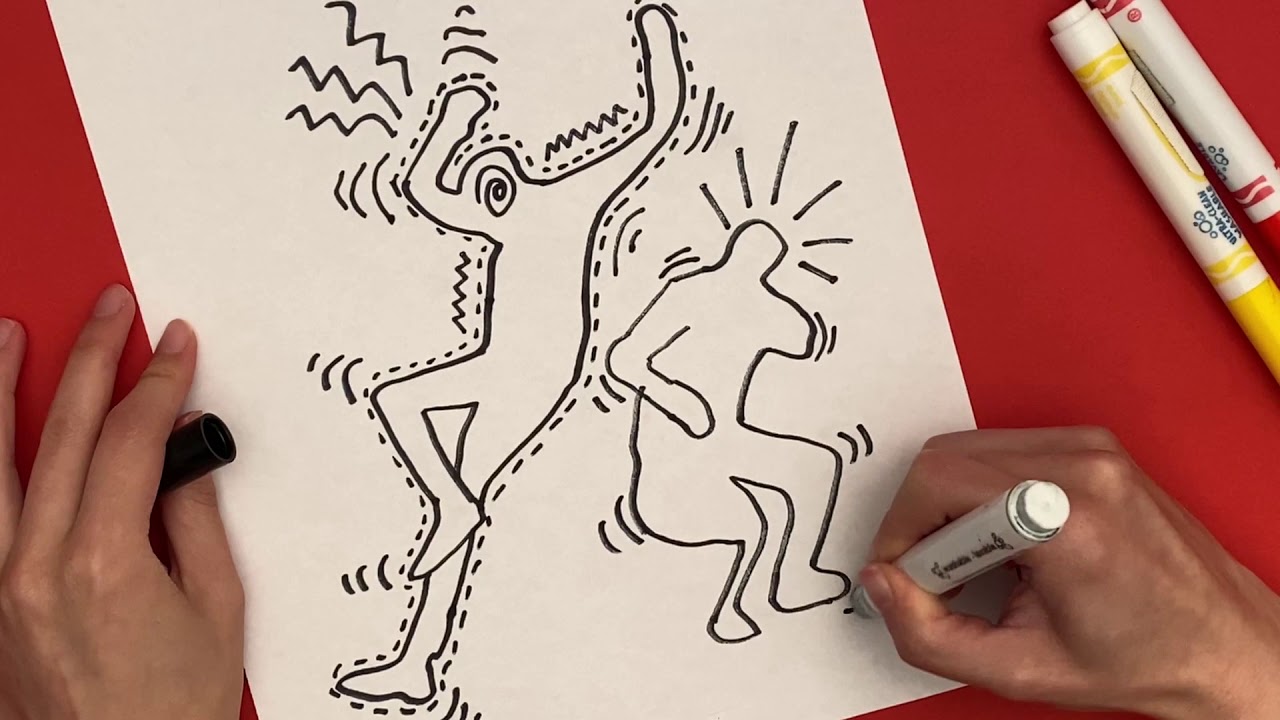
Haring’s lines have clean, continuous edges. No broken strokes, no visible brushwork anxiety, no corrections.
Compare to Basquiat’s fractured, overworked surfaces or Jean Dubuffet’s textured, encrusted mark-making. Haring’s surfaces stay smooth, graphic, poster-like.
His figures interlock like jigsaw pieces. Positive and negative shapes balance perfectly. This comes from treating the entire surface as unified field rather than figure-ground hierarchy.
Compositional Approach
No focal point in traditional sense.
All-over composition borrowed from Jackson Pollock but translated into cartoon clarity. Figures distribute across surface with equal visual weight. Eyes move continuously without resting. This creates energetic, activated feeling even in static images.
Materials, Techniques, and Process
Supports & Surfaces
Subway period (1980-1984): Matte black paper advertisement backing, NYC subway stations. Temporary, unauthorized, ephemeral.
Studio works: Primarily vinyl or muslin tarpaulin (early 1980s onward). Tarpaulin hung via grommets, not stretched like traditional canvas. Allowed monumental scale while maintaining street art aesthetic. Also used paper, wood panels, vases, found objects.
Public murals: Exterior walls, handball courts, building facades worldwide.
Painting Mediums
Chalk: White chalk on black paper, subway drawings. Clean, erasable, temporary.
Acrylic paint: Primary studio medium. Fast-drying, vibrant, opaque. Applied with brushes, sometimes palette knives.
Spray paint: For large-scale murals. Used commercial aerosol cans in primary colors: red, yellow, blue, plus green, orange. Chemical analysis of Tuttomondo mural (Pisa, 1989) revealed styrene/n-butyl propionate copolymer binders; Necker Hospital mural (Paris, 1987) used vinyl resin emulsion. Most spray works contained acrylic or alkyd resins modified with nitrocellulose.
Sumi ink: Japanese ink for works on paper, often combined with acrylic and spray paint.
Vinyl ink: Used on tarpaulin pieces. Created bold, flat color areas with strong adhesion to fabric support.
Markers & felt-tip pens: For drawings, small works, vase decorations.
Technical Approach
No preliminary sketches. Even on 60-foot murals. Direct execution, improvised.
Continuous line drawing: Pen/brush never lifts from surface during figure execution. Creates flowing, uninterrupted contour that gives work its signature energy. Line becomes a recording of gesture and speed.
Flat color application: No chiaroscuro, no modeling, no atmospheric effects. Pure local color within black outlines. This amplifies graphic punch, makes imagery readable from distance.
Edge control: Haring’s black outlines have consistent thickness, clean boundaries. No hesitation marks, no overpainting to correct edges. Mastery of brush control creates mechanical-looking precision achieved freehand.
Color Palette
Primary dominance: Red, yellow, blue as base. Plus orange, green (mixed or pre-mixed).
Temperature: Warm bias overall. Hot reds, bright yellows, electric oranges. Even blues skew toward cerulean rather than ultramarine.
Value range: Limited. Most works stay in middle-to-high values. Few darks except black outlines. This keeps work vibrant, optimistic, poster-like.
Color psychology: Used color contrast for maximum visibility. Orange against blue, red against green, yellow against purple. Borrowed from commercial design and signage.
Printmaking Techniques
Lithography: Collaborated with master printmakers to create editions. Drew on stone or metal plate with grease-based materials, then inked and printed. Allowed mass production while maintaining hand-drawn quality.
Silkscreen (screen printing): Created stencils, pressed ink through mesh screen. Used for posters, Pop Shop merchandise, multiples. Enabled consistent reproduction of bold graphic imagery.
Both techniques aligned with democratic art philosophy: make work affordable and widely available.
Studio Practice
Rapid execution: Could complete major paintings in single sessions. Movement and energy in finished work reflects speed of creation.
Alla prima approach: No layered glazing, no waiting for underpaint to dry. Direct, wet-into-wet when necessary, but usually one pass.
Repetitive motif system: Established vocabulary of 20-30 core symbols. Recombined in endless variations. This systematic approach allowed prolific output without creative exhaustion.
Scale flexibility: Same imagery worked at subway poster size (24×36 inches), mid-scale paintings (48×48, 60×60 inches), and monumental murals (300 meters Berlin Wall).
Themes, Subjects, and Iconography
Core Symbol Set
Radiant Baby (Radiant Child): Crawling infant with radiating lines. Represents innocence, purity, potential, Christ child. Most personal symbol for Haring. Also appears in darker contexts: atop nuclear mushroom clouds, in scenes of war. Multi-valent meaning: hope and destruction.
Barking Dog: Rectangular-snouted dog, aggressive posture. Authority, power, threat, sometimes protection. Anti-apartheid imagery used barking dogs as state violence symbol.
Dancing Figures: Interlocking human forms, linked arms and legs. Unity, community, joy, connection. Often forms human chains across composition.
Flying Saucer/UFO: Technology, surveillance, alien presence, Cold War paranoia.
Television: Media control, passive consumption, mind manipulation.
Heart: Love, desire, sometimes pierced or broken.
Cross/Plus Sign: Christianity, medical symbol, addition, intersection.
Pyramid: Ancient wisdom, conspiracy, power structures.
Three-Eyed Face: Heightened awareness, paranoia, surveillance state.
Dollar Sign: Capitalism, materialism, economic systems.
Compositional Structures
All-over patterning: Figures distribute evenly across surface. No traditional foreground/background. Inspired by Islamic tile work, prehistoric cave paintings, urban graffiti density.
Interlocking forms: Bodies connect, overlap, merge. Arms become legs, legs become snakes, snakes become ropes. Continuous flow of line creates unified field.
Radial energy: Lines emanate from central figures (especially Radiant Baby). Creates sense of radiation, explosion, cosmic energy.
Grid-like organization: Some works organize symbols in loose grid. Maintains visual order while allowing spontaneous variation within cells.
Political & Social Content
AIDS activism: Diagnosed 1988. Created “Silence=Death” (1989) with ACT UP. Pink triangle, urgent text, confrontational messaging. Many late works addressed stigma, fear, death, safe sex education.
Anti-apartheid: Posters and murals denouncing South African racial segregation. Used barking dogs, chains, divided figures.
Drug abuse: “Crack Is Wack” mural (1986, East Harlem handball court, visible from FDR Drive). Addressed crack cocaine epidemic devastating urban communities. Originally illegal, later preserved by city. Second version painted October 1986 after original vandalized.
Nuclear disarmament: Radiant Baby atop mushroom clouds. Figures fleeing explosions. Anti-nuclear proliferation messaging.
LGBTQ rights: Openly gay artist. Work addressed queer experience, persecution, community. Safe sex campaigns targeting gay community.
Accessible art philosophy: Opposed elitist gallery system. Created public murals, sold affordable merchandise through Pop Shop. Believed art belongs to everyone, not just collectors.
Religious Undercurrents
Teenage involvement with Jesus Movement (evangelical Christian group) left lasting mark. Radiant Baby originated from Christ Child imagery. Nativity scenes appear throughout subway drawings and paintings.
Late works include two religious triptychs gifted to Episcopal cathedrals. Illustrated Last Judgment, though salvation/damnation remained ambiguous.
Religious iconography mixed with contemporary symbols: Radiant Baby with TV screens, crosses with dollar signs, halos on queer bodies.
Notable Works
Radiant Baby (1982)

Medium: Various iterations – chalk, ink, acrylic, silkscreen
Signature motif, not single artwork
Current locations: Variations in MoMA, private collections, Pop Shop merchandise
Visual signature: Crawling infant, four limbs on ground, radiating lines emanating from body in all directions. Simple black outline, sometimes filled with single color (yellow, orange, red).
Why it matters: Became Haring’s personal logo and most recognizable image worldwide. Functioned as both signature and symbol. Represents “the purest and most positive experience of human existence” (Haring’s words). Used as subway tag, evolved into complex political symbol when placed in nuclear/war contexts.
Related works: Appeared in thousands of variations across all mediums and scales.
Crack Is Wack Mural (1986)

Medium: Spray paint on handball court wall
Size: Large-scale mural, both sides of handball court at East 128th Street and Second Avenue, Harlem
Current location: Still exists on site, restored 2007
Visual signature: Vibrant orange background, black-outlined figures in chaos. Serpentine creature, human figures, skulls, crosses, dollar signs. Bold text “CRACK IS WACK” dominates composition.
Why it matters: Created without permission, Haring arrested and fined $25. Media coverage led to preservation by NYC Parks Department. Direct community intervention addressing crack cocaine crisis. Proof that public art can function as activism. Restored 2007, remains visible from FDR Drive.
Related works: Second version painted October 1986 after original vandalized to read “Crack Is It.” Both versions documented by photographer Tseng Kwong Chi.
Berlin Wall Mural (1986)

Medium: Spray paint on concrete wall
Size: 300 meters (984 feet) long section
Location: Checkpoint Charlie, Berlin (destroyed 1989 when Wall demolished)
Visual signature: Human chain of interlocking yellow and red figures against German flag colors (black-red-yellow background). Figures hold hands and feet, creating continuous unity chain.
Why it matters: Invited by Checkpoint Charlie Museum. Painted during media frenzy with international press coverage. Symbolized hope for German reunification, protest against division. Haring stated intention to “destroy the wall through painting it.” Work existed only three years before Wall fell and mural destroyed with it. Documented in photographs and video.
Related works: Other political murals addressing Cold War, nuclear threat, freedom of movement.
Tuttomondo (1989)

Medium: Acrylic/spray paint on exterior building wall
Size: 180 square meters
Location: Sant’Antonio church, Pisa, Italy (still exists)
Visual signature: 30 interlocking figures in vibrant colors. Snakes, dancing people, figures holding babies, barking dog, all in Haring’s signature black outlines. Warm color palette: yellows, oranges, reds, greens, blues.
Why it matters: Last major public mural before death (1990). “Tuttomondo” means “all world” – represents universal harmony, peace, interconnectedness. Commissioned work, not guerrilla. One of few large-scale Haring murals still intact in original location. Chemical analysis revealed styrene/n-butyl propionate copolymer binders typical of commercial spray paint.
Grace House Mural (1983/1984)

Medium: Acrylic on wall
Size: Spanned three floors, 85 feet total
Original location: Catholic youth center, Upper West Side Manhattan (destroyed)
Visual signature: Radiant Baby, barking dog, dancing figures across multiple floors in connected composition.
Why it matters: Major indoor mural. When Grace House sold, Church of the Ascension went against Keith Haring Foundation’s wishes. Cut sections from walls, auctioned 13 panels for $3.86 million (2019). Ethical controversy over destroying/commodifying site-specific public artwork. Panels now in Museum of Contemporary Art Denver (loan from private collector).
Untitled (1982) – Record Sale

Medium: Acrylic and oil paint stick on canvas
Size: Standard large format
Location: Private collection
Visual signature: Radiant Baby, barking dogs, angels, red X marks – core Haring vocabulary
Why it matters: Sold Sotheby’s May 2017 for $6.5 million (record auction price for Haring). Original buyer Anatole Shagalov failed to pay. Resold August 2017 for $4.4 million. Demonstrates market peak and volatility.
Subway Drawings (1980-1985, series)
Medium: White chalk on matte black paper
Size: Roughly 24×36 inches (subway advertisement space)
Location: Originally NYC subway stations, now destroyed or in private collections
Visual signature: White chalk lines on black. Radiant Baby, barking dog, flying saucer, three-eyed face, dancing figures. Quick execution, visible chalk texture, occasional smudges from commuter contact.
Why it matters: Foundation of Haring’s public practice and fame. Created up to 40 daily at peak. Free, accessible, ephemeral. Documented by Tseng Kwong Chi photographs. By 1984, theft became problem as value increased. Some preserved, most destroyed. Directly inspired Tony Shafrazi Gallery 1982 debut exhibition poster design (white on black, chalk-like aesthetic).
Exhibitions, Collections, and Provenance
Major Solo Exhibitions (Lifetime)

1981: Westbeth Painters Space, NYC (first solo show)
1982: Tony Shafrazi Gallery, NYC (career breakthrough, October 9 – November 13, “Keith Haring Drawings”)
1983: Tony Shafrazi Gallery, “Into 84” (December 3 opening, featured Bill T. Jones body painting photography)
1984-1989: Over 50 solo exhibitions globally including Stedelijk Museum Amsterdam, Musée d’Art Moderne de la Ville de Paris, Museum Boijmans van Beuningen Rotterdam
1986: Multiple exhibitions including Stedelijk Museum Amsterdam major retrospective
Posthumous Exhibitions
1997: Whitney Museum retrospective (major career survey)
2008: Museum of Contemporary Art Lyon, France
2013: Musée d’Art Moderne de la Ville de Paris
2014: De Young Museum, San Francisco
2018: Albertina, Vienna
2019: Tate Liverpool
2020: National Gallery of Victoria, Melbourne
2023: Stedelijk Museum, Amsterdam
Museum Collections (Works Owned)
United States:
- Museum of Modern Art (MoMA), NYC
- Whitney Museum of American Art, NYC
- Solomon R. Guggenheim Museum, NYC
- Art Institute of Chicago
- Los Angeles County Museum of Art
- Smithsonian American Art Museum, Washington DC
Europe:
- Centre Georges Pompidou, Paris
- Stedelijk Museum, Amsterdam
- Ludwig Museum, Cologne
Depth collections: MoMA and Whitney hold multiple works spanning different periods and mediums.
Dealer Representation
Primary dealer: Tony Shafrazi Gallery (1982-1990). Shafrazi gave Haring first major solo show, represented him throughout career. Gallery located 163 Mercer Street, Soho.
Secondary representation: Leo Castelli Gallery (occasional collaborations)
Estate management: Keith Haring Foundation (established 1989) manages estate, licenses imagery, represented by Gladstone Gallery.
Pop Shop (1986-2005)
Original location: Lafayette Street, Soho, NYC (opened April 1986)
Concept: Retail space selling affordable merchandise featuring Haring imagery. T-shirts, posters, toys, buttons, magnets. Walls and ceiling covered in Haring murals. Philosophy: art should be accessible to everyone, not just collectors.
Controversy: Art world critics accused Haring of “selling out.” Haring defended as extension of subway practice, democratizing art.
Tokyo location: Opened January 30, 1988. Closed summer 1988 due to counterfeit competition and disappointing sales. Painted shipping containers that formed shop structure given to art publisher George Mulder, Berlin. Containers restored, exhibited Saint Tropez (2005).
NYC closure: August 28, 2005 (15 years after Haring’s death). Rising rent, insufficient income. Ceiling donated to New York Historical Society.
Legacy exhibitions: Tampa Museum of Art, “Keith Haring Art & Commerce” (2006); Tate Modern, “Pop Life: Art in a Material World” (2009, shop reconstructed).
Catalogue Raisonne Projects
Keith Haring Posters catalogue (Doring & Von Der Osten) documents poster works.
No complete catalogue raisonne exists for paintings/drawings due to massive output (thousands of subway drawings alone, plus studio works, murals, prints).
Provenance Patterns
Early collectors: acquired directly from Tony Shafrazi Gallery exhibitions or Pop Shop.
Estate works: Keith Haring Foundation held large collection, conducted online auction through Sotheby’s (October 2020) selling 140+ works. “Dear Keith” auction exceeded $1.4 million estimate, achieved $4.6 million, 100% sell-through. Proceeds to LGBT Community Center of New York.
Theft and forgery: Subway drawings stolen while wet in 1980s. Counterfeit merchandise plagued Pop Shop, especially Tokyo location. Today, authentication requires Foundation approval.
Market & Reception
Auction Records
Peak: $6.5 million (May 2017, Sotheby’s NYC, Untitled 1982)
- Buyer failed to pay
- Resold August 2017 for $4.4 million (actual realized price)
Typical price bands:
- Major canvases (48×48″+): $500,000 – $2 million
- Mid-size paintings: $200,000 – $800,000
- Works on paper: $50,000 – $300,000
- Prints/multiples: $5,000 – $100,000
Market factors: Consistent demand. Pop art category remains strong. Imagery recognizable to non-collectors increases liquidity. Estate control prevents market flooding.
Authentication Challenges
Foundation role: Keith Haring Foundation maintains authentication board. All works require Foundation approval for authentication.
Common issues:
- Forged signatures (Haring’s signature evolved over time)
- Fake prints/multiples (original Pop Shop merchandise versus counterfeits)
- Misattributed collaborations (Angel “LA II” Ortiz contributed to many works but often uncredited)
Provenance importance: Tony Shafrazi Gallery records, exhibition history, Foundation documentation critical for authentication.
Conservation Issues
Chalk drawings: Original subway works (if preserved) extremely fragile. Chalk smudges, paper degrades.
Spray paint murals: Outdoor works face weathering, UV damage, graffiti vandalism. Tuttomondo (Pisa) and Crack Is Wack (Harlem) underwent restoration. Chemical analysis reveals binder degradation, color fading over decades.
Tarpaulin works: Vinyl/muslin support more stable than expected. Some color shift in vinyl inks over 40 years.
Paper works: Sumi ink generally stable. Acrylic and spray combinations on paper can show minor surface changes.
General condition concerns: Works on paper show typical foxing, toning. Most canvas/tarpaulin works in good condition due to recent creation (1980s). Outdoor murals require active conservation.
Influence & Legacy
Direct Artistic Influence
Street artists: Banksy, Shepard Fairey (Obey), Swoon, Invader, JR. Haring legitimized street art as fine art. Proved public space could launch gallery careers. Demonstrated that graphic simplicity communicates across cultures.
Pop artists: KAWS, Takashi Murakami, Yoshitomo Nara. Cartoon-influenced imagery, commercial collaboration, merchandise as art practice.
Graphic designers: Haring’s bold outlines, flat color, symbolic vocabulary influenced poster design, logo design, illustration. Visible in contemporary streetwear graphics, sneaker collaborations, brand identity.
Cross-Domain Impact
Fashion: Coach released Keith Haring collection (2018) featuring Radiant Baby, dancing figures on bags, clothing. Uniqlo, Reebok, others license imagery for apparel. Haring predicted art-fashion fusion in 1980s Pop Shop.
Music: Grace Jones collaboration (body painting for performances, “Slave to the Rhythm” album art). Madonna (personal friendship, design work). Contemporary artists continue sampling Haring imagery in music videos, album art.
Film/TV: Documentary “The Universe of Keith Haring” (2008). Biopic development announced (2025, director Andrew Haigh adapting Brad Gooch biography “Radiant: The Life and Line of Keith Haring”).
Technology: Google Doodle honored Haring (May 4, 2012, 54th birthday). Digital artists reference Haring’s line work in animation, GIF art, emoji design.
Institutional Recognition
Museums: Major institutions (MoMA, Whitney, Tate) validated street art as museum-worthy. Haring’s inclusion opened doors for graffiti artists, outsider artists, public artists.
LGBTQ legacy: Rainbow Honor Walk, San Francisco Castro neighborhood (2014, inaugural honoree). Place Keith Haring dedicated in Paris 13th arrondissement (2018).
AIDS activism: Haring Foundation continues funding AIDS organizations, children’s programs. Late work remains central to AIDS activism visual history alongside Gran Fury collective, ACT UP graphics.
Philosophical Legacy
Democratic art: Haring’s insistence that art belongs in public space, on merchandise, outside museums influenced contemporary art practice. Artists now routinely work across gallery shows, public murals, commercial collaborations without contradiction.
Social responsibility: Demonstrated artists can address political issues directly without sacrificing aesthetic power. Used commercial success to fund activism (Haring Foundation established 1989).
Visual language: Proved that simple, repeated symbols could communicate complex ideas. Influenced emoji culture, international signage, pictograph systems.
Critical Reception Evolution
1980s: Mixed. Celebrated for energy, public engagement, commercial success. Criticized for “selling out” (Pop Shop), simplification, commercialism.
1990s-2000s: Posthumous reassessment. Recognition of AIDS activism, political content beneath cartoon surface. Whitney retrospective (1997) established art historical significance.
2010s-present: Full canonization. Major museum exhibitions worldwide. Scholarly attention to collaborations (Angel Ortiz finally credited), LGBTQ themes, activist strategies. Market prices rival established 20th century artists.
Contemporary Relevance
Haring’s accessible visual language remains relevant in social media age. Imagery shareable, instantly recognizable, politically charged but aesthetically pleasing. Perfect for Instagram, memes, protest graphics.
AIDS activism work resonates during COVID-19 pandemic. “Silence=Death” echoes in contemporary health crisis discourse.
Anti-apartheid, anti-nuclear, anti-drug messaging adapts to current social justice movements. Black Lives Matter protests used Haring-style graphics. Climate activists employ his all-over composition strategy, interlocking figures representing global unity.
How to Recognize a Haring at a Glance

Diagnostic checklist:
- Continuous black outline: Thick, flowing, unbroken line work. No visible starts/stops, no hesitation marks.
- Flat color fields: No shading, no modeling, no atmospheric perspective. Pure local color within black boundaries.
- Radiant Baby or barking dog: If present, likely Haring. Both are signature motifs rarely used by other artists.
- Primary color dominance: Red, yellow, blue as base palette. Plus orange, green. Bright, optimistic temperature.
- All-over composition: No single focal point. Figures distribute evenly across surface.
- Interlocking forms: Bodies connect, arms become legs, lines flow continuously from figure to figure.
- No texture: Smooth surface, no impasto, no visible brushwork beyond clean edges.
- Scale flexibility: Same imagery works at 12×12 inches or 300 meters. Graphic clarity maintained across sizes.
- Medium-specific execution: Chalk on black = subway period (1980-1984). Vinyl ink on tarp = early-mid 1980s studio work. Spray paint = outdoor murals.
- Signature placement: Often unsigned, or signed “K. Haring” in black marker. Radiant Baby sometimes functioned as signature. Unlike most artists, Haring didn’t always sign works, especially subway drawings.
FAQ on Keith Haring
What is Keith Haring known for?
Keith Haring is known for his bold graffiti-inspired drawings in New York City subway stations and vibrant pop art featuring dancing figures, barking dogs, and the Radiant Baby. His accessible visual language addressed AIDS activism, apartheid, and drug abuse through public murals and commercial merchandise.
What was Keith Haring’s art style?
Haring’s style featured continuous black outlines, flat primary colors, and cartoon-like figures without shading or texture. He worked with rapid execution, never sketching beforehand, creating energetic compositions that distributed figures evenly across surfaces in all-over patterns.
How did Keith Haring die?
Haring died on February 16, 1990, at age 31 from AIDS-related complications. Diagnosed in 1988, he established the Keith Haring Foundation in 1989 to support AIDS organizations and children’s programs. His late work became increasingly focused on AIDS awareness and activism.
What does the Radiant Baby symbolize?
The Radiant Baby represents innocence, purity, and potential. Haring described it as “the purest and most positive experience of human existence.” The crawling infant with radiating lines also referenced the Christ Child and appeared in darker contexts atop nuclear mushroom clouds.
Where can I see Keith Haring’s art?
Haring’s work is in the Museum of Modern Art, Whitney Museum, Art Institute of Chicago, and Centre Georges Pompidou. His “Crack Is Wack” mural remains visible in East Harlem. Tuttomondo (1989) still covers a church wall in Pisa, Italy.
What materials did Keith Haring use?
Haring used white chalk on black paper for subway drawings, acrylic paint and spray paint for murals, and vinyl ink on tarpaulin for studio works. He also worked with sumi ink, markers, lithography, and silkscreen printing for multiples and Pop Shop merchandise.
Why did Keith Haring open the Pop Shop?
The Pop Shop (1986-2005) sold affordable merchandise featuring Haring’s imagery. He wanted to make art accessible to everyone beyond collectors and combat counterfeit versions of his work. Critics called it commercialism; Haring defended it as democratic art practice extending his subway philosophy.
Who influenced Keith Haring?
Andy Warhol mentored Haring and supported the Pop Shop concept. Jean-Michel Basquiat and Kenny Scharf were close peers. Pierre Alechinsky, Jean Dubuffet, and William Burroughs’ cut-up technique shaped his visual approach. His father taught him basic cartooning, while Disney and Dr. Seuss provided early inspiration.
What was Keith Haring’s political message?
Haring’s work addressed AIDS awareness, anti-apartheid campaigns, nuclear disarmament, crack cocaine epidemics, and LGBTQ rights. His “Silence=Death” piece (1989) became an iconic AIDS activism image. “Crack Is Wack” warned against drug abuse. He believed art should serve social justice, not just aesthetics.
How much is Keith Haring’s art worth?
Haring’s record auction price is $6.5 million (2017, though the buyer defaulted and it resold for $4.4 million). Major canvases typically sell for $500,000-$2 million. Works on paper range $50,000-$300,000. Prints and multiples cost $5,000-$100,000. The Keith Haring Foundation authenticates all works.
Conclusion
Keith Haring collapsed the barrier between gallery walls and city streets, proving that contemporary art could speak to everyone. His continuous line work and symbolic vocabulary created a universal language that transcended traditional art world boundaries.
From subway chalk drawings to the Pop Shop, Haring democratized access to visual culture. His barking dogs and dancing figures weren’t just playful cartoons but urgent messages about social justice, nuclear war, and the AIDS crisis.
His legacy lives beyond museum collections. Street artists, graphic designers, and activists continue mining his belief that art belongs in public space, not locked behind institutional doors.
The Radiant Baby still radiates. Haring’s painting styles influenced generations of artists who blend commercial appeal with political bite, who treat merchandise and murals as equally valid creative expressions.