A sixteen-foot sculpture sits slumped outside a Texas museum, head buried in cartoon-gloved hands. KAWS turned Mickey Mouse into an icon of modern exhaustion.
Brooklyn-based artist Brian Donnelly built a career that confuses every boundary between street art and museum walls, between $15 T-shirts and $14 million paintings. His XX-eyed characters appear on Uniqlo racks and in permanent collections simultaneously.
This guide breaks down how a Jersey City graffiti writer became one of contemporary art’s most recognized figures. You’ll learn his techniques, understand his character vocabulary, and see why collectors and critics can’t agree on his legacy.
We cover his origins in 1990s subvertising, his material processes across vinyl and bronze, his collaborations from Dior to Sesame Street, and the market forces that crashed MoMA’s website when he dropped a $200 toy.
Identity Snapshot
Brian Donnelly (KAWS)
Born November 4, 1974, Jersey City, New Jersey
Primary roles: Painter, sculptor, designer, product designer
Nationality: American
Movements: Street art, pop art, contemporary art, urban art
Mediums: Acrylic painting on canvas, vinyl toys, fiberglass, bronze, wood, aluminum, screen prints
Signature traits: XX eye motif, skull and crossbones imagery, hard-edge graphic style, flat color application, cartoon appropriation
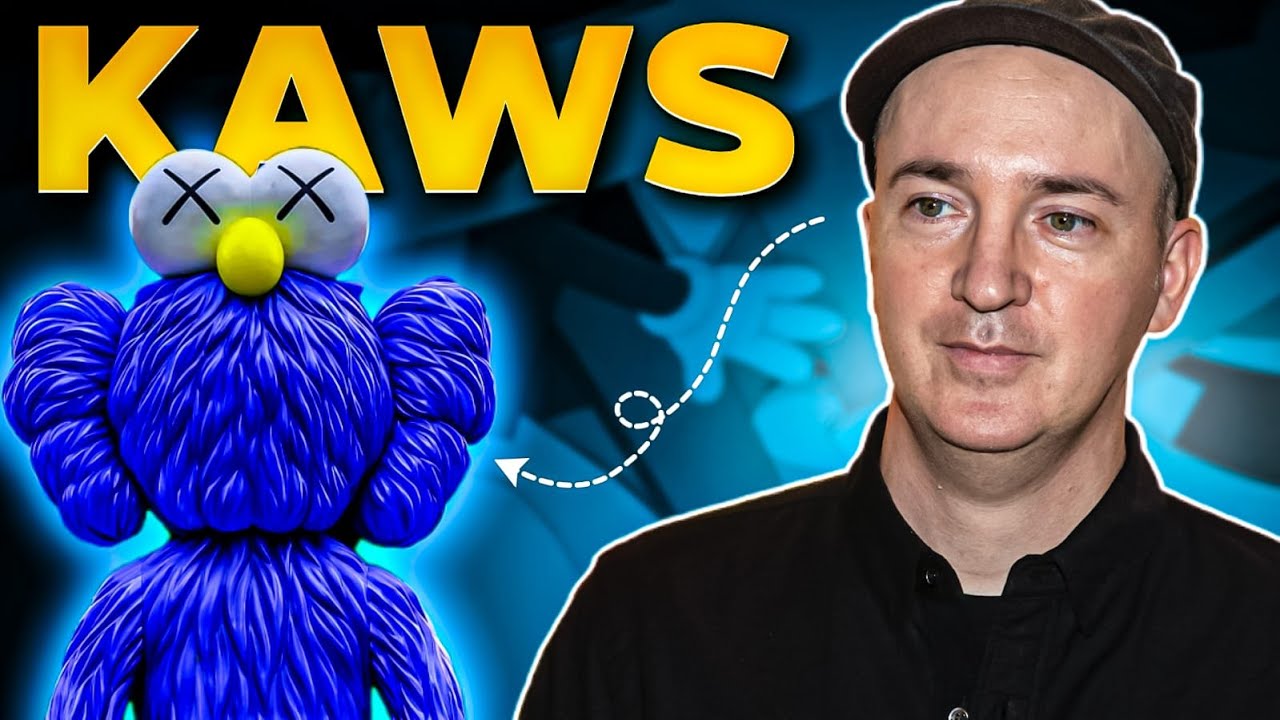
Iconography: Companion, BFF, Chum, Accomplice, Bendy characters; crossed-out eyes; gloved hands
Geographic anchors: Jersey City (birthplace), Brooklyn (current studio), Tokyo (collaborations), Hong Kong (public installations)
Key collaborations: Medicom Toy, Bounty Hunter, Uniqlo, Dior, Nike, Comme des Garçons, Sesame Street Workshop
Collections: Brooklyn Museum, Modern Art Museum of Fort Worth, Museum of Contemporary Art San Diego, National Gallery of Victoria, Museum of Modern Art
Market signals: $14.7 million auction record (The KAWS Album, 2005), typical vinyl figures 8-34 inches, monumental sculptures up to 10 meters
What Sets The Artist Apart
KAWS demolished barriers between commercial design and fine art decades before it became fashionable. His XX-eyed characters exist simultaneously as $200 vinyl toys and million-dollar acrylic paintings.
The work operates on emotional frequency rather than intellectual distance. Where Andy Warhol maintained cool detachment from his pop art subjects, KAWS infuses recognizable cartoon forms with visible vulnerability.
His Companion figure, slumped with head in hands, channels human exhaustion through Mickey Mouse’s body. That’s the trick: borrowed iconography carrying genuine pathos.
The color palette stays punchy (hot pinks, electric blues, acidic greens) but the compositions often depict isolation. Bright surfaces, melancholic subjects.
KAWS built a global audience outside traditional gallery systems first, then museums came calling. The trajectory reversed the usual path.
Origins & Formation
Jersey City Beginnings (1974-1992)
Donnelly grew up middle class in Jersey City. His father worked as a stockbroker; his mother stayed home.
Neither parent showed interest in his early graffiti work, which started in seventh grade. He created the KAWS tag simply because the letters fit together visually. The word means nothing.
While attending St. Anthony High School, he painted KAWS on a nearby building’s roof so he could see it from classroom windows.
School of Visual Arts (1992-1996)
Earned a BFA in illustration at School of Visual Arts, New York. Studied traditional techniques while painting illegal street art at night.
The dual life (student by day, graffiti writer after dark) established his pattern of working across supposedly separate worlds.
Graduated 1996 and immediately took freelance animation work at Disney-owned Jumbo Pictures. Painted backgrounds for 101 Dalmatians, Daria, and Doug.
Animation taught him clean line work and character consistency. But the job bored him.
Early Street Interventions (1996-1999)
Started “subvertising” in the late 1990s. Used a skeleton key (gift from graffiti artist Barry McGee) to open bus shelter and phone booth ad frames.
He’d remove posters, take them to his studio, paint his characters over existing advertisements, then reinstall them. The ads stayed functional but now featured his XX-eyed figures merged with fashion models and corporate messaging.
This guerrilla work gained underground attention. People started stealing the modified ads to collect them.
Made multiple trips to Tokyo, where youth culture embraced his aesthetic immediately.
First Toy Production (1999)
Japanese streetwear brand Bounty Hunter produced his first Companion vinyl figure in 1999. Limited run of 500 pieces, eight inches tall.
Sold out fast. That success launched two decades of toy collaborations.
Movement & Context
Pop Art Lineage

KAWS works within pop art traditions established by Andy Warhol and Roy Lichtenstein, but his approach diverges significantly.
Compared to Warhol: Both appropriate commercial imagery. Warhol maintained ironic distance; KAWS injects emotional content. Warhol silk-screened Campbell’s soup cans unchanged; KAWS reimagines Mickey Mouse with crossed-out eyes and skull anatomy.
Compared to Lichtenstein: Both use hard-edge graphic styles and borrow from popular culture. Lichtenstein quoted comic panels directly with Ben-Day dots; KAWS creates hybrid characters that reference multiple sources simultaneously.
Compared to Keith Haring: Closer parallel. Both started in street art, developed instantly recognizable iconography, worked in commercial realms (Haring’s Pop Shop, KAWS’s toy collaborations), and created public installations. But Haring’s figures stayed abstract and energetic. KAWS’s characters register as specific personalities with visible emotions.
Contemporary Street Art Context

Compared to Banksy: Both subvert advertising and maintain street credibility while commanding high gallery prices. Banksy stays anonymous and political; KAWS works publicly under his tag and focuses on emotional rather than ideological messaging.
Compared to Takashi Murakami: Strongest contemporary parallel. Both blur high/low art distinctions, create cartoon-inspired characters, produce commercial collaborations, and command serious auction prices. Murakami’s Superflat theory explicitly connects fine art to otaku culture; KAWS operates similarly but without manifesto-level theorizing.
Technical Distinctions
KAWS uses cleaner edges than most street artists. His acrylic paintings show no visible brushwork, achieving almost mechanical precision through hand painting.
Most pop art predecessors worked in screen printing or mechanical reproduction. KAWS paints by hand but makes it look printed.
Materials, Techniques, and Process
Painting Materials
Works primarily in acrylic on canvas. Chooses acrylics for their fast drying time and flat, matte finish.
Canvas surfaces are pre-primed, often commercial-grade stretched canvas in standard and custom sizes. Ranges from intimate 18×18 inch works to massive multi-panel installations.
Color Application
Applies paint in thin, even layers. No impasto, no visible brushstrokes. The surface reads as smooth and industrial.
Uses high-flow acrylics or adds matte medium to achieve consistent viscosity. Multiple thin coats rather than single thick applications.
Hard edges achieved through careful masking and steady hand control. No tape lines visible in finished works.
Palette Construction
Dominant hues: Hot pinks, electric blues, bright yellows, lime greens, pure black, white
Value distribution: High contrast with pure colors against black or white grounds
Temperature bias: Tends toward cool colors (blues, purples) for melancholic subjects; warm colors (pinks, yellows) for energetic compositions
Rarely uses earth tones or muted colors. The palette stays saturated and synthetic.
Sculptural Materials
Vinyl figures: Produced through rotocasting. Hollow interiors, hand-painted surfaces, editions numbered and signed on feet
Fiberglass sculptures: Medium-scale works (5-16 feet). Lightweight, durable, suitable for public installations
Bronze sculptures: Monumental works cast through traditional lost-wax process. Painted surfaces over bronze (unusual choice that references toy finishes)
Wood sculptures: Large-scale painted wood constructions. Often shown outdoors
Inflatable sculptures: Steel pontoon structures supporting massive inflatables (KAWS Holiday series)
Studio Practice
Works in a large Brooklyn studio. Employs assistants for production but maintains hands-on involvement.
Paintings start with digital sketches and compositional planning. Transfers outlines to canvas, then fills areas with flat color.
No visible underdrawing in finished works. Clean, graphic execution.
Sculpture prototypes start small (clay or digital modeling), then scale up through fabrication partners. KAWS oversees production closely and hand-paints many surfaces himself.
Themes, Subjects, and Iconography
Core Characters

Companion (1999-present): Most recognizable figure. Based on Mickey Mouse with skull-and-crossbones head, XX eyes, cartoon gloves and shoes. Usually shown in poses of exhaustion, grief, or isolation.
BFF (2016-present): Shaggy, fur-covered character with bulging eyes. Inspired by Sesame Street’s Elmo/Grover aesthetic. Often depicted embracing Companion or in vulnerable positions.
Chum (2002-present): Rotund, inflated figure based on Michelin Man. Despite cheerful appearance, frequently shown in slouched or overwhelmed postures.
Accomplice: Bunny-like character with long ears and similar XX eye treatment. Less frequently deployed than Companion.
Bendy: Amoeba-shaped character from early graffiti days. Snake-like, fluid form used in advertisement subversions.
Recurring Motifs
XX marks appear on eyes, hands, ears across all characters. Originally a graffiti tag signature, now reads as symbol of death, cancellation, or emotional shutdown.
Skull and crossbones reference punk aesthetics, cartoon danger symbols, and mortality.
Gloved hands (borrowed from early animation) cover faces, reach out, or hang limply depending on emotional content.
Compositional Patterns
Isolated figures: Single characters occupying pictorial space alone, suggesting loneliness or introspection
Embracing pairs: Two figures holding each other (often Companion + BFF), depicting comfort-seeking or co-dependence
Fragmented abstractions: Characters broken into geometric shapes and color planes, showing psychological dissolution
Crowds: Multiple characters packed together (The KAWS Album), exploring mass culture and collective identity
Emotional Range
Despite cartoon origins, the work traffics in adult emotions: exhaustion, anxiety, grief, isolation, tenderness.
The juxtaposition of cheerful forms (bright colors, cartoon bodies) with dejected poses creates productive tension.
Viewers recognize themselves in the slumped postures and covered faces. The work feels personal despite using borrowed iconography.
Cultural Commentary
KAWS addresses consumer culture by working within it. The characters exist as both critique and product.
Appropriating Mickey Mouse and other corporate mascots questions who owns popular imagery. His modifications suggest these icons belong to collective consciousness, available for reinterpretation.
The work also reflects modern alienation. Characters designed for children’s entertainment now express adult disappointment.
Notable Works
The KAWS Album (2005)

Medium: Acrylic on canvas
Size: Large-scale (exact dimensions 118 x 153 inches)
Location: Private collection (sold through Sotheby’s Hong Kong)
Reimagines The Beatles’ Sgt. Pepper’s Lonely Hearts Club Band album cover using Simpsons characters. All figures feature KAWS’s XX eyes and skull modifications.
Why it matters: Set artist’s auction record at $14.7 million in 2019. Demonstrated his ability to merge multiple pop culture references (Beatles + Simpsons + street art) into unified composition.
Commissioned by Japanese streetwear designer Nigo, showing early intersection of fashion and fine art in his career.
WHERE THE END STARTS (2011)

Medium: Acrylic on canvas
Location: Modern Art Museum of Fort Worth permanent collection
Large painting acquired directly from artist’s first museum solo exhibition. Features fragmented Companion figures in jewel tones against white ground.
Why it matters: First major museum acquisition, legitimizing his practice within institutional contexts.
The composition shows his mature style: hard-edge abstraction derived from figurative sources, high color saturation, sophisticated spatial layering.
COMPANION (PASSING THROUGH) (2010)

Medium: Fiberglass, metal structure, paint
Size: 16 feet tall
Location: Various installations; originally Honor Fraser Gallery
Monumental seated Companion with head in hands. The pose directly references Rodin’s The Thinker but replaces philosophical contemplation with visible emotional overload.
Why it matters: Installed outside Modern Art Museum of Fort Worth, bringing street art scale and accessibility to museum context. The work functions as public art without requiring institution entry.
Smaller version became balloon in 2012 Macy’s Thanksgiving Day Parade, reaching millions of viewers.
FAMILY (2021)

Medium: Bronze with paint
Size: Larger-than-life
Location: Private collection; shown in multiple exhibitions
Bronze sculpture grouping Companion, BFF, and Chum in family portrait configuration. Figures embrace and support each other.
Why it matters: Title work for major touring exhibition (Art Gallery of Ontario, SFMOMA). Represents his mature exploration of connection and interdependence.
The bronze casting with painted surface challenges traditional sculpture conventions, maintaining toy aesthetic at monument scale.
KAWS Holiday Series (2018-2023)

Medium: Inflatable sculpture (steel pontoon, vinyl)
Sizes: Up to 121 feet long (Hong Kong installation)
Locations: Seoul, Taipei, Hong Kong Victoria Harbour, Tokyo, Mount Fuji
Massive floating Companion sculptures installed in public waterways and landscapes. The reclining figure rests peacefully on water or land.
Why it matters: Brought contemporary art to unprecedented public audiences (millions of viewers). Demonstrated sculpture’s potential to activate urban spaces without commercial sponsorship pressure.
Each installation photographed extensively, creating viral social media moments that extended reach beyond physical viewers.
ALONG THE WAY (2013)

Medium: Acrylic on canvas
Location: Brooklyn Museum permanent collection
Multi-panel abstract composition fragmenting Companion into geometric color fields. Shapes interlock and overlap creating spatial ambiguity.
Why it matters: Brooklyn Museum’s first KAWS acquisition, significant given Brooklyn as his home base. Shows his progression from figurative character work into sophisticated abstraction.
The painting demonstrates how his vocabulary functions beyond literal representation.
Exhibitions, Collections, and Provenance Highlights
Major Solo Exhibitions

KAWS: WHERE THE END STARTS (2016-2017)
Modern Art Museum of Fort Worth, then Yuz Museum Shanghai. First major survey, approximately 100 works spanning two decades.
KAWS: WHAT PARTY (2021)
Brooklyn Museum. First New York museum retrospective. Featured paintings, sculptures, drawings, and commercial collaborations.
KAWS: FAMILY (2021-2026)
Originated Art Gallery of Ontario. Traveled internationally including SFMOMA presentation. Over 100 works organized thematically around connection and relationships.
BLACKOUT (2019)
Skarstedt Gallery London. First London solo show featuring SHARE sculpture series.
KAWS: HOLIDAY (2018-2023)
Public art series across Asia. Massive floating Companion installations in Seoul, Taipei, Hong Kong, Tokyo, Mount Fuji.
Museum Collections (3+ works)
Modern Art Museum of Fort Worth
Acquired WHERE THE END STARTS (2011) from Focus exhibition. COMPANION (PASSING THROUGH) temporarily installed 2012-2013. Houses comprehensive holding of paintings and works on paper.
Brooklyn Museum
First major institution to acquire work for permanent collection. ALONG THE WAY (2013) plus additional holdings.
Museum of Contemporary Art San Diego
Single significant sculpture in outdoor installation.
Gallery Representation
Skarstedt Gallery (New York, London)
Primary gallery representation since mid-2010s. Handles major paintings and sculptures.
Galerie Perrotin (Paris, Hong Kong, Seoul, Tokyo, New York, Shanghai)
Represents work in Asian and European markets.
Honor Fraser Gallery (Los Angeles)
Early supporter, facilitated major sculpture installations.
Notable Private Collections
Collected by Swizz Beatz (music producer), Pharrell Williams, Kid Cudi, BTS members, PewDiePie. The collector base spans art world insiders and popular culture figures.
Catalogues Raisonnés
No official catalogue raisonné published yet. Comprehensive documentation challenging given volume of commercial products, unauthorized works, and ongoing production.
Major exhibition catalogues serve as primary documentation: WHERE THE END STARTS (2016), KAWS: FAMILY (2021).
Market & Reception
Auction Records
Primary record: The KAWS Album (2005) – $14.7 million, Sotheby’s Hong Kong, April 2019
Previous record: THE KAWS ALBUM study – $2.7 million, 2018
Sculpture record: Seated Companion (2011) – $411,000, Phillips London, May 2017
Price Ranges by Medium
Original paintings: $100,000 – $14.7 million depending on size, period, subject
Screen prints: $5,000 – $50,000 for editions
Vinyl figures: $200 – $5,000 retail; secondary market varies wildly. Limited editions often flip for 5-10x retail immediately.
Monumental sculptures: Seven figures for institutional commissions and private sales
Market Patterns
Strong secondary market for vinyl toys often exceeds original retail by 500-1000%. Creates accessibility issues as affordable editions become expensive collectibles instantly.
Younger collector demographic (millennials, Gen Z) drives demand. Instagram following exceeds 3.3 million.
2017 MoMA Design Store release of $200 Companion figure crashed website multiple times due to traffic.
Uniqlo collaborations (T-shirts $15-30) provide genuine accessibility, selling millions of units.
Authentication
Vinyl figures signed/stamped on feet. Edition numbers when applicable.
Paintings signed and dated on reverse. Artist maintains studio records.
Counterfeiting major problem, particularly for toys. 2023 legal victory against Singaporean counterfeiters who replicated Companion and other characters.
Condition Issues
Vinyl figures: color fading from UV exposure, paint chips, disintegrating original boxes
Paintings: generally stable due to acrylic medium. Surface accumulates dust on matte finish.
Bronze sculptures with paint: outdoor installations show weathering. Paint maintenance required.
Critical Reception
Supporters credit democratizing art access, emotional authenticity, technical skill, bridging commercial/fine art divide.
Detractors (Anny Shaw, M.H. Miller) argue work is “conceptually bankrupt,” serves primarily as billionaire investment vehicle rather than cultural contribution.
KAWS himself remains modest about prices: “It’s not worth what people pay on resale.”
The debate mirrors broader contemporary art arguments about accessibility, commercialization, and institutional validation.
Influence & Legacy
Upstream Influences
Direct predecessors:
Andy Warhol – appropriation strategies, commercial collaborations
Roy Lichtenstein – hard-edge graphic style, pop culture sources
Keith Haring – street art to gallery trajectory, public accessibility
Claes Oldenburg – sculpture scale shifts, everyday objects as art
Takashi Murakami – anime/manga aesthetics, Superflat theory, commercial collaborations
Graffiti influences:
Barry McGee – technical mentor, gifted skeleton key for ad interventions
Futura 2000 – abstract graffiti, gallery crossover
Lee Quiñones – large-scale train paintings, graffiti as fine art
Animation sources:
Disney’s Mickey Mouse, Fleischer Studios rubber-hose animation, Sesame Street characters, The Simpsons, Snoopy/Peanuts
Downstream Impact
On contemporary artists:
Legitimized toy/figure production as fine art medium. Artists like KNGHTMRE, Daniel Arsham, FriendsWithYou now work in similar territory.
Demonstrated viability of Instagram-driven art careers bypassing traditional gallery systems initially.
On commercial design:
Fashion houses (Dior, Uniqlo, Comme des Garçons) now regularly collaborate with contemporary artists, model KAWS helped establish.
Toy industry recognized adult collector market potential. Designer toy movement exploded partially due to his success.
On institutions:
Museums increasingly program street art and commercial design-adjacent work. Brooklyn Museum, Modern Fort Worth acquisitions signaled institutional acceptance.
MoMA Design Store toy releases showed museums embracing product sales beyond traditional merchandise.
Cross-Domain Echoes
Fashion: His silhouettes appear in streetwear globally. The XX eye motif functions as shorthand for contemporary cool.
Music: Album covers for Kanye West (808s & Heartbreak), Travis Scott, Kid Cudi integrated his aesthetic into hip-hop visual culture.
Architecture/Design: Estúdio Campana loveseat collaboration (plush toys as furniture) explored functional applications.
Technology: Augmented reality projects (Acute Art platform) extended characters into digital space, pioneering AR art applications.
Cultural Impact
KAWS proved street art credibility and commercial success aren’t mutually exclusive. His career path, once controversial, now seems prescient.
The work demonstrated cartoon imagery could carry genuine emotional weight for adult audiences without irony.
Made contemporary art genuinely accessible to non-art-world audiences through affordable products while maintaining high-end market simultaneously.
How to Recognize a KAWS at a Glance

Visual diagnostics:
- XX marks over eyes, hands, or throughout composition – his signature element
- Skull and crossbones head on humanoid cartoon body (Companion)
- Mickey Mouse gloves and shoes combined with non-Disney anatomy
- Flat, matte color application with zero visible brushwork
- Hard-edge shapes with clean borders, mechanical precision
- High color saturation – pure, bright hues (hot pink, electric blue, lime green)
- Dejected postures – head in hands, slumped shoulders, curled positions
- Gloved hands covering face – recurring gesture across works
- Hybrid cartoon anatomy – recognizable source (Mickey, Elmo, Michelin Man) with modifications
- Signature on feet – vinyl figures stamped/signed on underside of feet
- Consistent character design – same figures appear repeatedly across mediums
- Toy-like finish – even on paintings and bronze, surfaces reference vinyl toy aesthetics
FAQ on KAWS
What does KAWS stand for?
KAWS doesn’t stand for anything. Brian Donnelly created the tag in high school because he liked how the letters looked together visually.
The name has no meaning beyond its aesthetic appeal. He painted it on a building roof visible from his Jersey City classroom windows.
Who is the artist behind KAWS?
Brian Donnelly, born November 4, 1974, in Jersey City, New Jersey. He graduated from School of Visual Arts in 1996 with a BFA in illustration.
Started as a graffiti artist, worked briefly in Disney animation, then built his contemporary art career. Now lives and works in Brooklyn with his wife, sculptor Julia Chiang.
What is KAWS most famous for?
His Companion character, a Mickey Mouse reimagining with skull-and-crossbones head and XX eyes. The figure appears in vinyl toys, monumental sculptures, and acrylic paintings.
Also known for blurring fine art and commercial design through collaborations with Uniqlo, Dior, and major museums. His work reached global audiences through accessible products and public installations.
How much is KAWS art worth?
His auction record stands at $14.7 million for The KAWS Album (2005), sold at Sotheby’s Hong Kong in 2019. Original paintings range from $100,000 to millions.
Vinyl figures retail $200-$5,000 but flip for 5-10x on secondary markets. Screen prints run $5,000-$50,000. Uniqlo collaborations cost $15-30, providing genuine accessibility.
What are KAWS’s main characters?
Companion (Mickey Mouse-inspired, 1999), BFF (Sesame Street-influenced, 2016), Chum (Michelin Man derivative, 2002), Accomplice (bunny character), and Bendy (amoeba form from early graffiti).
All feature his signature XX eyes and skull motifs. The characters express human emotions through cartoon bodies, typically showing vulnerability, exhaustion, or tenderness.
Where can I see KAWS art?
Brooklyn Museum, Modern Art Museum of Fort Worth, Museum of Contemporary Art San Diego, and National Gallery of Victoria hold permanent collections. Skarstedt Gallery and Galerie Perrotin represent him commercially.
Public installations appeared in Hong Kong Victoria Harbour, Seoul, Tokyo, and Times Square. His KAWS Holiday series brought floating sculptures to millions of viewers across Asia.
What techniques does KAWS use?
Acrylic painting with hard-edge application, zero visible brushstrokes. Multiple thin layers create flat, matte surfaces that mimic mechanical printing.
Sculptures use vinyl (rotocasting), fiberglass, bronze, and wood. He hand-paints many surfaces despite monumental scale. The toy-like finish persists even in bronze castings, challenging traditional sculpture conventions.
How did KAWS start his career?
Started tagging buildings in Jersey City during seventh grade. While studying at School of Visual Arts, he performed illegal graffiti and subvertising (painting over advertisements in bus shelters).
After graduation, worked as Disney animator briefly. 1999 collaboration with Japanese brand Bounty Hunter produced his first Companion vinyl toy, selling out immediately and launching his toy-based practice.
Why are KAWS toys so expensive?
Limited editions create artificial scarcity. A $200 MoMA release crashed their website multiple times in 2017 from demand.
Secondary market speculation drives prices up 500-1000% immediately after drops. Counterfeiters exploit demand, leading to authentication problems. His 3.3 million Instagram followers fuel hype cycles around each release.
What influences KAWS’s work?
Pop art traditions from Andy Warhol and Roy Lichtenstein, street art from Keith Haring and Barry McGee, Japanese toy culture and otaku aesthetics.
Cartoon sources include Mickey Mouse, Sesame Street, Michelin Man, The Simpsons, and Snoopy. Takashi Murakami‘s Superflat theory and commercial collaborations provided contemporary model for bridging high/low art distinctions.
Conclusion
KAWS proved that street art credibility and museum validation aren’t opposing forces. His trajectory from Jersey City graffiti to Brooklyn Museum retrospectives rewrote the contemporary art playbook.
The XX-eyed characters function simultaneously as designer toys and bronze sculptures, as Uniqlo merchandise and auction records. That multiplicity isn’t confusion but strategy.
Brian Donnelly democratized access while maintaining exclusivity, sold affordable products while commanding millions, borrowed cartoon imagery while expressing genuine pathos. The contradictions define rather than undermine the work.
Whether you encounter Companion on a T-shirt or floating in Hong Kong’s Victoria Harbour, the emotional register stays consistent. Exhaustion, vulnerability, and connection rendered in flat acrylics and vinyl.
His influence persists across fashion collaborations, public installations, and the secondary market chaos surrounding each toy drop. The debate about conceptual depth versus commercial savvy continues, but the cultural impact remains undeniable.