Takashi Murakami turned smiling flowers and cartoon monsters into multimillion-dollar statements that split critics and collectors down the middle. Some call him the Andy Warhol of Japan. Others see him as a shrewd entrepreneur disguised as a contemporary artist.
His rainbow-colored works blur the line between fine art and commercial merchandise, appearing on both museum walls and Louis Vuitton handbags. The Superflat movement he founded redefined how Japanese pop culture intersects with traditional art.
This article examines Murakami’s techniques, his signature characters like Mr. DOB, and the production methods behind his Kaikai Kiki studio. You’ll discover why his acrylic paintings command millions at auction, how his collaborations with Kanye West and Billie Eilish expanded contemporary art’s reach, and what distinguishes his work from other Neo-Pop artists.
Whether you’re evaluating his market value or understanding his cultural critique, here’s everything you need to recognize a Murakami at a glance.
Identity Snapshot
Name: Takashi Murakami (村上 隆, Murakami Takashi)
Lifespan: Born February 1, 1962
Primary roles: Painter, Sculptor, Entrepreneur, Curator, Film Director
Nationality: Japanese
Movements: Superflat, Neo-Pop, Contemporary Japanese Art
Primary mediums: Acrylic painting on canvas mounted on board, fiberglass sculpture, digital prints, offset lithographs
Signature traits: Flat graphic surfaces rendered through digital design and layered acrylic application, candy-bright color saturation, edge-to-edge compositional density
Iconography: Smiling rainbow flowers with twelve petals, Mr. DOB character, mushrooms (referencing both psychedelic culture and nuclear imagery), Buddhist arhats, skulls, Kaikai and Kiki guardian figures
Geographic anchors: Tokyo (birthplace), Asaka City (early Kaikai Kiki studio), Moto-Azabu Tokyo (current headquarters), New York Brooklyn (studio branch)
Training: Tokyo University of the Arts (Bachelor’s 1986, MFA 1988, PhD 1993 in nihonga traditional Japanese painting)
Studio: Kaikai Kiki Co., Ltd. (founded 2001, previously Hiropon Factory 1996)
Key collections: Museum of Modern Art New York, The Broad Los Angeles, Guggenheim Bilbao, Museum of Contemporary Art Chicago, Brooklyn Museum, Queensland Art Gallery
Market signals: Record auction price $15.16 million (My Lonesome Cowboy, 2008), typical large paintings 100-300cm range, prints often 50x50cm editions of 300
What Sets Him Apart
Murakami collapses the distance between Edo-period flatness and anime saturation through a production model that treats painting as both digital manufacture and collaborative craft.
His work reads simultaneously as saccharine Pop commodity and sharp postwar critique. The surfaces appear accessible but encode trauma.
That duality made him the fulcrum figure for dissolving hierarchies between commercial design and fine art in contemporary Japanese practice.
Origins & Formation
Early Training and Childhood
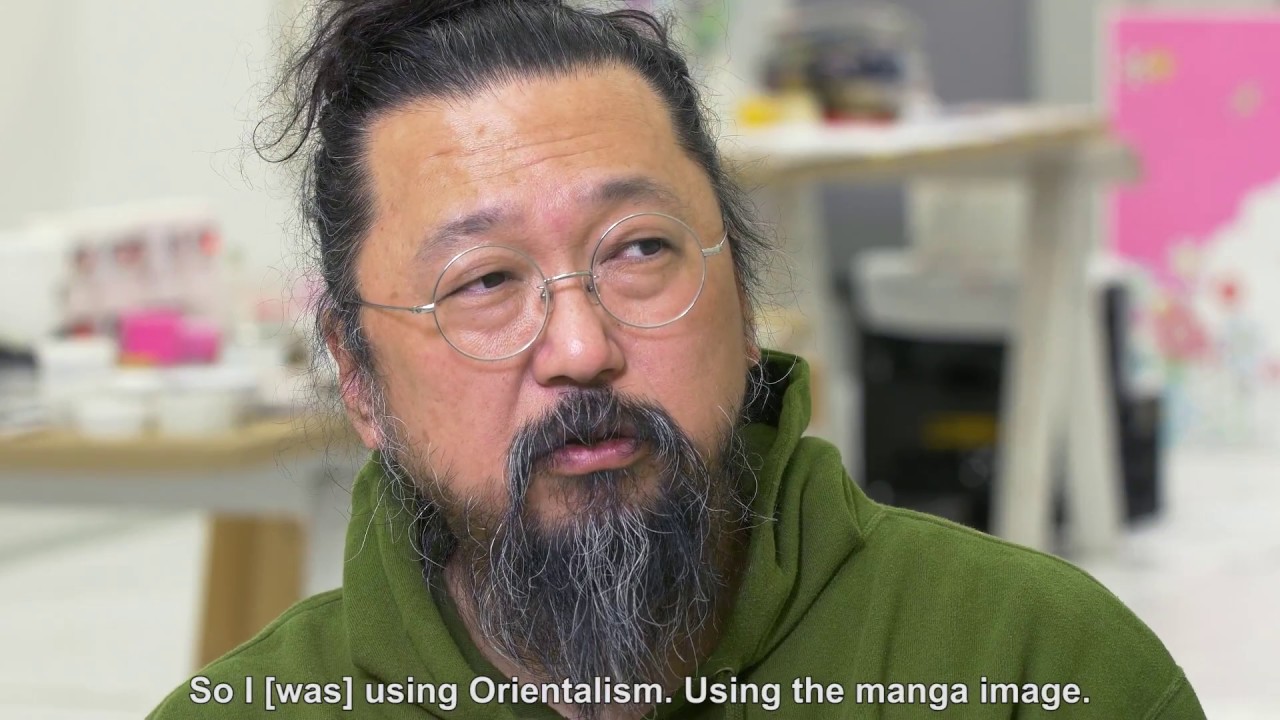
Murakami grew up hearing his mother recount how cloud cover saved their city from atomic targeting in 1945. That absence-presence structured everything.
His father drove taxis. His mother studied needlepoint and textiles, drilling him to write exhibition reviews or skip dinner.
The discipline stuck.
Initial Artistic Direction
He originally aimed for animation work, obsessed with anime and manga. But shifted after encountering nihonga’s rigorous techniques at Tokyo University of the Arts.
The training felt suffocating.
Traditional Japanese painting seemed hermetic, copying Western trends without acknowledgment.
First Satirical Works
His early 1990s work turned satirical. Performance pieces like Osaka Mixer Project (1992) mocked the “message art” dominating Japan’s galleries.
By 1993 he’d invented Mr. DOB, a Mickey-on-acid avatar whose name derives from “dobozite” (Japanese slang for “why?”).
New York Turning Point
A 1994 fellowship from the Asian Cultural Council sent him to PS1 in New York for a year.
Andy Warhol‘s production model clicked. He saw Jeff Koons’ simulationism and Anselm Kiefer’s material density.
Western contemporary artists weren’t afraid of scale or commerce.
He returned to Tokyo determined to build an infrastructure that could compete internationally while staying rooted in Japanese visual DNA.
Movement & Context
Superflat Theory

Murakami didn’t join pop art so much as reimagine it through postwar Japanese rubble.
His 2000 exhibition “Superflat” at MOCA Grand Avenue formalized the theory: Japanese visual culture from ukiyo-e woodblocks to Hello Kitty shares a compressed spatial logic.
No linear perspective, no Renaissance depth. Everything exists on one shimmering plane.
Comparison to Yoshitomo Nara
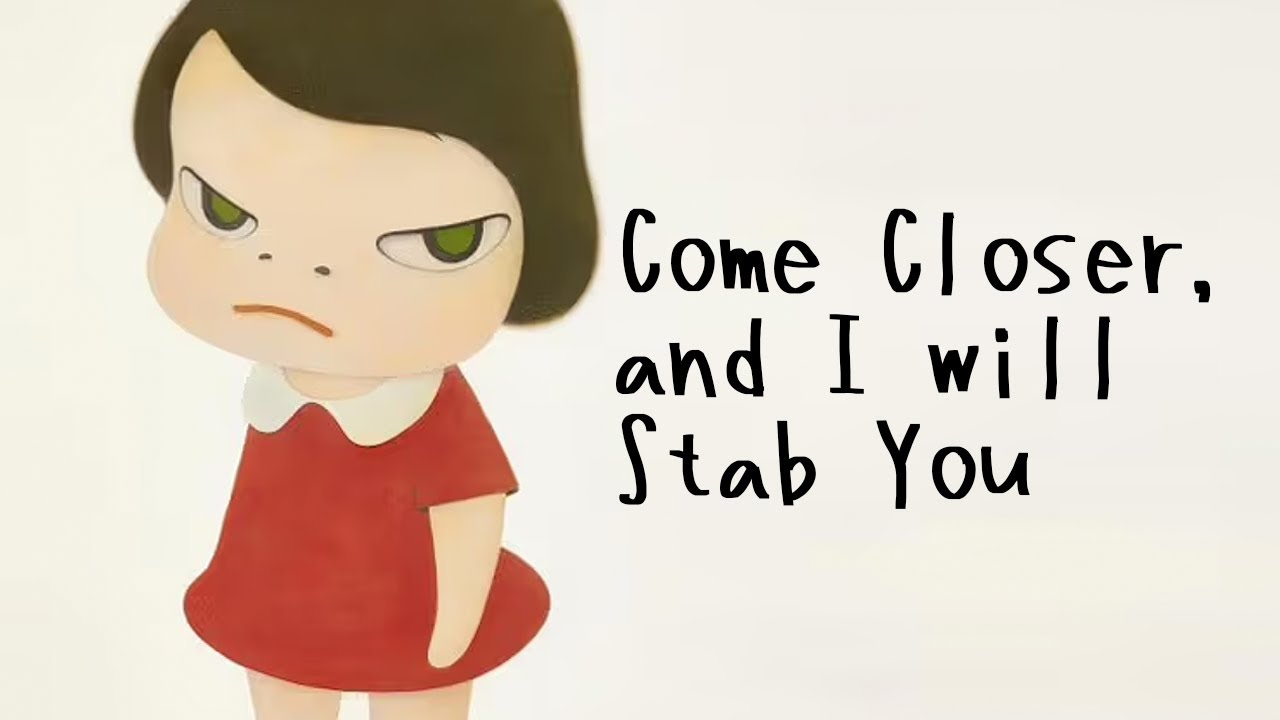
Compare him to Yoshitomo Nara, whose punk-inflected children radiate psychological interiority.
Nara’s surfaces feel painted, brushy, emotionally direct. Murakami’s feel printed, mechanically perfect, emotionally encrypted.
Where Nara gives you alienation straight, Murakami wraps it in Day-Glo flowers.
Both emerged from otaku subculture but Nara stays introspective while Murakami explodes outward into spectacle.
Comparison to Yayoi Kusama
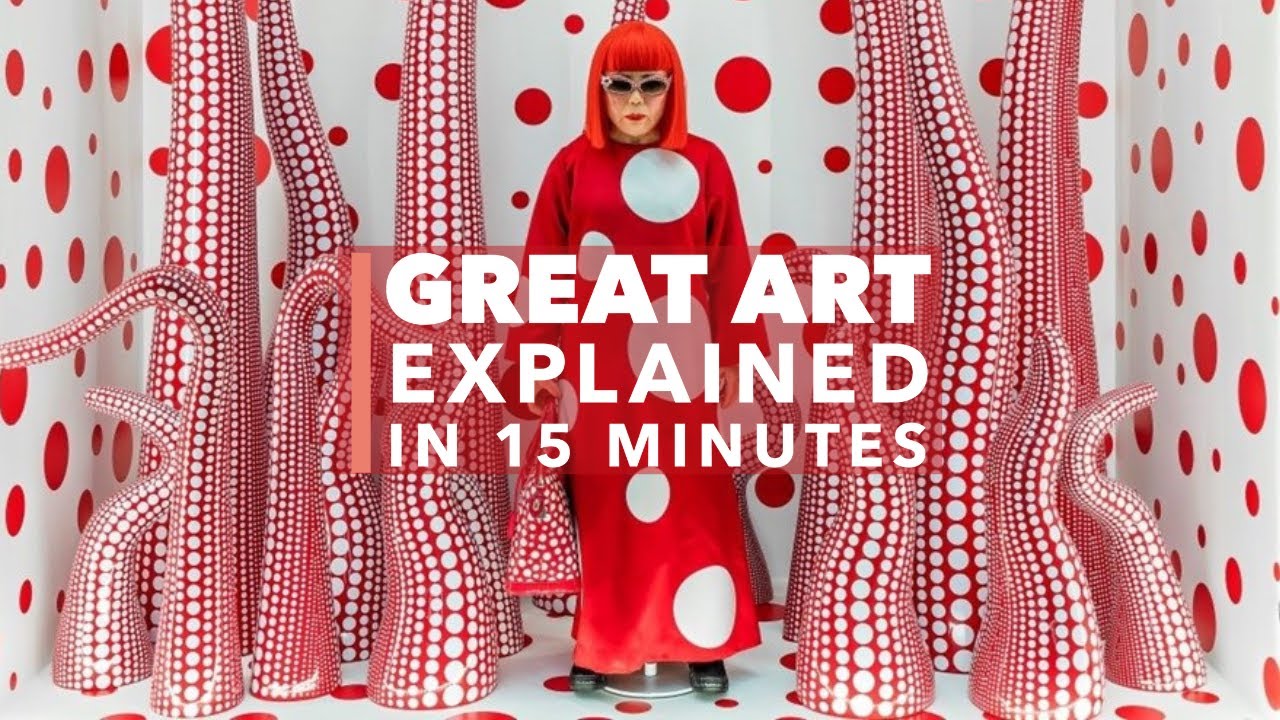
Against Yayoi Kusama’s obsessive repetition and infinity nets, Murakami feels corporate.
Kusama’s marks bear her hand. Murakami’s bear his factory.
He aligned more with Warhol’s atelier model than with Abstract Expressionist solitude.
His edge control is digital-hard where Kusama’s is organic-soft. His color contrast maxes out saturation; hers modulates through accumulation.
The Superflat Collective
The Superflat label stuck to artists like Chiho Aoshima, Aya Takano, and Mr., all operating under Kaikai Kiki’s umbrella.
They share graphic clarity and pop cultural fluency but lack Murakami’s scale ambitions and art-historical self-awareness.
He positioned himself as both participant and theorist, curator and producer.
Materials, Techniques, and Process
Digital-to-Physical Workflow
Murakami’s paintings start on screen, not canvas.
He designs in Adobe Illustrator using Bezier curves, the parametric equations that generate smooth vector paths. This digital drafting phase determines every edge before a brush touches fabric.
Compositions get refined, color-tested, then output as full-scale prints.
Canvas Preparation and Application
Teams of assistants transfer these templates via silkscreen onto primed canvas (cotton or linen, rarely panel).
The acrylic application happens in controlled layers.
His studio operates like animation cels, building color fields through multiple passes.
Some works incorporate gold leaf or platinum leaf adhered to canvas before mounting on aluminum frames. The metal backing prevents warping on oversized pieces.
Surface Treatment
Large triptychs like 727 (1996) required scraping away twenty layers of paint to reveal a nihonga-inspired background.
No impasto. No visible brushwork.
The surfaces read as industrial, glossy, unapologetically synthetic.
Factory System
Paint application follows strict protocols: each assistant handles discrete tasks (base coats, detail work, varnishing).
This division mirrors anime production studios like Studio Ghibli more than Western painting mediums where artists control every mark.
Murakami’s role shifts to director, approving color matches and compositional tweaks.
Sculpture Fabrication
For sculptures, he uses fiberglass and resin, materials borrowed from anime figure manufacturing.
Works like Miss Ko2 (1996) and Hiropon (1997) start as 3D digital models, then get fabricated in workshops specializing in commercial collectibles.
The shiny, plastic-perfect finish intentionally mimics mass-produced toys.
Palette Strategy
His palette skews toward synthetic primaries: electric blues, hot pinks, acid yellows.
Complementary colors slam against each other without atmospheric perspective to soften transitions.
The color harmony operates through maximal contrast rather than subtle gradation.
Think color wheel opposites cranked to eleven.
Themes, Subjects, and Iconography
The Smiling Flowers
The smiling flowers encode collective grief.
Murakami stated they represent “hidden, mixed feelings and shared pain of Japanese people” after Hiroshima and Nagasaki.
Twelve petals, rainbow hues, empty grins. They populate everything from 50cm prints to gallery-spanning installations.
The cuteness doesn’t mask trauma so much as package it for mass consumption.
Mr. DOB Character Evolution
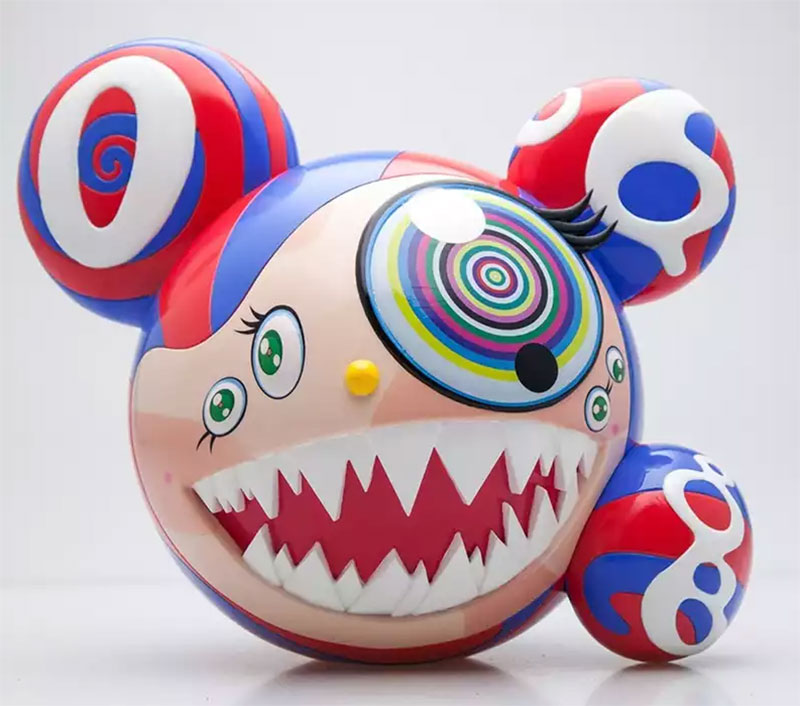
Mr. DOB morphs continuously across three decades.
Early versions (1993-1996) looked cartoonish, almost friendly. By the late 1990s he’d grown monstrous, all teeth and eyes.
The 727 triptych shows him surfing a Hokusai wave, mouth agape, pupils roving.
The reference to Boeing 727s flying over Murakami’s childhood home makes the American military presence literal. Mr. DOB became Murakami’s brand DNA, appearing on t-shirts, plush toys, gallery walls.
Mushroom Symbolism
Mushrooms appear constantly, their dual symbolism obvious.
Psychedelic drug culture meets mushroom-cloud devastation.
Works like Super Nova (1999) render them in acidic hues, each stem a different thickness, caps bulging. The cuteness wars with the horror reference.
Buddhist Iconography Post-Fukushima
Buddhist iconography surged after the 2011 Tohoku earthquake and Fukushima disaster.
The Five Hundred Arhats (2012) stretches 100 meters, populated by grotesque monk figures.
Arhats traditionally traveled countryside offering spiritual support after natural disasters. Murakami updated the Heian-period practice, employing over 200 assistants working 24/7 in shifts.
The work references four Taoist directional guardians (blue dragon east, white tiger west, red bird south, black tortoise north) amidst flames and skeletal followers.
Skulls and Memento Mori
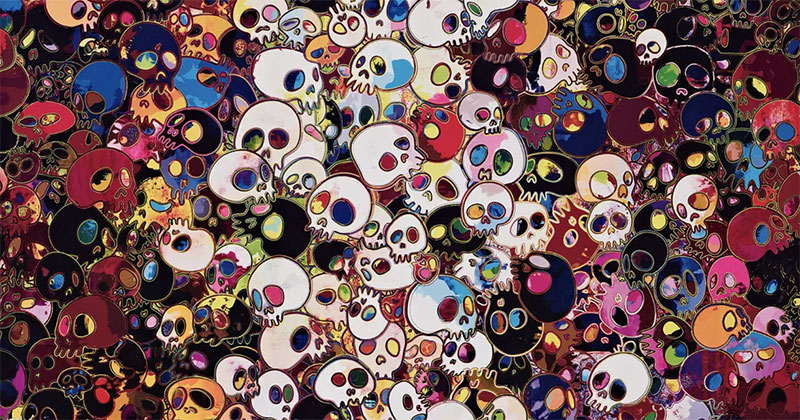
Skulls infiltrated his vocabulary around 2007-2010, often paired with flowers.
Who’s Afraid of Red, Yellow, Blue and Death (2011) scatters hundreds across the pictorial space, a memento mori in kawaii drag.
The repetition exhausts the viewer through visual overload.
Compositional Strategies
Composition typically avoids classical triangular or serpentine structures.
Instead, all-over patterning with radial balance centered on a character or motif.
Space flattens deliberately. No foreground-background hierarchy. Everything presses forward at equal intensity.
Notable Works
727 (1996)

Medium: Acrylic on canvas mounted on board, triptych
Dimensions: 299.7 x 449.6 cm total
Location: Museum of Modern Art, New York
Visual signature: Twenty scraped-away paint layers revealing nihonga-style clouds beneath digital-flat Mr. DOB surfing Hokusai waves. Razor teeth, multiple roving eyeballs, psychedelic mushrooms scattered throughout.
Why it matters: First major statement synthesizing traditional Japanese aesthetics with anime aggression. The title references American military planes overhead during childhood. Established Mr. DOB as Murakami’s alter-ego and launched Superflat theory into international discourse.
Related works: The Castle of Tin Tin (1998), Tan Tan Bo series (2001)
My Lonesome Cowboy (1998)
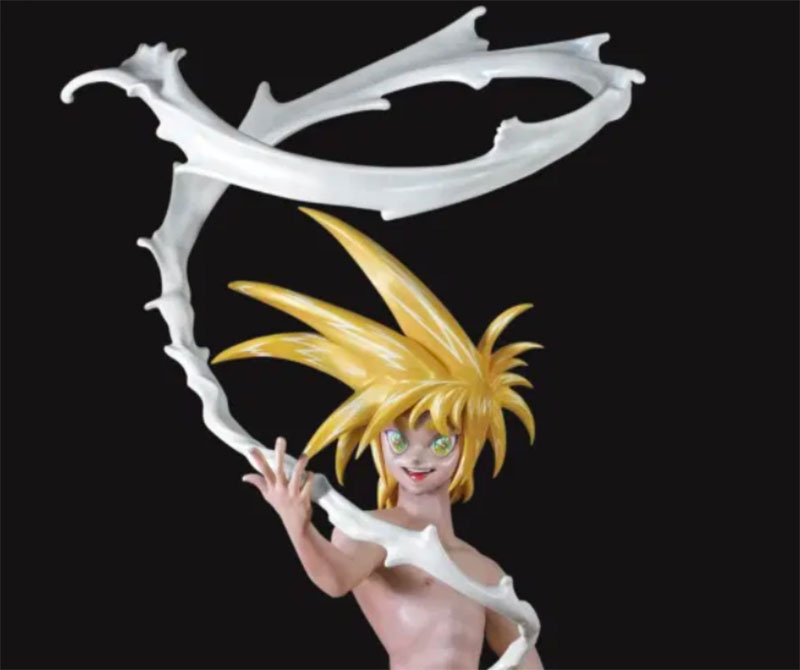
Medium: Fiberglass, acrylic, steel
Dimensions: Life-size figure
Location: Private collection (sold Sotheby’s 2008)
Visual signature: Naked anime-style male figure with spiky blonde hair, oversized proportions, spiral of white liquid circling body. Shiny plastic surface mimicking collectible figurines.
Why it matters: Record-breaking $15.16 million auction price in 2008 established Murakami’s commercial dominance. Direct confrontation with otaku culture’s sexual obsessions. Work embodies high-low art collapse.
Related works: Hiropon (1997), Miss Ko2 (1996)
The Five Hundred Arhats (2012)
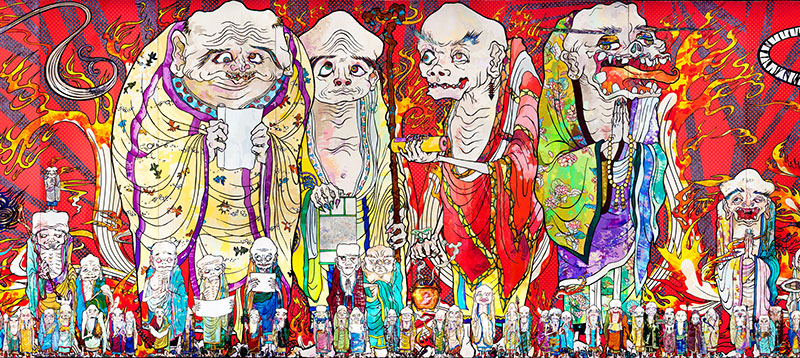
Medium: Acrylic on canvas mounted on board, four sections
Dimensions: 302 x 10,000 cm (100 meters long)
Location: Private collection
Visual signature: Grotesque Buddhist monks with skeletal followers, four Taoist directional guardians, flames and wind rendered through flat digital precision. Gold and platinum leaf accents.
Why it matters: Direct response to 2011 Tohoku earthquake and Fukushima nuclear disaster. Revived Heian-period tradition of creating spiritual art for disaster victims. Production involved 200+ assistants, over 1,000 preparatory sketches.
Related works: Red Demon and Blue Demon with 48 Arhats (2013), In the Land of the Dead installation (2014)
Flower Ball Series (2002-present)

Medium: Various (acrylic paintings, offset lithographs, digital prints)
Dimensions: Range from 40cm to 300cm diameter
Location: Multiple collections worldwide
Visual signature: Spherical arrangements of smiling flowers with twelve petals, densely packed. Color saturation maxed out, each petal rendered in flat primary or secondary colors. No shadows, no depth cues.
Why it matters: Most commercially successful and widely reproduced motif. Bridges fine art and merchandise seamlessly. Embodiment of Superflat’s commercial-artistic fusion.
Related works: Champagne Supernova series (2000s), Flowers and Skulls combinations (2007-2011)
DOB in the Strange Forest (1999)
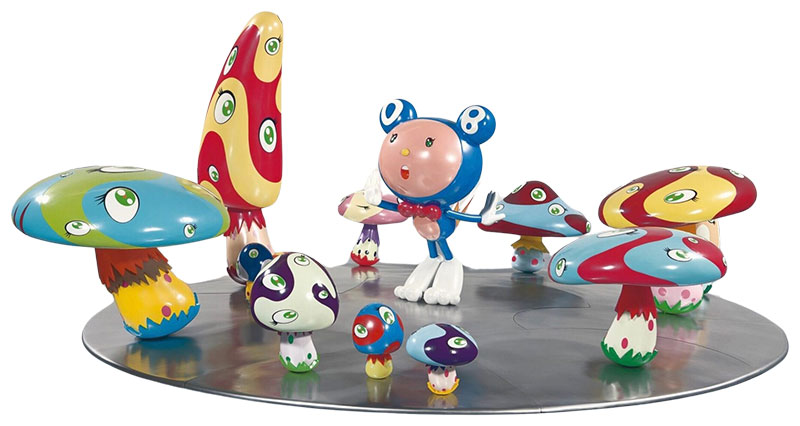
Medium: FRP, resin, fiberglass.
Dimensions: 360 x 360 cm
Location: The Broad, Los Angeles
Visual signature: Mr. DOB rendered in blue against complex Japanese landscape turning menacing. Multiple eyeballs, sharp teeth, defensive posture.
Why it matters: Demonstrates ability to inject psychological tension into superficially cute imagery. DOB’s resistance gesture reveals artist’s ambivalent relationship to Japanese consumer culture.
Related works: 727 series variations, Mr. DOB character evolution studies
Exhibitions, Collections, and Provenance Highlights
Early International Recognition
Venice Biennale 1995 marked European debut in “TransCulture” group show.
Solo exhibitions accelerated: second Asia-Pacific Triennial Brisbane 1996, Marianne Boesky Gallery New York 1998.
Major Retrospectives
The 2007-2008 ©MURAKAMI retrospective at MOCA Los Angeles traveled to Brooklyn Museum, Museum für Moderne Kunst Frankfurt, Guggenheim Bilbao.
Over 3,000 works spanning paintings, sculptures, videos, product design.
Museum of Contemporary Art Chicago hosted “The Octopus Eats Its Own Leg” (2017), another major retrospective featuring early works rarely shown publicly.
Controversial Versailles Show

Versailles exhibition (2010) installed fiberglass sculptures throughout Marie Antoinette’s chateau rooms.
Critics split: some praised audacity, others condemned cultural clash.
Murakami defended it as questioning “high art” pretensions.
Gallery Partnerships
Gagosian partnership began 2011, providing commercial gallery muscle.
Multiple exhibitions across New York, London, Hong Kong, Paris locations.
2014 “In the Land of the Dead, Stepping on the Tail of a Rainbow” at West 24th Street NYC created immersive installation with sanmon gate entry.
Museum Holdings
Institutions with significant collections: The Broad Los Angeles, MoMA New York, Guggenheim Bilbao, Mori Art Museum Tokyo.
Private collections include François Pinault, Eli and Edythe Broad, David Teiger acquisitions.
Kaikai Kiki Gallery Network
Kaikai Kiki Gallery (Tokyo, Nakano Broadway) exhibits stable artists: KAWS, Chiho Aoshima, Aya Takano, Mr., Ob.
Hidari Zingaro opened 2010, expanded to four Nakano locations.
Market & Reception
Auction Records
Record remains My Lonesome Cowboy at $15.16 million (Sotheby’s New York, May 2008).
That sale positioned him among market heavyweights.
Dragon in Clouds – Red Mutation (nearly 60 feet) fetched ¥55.8 million ($6.4 million) at Council Shanghai 2018.
Tan Tan Bo sold $5 million at Christie’s New York 2018.
Price Bands
Paintings hover between $1-5 million for major works.
Smaller paintings cluster $30,000-100,000 range, making entry-level collecting feasible.
Panda fiberglass sculpture editions: one reached £2.2 million Seoul Auction in Hong Kong in 2017.
Print Market
Prints dominate auction volume: 84% of works sold.
Edition sizes typically 300, signed in silver or gold pen.
Prices range £1,000-5,000 for standard editions.
Portrait de Karl Lagerfeld (unique 2014 serigraph) achieved £196,555 at Sotheby’s 2021, exceptional for print medium.
Authentication and Condition
Authentication relatively straightforward due to Kaikai Kiki documentation and consistent signature practices.
Forgery risk lower than many contemporaries because production process leaves digital records.
Certificates of authenticity issued for prints, sculptures.
Condition concerns minimal on properly stored works. Acrylic on board doesn’t crack like oil.
Market Trends
Market experienced 10% growth over 2015-2020 period.
COVID disrupted sales briefly; NFT ventures (Murakami.Flowers, CloneX collaboration with RTFKT) expanded digital market presence.
Traditional auction results rebounded 2021-2024.
Influence & Legacy
Upstream Influences
Nihonga tradition (Kano Eitoku’s 17th-century paintings), Hokusai’s waves, Ito Jakuchu’s detailed ornithology.
Postwar trauma narratives (Goya’s Saturn Devouring His Son haunted him since age eight).
Shigeru Mizuki’s manga specters. Ultraman monsters.
Andy Warhol‘s Factory model. Jeff Koons’ embrace of kitsch and craft. Anselm Kiefer’s material intensity.
Downstream Impact on Artists
Entire generation of Japanese artists working in Superflat idiom.
Chiho Aoshima’s digital dreamscapes, Aya Takano’s sci-fi girls, Mr.’s manga paintings.
Kaikai Kiki functions as talent incubator and distribution network.
Western artists engaged with his commercial strategies: KAWS adopted similar character merchandising.
Music Industry Collaborations
Kanye West’s Graduation cover (2007) brought Murakami aesthetic to hip-hop audience.
Billie Eilish “You Should See Me in a Crown” animated video (2019) used motion-capture technology across eight months production.
J Balvin Colores album (2020). Juice WRLD’s posthumous The Party Never Ends (2024).
Fashion Industry Partnerships
13-year Louis Vuitton collaboration with Marc Jacobs (2002-2015) generated hundreds of millions in handbag sales.
Supreme, Uniqlo, Vans, Billionaire Boys Club partnerships.
Virgil Abloh collaboration (2018) connected streetwear and gallery worlds.
Cross-Media Ventures
Jellyfish Eyes film (2013) brought CG creatures into live-action Japanese setting.
ComplexCon presence made him fixture in sneaker culture and street art communities.
NFT experiments positioned him as tech-forward despite initial stumbles.
Theoretical Contributions
Superflat concept provided framework for analyzing how Japanese visual culture operates differently from Western spatial traditions.
Academic discourse embraced it, though some critics argue it oversimplifies.
How to Recognize a Murakami at a Glance

Digital-hard edges: No soft transitions. Every boundary between color field reads as laser-cut.
Maxed-out saturation: Primary colors and complementary colors at full intensity, zero atmospheric modulation.
Smiling twelve-petal flowers: If rainbow flowers with faces appear, it’s Murakami or direct homage.
Mr. DOB character: Mickey-like ears, multiple eyes, sharp teeth. Appears across decades in morphing forms.
All-over composition density: Edge-to-edge activity, minimal negative space. Visual hierarchy through character placement rather than empty zones.
Canvas mounted on aluminum frame: Technical construction choice visible in side profile. Prevents warping on large scale.
Edition numbering on prints: Signed in silver or gold ink, numbered fractions (like 151/300). Kaikai Kiki publishing marks.
Kawaii-grotesque fusion: Cute imagery with disturbing undertones (hypersexualized figures, skulls, mutation).
Shiny plastic sculpture surfaces: Fiberglass with automotive-grade finish mimicking collectible toys.
Signature placement: Usually lower right or left edge, sometimes gold or silver pen. Consistent across decades.
FAQ on Takashi Murakami
What is Takashi Murakami known for?
Takashi Murakami is known for founding the Superflat movement, which merges traditional Japanese art with anime and manga aesthetics. His signature rainbow flowers, Mr. DOB character, and collaborations with brands like Louis Vuitton made him a contemporary art icon who dissolves boundaries between high art and commercial design.
What does Superflat mean in Murakami’s art?
Superflat describes both the flat spatial composition in Japanese visual culture and a critique of postwar consumer culture’s shallow nature. The term references how Japanese art from ukiyo-e woodblock prints to modern anime shares compressed pictorial space without Western linear perspective or atmospheric depth.
How much is Takashi Murakami’s art worth?
His auction record stands at $15.16 million for My Lonesome Cowboy (2008). Major paintings sell between $1-5 million. Smaller works range $30,000-100,000. Limited edition prints typically cost £1,000-5,000. His market has grown 10% over the past five years.
Who influenced Takashi Murakami’s artistic style?
Andy Warhol’s Factory production model and Jeff Koons’ embrace of kitsch heavily influenced him. Traditional nihonga painting techniques from Tokyo University of the Arts shaped his foundation. Francisco Goya’s Saturn Devouring His Son traumatized him at age eight, sparking his monster fascination.
What is the meaning behind Murakami’s smiling flowers?
The rainbow flowers encode collective trauma rather than pure joy. Murakami stated they represent “hidden, mixed feelings and shared pain of Japanese people” after the Hiroshima and Nagasaki atomic bombings. The twelve-petal design packages grief for mass consumption through kawaii cuteness.
What is Kaikai Kiki Co., Ltd.?
Kaikai Kiki is Murakami’s art production company founded in 2001, previously called Hiropon Factory (1996). It operates like an anime studio with teams handling discrete production tasks. The company manages emerging artists, curates exhibitions, produces merchandise, and runs galleries in Tokyo and Nakano Broadway.
Why did Murakami collaborate with Louis Vuitton?
The 13-year collaboration (2002-2015) with Marc Jacobs at Louis Vuitton deliberately collapsed art-fashion hierarchies. Murakami argued Japanese culture doesn’t rigidly separate high and low art. The partnership generated hundreds of millions in handbag sales while positioning his work in commercial retail spaces.
What painting medium does Takashi Murakami use?
He primarily uses acrylic on canvas mounted on aluminum frames or board. Works begin as digital designs in Adobe Illustrator using Bezier curves. Teams transfer templates via silkscreen, then apply layered acrylic. Some pieces incorporate gold leaf or platinum leaf for traditional nihonga references.
What is Mr. DOB in Murakami’s work?
Mr. DOB is Murakami’s alter-ego character created in 1993, named from Japanese slang “dobozite” (why?). The Mickey Mouse-like figure with multiple eyes and razor teeth evolved from friendly (1993-1996) to monstrous (late 1990s). He appears across paintings, sculptures, and commercial merchandise as artistic DNA.
Where can I see Takashi Murakami’s art?
Major holdings exist at Museum of Modern Art New York, The Broad Los Angeles, Guggenheim Bilbao, Museum of Contemporary Art Chicago. Gagosian galleries in New York, London, Hong Kong show his work regularly. Kaikai Kiki Gallery and Hidari Zingaro in Tokyo exhibit pieces alongside emerging artists.
Conclusion
Takashi Murakami transformed contemporary Japanese art by merging nihonga traditions with anime-inspired imagery through factory production methods. His Kaikai Kiki studio proved collaborative manufacture could generate museum-quality work.
The digital workflow he pioneered changed how artists approach scale and edge control. Fiberglass sculptures and acrylic paintings became vehicles for cultural critique wrapped in Pop aesthetics.
His influence spans fashion collaborations, music videos, and NFT experiments. From Versailles exhibitions to ComplexCon appearances, he forced institutions to reconsider artistic legitimacy.
The smiling flowers and Buddhist arhats encode postwar trauma through kawaii cuteness. That tension between surface appeal and deeper meaning defines his contribution to global art discourse.
His work questions where art ends and merchandise begins-the ambiguity remains his sharpest statement.