A giant chained beneath mountains. Winged creatures severed from their legs. Factory smoke choking jungle foliage.
Rodel Tapaya doesn’t illustrate Philippine folklore. He collides it with the wreckage of modernization, creating dense visual labyrinths that refuse easy answers.
Born in 1980 in Montalban, Rizal, this Filipino contemporary artist has become one of Southeast Asia’s most recognized painters. His large-scale canvases pack mythological beings against urban debris, using acrylic painting techniques that flatten everything into explosive patterns.
This article maps Tapaya’s artistic vision from his Sierra Madre origins through his international breakthrough. You’ll discover how he transforms folk narratives into political commentary, what technical choices define his painting style, and why collectors pay six figures for his works.
His practice bridges pre-colonial mythology and postcolonial trauma without sentimentality. Just collision.
Identity Snapshot
Rodel Tapaya
Born 1980, Montalban, Rizal, Philippines
Lives and works in Bulacan, Philippines
Primary role: Painter
Secondary practices: Diorama artist, installation artist, under-glass painter
Nationality: Filipino
Movements: Contemporary Philippine art, Southeast Asian contemporary art
Mediums: Acrylic painting on canvas, acrylic on burlap, reverse glass painting, mixed media, charcoal and ink on paper
Signature traits: Smooth acrylic application, cramped figurative layouts, labyrinthine patterns, flat decorative surfaces, dense narrative assemblages
Iconography: Philippine folk creatures (Bernardo Carpio, manananggal, Buwan), mythological beasts, factory towers, urban detritus, jungle foliage, revolutionary heroes (Andres Bonifacio, Jose Rizal)
Geographic anchors: Montalban (birthplace, Sierra Madre foothills), Manila periphery, Bulacan (current studio)
Education: University of the Philippines College of Fine Arts (BFA), Parsons School of Design (New York), University of Helsinki
Key influence: Professor Damiana Eugenio (folklore studies)
Major awards: Nokia Art Awards Top Prize (2001), Signature Art Prize (2011, Asia-Pacific Breweries Foundation/Singapore Art Museum), Thirteen Artists Awardee (2012, Cultural Center of the Philippines)
Collections: National Gallery of Australia, Art Gallery of New South Wales, Singapore Art Museum, Mori Art Museum Tokyo, Ateneo Art Gallery Manila, Pinto Art Museum, BenCab Museum, Central Bank of the Philippines
Market range: Works sell between $30,000-$380,000 at auction; auction record $380,852 for “Baston ni Kabunian, Bilang pero di Mabilang” (2019, Salcedo Auctions)
Standard formats: 152 x 122 cm, 193 x 152 cm, large-scale murals up to 244 x 335 cm
What Sets Tapaya Apart

Tapaya doesn’t paint folklore. He collides it with factory smoke.
His canvases pack mythological figures against television antennas and concrete rubble, creating visual overload that mirrors Manila’s sprawl creeping into the Sierra Madre. The flat application feels almost graphic, like murals compressed into chaos.
Mexican muralists Diego Rivera and Jose Clemente Orozco haunt the work, but Tapaya adds something rawer. His color scheme splits between vibrant tropical hues and darkened margins where colonial ghosts linger. The cramped composition technique (horror vacui pushed to its limit) makes viewers hunt for narrative threads through visual mazes.
What makes him distinct is material experimentation paired with ideological weight. Burlap grounds add poverty’s texture to creation myths. Glass painting borrows from folk craft while depicting overseas workers as winged, severed creatures. Scale matters too: ten-meter triptychs that demand physical navigation, not passive viewing.
He bridges pre-colonial mythology and postcolonial trauma without nostalgia or cynicism. Just collision.
Origins & Formation
Early Environment
Montalban sits where urban Manila dissolves into Sierra Madre jungle.
Tapaya grew up immersed in oral tradition. Bernardo Carpio (the giant chained beneath mountains, causing earthquakes) wasn’t just a story but local geography made mythic. Folk narratives structured how people understood power, suffering, displacement.
Academic Training
2001: Won Nokia Art Awards Top Prize (Asia-Pacific competition) Prize funded intensive studies at Parsons School of Design and University of Helsinki
University of the Philippines College of Fine Arts: Completed BFA degree Studied under Professor Damiana Eugenio, whose scholarly work on Philippine supernatural traditions provided academic framework for folk material
Stylistic Formation
Early work centered on burlap painting, Tapaya’s initial signature before folk narrative dominance.
Burlap challenged him technically. Unlike primed canvas, burlap’s translucency required heavy base coats. The material itself carried class signage (rice sacks, poverty, rural labor) that added semantic weight to mythological subjects.
Parsons and Helsinki exposed him to Western contemporary practices while his UP education grounded him in local visual languages. This dual formation shows: he paints like someone who studied surrealism abroad but never stopped thinking about provincial Philippines.
Exhibition Breakthrough
First exhibitions established his literary-based visual approach.
The Nokia prize in 2001 (age 21) provided international visibility early. By his mid-twenties, galleries recognized his ability to make Philippine-specific content legible to international art markets without diluting ideological content.
Movement & Context
Positioning Within Contemporary Philippine Art

Tapaya operates at the intersection of social realism and magical thinking.
He’s not alone in mining Philippine mythology. But where others illustrate folklore, he weaponizes it as political allegory. The 2016 work “Adda Manok Mo, Pedro?” (Do You Have a Rooster, Pedro?) used cockfighting metaphors to critique military dictatorship. Subtlety isn’t the goal; clarity through visual density is.
Comparative Analysis: Mexican Muralists
The comparison to Diego Rivera and Orozco appears constantly in criticism. Valid parallels exist:
- Large-scale narrative ambition: Both use physical size to demand engagement
- Political directness: Social commentary without aesthetic distance
- Indigenous imagery recontextualized: Pre-colonial symbols deployed against colonial legacy
- Flat decorative surfaces: Rejection of illusionistic depth for graphic clarity
Key differences:
Rivera’s murals organize through clear zones and sequential reading. Tapaya’s canvases assault through simultaneity. No clear entry point. Rhythm comes from pattern repetition, not compositional flow.
Rivera celebrated Indigenous labor through heroic figuration. Tapaya’s figures appear compressed, anonymous within pattern. Less heroic, more symptomatic of systems.
Chiaroscuro and volume? Rivera built forms through modeling. Tapaya keeps everything flat. His value range compresses; figures and ground compete equally for attention.
Comparative Analysis: Hieronymus Bosch
Hieronymus Bosch‘s crowded hellscapes offer another useful contrast.
Bosch layers creatures and scenarios across pictorial space. Tapaya does too. But Bosch maintains spatial recession and atmospheric perspective. Tapaya refuses depth cues. His jungles and factories exist on the same flattened plane.
Bosch’s symbolism requires Christian iconographic knowledge. Tapaya’s requires familiarity with Philippine folk taxonomy and contemporary political context. Both demand cultural literacy, but different archives.
Southeast Asian Contemporary Context

Within Southeast Asian art markets (Singapore, Hong Kong), Tapaya represents the “folk-contemporary” fusion that collectors recognize.
Artists like Heri Dono (Indonesia) similarly mine local mythology. But Dono leans into whimsy and installation. Tapaya stays grounded in painting’s two-dimensional constraints, even when making dioramas.
His market position: accessible enough for collectors unfamiliar with Philippine history (visual interest carries without context) but layered enough for scholarly attention.
Materials, Techniques, and Process
Supports
Primary: Cotton canvas, medium-weight
Secondary: Burlap (unprimed or minimally primed)
Tertiary: Acrylic sheet for reverse glass painting
Scale range: Small works (65 x 50 cm charcoal on paper) to large-scale murals (244 x 335 cm, 300 x 700 cm)
Standard formats cluster around 152 x 122 cm and 193 x 152 cm (portrait and landscape orientations in 4:5 and 5:4 ratios). These dimensions feel deliberate: large enough to create immersion but manageable for gallery walls and collector spaces.
Paint Medium
Acrylic exclusively in recent work. Rare early pieces use oil.
Acrylics suit his needs: fast drying enables dense layering without long waits between sessions, flat finish reinforces decorative surface quality, less toxicity matters in tropical studio without perfect ventilation.
Application Technique
Smooth, even application. No visible brushwork or impasto.
The painting mediums are handled to eliminate texture. This creates tension: folk subject matter (typically associated with roughness, “naive” handling) rendered through controlled, almost commercial smoothness.
Technique feels closer to sign painting or illustration than expressionism. Every edge stays crisp. Texture comes from pattern density, not paint physicality.
Brushwork Taxonomy
- Flat application: Building opaque color fields without stroke visibility
- Edge control: Hard edges throughout (no sfumato, no atmospheric blending)
- Pattern rendering: Repetitive small marks creating decorative zones (scales, foliage, architectural detail)
Palette Archetype
Dominant hues: Saturated reds, yellows, blues, greens
Supporting cast: Ochres, siennas for earth tones; blacks for silhouettes and shadow zones
Temperature bias: Warm overall, but with strategic cool zones (blue skies, water, metal surfaces)
His color theory approach prioritizes local color over atmospheric modulation. Things stay their “true” color regardless of lighting or spatial position. A red creature in the foreground uses the same red as one in the background.
This flattening strategy comes partly from folk craft traditions (under-glass painting, diorama painting) where atmospheric perspective doesn’t apply.
Value distribution: Mid-tones dominate. Fewer extremes of light and dark. This creates visual density; without strong lights to act as focal points, the eye roams constantly.
Studio Practice
Process (post-2021):
- Collage stage: Works on A4/A3 paper, cutting and pasting magazine images, erasing details, no paint
- Scaling up: Translates collage to canvas at 4-6x size
- Painting: Layers forms atop each other, maintaining collage’s chaos and fragment logic
This two-stage process (introduced in “Random Numbers” series, 2021) marks a shift from his earlier narrative approach. Earlier works were conceived directly as paintings. The collage-first method introduces more chance and fragmentation.
Layering approach: Builds complexity through additive layers. Figures overlap without transparency; each form stays opaque. This creates spatial ambiguity: is that creature behind or in front of the factory? Both? Neither?
No underdrawing visible. Either painted directly or underdrawing completely obliterated by opaque acrylic.
Alternative Media
Under-glass painting: Traditional Philippine craft reversed. Paint applied to glass back, viewed through front. This creates luminosity and jewel-like color saturation. Tapaya uses it for works like “Five Months” (2017).
Diorama: Three-dimensional assemblages combining painting, found objects, metalwork. Example: “Modern Manananggals” (2014), where winged figures reference overseas Filipino workers separated from families.
Metalwork integration: Occasional pieces incorporate traditional metalwork techniques, bridging fine art and craft categories.
Themes, Subjects, and Iconography
Core Motifs
Bernardo Carpio: Giant chained beneath Sierra Madre mountains. Earthquakes happen when he struggles. Symbolizes Filipino resistance against Spanish, Japanese, American oppression. Recurs throughout work as both literal figure and structural metaphor.
Manananggal: Visayan creature that detaches upper torso (with wings) from lower body at night. In “Modern Manananggals,” Tapaya maps this onto overseas Filipino workers: separated from families, unable to return, laboring under poor conditions.
Jose Rizal and Andres Bonifacio: Revolutionary heroes. Not depicted reverently but incorporated into mythic landscapes where past and present collapse.
Factory towers and industrial debris: Post-industrial ruins, suggesting failed modernization promises. Often appear in “natural” settings, showing urbanization’s creep.
Television antennas and consumer objects: Contemporary markers interrupting folk scenes. Signal cultural colonization through media and commodification.
Jungle foliage and tropical flora: Not Eden. Often appears oppressive, overgrown, reclaiming space. Nature as active force, not backdrop.
Compositional Schemes
Primary structure: all-over composition with no clear focal point.
Space and balance operate through distribution rather than hierarchy. Traditional emphasis strategies (size contrast, value contrast, isolation) get subverted. Everything competes equally for attention.
This “horror vacui” approach (fear of empty space) has ideological weight. The cramped visual field mirrors Manila’s density, where informal settlements press against every available space. It also reflects oral storytelling’s additive logic, where tangents and digressions accumulate rather than resolve.
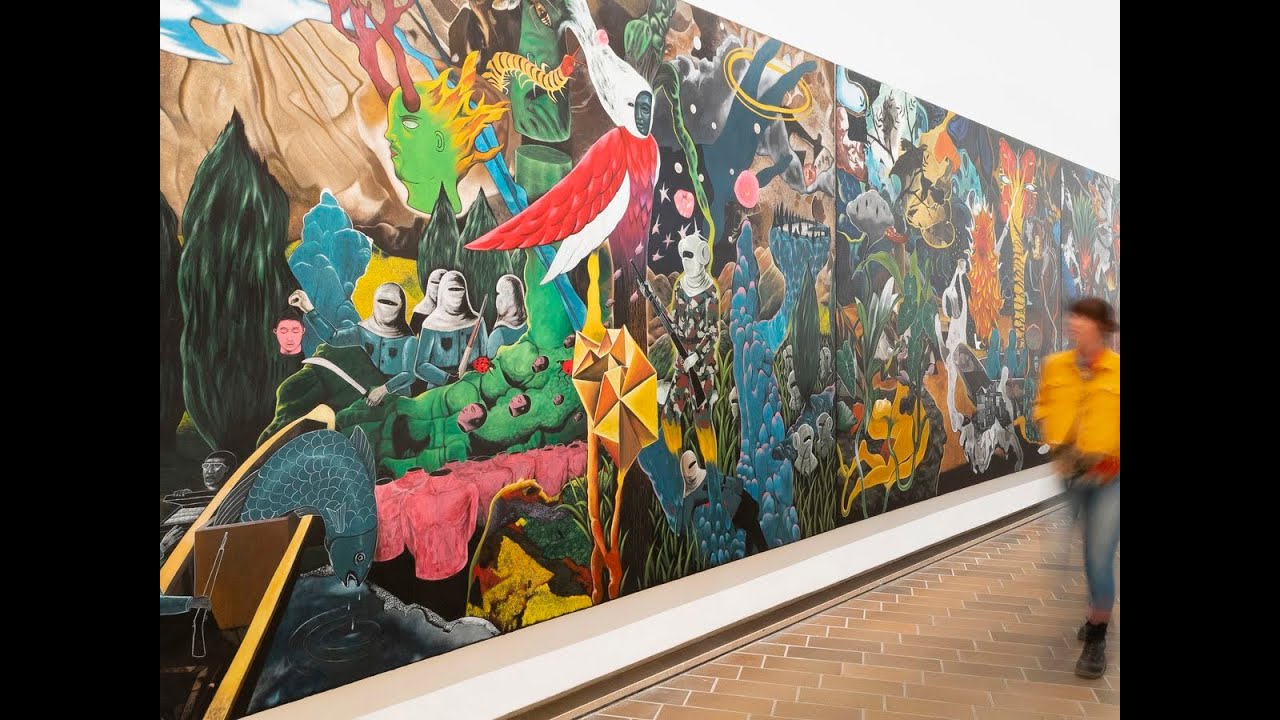
When he does use triangular composition (see “The Promise Land: the moon, the sun, the stars,” 2017), it’s to organize epic scale (ten-meter triptych) into manageable zones while maintaining overall density.
Serpentine paths: Viewers’ eyes follow winding roads, rivers, or figure arrangements through the visual maze. These create movement without traditional linear perspective recession.
Symbol Systems
Animals as stand-ins: Not just decorative. Dogs represent loyalty under abandonment. Birds carry messages between worlds. Roosters signal masculine violence (cockfighting as political metaphor).
Architectural fragments: Concrete slabs, brutalist structures in decay. These mark the failure of modernist development promises. Often half-consumed by vegetation.
Eyes (recurring): Disembodied eyes appear across many works. Surveillance, visibility, being seen by history or gods. “Many Eyes But They Cannot See” (2024) makes this explicit.
Wheels and circular forms: Cycles of labor, repetition, being trapped in systems. “Happy Wheels” series title plays on this darkly.
Socio-Historical Triggers
Postcolonial trauma: 333 years Spanish colonization, 48 years American control, 3 years Japanese occupation. Layers of subjugation inform how mythology gets deployed against continuing neocolonial pressures.
Rural-to-urban migration: Manila’s explosive growth destroys provincial lifeways. Tapaya’s work positions spiritual and communal values in jungles being consumed by urbanization.
Overseas Filipino Workers (OFW): 10% of population works abroad, often in exploitative conditions. Family separation becomes structural condition. Manananggal imagery directly addresses this.
Environmental destruction: Mining, logging, industrial pollution in provinces. Factories appear in wilderness settings not as anachronism but as documentary fact.
Duterte-era politics: Works like “Adda Manok Mo, Pedro?” respond to specific political moments (2016 onwards), using folk allegory to critique authoritarian turns.
Notable Works
“Baston ni Kabunian, Bilang pero di Mabilang” (2019)

Details: Acrylic on canvas, dimensions not specified
Current location: Private collection
Auction record: $380,852 (Salcedo Auctions, 2019) – artist’s highest price
Visual signature: Dense patterning, mythological figures interwoven with contemporary markers
Why it matters: Established Tapaya’s market position in six-figure range. Title translates to “Cane of Kabunian, numbered but cannot be counted,” referencing impossibility of quantifying spiritual or cultural value.
“The Promise Land: the moon, the sun, the stars” (2017)

Details: Acrylic on canvas, 10-meter triptych (three connected panels)
Current location: National Gallery of Australia (commissioned work)
Visual signature: Great winged creature Buwan with crescent-split face, red-feathered form against black night sky. Dense mythological assemblage across three panels.
Why it matters: Tapaya’s first major institutional commission in Australia. Demonstrates his ability to work at architectural scale while maintaining detail density. Reimagines Moro-Isolan creation myth from Mindanao, connecting Indigenous cosmology to contemporary displacement.
Artist statement: “In some way, I realise that old stories are not just metaphors. I can find connections with contemporary time. It’s like the myths are poetic narrations of the present.”
“Adda Manok Mo, Pedro?” / “Do You Have a Rooster, Pedro?” (2016)

Details: Acrylic on canvas, large-scale
Current location: Exhibited at Biennale of Sydney 2016
Visual signature: Cockfighting imagery deployed as political allegory
Why it matters: Direct critique of Philippine military dictatorships using folk metaphor. Cockfighting (illegal but culturally persistent) becomes framework for analyzing authoritarian governance. Work’s inclusion in Sydney Biennale marked international recognition of Tapaya’s political engagement.
“Modern Manananggals” (2014)

Details: Installation/diorama with painted elements, metalwork
Current location: Private collection
Visual signature: Winged figures detached from legs, referencing Visayan mythology
Why it matters: Bridges traditional crafts and contemporary installation. Makes explicit connection between folk horror and OFW labor conditions. Visceral image (severed torso) carries emotional weight beyond allegory.
“Multi-petalled Beauty” (2013)

Details: Acrylic on canvas
Current location: Private collection
Auction performance: Sold for $159,660 at Sotheby’s Singapore, doubling high estimate
Why it matters: Early market success that established collector demand for Tapaya’s work outside Philippines.
“Creation of the Bat” (2011)

Details: Oil on canvas, 151.7 x 121.1 cm
Visual signature: Rare oil painting from early period, creation mythology theme
Auction appearance: Sotheby’s 2023
Why it matters: Shows Tapaya working in oil before switching almost exclusively to acrylic. Creation myths form recurring strand in his work, investigating how cosmological stories encode power relations.
“Random Numbers” series (2021)

Details: Nine large-scale acrylic works, various dimensions
Exhibition: Tang Contemporary Art, Hong Kong (April-May 2021)
Visual signature: Explosive collision of fragments: airplane wings, propellers, animal skulls, television sets, concrete brutalist structures, car parts. Industrial chimneys. Dense chaotic fusion without clear narrative.
Why it matters: Marks stylistic shift to “Scrap Paintings.” Introduced collage-first process. Moves away from clear folk narrative toward fragmentation and urban debris. “Flying Objects” (243.8 x 335.3 cm) exemplifies this turn: suggests plane wreck or scrapyard, “overflow of visual information” (critic’s description). Less myth, more postindustrial ruin.
“Left Behind” (2021)

Details: Acrylic on canvas, 135 x 135 cm
Visual signature: Dark blurred dog against landscape of sand, concrete fragments, factory towers, eerie blue sky
Why it matters: Compared to Tarkovsky’s “Stalker” in criticism. Carries apocalyptic tone: aftermath of human-caused catastrophe (Chernobyl, Fukushima echoes). Demonstrates Tapaya’s range beyond folk narrative into sci-fi dread.
“Instant Gratification” (2018)

Details: Acrylic on canvas, 244 x 335 cm (96 x 132 inches)
Exhibition: “Urban Labyrinth,” Ayala Museum, Manila (Feb-Apr 2018)
Literature: Full-color reproduction and description in exhibition catalogue
Why it matters: Part of major Manila museum exhibition. Title critiques consumer culture and instant digital satisfaction replacing sustained community values. Works from this exhibition appeared later at auction.
Exhibitions, Collections, and Provenance Highlights
Solo Exhibitions (Selected)
2023: “Can’t See the Forest for the Trees,” Jack Bell Gallery, London
2021: “Random Numbers,” Tang Contemporary Art, Hong Kong
2018: “Myths and Truths,” Tang Contemporary Art, Beijing
2018: “Urban Labyrinth,” Ayala Museum, Manila (co-presented with Arndt Art Agency)
2017: “Rodel Tapaya: New Art from the Philippines,” National Gallery of Australia, Canberra (first Australian solo exhibition)
2016: “Rodel Tapaya,” Galerie der Stadt Sindelfingen, Germany
Group Exhibitions (Selected)
2020: “The Possibility of an Island,” Cromwell Place, London (Southeast Asia focus, organized by A3-Arndt Art Agency)
2019: “On The Benefits of a Crowded Space,” Art Informal, Makati City
2019: “Echo among Geographies,” Tang Contemporary Art, Hong Kong
2016: Biennale of Sydney (included “Adda Manok Mo, Pedro?”)
Museum Collections (with depth)
National Gallery of Australia, Canberra: Commission piece “The Promise Land” plus additional acquisitions
Art Gallery of New South Wales, Sydney: Multiple works
Singapore Art Museum: Partnership institution for Signature Art Prize
Mori Art Museum, Tokyo: Contemporary Asian art collection
Ateneo Art Gallery, Manila: Significant Philippine contemporary holdings
BenCab Museum, Benguet, Philippines: Regional art focus
Pinto Art Museum, Antipolo, Philippines: Major Philippine contemporary collection
Central Bank of the Philippines: Institutional collection
Gallery Representation
Tang Contemporary Art (Hong Kong, Beijing, Seoul, Bangkok): Primary international representation
Ames Yavuz (Singapore, Sydney): Asia-Pacific markets
Gajah Gallery (Singapore): Southeast Asian contemporary focus
Jack Bell Gallery (London): European representation
Larkin Durey (various): Additional representation
Catalogues and Publications
2018: “Rodel Tapaya: Urban Labyrinth” (Ayala Foundation and Arndt Art Agency). Full exhibition catalogue with artist statement, critical essays, documentation of works.
2015: “Rodel Tapaya” (Distanz Publishers). Major monograph, 176 pages, 130 color reproductions. Covers acrylic on canvas, glass painting, dioramas, drawings.
Multiple essays in art magazines including Ocula, Forbes, Hi-Fructose features.
Provenance Patterns
Works move through several channels:
Primary market: Gallery sales to private collectors, institutions purchase directly from exhibitions
Secondary market: Christie’s and Sotheby’s handle higher-value pieces for Asian art auctions. Salcedo Auctions and Leon Gallery handle Philippines market. Local auction houses like Salcedo maintain connection to domestic collector base while international houses pull works into global circulation.
Institutional acquisition: Museums purchase through exhibition or acquire works from collectors
Market & Reception
Auction Performance
Record price: $380,852 for “Baston ni Kabunian, Bilang pero di Mabilang” (2019, Salcedo Auctions, Manila)
Price range: Entry-level works (small paper pieces, prints) start around $5,000-$10,000. Standard canvas formats (152 x 122 cm) typically $30,000-$80,000. Large-scale works (244 x 335 cm) reach $100,000-$200,000. Works with strong provenance (exhibited, published) or exceptional quality break above $200,000.
Notable sales:
- “Multi-petalled Beauty” (2013): $159,660 at Sotheby’s Singapore, doubled high estimate
- “The Hunter” (2007): Appeared at Christie’s Hong Kong 2024
- “The Rising Tide” (244 x 334 cm): Offered at Christie’s 2025
- Various works through Salcedo Auctions consistently meet or exceed estimates
Market position: Top tier of Southeast Asian contemporary painters. Works compete in same auction lots as established names like Ronald Ventura (Philippines), Heri Dono (Indonesia), other regional heavy-hitters.
Collector base: Strong domestic Philippine collecting (wealthy families, corporate collections). Growing international interest from Singapore, Hong Kong, Australian buyers. Institutional interest from Australian and Japanese museums.
Price Factors
Size matters: Large-scale works command premium. Collectors want the “experience” pieces that define his practice.
Period: Early burlap works carry scarcity premium. “Scrap Paintings” period (2021+) still establishing secondary values.
Provenance: Exhibition history adds 20-40% to estimate. If shown at major institutions (National Gallery Australia, Sydney Biennale, Singapore Art Museum), value increases.
Subject: Clear mythological narrative works versus abstract “Random Numbers” series. Market currently favors recognizable folk figures.
Authentication
Artist certificates: Tapaya provides signed certificates of authenticity for works. These appear in auction lots regularly.
Signature: Signs and dates works, typically lower right or lower left. Signature consistent: “Tapaya” with year.
Documentation: Gallery labels, exhibition stickers on verso add verification.
Risk factors: As with any living artist with rising market, reproduction risk exists. Prints released in small editions (example: “The Generous Man,” 2019, edition 65/75). These clearly marked as prints. Canvas fakes less common due to technique complexity and recent market rise (forgers prefer artists with established authentication infrastructure).
Condition Patterns
Acrylic on canvas: Generally stable. Acrylics don’t yellow like oils, crack less dramatically. Main risks: surface dirt accumulation (flat finish shows dust), edge wear if unframed, impact damage to densely painted surfaces.
Burlap works: More fragile. Burlap fibers can degrade, especially in humid tropical conditions. Works require careful storage and climate control. This affects pricing: condition reports matter more for burlap pieces.
Glass paintings: Vulnerable to breakage, obviously. Backing/frame quality determines longevity.
Influence & Legacy
Upstream Influences
Mexican muralists: Diego Rivera, Jose Clemente Orozco, David Alfaro Siqueiros (social narrative at scale, Indigenous imagery)
Hieronymus Bosch: Crowded hellscapes, symbolic density
Frida Kahlo: Personal/political fusion, folk art integration
Philippine predecessors: BenCab (Benedicto Cabrera), social realism painters of Philippine modern art
Folk craft traditions: Under-glass painting, diorama makers, sign painters, religious icon painters
Professor Damiana Eugenio: Academic folklore scholarship provided intellectual framework
Downstream Influence
Still early to assess full impact (Tapaya born 1980, major recognition from 2011 onwards).
Younger Philippine artists: His success opened international market for Philippine mythology-based work. Created template for making local content globally legible without “explaining” it.
Craft-fine art boundary: His integration of under-glass painting and metalwork into fine art context legitimizes these practices. Younger artists now move more fluidly between categories.
Scale as political statement: Large-scale works as norm for addressing political content. Size becomes necessary, not optional.
Cross-Domain Echoes
Literature: Connection to Gabriel Garcia Marquez’s magical realism acknowledged by critics. Both use fantastic elements to address political reality without metaphor-as-escape.
Film: Comparisons to Andrei Tarkovsky (“Stalker,” apocalyptic landscapes), Guillermo del Toro (folkloric creatures in contemporary settings). Visual language translates across media.
Cultural discourse: Work enters broader Philippine conversations about labor migration, environmental destruction, neocolonial pressures. Gets referenced in political commentary, not just art criticism.
Recognition Markers
2011 Signature Art Prize: Landmark for Filipino artist. Prize elevated Philippine contemporary art’s visibility in Singapore/regional markets.
Institutional commissions: National Gallery Australia commission (2017) marked acceptance into Australian museum collecting, rare for Southeast Asian living artist.
Biennale inclusion: Sydney Biennale 2016. Signals international curator recognition.
Gallery representation: Tang Contemporary Art (major regional player) provides distribution network across East/Southeast Asia.
Academic attention: Work appears in Southeast Asian art history scholarship, contemporary art surveys. Gets taught in university courses.
How to Recognize a Tapaya at a Glance
Diagnostic checklist:
- All-over density: No empty spaces. Figures, patterns, objects pack every zone. If there’s breathing room, probably not Tapaya.
- Flat application: Zero impasto. Smooth acrylic surface. Brush strokes invisible. Looks almost printed or screen-applied.
- Hard edges throughout: No sfumato or blurring. Every form maintains crisp boundaries. Figures don’t dissolve into backgrounds.
- Mythological + industrial collision: Folk creatures appear near factories, antennas, or urban debris. Past and present occupying same flattened space.
- Scale signatures: Either standard 152 x 122 cm / 193 x 152 cm formats, or large murals 244+ cm wide. Consistent aspect ratios (4:5, 5:4, or horizontal doubles).
- Signature location: Lower right or lower left, simple “Tapaya” with year. Not elaborate or incorporated into imagery.
- Color saturation: Tropical palette. Saturated reds, yellows, blues. Mid-tone dominance (not high-contrast dramatic lighting). Local color without atmospheric modulation.
- Pattern as structure: Decorative zones (scales, foliage detail, architectural fragments) operate as compositional building blocks. Pattern creates rhythm more than figural arrangement does.
- Philippine folk taxonomy: Recurring creatures: Bernardo Carpio (giant), manananggal (winged torso), Buwan (moon deity). If you see these specific beings, strong Tapaya indicator.
- Burlap support (earlier works): Visible textile weave under paint in works pre-2015. Later works shift to standard canvas.
- No perspectival depth: Everything flat. No vanishing points. No atmospheric perspective. Front and back compete on same plane.
- Horror vacui taken seriously: Not just crowded but systematically packed. Conscious strategy, not compositional weakness.
FAQ on Rodel Tapaya
Who is Rodel Tapaya?
Rodel Tapaya is a Filipino contemporary artist born in 1980 in Montalban, Rizal. He’s recognized internationally for large-scale paintings that merge Philippine mythology with postcolonial commentary, using dense acrylic painting techniques and flat decorative surfaces.
What is Rodel Tapaya known for?
Tapaya’s known for cramming mythological creatures against factory towers and urban debris. His labyrinthine compositions blend folk narratives with contemporary political critique, creating visual overload that mirrors Manila’s chaotic expansion into rural landscapes.
What painting style does Rodel Tapaya use?
His style fuses elements of surrealism with social realism, drawing heavily from Mexican muralists like Diego Rivera. Smooth acrylic application, hard edges, flat surfaces, and horror vacui (fear of empty space) define his technique.
Where did Rodel Tapaya study art?
Tapaya studied at the University of the Philippines College of Fine Arts, completing his BFA degree. He also trained at Parsons School of Design in New York and the University of Helsinki, funded by his 2001 Nokia Art Awards prize.
What materials does Rodel Tapaya use?
He primarily works with acrylic on canvas, though early signature pieces used burlap. He also experiments with reverse glass painting, dioramas, metalwork, and charcoal on paper, integrating traditional Philippine craft techniques into contemporary practice.
What awards has Rodel Tapaya won?
Major recognitions include the Nokia Art Awards Top Prize (2001), the prestigious Signature Art Prize from Asia-Pacific Breweries Foundation and Singapore Art Museum (2011), and the Thirteen Artists Awardee from Cultural Center of the Philippines (2012).
Where is Rodel Tapaya’s work collected?
His paintings are held by the National Gallery of Australia, Art Gallery of New South Wales, Singapore Art Museum, Mori Art Museum Tokyo, Ateneo Art Gallery Manila, BenCab Museum, and the Central Bank of the Philippines among others.
What is Rodel Tapaya’s most expensive painting?
“Baston ni Kabunian, Bilang pero di Mabilang” holds his auction record at $380,852, sold through Salcedo Auctions in 2019. His works typically range from $30,000 to $200,000 depending on scale, provenance, and subject matter.
What themes does Rodel Tapaya explore?
He examines postcolonial trauma, overseas Filipino worker exploitation, environmental destruction, and urbanization’s impact on Indigenous culture. Philippine folk creatures like Bernardo Carpio and manananggal become allegories for contemporary political and social struggles.
How can you recognize a Rodel Tapaya painting?
Look for all-over density with zero empty space, smooth flat application without visible brushstrokes, hard edges throughout, mythological figures colliding with industrial objects, and saturated tropical color palettes. His signature appears lower right or left.
Conclusion
Rodel Tapaya operates where mythology meets concrete. His canvases refuse the clean separation between past and present that museum walls usually enforce.
From Montalban’s Sierra Madre foothills to international museum collections, his trajectory maps a broader shift. Philippine contemporary art no longer explains itself to Western audiences. It asserts.
His painting mediums and techniques (smooth acrylics, burlap experiments, reverse glass craft) serve ideological ends. Dense visual storytelling becomes political tool, not decoration.
The market responded. Six-figure auction prices confirm what Manila galleries knew early.
But Tapaya’s work matters beyond collector demand. He demonstrates how folk narratives can carry contemporary critique without becoming nostalgic or didactic.
Giants still shake mountains. Factory smoke still chokes jungles. His paintings just make both visible simultaneously.