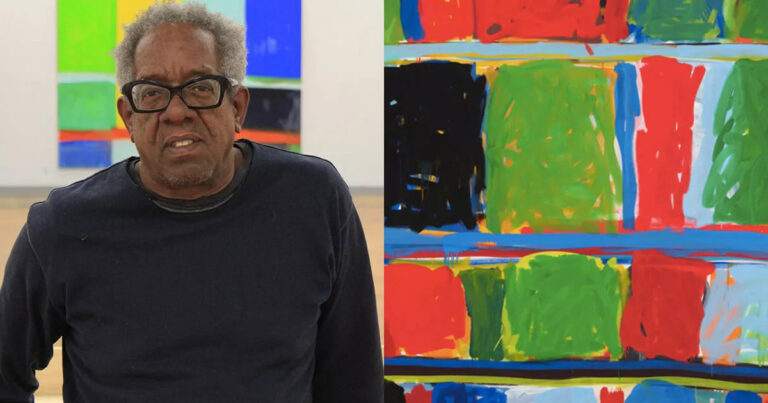
Tomas Sanchez is a Cuban painter recognized internationally for his detailed landscape paintings that blend hyperrealism with spiritual themes. Born in 1948 in Aguada de Pasajeros, Cuba, he creates tropical nature scenes and contemplative waterscapes that position him among the most celebrated Latin American contemporary artists working today.
His work occupies a unique space within contemporary Cuban art. Sanchez combines technical precision with meditative subject matter, producing paintings that address environmental consciousness and human spirituality. He is widely considered the most expensive living Cuban painter, with auction records reaching $1.8 million at Christie’s in 2022.
His career spans over five decades of practice rooted in both Eastern philosophy and the Caribbean landscape tradition.
Identity Snapshot
- Full Name: Tomas Sanchez Requeiro
- Lifespan: Born May 22, 1948 (still living)
- Primary Roles: Painter, engraver, printmaker
- Nationality: Cuban (based in Costa Rica and Miami, Florida)
- Movements: Contemporary Latin American Art, Volumen Uno, Hyperrealism with Surrealist influences
- Mediums: Oil on canvas, acrylic on canvas, acrylic on linen, tempera on paper, gouache, graphite, conte crayon, lithography
- Signature Traits: Precise brushwork, lush green palette, water reflections, solitary figures, pristine wilderness scenes
- Iconography: Palm trees, lagoons, waterfalls, meditating figures, garbage dumps, tropical forests
- Geographic Anchors: Aguada de Pasajeros (birthplace), Havana, Mexico City, Miami, Costa Rica
- Training: San Alejandro Academy, Escuela Nacional de Arte (ENA)
- Collections: Museo Nacional de Bellas Artes (Havana), Kemper Museum of Contemporary Art, Toledo Museum of Art, Berardo Collection Museum
- Gallery Representation: Marlborough Gallery (New York)
- Market Record: $1,800,000 for “Llegada del caminante a la laguna” (Christie’s, 2022)
What Sets Tomas Sanchez Apart
Most landscape painters record what exists. Sanchez paints places that have never existed but feel more real than photographs.
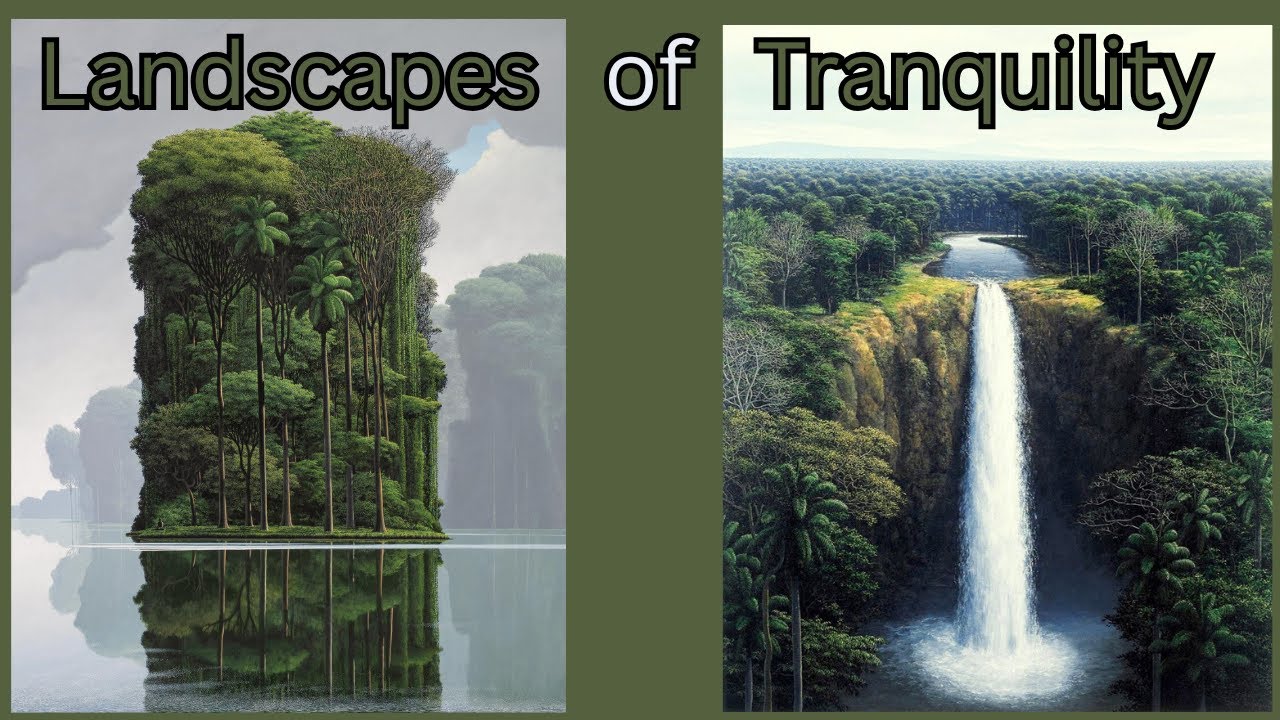
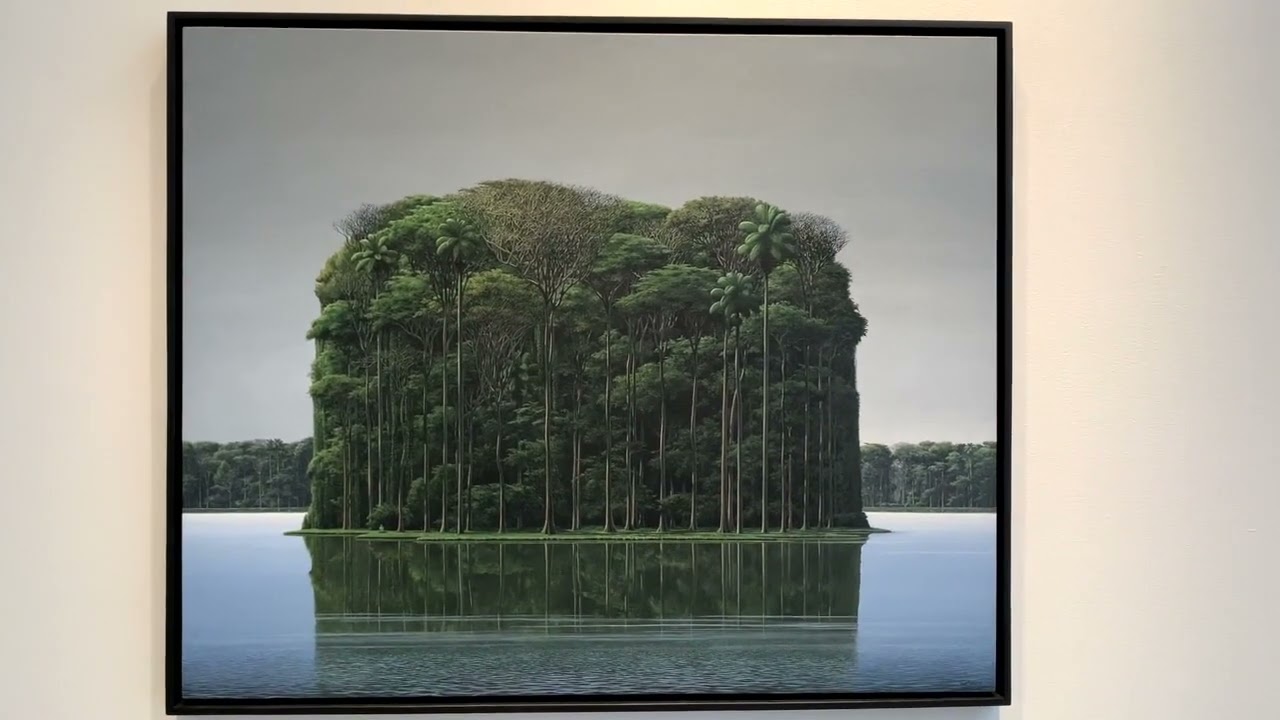
His technique sits somewhere between photorealism and surrealism. The vegetation is botanically precise, yet the overall scene reads as imagined.
He works from memory and meditation, not observation. Each canvas takes months, sometimes years, to complete.
The palette leans heavily toward emerald greens and deep blues. Cool shadows dominate the forest floor. Warm amber light appears during golden hour scenes.
Then there are the garbage dumps. These sprawling wastelands of colorful trash create a jarring counterpoint to his paradise imagery. Same technical precision. Completely opposite message.
A tiny human figure often appears in his landscapes. Usually seated. Back to the viewer. This is what he calls “the witness” from Kashmir Shaivism philosophy.
Compared to other Latin American painters, Sanchez rejected the neo-Expressionist trends of his generation. While his peers pursued abstraction and installation work, he doubled down on traditional landscape painting. It was a contrarian choice that paid off.

Origins and Formation
Early Years in Cuba
Born into a middle-class family in central Cuba’s sugar country. His father worked in sugar production. His mother shared his sensitivity for visual art.
He was a sickly child who spent considerable time wandering farmland near his home. These early experiences with rural Cuban landscape would later inform his painted forests.
Academic Training
1964-1966: San Alejandro Academy of Fine Arts, Havana. Conservative academic training in classical techniques.
1967-1971: Escuela Nacional de Arte (ENA). Exposure to expressionist influences. Graduated with formal recognition.
1971: First Prize in Drawing for Young Artists at the National Exhibition of Arts.
Early Career
1971-1976: Taught engraving at ENA. Developed lithography skills that would later translate to his print editions.
1975: First Prize in Painting and First Prize in Lithography at the National Salon.
1976-1978: Stage designer at Teatro de Munecros (Children’s Theater), Ministry of Culture. This period introduced theatrical sensibilities to his composition work.
1973: Discovered Andrew Wyeth’s work. This American painter’s cinematic approach to landscape resonated with Sanchez’s own emerging vision.
The Turning Point
1970: Began meditation practice following Paramahansa Yogananda’s teachings. Started attending the Self-Realisation center in Havana.
This spiritual practice would become the foundation of everything that followed. His landscapes emerged not from sketching outdoors but from states experienced during meditation.
1980: Won the Joan Miro International Drawing Prize for “Desde las aguas blancas.” His international career launched practically overnight.
1981: Exhibition at Joan Miro Foundation, Barcelona.
Movement and Context
Volumen Uno (1981)
On January 14, 1981, a controversial exhibition opened in Havana’s International Art Center. Eleven artists participated, including Sanchez.
Volumen Uno marked a break from the dogmatism of the 1970s in Cuban art. Over 10,000 visitors attended in two weeks. Even the Minister of Culture showed up.
The exhibition featured neo-Expressionism, installation work, performance, and process art. Sanchez contributed his hyperrealistic landscapes, an anomaly among the experimental pieces.
His participation was significant because it proved traditional painting could be radical. While others smashed conventions through new media, he challenged them by painting exceptionally well in an “outdated” genre.
Comparative Positioning
Versus Wifredo Lam: Both Cuban painters who used the forest as a spiritual space. Lam’s jungle contains Santeria orishas and aggressive abstraction. Sanchez’s forests are calm, precise, devoid of mythological figures. Same conceptual territory, opposite execution.
Versus Caspar David Friedrich: Sanchez openly acknowledges Friedrich as his primary influence among the Romantics. Both use the Ruckenfigur (figure seen from behind) compositional device. Both address nature’s spiritual magnitude. Friedrich worked in Northern European muted tones; Sanchez works in Caribbean saturated greens.
Versus Hudson River School: Art critics frequently compare his work to this American movement. The idealized wilderness aesthetic aligns. But Sanchez paints imagined spaces rather than specific locations. And he adds the garbage dump series, which has no Hudson River School equivalent.
Position Within Latin American Art
Sanchez emerged during a period when Latin American contemporary art favored political conceptualism and installation. His commitment to painting and technical virtuosity set him apart.
He left Cuba in 1989. Lived in Mexico first. Then moved between Miami and Costa Rica. This diaspora experience appears in his work as landscapes of idealized memory rather than documented reality.
Materials, Techniques, and Process
Supports and Mediums
Primary Supports: Canvas (both cotton and linen), paper, board
Dominant Mediums: Acrylic on canvas for most major works. Oil on canvas for some pieces. Tempera and gouache on paper for smaller studies.
Print Editions: Lithography, serigraph (silkscreen), archival pigment prints
Brushwork and Execution
The brushwork is invisible. That is the point.
Sanchez builds up thin layers with extraordinary patience. No visible strokes in the finished work. No impasto. No texture from the paint itself.
Each leaf receives individual attention. The texture comes from depicted subjects, not paint handling.
This approach requires extensive layering. He works wet on dry, allowing each layer to cure before applying the next.
Palette Architecture
Temperature Bias: Cool overall. Warm accents in golden hour scenes.
Dominant Hues: Emerald green, viridian, sap green, Prussian blue, cerulean, warm ambers
Value Distribution: High contrast between dark forest interiors and bright sky openings. Gradual gradation in water reflections.
Garbage Dump Palette: Completely different. Saturated primaries and secondaries. Reds, yellows, blues scattered across the canvas like confetti. Visually jarring by design.
Studio Practice
Sanchez works from his studios in Costa Rica and Miami. He does not paint outdoors or work from photographs.
The process begins in meditation. He visualizes the complete scene before touching the canvas. Then executes from mental image.
Completion takes months, sometimes years. He has described the final moments before a painting leaves the studio as the most difficult because he never feels the work is truly finished.
Themes, Subjects, and Iconography
Primary Subjects
Pristine Wilderness: Tropical forests dense with vegetation. Rivers and lagoons. Waterfalls. Shorelines. None exist as actual locations.
Garbage Dumps: Mountains of colorful trash extending to the horizon. These “basureros” began appearing in the 1980s. They address environmental destruction with the same technical precision as the paradise scenes.
Recurring Motifs
Palm Trees: Central to his tropical vocabulary. Often frame the composition or create natural arches.
Water Reflections: Rivers, lagoons, and flooded landscapes provide mirror surfaces. These represent meditative states of awareness and spiritual regeneration.
The Witness Figure: A small human figure, usually seated in meditation posture with back to viewer. This represents “the consciousness of the witness” from Kashmir Shaivism philosophy.
Natural Arches: Tree canopies forming cathedral-like arches. Sanchez describes these as “reminiscent of temples.”
Compositional Schemes
Most works use asymmetrical balance. Dense vegetation on one side, open sky or water on the other.
Horizon placement typically sits in the upper third. This gives landscapes their immersive quality.
The witness figure, when present, occupies a small portion of the canvas. Scale contrast between tiny human and vast nature is central to the message.
Symbolic Meanings
Paradise landscapes represent the inner peace achieved through meditation. They are maps of consciousness, not geography.
Garbage dumps represent “the restlessness of my mind transformed into landfills.” They document ecological destruction but also internal states of agitation.
Both subject types are landscapes. Both address human relationship to nature. Sanchez insists one cannot exist without the other.
Notable Works
Llegada del caminante a la laguna (2021)

Medium: Oil on canvas
Dimensions: 78 3/4 x 99 3/8 in. (200 x 252.3 cm)
Sale: Christie’s New York, 2022
Price: $1,800,000 (artist auction record)
Significance: This large-scale work established Sanchez as the most expensive living Cuban painter. The composition features his characteristic lagoon with vegetation and solitary figure.
Desde las aguas blancas (1980)

Medium: Drawing
Award: Joan Miro International Drawing Prize, 1980
Significance: The work that launched his international career. Won at the 19th edition of the prize, leading to exhibitions at the Miro Foundation in Barcelona.
Orilla en la Noche Clara (1993)

Medium: Oil on canvas
Significance: Representative of his mature shoreline paintings. Pristine and devoid of human presence, giving the work its otherworldly quality.
Basurero Series (1985-present)

Medium: Acrylic and oil on canvas
Significance: These garbage dump paintings form a counterpoint to paradise landscapes. “Basurero No. 1” (1985) and “Basurero verde para falsos ecologistas” (1996) represent key works in this series addressing environmental themes.
Meditador (1995)

Medium: Oil on canvas
Significance: Classic example of the witness figure composition. Small meditating figure set against expansive landscape demonstrates his exploration of human insignificance and inner peace themes.
Exhibitions, Collections, and Provenance
Major Solo Exhibitions
1985: Retrospective, Museo Nacional de Bellas Artes, Havana. His first major institutional survey.
1996: “Tomas Sanchez: Different Worlds,” Museum of Art, Fort Lauderdale, Florida.
2008: 60th birthday exhibition, Museo de Arte Contemporaneo de Monterrey, Mexico.
2021-2022: “Tomas Sanchez: Inner Landscape,” Marlborough Gallery, New York. First solo show in 17 years.
Institutional Collections

- Museo Nacional de Bellas Artes, Havana
- Kemper Museum of Contemporary Art, Kansas City
- Toledo Museum of Art, Ohio
- Berardo Collection Museum, Lisbon
- University of Essex, UK
- Museo de Arte Contemporaneo de Monterrey, Mexico
Gallery Representation
Joined Marlborough Gallery in 1996. This remains his primary representation for major works.
Publications
2003: Monograph published by Skira with essay by Gabriel Garcia Marquez and texts by Edward J. Sullivan, the leading Latin American art scholar.
Market and Reception
Auction Performance
Record Price: $1,800,000 (Christie’s, 2022)
Price Range: Works sell between $100 and $1.8 million depending on size, medium, and period.
Typical Range: Major canvases trade between $100,000 and $500,000.
Primary Auction Houses: Christie’s, Sotheby’s, Bonhams, Phillips
Production Rate
Sanchez paints slowly. Only a few major works per year. This controlled scarcity maintains demand.
Print Editions
Recent collaborations with Avant Arte have made his work accessible at lower price points through limited edition prints. These editions sell in the hundreds to low thousands of dollars.
Authentication
Works are accompanied by certificates of authenticity signed by the artist. Signature typically appears in the lower right corner with date.
Influence and Legacy
Upstream Influences
Caspar David Friedrich: Primary influence among the Romantics. The Ruckenfigur device and sublime nature themes come directly from Friedrich’s approach.
Andrew Wyeth: Sanchez discovered Wyeth’s work in 1973. The American painter’s cinematic treatment of landscape offered a contemporary model for realistic painting.
Hudson River School: The idealized American wilderness tradition informs his paradise aesthetic, though Sanchez paints from imagination rather than observation.
Wifredo Lam: Fellow Cuban who treated the forest as spiritual space. Different in execution but conceptually linked.
Spiritual Lineage
Paramahansa Yogananda: Initial meditation teacher whose Self-Realisation teachings began Sanchez’s practice in 1970.
Kashmir Shaivism: The philosophical tradition he currently follows. The concept of “the witness” comes from this lineage.
Siddha Yoga: Discovered in Mexico in 1990. Became his primary meditation practice.
Downstream Impact
Sanchez taught engraving at ENA from 1971-1976. His students encountered both his technique and his commitment to traditional media during a period favoring experimentation.
His commercial success demonstrated that Latin American painters could achieve international recognition and market prices through landscape painting, a genre often dismissed as conservative.
Cross-Domain Influence
Gabriel Garcia Marquez wrote about his work, establishing literary validation for his visual approach. The Nobel laureate’s essay appears in Sanchez’s 2003 Skira monograph.
His meditation-based creative process has influenced discussions about consciousness and artistic practice beyond visual art circles.
How to Recognize a Tomas Sanchez at a Glance

- Invisible brushwork: No visible strokes. Surface reads as smooth despite dense vegetation detail.
- Emerald green dominance: Saturated tropical greens throughout forest scenes.
- Water reflection precision: Mirror-perfect reflections in rivers and lagoons.
- Tiny witness figure: Small seated human with back to viewer, often in meditation posture.
- Natural arch compositions: Tree canopies forming cathedral-like curves overhead.
- Pristine, uninhabited wilderness: No signs of human development or intervention in paradise scenes.
- Colorful garbage mountains: In basurero series, saturated primary colors scattered across trash heaps.
- Horizon in upper third: Low horizon line creates immersive, overwhelming landscape effect.
- Signature placement: Lower right corner, typically with date.
- Large canvas formats: Major works often exceed 40 x 60 inches. Some reach 78 x 99 inches.
FAQ on Tomas Sanchez
Who is Tomas Sanchez?
Tomas Sanchez is a Cuban painter born in 1948 in Aguada de Pasajeros. He creates detailed landscape paintings that blend hyperrealistic technique with spiritual themes.
He is considered the most expensive living Cuban artist, with works selling at major auction houses like Christie’s and Sotheby’s.
What is Tomas Sanchez known for?
Sanchez is known for his tropical nature paintings featuring pristine wilderness scenes, water reflections, and palm trees. He also paints garbage dump landscapes addressing environmental themes.
His solitary figure compositions and meditation-inspired artwork distinguish him from other contemporary painters.
What painting style does Tomas Sanchez use?
His style combines hyperrealistic precision with surrealist dreamlike qualities. Critics compare his approach to symbolism and the Romantic tradition of Caspar David Friedrich.
The brushwork is invisible. Each leaf receives individual attention through meticulous layering techniques.
How much are Tomas Sanchez paintings worth?
Prices range from a few hundred dollars for prints to $1.8 million for major canvases. His auction record was set at Christie’s in 2022 for “Llegada del caminante a la laguna.”
Most Latin American art auction sales fall between $100,000 and $500,000.
Where can I see Tomas Sanchez artwork?
His work belongs to the Museo Nacional de Bellas Artes in Havana, Kemper Museum of Contemporary Art, and Toledo Museum of Art. Marlborough Gallery in New York represents him.
Private collections hold most of his paintings.
What do Tomas Sanchez landscapes mean?
His pristine landscapes represent inner peace achieved through meditation. The tiny witness figures embody “the consciousness of the witness” from Kashmir Shaivism philosophy.
These are maps of contemplative experience, not actual geographic locations.
Does Tomas Sanchez practice meditation?
Yes. He began practicing in 1970 following Paramahansa Yogananda’s teachings. Meditation remains central to his daily life and creative process after more than fifty years.
He paints from mental images formed during meditative states, not from observation.
What are the Tomas Sanchez garbage dump paintings?
His “basurero” series depicts colorful mountains of trash extending to the horizon. These works address environmental consciousness and ecological destruction with the same technical precision as his paradise scenes.
He considers both subject types part of the same conversation about nature.
Was Tomas Sanchez part of Volumen Uno?
Yes. He participated in this groundbreaking 1981 Havana exhibition alongside ten other Cuban artists. Volumen Uno resisted censorship and marked a turning point in contemporary Cuban art history.
His hyperrealistic landscapes stood apart from the experimental works of his peers.
Where does Tomas Sanchez live and work now?
He divides time between Costa Rica and Miami, Florida. He left Cuba in 1989, living first in Mexico before settling in his current locations.
His studios in both places produce the tropical landscape paintings for which he is celebrated.
Conclusion
Tomas Sanchez has built one of the most distinctive careers in Latin American contemporary painting. His meditative visual art bridges Cuban cultural identity with universal themes of nature spirituality and ecological awareness.
The pristine nature scenes and garbage dump paintings work together. One cannot exist without the other.
His five decades of daily meditation practice inform every brushstroke. Few artists achieve this integration of spiritual discipline and technical mastery.
Whether collected through major auction houses or experienced in museum galleries, his work offers something increasingly rare: genuine stillness in a restless world.