
A Swiss painter makes rocks glow hot pink and sunsets bleed acid yellow, yet museums can’t get enough.
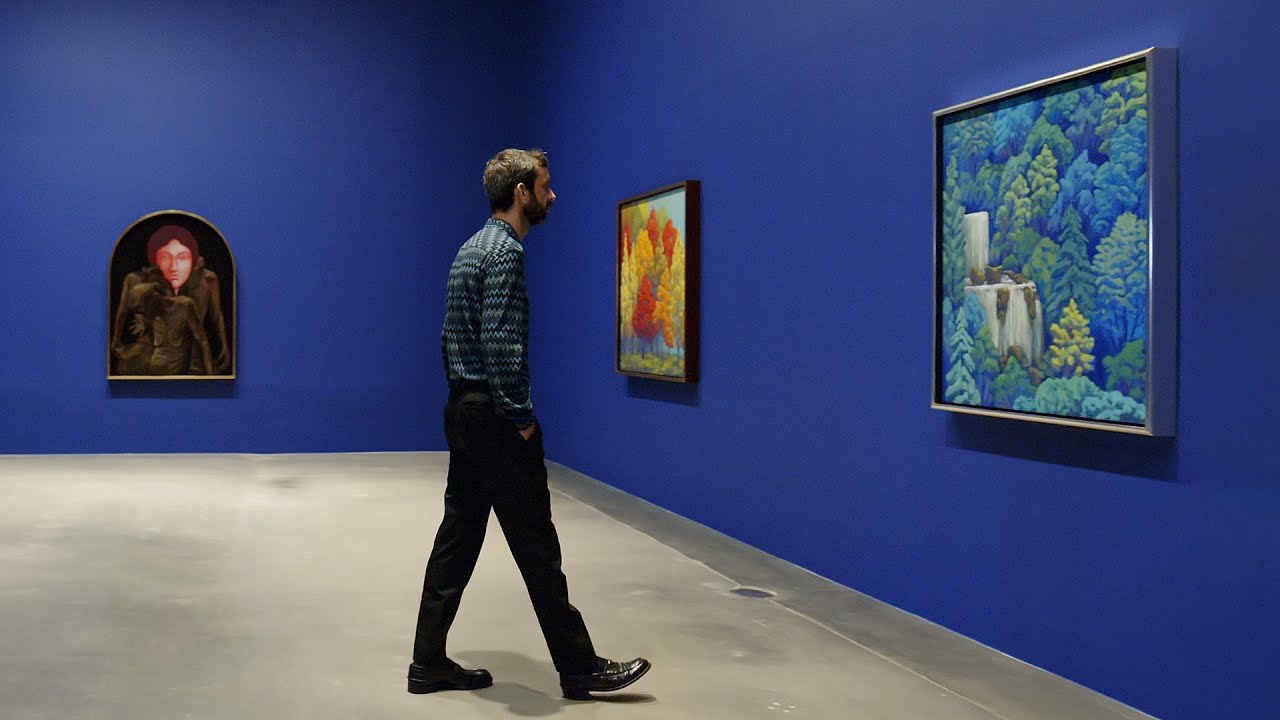
Nicolas Party rewired the 300-year-old pastel medium for digital-age eyes. His velvety surfaces read as both hand-rubbed and computer-rendered, a visual glitch that places him outside typical contemporary art categories.
Born in Lausanne in 1980, Party started as a teenage graffiti artist before formal training at Glasgow School of Art. Now his work hangs in the Hammer Museum, Kunsthaus Zurich, and Hirshhorn Museum.
This article maps Party’s complete artistic identity. You’ll discover his signature pastel technique, the influences from Rosalba Carriera to Giorgio Morandi, his record-breaking auction results, and how to recognize his work instantly.
From rock formations to mask-like portraits, we break down what makes this contemporary painter distinct in today’s crowded art market.
Identity Snapshot
Nicolas Party (b. 1980)
Born: July 1, 1980, Lausanne, Switzerland
Primary Roles: Painter, muralist, sculptor, installation artist
Nationality: Swiss
Current Base: New York City and Brussels
Movements: Contemporary figurative painting, post-pop aesthetics, fauvism-influenced chromatic work
Primary Medium: Soft pastel on canvas, linen, and pastel card
Secondary Mediums: Oil on copper, colored pencil, charcoal, pietra dura, ceramics
Signature Traits: Velvety pastel surfaces, hyper-saturated color saturation, knife-edge contour work, flattened digital aesthetic, skewed perspective
Iconography: Rock formations, sunset gradients, botanical elements, mask-like portraits, biomorphic still life objects
Key Studios: New York studio (primary production), Brussels workspace
Education: BFA, Ecole cantonale d’art de Lausanne (2004); MFA, Glasgow School of Art (2009)
Gallery Representation: Hauser & Wirth (primary), The Modern Institute (Glasgow), Kaufmann Repetto (Milan), Xavier Hufkens (Brussels), Karma (New York), Gregor Staiger (Zurich)
Major Collections: Hammer Museum, K11 Art Foundation, Kunsthaus Zurich, MASI Lugano, M Woods Beijing, Hirshhorn Museum, Los Angeles County Museum of Art, Royal Museums of Fine Arts Belgium
Market Signal: Record auction result of $1.1 million (Rocks, 2014, Christie’s 2016); typical canvas sizes range 60 x 80 cm to 150 x 180 cm
What Sets Nicolas Party Apart
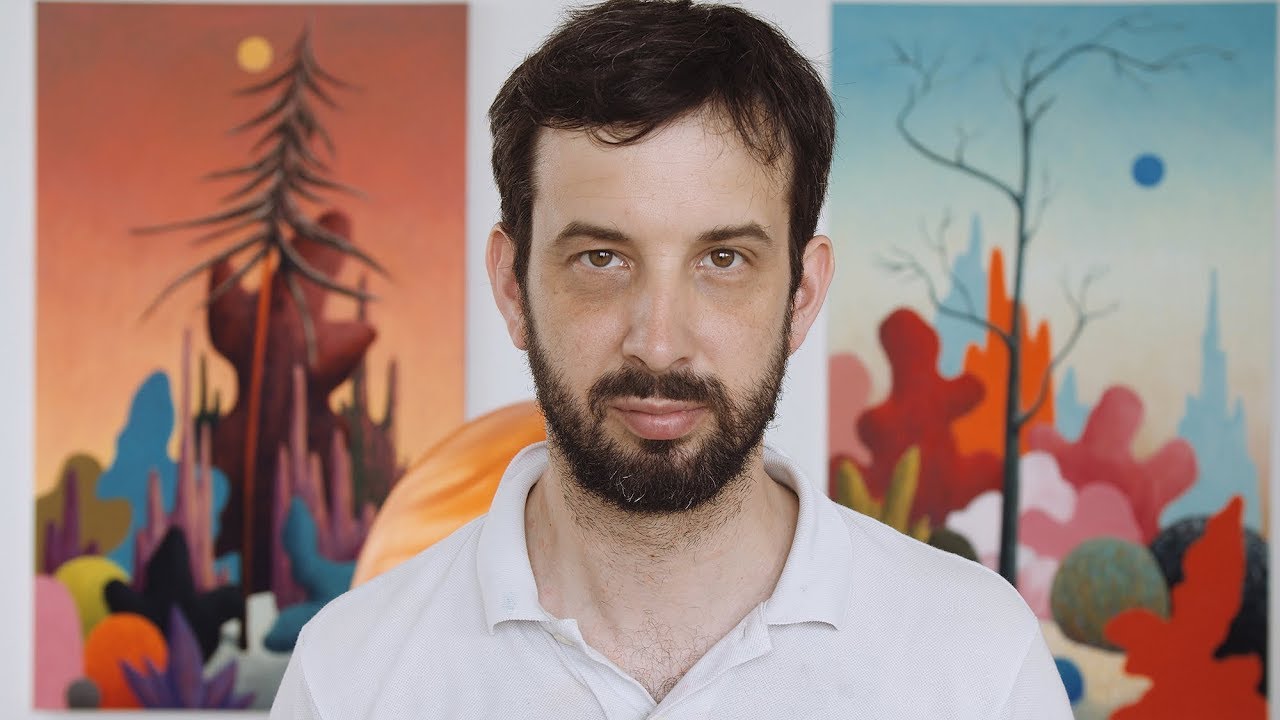
Party rewired the pastel medium for digital-age eyes.
Where 18th-century practitioners like Rosalba Carriera used soft pastel for courtly delicacy, Party weaponizes it for chromatic violence. His surfaces read as both hand-rubbed and computer-rendered, a perceptual glitch that places him outside standard contemporary painting taxonomies.
The artist collapses three centuries of landscape painting tradition into simplified geometric forms drenched in non-naturalistic hues. Rock formations become hot pink. Sunsets bleed into acid yellow. Tree trunks pulse with electric blue.
What separates Party from other figurative revivalists is his material commitment. Pastel is fragile, unforgiving, impossible to correct. Every stroke is final.
His large-scale murals transform exhibition architecture into total environments, a practice rooted in teenage graffiti work rather than academic training.
Origins & Formation
Early Graffiti Years (1992-2001)
Party entered Switzerland’s tagging scene at age 12. He spent nine years bombing trains, hiding from police, working at night. This wasn’t art school prep. It was obsession with surface, scale, and public space.
The Swiss landscape imprinted early. Alpine forms, glacial color temperature, Hodler’s stylized mountains. All of it sank in while Party was supposedly vandalizing property.
Academic Training (2000-2009)
Lausanne School of Art (2000-2004)
Shifted from spray paint to traditional painting mediums. Studied Swiss figurative tradition: Felix Vallotton’s flattened planes, Ferdinand Hodler’s symbolic landscapes. The school emphasized technical precision over conceptual gymnastics.
3D Animation Detour (2004-2005)
Brief career as digital animator. This work permanently altered his visual processing. “We’re so used to seeing computer-generated images now that it has a big impact on how we see all images,” Party explained. His figures would forever carry this thin-layer digital quality.
Glasgow School of Art, MFA (2006-2009)
Scotland’s damp light and decaying architecture offered chromatic contrast to Swiss clarity. Party began serious pastel experimentation after seeing a small Pablo Picasso pastel portrait at Art Basel. The medium’s directness solved his frustration with oil painting‘s glacial drying time.
First Exhibitions (2010-2012)
2010: First solo show at Rez-de-chaussee, Glasgow. Painted directly on gallery walls. Combined pastel paintings with ephemeral mural work. The installation announced his total-environment approach.
2012: “Still Lifes, Stones and Elephants,” Swiss Institute, New York. American debut. Introduced biomorphic still life forms that would become signature motifs.
Critical reception noted the work’s uncanny quality but couldn’t place it historically. Too colorful for neo-expressionism. Too figurative for abstract discourse. Too polished for outsider categorization.
Movement & Context
Post-Internet Figuration

Party operates within a loose cohort of painters treating representation as code rather than observation. His work shares digital flatness with artists like Alex Katz (whose simplified planes preceded the internet by decades) but adds pastel’s material friction.
The “post-pop” label fits his bright palette and iconic simplification. But Party lacks pop art‘s ironic distance. His sincerity reads as genuinely strange.
Comparative Positioning
vs. Henri Matisse:

Both deploy color for psychological impact rather than optical truth. Matisse used broad, liquid brushwork in oil. Party’s pastel creates matte, velvety surfaces with no visible stroke. Matisse’s edges dissolve. Party’s edges slice.
vs. Georgia O’Keeffe:

O’Keeffe magnified natural forms to abstraction through close observation. Party simplifies natural forms to geometric essence without direct observation. Her palette stayed within plausible natural ranges. His palette exists nowhere in nature.
vs. David Hockney:

Hockney’s saturated acrylic painting creates sun-bleached California flatness. Party’s pastel creates something closer to CGI rendering. Hockney’s space reads as observed. Party’s space reads as constructed, with deliberately wrong perspective and impossible light sources.
Historical Lineage

18th-Century Pastel Portraiture:
Rosalba Carriera revolutionized pastel by binding pigments into uniform sticks. Her portraits feature the “bloom” effect that makes pastel skin glow. Party uses the same material but rejects naturalistic rendering entirely.
Swiss Landscape Tradition:
Ferdinand Hodler’s symbolic landscapes with rhythmic repetition. Felix Vallotton’s woodcut-like simplification. Hans Emmenegger’s Alpine clarity. Party absorbs all three but adds digital-age artificiality.
Italian Still Life Painting:
Giorgio Morandi‘s bottles become Party’s rocks. The Italian’s muted earth tones become Party’s acid brights. Both reduce objects to essential geometric volumes.
Materials, Techniques, and Process
Supports & Grounds
Canvas: Belgian linen (large works 120-180 cm) and cotton canvas (mid-size 60-100 cm)
Pastel Card: Pre-textured heavy paper with tooth for smaller studies and portraits
Copper Panels: For oil miniatures, typically 10 x 15 cm, following Renaissance precedent
Gallery Walls: Direct application for site-specific murals using industrial primers
Pastel Specifics
Party sources soft pastels from La Maison du Pastel in Paris, the world’s oldest pastel manufacturer (founded 1720). These handmade sticks contain minimal binder, creating maximum pigment load and color intensity.
The medium allows no corrections. Overworking creates mud. Each application is additive and permanent.
Application Method
Layering Sequence:
- Light underdrawing in charcoal (often eliminated in final work)
- Broad color blocking with pastel stick sides
- Edge definition with stick tips
- Finger-blending for gradation zones
- Final highlights and darkest darks
Party works standing, moving around the canvas. The posture comes from graffiti practice rather than easel training.
No Fixative: Unlike most pastels, Party never sprays fixative. The powder remains loose, creating maximum light reflection but also maximum fragility. Finished works require specialized framing with spacing between glass and surface.
Brushwork Taxonomy
Party doesn’t use brushes for pastel work. All marks come from:
- Stick-side dragging (broad fields)
- Stick-tip drawing (contour lines)
- Finger-rubbing (soft transitions)
- Palm-smudging (large gradients)
For oil-on-copper miniatures, he uses sable rounds (size 00-2) for Renaissance-style precision.
Palette Construction
Dominant Hues:
Magenta, hot pink, acid yellow, electric blue, burnt orange, lime green. Party avoids earth tones almost entirely. When brown appears, it’s usually a warm purple-gray rather than true umber.
Temperature Bias:
Warm-dominant palette with cool accents. Sunsets run hot. Skies push toward cyan rather than natural blue. Greens trend acidic rather than forest-deep.
Value Distribution:
Party maintains strong value contrast even within saturated color. Darkest passages hit true black. Lightest areas reach pure white. This prevents the muddy mid-value trap that plagues many colorists.
Pastel Stick Inventory:
Studio contains approximately 1,600 individual pastel sticks organized by hue family. Party treats the collection like a pre-mixed color wheel rather than mixing colors during application.
Studio Practice
Alla Prima Approach:
Most paintings complete in one to three sessions. The pastel medium doesn’t allow extended layering periods. What reads as thick impasto is actually maximum pigment density in single application.
No Photographic Reference:
Party works from memory and imagination rather than observation. Landscape paintings reference Swiss topography but aren’t site-specific. Portraits follow archetypes rather than sitters.
Mural Production:
Large-scale wall drawings take 3-4 weeks for major installations. Party uses scaffolding and works section by section. Colors appear brighter on vertical surfaces due to different light reflection angles.
Themes, Subjects, and Iconography
Landscape as Constructed Memory
Party’s landscapes don’t document places. They reconstruct childhood Swiss scenery filtered through decades of art history and digital imagery.
Rock Formations: Appear in dozens of paintings. Simplified to geometric volumes. Often stacked impossibly. Read as both natural phenomena and CGI renders.
Sunset Gradients: Horizontal bands of color shifting from warm to cool. The transitions follow atmospheric perspective logic but use impossible hues.
Tree Trunks: Vertical elements providing [compositional](https://harmony](https://russell-collection.com/what-is-harmony-in-art/) and anchoring otherwise floating forms.
Portraiture as Archetype
Faces in Party’s work carry disturbing flatness. Eyes appear as simple circles. Noses reduce to triangular planes. Mouths become curved lines.
The effect sits between medieval icon painting and emoji simplification.
Recurring Elements:
- Wide, staring eyes (no pupils, just dark circles)
- Symmetrical facial structure
- Frontal positioning
- Jewelry as symbolic markers (shells, beads, geometric pendants)
- Hair treated as solid colored mass
Still Life as Symbol Set
Botanical Forms: Flowers, leaves, branches. Treated as geometric abstractions rather than observed specimens.
Vessels: Vases, bowls, cups. Always simplified to essential cylindrical or spherical volumes.
Food Elements: Fruit (especially peaches and pears), occasionally vegetables. Colors shift to unnatural spectrum.
Compositional Architecture
Triangular Schemes: Dominant strategy. Three rocks form pyramid. Three portrait figures create stable base.
Horizontal Banding: Landscape works divide into three to five horizontal color zones. Sky, distant mountains, middle ground, foreground, ground plane.
Centralized Focal Points: Objects or figures placed dead center. Classical symmetrical balance rather than dynamic asymmetrical balance.
Compressed Space: Minimal depth cues. Background and foreground elements exist on near-identical planes. This flatness reinforces the digital aesthetic.
Symbolic Color Associations
Party’s color psychology operates outside Western tradition:
- Pink rocks suggest geological specimens under ultraviolet light
- Yellow skies evoke air pollution or alien atmospheres
- Blue shadows reference impressionism but intensified to artificial levels
- Green skin tones in portraits suggest masks or avatars
Notable Works
“Rocks” (2014)

Medium: Soft pastel on canvas
Size: 155 x 125.5 cm (61 x 49 3/8 in)
Current Location: Private collection
Visual Signature: Five boulder forms stacked impossibly. Colors shift from blood orange (bottom) through hot pink (middle) to scarlet red (top). Dark purple-brown shadows create sculptural volume despite flat application. Background gradient runs cool gray to warm taupe.
Why It Matters: Established Party’s auction market with $1.1 million Christie’s sale (2016). The work demonstrates his ability to make geological forms read as both ancient and digital. Included in major exhibitions at Centre Culturel Suisse (Paris, 2015) and Royal Botanic Garden Edinburgh (2015).
Related Works: “Stones” series (2013-2016) exploring similar rock-stacking compositions.
“Portrait” (2015)
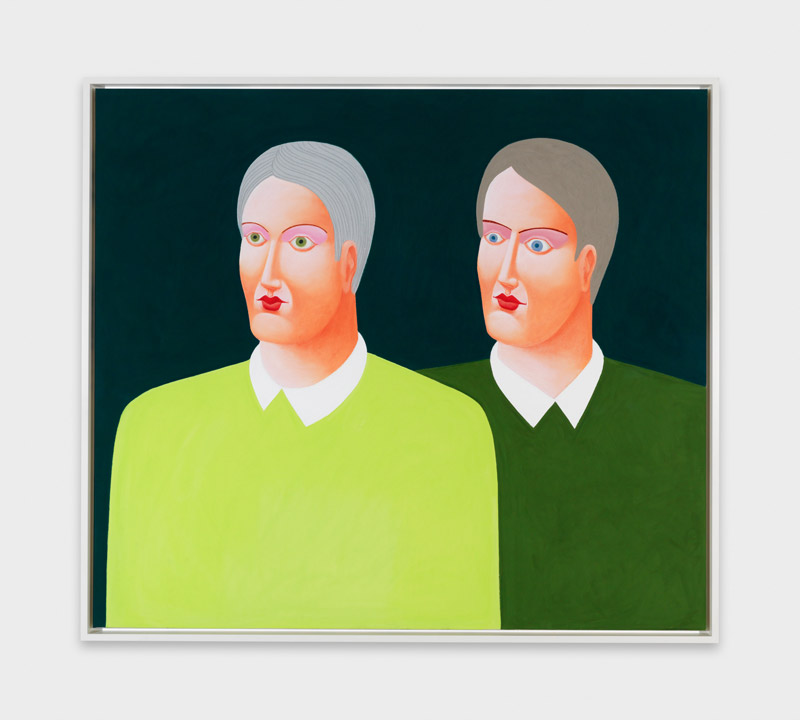
Medium: Soft pastel on canvas
Size: Approximately 80 x 60 cm
Current Location: Private collection
Visual Signature: Single frontal face. Simplified features. Large circular eyes. Geometric necklace of abstract shells. Background solid magenta. The figure’s skin reads as pale yellow-green. Hair rendered as solid burnt orange mass.
Why It Matters: Sold for $650,000 at Sotheby’s Contemporary Art Evening Auction (June 2020). Exemplifies Party’s portrait archetype. The mask-like quality disturbs while remaining formally beautiful.
Related Works: “Three Portraits” series (2018), exploring facial variations within consistent compositional framework.
“Landscape” (2018)
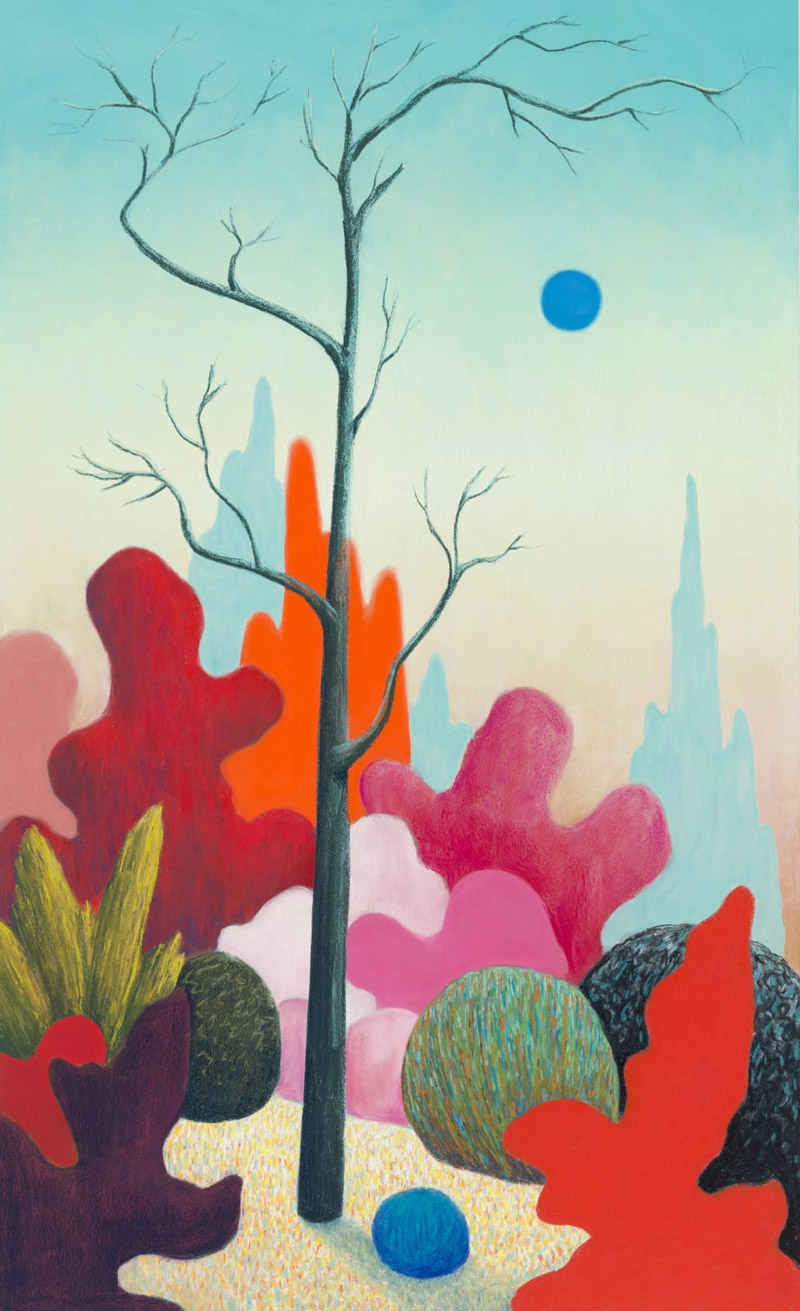
Medium: Soft pastel on canvas
Size: 120 x 100 cm (estimated)
Current Location: Museum or private collection
Visual Signature: Horizontal color banding. Sky gradient from yellow (top) to pink (middle) to orange (horizon). Dark purple mountain silhouettes. Three stylized trees in foreground. Ground plane shifts from lime green to darker green-gray.
Why It Matters: Demonstrates Party’s mature landscape syntax. The composition follows traditional landscape structure but color choices explode naturalistic convention. Critics noted resemblance to Salvo’s neo-expressionist landscapes but acknowledged Party’s distinct digital flatness.
“Draw the Curtain” (2021-2022)
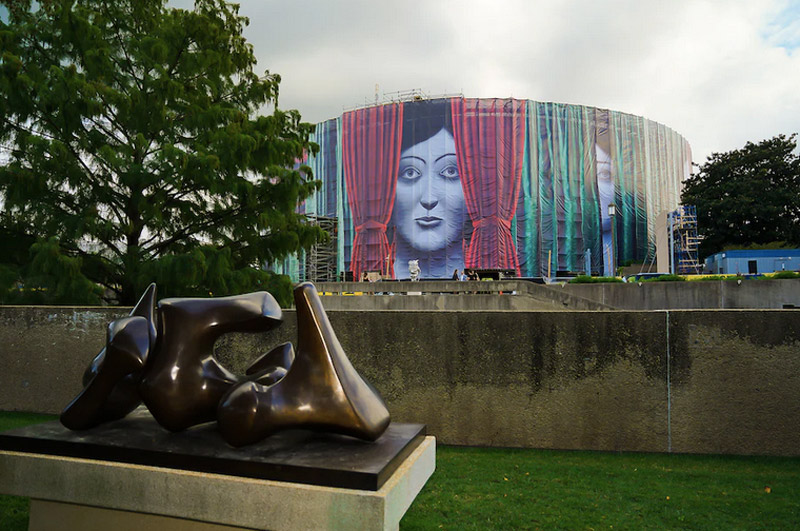
Medium: Original pastel painting digitally collaged and printed on scrim
Size: 829 feet circumference, wrapped 360 degrees around Hirshhorn Museum building
Location: Hirshhorn Museum and Sculpture Garden, Washington DC (temporary installation)
Visual Signature: Monumental scale. Continuous landscape frieze visible from National Mall. Mountains, sunsets, botanical forms cycling around cylindrical museum architecture. Colors shift as viewers walk around building.
Why It Matters: Largest work in artist’s career. Transformed institutional architecture into total artwork. Demonstrated transition from gallery-scale intimacy to public monument ambition. Installation ran September 2021 through Spring 2022.
Technical Innovation: First major translation of Party’s hand-worked pastel aesthetic to architectural scale via digital reproduction technology.
“Water Reflection” (2022)
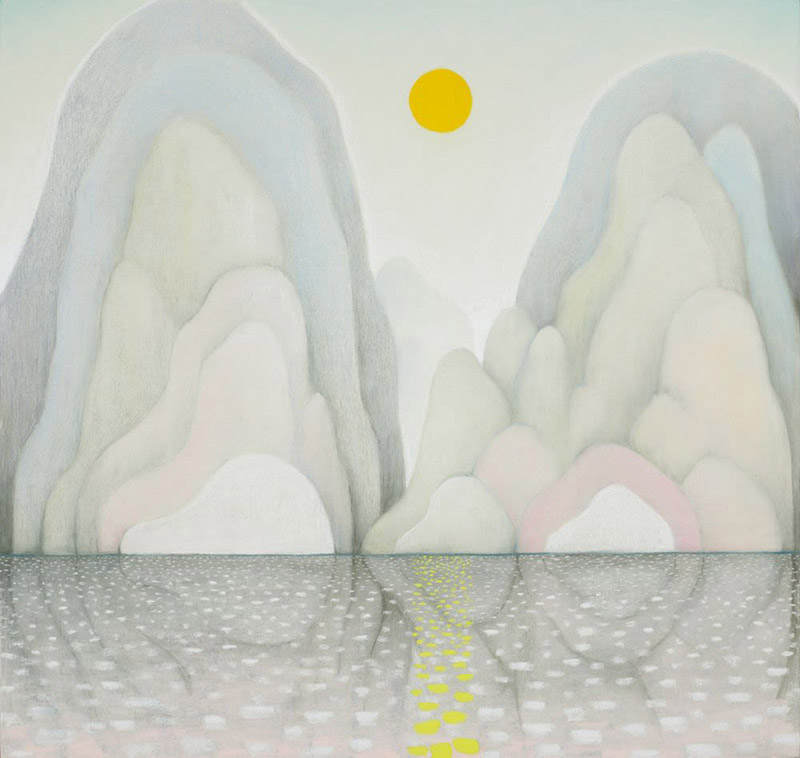
Medium: Soft pastel on canvas
Size: Approximately 150 x 120 cm
Current Location: Private collection
Visual Signature: Simplified tree forms mirrored in water surface. Vertical symmetry. Color palette shifts from warm oranges (trees) to cool blues (water reflection). The reflection isn’t naturalistic, just inverted color zones.
Why It Matters: Recent work showing continued investigation of reflection and doubling. The composition explores repetition as formal device.
Exhibitions, Collections, and Provenance
Major Solo Exhibitions
2016
- Hammer Museum, Los Angeles (Hammer Projects series)
- Dallas Museum of Art, Texas
2017
- Hirshhorn Museum and Sculpture Garden, Washington DC (“Sunrise, Sunset”)
- Xavier Hufkens, Brussels (“Three Seasons”)
2018
- M Woods Museum, Beijing (“Arches”)
- Magritte Museum, Royal Museums of Fine Arts Belgium, Brussels (“Magritte Parti”)
2019
- FLAG Art Foundation, New York (“Pastel”) – featured historical pastel works by Rosalba Carriera, Edgar Degas, Mary Cassatt alongside Party’s contemporary work
2020
- Hauser & Wirth, Los Angeles (“Scottsboro”) – debut exhibition with mega-gallery
2021
- MASI Lugano, Switzerland (major retrospective)
- Le Consortium, Dijon, France
2023
- Museum Frieder Burda, Baden-Baden, Germany (“When Tomorrow Comes”) – first museum presentation in Germany
2025
- Currier Museum of Art, Manchester (“Nicolas Party and Surrealism: An Artist’s Take on the Movement”)
Institutional Collections (Depth Holdings)
Kunsthaus Zurich – Multiple works spanning 2014-2020
MASI Lugano – Significant holdings following 2021 retrospective
Hirshhorn Museum and Sculpture Garden – Acquired works from 2017 solo exhibition
M Woods Beijing – Asian collection anchor following 2018 solo show
Hammer Museum, Los Angeles – West Coast institutional presence
Royal Museums of Fine Arts Belgium, Brussels – European survey representation
K11 Art Foundation, Hong Kong – Major Asian private foundation holding
Los Angeles County Museum of Art (LACMA) – Broad survey collection
Key Provenance Patterns
Primary Market Channels: Works typically enter market through representing galleries at $50,000-$300,000 for mid-size pastels (80-120 cm dimension).
Dealer Network: Hauser & Wirth (international), Kaufmann Repetto (Italy/US), Xavier Hufkens (Belgium), The Modern Institute (Scotland), Karma (New York), Gregor Staiger (Switzerland).
Notable Private Collections: Rubell Museum, Fiorucci Art Trust, Fondazione Sandretto Re Rebaudengo, Julius Baer Art Collection, UBS Art Collection.
Auction Frequency: Relatively controlled secondary market. Major works appear at Christie’s and Sotheby’s evening sales 2-3 times annually.
Market & Reception
Auction Performance
Record Price: $1.1 million for “Rocks” (2014), Christie’s London, 2016
Recent Results:
- “Portrait” (2015): $650,000, Sotheby’s New York, June 2020
- “Tree Trunks” (2015): Withdrawn from Christie’s London, October 2024 (estimated £800,000-£1.2 million / $1-1.5 million)
- Various works: $200,000-$400,000 range at Phillips and regional auction houses
Price Stratification by Medium:
- Large pastel on canvas (120-180 cm): $300,000-$800,000
- Mid-size pastel (80-100 cm): $150,000-$400,000
- Small pastel studies: $50,000-$150,000
- Oil on copper miniatures: $30,000-$80,000
- Prints and multiples: $2,000-$15,000
Market Trajectory: Steady climb from 2014-2020. Slight correction 2021-2023 (broader contemporary market softness). Renewed institutional interest 2024-2025.
Authentication Considerations
Signature Placement: Party signs verso (back of canvas or support). Front signatures appear only on prints and multiples.
Studio Assistance: Party maintains small studio team. All pastel work executed by artist’s hand. Some mural projects involve assistants for ground preparation.
Catalogue Documentation: Hauser & Wirth maintains comprehensive records of major works. Gallery website features extensive exhibition history and provenance tracking.
Forgery Risk: Low currently. Pastel technique difficulty and Party’s distinctive color mixing provide natural authentication barriers. As prices rise, risk increases.
Condition Patterns
Pastel Fragility: Unfixed pastel surfaces shed pigment with any contact or vibration. Professional framing with spacers mandatory. Works cannot be rolled or shipped without elaborate custom crating.
Color Stability: High-quality artist-grade pastels show minimal fading under proper conservation conditions. Exposure to direct sunlight causes rapid degradation.
Mural Ephemerality: Wall paintings intentionally temporary. Many destroyed after exhibitions close. Party treats these as installation components rather than permanent works.
Copper Panel Stability: Oil-on-copper works show excellent long-term stability. Renaissance precedent suggests centuries-long durability when properly housed.
Influence & Legacy
Upstream Influences (Artists Who Shaped Party)
Historical:
- Rosalba Carriera (1673-1757): Pastel technique precedent, Rococo color luxury
- Ferdinand Hodler (1853-1918): Swiss landscape symbolism, rhythmic pattern work
- Felix Vallotton (1865-1925): Woodcut-like simplification, flattened pictorial space
- Giorgio Morandi (1890-1964): Still life reduction to essential volumes
- Milton Avery (1885-1965): Simplified natural forms, high-key color
Modernist:
- Henri Matisse (1869-1954): Fauve color liberation, decorative flatness
- Pablo Picasso (pastel portraits): Direct medium use, Greek sculpture influence
- Rene Magritte (1898-1967): Belgian surrealist clarity, object displacement
Contemporary:
- David Hockney (b. 1937): Saturated acrylic palette, California light
- Alex Katz (b. 1927): Figure-ground simplification, billboard-scale ambition
- Salvo (1947-2015): Neo-expressionist landscape, chromatic intensity
Downstream Influence (Artists Shaped by Party)
Emerging Pastel Revival: Party’s success sparked renewed interest in soft pastel among younger painters. Art schools report increased pastel coursework enrollment post-2015.
Post-Internet Figuration: Influenced cohort of artists treating representation as digital code:
- Issy Wood (b. 1993): Airbrush technique, similar uncanny quality
- Louis Fratino (b. 1993): Intimate pastel work, queer domesticity
- Various emerging painters exploring simplified figuration with non-naturalistic color
Installation Practice: Party’s total-environment exhibitions influenced how galleries present contemporary painting. The mural-as-frame concept now appears regularly in institutional shows.
Cross-Domain Impact
Design: Party’s color palettes appear in fashion (Jacquemus Spring 2020 collection noted visual parallels), interior design (2020s “new maximalism” movement), graphic design (editorial illustration trending toward simplified forms with saturated color).
Digital Art: NFT artists cite Party’s hybrid analog/digital aesthetic. The tension between handmade and computer-rendered surfaces resonates with crypto art discourse.
Architecture: Several architects commissioned Party-influenced color schemes for residential and commercial projects. The pastel-bright palette entered interior architecture vocabulary.
How to Recognize a Nicolas Party at a Glance

Diagnostic Checklist:
- Surface Quality: Velvety, matte pastel finish (if original). No brush strokes. Even pigment density across surface.
- Color Intensity: Hyper-saturated hues. If landscape includes hot pink rocks or acid yellow sky, likely Party.
- Edge Control: Hard, knife-like contour lines separating color zones. No soft blending except in gradient passages.
- Simplified Forms: Geometric reduction of natural objects. Three to five basic shapes per composition.
- Flattened Space: Minimal depth recession. Background and foreground exist on similar planes.
- Frontal Positioning: Subjects face viewer directly (portraits) or arrange symmetrically (landscapes, still lifes).
- Signature Palette Markers: Hot pink, acid yellow, electric blue, lime green, burnt orange. Absence of earth tones.
- Canvas Aspect Ratios: Typically vertical formats for portraits (80 x 60 cm common). Square or horizontal for landscapes (120 x 100 cm, 150 x 120 cm frequent).
- Horizon Placement: In landscapes, horizon line positioned at exact center or upper third. Rarely in lower frame.
- Digital Flatness: Overall impression of CGI render or emoji simplification despite clearly hand-worked surface.
Common Party Subjects:
- Stacked rocks (multiple works titled “Rocks” or “Stones”)
- Frontal portraits with circular eyes and geometric jewelry
- Sunset gradients with simplified mountain silhouettes
- Single trees or tree trunks against colored backgrounds
- Still life arrangements of simplified vessels and fruit
Scale Signals:
- Gallery paintings: 60-180 cm range
- Studies and works on paper: 30-50 cm
- Copper miniatures: 10-15 cm
- Murals: Architectural scale, often wrapping entire walls or rooms
Signature Placement: Always verso (back of support). Never signed on front surface (except prints/multiples).
Framing Convention: Pastel works require spacers between glass and surface. If framed flush, likely print reproduction rather than original pastel.
FAQ on Nicolas Party
Who is Nicolas Party?
Nicolas Party is a Swiss contemporary artist born in Lausanne in 1980. He’s known for vivid soft pastel paintings depicting landscapes, portraits, and still lifes with hyper-saturated colors and simplified geometric forms that blend classical painting tradition with digital-age aesthetics.
What medium does Nicolas Party use?
Party primarily works with soft pastel on canvas and linen, an 18th-century medium he revived for contemporary use. He also creates oil-on-copper miniatures, large-scale murals painted directly on gallery walls, and sculptural works including painted busts and pietra dura.
Why does Nicolas Party use pastels?
Pastel allows Party immediate access to pure color without mixing. “If you work with paint, you kind of imagine a color. In pastel, it’s right there,” he explains. The medium creates velvety, matte surfaces with maximum color intensity and light reflection.
What is Nicolas Party’s most expensive painting?
Party’s auction record is $1.1 million for “Rocks” (2014), sold at Christie’s London in 2016. His 2015 work “Portrait” achieved $650,000 at Sotheby’s in 2020. Exhibition works typically range $300,000-$800,000 for large-scale pastel paintings depending on size and period.
Where can I see Nicolas Party’s art?
Party’s work appears in permanent collections at the Hammer Museum (Los Angeles), Kunsthaus Zurich, Hirshhorn Museum (Washington DC), M Woods (Beijing), and MASI Lugano. He’s represented by Hauser & Wirth gallery with locations in New York, Los Angeles, London, and other major cities.
What is Nicolas Party’s painting style?
Party’s style combines post-pop aesthetics with classical landscape and portrait traditions. He simplifies natural forms into geometric shapes, applies non-naturalistic color saturation, and creates flattened pictorial space that reads as both hand-worked and computer-generated-a distinctive contemporary figurative approach.
How does Nicolas Party create his paintings?
Party applies pastel stick directly to canvas using side-dragging for broad color fields and tip-drawing for contour lines. He blends with fingers and palms, building up powder pigment without fixative. Works complete in one to three sessions since pastel doesn’t allow extended layering periods.
Who influenced Nicolas Party’s work?
Party draws from 18th-century pastel portraitist Rosalba Carriera, Swiss landscape painters Ferdinand Hodler and Felix Vallotton, Italian still-life master Giorgio Morandi, and modernists like Pablo Picasso and Henri Matisse. His teenage graffiti practice also shaped his approach to scale and surface.
What makes Nicolas Party’s work unique?
Party revived soft pastel-a fragile, rarely-used medium-for monumental contemporary painting. His hyper-saturated color palette, digital flatness combined with hand-worked surfaces, and site-specific mural installations create immersive environments that transform how viewers experience figurative painting in gallery spaces.
How much do Nicolas Party paintings cost?
Primary market prices through galleries range $50,000-$300,000 for mid-size pastels. Large exhibition works (120-180 cm) sell $300,000-$800,000. Small studies and works on paper start around $30,000-$50,000. Oil-on-copper miniatures range $30,000-$80,000. Prints and multiples sell $2,000-$15,000.
Conclusion
Nicolas Party rewired an obsolete medium for contemporary eyes. His soft pastel technique bridges 18th-century Rococo refinement and digital-age flatness, creating surfaces that confuse the eye while satisfying it.
From teenage graffiti artist in Lausanne to blue-chip gallery representation at Hauser & Wirth, Party compressed decades of typical career development into fifteen years. His rock formations glow impossible pink. His sunsets bleed synthetic yellow. His portraits stare with mask-like intensity.
The art market responded with million-dollar auction results and museum acquisitions from the Hirshhorn to Kunsthaus Zurich. But Party’s real achievement sits beyond price tags.
He made fragile powder pigment feel monumental. He transformed gallery walls into total immersive environments. He proved figurative painting could be both historically informed and radically contemporary.
That’s the work speaking louder than the hype.