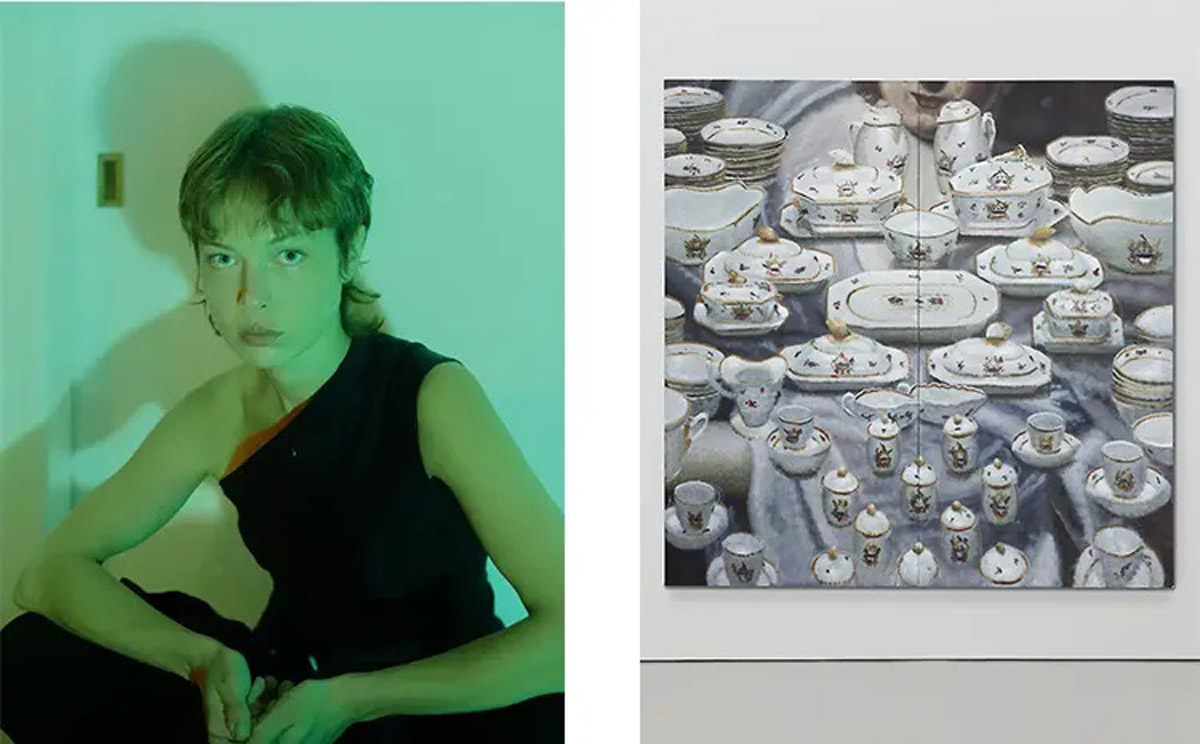

Issy Wood paints luxury like a crime scene.
The London-based contemporary artist turns leather car seats, designer jackets, and teeth into melancholic artifacts of consumer desire. Her oil paintings on velvet blur into soft focus, making every object look like it’s dissolving or already dead.
Born in 1993, Wood emerged during the figurative painting revival but never fit cleanly into it. She crops compositions so tightly you can’t tell what you’re looking at. A steering wheel becomes abstract. Wisdom teeth become monuments.
This article covers Wood’s distinctive techniques, her notable works across major exhibitions, and the visual signatures that make her paintings instantly recognizable. You’ll understand why critics call her work “perverted realism” and why collectors pay six figures for paintings that refuse to glamorize anything.
Wood also writes and makes music. But the paintings came first, reluctantly.
Identity Snapshot
Full Name: Issy Wood
Born: 1993, Durham, North Carolina, USA
Primary Role: Painter, Musician, Writer
Current Location: London, England
Education:
- BA Fine Art, Goldsmiths, University of London (2015)
- MA Fine Art, Royal Academy Schools, London (2018)
Movements: Contemporary figurative painting, perverted realism
Primary Mediums: Oil painting on velvet, oil on linen, oil on canvas
Signature Traits: Blurred soft-focus application, muted earthy palette, claustrophobic cropping, velvet support preference
Recurring Motifs: Leather car interiors, luxury goods, teeth and dental work, designer jackets, vintage objects, gloves, body fragments
Key Galleries: Carlos/Ishikawa (London), Michael Werner Gallery (New York, Beverly Hills, Athens)
Collections: National Portrait Gallery (London), Zabludowicz Collection, Institute of Contemporary Art Miami, Rhode Island School of Design Museum, Sifang Art Museum (Nanjing)
Market Position: Record auction price $599,035 USD (2022)
Self-Description: “Medieval millennial”
What Sets Issy Wood Apart

Wood treats luxury objects like rotting specimens under glass.
Her oil paintings on velvet blur the distinction between advertisement and autopsy. She crops compositions so tightly that car seats become skin, teeth become monuments, and jackets hang like deflated bodies. The velvet support dulls any shine into something almost sepulchral.
Where other contemporary painters chase clarity, Wood builds fog.
Her soft-focus technique recalls sfumato but warped through Instagram filters and auction catalog reproductions. Everything looks secondhand, even brand-new Porsches. The paintings operate in this weird zone between photorealism and total dissolution.
She paints like someone who learned technique from Old Masters but sources imagery from eBay listings.
Origins & Formation
Early Life (1993-2015)
Born in Durham, North Carolina, Wood moved to South London as a child. Her parents were both doctors. Medical journals cluttered the family dining table.
She describes arriving late to womanhood, to femininity, to painting itself.
Education Arc
Goldsmiths (2015)
Studied Fine Art and History of Art. Started building the visual vocabulary that would define her practice.
Royal Academy Schools (2015-2018)
Initially avoided painting. Tried video and sculpture instead.
A tutor intervened at 22: “What on earth are you doing? You have to carry on painting. I know it’s embarrassing, but you have to suck it up because it’s the only thing you’re good at right now.”
She listened.
First Recognition (2017)
Debut solo show “When You I Feel” at Carlos/Ishikawa, London. Gallery director Vanessa Carlos saw something in Wood’s work that the art world hadn’t quite processed yet.
The relationship stuck. Carlos/Ishikawa remains her primary gallery.
Movement & Context
Positioning
Wood emerged during the 2010s figurative painting revival but never fit cleanly into it. While peers like Caroline Walker, Anna Weyant, and Ewa Juszkiewicz investigated femininity through more declarative means, Wood encrypted everything.
She occupies a strange tributary between contemporary realism and what critic Barry Schwabsky called “perverted realism.”
Comparative Attributes
vs. Michaël Borremans
Both work in ominous registers with muted palettes. But Borremans uses hard edges and deliberate staging. Wood’s edges dissolve. Her compositions feel stumbled upon rather than arranged.
vs. Cecily Brown
Brown’s gestural energy and visible brushwork celebrate paint as substance. Wood suppresses gesture entirely. Her surfaces feel wiped, smudged, almost apologetic.
vs. Malcolm T. Liepke
Liepke paints intimate figures with confident, sculptural form. Wood fragments bodies into unrecognizable components. A hand gripping a steering wheel. Teeth under dental examination. No full figures, no sky, no context.
Temporal Displacement
Wood deliberately confuses time signatures. She’ll render a 1950s Mercedes in techniques borrowed from 17th-century Dutch still life painters, then add Gothic-font date stamps. Viewers can’t tell if paintings were made in 1910 or 2010.
That’s intentional.
Materials, Techniques, and Process
Supports
Velvet (primary)
Panne velvet stretched on frames. The fabric absorbs light and creates instant atmospheric depth. Wood calls it a conceptual statement as much as an aesthetic choice.
The material historically signaled wealth and power. Under her brush it becomes a shroud.
Linen
Secondary support for works requiring smoother surfaces. Used more frequently in recent self-portrait series.
Canvas
Occasional use, especially in earlier works (2017-2018).
Paint Application
Soft-Focus Technique
Wood applies paint in blurred, wiped layers that mimic photographic grain and digital compression artifacts. Nothing snaps into focus.
The technique sits somewhere between sfumato and deliberate degradation.
No Impasto
Surfaces remain flat. No visible brushwork or texture variation beyond the velvet support itself. Paint seems breathed onto the surface rather than applied.
Wet-in-Wet Passages
Colors blend directly on the canvas without crisp boundaries. Contributes to the smudged, uncertain quality.
Palette
Muted earths dominate: grays, taupes, olive greens, cream brulee yellows, metallic silvers.
Occasional deep blacks on velvet create void-like spaces.
Rare pops of color (mint green, mustard yellow) appear in furniture paintings and self-portraits from 2023 onward.
Temperature bias leans cool, even when depicting warm leather or skin.
Studio Practice
Daily Discipline
10 a.m. to 5 p.m. studio hours. Rigid routine as coping mechanism.
Wood produces around 100 paintings to show a handful. She bins or paints over mistakes.
Source Material
Auction catalogs (especially for cars and luxury goods), her grandmother’s inherited objects, personal photographs, screenshots from TV shows (Sex and the City, The Sopranos, Totally Spies).
Small Painting Series
Maintains ongoing practice of small-format oils documented in published volumes (SML PTNGS Vol 1-3). Daily exercises that parallel her songwriting.
Themes, Subjects, and Iconography
Consumer Fetishism
Luxury cars (Mercedes, Porsche) painted with forensic attention but zero glamour. The objects become relics of desire rather than aspirational symbols.
Designer jackets (leather, Moncler, cowhide) hang empty, suggesting bodies absent or discarded.
Wood exposes how consumer goods function as modern devotional objects.
Dental Imagery
Teeth under orthodontic treatment. Wisdom teeth extractions. Mouths open during procedures.
The series connects to Wood’s personal history with eating disorders and her parents’ medical backgrounds.
Teeth can’t grow back. The imagery explores irreversibility, damage, attempts at repair.
Body Fragments
Never full figures. Hands gripping door handles. Torsos in armor. Mouths. Nails.
The fragmentation mirrors how we consume images online – cropped, decontextualized, isolated.
Gender Signifiers
Knight’s armor paired with feminine cowhide jackets. Fake nails. Cigarette smoke. The work constantly negotiates perceived femininity versus masculinity.
Wood arrived “very late to womanhood and even later to femininity.”
Compositional Patterns
Extreme Cropping
No horizons. No full objects. Claustrophobic framing that traps the viewer’s eye.
Implausible Perspective
Spatial relationships feel wrong. Distances crush. The paintings resist logical viewing.
Diptych/Patchwork Structures
Some works split into panels (inspired by split-screen TV shows from her childhood). Creates censored, interrupted viewing experience.
Notable Works
Actual car 2 (2019)
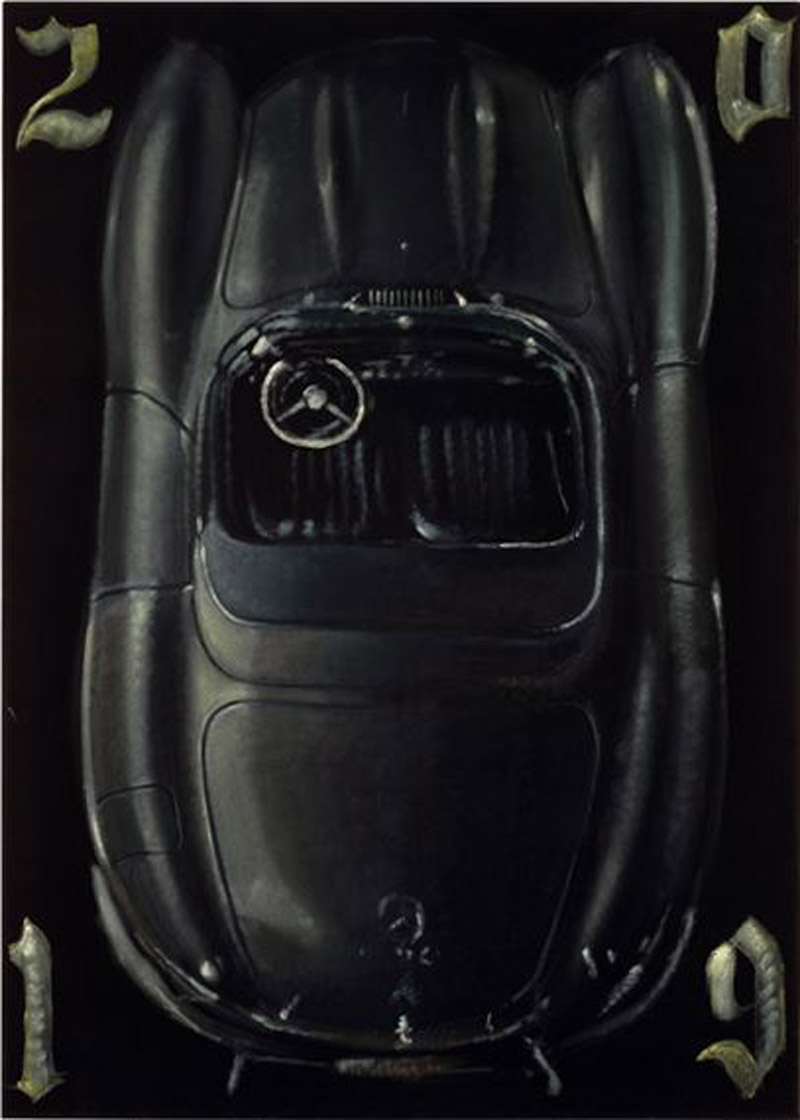
Medium: Oil on velvet
Dimensions: 60 7/8 x 43 3/8 inches
Collection: Private
Visual Signature: Black luxury convertible (1950s Mercedes 300 SL) emerging from void-like darkness. Rendered in soft-focus with velvet support killing any metallic sheen.
Why It Matters: Sold at Phillips for significant sum. Exemplifies Wood’s investigation of desire, luxury, and degradation. The temporal confusion (vintage car, contemporary technique, Gothic date stamp) operates perfectly here.
My consequences (2021)
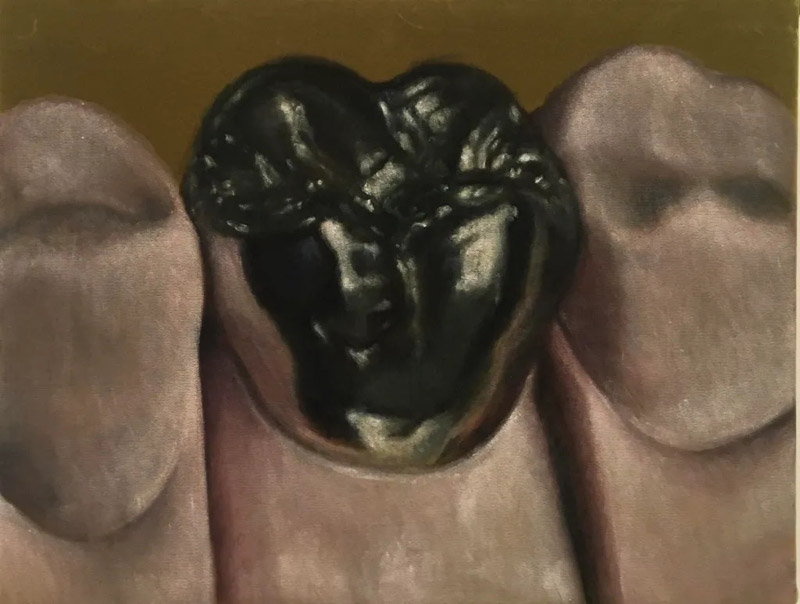
Medium: Oil on panne velvet
Subject: Impacted wisdom teeth in metallic gray and cream
Visual Signature: Blurred texture shows rotted cavities burrowing into dental pulp. Extreme close-up removes all context.
Why It Matters: Dental series breakthrough. Connected personal trauma (eating disorders) to broader themes of irreversible damage and failed repair.
Chalet (2022)
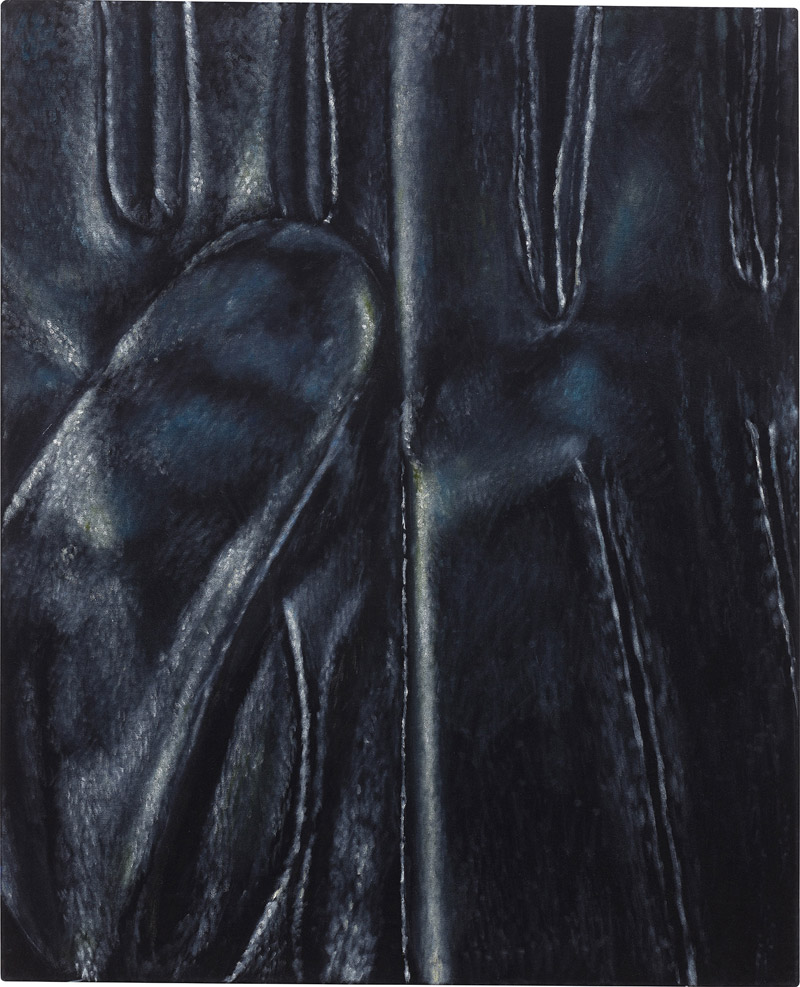
Medium: Oil painting
Auction Record: $599,035 USD (Phillips London, 2022)
Why It Matters: Current auction record for the artist. Demonstrates market enthusiasm for her work.
Kinkstarter (2020)
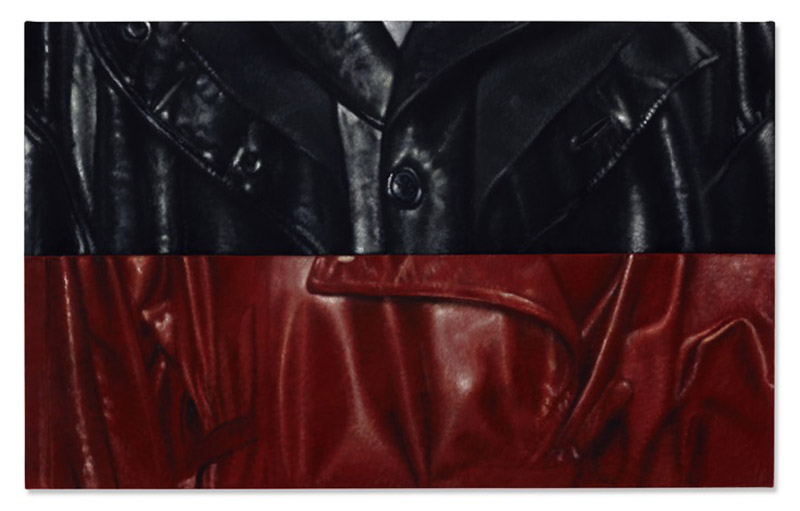
Medium: Oil on velvet
Dimensions: 180.2 x 290.5 cm (71 x 114 3/8 inches)
Visual Signature: Large-scale leather interior, possibly car seat. Title injects sardonic humor into luxury fetishism.
Relapsing in2 mysticism (2019)
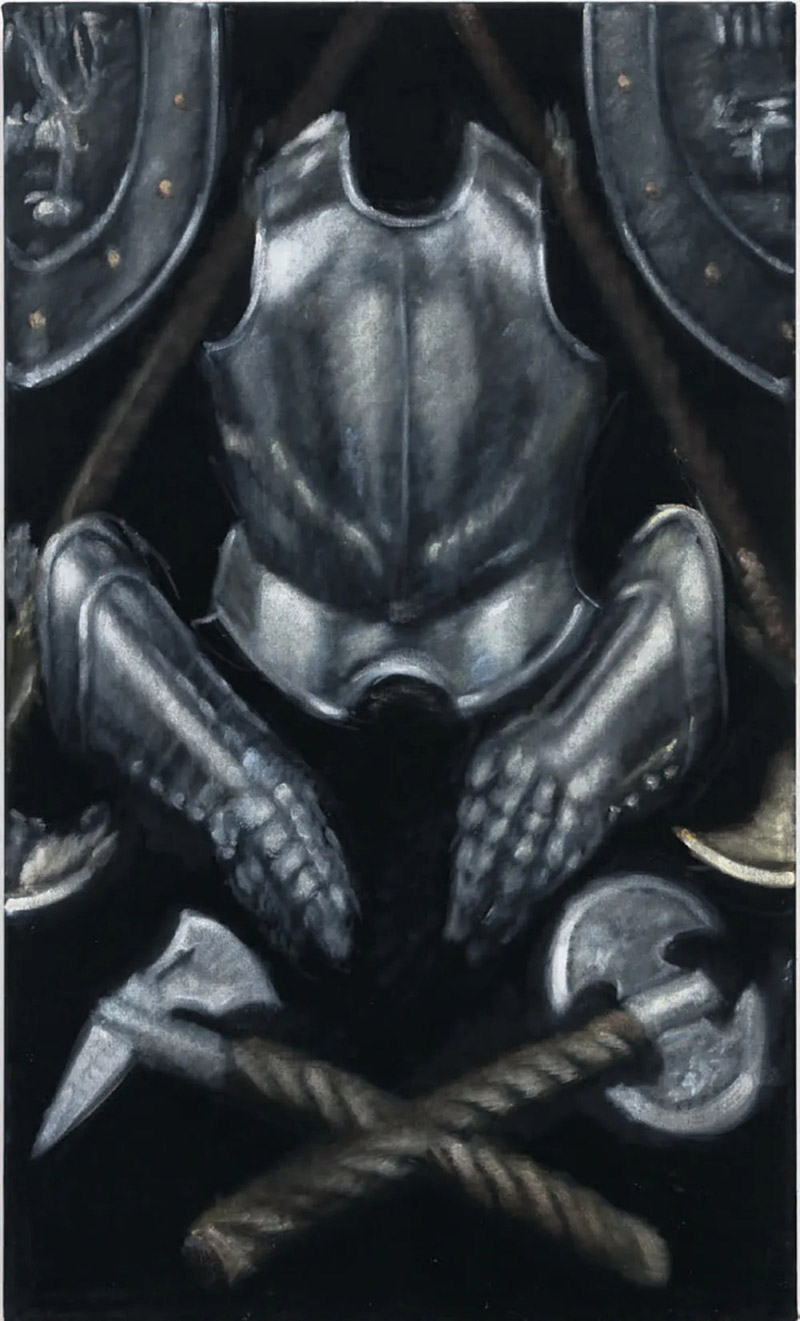
Medium: Oil on black velvet
Subject: Knight’s armor, gleam suppressed by velvet support
Visual Signature: Burlap-like quality despite velvet surface. Armor offers false security.
Related Works: Paired conceptually with leather jacket paintings to explore masculine/feminine signifiers.
Joan Series (2018-2019)
Subject: Tiny oil portraits of comedian Joan Rivers
Context: Exhibited at Zabludowicz Collection’s “World Receivers” (2019) alongside 1,000+ hand-painted floor tiles
Why It Matters: Wood sourced imagery from Rivers’ auctioned jewelry and personal effects. The work mines celebrity, inheritance, and objects outliving bodies.
Self portrait 52 (2023)
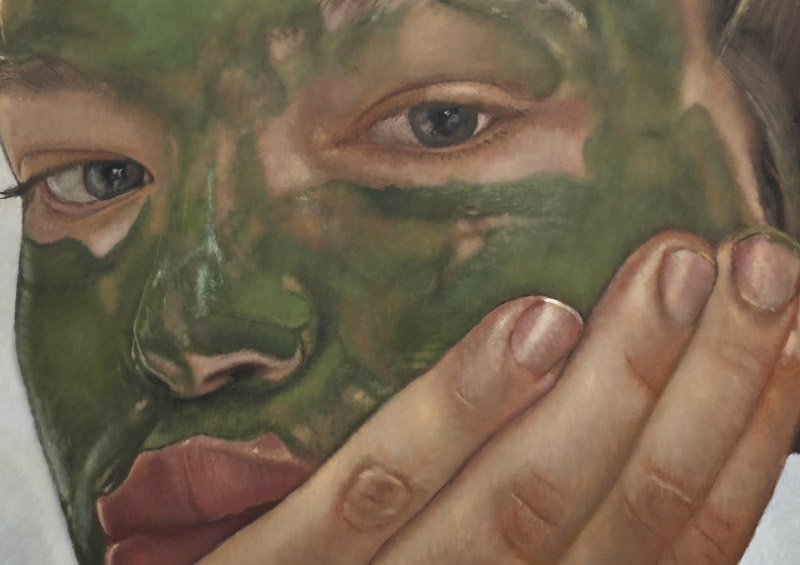
Medium: Oil on linen
Dimensions: 215 x 175 cm
Context: Part of “Furni” exhibition at Carlos/Ishikawa
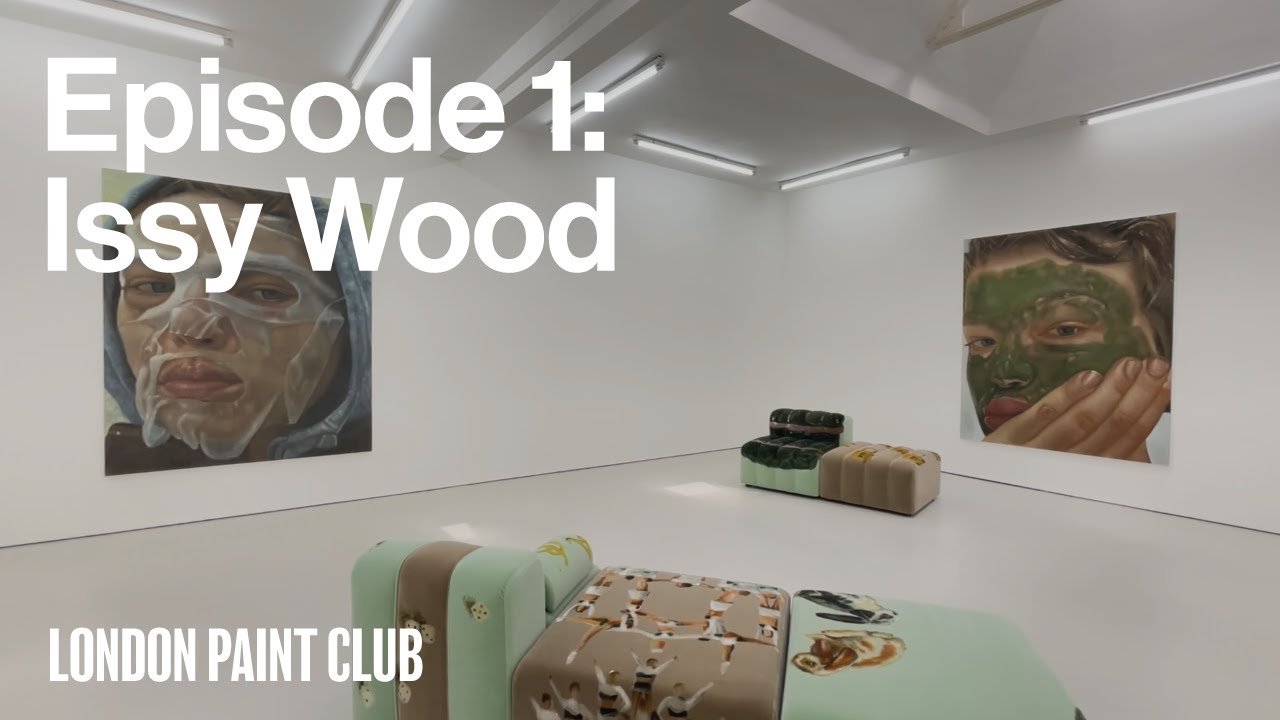
Visual Signature: Face covered in translucent paper face mask. Expression: bored.
Shift: Move toward self-representation after years of avoiding portrait commissions. Still encrypted through masks and obstructions.
Charli 2 (2025)
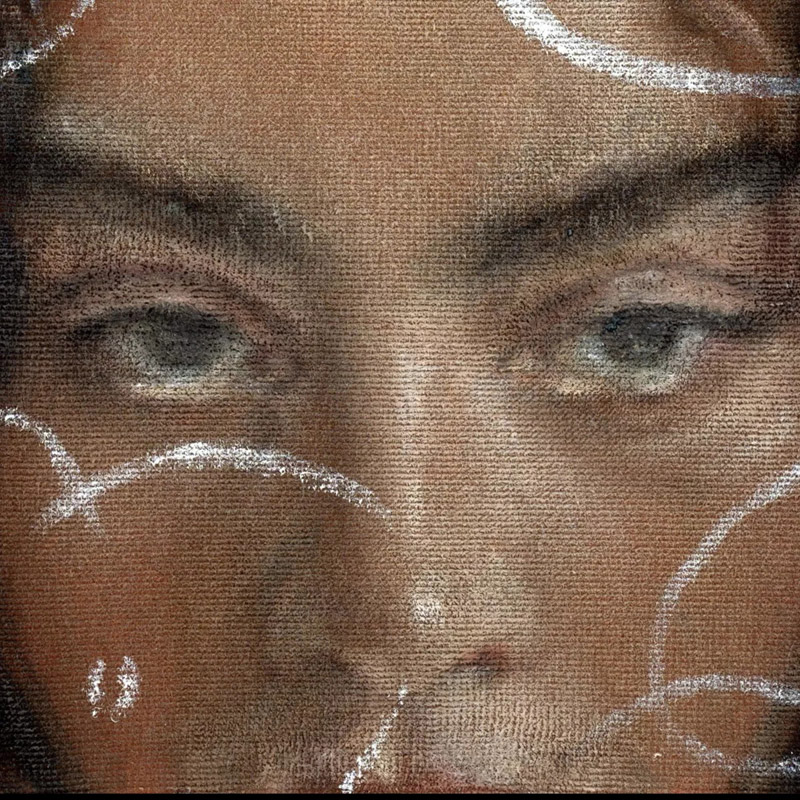
Medium: Oil on velvet
Subject: Singer Charli XCX amid gauzy stars and white swoops
Context: Commissioned for Vanity Fair cover
Why It Matters: Rare celebrity portrait. Wood called it “fan art,” which she considers “one of the purest and most tender art forms we have.”
Exhibitions, Collections, and Provenance Highlights
Major Solo Exhibitions

Magic Bullet (2025) – Schinkel Pavillon, Berlin
What I Eat In A Day (2024) – TANK Shanghai
A Lover’s Discourse (2023) – Aspen Art Museum
Study For No (2023) – Lafayette Anticipations, Paris. First institutional solo in France. Over 60 canvases.
I Like To Watch (2023) – Ilmin Museum of Art, Seoul
Time Sensitive (2022) – Michael Werner Gallery, New York. First US solo with Michael Werner.
All The Rage (2019) – Goldsmiths Centre for Contemporary Art, London. Largest solo to that point.
daughterproof (2020) – JTT, New York
When You I Feel (2017) – Carlos/Ishikawa, London. Debut solo show.
Key Group Exhibitions
Mixing it Up: Painting Today (2021) – Hayward Gallery, London
Artists Inspired by Music: Interscope Reimagined (2022) – LACMA, Los Angeles
Virginia Woolf, An Exhibition Inspired by Her Writings (2018) – Tate St Ives
World Receivers (2019) – Zabludowicz Collection, London
Paint Also Known as Blood (2019) – Museum of Modern Art, Warsaw
Collections with Depth
National Portrait Gallery, London – Multiple works including recent self-portraits from reopening display (2023)
Zabludowicz Collection, London – 3+ works
Institute of Contemporary Art, Miami
Sifang Art Museum, Nanjing
Rhode Island School of Design Museum, Providence
Gallery Representation
Carlos/Ishikawa, London – Primary gallery since 2017. Deep relationship with founder Vanessa Carlos.
Michael Werner Gallery – New York, Beverly Hills, Athens. Joined roster 2022. One of only two women represented.
Anthony Gallery, Chicago
Publications
Wood self-publishes diary compilations through Carlos/Ishikawa:
- “When You I Feel” (2017) – Blog posts 2007-2017
- “SML PTNGS Vol 1” (2018)
- “All The Rage” (2019) – Blog posts 2017-2019
- “But Who’s Counting” (2021) – Blog posts 2019-2020
- “SML PTNGS Vol 2” (2021)
- “Queen Baby” (2022) – Blog posts 2021-2022
- “SML PTNGS Vol 3” (2023)
Market & Reception
Auction Performance
Record Price: $599,035 USD for “Chalet” (Phillips London, 2022)
Price Range: $20,538 – $599,035 USD depending on size, medium, period
Peak Period: 2022-2023 saw strongest auction results
Common Lot Types:
- Oil on velvet: 39-180 cm works
- Small format oils on linen: 20-30 cm
- Mid-size canvas works: 70-140 cm
Market Characteristics
Works rarely come to auction. Most sell through primary market (Carlos/Ishikawa, Michael Werner).
Strong collector demand from institutions and private collectors focused on contemporary figurative painting.
Velvet works command premium over canvas/linen equivalents.
Critical Reception
Wood’s work divides critics. Some praise the “perverted realism” and emotional encryption. Others find the blurred surfaces evasive.
Barry Schwabsky (Artforum) positioned her within uncomfortable realism that sits between traditional representation and surrealism.
Financial Times, ARTnews, New York Times coverage tracks her as key voice in millennial figuration.
Authentication
Wood signs work on stretcher bars or reverse. Sometimes uses initials on front.
Gothic-font date stamps appear in some compositions as both signature and conceptual element.
Limited forgery risk due to specific velvet surface handling and soft-focus technique difficulty.
Influence & Legacy
Upstream Influences
Old Master Techniques
Wood learned classical painting methods at Royal Academy Schools. Her soft-focus recalls sfumato traditions but filtered through digital degradation.
Dutch Still Life
The attention to luxury objects and memento mori themes connects to 17th-century vanitas paintings. But Wood replaces flowers and skulls with Porsches and teeth.
Julian Schnabel
Velvet painting precedent. Schnabel elevated velvet from kitsch to high art. Wood inherited that permission but uses the material differently – suppressing rather than amplifying.
Michaël Borremans
Shared interest in ominous, muted figurative work. Both create unsettling realism.
Auction Catalogs & Commercial Photography
Wood sources heavily from eBay, auction houses, lifestyle magazines. The imagery arrives pre-commodified.
Downstream Impact
Emerging Figurative Painters
Wood’s success opened space for painters working in uncomfortable, encrypted registers. Her velvet technique sparked renewed interest in non-traditional supports.
Multidisciplinary Practice
Her seamless integration of painting, music, and writing models a holistic creative practice for younger artists.
Market Influence
Strong auction results (especially for an artist under 35) signaled collector appetite for figurative painting that resists easy interpretation.
Cross-Domain Echoes
Music
Wood releases lo-fi pop under Mark Ronson’s Zelig Records. EPs include “Cries Real Tears!” (2020), “If It’s Any Constellation” (2021), “My Body Your Choice” (2022), “Accidental American” (2024).
The music carries the same melancholic, introspective quality as paintings.
Writing
Prolific blogger since 2007. Self-publishes diary compilations that function as parallel practice to painting. The writing is unedited, raw, confessional.
Fashion/Design
Collaborated with designer Jermaine Gallacher on her Bloomsbury townhouse. Interest in objects extends beyond painting into lived space.
How to Recognize an Issy Wood at a Glance
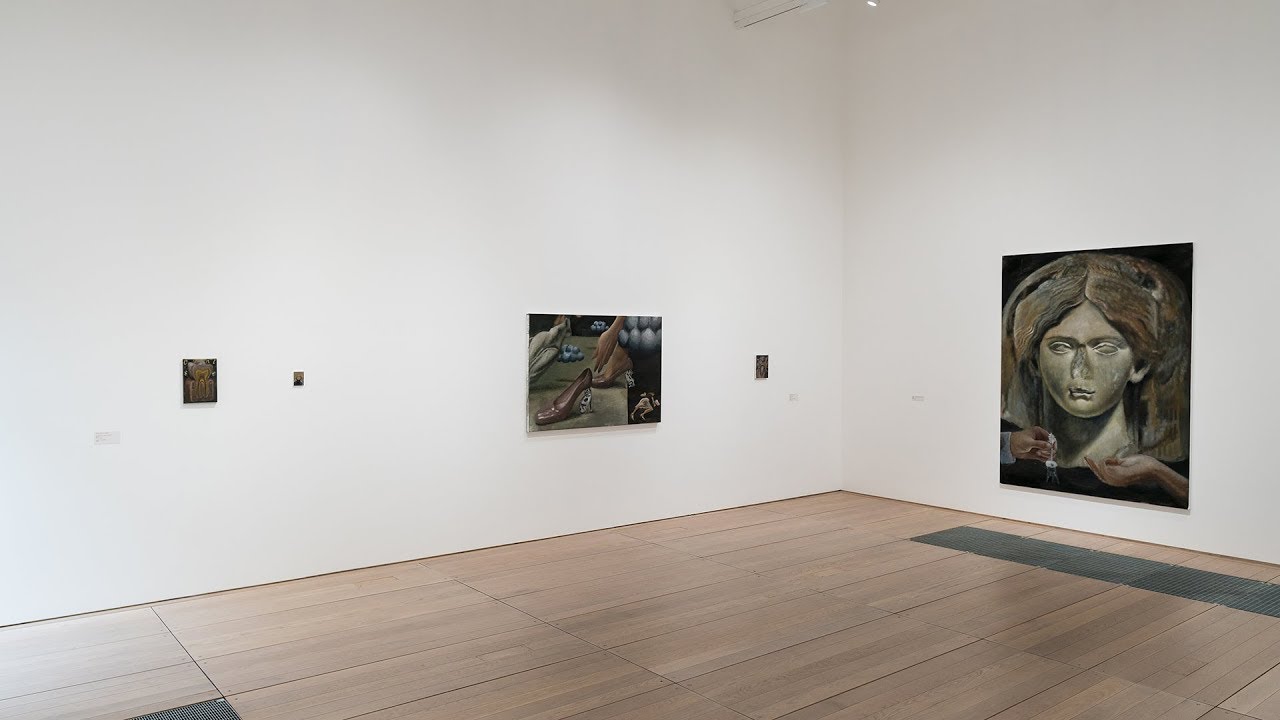
1. Velvet Support
If it’s on velvet with dulled, non-reflective surface, strong possibility.
2. Soft-Focus Blur
No crisp edges. Everything slightly out of focus, as if viewed through dirty glass or low-resolution screen.
3. Extreme Cropping
No horizons, no full objects, no complete figures. Compositions feel claustrophobic and fragmentary.
4. Muted Earth Palette
Grays, taupes, olive greens, metallic silvers. Rare color pops. Cool temperature bias even in warm subjects.
5. Subject Matter: Luxury Objects
Leather car interiors (especially vintage Mercedes, Porsche), designer jackets, teeth, gloves, armor, vintage objects. Never landscapes, never full portraits.
6. Flat Paint Application
No impasto, no visible brushwork. Paint appears wiped or breathed on rather than applied with traditional stroke.
7. Temporal Confusion
Can’t tell if painting was made in 1917 or 2017. Gothic fonts, vintage subjects, classical technique, but contemporary references (cigarette brands, nail designs) provide clues.
8. Sardonic Titles
“Kettle (By which I mean you die in a fire)” – Dark humor and parenthetical asides appear frequently.
9. Signature Placement
Typically signs on stretcher bars or canvas reverse. Occasional Gothic-font date stamps incorporated into composition.
10. Size Range
Small format (20-30 cm) daily exercises up to large scale (180-290 cm) statement pieces. Mid-range (60-140 cm) most common for exhibition works.
FAQ on Issy Wood
Who is Issy Wood?
Issy Wood is a British contemporary artist born in 1993 who paints oil on velvet works depicting luxury objects and body fragments. She’s also a musician and writer based in London, represented by Carlos/Ishikawa and Michael Werner Gallery.
What is Issy Wood known for?
Wood is known for soft-focus paintings of leather car interiors, designer jackets, and teeth rendered on velvet surfaces. Her blurred, melancholic style transforms consumer goods into uncomfortable relics of desire, earning the label “perverted realism.”
Why does Issy Wood paint on velvet?
Velvet dulls reflective surfaces and creates instant atmospheric depth. Wood uses it as a conceptual statement about luxury and decay. The material historically signaled wealth but under her brush becomes sepulchral, suppressing the glamour of objects she depicts.
What painting technique does Issy Wood use?
Wood applies oil paint in soft-focus layers with no visible brushwork or impasto. Her technique mimics photographic blur and digital compression. Paint appears wiped or breathed onto velvet rather than applied with traditional strokes, creating dissolution effects.
Where did Issy Wood study art?
Wood studied Fine Art at Goldsmiths, University of London (BA, 2015) and Royal Academy Schools (MA, 2018). At 22, a tutor pushed her toward painting after she avoided it for video and sculpture work.
What are Issy Wood’s most expensive paintings?
“Chalet” sold for $599,035 USD at Phillips London in 2022, setting her auction record. “Actual car 2” (2019) and “Kinkstarter” (2020) also achieved significant prices. Works on velvet command premiums over canvas pieces in the market.
Does Issy Wood make music?
Yes. Wood releases lo-fi pop music under Mark Ronson’s Zelig Records. Her EPs include “Cries Real Tears!” (2020), “If It’s Any Constellation” (2021), and “My Body Your Choice” (2022). The music carries the same melancholic quality as her paintings.
What museums own Issy Wood paintings?
The National Portrait Gallery (London), Zabludowicz Collection, Institute of Contemporary Art Miami, Rhode Island School of Design Museum, and Sifang Art Museum (Nanjing) hold her work. She’s exhibited at Hayward Gallery, LACMA, and Tate St Ives.
Why does Issy Wood paint teeth?
Wood’s dental paintings connect to her personal history with eating disorders and her parents’ medical backgrounds. Teeth represent irreversibility and damage. The extreme close-ups of dental procedures explore healing versus injury, interiority versus exteriority.
How can you identify an Issy Wood painting?
Look for velvet support, soft-focus blur, extreme cropping with no horizons, muted earth palette, luxury object subjects (cars, jackets), flat paint application, and temporal confusion. Her work feels simultaneously old and contemporary, with sardonic titles and Gothic-font date stamps.
Conclusion
Issy Wood operates at the intersection where classical painting techniques meet digital-age melancholia.
Her work on velvet transforms everyday luxury into something unsettling. The soft-focus application and claustrophobic composition create a visual language that’s entirely her own.
Wood’s trajectory from reluctant painter at Royal Academy Schools to one of Michael Werner Gallery’s roster demonstrates how quickly distinctive voices can rise in contemporary art. Her auction record of nearly $600,000 proves collectors respond to work that refuses easy interpretation.
The British painter’s multidisciplinary practice spans music, writing, and figurative painting. But the paintings remain central, blurring consumer desire into something closer to forensic documentation.
Wood doesn’t glorify luxury. She autopsies it, one blurred brushstroke at a time.