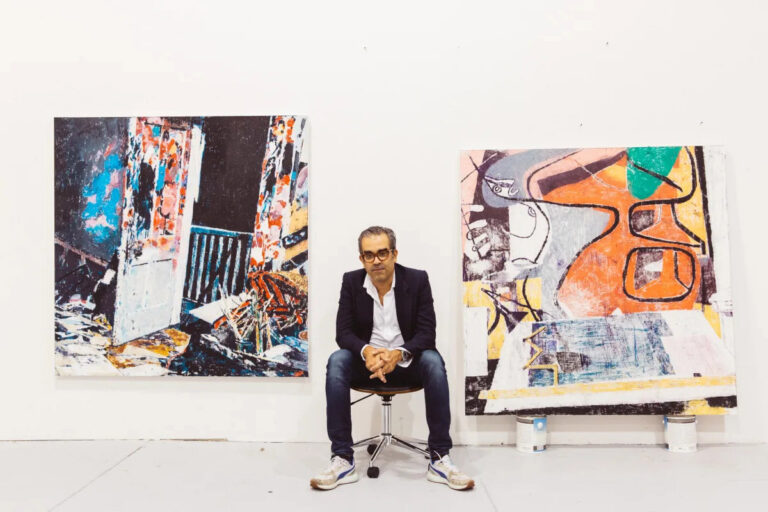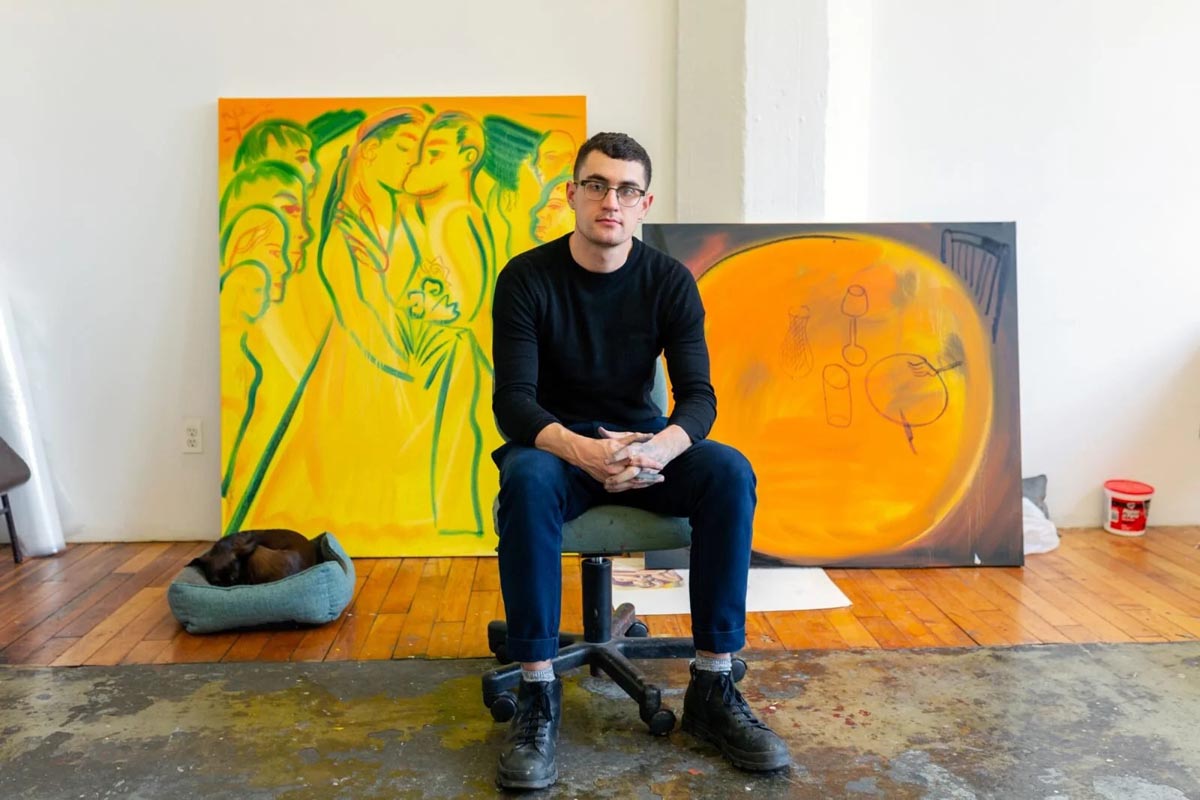

Louis Fratino paints queer domesticity with the same reverence modernists once reserved for Parisian cafes and Mediterranean coastlines. Born in 1993, this contemporary painter collapses Cubism‘s fractured planes into intimate scenes of male lovers, bedroom light, and post-coital vulnerability.
His work doesn’t apologize or explain. It simply exists.
This article examines Fratino’s technical approach, tracing how oil painting on raw linen and soft pastel create atmospheric depth. You’ll understand his relationship to Henri Matisse and Pablo Picasso, his market trajectory (including a $756,000 auction record), and the visual signatures that make his paintings instantly recognizable.
Whether you’re a collector, art student, or simply curious about contemporary figurative art, you’ll discover what distinguishes Fratino within the New Queer Intimism movement and why major museums are acquiring his work.
Identity Snapshot
Name: Louis Fratino
Born: 1993, Annapolis, Maryland, United States
Primary roles: Painter, Printmaker, Sculptor
Nationality: American
Movements: New Queer Intimism, Contemporary Figurative Art
Mediums: Oil on canvas, soft pastel on linen, copperplate etching, terra cotta sculpture
Signature traits: Semi-cubist figuration, blended color swathes, gestural mark-making, tactile paint application, raw linen surfaces
Iconography: Male nudes, domestic interiors, lovers in embrace, urban vistas, still life arrangements, Catholic imagery (ceramic works)
Geographic anchors: Annapolis (birthplace), Baltimore (MICA), Berlin (Fulbright 2015-16), Paris, Brooklyn (current studio)
Mentors/Influences: Henri Matisse, Pablo Picasso, Fernand Léger, Nicole Eisenman, Marsden Hartley, Georgia O’Keeffe
Collections: Whitney Museum, Baltimore Museum of Art, Museum of Fine Arts Houston, RISD Museum, Hammer Museum, Institute of Contemporary Art Miami
Market signals: Record auction $756,000 (You and Your Things, 2022, Christie’s 2025). Works range from $2,300 to $756,000 depending on medium and size
What Sets Fratino Apart
Fratino renders queer domesticity through a modernist lens that splits the difference between Cubism‘s faceted planes and Fauvism‘s saturated color fields.
His male nudes occupy picture planes with the compositional weight traditionally reserved for female subjects. Raw linen absorbs soft pastel in ways that canvas cannot, creating atmospheric halos around figures.
The work reads as memory rather than observation. Fratino collapses multiple viewpoints within single compositions, borrowing Cubism‘s fracturing without its analytical distance.
Paint application alternates between thick, viscous passages and translucent washes. Scratched-in marks coexist with blended color transitions.
Bodies intertwine with geometric precision. His couples don’t simply touch but fuse through overlapping form and shared contour lines.

Origins & Formation
Early Training
Maryland Institute College of Art, Baltimore (BFA Painting with Illustration concentration, 2015). Studied under Jo Smail, an abstract painter who championed unselfconscious play over forced production.
Yale Norfolk Painting Fellowship (2014). Brief but concentrated exposure to condensed artistic dialogue.
Berlin Period
Fulbright Research Fellowship in Painting (2015-16). First sustained exposure to European modernist masterworks in their original contexts.
Berlin residency coincided with experimentation in soft pastel on raw linen. The city’s distance from American art world pressures allowed technical risk-taking.
Stylistic Emergence
Early works showed tight illustration-influenced realism. The shift toward fragmented planes and gestural application occurred during Paris residency (2018).
First solo exhibition “Heirloom” at Galerie Antoine Levi (Paris, 2018) marked departure from tight rendering toward memory-based composition.
Critical reception identified immediate connection to early 20th-century modernism. Art critic Roberta Smith noted the work’s “painterly attention and erudition.”
Movement & Context
New Queer Intimism
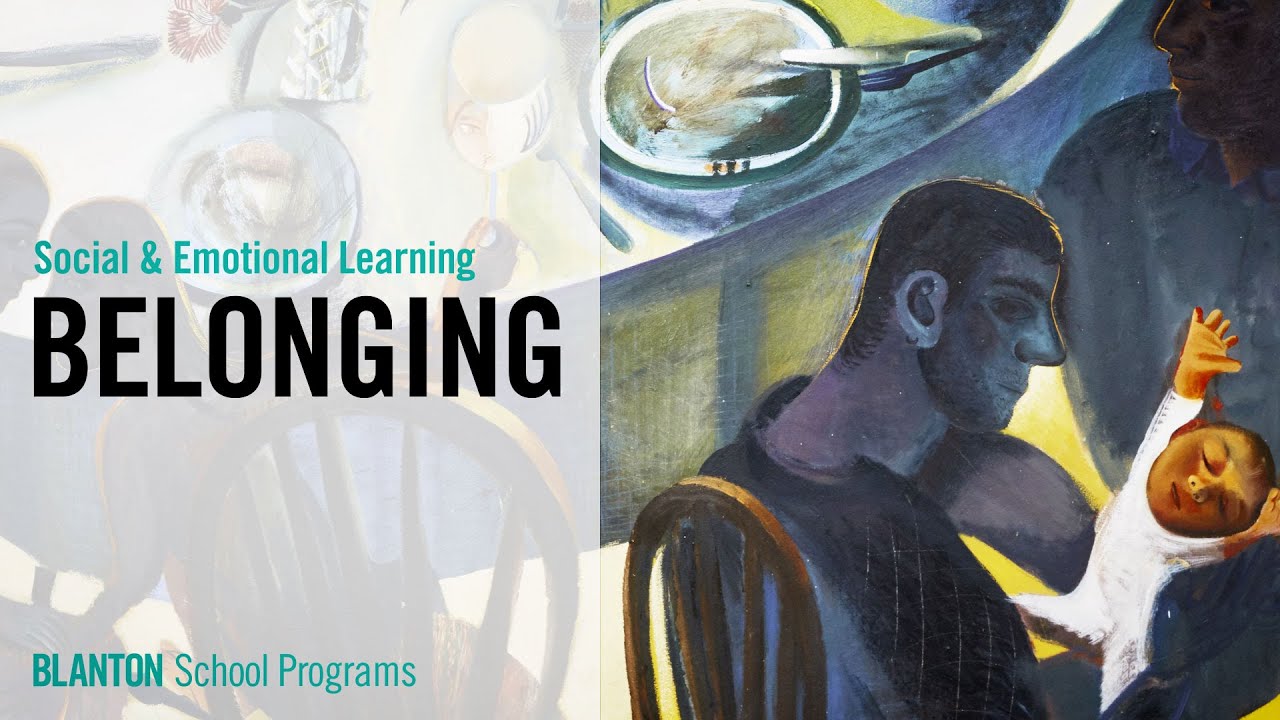
Fratino anchors a loose confederation of painters including Salman Toor, Anthony Cudahy, Doron Langberg, and Kyle Coniglio. The movement pulls Impressionism‘s immediacy and colorwork into contemporary queer life.
Where Impressionism captured bourgeois leisure, New Queer Intimism documents post-Stonewall domesticity without defensive posturing or political messaging.
Comparative Analysis
vs. Salman Toor: Toor employs flatter, more illustrative planes with cooler color psychology. Fratino’s surfaces carry more physical texture and warmer saturation.
vs. Nicole Eisenman: Both share irreverent figuration, but Eisenman leans toward caricature and social commentary. Fratino’s work holds sentimentality without irony.
vs. Dana Schutz: Though frequently compared, Schutz pursues exaggerated, sometimes grotesque distortion. Fratino’s figures remain recognizably human despite fragmentation.
His edge quality falls between Cubism‘s hard geometry and Fauvism‘s soft bleeding. Stroke length varies from short stippled marks to sweeping gestural passages.
Composition frequently centers on beds, bathtubs, and windows. These domestic anchors create psychological containment similar to Pierre Bonnard’s interiors.
Materials, Techniques, and Process
Supports
Primarily linen canvas, both primed and raw. Raw linen absorbs pastel differently than sized canvas, creating softer edges and atmospheric depth.
Occasional experiments on wood panels and box lids for intimate scale works.
Grounds and Application
Earlier works used traditional gesso priming. Paris period introduced raw linen for pastel works, eliminating the barrier between pigment and fiber.
Oil painting technique combines alla prima directness with occasional glazing for depth. Paint never fully dries between sessions, allowing wet-into-wet blending.
Brushwork Taxonomy
Swathed application dominates. Wide flat brushes lay broad color fields that get reworked while wet.
Scratching and scraping create linear elements. Body hair, architectural details, and contour emphasis emerge through subtractive mark-making.
Occasional impasto builds up around figure edges, creating tactile relief. Most surfaces remain relatively thin despite appearing substantial.
Palette Archetype
Mid-value dominance with occasional bright accents. Blues (cobalt, ultramarine) anchor many compositions. Warm flesh tones lean toward terra cotta rather than pink.
Muted earth tones (raw umber, yellow ochre) provide structural grounding. High-key passages appear as sunlight rather than artificial illumination.
Temperature contrast drives spatial relationships. Warm figures advance against cooler backgrounds, following traditional atmospheric perspective principles.
Studio Practice
Works from memory rather than live models. Multiple sketchbooks accumulate drawings that later inform paintings.
No preliminary underdrawing on canvas. Composition emerges through color application and adjustment.
Printmaking collaboration with master printer Gregory Burnet (Burnet Editions, NYC) introduced copperplate etching technique. The physicality of drawing into metal influenced subsequent painting marks.
Themes, Subjects, and Iconography
Recurring Motifs
Male nude as central subject. Bodies appear sleeping, embracing, bathing, or in post-coital repose.
Beds function as compositional stages. Four-poster beds, daybeds, and unmade sheets create theatrical framing.
Windows and light sources establish time of day. Morning light appears frequently, suggesting awakening and vulnerability.
Compositional Schemes
Centered, frontal arrangements dominate. Figures face viewer or turn inward toward partners.
Symmetrical or asymmetrical balance depends on figure count. Couples create natural symmetrical balance; solo figures require environmental counterweights.
Overlapping planes compress pictorial depth. Fratino follows Cubism‘s multiple viewpoint approach without full abstraction.
Symbol Sets
Flowers (particularly anemones) signal transience. Fish suggest abundance and sensuality.
Mirrors and reflective surfaces double figures, creating psychological complexity. Subway car windows show passengers confronting their reflections.
Catholic imagery appears in ceramic sculptures but rarely in paintings. Coming Back from the Beach (2019, terra cotta) includes religious iconography absent from his canvas work.
Socio-Historical Context
Work emerges from post-marriage equality America, where queer domesticity no longer requires justification. The paintings document normalcy rather than activism.
References to AIDS-era loss appear obliquely through empty spaces and solitary figures. But the dominant mood celebrates presence rather than mourning absence.
Notable Works
You and Your Things (2022)
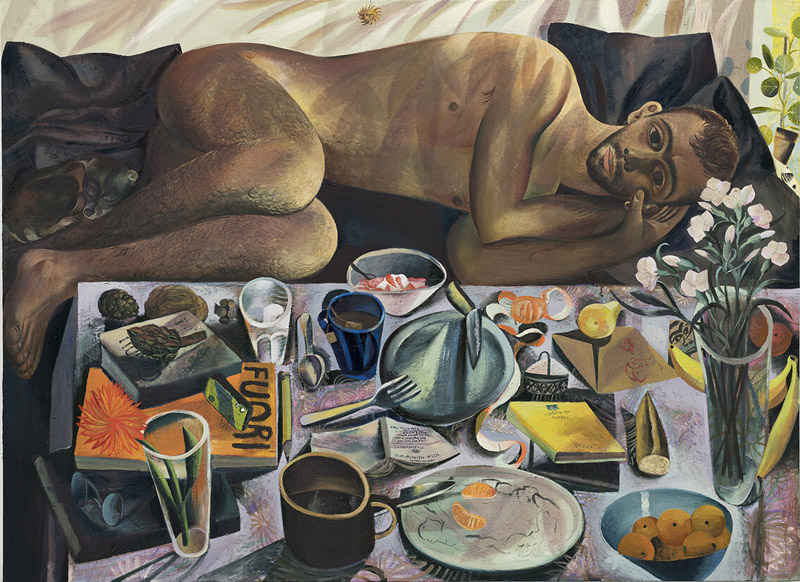
Medium: Oil on canvas
Size: Approximately 60 x 94 inches (based on typical large-scale dimensions)
Location: Private collection
Visual signature: Warm color harmony with figures amid accumulated personal objects. Scratched linear marks define edges while broad passages of blended paint create atmospheric depth.
Why it matters: Set artist’s auction record at $756,000 (Christie’s New York, 2025), establishing market validation. Title suggests accumulation of shared life rather than isolated possessions.
The Beautiful Summer (2023)
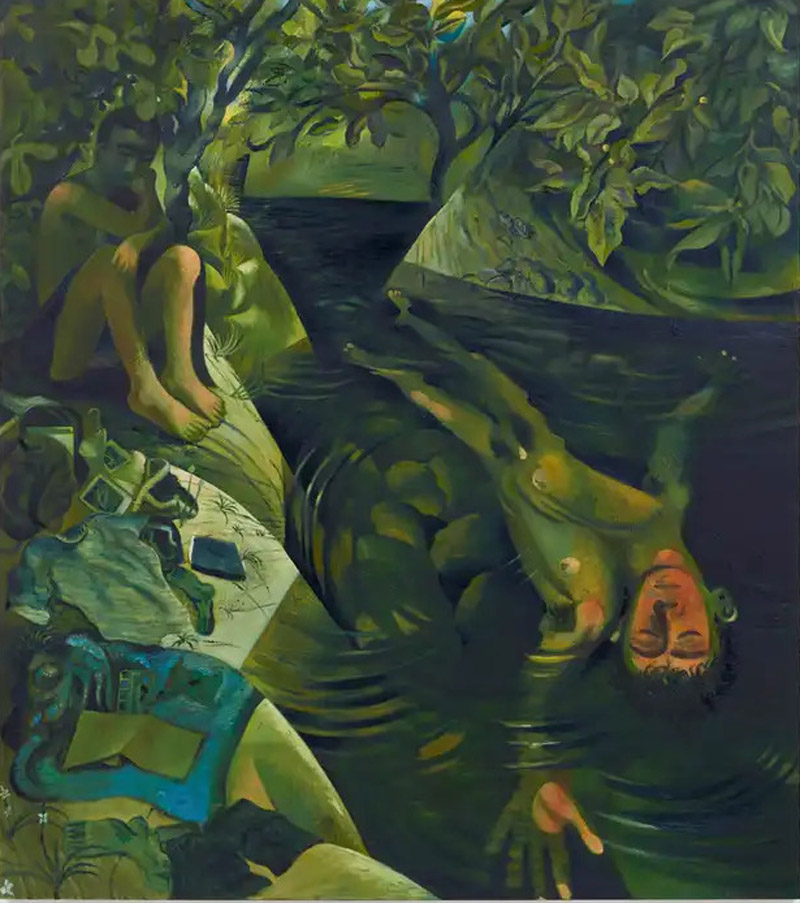
Medium: Oil on canvas
Size: 182.9 x 162.6 cm (72 x 64 inches)
Location: Private collection (exhibited Sikkema Jenkins & Co.)
Visual signature: Large-scale work with multiple figures in outdoor setting. Vibrant color saturation suggesting peak seasonal light.
Why it matters: Represented shift from interior domestic scenes to outdoor communal spaces. Featured in “In Dialogue with Picasso” exhibition at Skarstedt Gallery (2023).
Four Poster Bed (2021)
Medium: Oil on canvas
Size: Standard large format
Location: Unknown
Visual signature: Two sleeping male figures bathed in directional natural light. Sheets create complex drapery folds. Warm sunlight tone contrasts with cool shadow areas.
Why it matters: Exemplifies post-coital vulnerability without eroticism. The painting documents rest rather than activity, celebrating intimacy’s aftermath.
Metropolitan (2019)
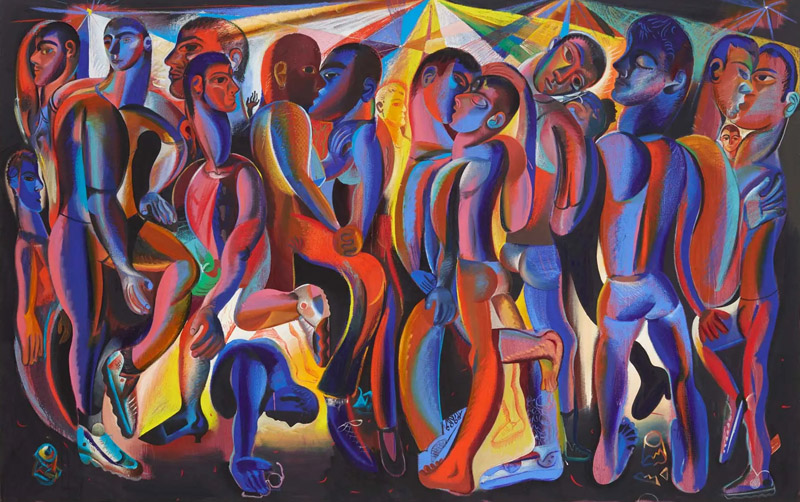
Medium: Oil on canvas
Size: 60 x 94.75 inches
Location: Private collection
Visual signature: Urban scene with recognizable New York landmarks. Figures occupy subway car interior with fragmented geometric planes.
Why it matters: Marked departure from private domestic spaces into public urban environment. Demonstrated range beyond bedroom interiors.
YMCA (2023)
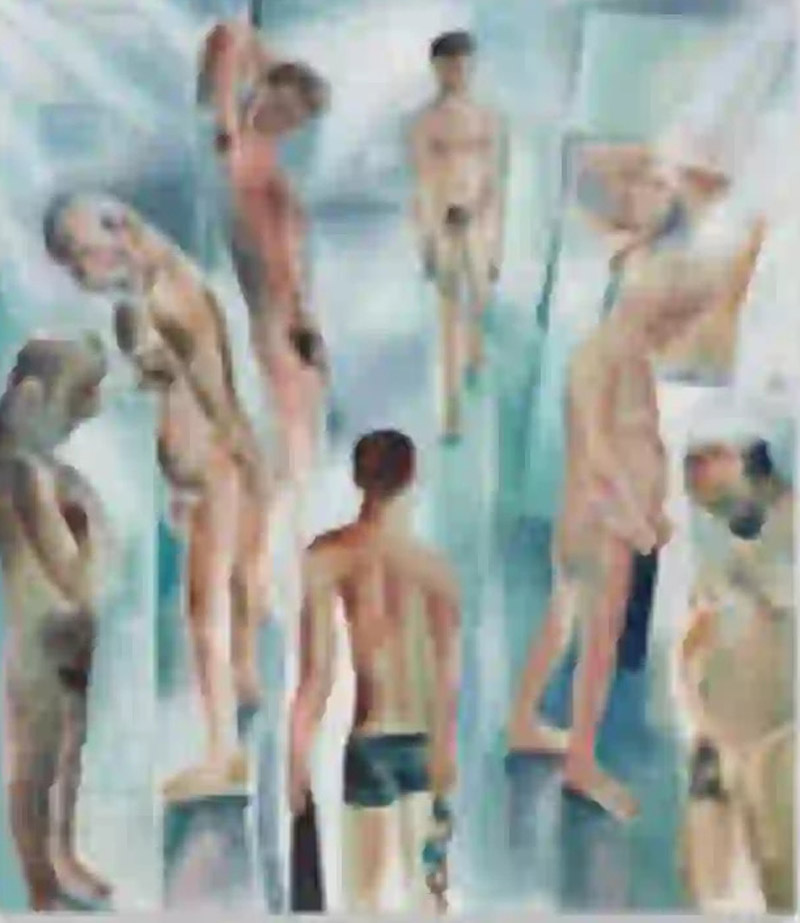
Medium: Oil on canvas
Size: Large format
Location: Centro Pecci collection
Visual signature: Group shower scene with overlapping vertical planes. Steam creates atmospheric blurring. Neutral browns and blues dominate.
Why it matters: References both communal bathing tradition and queer cruising spaces. The composition evokes early Cubism‘s faceted form while maintaining contemporary subject matter.
Anemones and Shells (2021)
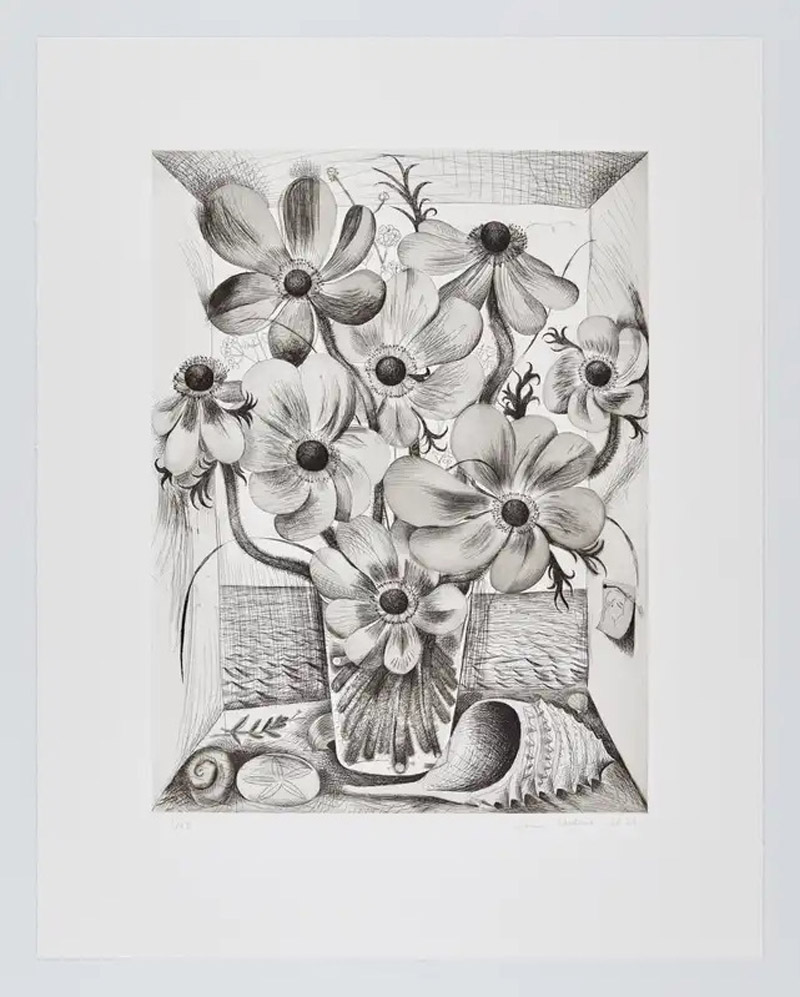
Medium: Copperplate etching
Size: Print dimensions variable
Location: Edition distributed through Burnet Editions
Visual signature: Still life rendered in crosshatching and aquatint. Black and white contrast emphasizes form and texture.
Why it matters: Demonstrated technical range beyond painting. The etching process influenced subsequent mark-making in painted works.
Coming Back from the Beach (2019)
Medium: Terra cotta sculpture with manganese oxide
Size: Wall relief, approximately 12 x 9 inches
Location: Private collection
Visual signature: Paired male figures in low relief. Pale umber surface with minimal glaze. Catholic iconographic elements integrated.
Why it matters: Rare three-dimensional work showing influence of Italian ceramic tradition. Created during Albissola Marina residency on Ligurian coast.
Exhibitions, Collections, and Provenance
Solo Exhibitions
Satura – Centro Pecci, Prato, Italy (2024-25). First institutional solo exhibition.
In bed and abroad – Sikkema Jenkins & Co., New York (2023)
Die bunten Tage – Galerie Neu, Berlin (2022). Return to Berlin after Fulbright period.
Morning – Sikkema Jenkins & Co., New York (2020)
Come Softly to Me – Sikkema Jenkins & Co., New York (2019). First exhibition with major New York gallery.
Nudissima – Antoine Levi, Paris (2019)
Heirloom – Galerie Antoine Levi, Paris (2018). Breakthrough European solo show.
Night and Day – Jeff Bailey Gallery, Hudson, NY (2018)
So I’ve got you – Thierry Goldberg, New York (2017)
Group Exhibitions
60th Venice Biennale – Stranieri Ovunque (Foreigners Everywhere), curated by Adriano Pedrosa (2024)
In Dialogue with Picasso – Skarstedt Gallery, New York (2023)
Good Pictures – Jeffrey Deitch Gallery, New York (2020)
Them – Perrotin, New York (2019)
Matisse + Fratino – Cabinet Printemps, Dusseldorf (2018). Early recognition of modernist connections.
Museum Collections

Whitney Museum of American Art, New York
Baltimore Museum of Art, Maryland
Museum of Fine Arts, Houston, Texas
RISD Museum, Providence, Rhode Island
Hammer Museum, Los Angeles, California
Museum of Contemporary Art San Diego, California
Institute of Contemporary Art, Miami, Florida
Gallery Representation
Primary: Sikkema Jenkins & Co., New York
European: Galerie Neu, Berlin; Antoine Levi (formerly Ciaccia Levi), Paris
Provenance Patterns
Work enters market through gallery exhibitions. Secondary market activity accelerated after Venice Biennale inclusion (2024).
Institutional acquisitions increased following critical acclaim. Whitney Museum acquisition signaled major museum validation.
Private collectors include contemporary art specialists focusing on figurative painting and queer visual culture.
Market & Reception
Auction Performance
Record: $756,000 for You and Your Things (2022) at Christie’s New York (May 2025)
Previous record: $730,800 for An Argument (2021) at Sotheby’s (November 2022)
Price range: $2,303 to $756,000 depending on medium, size, and date
Works on paper average $16,000-$19,000 in recent 12-month period
Small oils on panel: $20,000-$80,000 range
Large-scale canvases: $200,000+ at auction
Market Trajectory
Steady price increases since 2021. Venice Biennale inclusion (2024) accelerated institutional and collector interest.
Primary market sells out quickly through gallery exhibitions. Secondary market remains active with consistent price appreciation.
Authentication Considerations
Signature placement varies. Early works show verso signatures; later pieces include front signatures in lower corners or edges.
Scratched-in marks and specific color mixing create identifiable fingerprints. Forgers would struggle replicating the balance between blended passages and linear incisions.
Catalogue raisonne not yet published. Gallery records and exhibition history provide primary documentation.
Condition Patterns
Raw linen works require careful handling. Pastel on unprimed support can abrade if improperly stored.
Oil painting surfaces generally stable. Minimal craquelure given recent production dates.
Terra cotta sculptures vulnerable to impact damage. Manganese oxide surface relatively durable but can chip.
Influence & Legacy
Upstream Influences
Henri Matisse: Color harmony and figure-ground relationships. The Nice period interiors particularly resonate.
Pablo Picasso: Cubist fragmentation without full abstraction. The Rose Period’s tender figuration more than Analytical Cubism‘s austerity.
Fernand Leger: Geometric simplification of organic form. Fratino borrows tubular limb construction.
Pierre Bonnard: Intimate interior scenes lit by natural light. Both artists compress pictorial space while maintaining atmospheric depth.
Nicole Eisenman: Contemporary permission to combine figuration with personal narrative. Eisenman’s unironic emotional register.
Georgia O’Keeffe: Sensuality through close observation. O’Keeffe’s flower paintings influence Fratino’s still life works.
Marsden Hartley: Same-sex desire coded through symbolism. Hartley’s post-Berlin work especially relevant.
Downstream Influence
Younger painters citing Fratino include emerging artists working in queer figuration.
His successful integration of art historical reference with contemporary content provides model for avoiding pastiche.
The market success validates figurative painting focused on queer domesticity as commercially viable.
Art school students reference his blending of gesture drawing immediacy with careful composition.
Cross-Domain Echoes
Fashion photography increasingly references his color palettes and casual intimacy.
Independent film aesthetics borrow his lighting scenarios and domestic framing.
Graphic design incorporates his approach to overlapping translucent planes.
How to Recognize Fratino at a Glance

Color temperature: Warm flesh tones against cooler backgrounds. Predominant blues (cobalt, cerulean) in atmospheric passages.
Edge control: Soft, blended transitions between major forms. Occasional hard edges created through scraping or scratching.
Canvas texture: Raw linen visible through thin paint application. Uneven absorption creating natural gradation.
Figure construction: Semi-cubic simplification. Tubular limbs with geometric joint articulation.
Mark variety: Broad swathes of blended color interrupted by incised linear marks. Scratched-in details for body hair and contour emphasis.
Composition centering: Figures occupy center-weighted positions. Beds, windows, or architectural elements frame subjects.
Scale relationships: Large figures in compressed spaces. Intimate scale (12 x 16 inches) to large format (60 x 94 inches).
Subject matter: Male nudes in domestic settings. Couples embracing, sleeping, or bathing. Occasional urban scenes with subway interiors.
Surface quality: Matte finish from raw linen absorption. Variable paint thickness creating topographic surface relief.
Palette knife traces: Occasional use for broad color blocking, but brushwork dominates. Different from pure palette knife painting.
Signature style: Often includes year. Placement varies between verso and front lower corners.
Typical dimensions: Small works: 10 x 14 inches. Medium: 30 x 40 inches. Large: 60 x 94 inches (Metropolitan canvas format).
Recurrent props: Four-poster beds, mirrors, windows with natural light, flowers (especially anemones), fish, personal objects scattered across surfaces.
FAQ on Louis Fratino
Who is Louis Fratino?
Louis Fratino is an American contemporary painter born in 1993 in Annapolis, Maryland. He creates figurative artwork focused on queer intimacy and domestic life using oil painting, pastel, and printmaking.
His work blends Cubism and Fauvism influences with contemporary subject matter.
What is Louis Fratino known for?
Fratino is known for intimate paintings of male nudes in domestic settings. His semi-cubist style renders bodies through overlapping planes and blended color fields.
He’s associated with the New Queer Intimism movement alongside painters like Salman Toor and Anthony Cudahy.
What painting style does Louis Fratino use?
Fratino employs contemporary figurative painting with Cubism and Fauvism influences. He fragments form through geometric simplification while maintaining recognizable subjects.
His technique combines gestural brushwork with scratched linear marks on both primed and raw linen.
Where did Louis Fratino study art?
Fratino earned his BFA in Painting from Maryland Institute College of Art in Baltimore (2015). He received a Yale Norfolk Painting Fellowship in 2014.
He completed a Fulbright Research Fellowship in Berlin from 2015 to 2016, which significantly influenced his technical development.
Which museums own Louis Fratino paintings?
The Whitney Museum, Baltimore Museum of Art, and Museum of Fine Arts Houston hold Fratino’s work. The RISD Museum, Hammer Museum, and Institute of Contemporary Art Miami also acquired pieces.
His first institutional solo exhibition occurred at Centro Pecci in Prato, Italy (2024-25).
What are Louis Fratino’s most expensive paintings?
You and Your Things (2022) sold for $756,000 at Christie’s New York in May 2025, setting his auction record. An Argument (2021) previously held the record at $730,800.
Large-scale oil paintings typically sell for over $200,000 at auction.
How does Louis Fratino create his paintings?
Fratino works from memory rather than live models. He applies oil paint and soft pastel to linen without preliminary sketches.
Paint gets blended while wet, then scratched with tools to create linear details. Raw linen absorbs pigment differently than primed canvas, producing atmospheric effects.
What artists influenced Louis Fratino?
Henri Matisse and Pablo Picasso provided primary influences through their color harmony and cubist fragmentation. Fernand Léger’s geometric figure construction also shaped his approach.
Contemporary painter Nicole Eisenman influenced his unironic emotional register.
Where does Louis Fratino live and work?
Fratino lives and works in Brooklyn, New York. He maintains a studio practice there while exhibiting internationally through galleries in New York, Berlin, and Paris.
His primary gallery representation is Sikkema Jenkins & Co. in New York.
What themes does Louis Fratino explore?
Fratino explores queer domesticity, physical intimacy, and everyday vulnerability. His subjects include lovers embracing, men bathing or sleeping, and post-coital moments.
The work celebrates normalcy in queer life without political messaging or defensive posturing, treating same-sex intimacy as natural subject matter.
Conclusion
Louis Fratino transforms queer experience into visual language that speaks across generations. His oil on canvas works balance technical sophistication with emotional immediacy, proving that contemporary figurative art can honor art historical tradition without becoming derivative.
The market recognizes his significance. Museum acquisitions accelerate.
His approach to composition and color theory offers lessons for emerging painters working in any genre. The way he applies gesture drawing principles to finished paintings demonstrates that spontaneity and structure aren’t opposites.
Watch how his brushwork creates both texture and atmosphere. Study his color saturation choices in domestic scenes.
Whether you collect contemporary art or simply appreciate skilled painting, Fratino’s trajectory matters. He’s reshaping what figurative painting can accomplish in the 21st century.