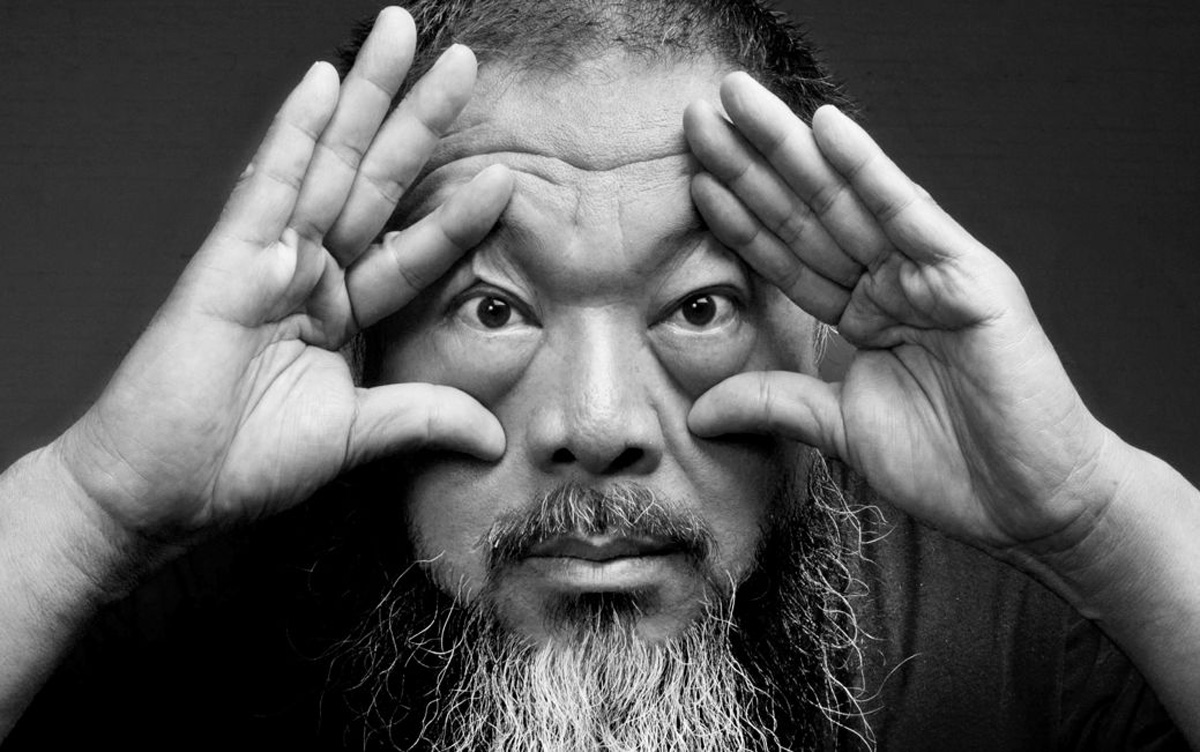

Few artists have challenged authority with the fearless conviction of Ai Weiwei. Standing at the intersection of art and activism, this Chinese contemporary artist transforms porcelain, ancient artifacts, and everyday objects into powerful statements about human rights and freedom of expression.
Born during China’s Cultural Revolution and later exiled with his dissident poet father, Ai’s personal experience with political persecution shapes his provocative installations and multimedia projects. His work spans conceptual art, sculpture, photography, and documentary filmmaking.
From dropping a 2,000-year-old Han Dynasty urn to creating 100 million hand-painted porcelain sunflower seeds, Ai’s artistic protest bridges traditional Chinese craftsmanship with global contemporary concerns.
This article explores Ai Weiwei’s remarkable journey from Beijing to international acclaim, examining:
- His formative years and artistic development
- Signature works that defined his career
- His bold fusion of Chinese cultural heritage with political commentary
- The global impact of his artistic activism
Through Ai Weiwei’s story, we discover how one artist’s defiance became a universal symbol for creative freedom in the face of censorship.
Identity Snapshot
- Entity name: Ai Weiwei (艾未未)
- Also known as: Ai Wei Wei, Ai
- Lifespan: 1957–present
- Primary roles: Conceptual artist, Activist, Sculptor, Photographer, Filmmaker, Architect
- Nationality: Chinese
- Movements: Contemporary art, Political activism, Conceptual art, Post-modernism
- Mediums: Mixed media, Installation, Sculpture, Photography, Documentary film, Porcelain
- Signature traits: Political commentary, appropriation of traditional Chinese objects, use of repetition, transformation of found objects
- Iconography/motifs: Bicycles, sunflower seeds, Chinese antiquities, surveillance cameras, middle finger
- Geographic anchors: Beijing (birth/studio), New York (formative years), Berlin (exile), Lisbon (current residence)
- Mentors/students/patrons: Father Ai Qing (poet), Marcel Duchamp (influence), Herzog & de Meuron (collaborators)
- Collections & museums: Tate Modern, MoMA, Guggenheim, Royal Academy, National Gallery Prague
- Market signals: Record auction price $5.4 million for “Zodiac Heads” (2011), Sunflower Seeds sold for $782,000 (2012)
What Sets The Artist Apart
Ai Weiwei stands at the intersection of art and dissent, merging tradition with subversion. His work transforms cultural artifacts into provocative statements on power, history, and freedom.
Few artists match his bold fusion of conceptual rigor and political courage. He uses scale to create overwhelming visual impact-millions of porcelain sunflower seeds or thousands of backpacks-while maintaining meticulous attention to craftsmanship.
Ai’s distinct approach centers on the deliberate tension between creation and destruction. His iconoclastic actions-smashing ancient urns, dipping antiquities in industrial paint-serve as metaphors for cultural rupture.
The artist’s personal narrative of persecution fuels his practice, making his installations deeply autobiographical yet universally resonant. His work navigates the complex territory between Chinese artistic heritage and contemporary global concerns.

Origins & Formation
Early Life & Exile
Born in Beijing in 1957 to poet Ai Qing, his childhood was marked by political persecution during China’s Cultural Revolution. His family was exiled to remote labor camps in Heilongjiang and later Xinjiang, where they lived under harsh conditions. These formative experiences shaped his understanding of state power and resilience.
New York Years
In 1981, Ai moved to New York, studying briefly at Parsons School of Design before immersing himself in the city’s vibrant art scene. For twelve years, he absorbed the influence of Marcel Duchamp, Andy Warhol, and Jasper Johns. This period introduced him to conceptualism and readymades that would define his later practice.
Return to China
Returning to Beijing in 1993 to care for his ailing father, Ai became a central figure in China’s emerging contemporary art scene. He co-founded the China Art Archives & Warehouse (CAAW) in 1997, providing crucial support for experimental artists. By the early 2000s, he began producing the provocative works that would establish his international reputation.
Architectural Turn
In 1999, Ai designed his own studio in Caochangdi, Beijing, marking his entry into architecture. His most significant architectural collaboration came in 2008, working with Herzog & de Meuron on Beijing’s National Stadium (Bird’s Nest) for the Olympic Games-a project he later disavowed as government propaganda.
Movement & Context
Political Art in Contemporary China

Within Chinese art, Ai represents a direct, confrontational approach unlike peers who use more oblique criticism. While artists like Xu Bing explore language and calligraphy, Ai’s work directly challenges state narratives through explicit imagery and actions.
Global Contemporary Art Position
Ai occupies a unique position between East and West. Unlike Western political artists focused on identity politics, Ai’s work addresses fundamental human rights and freedom of expression. His approach differs from Banksy’s street interventions or Damien Hirst’s commercial spectacles through its deep engagement with cultural heritage.
Comparative Context
In contrast to Yayoi Kusama’s obsessive repetition or Takashi Murakami’s pop sensibilities, Ai’s repeated elements (sunflower seeds, bicycles) carry explicit political meaning. Unlike James Turrell’s pure perceptual experiences, Ai’s installations demand social awareness. His work shares KAWS’ pop cultural references but applies them to political critique rather than consumer culture.
Materials, Techniques, and Process
Material Choices
Ai deliberately selects materials with cultural significance. His use of ancient wood from dismantled temples, Qing Dynasty furniture, and Han Dynasty urns confronts viewers with questions of cultural value. His installations often feature industrial materials-steel rebar, bicycles-contrasted with traditional handicrafts.
Collaborative Production
Many of Ai’s major works involve large-scale collaboration with artisans. For “Sunflower Seeds” (2010), he employed 1,600 craftspeople in Jingdezhen to hand-make and paint 100 million porcelain seeds over two years. This process highlights both traditional craftsmanship and China’s mass production capabilities.
Digital Documentation
Documentation is integral to Ai’s process. His studio meticulously photographs and films projects, with this documentation often becoming art in itself. His “Study of Perspective” series (1995-2011) uses photography to capture his middle finger directed at seats of power worldwide.
Readymades and Transformation
Influenced by Duchamp, Ai frequently transforms found objects. His “Forever Bicycles” installations reconfigure hundreds of bicycles into architectural structures, while his furniture series joins antique wooden pieces in physically impossible configurations, challenging their original form and function.
Technical Precision
Despite conceptual focus, Ai’s work demonstrates exacting technical standards. His wooden sculptures maintain traditional joinery techniques without nails or screws. His porcelain works honor the material’s history while subverting its purpose through scale and context.
Themes, Subjects, and Iconography
Political Resistance
Resistance to authoritarianism forms Ai’s core theme. His middle finger motif, appearing in photos and sculptures, succinctly expresses defiance toward power structures. His “Surveillance Camera” sculptures transform instruments of state control into objects for contemplation.
Cultural Memory
Ai’s work frequently addresses how societies remember or forget historical trauma. His “Straight” installation (2008-2012) featured 90 tons of straightened rebar recovered from schools collapsed in the Sichuan earthquake, making material the government’s attempt to erase the memory of children who died due to poor construction.
Traditional vs. Contemporary
The tension between traditional Chinese culture and contemporary society runs throughout his work. By painting Coca-Cola logos on ancient vases or destroying Han Dynasty urns, he creates provocative commentary on cultural value systems and preservation.
Mass Production and Individuality
Ai explores the relationship between mass production and individual expression. His “Sunflower Seeds” installation presents millions of seemingly identical objects that are actually uniquely handcrafted, challenging perceptions of Chinese manufacturing and human labor.
Displacement and Migration
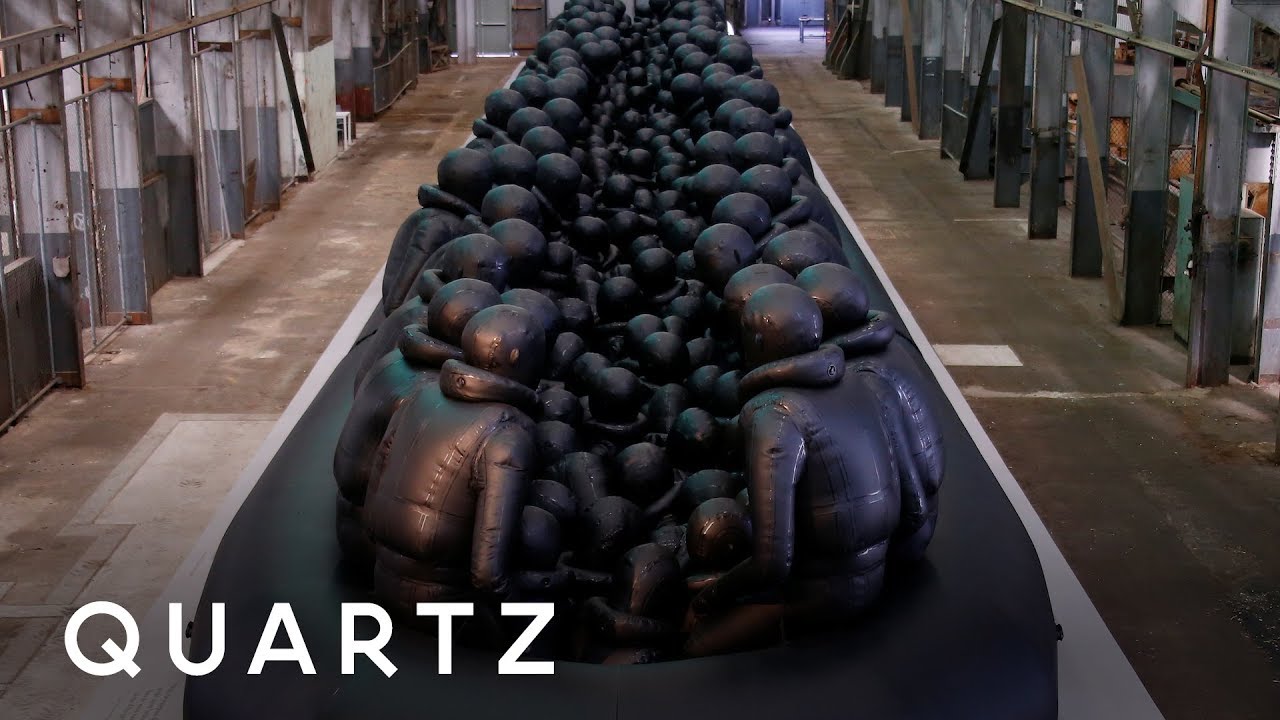
Recent work addresses global refugee crises. His “Law of the Journey” (2017) features an enormous inflatable boat filled with anonymous human figures, while installations using life jackets recovered from refugee landings create stark memorials to humanitarian crisis.
Notable Works
Dropping a Han Dynasty Urn (1995)
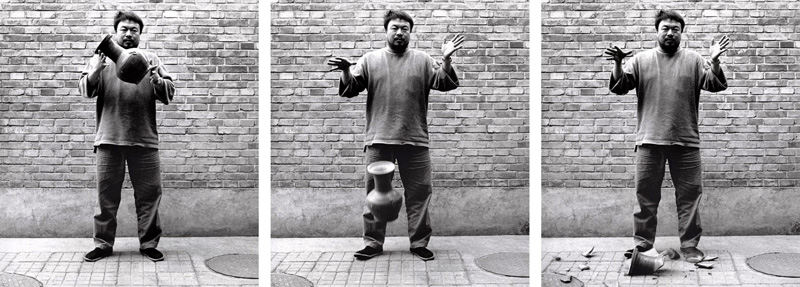
- Medium: Photographic triptych, black and white
- Current location: Private collections; editions at multiple museums
- Visual signature: Stark documentation of destruction, emotionless facial expression, ancient artifact reduced to fragments
- Why it matters: This provocative work established Ai’s willingness to destroy cultural artifacts to create new meaning. The deliberate shattering of a 2,000-year-old Han Dynasty urn challenges notions of cultural value, preservation, and transformation.
- Related works: “Colored Vases” (2006), “Coca Cola Vase” (2007)
Sunflower Seeds (2010)
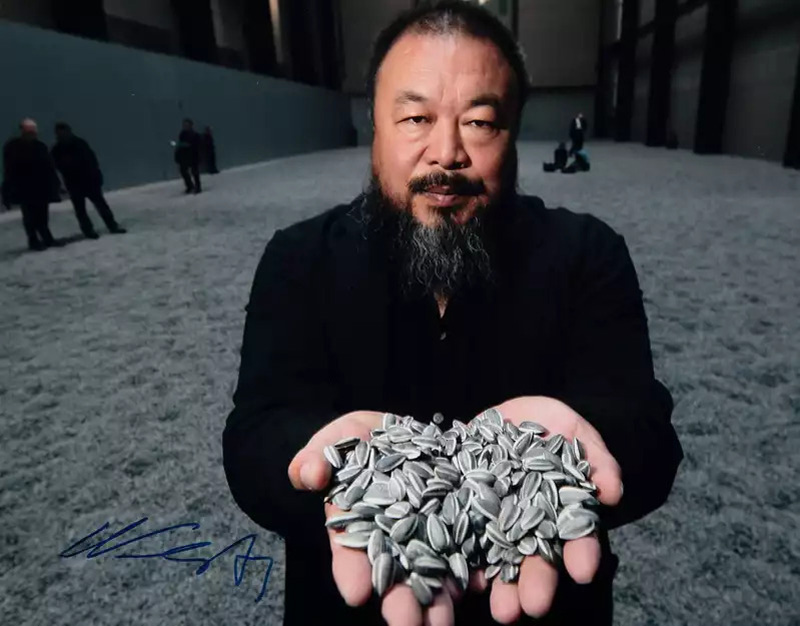
- Medium: Installation with 100 million hand-painted porcelain seeds
- Current location: Tate Modern (partial); various collections (portions)
- Visual signature: Vast field of black and white seeds, apparent uniformity masking individual craftsmanship
- Why it matters: This landmark installation employed 1,600 artisans from Jingdezhen to create millions of unique porcelain seeds. It references both Mao-era propaganda (where citizens were portrayed as sunflowers turning toward Chairman Mao) and childhood poverty (when sunflower seeds were a rare treat).
- Related works: “Kui Hua Zi” (variations), “Porcelain Cube” (2009)
Circle of Animals/Zodiac Heads (2010)
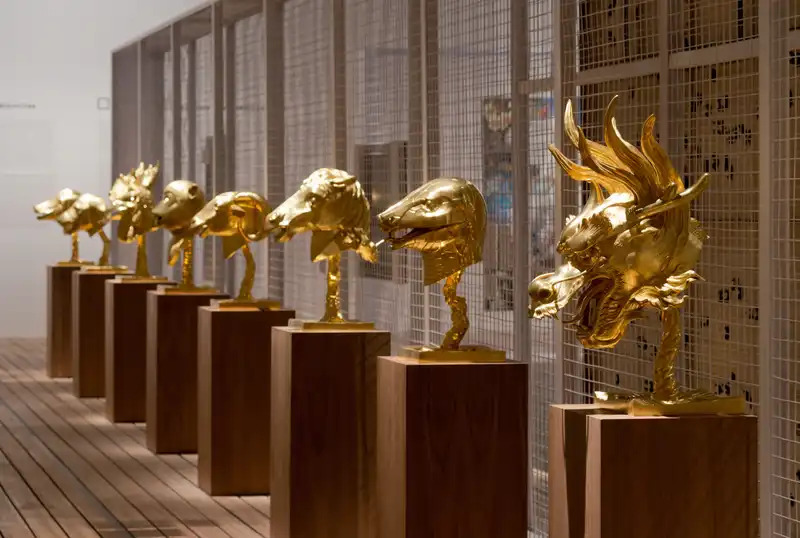
- Medium: Bronze sculpture series
- Current location: Traveling exhibition; collections worldwide
- Visual signature: Twelve oversized animal heads on poles arranged in a circle, combining traditional Chinese zodiac with Western sculptural presence
- Why it matters: This work reimagines bronze zodiac heads looted from Beijing’s Old Summer Palace in 1860 during the Second Opium War. By recreating these contested artifacts, Ai comments on cultural repatriation, historical wounds, and national identity.
- Related works: “Zodiac Heads: Gold” (2010), “Zodiac LEGO Portraits” (2018)
Straight (2008-2012)
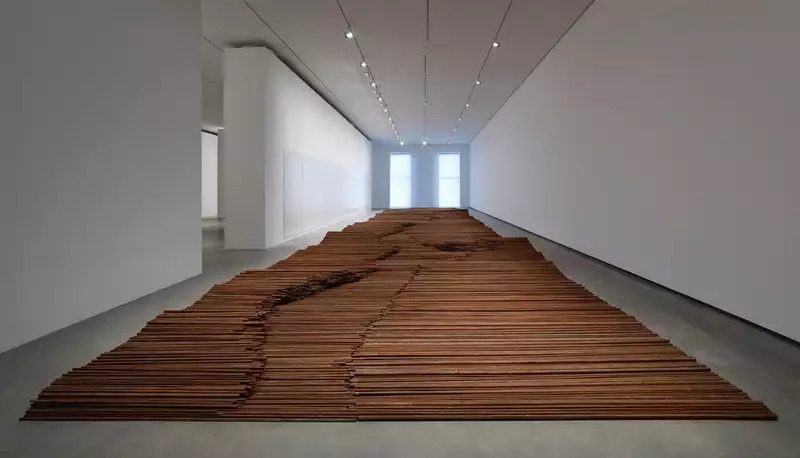
- Medium: 90 tons of straightened steel rebar recovered from Sichuan earthquake
- Current location: Royal Academy, London
- Visual signature: Undulating landscape of meticulously straightened metal rods
- Why it matters: Created in response to the 2008 Sichuan earthquake that killed thousands of schoolchildren due to poorly constructed buildings. Each steel rod was recovered from the ruins, then painstakingly straightened-a labor-intensive act of remembrance and accountability.
- Related works: “Remembering” (2009), “Names of the Student Earthquake Victims Found by the Citizens’ Investigation” (2008-2011)
Forever Bicycles (2003-present)
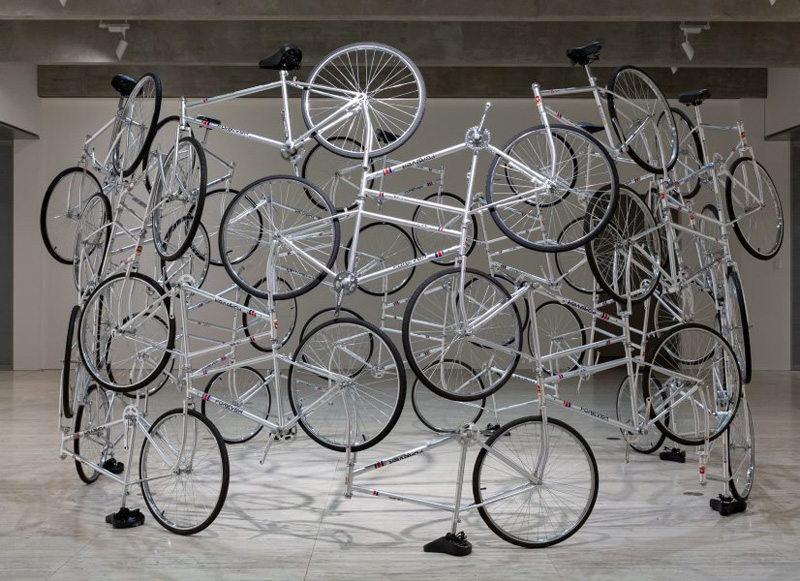
- Medium: Installation with hundreds of interconnected bicycles
- Current location: Various versions in collections worldwide
- Visual signature: Mesmerizing, seemingly infinite structure of interlocking bicycle frames creating optical illusion
- Why it matters: Using the Forever brand bicycle (once ubiquitous in China), this installation creates an architectural structure from a symbol of Chinese everyday life. The interconnected frames suggest both social connection and industrial reproducibility.
- Related works: “Very Yao” (2007-2008), “Stacked” (2012)
Exhibitions, Collections, and Provenance Highlights
Major Exhibitions
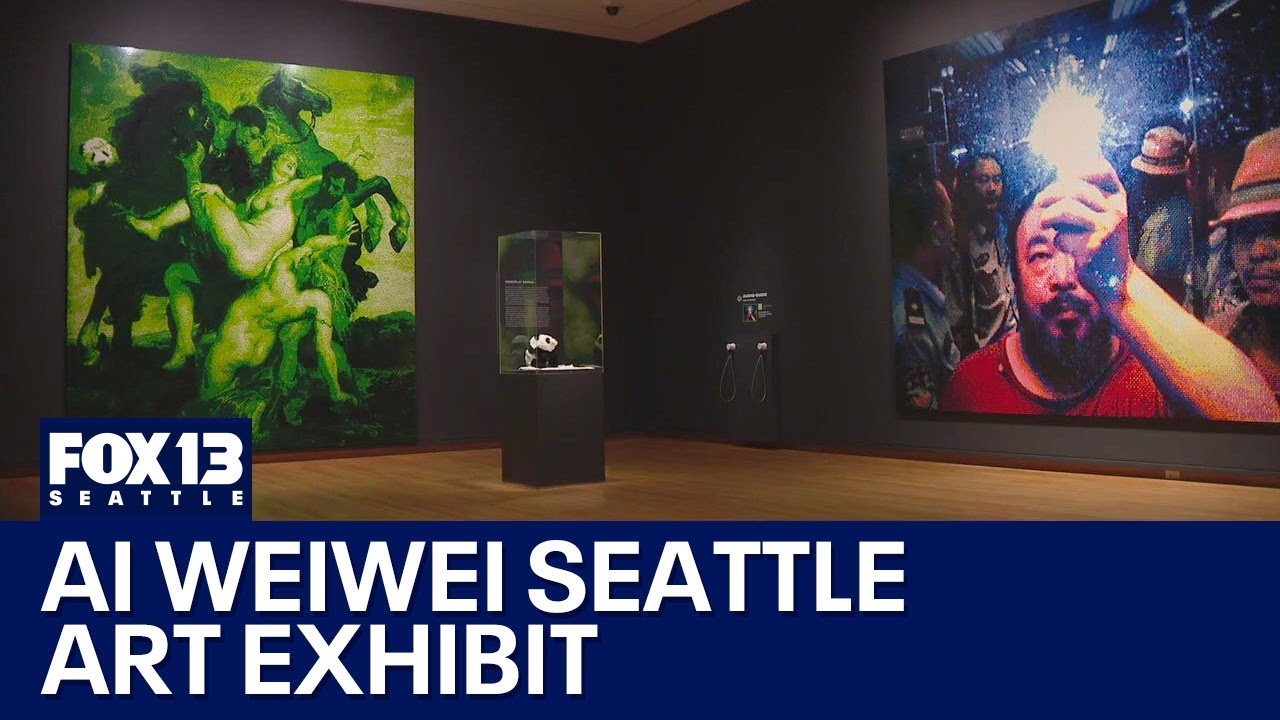
Ai’s first significant international exposure came through documenta 12 (2007) where his “Fairytale” project brought 1,001 Chinese citizens to Kassel, Germany. His breakthrough installation “Sunflower Seeds” at Tate Modern’s Turbine Hall (2010) coincided with his detention by Chinese authorities, bringing worldwide attention to his work and activism.
The traveling retrospective “According to What?” (2012-2014) marked his first major North American survey, while “Evidence” at Martin-Gropius-Bau (2014) became the largest solo show in his career. His provocative installation at Alcatraz prison (2014-2015) effectively utilized the site’s history of confinement.
Museum Collections
Major holdings of Ai’s work exist at Tate Modern (London), MoMA (New York), and the Guggenheim (New York). The Hirshhorn Museum acquired his monumental “Cube Light” (2008), while smaller but significant collections exist at SFMOMA, the Art Institute of Chicago, and M+ in Hong Kong.
Provenance Patterns
Much of Ai’s early work was sold through Chinese galleries like China Art Archives & Warehouse (which he co-founded) and ShanghART. His international career has been managed primarily through Lisson Gallery (London/New York) and neugerriemschneider (Berlin).
Private collectors with significant holdings include Uli Sigg, whose collection forms the core of M+ Museum in Hong Kong, and the Boros Collection in Berlin. Editions of major photographic works are distributed across multiple prominent collections.
Market & Reception
Auction Performance
Ai’s market has experienced steady growth since 2008, with significant spikes following his 2011 detention. His auction record stands at $5.4 million for a set of “Zodiac Heads” in 2015. Photography works typically range from $20,000-$100,000, while major installations can command millions.
The “Sunflower Seeds” have become particularly valuable, with a 100kg portion selling at Sotheby’s for $782,000 in 2012. Limited editions of his iconic “Dropping a Han Dynasty Urn” photographs have consistently achieved six-figure results.
Authentication Considerations
Ai’s conceptual approach and use of collaborative production creates authentication complexities. Many works include certificates from his FAKE Design studio. Photographic editions are strictly limited and tracked. For large installations, certificates detail precise installation parameters.
Critical Reception
Critical reception has sometimes struggled to separate Ai’s artistic merits from his political significance. Western critics occasionally overlook formal innovations while focusing on dissident status. Chinese reception remains complicated, with official censorship contrasting underground influence.
Art historian Karen Smith has noted how Ai’s work transforms “cultural readymades” into contemporary political statements. His influence on younger Chinese artists remains significant despite government attempts to minimize his legacy.
Influence & Legacy
Artistic Influences
Ai cites Marcel Duchamp’s readymades and Andy Warhol’s factory production as key influences. His conceptual approach draws from Joseph Beuys’ social sculpture and political activism. Traditional Chinese craft traditions, particularly ceramics and woodworking, inform his material sensibility.
Artists Influenced
Ai’s approach has significantly influenced younger Chinese artists like He Xiangyu and Zhao Zhao (who worked as his assistant). His fusion of political activism and conceptual strategies has impacted international artists like Olafur Eliasson and Trevor Paglen.
His use of social media as artistic medium pioneered digital activism among artists globally. His documentation of state surveillance has informed a generation of artists addressing digital privacy and control.
Cross-Domain Impact
Beyond art, Ai’s work has influenced architectural discourse through his collaborations with Herzog & de Meuron. His documentary films, particularly “Human Flow” (2017), have contributed to visual journalism about the global refugee crisis.
His memoir “1000 Years of Joys and Sorrows” (2021) has brought his story to broader literary audiences. Tech activists have adopted his strategies of systematic documentation and data collection as tools for transparency and accountability.
How to Recognize Ai Weiwei’s Work at a Glance
- Scale extremes: Either massive installations with thousands/millions of components or intimate objects imbued with political significance
- Material contrasts: Traditional Chinese materials (porcelain, ancient wood) juxtaposed with industrial elements
- Cultural iconography: Recurring use of Chinese historical objects transformed or recontextualized
- Documentation emphasis: Photography and video that meticulously records actions and processes
- Seriality and repetition: Multiple similar elements arranged to create overwhelming visual impact
- Collaboration evidence: Works often show signs of many hands through slight variations in seemingly identical elements
- Conceptual clarity: Direct, easily understood political messaging without obscure symbolism
- Material transformation: Common objects reconfigured into unexpected arrangements or purposes
- Confrontational stance: Works directly challenge viewer to consider political implications
- Technical precision: Despite conceptual focus, execution shows extremely high craft standards
FAQ on Ai Weiwei
Who is Ai Weiwei?
Ai Weiwei is a renowned Chinese contemporary artist, activist, and documentary filmmaker born in 1957. Son of poet Ai Qing, he emerged as a vital figure in Chinese cultural development while becoming one of the nation’s most vocal political commentators.
His work spans multiple disciplines including sculpture, installation, photography, and architectural collaborations.
Why was Ai Weiwei arrested?
Ai was arrested in April 2011 at Beijing Capital International Airport and detained for 81 days without formal charges. Chinese authorities claimed “economic crimes,” but the detention was widely seen as retaliation for his human rights activism and criticism of government corruption.
International pressure from artists and governments contributed to his eventual release.
What is Ai Weiwei’s most famous artwork?
The “Sunflower Seeds” installation at London’s Tate Modern (2010) stands as his most recognized work. This massive installation featured over 100 million hand-painted porcelain sunflower seeds created by 1,600 Chinese artisans in Jingdezhen.
The work explored themes of mass production, Chinese manufacturing, individuality, and collective effort.
Why did Ai Weiwei drop a Han Dynasty urn?
His provocative 1995 performance “Dropping a Han Dynasty Urn” documented the deliberate destruction of a 2,000-year-old artifact. This act critiqued China’s relationship with its cultural heritage during the Cultural Revolution, when historical artifacts were systematically destroyed.
The work questions cultural value, authenticity, and the power to redefine history.
What is the Zodiac Heads project?
“Circle of Animals/Zodiac Heads” (2010) is Ai’s first major public sculpture series featuring 12 bronze animal heads representing the Chinese zodiac. The work reimagines bronze sculptures looted from Beijing’s Old Summer Palace during the Second Opium War in 1860.
This project addresses issues of cultural repatriation, national identity, and historical wounds.
How does Ai Weiwei use traditional Chinese materials?
Ai frequently incorporates traditional Chinese materials like porcelain, jade, and ancient wood into contemporary contexts. He applies techniques from imperial craftsmanship to create politically charged works.
His approach creates tension between cultural preservation and transformation, often subverting traditional forms through scale, repetition, and unexpected juxtapositions.
Where does Ai Weiwei live now?
Ai Weiwei currently resides primarily in Portugal, after previous periods living in Germany and the United Kingdom. He left China in 2015 when authorities returned his passport after four years of travel restrictions.
His studio practice continues internationally, with ongoing exhibition projects across Europe, North America, and Asia.
What themes appear most in Ai Weiwei’s work?
His art consistently explores human rights, freedom of expression, and government accountability. Key recurring themes include surveillance, displacement, cultural memory, and the tension between individual and state power.
His recent work has increasingly addressed global refugee crises through installations, films, and photography projects.
How does Ai Weiwei use social media?
Ai pioneered artistic use of social media as both documentation and activism. Before his 2011 detention, his blog documented government corruption and social issues. Later, Twitter became central to his practice for sharing political views and artistic processes.
He embraces digital platforms as extensions of his artistic voice while documenting state censorship attempts.
What is Ai Weiwei’s artistic influence?
Ai’s fusion of conceptual art with political activism has influenced a generation of artists globally. His work bridges Western artistic traditions (particularly Marcel Duchamp’s readymades) with Chinese cultural heritage.
His collaborative approach to massive projects, engagement with artisans, and bold institutional critiques have redefined what political art can accomplish in the 21st century.
Conclusion
Ai Weiwei stands as a defining voice in global contemporary art, merging traditional Chinese craftsmanship with provocative political statements. His artistic rebellion transcends conventional boundaries, creating a visual language that speaks directly to power structures and social injustices.
The impact of his multimedia installations extends far beyond gallery walls into the realm of human rights discourse. Through his deliberate transformation of cultural artifacts, Ai forces viewers to confront uncomfortable questions about authenticity, censorship, and collective memory.
What distinguishes his artistic practice is the seamless integration of personal narrative with universal concerns. Whether working with ancient porcelain or digital documentation, his conceptual approach maintains a remarkable compositional clarity.
As both witness and participant in China’s complex relationship with modernity, Ai continues to create work that resonates with profound symbolic weight while retaining accessibility to global audiences. His artistic legacy reminds us that the most powerful expressions of dissent often emerge from deep cultural understanding.