Standing at the threshold of a James Turrell installation feels like crossing into another dimension where light becomes tangible. Since the 1960s, this pioneering light artist has transformed our relationship with visual perception through his immersive environments.
Born in Los Angeles and trained in perceptual psychology, Turrell creates works that blur the boundary between the material and immaterial. His iconic Skyspace installations-architectural chambers with openings to the sky-have redefined how we experience celestial light.
Unlike painters who merely depict light, Turrell sculpts with light itself. His work spans from intimate projection pieces to the monumental Roden Crater project-a massive naked-eye observatory carved within an extinct Arizona volcano.
This article explores Turrell’s revolutionary approach to light and space, examining:
- His development from early Mendota Hotel experiments to global installations
- The perceptual psychology behind his Ganzfeld environments
- How his Quaker upbringing influenced his artistic vision
- Key installations that showcase his mastery of atmospheric works
Identity Snapshot
- Entity name: James Turrell
- Born: May 6, 1943, Los Angeles, California, USA
- Primary roles: Light artist, Installation artist, Land artist
- Nationality/schools: American, California Light and Space movement
- Movements: Light and Space art, Perceptual art, Minimalism
- Mediums: Light installations, Skyspaces, projection pieces, sensory environments
- Signature traits: Use of pure light as medium, creation of perceptual experiences, spatial interventions
- Iconography/motifs: Sky apertures, geometric forms, light tunnels, sensory deprivation
- Geographic anchors: Los Angeles (birthplace), Flagstaff, Arizona (Roden Crater), Mendota Hotel (early studio)
- Mentors/students/patrons: Robert Irwin (colleague), Donald M. Hess (patron), Suzanne Deal Booth (patron)
- Collections & museums: Guggenheim Museum, LACMA, MoMA, National Gallery of Australia, James Turrell Museum (Argentina)
- Market signals: Commissioned works in public and private collections worldwide, site-specific installations
What Sets The Artist Apart

James Turrell manipulates light itself as his primary medium, creating immersive environments that transform human perception. Unlike painters who represent light on canvas, Turrell crafts actual light experiences that challenge how we see.
His work occupies a unique intersection between art, science, and spiritual experience. Influenced by his Quaker background, Turrell’s installations invite quiet contemplation and heightened awareness.
What distinguishes Turrell is his ability to make the intangible tangible. He doesn’t merely illuminate spaces – he sculpts with light, manipulating its properties to create profound perceptual shifts.
Origins & Formation
Early Training
- Studied perceptual psychology at Pomona College (BA, 1965) and art at University of California, Irvine
- Obtained pilot’s license at 16, developing fascination with aerial perspective and light
- Quaker upbringing instilled value of “inner light” and meditative spaces
First Artistic Explorations
- Began experimenting with light projections in 1966 at Mendota Hotel studio in Santa Monica
- Created “Afrum-Proto” (1966), projecting tungsten light to create floating cube illusions
- Developed the Mendota Stoppages series (1969-74), cutting walls to create controlled light apertures
Key Influences and Collaborations
- Participated in LACMA’s Art and Technology Program (1968-69) with Robert Irwin
- Explored Ganzfeld effect (perceptual field loss through sensory deprivation)
- Created sky drawings with Sam Francis using colored skywriting smoke
First Exhibitions
- First solo exhibition “James Turrell: Light Projections” at Pasadena Art Museum (1967)
- Early recognition for pioneering work with light as artistic medium
- Began receiving commissions for permanent installations in the 1970s
Movement & Context
Light and Space Movement
Turrell stands as a founding figure of California’s Light and Space movement alongside Robert Irwin and Doug Wheeler. Where Irwin focused on material manipulation and Wheeler on atmospheric environments, Turrell’s distinction lies in using pure light to create perceptual phenomena.
Artistic Comparisons
- vs. Dan Flavin: While Flavin used fluorescent tubes as physical objects, Turrell conceals his light sources to create immaterial experiences
- vs. Olafur Eliasson: Eliasson combines natural elements with technology; Turrell works with pure light perception
- vs. Land Artists: Unlike earthwork artists like Robert Smithson who dramatically alter landscapes, Turrell makes minimal terrain modifications, focusing instead on celestial observation
Historical Context
Emerging during 1960s California’s artistic experimentation, Turrell’s work represents a unique convergence of minimalism, scientific inquiry, and spiritual contemplation. His approach diverges from conventional art by eliminating object-based focus entirely.
Materials, Techniques, and Process
Light Sources
- LED lighting systems with precise color calibration
- Natural light through carefully calculated apertures
- Hidden light sources that create seamless visual effects
- Programmed lighting sequences synchronized with sunrise/sunset
Spatial Constructions
- Architectural modifications to existing buildings
- Purpose-built structures with precise geometric composition
- Mathematical calculations for light angles and aperture dimensions
- Specially treated surfaces for light reflection and diffusion
Key Techniques
- Ganzfeld Effect: Total field of uniform color creating perceptual disorientation
- Aperture Cutting: Precise openings that frame and transform natural light
- Light Projection: Creating volumetric forms using controlled light beams
- Color Sequencing: Programmed light changes that alter perception of ambient light
Perceptual Manipulation
- Controlled viewing positions and seating arrangements
- Extended viewing duration requirements (typically 45+ minutes)
- Carefully calculated light source positioning
- Use of after-image effects and retinal adaptation
Themes, Subjects, and Iconography
Perceptual Experience
Turrell’s central theme is human perception itself. His work challenges viewers to recognize how we construct visual reality, revealing the subjective nature of seeing. By creating subtle shifts in light conditions, he exposes the gaps between what we think we see and what actually exists.
Transcendence and Contemplation
Drawing from Quaker traditions of inner light and silent worship, Turrell’s installations function as meditative spaces that invite introspection. The slow-changing nature of works like Skyspaces creates extended viewing experiences that reward patient observation.
Cosmic Connection
Celestial observation forms a key aspect of Turrell’s practice. Works like Roden Crater and his Skyspaces create direct connections between viewers and astronomical phenomena, positioning humans within the larger context of cosmic time and space.
Recurring Forms
- Square/rectangular apertures: Frames that isolate sky portions
- Elliptical spaces: Mirroring celestial formations
- Geometric light projections: Creating volumetric illusions
- Horizon lines: Establishing spatial orientation points
Notable Works
Roden Crater (1979-present)
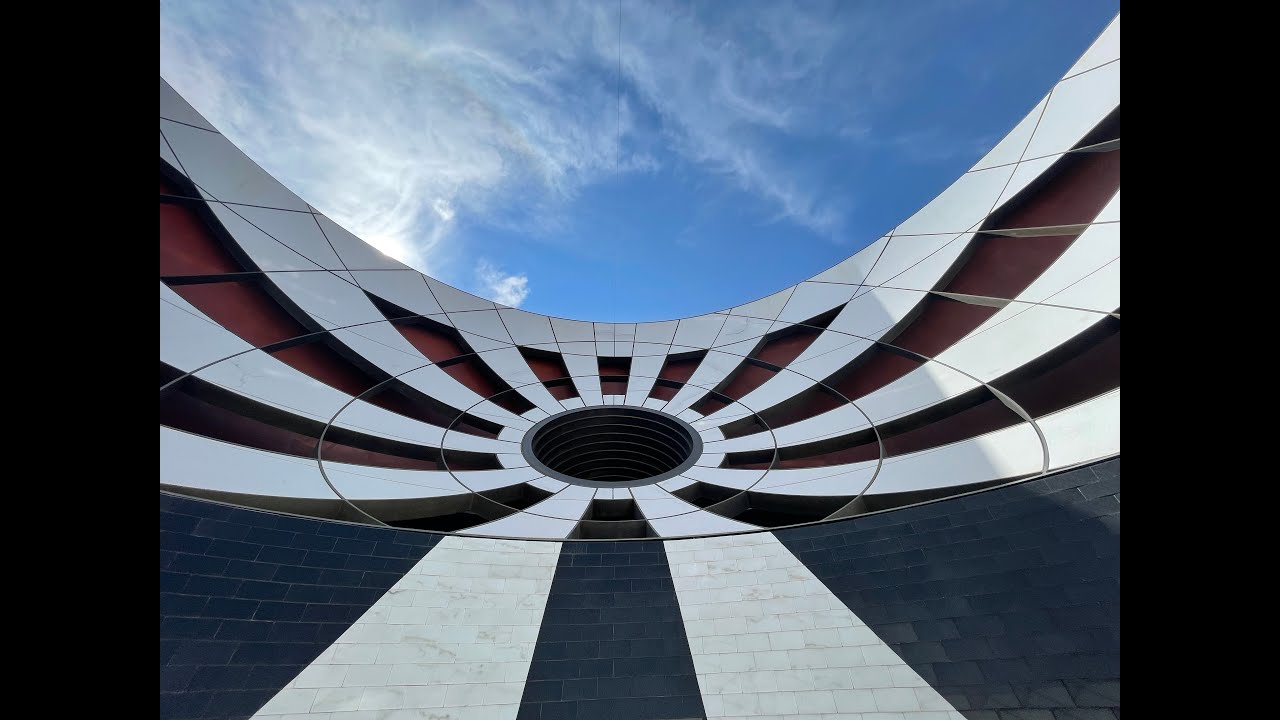
- Description: Massive naked-eye observatory inside extinct volcanic crater near Flagstaff, Arizona
- Current status: Ongoing project, partially complete with multiple chambers and viewing tunnels
- Visual signature: Precisely calculated apertures framing celestial events; light tunnels calibrated to specific astronomical phenomena
- Significance: Represents Turrell’s magnum opus, combining art, astronomy, and architecture on monumental scale
Skyspace Series (1974-present)

- Description: Architectural chambers with ceiling apertures framing the sky, enhanced by concealed lighting
- Locations: Nearly 100 worldwide, including “Meeting” (1980/86) at MoMA PS1; “Twilight Epiphany” (2012) at Rice University
- Visual signature: Lighting transitions that transform perception of sky color, particularly at dawn and dusk
- Significance: Created accessible versions of Turrell’s perceptual art for public engagement around the world
Ganzfeld Series (1976-present)

- Description: Immersive light environments creating perceptual disorientation through uniform color fields
- Examples: “Apani” (2011), “Breathing Light” (2013), “Akhob” (2013) at Louis Vuitton, Las Vegas
- Visual signature: Total immersion in monochromatic light creating loss of depth perception
- Significance: Demonstrates how uniform light fields can disorient and transform visual perception
Exhibitions, Collections, and Provenance Highlights
Major Retrospectives
- “James Turrell: A Retrospective” at LACMA, 2013-2014 (traveled to NGA Australia)
- “James Turrell” at Guggenheim Museum, New York, 2013
- “Into the Light” at MASS MoCA, 2017-2025
Permanent Collections
- Guggenheim Museum, New York
- Museum of Fine Arts, Houston (“The Light Inside”)
- LACMA, Los Angeles
- Centre for International Light Art, Unna, Germany
- National Gallery of Australia, Canberra
Dedicated Venues
- James Turrell Museum, Bodega Colomé, Argentina (opened 2009)
- Multiple Skyspaces in public institutions worldwide
- Live Oak Friends Meeting House, Houston (1999)
Key Patrons and Commissions
- Donald M. Hess (established James Turrell Museum)
- Dia Art Foundation (early Roden Crater support)
- Suzanne Deal Booth (commissioned “Twilight Epiphany” at Rice University)
- Arizona State University (ASU-Roden Crater Project partnership)
- Marquess of Cholmondeley (Houghton Hall Skyspace, Norfolk, UK)
Market & Reception
Recognition and Awards
- MacArthur Foundation Fellowship, 1984 (with Robert Irwin)
- Praemium Imperiale for Sculpture, Japan Art Association, 2021
- National Medal of Arts recipient
- Guggenheim Fellowship
Critical Reception
- Praised for pioneering use of light as artistic medium
- Recognized for contributions to perceptual psychology
- Described as creating “transcendent” viewing experiences
- Los Angeles Times called his Pomona College Skyspace “one of the best works of public art in recent memory”
Accessibility Challenges
- Limited public access to Roden Crater (still incomplete)
- Many Skyspaces require timed reservations
- Optimal viewing during specific times of day (dawn/dusk)
- Continual funding needed for ambitious long-term projects
Authentication Considerations
- Works typically site-specific and immovable
- Extensive documentation and lighting specifications
- Authorized designs follow precise mathematical calculations
Influence & Legacy

Artistic Impact
Turrell has transformed how artists approach light as a medium. His influence extends to contemporary practitioners like Olafur Eliasson and Tokujin Yoshioka who explore perceptual phenomena and immersive environments.
Architectural Influence
His work has significantly impacted architectural lighting design, with principles from his Skyspaces influencing how architects incorporate natural light into buildings. The concept of “experiential architecture” owes much to Turrell’s innovations.
Cross-Disciplinary Impact
- Science: Contributed to research on human perception and visual processing
- Spirituality: Created contemporary secular spaces for meditation and contemplation
- Environmental awareness: Heightened attention to natural light cycles and celestial phenomena
- Education: Inspired new approaches to teaching about light, perception, and color theory
Ongoing Projects
The continuing development of Roden Crater, now in partnership with Arizona State University, ensures Turrell’s legacy will extend well beyond his lifetime, creating a permanent observatory for future generations.
How to Recognize a James Turrell at a Glance
- Pure light as primary medium without visible support structures or obvious sources
- Geometric precision in apertures and viewing chambers
- Extended viewing duration required to experience perceptual effects
- Immersive environments that eliminate conventional art object boundaries
- Seamless light transitions with invisible edges and gradients
- Mathematical precision in spatial proportions and light angles
- Absence of narrative content or representational elements
- Controlled viewing positions often with specific seating arrangements
- Dawn/dusk programming synchronized with natural light cycles
- Spiritual atmosphere conducive to meditation and contemplation
FAQ on James Turrell
Who is James Turrell?
James Turrell is an American light artist born in Los Angeles in 1943. He’s a pioneering figure in the Light and Space movement who creates immersive installations using light as his primary medium. Trained in perceptual psychology, Turrell crafts experiences that challenge how we see and perceive our environment.
What are Skyspaces?
Skyspaces are architectural installations with apertures in the ceiling that frame the sky. These enclosed viewing chambers feature carefully calibrated lighting that changes viewers’ perception of the sky’s color, especially during sunrise and sunset. Nearly 100 exist worldwide in museums, private collections, and public spaces.
What is the Roden Crater Project?
The Roden Crater Project is Turrell’s magnum opus-an extinct volcano in Arizona that he’s transforming into a massive naked-eye observatory.
Started in 1979, this ongoing installation contains tunnels, chambers, and apertures designed for experiencing celestial events. The project involves minimal landscape alteration while creating powerful perceptual experiences.
How does Turrell use light in his art?
Unlike artists who depict light through painting mediums, Turrell works with actual light as his material. He creates controlled environments where light itself becomes the artwork.
His installations manipulate illumination to alter spatial perception, using both natural and artificial light sources with mathematical precision.
What is the Ganzfeld effect in Turrell’s work?
The Ganzfeld effect occurs when viewers experience a uniform field of color that fills their entire visual field, causing perceptual disorientation. Turrell creates these experiences in his immersive installations where walls appear to dissolve, eliminating depth cues and spatial references. This effect heightens awareness of one’s own visual processing.
How did Turrell’s Quaker background influence his art?
Turrell’s Quaker upbringing, with its emphasis on “inner light” and silent contemplation, profoundly shaped his artistic vision.
His work creates meditative spaces encouraging introspection and spiritual experience. The extended viewing duration his installations demand mirrors the patient contemplation practiced in Quaker meetings.
What materials does Turrell use to create his installations?
Though light is his primary medium, Turrell’s installations involve architectural elements with precise mathematical calculations. He uses LED lighting systems, specialized projection equipment, and carefully designed spaces with treated surfaces for optimal light diffusion. His works often incorporate color theory principles to achieve specific perceptual effects.
Where can I experience James Turrell’s work?
Turrell’s installations can be found in major museums worldwide, including the Guggenheim, LACMA, and MoMA. The James Turrell Museum in Argentina houses nine installations. Many universities and public spaces feature his Skyspaces, though optimal viewing requires specific timing-usually dawn or dusk when light sources create the most dramatic effects.
How does Turrell’s work differ from minimalism?
While sharing minimalism’s concern with simplified forms and viewer experience, Turrell’s work goes beyond physical objects to create perceptual phenomena. Unlike minimalist sculptures that occupy space, his installations transform space itself through light manipulation. Turrell eliminates the art object entirely, focusing instead on perception as the subject matter.
What is Turrell’s artistic legacy?
Turrell revolutionized how we understand light in contemporary art. His influence extends beyond fine art into architecture, design, and environmental awareness. The ASU-Roden Crater partnership ensures his work will impact future generations, while his techniques have inspired countless artists working with sensory experiences, spatial constructs, and perceptual psychology.
Conclusion
James Turrell transcends conventional artistic boundaries by transforming how we experience the fundamental element of vision itself. His celestial vaulting installations and void rooms invite us into a realm where perception becomes the subject rather than merely the means of observation.
The impact of Turrell’s work extends beyond galleries into architectural lighting design, environmental awareness, and meditative practice. His autonomous structures create spaces where viewers confront their own visual processing.
What makes Turrell’s contribution so significant is his lifelong dedication to a single artistic pursuit: the manipulation of light as both medium and message. Through mathematical precision and spatial constructs, he creates environments that reveal the mechanics of human vision.
Key aspects of Turrell’s legacy include:
- Pioneering perceptual art that bridges science and spirituality
- Creating atmospheric works that alter our relationship with light
- Developing site-specific installations that engage with natural phenomena
- Establishing a new visual language through holographic spaces and LED technology
In experiencing Turrell’s work, we don’t just see light-we see ourselves seeing.