At 96, Yayoi Kusama still works daily from a studio adjacent to the Tokyo psychiatric facility where she’s lived voluntarily since 1977. Her polka dots aren’t decoration but survival mechanisms, obsessive marks born from childhood hallucinations that threatened to consume her.
From her 1960s New York happenings where she painted naked bodies to today’s Instagram-breaking infinity mirror rooms, Kusama transformed mental illness into the most popular contemporary art on earth.
She’s the world’s top-selling female artist and most-visited living artist by museum attendance. Yet her innovations were plagiarized by male contemporaries who gained fame while she attempted suicide from obscurity.
This profile examines what makes Kusama’s work instantly recognizable: her materials and techniques, signature motifs from pumpkins to infinity nets, notable installations that redefined contemporary art, and the market that now values her early paintings at $10 million. You’ll learn to identify her work at a glance and understand the hallucinations that shaped six decades of relentless creativity.
Identity Snapshot
Name: Yayoi Kusama (草間 彌生, Kusama Yayoi)
Born: March 22, 1929, Matsumoto, Nagano, Japan
Age: 96 years old (as of 2025)
Primary roles: Sculptor, Installation Artist, Painter, Performance Artist
Also works in: Printmaking, Video Art, Fashion Design, Poetry, Fiction, Film
Nationality: Japanese
Movements: Pop Art, Minimalism, Abstract Expressionism, Conceptual Art, Surrealism
Mediums: Acrylic painting, oil painting, watercolor, gouache, ink, pastel, sewn stuffed fabric, bronze, stainless steel, mirrors, LED lights
Signature traits: Polka dots, repetitive patterns, infinity nets, obsessive mark-making, impasto white paint loops, monochrome palettes transitioning to vibrant multi-color
Iconography: Polka dots, pumpkins, infinity nets, phalli forms, flowers, cosmic themes
Geographic anchors: Matsumoto (birthplace), Kyoto (training), New York City (1958-1973), Tokyo (1973-present, resides in mental health facility)
Mentors/influences: Georgia O’Keeffe (correspondence), Japanese Nihonga tradition (rejected)
Associates: Donald Judd, Joseph Cornell, Claes Oldenburg, Andy Warhol, Lucio Fontana
Collections: MoMA, Tate Modern, Hirshhorn Museum, The Broad, Louisiana Museum, Centre Pompidou, National Museum of Modern Art Tokyo, Yayoi Kusama Museum Tokyo
Market signals: Record auction: $10.5 million (Untitled Nets, 2022). Average price: $244,638. Most valuable works from 1959-1960 New York period.
What Sets This Artist Apart
Kusama turned hallucinations into methodology.
Her polka dots aren’t decoration but survival tools, compulsive marks to combat visual distortions she’s experienced since age ten. The infinity nets grew from airplane-window glimpses of Pacific waves, transformed into obsessive white-on-white loops applied in trance states lasting 50-60 hours straight. She lives voluntarily in a psychiatric facility, working daily in an adjacent studio.
Unlike male abstract expressionists who dominated 1960s New York, Kusama rejected gestural drama. Her marks are mechanical, relentless, eerily restrained.
While Jackson Pollock dripped and Willem de Kooning slashed, she stippled thousands of identical semi-circles until her hands bled. This wasn’t emotional release but psychological architecture built one dot at a time.
The mirror rooms came later, amplifying repetition through reflection rather than physical labor. Now one pumpkin becomes infinite pumpkins. One viewer multiplies endlessly.
She bridges East and West without fully belonging to either. Trained in traditional Japanese painting, she fled to America. Made her name in New York, then returned to Tokyo. Embraced pop art commercialism through Louis Vuitton while maintaining avant-garde credibility.
At 96, she remains the world’s top-selling female artist and most popular living artist by museum attendance.
Origins & Formation
Early Childhood (1929-1948)
Born into wealthy merchant family operating plant nursery in Matsumoto. Fourth and youngest child.
Mother physically and verbally abusive, discouraging artistic pursuits. Father a womanizer, creating volatile household environment.
First hallucinations around age ten: dots, flashes, speaking flowers, fabric patterns coming alive and engulfing her. Called this process “self-obliteration.” Found white stones in nearby riverbed, sparking lifelong dot obsession.
Drew frantically between episodes, rushing to finish before mother destroyed work.
Formal Training (1948-1949)
Studied briefly at Kyoto City University of Arts (then Kyoto Municipal School of Arts and Crafts). Learned Nihonga, traditional Japanese painting using 1000-year-old techniques and materials.
Hated the conservative restrictions. Japan’s post-war cultural climate rejected Western influences, forcing adherence to rigid conventions.
Began experimenting with available materials from family nursery: sand, seed sacks, oil paint.
Created dark, war-influenced works like Accumulation of the Corpses (1950) showing trauma of growing up during WWII. Military service included forced labor in parachute factory, up to twelve hours daily.
First Exhibitions (1950-1957)
Staged first solo show March 1952 at First Community Centre, Matsumoto. Showed 250 works.
Second exhibition September 1952 at same venue: 280 additional works. Astonishing production rate.
Worked in watercolor, gouache, oils. Shifted from nihonga to gestural, spontaneous mark-making.
Discovered book of Georgia O’Keeffe paintings. Wrote to O’Keeffe asking advice. O’Keeffe responded quickly, urging move to United States for artistic freedom.
New York Arrival (1957-1958)
Left Japan 1957 with mother’s money and command to “never set foot in her house again.” Destroyed hundreds of works in anger before departing.
Brought approximately 2,000 works on paper.
Settled in New York 1958. First solo exhibition 1959 at Brata Gallery, East 10th Street, showing white Infinity Nets paintings. Immediate critical attention.
Movement & Context
Positioning Within Pop Art and Minimalism

Kusama arrived in New York as abstract expressionism peaked. Her 1959 debut coincided with emergence of minimalism and pop art.
Critics compared Infinity Nets to Jackson Pollock, Mark Rothko, Barnett Newman. But her approach differed fundamentally.
Kusama vs. Pollock:
- Pollock: explosive gesture, wide arm movements, drips, action painting
- Kusama: contained repetition, small circular marks, meditative accumulation, wet-in-wet impasto
Kusama vs. Rothko:
- Rothko: soft-edged color fields, atmospheric washes, emotional transcendence
- Rothko used thin glazes
- Kusama: hard-edged nets, thick impasto loops, physical infinity through pattern
- Kusama built surfaces with knife-applied white paint
Kusama vs. Andy Warhol:
- Warhol: mechanical reproduction, silkscreen, celebrity culture, commercial embrace
- Kusama: hand-executed repetition, personal obsession made universal, strategic self-promotion
- Both understood artist-as-celebrity
- Kusama painted dots on bodies; Warhol screen-printed soup cans
Influence and Appropriation
Donald Judd became close friend after seeing Infinity Nets. Her Accumulation sculptures (1961-1965) presaged Claes Oldenburg’s soft sculptures.
Andy Warhol purchased her work, became first buyer.
Male artists appropriated her innovations. Lucas Samaras exhibited mirrored room at Pace Gallery 1966, gaining more attention than Kusama’s earlier 1965 Phalli’s Field mirror installation. Many assumed Samaras originated the form.
Financial stress, plagiarism, and lack of recognition led to suicide attempts in late 1960s.
Return and Revival
Left New York 1973, practically forgotten. Voluntarily entered Tokyo psychiatric facility 1977, where she still resides.
International revival began 1989 with retrospectives at Center for International Contemporary Arts (New York) and Museum of Modern Art (Oxford).
1993 Venice Biennale: represented Japan officially with Mirror Room (Pumpkin). First woman solo presenter for Japanese pavilion. Career turning point.
Late 2010s Infinity Mirrors exhibitions became social media phenomena. Instagram posts using #InfiniteKusama garnered 330 million impressions.
Materials, Techniques, and Process
Painting Supports
Early period (1950s): Paper, canvas
New York period (1959-1973): Large stretched canvases, some exceeding 3 meters. Cotton canvas standard.
Later work: Canvas, wood panels, mixed media collage incorporating found materials
Ground and Paint Application
Infinity Nets technique:
- Dark ground layer (black, red, blue, or yellow)
- Semi-circular white impasto marks applied with brush, sometimes palette knife
- Marks cover entire surface edge-to-edge
- Thin white wash over impasto creates misty, atmospheric depth
- Cool monochrome palette in early works
- Later nets incorporate vivid colors: vermilion, gold, electric blue
Application is time-consuming, requiring extreme focus. Marks must be uniform size, evenly spaced, perfectly repeated.
Works take weeks to complete. Kusama works in extended sessions, describing process as “indescribable spell.”
Soft Sculpture Materials
Accumulation series (1961-1965):
- Found furniture: chairs, tables, ladders, shoes, rowboats
- Hand-sewn stuffed fabric phalli forms, 10-30 cm long
- White cotton or canvas fabric
- Multiple coats thick white paint over sewn forms
- Forms attached densely, covering every surface
Later installations:
- Sewn stuffed fabric in various colors
- Polka dot patterns painted or printed on fabric
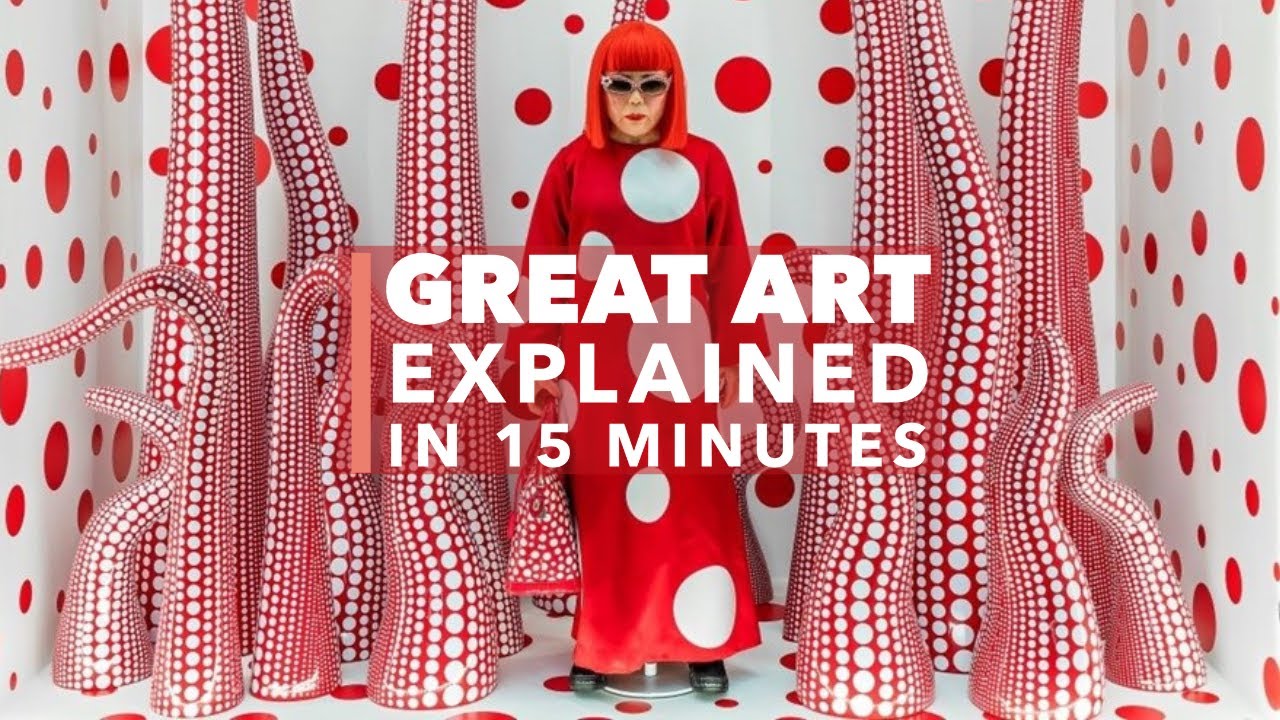
- Biomorphic shapes resembling vines, roots, tendrils
- Suspended or floor-based configurations
Mirror Installation Construction
Infinity Mirror Rooms components:
- Mirrored walls on all sides (sometimes floor and ceiling)
- Wooden or metal structural framework
- LED lights in various colors and patterns
- Hanging elements: lanterns, spheres, lights
- Reflective stainless steel spheres
- Small viewing platform for one or two visitors
- Timed entry (30-90 seconds typical)
Narcissus Garden:
- 700-1,500 stainless steel mirror balls
- Each approximately 30 cm diameter
- Arranged on ground or lawn
- Creates reflective field where viewers see distorted self-images
Printmaking Methods
Screenprints, lithographs, etchings on Arches paper. Editions typically numbered 50-130 copies.
Uses vivid, bold colors. Incorporates signature motifs: dots, nets, pumpkins, flowers.
Prints maintain same hypnotic quality as large installations. Allows broader market access.
Studio Practice
Works daily from studio adjacent to psychiatric facility in Tokyo.
Maintains rigorous schedule despite age. Creates paintings, sculptures, plans installations.
Staff assists with fabrication of large-scale works, but Kusama directs all aspects.
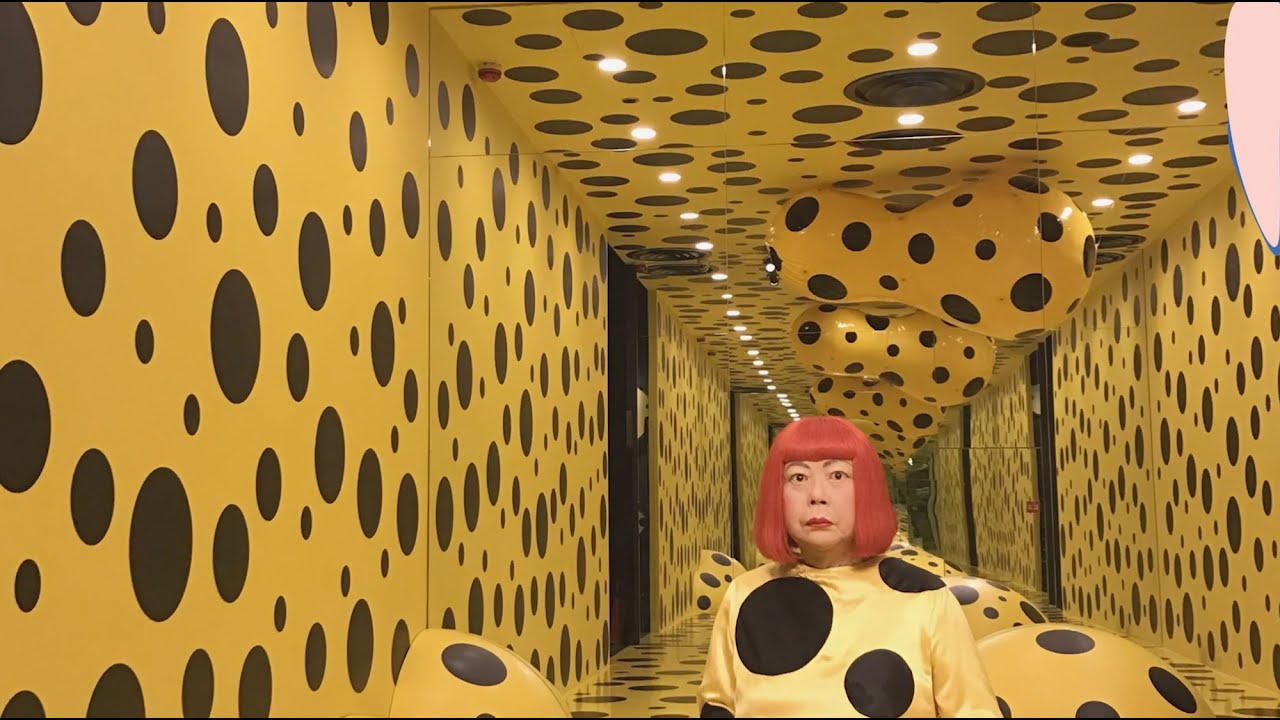
Wears custom-designed clothing featuring patterns from paintings. Brightly colored wigs complete distinctive “Kusama look.”
Themes, Subjects, and Iconography
Polka Dots: Self-Obliteration

Dots represent Kusama’s identity fragmenting into infinite points. “My life is a dot lost among thousands of other dots.”
Apply dots everywhere: paintings, sculptures, bodies, trees, rooms. Dots multiply until individual dissolves into pattern.
Process mirrors childhood hallucinations where dots expanded from her body to cover walls, ceiling, universe.
Therapeutic function: externalizing internal chaos creates order through repetition.
Infinity Nets: Cosmic Connection
Looping marks suggest endlessness. “I gradually feel myself under the spell of the accumulation and repetition in my nets which expand beyond myself.”
Inspired by aerial view of Pacific Ocean from airplane. Saw ever-expanding nets on water surface.
Philosophical dimension: individual consciousness merging with universal infinity. Buddhist undertones of self-dissolution.
Pumpkins: Structural Beauty
First drew pumpkins in elementary school. Walked through grandfather’s farm fields, admiring their “generous unpretentiousness” and “solid spiritual balance.”
Pumpkins appear in watercolors (1940s), paintings (1980s-present), bronze sculptures (2000s-present), mirror installations (1991-present).
Yellow pumpkin with black dots became iconic motif. Represents organic growth, rural childhood, structural simplicity.
Large-scale outdoor bronze pumpkins installed globally. Recognizable brand.
Phalli: Confronting Fear
Soft phallic forms cover furniture, walls, floors in Accumulation series. “My sofas, couches, dresses, and rowboats bristle with phalluses.”
Stems from sexual anxiety related to father’s infidelity and mother’s rage. Confronts fear through obsessive replication.
By multiplying feared object thousands of times, reduces power. Transforms anxiety into aesthetic pattern.
War and Peace
Early paintings respond to WWII trauma. Accumulation of the Corpses (1950), Earth of Accumulation (1950) show bleak war-torn landscapes.
1960s happenings protested Vietnam War. Painted naked bodies with dots in unauthorized performances: Grand Orgy to Awaken the Dead (1969) at MoMA sculpture garden.
Nudity represented peace and love countering war violence. Combined political protest with self-promotion.
Later works: Revived Soul (1995) triptych commemorating Hiroshima atomic bomb victims. Black and white vertical bands suggesting dead forest, covered in dots.
Compositional Schemes
All-over composition: Nets and dots extend to canvas edges, implying continuation beyond frame. No focal point, no hierarchy.
Centralized masses: Pumpkin sculptures occupy center, surrounded by negative space or mirrored infinity.
Grid structures: Wooden boxes containing soft sculptures arranged in geometric grids (Genesis, 1992-1993).
Immersive environments: Mirror rooms surround viewer completely. No outside/inside distinction. Viewer becomes part of artwork through reflection.
Notable Works
No. F (1959)

Medium: Oil on canvas
Size: 180 x 180 cm
Collection: Private
Visual signature: White impasto loops on pale ground. Monochromatic restraint. Loops fade at edges suggesting atmospheric depth. Dense accumulation creates optical vibration.
Why it matters: Among first Infinity Nets paintings made after arriving in New York. Established signature style that influenced minimalism. Garnered immediate critical attention.
Related works: Pacific Ocean (1959), White No. 28 (1960)
Accumulation No. 1 (1962)

Medium: Sewn stuffed fabric, paint, chair
Size: Approximately 90 x 90 x 95 cm
Collection: Private
Visual signature: Armchair completely covered with white stuffed phallic protuberances. Forms wave like sea anemones or grass field. Thick white paint unifies surface.
Why it matters: First major Accumulation sculpture. Presaged Claes Oldenburg’s soft sculptures and aspects of pop art. Bridged painting’s repetition into three dimensions.
Related works: Aggregation: One Thousand Boats Show (1963), Macaroni Infinity Nets (1962)
Infinity Mirror Room – Phalli’s Field (1965)

Medium: Mirrors, sewn stuffed fabric, paint
Size: Approximately 250 x 450 x 450 cm (room dimensions)
Collection: Originally destroyed, later reconstructed
Visual signature: Mirrored walls without ceiling. Floor covered with hundreds of red-dotted white phalli of varying heights. Mirrors create illusion of infinite field extending in all directions.
Why it matters: First mirror installation. Pioneered immersive environmental art. Achieved through reflection what painting achieved through manual repetition. Introduced interactive viewer experience.
Related works: Love Forever (1966/1994), subsequent Infinity Mirror Rooms
Narcissus Garden (1966)

Medium: 1,500 mirrored plastic spheres (original), later stainless steel
Size: Variable installation
Collection: Multiple iterations, owned by various institutions
Visual signature: Hundreds of reflective spheres arranged on ground. Each sphere reflects distorted environment and viewer. Creates shimmering field.
Why it matters: Unauthorized guerrilla installation at Venice Biennale outside Italian Pavilion. Kusama wore gold kimono, sold balls for $2 each until officials intervened. Critiqued art market commercialization while embracing it. Generated international press. Installation continues to be recreated globally.
Related works: Let’s Survive Forever (2017), various Narcissus Garden iterations
Pumpkin (1994)

Medium: Acrylic painting on canvas
Size: 162 x 162 cm
Collection: Private
Visual signature: Large yellow pumpkin with black spots against red netted background. Bold color contrast. Pumpkin centrally positioned, anthropomorphic presence.
Why it matters: Established pumpkin as signature motif for international audience. Led to large-scale outdoor bronze pumpkin sculptures. Symbol of Kusama’s practice globally recognized.
Related works: Yellow pumpkin bronze sculptures, All the Eternal Love I Have for the Pumpkins (2016)
Obliteration Room (2002-present)

Medium: White room, furniture, participatory dot stickers
Size: Variable installation
Collection: Touring installation
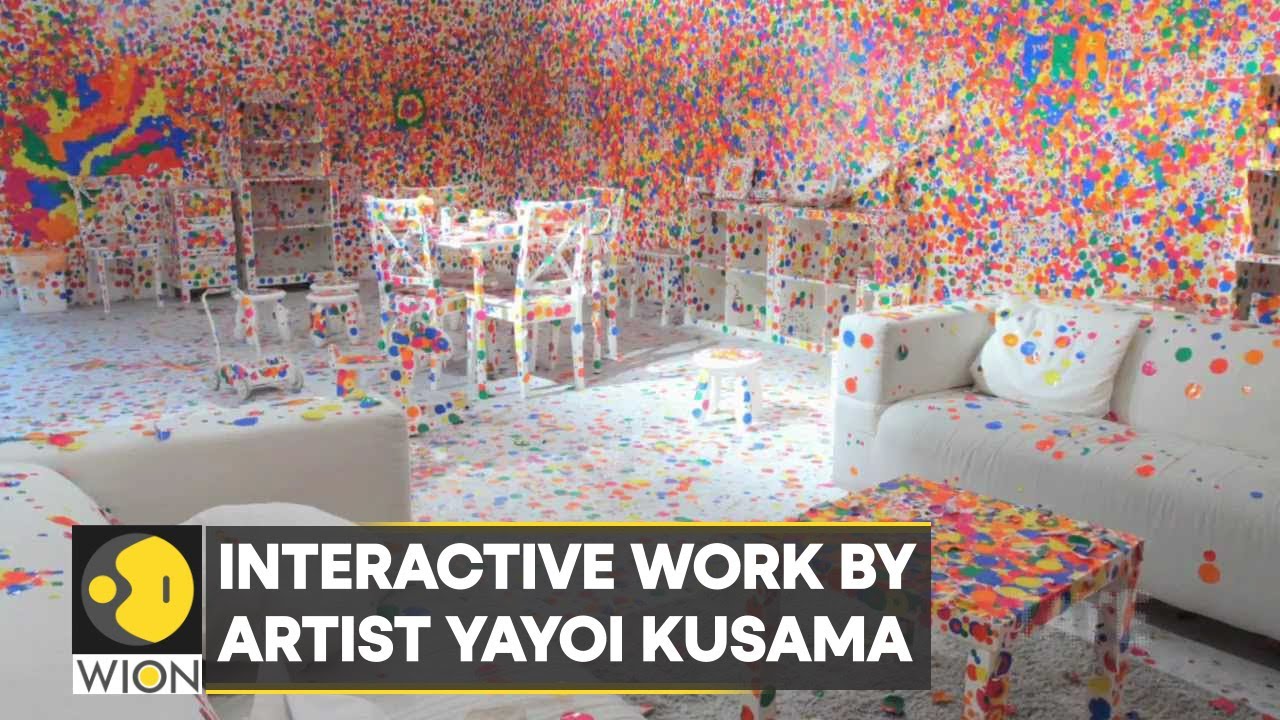
Visual signature: All-white room with white furniture. Visitors given colorful dot stickers to place anywhere. Over exhibition duration, room transforms from white to multicolored dot saturation.
Why it matters: Democratizes Kusama’s process. Viewers create Kusama aesthetic collectively. Documents transformation photographically. Highly popular with families and social media. Exemplifies participatory contemporary art.
Related works: Various interactive installations
Infinity Mirrored Room – The Souls of Millions of Light Years Away (2013)

Medium: Wood, mirrors, LED lights, acrylic panel
Size: Room dimensions variable
Collection: The Broad, Los Angeles
Visual signature: Dark mirrored chamber. Hundreds of LED lights in various colors suspended at different heights. Lights pulse in varying rhythms. Creates illusion of floating in deep space among stars.
Why it matters: Most popular Infinity Mirror Room. Lines form hours before museum opening. Made available online during COVID lockdown, viewed globally. Exemplifies why Kusama became social media sensation. Transcendent experience of cosmic infinity.
Related works: Where the Lights in My Heart Go (2016), My Heart is Dancing into the Universe (2018)
Exhibitions, Collections, and Provenance
Major Retrospectives
1989: Center for International Contemporary Arts, New York (first critical survey organized by Alexandra Munroe); Museum of Modern Art, Oxford
1993: Venice Biennale, Japanese Pavilion (first woman solo presenter for Japan)
1998-1999: Love Forever: Yayoi Kusama, 1958-1968, Los Angeles County Museum of Art and MoMA, toured to Walker Art Center, Museum of Contemporary Art Tokyo
2012: Whitney Museum of American Art, major retrospective
2017-2019: Infinity Mirrors exhibition, Hirshhorn Museum (Washington DC), toured to Seattle Art Museum, The Broad (Los Angeles), Art Gallery of Ontario, Cleveland Museum of Art, High Museum of Art (Atlanta). Exhibition generated 34,000 Instagram images, 330 million social media impressions.
2022-2024: Yayoi Kusama: 1945 to Now, M+ Museum Hong Kong, toured to Guggenheim Bilbao, Serralves Museum Portugal
Museum Collections

Major holdings (3+ works):
- Yayoi Kusama Museum, Tokyo (dedicated museum opened 2017)
- Hirshhorn Museum and Sculpture Garden, Washington DC
- Tate Modern, London
- The Broad, Los Angeles
- Museum of Modern Art, New York
- Centre Pompidou, Paris
- National Museum of Modern Art, Tokyo
- Louisiana Museum of Modern Art, Denmark
- M+ Museum, Hong Kong
Provenance Patterns
Early New York works (1959-1973) most sought-after. Many gifted to friends, collectors, doctors in exchange for support.
2021 Bonhams sale: 11 works gifted to cardiovascular surgeon Teruo Hirose in exchange for medical care sold for $15.2 million collectively.
Works passing through Japanese, Hong Kong, and international auctions. Strong Asian market.
Editions widely distributed through print publishers, increasing accessibility while maintaining artist control.
Key Dealers and Galleries
- David Zwirner (New York, London, Hong Kong, Paris)
- Ota Fine Arts (Tokyo, Singapore, Shanghai)
- Victoria Miro (London, Venice)
- Gagosian (various locations)
Market & Reception
Auction Records
Top prices:
- Untitled (Nets) (1959): $10.5 million, Phillips New York, 2022
- Pumpkin (ABCDS) (2004): $8.2 million, Christie’s Hong Kong, 2023
- White No. 28 (1960): $7.9 million, Sotheby’s Hong Kong, 2019
- Pumpkin (L) (2014), bronze: $6.4 million, Sotheby’s Hong Kong, 2023
- Interminable Net #4 (1959): $6 million, Sotheby’s Hong Kong, 2019
Average auction price: $244,638 (as of 2021 data).
Early Infinity Nets paintings (1959-1960) command highest prices. Eight of top ten auction records are works from this two-year period.
Bronze pumpkin sculptures increasingly valuable. Edition sizes typically 8 plus 2 artist proofs.
Price Bands
Paintings:
- Major Infinity Nets (1959-1960): $3-10 million
- Later paintings: $500,000-$3 million
- Recent acrylic works: $100,000-$1 million
Sculptures:
- Large bronze pumpkins: $3-7 million
- Medium bronze pumpkins: $1-3 million
- Soft sculptures/installations: Rarely appear at auction
Prints/Editions:
- Screenprints: $5,000-$50,000
- Lithographs: $3,000-$30,000
- Ceramic pumpkins: $1,000-$10,000
Market driven by volume rather than trophy lots. 750 lots sold in 2021, record year.
Market Position
2021: First woman to crack top 10 best-selling artists at auction worldwide.
Accounts for 25% of all auction sales of work by women artists.
World’s top-selling female artist and most popular living artist by museum attendance.
Market remains fraction of male contemporaries. Kusama’s $10.5 million record vs. Jean-Michel Basquiat‘s $110+ million.
Authentication
Works authenticated through Kusama Studio Inc., Tokyo.
Signature varies: English “Yayoi Kusama,” Japanese characters, or both. Early works sometimes unsigned.
Prints include edition numbers, studio stamps, certificates of authenticity.
Forgeries exist, particularly of popular pumpkin motifs. Provenance documentation critical.
Condition Considerations
Paintings: Acrylic and oil generally stable. Impasto surfaces can crack if improperly stored. Varnish yellowing on early oils.
Soft sculptures: Fabric vulnerable to light damage, fading. Paint can crack on heavily stuffed forms. Dust accumulation in crevices.
Prints: Standard paper conservation issues. Screenprints hold color well.
Influence & Legacy
Upstream Influences
Japanese Nihonga training (rejected but informed disciplined approach)
Georgia O’Keeffe (correspondence, encouragement)
Abstract expressionists (Jackson Pollock, Mark Rothko) (responded against)
Zen Buddhism concepts of infinity, self-dissolution
Wartime trauma, childhood abuse
Downstream Impact
Direct artistic influence:
- Claes Oldenburg soft sculptures
- Andy Warhol repetition and celebrity
- Installation art immersive environments
- Participatory art practices
- Minimalist all-over composition
- Pop art commercial engagement
Contemporary artists citing Kusama:
- Yayoi Kusama influenced generation of Japanese contemporary artists
- Takashi Murakami (dots, commercial collaboration, Japanese pop aesthetic)
- Yoshitomo Nara
- Installation artists worldwide creating immersive mirror/light environments
Cross-domain impact:
Fashion: Louis Vuitton collaboration 2012 and 2023 with Marc Jacobs. Polka dot patterns on bags, clothing, accessories. Commercial success demonstrated art-fashion crossover potential.
Design: Kusama-designed buses in Matsumoto, Tokyo subway maps, architectural collaborations.
Social media: Infinity Mirror Rooms became ultimate Instagram experience. Changed museum attendance patterns. Younger audiences seek experiential, photographable art.
Mental health advocacy: Openness about living in psychiatric facility, using art as therapy. Reduced stigma. “I fight pain, anxiety, and fear every day, and the only method I have found that relieved my illness is to keep creating art.”
Feminist impact: Overcame sexism in Japanese culture and New York art world. Highest-selling female artist proves market viability. Role model for women artists globally.
Curatorial Legacy
Museums increasingly acquire immersive installations. Kusama proved audience appetite for experiential art.
Timed-entry ticketing systems developed for popular exhibitions. Kusama shows pioneered advance reservation models.
Social media integration into museum strategy. Kusama exhibitions tracked Instagram metrics, press coverage.
Academic Recognition
Subject of numerous dissertations, books, films. Documentary Kusama: Infinity (2018) brought wider recognition.
Art history canon expanded to include non-Western, female artists. Kusama central to this revision.
How to Recognize a Kusama at a Glance
Visual diagnostics:
- Polka dots everywhere – if dots cover entire surface, likely Kusama
- All-over patterning – no empty space, marks extend to edges
- Repetition as content – same mark repeated hundreds or thousands of times
- Monochrome Infinity Nets – white loops on dark ground or single-color fields
- Pumpkin motif – yellow with black dots, bulbous organic form
- Mirror installations – reflective surfaces creating infinite repetition
- Soft sculptures – sewn fabric forms, often phallic, painted white or dotted
- Bright color saturation – vivid primaries, neon tones in later work
- Biomorphic shapes – organic curves, tentacle forms, vine-like growth
- Signature placement – English or Japanese, sometimes both, typically lower right or on reverse
Common canvas sizes:
- Large-scale: 180 x 180 cm, 200 x 200 cm squares
- Very large: 300+ cm width
- Prints: Standard paper sizes, 40-70 cm range
Typical palette:
- Early: White on black, white on red, monochrome
- Later: Yellow, red, blue, green, pink in high saturation
- Pumpkins: Yellow-orange with black
- Installations: Multi-color LED lights
Material clues:
- Thick impasto in Infinity Nets
- Hand-sewn fabric with visible stitching
- Mirrored stainless steel surfaces
- Arches paper for prints
FAQ on Yayoi Kusama
What is Yayoi Kusama known for?
Kusama is known for her polka dots, infinity mirror rooms, and pumpkin sculptures. Her immersive installations create boundless spaces through mirrors and LED lights.
She pioneered participatory contemporary art and influenced both minimalism and pop art movements. At 96, she remains the world’s top-selling female artist.
Why does Yayoi Kusama use polka dots?
Polka dots originated from childhood hallucinations around age ten. She saw dots multiply and cover her body, walls, and entire rooms.
Creating dot patterns externalized these visions, providing therapeutic relief. She calls the process “self-obliteration,” where individual identity dissolves into infinite repetition.
Where does Yayoi Kusama live now?
Kusama has lived voluntarily in a psychiatric facility in Tokyo since 1977. Her studio sits adjacent to the hospital, where she works daily.
She chose this arrangement to manage mental health while maintaining artistic productivity. This hasn’t slowed her output or global exhibition schedule.
What mental illness does Yayoi Kusama have?
Kusama experiences obsessive-compulsive disorder and visual hallucinations since childhood. She’s been open about using art as therapy for anxiety and depression.
“I fight pain, anxiety, and fear every day,” she stated in 2012. Art became her survival mechanism, allowing her to function despite persistent symptoms.
How much is Yayoi Kusama’s art worth?
Her auction record is $10.5 million for Untitled (Nets) from 1959, sold at Phillips in 2022. Average sale price across all works: $244,638.
Early Infinity Nets paintings (1959-1960) command highest prices. Bronze pumpkin sculptures sell for $3-7 million. Her prints range $5,000-$50,000.
What are Yayoi Kusama’s Infinity Mirror Rooms?
Infinity Mirror Rooms are mirrored chambers filled with LED lights, spheres, or pumpkins. Mirrors on all sides create endless reflections.
Visitors enter for 30-90 seconds, experiencing illusion of infinite space. The Souls of Millions of Light Years Away (2013) remains most popular, drawing hours-long lines.
Why did Yayoi Kusama move to New York?
Kusama fled conservative Japanese culture that discouraged female artists. After correspondence with Georgia O’Keeffe, she moved to New York in 1958.
The city’s abstract expressionist scene offered freedom her nihonga training lacked. She exhibited with Donald Judd, Andy Warhol, and Claes Oldenburg.
What are Yayoi Kusama’s pumpkins about?
Pumpkins represent childhood memories of her grandfather’s farm in Matsumoto. She admired their “generous unpretentiousness” and structural simplicity.
First appearing in 1940s drawings, pumpkins became signature motifs in paintings, bronze sculptures, and infinity rooms. The yellow-and-black spotted version achieved global recognition.
What is Narcissus Garden by Yayoi Kusama?
Narcissus Garden consisted of 1,500 mirrored balls at the 1966 Venice Biennale. Kusama sold them for $2 each until officials stopped her.
The unauthorized guerrilla installation critiqued art commercialization while embracing it. Each sphere reflected distorted viewer images, forcing confrontation with vanity. It’s been recreated globally since.
How can I visit a Yayoi Kusama exhibition?
The Yayoi Kusama Museum in Tokyo opened in 2017, requiring advance reservations. Major institutions like The Broad, Hirshhorn Museum, and Tate Modern regularly show her work.
Infinity Mirror Rooms require timed tickets that sell out quickly. Check museum websites months ahead. Her traveling exhibitions generate record attendance worldwide.
Conclusion
Yayoi Kusama transformed childhood trauma into six decades of groundbreaking installations, sculptures, and paintings. Her infinity nets challenged abstract expressionism‘s masculine dominance while soft sculptures presaged pop art.
The mirror rooms that now draw millions began as therapeutic tools for managing hallucinations. What male contemporaries dismissed or plagiarized became the most photographed art of the social media era.
From struggling in 1960s New York to commanding $10 million at auction, her journey proves persistence against sexism and mental illness. She works daily at 96, still creating obsessive repetitive patterns that dissolve self into infinity.
Her pumpkins, dots, and immersive environments redefined what contemporary art could be: participatory, therapeutic, and wildly popular without sacrificing depth.