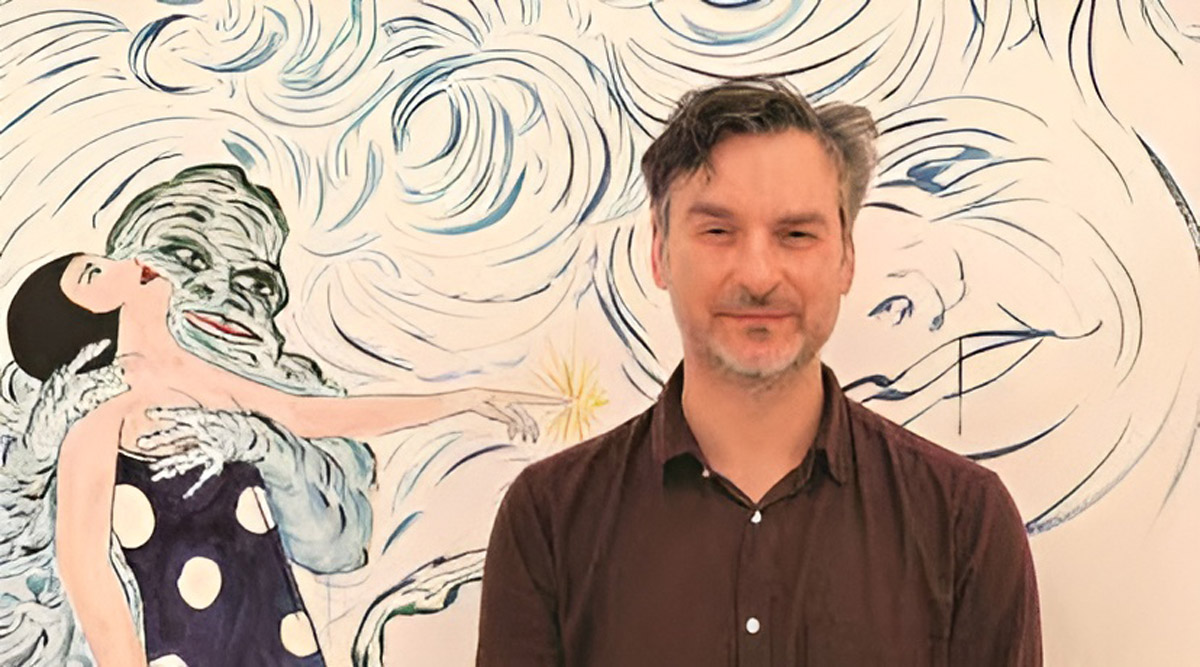

A masked dancer holds a rifle in one hand while frozen mid-arabesque. Bears in military uniforms stand beside tree people and bat swarms. Marcel Dzama creates worlds where童 fairy tales collide with violence, where innocent-looking figures engage in ambiguous acts that feel both sweet and sinister.
Since the late 1990s, this Canadian artist has developed one of contemporary art’s most recognizable visual languages.
His watercolor painting and ink drawings appear deceptively simple. Muted browns, greys, and khaki greens. Figures floating against white voids. But beneath the childlike surfaces runs a darker current of power, eroticism, and social commentary.
This guide examines what makes Dzama’s work distinctive. You’ll discover his techniques, recurring motifs, major exhibitions, and how to identify his art at a glance. From his early days co-founding the Royal Art Lodge in Winnipeg to his current Brooklyn studio practice, we’ll trace the evolution of an artist who turns dreams into theater.
Identity Snapshot
Full Name: Marcel Dzama
Born: May 4, 1974
Birthplace: Winnipeg, Manitoba, Canada
Current Location: Brooklyn, New York
Primary Roles: Painter, Illustrator, Filmmaker, Sculptor
Nationality: Canadian
Movements: Neo-Surrealism, Contemporary Figurative Art
Primary Mediums: Watercolor painting, ink, graphite, root beer concentrate, gouache, pearlescent acrylic
Signature Traits: Muted earth-tone palettes (khaki greens, beiges, muted browns, washed greys, deepened reds), white negative space backgrounds, anthropomorphic figures, masked characters
Recurring Motifs: Masked dancers, military officers, bats, moths, owls, bears, tree people, hybrid creatures, polka-dot bodysuits, rifles, Joan of Arc references
Key Associations: Royal Art Lodge (co-founder, 1996-2008), David Zwirner Gallery (represented since 1998)
Notable Collaborations: Raymond Pettibon, New York City Ballet, Spike Jonze, Dave Eggers, Beck, They Might Be Giants
Collections: Museum of Modern Art (New York), Tate (London), Centre Pompidou (Paris), National Gallery of Canada (Ottawa), Guggenheim Museum, Art Institute of Chicago, Dallas Museum of Art, Musée d’art contemporain de Montréal
Education: BFA, University of Manitoba (1997)
Market Signals: Works typically range 11×14 inches to 36×36 inches for works on paper, mid-range contemporary market positioning
What Sets Marcel Dzama Apart

Dzama works in a visual language that feels like intercepted dreams.
His drawings function as frozen theater stills, populated by figures caught mid-gesture in narratives that started before you arrived and will continue after you leave. Where many contemporary artists working with surrealism lean into chaos or shock, Dzama keeps his work eerily calm. Figures stand in organized formations like chess pieces waiting for orders.
The palette rarely deviates.
Browns that look like weak tea. Greys that belong to winter mornings in Manitoba. Occasional reds that suggest violence without depicting it directly. This chromatic restraint creates instant recognition.
What really separates him is the use of negative space as active compositional territory. White paper isn’t background, it’s atmospheric. It suggests the dissolution of Winnipeg’s horizon during whiteout conditions, which the artist has cited as formative.
His figures exist in this void without context cues like floors or walls.
Unlike Pablo Picasso‘s fractured planes or Salvador Dalí‘s melting clocks, Dzama’s surrealist imagery comes from folk art and underground comics more than European modernism. The work reads as accessible and childlike at first glance, then reveals darker undercurrents. Masked dancers hold weapons. Innocent-looking animals engage in ambiguous violence.
This duality between sweetness and menace defines his practice.
Origins & Formation
Early Years in Winnipeg
Dzama was born when his mother was 17. His father worked as a baker at Safeway and chose the name Marcel after seeing it inscribed on a workplace locker.
The artist struggled with dyslexia throughout elementary and high school. Teachers confiscated his drawings when he sketched instead of reading. This early friction with formal education pushed him deeper into visual language as refuge.
Winnipeg’s landscape shaped his visual grammar. The city’s flat prairie expanses and the way horizons disappear during winter storms became foundational to his compositional approach.
University of Manitoba (1994-1997)
While studying at the School of Art, Dzama regularly visited the Winnipeg Art Gallery for assignments. The museum’s Inuit collection made a lasting impression. Mythological scenes and shamans in animal costumes appeared as direct influences in his developing style.
A fire at his parents’ house in 1996 destroyed many of his large, messy paintings. This accident forced a shift toward smaller-scale ink and watercolor works on paper. The change was decisive. His thesis project featured these compact drawings, which were inexpensive to ship and caught the attention of curator Wayne Baerwaldt at Plug In Institute of Contemporary Art.
Royal Art Lodge Formation
In 1996, during his final university year, Dzama co-founded the Royal Art Lodge with fellow students Michael Dumontier, Neil Farber, Drue Langlois, Jon Pylypchuk, and Adrian Williams.
The group met weekly in a university studio to draw collaboratively. Members would start works and pass them to others, building layered narratives without individual authorship. This democratic process influenced Dzama’s approach to character development and storytelling.
The collective’s work combined text with imagery, often producing small-scale drawings and paintings with wry commentary on everyday life and existential questions. Their aesthetic drew from Fluxus, children’s art, comic strips, and science fiction.
First Recognition
Shortly after graduation, Baerwaldt selected Dzama’s work for a group exhibition in California. The drawings sold for $20 each. A Los Angeles Times critic called the work “simultaneously sweet and demented.”
This early success led to gallery representation at Richard Heller Gallery in Santa Monica. His first solo exhibition there attracted celebrity collectors including Jim Carrey and Nicolas Cage.
At this stage, Dzama used pen, ink, and diluted root beer concentrate. The root beer, once dried, created an effect reminiscent of blood without literal gore. This choice exemplified his approach to suggesting violence rather than depicting it directly.
Movement & Context
Neo-Surrealist Positioning

Dzama occupies a specific corner of contemporary surrealism that draws more from folk vernacular and outsider art than from the European surrealist tradition.
Where René Magritte used photorealistic rendering to create cognitive dissonance and Marc Chagall employed vivid colors for dreamlike narratives, Dzama works with deliberately muted tones and simplified forms. His surrealism feels handmade, closer to Henry Darger’s obsessive narratives or Joseph Cornell’s box assemblages than to Dalí’s technical precision.
Comparative Analysis
vs. Henry Darger: Both create elaborate alternate worlds populated by recurring characters. But where Darger used found imagery and worked in isolation, Dzama actively collaborates and exhibits. Darger’s compositions sprawl across large scrolls; Dzama typically works at intimate scales (11×14 inches to 18×24 inches). Darger’s palette includes bright primaries; Dzama restricts himself to earth tones.
vs. Raymond Pettibon: The two have collaborated extensively, and both merge text with image and draw from punk aesthetics. Pettibon uses aggressive mark-making and high contrast; Dzama’s touch is gentler, more controlled. Pettibon’s figures often appear isolated in existential crisis. Dzama’s characters exist in groups, suggesting social hierarchies and power dynamics.
vs. Yoshitomo Nara: Both artists create work that appears childlike but contains menacing subtexts. Nara focuses on single figures (mostly children) with confrontational stares. Dzama populates his scenes with multiple characters in theatrical arrangements. Nara’s color saturation runs high; Dzama keeps values close and subdued.
Contextual Threads
Dzama emerged during the late 1990s alongside a generation of artists (including KAWS, Takashi Murakami, and Yoshitomo Nara) who blurred boundaries between fine art, illustration, and design. His work was collected by musicians and appeared on album covers, situating him within indie rock culture of the early 2000s.
The Royal Art Lodge positioned Winnipeg as an unexpected center for contemporary drawing. This collective model influenced how younger artists approached collaboration and authorship.
Materials, Techniques, and Process
Paper Supports
Dzama typically works on standard watercolor painting paper in formats ranging from 11×14 inches to larger works around 36×36 inches for major pieces.
Early works used manila-colored paper, which provided a warm undertone that unified his restricted palette. More recent works use white paper, allowing greater control over tonal relationships.
Primary Media
Watercolor and Ink: The foundation of most drawings. Dzama applies watercolor in thin washes, building value gradually rather than using dense pigment loads.
Root Beer Concentrate: Used extensively in early work (late 1990s through early 2000s). When diluted and dried, it creates brownish-red tones that suggest blood or aged paper. This unconventional medium became a signature material choice.
Graphite: Used for underdrawing and sometimes left visible in finished works. Contour lines define figures precisely before color application.
Pearlescent Acrylic: Introduced in works from 2020 onward. Creates subtle iridescent effects that add atmospheric quality, particularly in nocturnal or celestial scenes.
Gouache: Appears in select works where opacity is needed, particularly for white highlights or dense color areas.
Palette Structure
The color system rarely deviates from a core range:
- Khaki greens (military uniform association)
- Beige and cream tones (neutral figures)
- Muted browns (earth, wood, aged materials)
- Washed greys (atmospheric effects, shadows)
- Deepened reds (violence suggestion, blood reference)
- Occasional blacks (masked figures, negative space definition)
This restricted palette creates color harmony through close value relationships. Temperature bias leans cool despite earth tone dominance.
Application Techniques
Wet-in-Wet: Limited use. Dzama generally prefers controlled edges over bleeding effects.
Layered Washes: Primary technique. Builds tone gradually through multiple transparent layers, similar to traditional watercolor practice.
Edge Control: Figures maintain relatively hard edges against backgrounds. This creates a cutout quality, like paper dolls arranged on a stage.
White Space Management: Perhaps the most distinctive technical aspect. Dzama leaves significant areas of paper untouched, using negative space as active compositional element rather than empty background.
Studio Practice
Dzama describes accumulating ideas in numerous sketchbooks, more than he could ever execute. The selection process happens through these preliminary drawings.
Works function as single entities but also as components of larger narrative systems. Characters recur across multiple drawings, creating an expanded universe of interconnected stories.
For film and diorama work, the process expands to include costume design, set construction, and choreography. The 2013 film “Une danse des bouffons” (A Jester’s Dance) required extensive pre-production with performers in elaborate costumes.
Scale shifts between intimate works on paper and large-scale installations or polyptychs, but the visual language remains consistent.
Themes, Subjects, and Iconography
Theatrical Staging
Nearly all works function as captured moments from ongoing performances. Figures stand in arabesque positions, process in organized lines, or arrange themselves in symmetrical formations.
This theatrical quality connects to Dzama’s interest in dance choreography and his collaborations with New York City Ballet. Movement is frozen but implied through gesture and positioning.
Masks and Identity
Masked figures appear constantly. Full face masks, animal heads, partial coverings. The masks suggest anonymity, ritual, performance, disguise, or transformation.
Specific mask types recur: gas masks (wartime reference), theatrical masks (commedia dell’arte influence), animal heads (shamanic practice), executioner hoods (violence and authority).
Military and Authority
Napoleonic officers, soldiers, figures in military dress. These characters represent power structures, hierarchy, and organized violence.
The military imagery often appears incongruous. Officers might dance with ballet grace or stand passively while surreal events unfold around them. This juxtaposition questions authority’s legitimacy.
Anthropomorphism
Bears in suits, tree people, bird-human hybrids, bat swarms with human characteristics. These figures draw from folk tales, Inuit mythology, and childhood monster imagery.
The animal-human boundary remains permeable. Characters shift between states or exist as permanent hybrids.
Violence and Eros
Weapons appear frequently but rarely in use. Rifles held by dancers, daggers in still lifes, suggestions of conflict without explicit gore.
Sexuality emerges through partial nudity, suggestive positioning, and erotic charge between figures, but remains understated rather than graphic.
Historical and Art Historical References
Dzama frequently appropriates from art history: Francisco Goya‘s war imagery, Hieronymus Bosch‘s hybrid creatures, Marcel Duchamp’s chess obsession, William Blake’s mystical visions.
These references aren’t direct quotations but filtered through his visual vocabulary. A Goya painting becomes a Dzama drawing with Goya’s compositional structure but Dzama’s characters and palette.
Compositional Systems
Processional Arrangements: Figures march in horizontal lines across the picture plane, suggesting narrative progression or cyclical movement.
Centered Symmetry: Single figures or paired characters positioned on central vertical axis with balanced composition.
Scattered Groupings: Multiple small scenes or characters distributed across white ground, creating visual rhythm through spacing.
Triangular Structures: Classical compositional device borrowed from Renaissance painting, used to organize figure groups and direct viewer attention.
Notable Works
“Untitled” (2000)
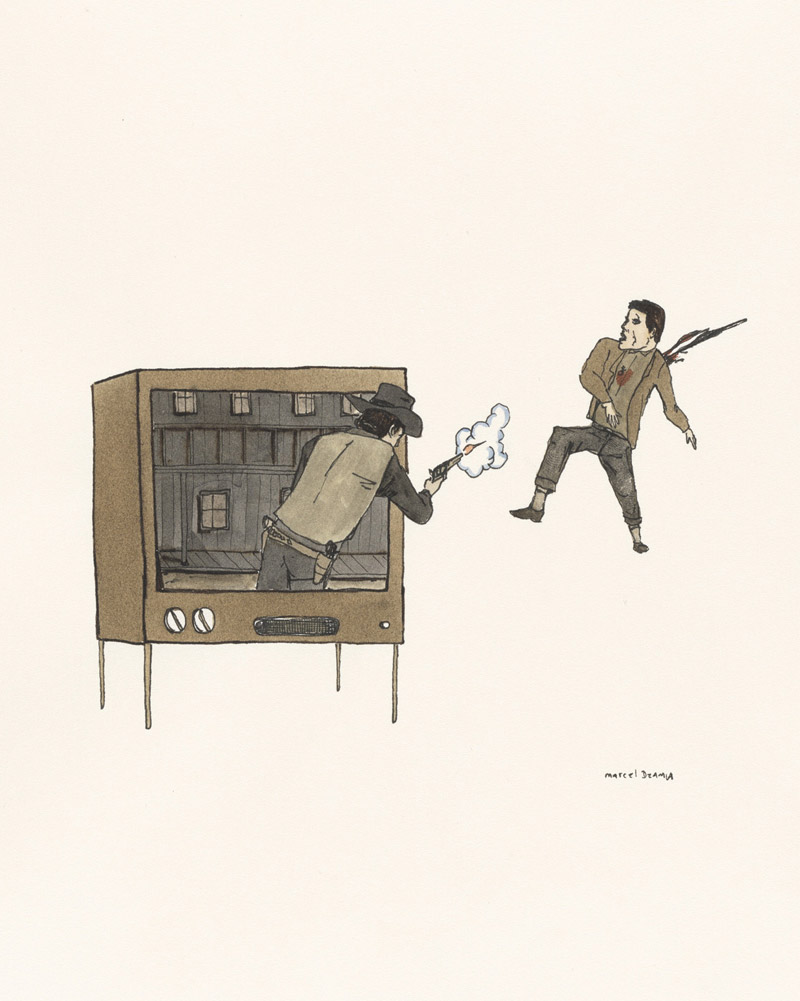
Medium: Ink, watercolor, and root beer concentrate on paper
Size: 12.5 x 10 inches
Collection: Gift of Susan and Arthur Fleischer, Jr., Museum of Modern Art, New York
Visual Signature: Characteristic muted palette, figures against white void, root beer concentrate creating blood-like tones
Significance: Exemplifies early period when root beer concentrate was primary medium for red-brown tones. Demonstrates the economy of means that defines Dzama’s approach. Sparse composition with maximum atmospheric effect.
“Underground” (2004)
Medium: Ink, watercolor, and root beer concentrate on twenty-five pieces of paper
Size: Installation dimensions 28 x 264 inches
Collection: The Judith Rothschild Foundation Contemporary Drawings Collection Gift, Museum of Modern Art, New York
Visual Signature: Large-scale polyptych format, narrative procession across multiple panels
Significance: Major work marking transition from small intimate drawings to expansive multi-panel compositions. Created same year Dzama moved from Winnipeg to New York, reflecting shift in ambition and scale. The horizontal format suggests cinematic storytelling or medieval altarpiece structure.
“A Game of Chess” (2011)
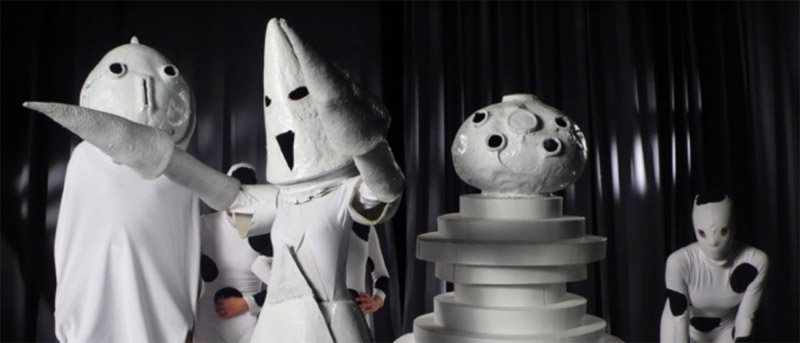
Medium: Video, 35 minutes
Collection: National Gallery of Canada
Visual Signature: Life-size performers in elaborate costumes as chess pieces, surreal choreography, Guadalajara setting
Significance: Major film work directly referencing Marcel Duchamp’s obsession with chess. Expands Dzama’s practice into moving image and performance. Demonstrates ability to translate two-dimensional visual language into three-dimensional choreographed space. Commissioned production showing institutional recognition and expanded resources.
Related Works: This film connects to ongoing interest in game structures, strategy, and ritualized conflict visible throughout drawing practice.
“Une danse des bouffons (A Jester’s Dance)” (2013)
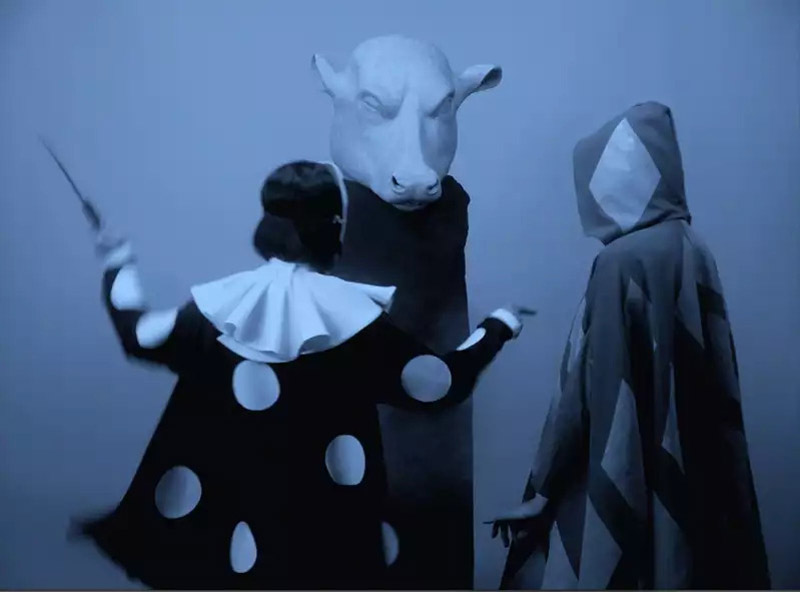
Medium: Film, 35 minutes
Visual Signature: Surrealist aesthetic, elaborate costumes, theatrical staging
Significance: Fictional drama depicting relationship between Marcel Duchamp and Brazilian sculptor Maria Martins. Dzama describes it as a “Dadaist love story” filled with art historical references. Film demonstrates deep engagement with modernist art history and ability to translate these influences into contemporary narrative form.
“Ghost of Canoe Lake” (2023)
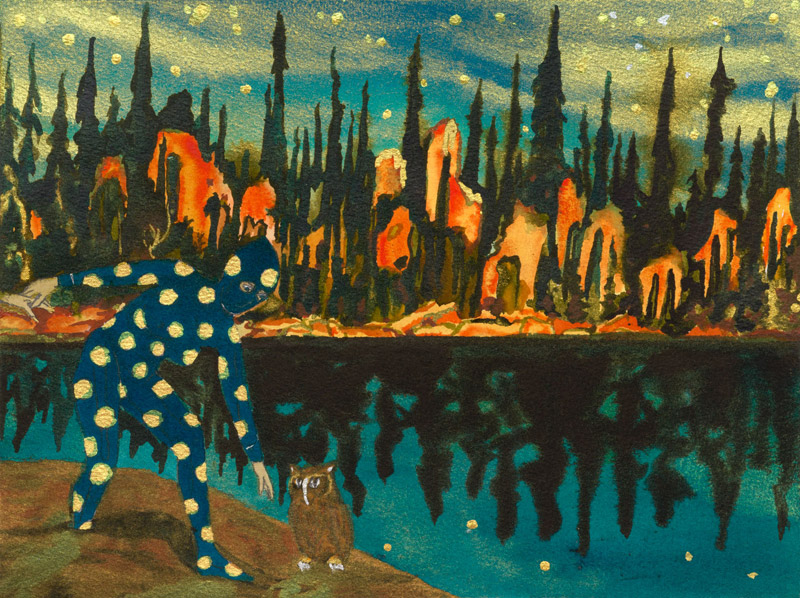
Medium: Pearlescent acrylic, ink, watercolor, and graphite on paper
Size: 36.2 x 36.2 cm
Exhibition: Part of “Ghosts of Canoe Lake” series
Visual Signature: Introduction of pearlescent acrylic creates luminous atmospheric effects, reference to Canadian art history (Tom Thomson’s mysterious death)
Significance: Recent work showing continued evolution. References Group of Seven painter Tom Thomson who drowned under mysterious circumstances in 1917. Connects Dzama’s practice to Canadian cultural mythology and ghost imagery that runs through his work. Exhibited at McMichael Canadian Art Collection, Contemporary Calgary, and Plug In Institute of Contemporary Art (2023-2025).
Exhibitions, Collections, and Provenance
Major Solo Exhibitions
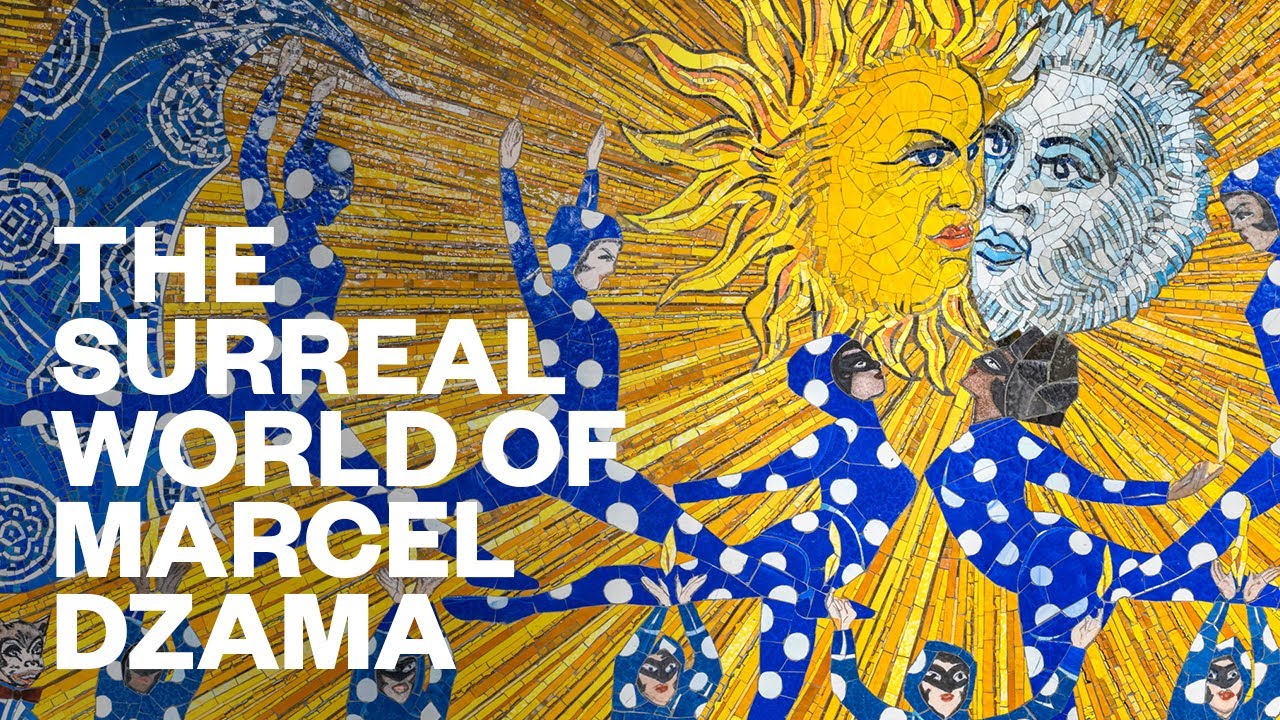
David Zwirner Gallery (Multiple locations, 1998-2025): Fifteen solo exhibitions with primary dealer. Recent shows include “Empress of Night” (Los Angeles, 2025), “Child of Midnight” (London, 2022), “Who Loves the Sun” (New York, 2021).
“Ghosts of Canoe Lake” (2023-2025): McMichael Canadian Art Collection (Kleinburg, Ontario), Contemporary Calgary (Alberta), Plug In Institute of Contemporary Art (Winnipeg). Major touring exhibition examining Canadian identity and mythology.
“Viviendo en el limbo y soñando con el paraíso” (2022): Museo de Arte de Zapopan, Mexico.
“An End to the End Times” (2021): Savannah College of Art and Design Museum of Art, Georgia.
“Tonight We Dance” (2021): Sara Hildén Art Museum, Tampere, Finland.
Musée d’art contemporain de Montréal (2010): Major survey exhibition in home country.
Whitney Biennial (2006): “Down By Law: Day for Night,” Whitney Museum of American Art, New York. Significant early career inclusion in prestigious biennial.
Institutional Collections with Depth
Museum of Modern Art, New York: 34 works online, primarily drawings from Judith Rothschild Foundation Contemporary Drawings Collection.
Tate, United Kingdom: Multiple works spanning career.
Centre Pompidou, Paris: Representation in major European collection.
National Gallery of Canada, Ottawa: Significant holdings including video work “A Game of Chess.”
Art Institute of Chicago: Early recognition with inclusion in “Contemporary American Realist Drawings” (1999).
Dallas Museum of Art, Musée d’art contemporain de Montréal, Museum of Contemporary Art Los Angeles, Solomon R. Guggenheim Museum, Art Gallery of Ontario, Vancouver Art Gallery: All maintain works in permanent collections.
Provenance Patterns
Primary Dealer: David Zwirner Gallery has represented Dzama since 1998, providing consistent market presence and institutional placement.
Secondary Dealers: Sies + Höke (Düsseldorf), Richard Heller Gallery (early career, Santa Monica), Timothy Taylor Gallery (London).
Collector Base: Celebrity collectors including Brad Pitt, Jim Carrey, Steve Martin. Strong institutional collecting from major museums.
Performance and Collaboration Documentation: Performa commissions, New York City Ballet collaborations create documented institutional relationships beyond traditional gallery system.
Market & Reception
Price Ranges by Medium and Period
Works on Paper (Small Scale, 11×14 to 14×17 inches): Early works from late 1990s sold initially for $20-100. Current market for comparable period works ranges $1,000-$5,000 at auction depending on imagery strength and provenance.
Works on Paper (Medium Scale, 18×24 to 24×30 inches): Gallery prices typically $8,000-$25,000 for recent works. Auction results show $3,000-$15,000 realized depending on period and complexity.
Works on Paper (Large Scale, 30×36 inches and above): Gallery pricing $25,000-$75,000. Major works with exhibition history command premium.
Sculptures and Dioramas: Significantly higher pricing due to labor intensity and rarity. “Poison With Self Confidence” (2005, hand-painted cast fiberglass) is representative of three-dimensional work market.
Prints and Multiples: Lithographs in editions of 75-500 range $1,500-$8,000 retail. Limited edition prints provide accessible entry point to market.
Films and Video: Institutional acquisitions rather than private market. “A Game of Chess” acquired by National Gallery of Canada represents institutional collecting pattern.
Authentication Considerations
Works typically signed “Marcel Dzama” in pencil or ink, often lower right but sometimes center or varied positions.
Early works may show different signature styles as artist’s hand evolved. Root beer concentrate medium is distinctive marker for late 1990s through early 2000s period.
David Zwirner Gallery maintains artist records and can provide authentication for works passing through primary market. Certificate of authenticity standard for gallery works.
Critical Reception
Los Angeles Times praised early work as “simultaneously sweet and demented” (1999), encapsulating the dual nature that defines critical response.
Canadian Art magazine called 2013 solo show “quietly terrific,” noting understated power.
Time Out London described 2016 exhibition “Puppets, Pawns and Prophets” as “utterly beguiling.”
Critical consensus recognizes Dzama’s unique position between illustration and fine art, folk vernacular and contemporary practice. Reviews consistently note the tension between innocent appearance and darker subtexts.
Awards and Recognition
Hnatyshyn Foundation Award for Outstanding Achievement (2013, Ottawa): Major Canadian arts prize recognizing sustained excellence.
ARCO Award (2012, Madrid): International recognition at Spanish contemporary art fair.
New Artist Award, Art Cologne (2000): Early career award at major German art fair, signaling international trajectory.
Influence & Legacy
Upstream Influences
Marcel Duchamp: Primary influence. Dzama’s film “Une danse des bouffons” directly addresses Duchamp’s relationship with Maria Martins. Chess imagery throughout work references Duchamp’s obsession. Conceptual approach to art-making and interest in games/systems derives from Duchamp’s example.
Francisco Goya: War imagery, violence suggestion, social commentary. “Grand presentiments of what must come” (2012) directly appropriates Goya composition while translating into Dzama’s visual vocabulary.
Hieronymus Bosch: Hybrid creatures, hellish visions, moral allegory. Dzama’s anthropomorphic figures descend from Bosch’s bestiary.
William Blake: Mystical visions, watercolor technique, integration of text and image.
Francis Picabia: Dada humor, mechanical forms, theatrical staging.
Henry Darger: Obsessive world-building, recurring characters, narrative ambiguity.
Joseph Cornell: Box assemblages, found object poetry, creating self-contained worlds.
Nancy Pukingrnak Aupaluktuq (Canadian Inuit artist): Early influence from Winnipeg Art Gallery collection. Mythological imagery and shamanic transformation visible in Dzama’s anthropomorphic figures.
Downstream Influence
Royal Art Lodge Alumni: The collective model influenced how Canadian artists approach collaboration. Michael Dumontier and Neil Farber continue collaborative practice established in Lodge.
Winnipeg Art Scene: Helped establish Winnipeg as recognized center for contemporary drawing. Younger artists from region cite Royal Art Lodge as formative example.
Illustration and Fine Art Crossover: Dzama’s success at navigating between gallery world and commercial work (album covers, music videos) provided model for artists working across boundaries.
Neo-Folk Art Movement: Part of broader early 2000s trend toward hand-drawn aesthetics and outsider art influence in contemporary practice.
Cross-Domain Echoes
Music: Album cover designs for Beck (“Guero,” 2005), They Might Be Giants (“The Else,” 2007), The Weakerthans (“Reconstruction Site,” 2002). Co-directed music video for Department of Eagles. Art direction for Arcade Fire’s “Scenes From The Suburbs” (2011).
Dance: Costume and set design for New York City Ballet’s “The Most Incredible Thing” (2016) based on Hans Christian Andersen fairy tale. Installation “The tension around which history is built” accompanied performance.
Film and Performance: Collaborations with Spike Jonze, Dave Eggers, Amy Sedaris. 2023 Performa commission “To Live on the Moon (For Lorca)” demonstrates ongoing performance practice.
Publishing: Illustrated monograph “Sower of Discord” (2013) with contributions from Dave Eggers and Spike Jonze. McSweeney’s published “The Berlin Years” (2003) and “The Berliner Ensemble Thanks You All” (2008).
How to Recognize a Marcel Dzama at a Glance

Muted Earth-Tone Palette: If the dominant colors are khaki green, beige, muted brown, washed grey, and occasional deepened red, with minimal bright color, you’re likely looking at Dzama.
White Negative Space: Extensive areas of bare paper serving as active compositional element rather than background. Figures float in undefined void.
Anthropomorphic Characters: Bears in clothing, tree people, bat swarms, hybrid creatures mixing human and animal features.
Masked Figures: Gas masks, theatrical masks, animal heads, partial face coverings appearing frequently.
Theatrical Staging: Figures arranged as if captured mid-performance, often in ballet positions or processional formations.
Small to Medium Scale: Most works on paper range 11×14 inches to 24×30 inches. Larger works exist but intimate scale is typical.
Ink and Watercolor Medium: Works on paper using transparent washes rather than opaque paint. Graphite underdrawing sometimes visible.
Military References: Napoleonic officers, soldiers, weapons held by dancers, authority figures in period costume.
Signature Placement: “Marcel Dzama” typically in pencil, often lower right but varied positions.
Root Beer Concentrate (Early Works): If brownish-red tones have particular quality suggesting dried blood or aged paper, likely late 1990s through early 2000s work using root beer concentrate.
Horizon Dissolution: Lack of ground line or spatial definition. Figures exist without floors, walls, or clear spatial relationships.
Narrative Ambiguity: Scenes suggest stories but resist clear interpretation. Characters engaged in actions whose meaning remains open.
FAQ on Marcel Dzama
Who is Marcel Dzama?
Marcel Dzama is a Canadian contemporary artist born in 1974 in Winnipeg. He’s known for watercolor painting and ink drawings featuring masked figures, anthropomorphic animals, and hybrid creatures in muted earth tones, currently working from Brooklyn.
What is Marcel Dzama’s art style?
Dzama’s style blends surrealism, folk art, and narrative illustration. His work features theatrical staging, restricted palettes of browns and greys, extensive white negative space, and characters that appear childlike yet contain darker subtexts of violence and power.
What techniques does Marcel Dzama use?
Dzama primarily works with watercolor, ink, graphite, and root beer concentrate on paper. He builds tone through layered washes, maintains controlled edges, and leaves significant white space. Recent works incorporate pearlescent acrylic for atmospheric effects.
What is the Royal Art Lodge?
The Royal Art Lodge was a Winnipeg collaborative art collective founded in 1996 by Dzama and fellow University of Manitoba students. Members met weekly to create collaborative drawings combining text and imagery, launching several careers before disbanding in 2008.
What are Marcel Dzama’s most famous works?
Notable works include “A Game of Chess” (2011 video), “Une danse des bouffons” (2013 film), “Underground” (2004 polyptych), and the recent “Ghosts of Canoe Lake” series. His album covers for Beck and They Might Be Giants gained widespread recognition.
Where can I see Marcel Dzama’s artwork?
Dzama’s work appears in major museums including MoMA, Tate, Centre Pompidou, National Gallery of Canada, and Guggenheim. David Zwirner Gallery represents him in New York, Los Angeles, London, Paris, and Hong Kong with regular exhibitions.
Who influenced Marcel Dzama’s art?
Primary influences include Marcel Duchamp, Francisco Goya, Hieronymus Bosch, William Blake, Francis Picabia, and Henry Darger. Canadian Inuit artist Nancy Pukingrnak Aupaluktuq and Winnipeg’s landscape also shaped his visual language.
What themes appear in Marcel Dzama’s work?
Recurring themes include theatrical performance, masked identity, military authority, anthropomorphic transformation, historical violence, and ambiguous sexuality. His work explores power dynamics through characters like Napoleonic officers, ballet dancers with weapons, and hybrid animal-human figures.
How much does Marcel Dzama’s art cost?
Small works on paper (11×14 inches) range $1,000-$5,000 at auction. Medium-scale drawings sell for $8,000-$25,000 through galleries. Large works and sculptures command significantly higher prices. Limited edition prints offer accessible entry at $1,500-$8,000.
Has Marcel Dzama collaborated with musicians?
Yes. Dzama created album covers for Beck’s “Guero,” They Might Be Giants’ “The Else,” and The Weakerthans’ “Reconstruction Site.” He directed music videos and contributed art direction for Arcade Fire’s “Scenes From The Suburbs” short film.
Conclusion
Marcel Dzama occupies a unique position in contemporary art. His instantly recognizable visual language bridges folk vernacular, surrealism, and illustration without settling comfortably into any single category.
From Winnipeg basements to museum collections worldwide, his trajectory demonstrates how consistent vision compounds into cultural significance.
The muted palette hasn’t changed much since the late 1990s. Neither has his interest in masked figures, theatrical staging, or the tension between innocence and violence. This consistency creates a body of work that functions as an interconnected universe rather than discrete pieces.
Whether you encounter his drawings at David Zwirner Gallery, see his films at institutional exhibitions, or spot his album cover designs, you’re entering worlds where narrative logic bends but emotional truth remains. That’s the particular magic of his practice.