Barry McGee is an American contemporary artist known for graffiti, mural painting, and mixed media installations. Born in 1966 in San Francisco, California, he became a central figure in the Mission School art movement during the 1990s.
His work sits at the intersection of street art and fine art. McGee gained international recognition after his inclusion in the 2001 Venice Biennale.
He continues to live and work in San Francisco. His career spans over three decades of drawings, paintings, sculptures, and site-specific installations that address urban life, social inequality, and counterculture.
Identity Snapshot
- Full Name: Barry McGee
- Also Known As: Twist, Ray Fong, Lydia Fong, Bernon Vernon, P.Kin, Ray Virgil
- Born: 1966, San Francisco, California
- Nationality: American (Chinese and Irish descent)
- Primary Roles: Painter, Graffiti Artist, Installation Artist, Printmaker
- Movement: Mission School, Lowbrow Art, Street Art
- Education: BFA in Painting and Printmaking, San Francisco Art Institute (1991)
- Mediums: Acrylic, spray paint, house paint, gouache, found objects, glass bottles
- Signature Traits: Cluster installations, droopy-eyed male caricatures, geometric patterns, paint drips
- Recurring Motifs: Hobos, liquor bottles, flathead screws, vernacular signage
- Geographic Anchors: San Francisco Mission District, Bay Area
- Key Relationships: Margaret Kilgallen (late wife), Clare Rojas (wife), Josh Lazcano (Amaze), Aaron Rose
- Major Collections: SFMOMA, MoMA New York, Walker Art Center, Fondazione Prada, Berkeley Art Museum
- Record Auction: $269,000 (Phillips, 2014)
What Sets Barry McGee Apart
McGee bridges two worlds that rarely mix. He moves from illegal tagging on freight trains to retrospectives at major museums without losing his street credibility.
His approach to painting rejects the clean separation between high art and graffiti. The cluster method, his signature installation technique, packs hundreds of framed works together on walls. It looks chaotic. But there is order underneath.
Where Jean-Michel Basquiat brought raw expressionist energy from the streets into galleries, McGee brings the community. He includes work by friends, family, and unknown taggers alongside his own pieces.
His droopy-eyed characters are instantly recognizable. They reference the unhoused people he sees in San Francisco. The faces appear on canvas, on found bottles, on flattened spray cans picked up at train yards.
McGee uses multiple monikers to separate his styles. Twist for street work. Ray Fong or Lydia Fong for other approaches. This fragmentation of identity mirrors the fractured experience of urban life he depicts.

Origins and Formation
Early Years
McGee grew up in San Francisco with a father who worked at an auto body repair shop. He graduated from El Camino High School in South San Francisco.
The DIY aesthetic started early. He was around cars, paint, industrial materials.
Introduction to Graffiti
At 18, McGee discovered graffiti. He started tagging under the name Twist throughout the streets of San Francisco during the late 1980s.
His early work featured stark black and white imagery. Stylized pictographs. Flathead screw motifs that became his calling card.
Formal Training
He enrolled at the San Francisco Art Institute. There he studied painting and printmaking, graduating in 1991.
The printmaking background shows in his later work. Clean line work and graphic clarity came from those years of technical training.
Early Recognition
In the early 1990s, McGee served as artist in residence at McClymonds High School in Oakland. He received a Eureka Fellowship from the Fleishhacker Foundation in 1993.
The Lila Wallace Readers Digest International Artist Program sent him abroad. A trip to Brazil connected him with OSGEMEOS, starting a lasting friendship.
Movement and Context
The Mission School

The term “Mission School” was coined by journalist Glen Helfand in 2002. It describes a loose group of artists who emerged from San Francisco’s Mission District in the 1990s.
Core members included McGee, Margaret Kilgallen, Chris Johanson, Alicia McCarthy, and Ruby Neri. Many attended the San Francisco Art Institute.
They shared a focus on urban realism filtered through graffiti. Folk art influences. Social commentary on found or recycled materials.
Lowbrow Connection

The Mission School aligns with the larger lowbrow art movement. Both reject the formal pretensions of the contemporary art world.
But McGee is not making ironic pop culture references like Andy Warhol. His subjects are working class. The overlooked. The struggling.
Comparisons to Other Street Artists
Keith Haring used bold lines and cartoon figures to communicate with mass audiences. McGee does something similar but with a more pessimistic edge.
Shepard Fairey leans into propaganda aesthetics and political messaging. McGee is less overt. His critique of consumerism and advertising comes through in the visual clutter itself.
Where Banksy uses stencils for quick, sharp statements, McGee layers complexity. His installations take days or weeks to build inside galleries.
Materials, Techniques, and Process
Supports and Surfaces
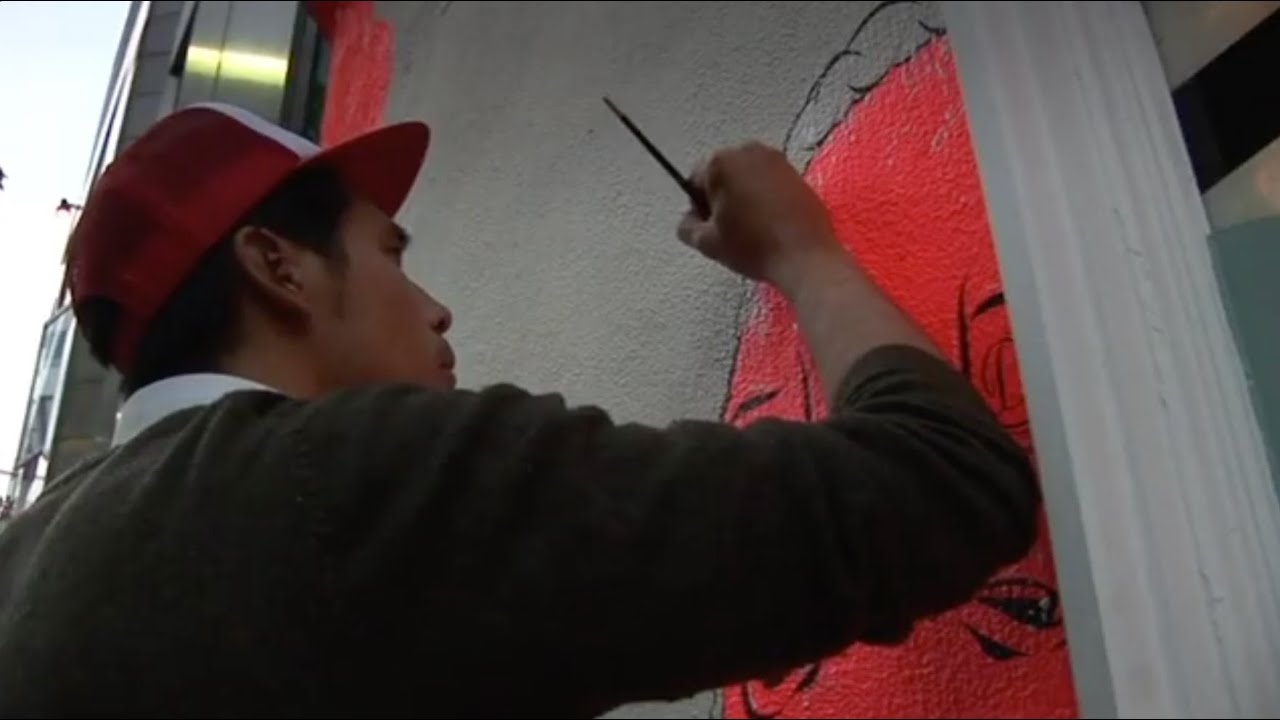
McGee works on canvas, wood panels, found metal, and glass bottles. He paints directly on gallery walls when given the chance.
Painting on wood gives his work a folk art quality. Luan panels are common. So are pieces of scrap plywood.
Paint and Medium
House paint, acrylics, spray paint, and gouache all appear in his work. He uses whatever gets the job done.
The combination of fine brush control and loose spray paint creates visual tension. Tight details next to drippy chaos.
Brushwork and Application
McGee’s figurative work shows careful, painstaking brush control. Fine lines define his characters.
His geometric patterns draw from Islamic tile designs and Op Art. These sections feel almost mechanical in their precision.
Paint drips appear throughout. He popularized this technique in urban-influenced graphic design.
Found Object Integration
Empty liquor bottles become canvases for disembodied faces. Flattened spray cans carry imagery. Wrecked vehicles serve as sculpture.
The texture of these salvaged materials matters. Rust, wear, and history add meaning.
Installation Method
The cluster method defines his gallery presentations. Hundreds of framed works, different sizes, pressed together on walls or around corners.
This approach subverts traditional museum display. Instead of isolated works demanding individual contemplation, McGee creates visual environments.
Collaborative Practice
Josh Lazcano (Amaze) frequently collaborates with McGee. They paint exteriors and interiors of galleries together.
Animatronic mannequins appear in installations. These mechanical figures seem to be tagging gallery walls, blurring the line between documentation and action.
Themes, Subjects, and Iconography
Urban Experience
McGee describes his subject matter as “urban ills, overstimulations, frustrations, addictions and trying to maintain a level head under the constant bombardment of advertising.”
His work critiques gentrification. Commodification. The privatization of public space.
The Droopy-Eyed Figure
His signature character is a male caricature with sagging, tired eyes and a bemused expression. The face appears everywhere in his work.
These figures reference the unhoused. The marginalized. People who live on the streets McGee has been painting since the 1980s.
Working Class Imagery
Hobos and tramps show up frequently. So do references to freight train culture, hobo tags, and the visual language of those who travel by rail.
Vernacular sign painting influences his lettering. Hand-painted typography. The look of old storefronts and advertisements.
Recurring Symbols
Flathead screws. Liquor bottles. Wrenches and tools. Cherries (which McGee says symbolize hope and eternal love).
These objects ground his work in physical reality. They connect abstract patterns to the material world.
Compositional Approach
Central figures dominate abstracted backgrounds. Drips, color fields, and geometric shapes surround them.
The repetition of motifs creates visual rhythm. Same faces appearing dozens of times. Same patterns echoing across multiple panels.
Notable Works
Untitled (Bottles) (2000)

Medium: Painted glass liquor bottles, wire, wood
Description: A large cluster of empty glass liquor bottles, each painted with disembodied faces in McGee’s signature caricature style.
Significance: Exemplifies his found object practice and the transformation of urban detritus into art.
Street Market (2000)

Medium: Mixed media installation
Location: Originally at Deitch Projects, New York
Collaborators: Todd James, Stephen Powers
Description: A large-scale immersive installation recreating the feeling of an urban street environment inside a gallery.
Significance: Brought national attention to the Mission School aesthetic and demonstrated how street art could function in institutional spaces.
Untitled (Screw) (1992)

Medium: Spray paint on wood, 36 x 65 inches
Description: Early work featuring McGee’s flathead screw motif, a signature element from his graffiti days as Twist.
Significance: Represents the transition from street to studio while maintaining his graphic vocabulary.
La Migra (1995)

Medium: Collaboration with Sandow Birk
Auction Record: $193,000 (November 2017), the highest price paid for a McGee work on the secondary market at that time.
Boil Series (2013)

Medium: Mixed media site-specific installation
Description: Three-dimensional sculptures constructed from upwards of 400 individual works. Photographs, doodles, and geometric paintings cluster together, emerging from walls.
Significance: McGee describes these as communities. Small parts coming together to create a larger whole.
Exhibitions, Collections, and Provenance
Major Solo Exhibitions
- 2012-2013: Barry McGee (mid-career retrospective), Berkeley Art Museum and Pacific Film Archive, traveled to ICA Boston
- 2013: FOCUS: Barry McGee, Modern Art Museum of Fort Worth
- 2011: Art in the Streets, MOCA Los Angeles (group exhibition)
- 2007: The Watari Museum of Contemporary Art, Tokyo
- 2002: Fondazione Prada, Milan
- 2001: Venice Biennale (breakthrough international exposure)
- 1999: The Buddy System, Deitch Projects, New York
Significant Group Shows
- 2004: Beautiful Losers, Yerba Buena Center for the Arts (curated by Aaron Rose)
- 2014: Energy That Is All Around: Mission School, Grey Art Gallery, NYU
- 2010: Houston/Bowery Mural, New York (with Josh Lazcano)
Museum Collections
San Francisco Museum of Modern Art. Museum of Modern Art, New York. Berkeley Art Museum and Pacific Film Archive. Walker Art Center, Minneapolis.
Fondazione Prada, Venice. The New Art Gallery, Walsall. Hammer Museum, Los Angeles.
Gallery Representation
Perrotin (Paris, Hong Kong, New York, Tokyo, Seoul). Cheim and Read. Ratio 3, San Francisco. V1 Gallery, Copenhagen.
Market and Reception
Auction Performance
McGee’s market value rose sharply after the 2001 Venice Biennale. Prices can range from a few thousand dollars for works on paper to six figures for major pieces.
Record auction price: $269,000 at Phillips in November 2014. Most works sell between $5,000 and $10,000 at auction.
Price Factors
Medium matters. Paintings on panel command higher prices than prints. Found object sculptures and bottle clusters attract serious collectors.
Provenance from major exhibitions adds value. Work included in the Berkeley retrospective or Venice Biennale carries additional weight.
Authentication Concerns
McGee uses multiple monikers. This can complicate attribution. Work signed Ray Fong or Lydia Fong is still McGee, but buyers need to understand the pseudonym system.
Street work presents challenges. Much of his San Francisco graffiti has been stolen or scavenged. A 64-foot mural was famously stolen from a South of Market building in 1999.
Critical Reception
Julie Caniglia wrote for Artforum in 1998: “Despite its distinctly downer vibe, McGee’s work has a paradoxical yet undeniable vibrancy, a sense of someone who’s found his calling in scavenging, documenting, and bearing witness to the urban wild.”
Critics note tension between his anti-establishment roots and museum success. McGee addresses this directly by including lesser-known artists in his shows.
Influence and Legacy
Upstream Influences
New York subway graffiti from the 1970s and 1980s. Mexican muralists. Bay Area Figurative Movement painters like Richard Diebenkorn.
American folk art and tramp art. Vernacular sign painting. Comics and cartoons.
Downstream Impact
McGee influenced a generation of street artists who followed. He popularized paint drips in urban-influenced graphic design.
The cluster display method changed how artists present work in galleries. It offered an alternative to the white cube isolation of individual pieces.
He was among the first street artists taken seriously by the contemporary museum circuit. This opened doors for others.
Cross-Domain Echoes
Skateboard and surf culture adopted his aesthetic. His work appears on decks, apparel, and in zines connected to those communities.
The Beautiful Losers documentary (2008) featured McGee and helped define the DIY movement for broader audiences. The film traced how artists moved from subculture to mainstream recognition.
Community Building
McGee uses his platform to include others. His retrospectives feature work by family members, friends, and unknown graffiti writers.
This democratic approach sets him apart. Success has not isolated him from the community that shaped his practice.
How to Recognize a Barry McGee at a Glance

- Droopy-eyed male figures with tired, bemused expressions
- Cluster installations with many framed works packed together
- Geometric patterns influenced by Islamic tiles and Op Art
- Paint drips running down from figures and shapes
- Found objects like liquor bottles and spray cans used as surfaces
- Flathead screw motifs from his Twist graffiti days
- Bold, graphic line work with clear contours
- Limited but strong color palette with reds, oranges, greens, pinks
- Vernacular lettering resembling hand-painted signs
- Mixed monikers including Twist, Ray Fong, Lydia Fong, P.Kin
- Wood panel supports with folk art quality
- Urban subject matter addressing homelessness, consumerism, street culture
FAQ on The Barry McGee
Who is Barry McGee?
Barry McGee is an American contemporary artist born in 1966 in San Francisco. He is a pioneer of the Mission School art movement and works across graffiti, mural painting, and mixed media installations.
He studied at the San Francisco Art Institute.
What is Barry McGee known for?
McGee is known for bridging street art and fine art. His cluster installations pack hundreds of framed works together on gallery walls.
His droopy-eyed male caricatures and geometric patterns are instantly recognizable. He also tags under the moniker Twist.
What is the Mission School art movement?
The Mission School emerged from San Francisco’s Mission District in the 1990s. Artists like McGee, Margaret Kilgallen, and Chris Johanson drew from urban realism, graffiti, and folk art traditions.
The movement connects to lowbrow art and DIY culture.
What does Twist mean in relation to Barry McGee?
Twist is McGee’s primary graffiti tag from his street art days in the late 1980s. He also uses other monikers including Ray Fong, Lydia Fong, Bernon Vernon, and P.Kin.
Each name represents different aspects of his practice.
What materials does Barry McGee use in his art?
McGee uses various painting mediums including acrylics, spray paint, house paint, and gouache. He paints on canvas, wood panels, and found objects like liquor bottles and flattened spray cans.
Recycled materials are central to his work.
Where can I see Barry McGee’s artwork?
Major collections include SFMOMA, MoMA New York, Walker Art Center, and Fondazione Prada. Galleries representing him include Perrotin and Cheim and Read.
His public murals appear throughout San Francisco and other cities worldwide.
How much is Barry McGee’s art worth?
Prices range from a few thousand dollars for works on paper to six figures for major paintings. His auction record stands at $269,000 from Phillips in 2014.
Most pieces sell between $5,000 and $10,000.
Was Barry McGee married to Margaret Kilgallen?
Yes. McGee married fellow Mission School artist Margaret Kilgallen in 1999. She died of breast cancer in 2001. They have a daughter named Asha.
McGee later married artist Clare Rojas in 2005.
What is Barry McGee’s signature artistic style?
His style combines bold graphic contour lines with paint drips and geometric patterns. Tired-looking male faces dominate his figurative work.
The visual hierarchy places central characters against abstracted backgrounds of drips and color fields.
Is Barry McGee still making art today?
Yes. McGee continues to live and work in San Francisco. Recent exhibitions include shows at Perrotin Paris (2025), Lehmann Maupin New York (2024), and V1 Gallery Copenhagen.
He remains active in both gallery and street contexts.
Conclusion
Barry McGee remains a defining figure in contemporary street art. His work connects the San Francisco graffiti scene to major museum retrospectives without losing authenticity.
The droopy-eyed characters, bottle installations, and cluster method have influenced a generation of urban artists worldwide.
Few artists move so freely between freight train tags and Fondazione Prada exhibitions. McGee does both.
His DIY aesthetic and working class imagery continue to challenge how galleries display and value art from the streets. The Mission District shaped him. Now his influence reaches far beyond it.