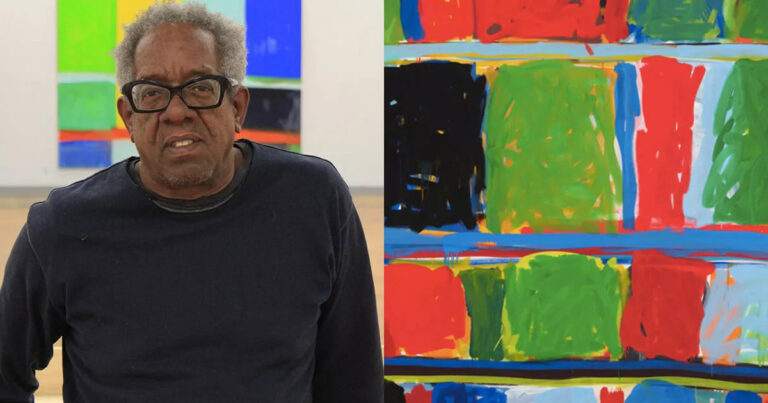
Katherine Bernhardt is a contemporary American painter known for large-scale canvases that merge consumer culture, cartoon characters, and everyday objects into explosive fields of color. Born in 1975 in Clayton, Missouri, she works primarily with acrylic painting and spray paint on canvas.
Her visual vocabulary pulls from pop art sensibilities while drawing on the Pattern and Decoration movement of the 1970s. Pink Panther, E.T., Garfield, toilet paper, cigarettes, tropical fruits. These unlikely combinations sit together on surfaces that reject perspective, atmosphere, and logical scale.
Bernhardt has exhibited globally since the early 2000s. Her works hang in the Hirshhorn Museum, the High Museum of Art, the Carnegie Museum of Art, and the Rubell Museum. She currently lives and works in St. Louis.
Identity Snapshot
Full Name: Katherine Bernhardt
Born: 1975, Clayton, Missouri, USA
Primary Role: Painter
Nationality: American
Movement: Post-Pop, Pattern and Decoration revival, Contemporary Figurative Abstraction
Mediums: Acrylic on canvas, spray paint, monotype prints
Signature Traits: Flat pictorial space, bold Day-Glo palette, dripping thinned-out acrylics, spray paint outlines, deliberate rejection of perspective
Iconography: Pink Panther, E.T., Garfield, cigarettes, toilet paper, tropical fruits, sneakers, Crocs, mushrooms, Pokemon characters
Geographic Anchors: St. Louis (birthplace, current residence), Brooklyn (former studio), Morocco (design influence), Puerto Rico (tropical motifs)
Influences: Henri Matisse, Pattern and Decoration movement, Peter Doig, Chris Ofili, Moroccan rug design
Gallery Representation: David Zwirner (global), Canada Gallery (New York)
Key Collections: Hirshhorn Museum and Sculpture Garden, Carnegie Museum of Art, High Museum of Art, Rubell Museum, Portland Museum of Art, Fondazione Sandretto Re Rebaudengo, The Brant Foundation
Auction Record: Phillips holds world record with “Hawaiian Punch” (2014)
What Sets Katherine Bernhardt Apart
Look, most painters take themselves way too seriously. Bernhardt does not.
She paints what she calls “the dumbest or the funniest painting” she can make. But that looseness is hard-earned. Her canvases feel effortless because she has spent decades perfecting a process that invites accident.
The visual language borrows from Moroccan textile traditions. Flat. Graphic. Two-dimensional. No illusion. No atmospheric depth. Just objects floating in fields of saturated color.
Pink Panther next to plantains. Garfield beside Vaseline. E.T. surrounded by mushrooms.
These combinations sound absurd. They are. That’s the point.
Her approach sits between graffiti mark-making and color field painting. The spray paint outlines recall street art. The staining acrylics nod toward Helen Frankenthaler. Meanwhile, the subject matter pulls straight from childhood nostalgia and consumer packaging.
Bernhardt chronicles contemporary visual culture without intellectualizing it. “The best painters don’t intellectualize their work,” she has said. “They just make stuff.”

Origins and Formation
Early Years
Bernhardt grew up in Clayton, Missouri, a suburb of St. Louis. Art started young. Saturday morning classes at the Saint Louis Art Museum. Painting in her childhood bedroom. Trips to Craft Alliance in the Loop.
She set up still-lifes of Nike shoes as a teenager. Already drawn to commercial imagery.
Formal Training
BFA from the School of the Art Institute of Chicago, 1998. MFA from the School of Visual Arts in New York, 2000.
During grad school, she spent free time visiting galleries obsessively. Interned at Team Gallery on the Lower East Side. They added her to their roster after graduation.
Early Career
The first works that got attention were portraits of fashion models. Kate Moss. Supermodels lifted from Elle and Vogue.
These paintings were deliberately messy. Brusque brushwork. Distorted proportions. The slickness of fashion photography disrupted by raw, gestural handling.
By 2005, she began showing at Canada Gallery in New York. They still represent her today.
The Pattern Shift
Around 2012, the model portraits faded. Pattern paintings emerged.
This shift came partly from her connection to Morocco through her then-husband Youssef Jdia, who worked in the rug trade. She began importing and selling Moroccan rugs through a side business called Magic Flying Carpets.
The graphic language of those textiles seeped into her painting practice. Flat pictorial space. Repeated motifs. No hierarchy between objects.
Movement and Context
Pattern and Decoration Revival

The Pattern and Decoration movement emerged in the mid-1970s as a reaction against Minimalism’s austerity. Artists like Miriam Schapiro and Robert Kushner embraced decorative traditions dismissed by the art establishment.
Bernhardt picks up that thread decades later. Her paintings treat everyday objects with the same formal attention that textile designers bring to fabric patterns.
But she’s not reviving the movement wholesale. She’s filtering it through pop imagery and street art energy.
Comparisons
Critics often place her alongside Keith Haring and Jean-Michel Basquiat for the graffiti-adjacent mark-making. Fair enough. The spray paint outlines read like street art.
But her surfaces differ. Haring’s lines are clean and continuous. Bernhardt’s drip and pool.
She gets compared to KAWS for the cartoon appropriation. Both painters take recognizable characters and run with them. Bernhardt works looser, though. Her Pink Panthers bleed at the edges.
The color sensibility recalls David Hockney’s California pools. Saturated. Joyful. Unapologetically bright.
Philip Guston comes up too. The late work. Cartoon forms rendered with painterly guts.
Position in Contemporary Painting
Bernhardt occupies a sweet spot. She’s accessible without being cheap. Intellectually interesting without being pretentious.
Jerry Saltz called her out in a Vulture piece about women “bad-boy artists” the art world refused to recognize. She paints with the same irreverence as male painters who get celebrated for it.
Materials, Techniques, and Process
Supports
Large-scale canvas. Often 8 to 10 feet or bigger. Some works stretch to 20 feet.
She also works on paper for monotypes and smaller pieces.
Paint Application
The process happens in two stages.
First, she draws on upright canvases with spray paint. Quick outlines. Loose contours.
Then she lays the canvas flat on the studio floor. Acrylic paint gets thinned with water and applied in puddles. It pools. Drips. Bleeds from one form into another.
“I’m really into what the water does,” she has said. “That’s more interesting to me than what I can do, now.”
Palette
Ranges from restrained to vivid Day-Glo. Neon pinks. Electric blues. Hot yellows.
Recent work has explored softer, matte tones. Butter yellow. Pastel mauve. But the saturated color remains her signature.
Brushwork
Utilitarian. She uses mops and standard brushes. Nothing precious.
The marks emphasize speed. Gesture. Accident.
Studio Practice
She works on multiple paintings at once. Moving between canvases while layers dry.
The current studio is a former auto shop in midtown St. Louis. Before that, a car detailing shop in Flatbush, Brooklyn.
Themes, Subjects, and Iconography
Recurring Motifs
The Pink Panther shows up constantly. So does E.T. Garfield. Bart Simpson. Darth Vader. Cookie Monster. Pokemon characters like Pikachu and Ditto.
Everyday objects repeat across canvases: toilet paper rolls, cigarettes, bananas, plantains, watermelons, Crocs, Nike sneakers, mushrooms, coffee makers, tacos, Scotch tape.
She explores each obsession thoroughly before moving on. Mushrooms for a while. Then Pokemon. Now butter and Lucky Charms.
Compositional Approach
Objects scatter across the surface without logical arrangement. No foreground or background. No scale consistency.
A cigarette might be the same size as a shark. Toilet paper rolls float next to cartoon characters. The pattern logic of textiles replaces pictorial hierarchy.
Meaning (or Not)
Critics read environmental commentary into paintings like “Sharks, Toilet Paper and Plantains.” Consumer culture critique. Digital overload.
Bernhardt doesn’t discourage these readings. But she doesn’t confirm them either.
“I look for the most obvious, overlooked things and then make them funny or animated in my paintings.”
The work stays open. You can find deeper meaning if you want. Or just enjoy the colors and shapes.
Notable Works
Hawaiian Punch (2014)

Medium: Acrylic and spray paint on canvas
Significance: Holds the world auction record for Bernhardt at Phillips
Visual Signature: Bright tropical imagery, trademark dripping acrylic pools
XXL Superflat Pancake (2017)

Medium: Mural, acrylic on wall
Dimensions: 60 feet long
Location: Contemporary Art Museum St. Louis
Significance: Major institutional commission in her hometown
Pink Panther + Scotch Tape + Green Plantains (2018)

Medium: Acrylic and spray paint on canvas
Dimensions: 120 x 240 inches
Visual Signature: Monumental scale, the Pink Panther surrounded by mundane objects, signature flat space
99 Cent Hot Dog (2018)

Medium: Mural
Context: Created for “Mickey: The True Original Exhibition” celebrating Mickey Mouse’s 90th anniversary
Imagery: Multiple Mickey and Minnie Mouse figures with hot dogs
Surfing Pikachu (2023)

Medium: Acrylic and spray paint on canvas
Context: Part of the Pokemon series shown at David Zwirner Hong Kong
Visual Signature: The yellow character bursts across the canvas in motion
Butter Butter Butter Butter Butter (2024)

Medium: Acrylic and spray paint on canvas
Context: Part of the “Sidewalk Chalk” exhibition at David Zwirner Los Angeles
Visual Signature: Pink Panther with butter sticks, Lucky Charms marshmallows, softer matte palette
Exhibitions, Collections, and Provenance
Solo Exhibitions (Selected)
2025: “Some of All of My Work” retrospective, Hangaram Art Museum, Seoul Arts Center; “A Match Made in Heaven” (with Jeremy Scott), Nerman Museum of Contemporary Art; “Sidewalk Chalk,” David Zwirner Los Angeles
2023: Pokemon series, David Zwirner Hong Kong
2022: “Why is a mushroom growing in my shower?”, David Zwirner London
2019: “Gold,” Art Omi, Ghent, New York; “Big in Japan!”, NANZUKA, Tokyo
2018: “Watermelon World,” Museo Mario Testino (MATE), Lima, Peru
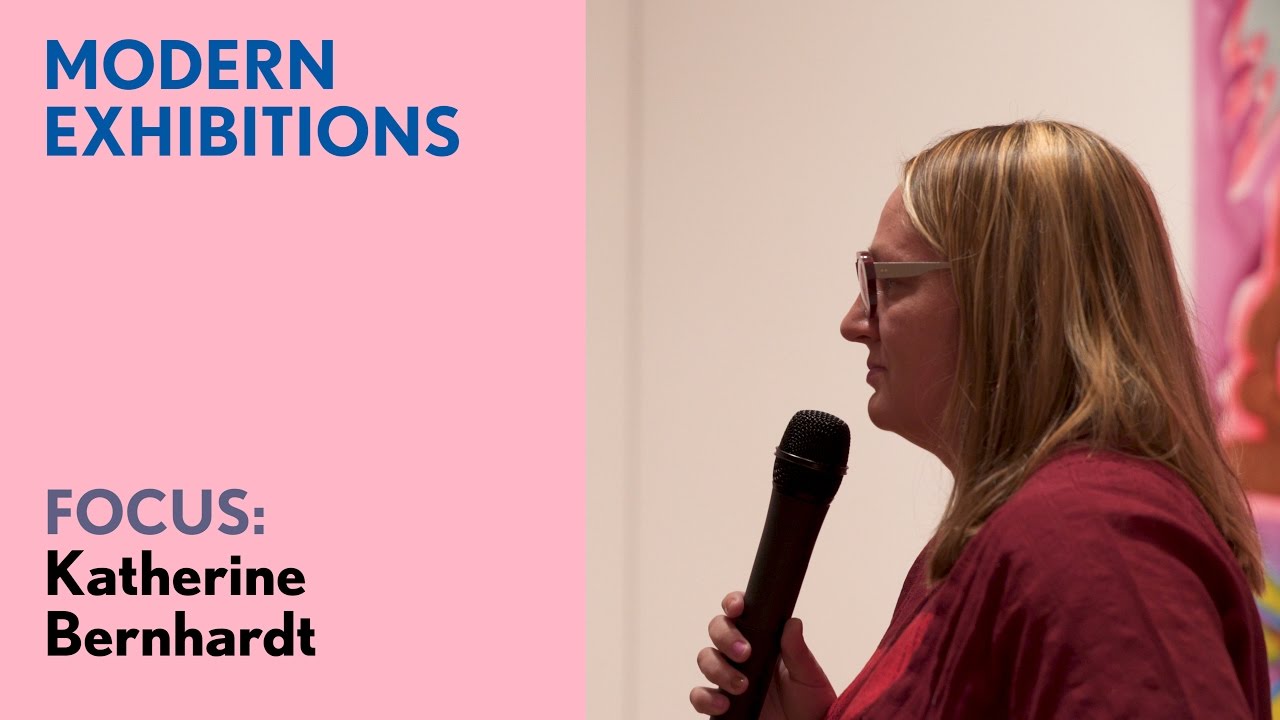
2017: “FOCUS: Katherine Bernhardt,” Modern Art Museum of Fort Worth
Permanent Installations
Club Caribe, Cidra, Puerto Rico (2015)
Pool painting, Nautilus South Beach, Miami Beach (2015)
Major Collections
Hirshhorn Museum and Sculpture Garden, Washington, D.C.
Carnegie Museum of Art, Pittsburgh
High Museum of Art, Atlanta
Rubell Museum, Miami
Portland Museum of Art, Maine
The Brant Foundation, New York
Fondazione Sandretto Re Rebaudengo, Turin
San Antonio Museum of Art, Texas
Knoxville Museum of Art, Tennessee
Market and Reception
Gallery Representation
David Zwirner announced global representation in July 2021, partnering with her longtime gallery Canada. This was a significant step up.
Before Zwirner, average auction price sat around $49,000. After the announcement, it jumped to $124,000.
Auction Performance
Phillips holds the world record with “Hawaiian Punch” (2014).
Her auction sales doubled every year from 2018 to 2022. In 2020, despite pandemic disruptions, annual auction total reached $770,016. By 2021, it hit $1.8 million.
Sell-through rate hovers around 33%. Price bands vary widely depending on size, period, and subject matter. Pink Panther works command premiums.
Critical Reception
Mostly positive. Roberta Smith reviewed her favorably in The New York Times. Jerry Saltz has championed her work.
A few critics have pushed back. Hyperallergic called some work “complacent.” Flash Art described it as “merely retinal.”
But the consensus? She’s a legitimate voice in contemporary painting. An “artist’s artist” admired by peers.
Influence and Legacy
Upstream Influences
Henri Matisse’s color fields and flat compositions. The Pattern and Decoration movement’s embrace of decorative traditions.
Moroccan rug design. West African Dutch wax fabrics. Graffiti culture. Philip Guston’s late cartoon forms.
Contemporary peers like Peter Doig and Chris Ofili.
Downstream Impact
Bernhardt helped legitimize a looser, more playful approach to figurative painting in the 2010s. Her success opened doors for painters working with pop imagery and maximalist color.
She proved you could make serious work that doesn’t take itself too seriously.
Cross-Domain Connections
Fashion collaborations with W Magazine, Chanel, and Miss Sixty. She contributed to Drake-inspired artwork for W Magazine’s 2015 Art Issue.
The Smith House in St. Louis, her current residence, has become a kind of living artwork. The 1984 Memphis-style home (designed by Gary Glenn and Marcia Smith) appeared in a Nelly music video. Bernhardt treats it as an extension of her practice.
She runs Magic Flying Carpet, an alternative exhibition space in St. Louis, and imports Moroccan rugs on the side.
How to Recognize a Katherine Bernhardt at a Glance

Flat pictorial space. No depth. No atmosphere. Objects exist on the same plane.
Spray paint outlines. Loose, drippy contours around forms.
Pooling, staining acrylics. Paint thinned with water. Colors bleed into each other.
Day-Glo palette. Neon pinks, electric blues, hot yellows. Though recent work includes softer pastels.
Cartoon characters. Pink Panther, E.T., Garfield, Pokemon. Usually rendered loose and drippy.
Everyday objects. Toilet paper, cigarettes, bananas, Crocs, sneakers. Scattered without hierarchy.
Large scale. Most major works run 8 to 20 feet wide.
No perspective or logical scale. A cigarette can be the same size as a shark.
Repetition of motifs. Objects repeat across the surface like textile patterns.
Speed and gesture. The marks look fast. Utilitarian brushwork. Nothing precious.
FAQ on Katherine Bernhardt
Who is Katherine Bernhardt?
Katherine Bernhardt is a contemporary American painter born in 1975 in Clayton, Missouri. She creates large-scale canvases featuring pop culture icons and everyday objects. Her bold color palette and flat compositions have made her one of the most recognized painters working today.
What is Katherine Bernhardt known for?
She’s known for vibrant pattern paintings that combine cartoon characters like the Pink Panther, E.T., and Garfield with mundane objects. Toilet paper, cigarettes, tropical fruits, and sneakers scatter across her canvases in fields of saturated color.
What art movement does Katherine Bernhardt belong to?
Bernhardt draws from the Pattern and Decoration movement of the 1970s while incorporating post-pop sensibilities. Her work sits between expressionism and figurative abstraction. Critics often connect her to street art and color field traditions.
How much are Katherine Bernhardt paintings worth?
Prices vary widely by size and subject. Auction averages jumped from $49,000 to $124,000 after David Zwirner began representing her in 2021. Phillips holds the world record with “Hawaiian Punch” (2014). Pink Panther works command premiums.
What galleries represent Katherine Bernhardt?
David Zwirner represents her globally since 2021. Canada Gallery in New York has shown her work since 2005. She has also exhibited at Xavier Hufkens in Brussels, Carl Freedman Gallery in London, and Venus Over Manhattan.
What cartoon characters does Katherine Bernhardt paint?
The Pink Panther appears most frequently. E.T., Garfield, Bart Simpson, Cookie Monster, Darth Vader, and Pokemon characters like Pikachu also show up. She explores each obsession thoroughly before moving to the next subject.
What is Katherine Bernhardt’s painting process?
She first draws on upright canvases with spray paint. Then she lays them flat and applies thinned acrylic that pools and drips. Water does much of the work. She moves between multiple paintings at once, inviting accident into the process.
Where can I see Katherine Bernhardt’s art in museums?
Her work hangs in the Hirshhorn Museum, Carnegie Museum of Art, High Museum of Art, Rubell Museum, and Portland Museum of Art. The Contemporary Art Museum St. Louis holds a 60-foot mural. The Brant Foundation also owns pieces.
What influences Katherine Bernhardt’s style?
Moroccan rug design shapes her flat, graphic compositions. She cites Picasso’s peer Henri Matisse, Philip Guston, Peter Doig, and Chris Ofili as influences. West African Dutch wax fabrics and graffiti culture also inform her visual language.
Where does Katherine Bernhardt live and work?
She currently lives in St. Louis, Missouri, in the Smith House, a Memphis-style home from 1984. Her studio occupies a former auto shop in midtown. She previously worked from a car detailing shop in Brooklyn’s Flatbush neighborhood.
Conclusion
Katherine Bernhardt has built a career by refusing to take painting too seriously. That approach works. Her large-scale canvases hang in major museums from the Hirshhorn to the Fondazione Sandretto Re Rebaudengo.
The spray paint outlines. The pooling acrylics. The cartoon characters next to consumer products. It all comes together in a maximalist aesthetic that feels both playful and deliberate.
She proves that gestural painting can still surprise. That texture and surface matter as much as concept.
Whether you see commentary on consumer culture or just enjoy the bold color palette, her work commands attention. And the art market has noticed.