A woman’s face emerges in stark black and white, red lips the only concession to color. You’ve seen this image before, even if you don’t know the name behind it.
Patrick Nagel transformed commercial illustration into an iconic 1980s visual language. His sleek, angular portraits of confident women appeared everywhere from Playboy magazine to Duran Duran’s Rio album cover, yet he remained largely anonymous despite creating some of the era’s most recognizable imagery.
This commercial artist died at 38, leaving behind a body of work that defined an entire decade’s aesthetic.
His distinctive style combined Art Deco simplicity with pop art sensibility, creating images that still resonate decades later. From his training and technique to his influence on contemporary design, understanding Nagel means understanding how commercial art can become cultural touchstone.
His legacy deserves recognition beyond nostalgia.
Identity Snapshot
Patrick Nagel (November 25, 1945 – February 4, 1984)
Primary roles: Painter, Illustrator, Graphic Designer, Commercial Artist
Nationality: American
Movements: Pop Art, Art Deco Revival, Commercial Illustration
Mediums: Acrylic on canvas, ink and gouache on board, serigraph
Signature traits: Angular geometric figures, hard-edge linework, flat color application, limited palette (black, white, red, occasional accent colors), high contrast imagery
Iconography: Stylized female portraits, almond-shaped eyes, jet-black hair, pale skin, red lipstick, confident poses
Geographic anchors: Dayton, Ohio (birthplace), Los Angeles, California (primary studio location)
Training: Chouinard Art Institute, California State University Fullerton (BFA, 1969)
Key associations: Playboy magazine (1975-1984), Mirage Editions (publisher), Duran Duran (Rio album cover)
Collections: Museum of Modern Art (MoMA), Library of Congress, Smithsonian Institution, Grunwald Center for the Graphic Arts at UCLA, Musée des Arts Decoratifs (Paris), Musée de L’Affiche (Paris)
Market signals: Original canvas paintings $100,000-$350,000; limited edition serigraphs $2,000-$15,000; created approximately 285 Playboy illustrations, 80 paintings, 15 commemorative poster series
What Sets Patrick Nagel Apart

Nagel stripped commercial illustration down to knife-edge precision.
His stylized female portraits combined Art Deco’s geometric simplicity with pop art‘s graphic punch. The result was distinctly 1980s but borrowed from Japanese ukiyo-e prints and fashion photography. While contemporaries like Andy Warhol worked in silk-screened celebrity faces and Roy Lichtenstein appropriated comic book dots, Nagel created an entirely new female archetype.
His “Nagel Woman” became shorthand for glossy materialism and sexual confidence.
Bold black line defined everything. Flat planes of color created form without modeling. White skin, black hair, red lips repeated like a mantra across 285 Playboy illustrations and countless serigraphs.
The absence of background detail forced attention to facial geometry and body posture.
Origins & Formation
Early Years (1945-1969)
Born in Dayton, Ohio, Nagel moved to Los Angeles as a child. The California aesthetic saturated his formative years.
After serving with the 101st Airborne Division in Vietnam, he enrolled at Chouinard Art Institute in 1969. Same year, he earned his BFA from California State University, Fullerton, studying painting and graphic design. His military mapmaking experience likely influenced his later use of high contrast and simplified forms.
Professional Launch (1971-1975)
In 1971, ABC Television hired Nagel as a graphic designer for promotions and news broadcasts. He left after a year to freelance for major corporations.
Early clients included IBM, Intel, Universal Studios, MGM, United Artists, Architectural Digest, Rolling Stone, and Harper’s.
His commercial work refined his ability to distill complex images into clean, reproducible graphics. Fashion photography became his primary source material. He’d photograph models, sketch simplified versions, then paint in acrylic painting with minimal detail.
Breakthrough (1975-1977)
August 1975 marked Nagel’s first Playboy illustration.
The magazine gave him specific prompts initially. By 1977-1978, his popularity earned him creative freedom. One Nagel illustration appeared in every Playboy issue from August 1975 through July 1984, mostly in Playboy Advisor, Playboy Forum, and Playboy After Hours columns.
In 1977, Mirage Editions published his first poster. The partnership launched the “Nagel woman” into poster art history.
Movement & Context
Art Deco Revival

Nagel’s work arrived during the early 1980s Art Deco resurgence.
While the 1920s-1930s style emphasized ornamental luxury, Nagel stripped it to bare geometry. His aesthetic shared DNA with Tamara de Lempicka’s streamlined figures but pushed further into abstraction. Where de Lempicka used soft modeling and atmospheric perspective, Nagel eliminated depth entirely.
Pop Art Connections

Nagel’s commercial illustration origins aligned him with pop art principles without fully joining the movement.
Andy Warhol celebrated consumer culture through repetition and celebrity worship. Warhol’s Marilyn series used photographic screen printing with visible registration marks. Nagel worked from photos but hand-painted everything, then reproduced through serigraph.
Roy Lichtenstein appropriated comic book aesthetics with Ben-Day dots and thought bubbles. Nagel borrowed the bold line quality but invented his own visual language rather than copying existing commercial art.
Comparison to Contemporaries
vs. Warhol: Both worked with idealized beauty and commercial distribution. Warhol embraced imperfection and mechanical reproduction marks. Nagel pursued flawless execution with crisp edges and perfect registration.
vs. Lichtenstein: Both used hard-edge graphics and primary colors. Lichtenstein referenced existing comic panels. Nagel created original compositions from photographic sources.
vs. Keith Haring: Contemporary timing (both peaked in early 1980s). Keith Haring used energetic, continuous lines and cartoon figuration. Nagel’s work was cool, calculated, and sexually sophisticated where Haring was playful and socially activist.
Materials, Techniques, and Process
Supports
Canvas: Stretched canvas for original paintings, typically 40 x 25 inches or similar vertical formats
Board: Illustration board for magazine work, standard sizes 20 x 15 inches
Paper: High-quality paper for serigraphs, various poster dimensions
Paint Application
Primary medium: Acrylic painting on canvas for originals
Magazine work: Ink and gouache on board, occasionally with airbrush for gradations
Palette: Severely restricted. Black (hair, outlines), white (skin), red (lips, occasional accents), with sparse use of additional hues like turquoise, magenta, or yellow for clothing or backgrounds.
No earth tones. No warm browns or ochres. His color theory emphasized cool neutrals punctuated by saturated accents.
Technical Process
Step 1: Photograph models in various poses, often sourced from fashion magazines (Vogue, Harper’s Bazaar) or commissioned shoots
Step 2: Create simplified pencil sketches, removing detail and reducing forms to essential contours
Step 3: Transfer sketch to canvas or board through tracing or freehand redrawing
Step 4: Paint in flat, opaque color areas with hard edges. No blending, no gradation, no visible brushwork. The surface appeared almost airbrushed in its smoothness despite being hand-painted.
Step 5: Define all forms with bold black line work, creating graphic separation between color zones
Brushwork Characteristics
Nagel’s technique eliminated traditional painterly qualities.
No impasto. No visible brushstrokes. No texture variation. He applied paint in thin, even layers that dried to matte finish. The goal was graphic perfection, not painterly expression.
Some works incorporated subtle airbrush effects for background gradations, but figures remained hard-edged throughout.
Edge Control
Every edge was decisive. No soft transitions, no sfumato, no atmospheric blur. This hard-edge approach derived from his graphic design training and commercial art requirements.
Crisp boundaries between color zones created the signature Nagel look. White skin met black hair with razor precision. Red lips defined themselves against pale faces without modeling or highlights.
Themes, Subjects, and Iconography
The Nagel Woman

Nagel’s defining subject was the idealized female figure.
Physical attributes: Jet-black hair (usually angular bob or swept geometric style), ghostly pale skin, bright red lipstick, almond-shaped eyes, sharp facial planes, elongated neck, confident posture
Psychological presence: Aloof, sexually confident, emotionally distant, materially aspirational. These women gazed directly at viewers or looked away with calculated indifference.
Clothing: Often minimal or stylized. Open jackets, off-shoulder tops, bold accessories. Fashion elements simplified to geometric shapes.
Compositional Schemes
Cropped framing: Figures often cut off at shoulders, chest, or waist. Tight cropping created immediacy and graphic impact.
Flat backgrounds: Solid colors or minimal geometric shapes. No environmental context. The figure existed in abstract space.
Angular geometry: Diagonal lines in hair, clothing, and body positioning created dynamic visual hierarchy.
Negative space: Large areas of flat color or white provided breathing room around intricate figure detail.
Cultural Context
Nagel’s women embodied 1980s aspirational femininity.
This was post-feminist sexual confidence filtered through consumer culture. His models projected power through beauty and style rather than traditional domesticity or professional achievement.
The images aligned with Reagan-era materialism, MTV aesthetics, and the rise of style magazines. They represented desire as commodity and beauty as achievement.
Critics noted the work captured “1980s American desire, collective materialistic aspiration, a Less than Zero state of mind” (artist Alex Israel).
Notable Works
Rio Album Cover (1982)

Medium: Acrylic on canvas
Current location: Original painting private collection; lithograph in MoMA permanent collection
Visual signature: Woman’s face in profile with red, black, and white palette. Bold magenta background. Model identified as Marcie Hunt from Vogue Paris 1981 issue.
Why it matters: Became one of the most recognized album covers of all time. Duran Duran’s Rio went platinum, plastering Nagel’s aesthetic across millions of homes. The image defined 1980s pop culture visual language.
Designer collaboration: Malcolm Garrett designed overall package incorporating Nagel’s painting.
Joan Collins Portrait (1982)

Medium: Acrylic on canvas
Commissioned work: Celebrity portrait that sold immediately
Visual signature: Collins’ distinctive features rendered in Nagel’s geometric style while maintaining recognizable likeness
Jeana (1983)

Medium: Acrylic on canvas, 40 x 25 inches
Current location: Private collection
Market significance: Sold for $350,000 at Heritage Auctions in 2020, setting Nagel’s auction record
Visual signature: Classic Nagel woman with black hair, pale skin, confident gaze
Playboy Illustrations (1975-1984)

Total output: Approximately 285 illustrations
Medium: Ink and gouache on board, typically 20 x 15 inches
Publication: Monthly appearances in Playboy Advisor, Playboy Forum, Playboy After Hours columns
Why they matter: Extended Nagel’s reach to millions of readers monthly. The consistency across nine years refined and codified the “Nagel woman” aesthetic.
Commemorative Series (1984-1990)

Format: Serigraph prints published by Mirage Editions
Count: 15 numbered designs (NC01-NC15)
Edition sizes: Typically 5,000 copies per design
Dimensions: Various, commonly 24 x 36 inches
Why they matter: Posthumous releases that sustained Nagel’s market presence. High-quality silk-screen printing maintained his exacting standards.
Exhibitions, Collections, and Provenance
Major Museum Holdings
Museum of Modern Art (MoMA): Rio album cover lithograph in permanent collection
Library of Congress: Poster collection with multiple Nagel serigraphs
Smithsonian Institution: Permanent collection holdings
Grunwald Center for the Graphic Arts (UCLA): Significant poster collection
Musée des Arts Decoratifs (Paris): European representation of American commercial illustration
Musée de L’Affiche (Paris): Poster art collection
Exhibition History

First solo exhibition: Complete sellout in 15 minutes, early 1980s
Posthumous exhibitions: Park South Gallery (New Mexico), Gallery 30 South, various commercial galleries
Recent museum attention: Growing recognition of Nagel’s influence on 1980s visual culture and commercial illustration
Key Publishers and Dealers
Mirage Editions: Primary publisher of Nagel’s poster work from 1977 onward. Founded by Karl Bornstein, published most of the artist’s limited edition serigraphs. Master printer Jeff Wasserman handled technical execution.
Playboy Enterprises: Largest commissioner of original illustrations, 1975-1984
Park West Gallery: Major secondary market dealer
Notable Private Collections
Hugh Hefner assembled the largest private Nagel collection, displayed at the Playboy Mansion. Included original paintings and comprehensive illustration archive.
Celebrity collectors included Joan Collins, David Copperfield, and numerous 1980s entertainment figures.
Cataloging Issues
No official catalogue raisonné exists.
Authentication relies on signature style (loose, widely-spaced letters spelling “Nagel”), provenance documentation, and comparison to known works. The Nagel estate, managed initially by widow Jennifer Dumas, licensed reproductions but comprehensive cataloging remained incomplete.
Market & Reception
Auction Records
Record price: $350,000 for “Jeana” (1983), Heritage Auctions, 2020
Original paintings: Generally $100,000-$350,000 depending on size, subject, and provenance
Original illustrations (board): $6,000-$50,000 for Playboy magazine originals
Limited edition serigraphs: $2,000-$15,000 depending on edition number and condition
Commemorative posters: $500-$3,000 for numbered editions in good condition
Market Trends
1980s peak: Nagel’s work sold rapidly during his lifetime. First solo show sold out in 15 minutes.
Post-death boom (1984-1990): Mirage Editions continued releasing commemorative series. Prices remained strong through nostalgia and cultural moment documentation.
1990s-2000s decline: Work fell out of fashion as 1980s aesthetics became dated. Market softened significantly.
2010s-present resurgence: Renewed interest from millennials and Gen-X collectors nostalgic for 1980s culture. Collaborations with Forever 21 (2020) and other brands brought renewed attention. Contemporary artists and designers reference Nagel’s visual language.
Authentication Challenges
Signature verification: Nagel signed originals with characteristic loose lettering. Forgeries often show tighter, more conventional signatures.
Reproduction confusion: Thousands of unlicensed reproductions flooded strip malls, hair salons, and poster shops after Nagel’s death. These lack edition numbers, proper paper quality, and registration precision.
Condition issues: Many serigraphs suffered from improper storage, fading, or frame damage. Pristine examples command premium prices.
Influence & Legacy
Upstream Influences
Japanese woodblock prints: Nagel acknowledged ukiyo-e influence, particularly Kitagawa Utamaro’s bijin-ga (beautiful person pictures). Flat color planes, bold outlines, simplified forms, and emphasis on feminine beauty all derive from this tradition.
Art Deco: 1920s-1930s poster artists like A.M. Cassandre, Ludwig Hohlwein, and Alphonse Mucha informed Nagel’s geometric simplification and commercial application.
Pre-Raphaelite painters: Nagel cited this influence though it’s less visually obvious. Perhaps the idealization of feminine beauty and emphasis on hair as decorative element connects the movements.
Fashion photography: Direct source material. Nagel’s process began with fashion magazine spreads from Vogue, Harper’s Bazaar, and similar publications.
Toulouse-Lautrec and Pierre Bonnard: Poster masters who also drew from Japanese prints. Nagel continued their tradition of commercial art as fine art.
Downstream Influence
Contemporary illustration: Nagel’s graphic approach influenced generations of commercial illustrators, particularly in entertainment and fashion industries.
Animation and design: Recent television shows and animated series reference Nagel’s visual language. The flat, geometric female figure appears in contemporary motion graphics.
Street art and pop culture: Artists like [Shepard Fairey](https://www.shepardfa irey.com/) and others working in graphic illustration acknowledge Nagel’s influence on bold, reproducible imagery.
Album cover design: The Rio cover’s success established Nagel’s template for music industry visual branding.
Fashion and merchandise: Nagel’s images appear on contemporary streetwear, gallery prints, and design objects. Forever 21’s 2020 collection brought his work to new audiences.
Contemporary Artists Influenced
Alex Israel: Los Angeles conceptual artist hired by Duran Duran to create Paper Gods (2015) album art that visually references Rio cover
Modern commercial illustrators: Countless graphic designers and digital artists working in fashion, entertainment, and advertising draw from Nagel’s minimalist approach
Digital artists: Vector-based illustration owes debt to Nagel’s hard-edge precision and simplified forms
Cross-Domain Impact
Music videos: MTV-era aesthetics borrowed Nagel’s high-contrast graphics and stylized figures
Fashion design: 1980s clothing and accessories referenced Nagel’s angular geometric patterns
Interior design: Nagel prints became ubiquitous in 1980s homes, defining period aesthetic
Graphic design: Corporate identity and advertising adopted Nagel’s clean, reproducible style
How to Recognize a Patrick Nagel at a Glance
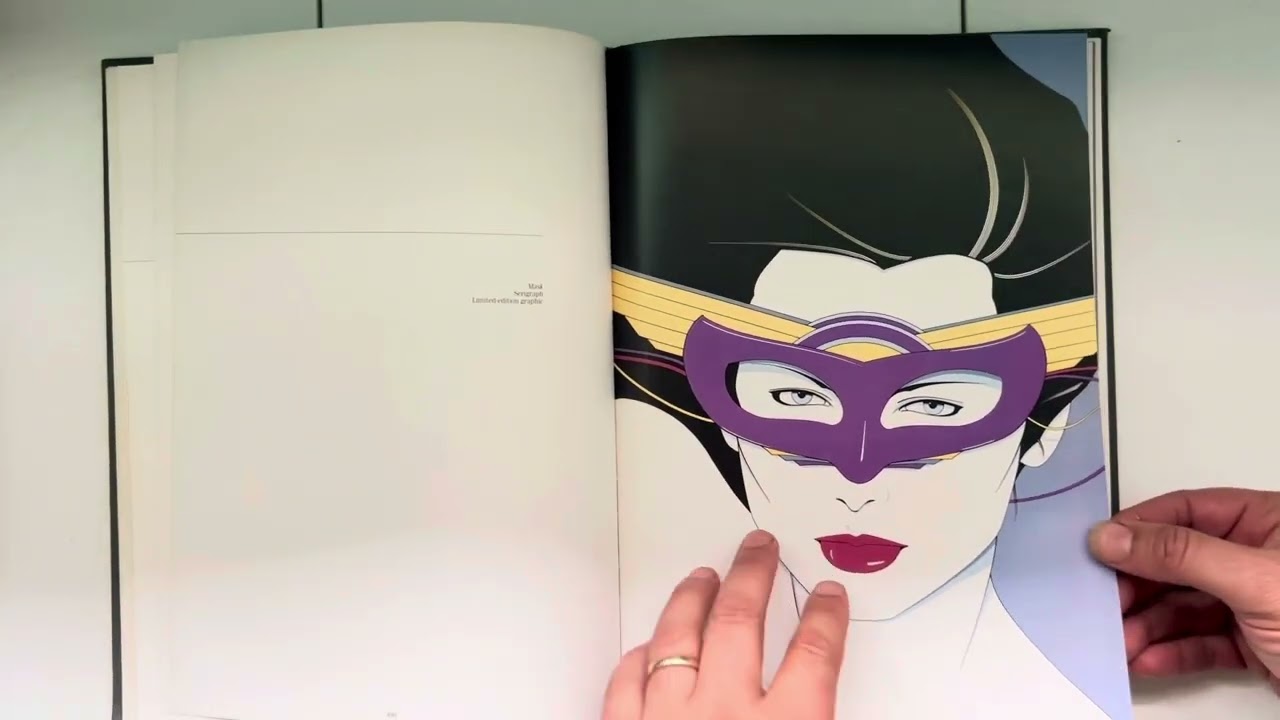
Diagnostic checklist:
- Hard-edge line work: Every boundary between color zones is razor-sharp, no soft edges or blending
- Severely limited palette: Predominantly black, white, and red, with occasional accent colors
- Flat color application: No visible brushstrokes, no texture, no impasto
- Geometric hair design: Angular black hair styled in sharp planes and curves
- Ghostly white skin: No modeling, no shading, pure flat white representing flesh
- Almond-shaped eyes: Distinctive eye shape, often with heavy eyeliner
- Red lipstick: Bright, flat red lips without dimensional modeling
- Cropped composition: Figures often cut off at shoulders or mid-torso
- Minimal or absent background: Solid colors or simple geometric shapes, no environmental detail
- Vertical format preference: Most works taller than wide, emphasizing elongated figures
- Signature placement: Lower right or left corner, loose widely-spaced letters spelling “NAGEL”
- Confident female poses: Subjects project sexual confidence and emotional distance
- Fashion-forward styling: Contemporary (to 1980s) clothing and accessories rendered as geometric shapes
- High contrast values: Stark black against white with no intermediate grays unless intentional accent
- Clean registration: In serigraphs, perfect alignment of color layers with no visible overlap or gaps
Common size formats:
- Original paintings: 40 x 25 inches, 30 x 24 inches, and similar vertical rectangles
- Magazine illustrations: 20 x 15 inches on board
- Serigraph posters: 24 x 36 inches, 27 x 20 inches, and similar poster dimensions
Material clues:
- Originals show matte acrylic surface with no gloss
- Authentic serigraphs display silk-screen texture under magnification
- Paper quality on legitimate prints significantly exceeds mass-market reproductions
- Edition numbers and proper printing credits appear on authentic limited editions
FAQ on Patrick Nagel
Who was Patrick Nagel?
Patrick Nagel was an American illustrator and painter who created distinctive Art Deco-inspired portraits of women. He gained fame through Playboy magazine illustrations and designing Duran Duran’s Rio album cover before his sudden death in 1984.
What is Patrick Nagel’s art style called?
Nagel’s style blends Art Deco revival with pop art aesthetics. His work features geometric simplification, hard-edge graphics, limited color palettes, and stylized female figures with angular features and high contrast imagery.
How did Patrick Nagel die?
Nagel died from a heart attack on February 4, 1984, after participating in a 15-minute celebrity aerobathon charity event. An autopsy revealed he had an undiagnosed congenital heart defect. He was 38 years old.
What is a Nagel woman?
The “Nagel woman” describes his signature stylized female portraits featuring jet-black angular hair, ghostly pale skin, red lipstick, almond-shaped eyes, and confident poses. These images became iconic representations of 1980s feminine beauty and materialism.
How much are Patrick Nagel prints worth?
Original Nagel paintings sell for $100,000-$350,000 at auction. Limited edition serigraphs range from $2,000-$15,000. His record auction price reached $350,000 for “Jeana” in 2020. Unlicensed reproductions hold minimal value.
Did Patrick Nagel work for Playboy?
Yes. Nagel contributed approximately 285 illustrations to Playboy magazine between August 1975 and July 1984. At least one of his paintings appeared in every monthly issue, primarily in the Playboy Advisor and Forum columns.
What technique did Patrick Nagel use?
Nagel photographed models, created simplified sketches, then painted in flat acrylic painting with hard edges. He used ink and gouache on board for magazine work. His process eliminated visible brushstrokes, creating graphic precision through minimal color palettes.
Where can I see Patrick Nagel’s art?
Nagel’s work appears in the Museum of Modern Art, Library of Congress, Smithsonian Institution, and Grunwald Center at UCLA. The Musée des Arts Decoratifs in Paris also holds his pieces. Private collections contain most original paintings.
Who influenced Patrick Nagel’s style?
Japanese ukiyo-e woodblock prints, particularly Kitagawa Utamaro’s bijin-ga, influenced Nagel’s flat color planes and bold outlines. Art Deco poster artists, fashion photography, and Pre-Raphaelite painters also shaped his aesthetic approach to feminine beauty.
Are Patrick Nagel prints still being made?
Legitimate Nagel prints come from estate-authorized reproductions or original edition serigraphs published by Mirage Editions. Many unlicensed reproductions exist. Authentic prints include edition numbers, proper signatures, and documentation. The commemorative series ended in 1990.
Conclusion
Patrick Nagel left an indelible mark on commercial illustration despite his brief career. His geometric female portraits captured 1980s cultural aspirations through bold graphic design and minimal color palettes.
The Nagel woman remains instantly recognizable.
From Playboy magazine illustrations to the Rio album cover, his work transcended commercial boundaries to become fine art. His Art Deco revival aesthetic influenced generations of illustrators, fashion designers, and graphic artists who continue borrowing his hard-edge precision and stylized forms.
Museums now collect what strip malls once mass-produced.
His legacy proves commercial art can achieve lasting cultural significance. The sleek lines and angular beauty he created still resonate, reminding us that popular culture sometimes produces its most enduring visual statements through illustration rather than traditional painting styles.