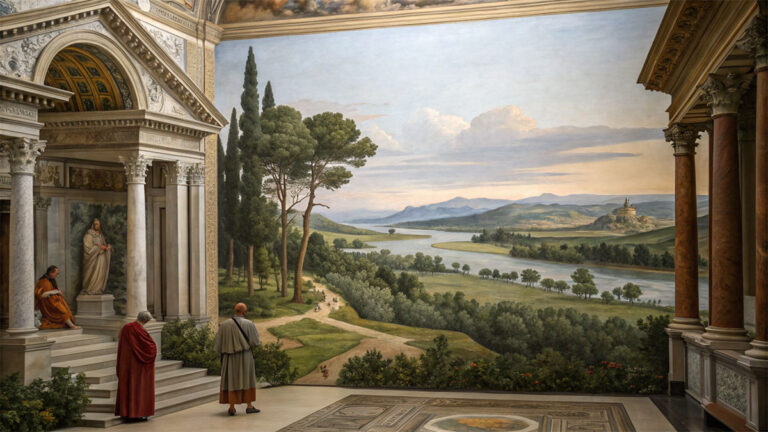
Museum visitors spend an average of 27 seconds looking at a painting. That is all the time a piece gets to grab attention, guide the eye, and leave an impression. The difference between a painting that holds someone and one they walk past almost always comes down to one thing: visual hierarchy.
So what is visual hierarchy in art, and why does it matter so much? It is the arrangement of elements within a composition to signal what the viewer should notice first, second, and last. Every painting style relies on it, whether the artist planned it deliberately or stumbled into it.
This guide breaks down how hierarchy works, the tools artists use to build it (size, contrast, color, placement), how different art movements handled it, common mistakes that weaken it, and practical steps for analyzing or constructing it in your own work.
What Is Visual Hierarchy in Art

Visual hierarchy is the arrangement of elements within a composition to signal their order of importance. It tells your eye where to go first, where to go second, and what to skip.
Every painting, photograph, and sculpture has one, whether the artist planned it or not. The difference between a strong piece and a forgettable one often comes down to how well the hierarchy is built.
A study published in Psychology of Aesthetics, Creativity, and the Arts found that museum visitors spend an average of 27 seconds looking at a single artwork. That number barely changed between the original 2001 study at the Metropolitan Museum of Art and a 2016 follow-up at the Art Institute of Chicago, where the mean came in at 28.63 seconds.
Twenty-seven seconds. That is all the time a painting gets to pull someone in, guide their attention, and leave a mark. Visual hierarchy is the mechanism that makes those seconds count.
It works because the human brain does not process all visual information equally. Research by Gitte Lindgaard at Carleton University showed that people form aesthetic judgments in as little as 50 milliseconds. That is faster than conscious thought. The brain is scanning for structure, contrast, and focal areas before you even realize you are looking.
Gestalt psychology explains part of this. Max Wertheimer, Kurt Koffka, and Wolfgang Kohler identified principles like proximity, similarity, and figure-ground relationships in the 1920s. These describe how the mind groups visual information into patterns and wholes rather than isolated parts. Those principles are still foundational in both fine art and design more than a century later.
So when an artist places a bright red figure against a muted gray background, your eye lands there instantly. Not because you chose to look there. Because your brain was wired to.
How Visual Hierarchy Controls the Viewer’s Eye

Think of visual hierarchy as a set of instructions embedded in the artwork itself. The viewer does not read them consciously, but the eye follows them anyway.
The concept behind this is visual weight. Certain elements carry more weight than others based on their size, color, placement, or level of detail. Heavier elements pull attention first. Lighter ones recede.
A Frontiers in Human Neuroscience study (2025) on color perception in art found that within the first 20 seconds of processing a visual scene, color accounts for nearly 80% of the perceptual attributes identified by the brain. Shape and texture fill in after that initial color-driven scan.
Eye-tracking research confirms this is not random. A 2024 study on hierarchical perception from Nanjing Forestry University found that when dashboard interfaces (used as a simplified model for visual layouts) became more complex, users allocated fewer attentional resources to each individual element. The same principle applies to painting. Too many competing elements and the eye has nowhere to land.
Dominant, Subdominant, and Subordinate Elements

Dominant elements grab attention first. They are the largest, brightest, or most isolated thing in the frame.
Subdominant elements support the main subject. They provide context, create rhythm, or direct the eye from the dominant area toward secondary information.
Subordinate elements sit in the background. Details, textures, ambient color. They complete the composition without competing for focus.
When all three tiers work together, you get a clear reading order. When they don’t (every element screaming for attention at the same volume), the piece feels chaotic. Or worse, flat.
Caravaggio understood this instinctively. Look at The Calling of Saint Matthew. The beam of light cutting across the dark tavern is the dominant force. Christ’s hand is subdominant, pointing directly at Matthew. The surrounding figures are subordinate, providing narrative context without stealing focus. Your eye follows a precise path that Caravaggio constructed over 400 years ago, and it still works.
Elements That Create Visual Hierarchy

Artists do not have one tool for building hierarchy. They have several, and the best work usually combines multiple tools at once.
| Element | Technical Logic | How It Signals Importance | Classic Example |
| Size & Scale | Hieratic Proportion: Large objects trigger a primal “proximity” alert. | Larger objects attract attention first; implies power or proximity. | Egyptian tomb paintings (Pharaoh as the largest figure). |
| Color Contrast | Chromatic Pull: High-saturation or warm hues (red/yellow) advance visually. | A single vivid hue in a neutral field creates an instant focal point. | Vermeer’s Blue and Yellow interplay. |
| Value Contrast | Tonal Extremes: The eye is biologically drawn to the meeting of light and dark. | Extreme “Chiaroscuro” creates a “Spotlight” effect on the subject. | Rembrandt’s Chiaroscuro portraits. |
| Position | Spatial Priority: Center or “Rule of Thirds” intersections feel intentional. | Placement near the top or center reads as “Primary” or “Heavenly.” | Renaissance Altarpieces. |
| Isolation | Negative Space: Removing “clutter” around an object prevents eye-wandering. | A separated element stands out by breaking the “Pattern” of a group. | Andrew Wyeth’s lone figures. |
Size and Scale

Bigger things get noticed first. This is not subtle, and it does not need to be.
In Renaissance religious paintings, Christ or the Madonna was almost always the largest figure. Egyptian art took it further. The pharaoh might be three times the size of servants in the same scene. Scale was not about realism. It was about rank.
But scale works in reverse too. A small, isolated object in a vast space can command just as much attention, if the surrounding area is quiet enough. That tension between the tiny figure and the huge emptiness is what makes certain landscape paintings so gripping.
Color and Value Contrast

Eye-tracking research published in the Journal of Sensory Studies (2025) confirmed that colors with high visual saliency, like bright red or yellow, attract initial fixations more quickly and frequently than less saturated colors. This attentional capture happens even when viewers are told to ignore color.
Chiaroscuro, the technique of extreme light-dark contrast, is one of the most direct hierarchy tools in painting. Rembrandt used it to spotlight faces and hands while letting backgrounds dissolve into darkness. Tenebrism pushed this even further, with pitch-black surroundings and sharp illumination on the subject.
Value does the heavy lifting in any composition. Strip the color from a painting (turn it grayscale), and if the hierarchy still reads clearly, it is built on a strong value structure. If it falls apart, the artist was relying too much on color alone.
Position and Placement

Where something sits within the pictorial space affects how important it feels.
Center placement is the most obvious approach, and it works. But it can also feel static. The rule of thirds and the golden ratio offer alternatives that create more dynamic tension while still guiding the viewer’s focal point.
Directional lines play a huge role here. Roads, rivers, architectural edges, even the direction a figure is looking. All of these function as visual arrows pointing toward the area of greatest importance. Leonardo da Vinci used the table’s edge, the disciples’ gestures, and the architectural lines of the room to funnel every eye toward Christ in The Last Supper.
Visual Hierarchy in Composition Structures

Hierarchy does not exist in isolation. It is embedded in a broader compositional structure that gives the entire piece its skeleton.
Triangular composition is one of the oldest and most stable frameworks. Da Vinci used it constantly. The apex draws focus to the primary subject, while the base provides grounding. It is why so many Renaissance paintings feel so balanced, even when depicting action or emotion.
Radial composition pushes everything outward from a central point, or pulls everything inward toward one. It naturally centralizes focus. You see it in ceiling frescoes, religious iconography, and radial balance arrangements across centuries of decorative art.
Asymmetrical layouts create hierarchy through deliberate imbalance. A heavy element on one side, counterbalanced by negative space or a cluster of smaller elements on the other. This approach feels more modern and less predictable than centered or symmetrical setups. Asymmetrical balance is trickier to pull off, but it creates more visual energy when it works.
The Z-pattern and F-pattern, commonly discussed in web design, actually trace back to how people scan visual fields generally. In paintings with text or sequential narrative elements, the eye tends to sweep from top-left to top-right, then diagonally down to the lower-left, and across to the lower-right. Movement in a composition often follows these ingrained scanning habits whether the artist planned for it or not.
Visual Hierarchy Across Art Movements

Different periods handled hierarchy in completely different ways. What counts as “good” hierarchy shifted dramatically depending on the goals, tools, and philosophies of each movement.
Renaissance Through Baroque
Renaissance artists built hierarchy with mathematical precision. Linear perspective, developed formally by Brunelleschi and applied by painters like Raphael and Botticelli, created a single vanishing point that naturally organized the entire picture plane into a clear depth structure.
Size hierarchy in religious scenes reinforced theological messages. Christ was central, elevated, and often the brightest figure. Supporting saints and donors occupied secondary positions. Sfumato, perfected by Da Vinci, softened edges to push background elements further back and pull focal areas forward with sharper detail.
Baroque art exploded those calm structures. Painters like Rubens and Velazquez used dramatic diagonal lines, extreme tonal shifts, and dynamic forms to guide the eye through turbulent, high-energy scenes. The hierarchy was still there, just delivered at full volume.
Impressionism and Post-Impressionism
Impressionism loosened the rules considerably. Monet did not rely on hard edges or dark-light extremes. Instead, he guided attention through shifts in color saturation and temperature. Warm colors pulled forward, cool colors pushed back. The hierarchy was softer but still present.
Cezanne did something different entirely. He fractured traditional perspective and flattened spatial depth, creating a kind of distributed hierarchy where multiple areas competed for attention simultaneously. That deliberate ambiguity became a bridge to Cubism.
Seurat took a scientific approach with Pointillism, using tiny dots of pure color that optically blended at viewing distance. His hierarchy came from value structure underneath the dots, not from brushwork or edge definition.
Modern and Contemporary Art

The 20th century asked a question nobody had bothered with before: what happens when you deliberately destroy hierarchy?
Jackson Pollock‘s drip paintings spread visual weight evenly across the entire canvas. There is no single focal point. No primary, secondary, or background. The result is what critics call “allover” composition, a radical rejection of traditional hierarchy that forces the viewer to engage with the painting as a total field rather than a guided path.
Mark Rothko went a different route. His color field paintings create hierarchy through subtle shifts between massive blocks of color. The edges where two rectangles meet become the focal zone, even though there are no objects, figures, or lines to anchor the eye. Just color contrast and gradation doing all the work.
Pop art brought hierarchy back with force. Andy Warhol‘s silkscreens used bold outlines, high-saturation color, and repetition to grab attention instantly. The hierarchy was blunt, commercial, and intentional, borrowed directly from advertising layout principles.
Visual Hierarchy in Art vs. Graphic Design

The principles overlap more than most people realize. Both fine art and graphic design rely on emphasis, balance, contrast, and alignment to direct attention.
The difference is purpose.
| Aspect | Fine Art Hierarchy | Design Hierarchy | Technical Logic |
| Primary Goal | Emotional/Narrative: Focuses on the “felt” experience. | Utility/Usability: Focuses on the “task” at hand. | Art invites reflection; Design facilitates function. |
| Focal Guidance | Suggested: Often uses “soft” paths or ambiguity. | Explicit: Uses a rigid, structured reading order. | Design removes “Focal Friction” to speed up comprehension. |
| Typography | Secondary: Often absent or treated as a “shape.” | Primary: The backbone of the communication hierarchy. | In Design, font weight and size dictate the “Voice” of the data. |
| Viewer Freedom | Encouraged: The eye is invited to “wander” and discover. | Restricted: The eye is funneled toward a specific “Call to Action.” | Design is a “Path”; Art is a “Landscape.” |
In painting, hierarchy serves the emotional arc. A Baroque altarpiece guides your eye to feel awe. A Romantic landscape draws you into a mood. The viewer is supposed to feel something, not necessarily do something.
In graphic design and UI/UX, hierarchy exists to get a message across efficiently. The heading is bigger than the body text. The call-to-action button is a contrasting color. Everything is optimized for speed and clarity.
But the crossover is real. The Constructivism movement in early Soviet Russia and De Stijl in the Netherlands explicitly fused art and design principles. Mondrian‘s grid-based paintings look like layout wireframes. Kandinsky‘s teachings at the Bauhaus directly influenced how designers think about visual harmony and compositional variety today.
The Bauhaus itself, running from 1919 to 1933, was essentially a school built on the idea that hierarchy principles in art and functional design are the same thing. Unity, dominance, subordination. These terms show up in both a painting critique and a UX audit. The vocabulary is shared because the underlying perceptual science is the same.
How to Analyze Visual Hierarchy in Any Artwork

You don’t need a degree in art history to read hierarchy. You just need a method and about two minutes of honest looking.
The simplest approach comes from formal analysis, a framework art educators have used for decades. Edmund Burke Feldman’s model breaks it down into description, analysis, interpretation, and judgment. For hierarchy specifically, the analysis step is where the action happens: identifying how elements relate to each other in terms of visual weight, pattern, and spatial arrangement.
Ask three questions in order:
- What do you see first?
- Where does your eye go second?
- What do you notice only after deliberate searching?
Those three answers map directly to the dominant, subdominant, and subordinate tiers. If you can not answer the first question quickly, the hierarchy is either weak or intentionally flattened (as in allover compositions by artists like Willem de Kooning).
A 2024 Rijksmuseum eye-tracking study published in Scientific Reports confirmed that when children received targeted descriptions pointing to specific areas of 17th-century paintings, their gaze durations on those areas increased measurably. But when given adult-oriented labels, their viewing behavior was no different from having no guidance at all. Knowing where to look, and why, changes how the hierarchy registers.
The Squint Test and Grayscale Check

The squint test is the fastest diagnostic tool in any painter’s kit. Partially close your eyes while looking at the piece. Details vanish. Colors mute. What is left are large shapes of light and dark, the raw value masses that carry the hierarchy.
If the composition still reads clearly when squinted, the hierarchy is strong. If everything blurs into a uniform gray, there is not enough value contrast to create separation between tiers.
The grayscale conversion works on the same principle but uses technology instead of your eyelids. Take a photo of the painting and desaturate it completely. This strips away hue and saturation so you can evaluate the underlying tonal structure in isolation.
James Gurney, author of Color and Light: A Guide for the Realist Painter, recommends planning every painting’s value design in two or three tones as a separate step before touching color. His book was Amazon’s top-selling art instruction title for over 100 consecutive weeks, partly because this kind of practical hierarchy-building advice is exactly what working painters need.
Common Visual Hierarchy Mistakes in Art

Most hierarchy failures come down to one problem: the artist treated every element as equally important. And when everything is important, nothing is.
| Mistake | Technical Logic | What Happens | The Fix |
| Equal Visual Weight | Lack of Dominance. No “Visual Gravity” to pull the eye. | No entry point; viewer feels overwhelmed or bored. | The 70/30 Rule: Push one area to be 70% of the focus. |
| Too Many Focal Points | Competition: Multiple elements “shout” for attention. | Eye “bounces” around; the message is lost in noise. | Ranking: Assign one Primary, one Secondary, and silence the rest. |
| Uniform Detail | Texture Flattening: Excessive high-frequency detail everywhere. | Hierarchy flattens; no “Rest Area” for the eye. | Lost & Found Edges: Loosen detail in subordinate areas. |
| Ignoring Negative Space | Compression: Lack of “Visual Oxygen.” | Composition feels cramped and amateurish. | Isolation: Use empty areas to “bracket” the focal point. |
| Centering without Contrast | Dead Center Bias: Predictable placement without support. | Subject is placed but doesn’t “pop” or command authority. | Contrast Support: Use Value or Saturation to justify the center. |
The “equal weight” problem is the most common by far. Took me forever to figure out why some of my early paintings felt flat even when the drawing was accurate. The answer was always the same: I had painted every area with the same level of care, the same level of detail, the same range of values. The background had as much going on as the subject.
Andrew Loomis addressed this directly in Creative Illustration, writing about the need to create a clear “path of the eye” through a picture. If the viewer’s gaze has nowhere specific to land, they disengage. And as the Smith and Smith research showed, museum visitors already spend fewer than 30 seconds per painting. You can not afford to waste half of that with a confused reading order.
Overuse of detail is a closely related trap. Beginners especially tend to render every leaf, every brick, every strand of hair with equal precision. The result looks technically accomplished but visually exhausting. Vermeer solved this by sharpening detail only in the areas closest to the viewer’s intended focal zone and softening everything else with those famously gentle transitions.
The fix for most of these mistakes is the same. Decide what matters most, then deliberately reduce everything else. Softer edges, lower contrast, less detail. Give the dominant element room to breathe by pulling back the subordinate ones.
How Artists Build Visual Hierarchy Step by Step

Hierarchy is not something you add at the end. It is the first decision you make, and it shapes everything that follows.
The process most working painters follow (whether they learned it from Loomis, Gurney, or just years of trial and error) breaks down into a sequence that front-loads the biggest decisions and saves refinement for last.
Thumbnail Value Studies
Start small. Literally.
Thumbnail sketches are quick, postcard-sized studies that map out the major light and dark areas before committing to a full-scale piece. Most painters work with just 3 to 5 values at this stage, which forces simplification.
Norman Rockwell described his process in detail, showing how he moved from thumbnails to posed models to comprehensive drawings before the final painting. James Gurney has adopted a similar workflow, noting that solving value and design problems early actually frees up more spontaneous brushwork later.
Establishing the Focal Point First

Once the thumbnail is resolved, the first marks on the actual canvas should establish the focal area.
Methods vary by medium:
- Oil painters often block in the darkest darks and lightest lights of the focal area first using transparent pigment
- Watercolorists typically preserve their whites in the focal zone from the start, since you can not reclaim them
- Acrylic painters can work either direction, but most start with a tonal underpainting to lock in the value hierarchy
The key is that the focal point gets resolved before the supporting areas. Not after.
Adjusting Through the Process

Hierarchy is not set once and forgotten. It needs checking at multiple stages as the painting develops.
Stage checks that experienced artists use:
Early block-in: Step back. Squint. Does the focal area read as the brightest or highest-contrast zone? If not, push it.
Mid-painting: Convert a phone photo to grayscale. Check whether the value structure from your thumbnail has survived the addition of color. It often drifts.
Near completion: Look at the painting in a mirror or upside down. This breaks your familiarity with the image and reveals hierarchy problems your brain has been ignoring.
The grisaille underpainting technique, where the entire piece is painted in grayscale before color is applied, is essentially a built-in hierarchy checkpoint. If the monochrome version reads well, the color version almost always will too. Perspective, contour clarity, and edge control all feed into this final assessment.
Look, there is no shortcut here. Composing a painting with clear hierarchy takes planning, patience, and a willingness to simplify. But the payoff is real. When the hierarchy works, the painting communicates instantly, even to someone giving it nothing more than a 27-second glance in a crowded gallery.
FAQ on What Is Visual Hierarchy In Art
What is visual hierarchy in art?
Visual hierarchy is the arrangement of elements in a composition to show their order of importance. It controls where the viewer’s eye goes first, second, and last, using tools like size, contrast, color, and placement.
Why is visual hierarchy important in painting?
Without hierarchy, every element competes for attention equally. The result is a flat, confusing image. Hierarchy gives a painting structure, guiding the viewer through the composition and making the artist’s intended message or mood land clearly.
What are the main elements that create visual hierarchy?
Size, value contrast, color saturation, placement within the frame, isolation through negative space, and level of detail. Most strong compositions combine several of these tools simultaneously rather than relying on just one.
How did Renaissance artists use visual hierarchy?
Renaissance painters used mathematical perspective, central placement, and size differences to organize their compositions. Da Vinci’s famous works demonstrate this clearly, with converging lines, gestures, and lighting all funneling attention toward the primary subject.
What is the difference between visual hierarchy in art and graphic design?
Art uses hierarchy for emotional or narrative impact, while graphic design uses it for communication and usability. The core principles (contrast, scale, alignment) overlap, but the purpose differs. Art invites wandering. Design directs action.
How does color affect visual hierarchy?
Warm, saturated colors pull forward and grab attention first. Cool, muted colors recede. High complementary color contrast between a subject and its background is one of the fastest ways to establish a clear focal point.
What is the squint test in art?
The squint test involves partially closing your eyes while viewing a painting. This blurs detail and mutes color, revealing the underlying value structure. If the composition still reads clearly when squinted, the hierarchy is strong.
Can visual hierarchy be intentionally broken?
Yes. Artists like abstract painters of the mid-20th century deliberately flattened hierarchy. Pollock’s drip paintings spread visual weight evenly across the canvas, forcing viewers to engage with the entire surface rather than following a guided path.
What is the most common visual hierarchy mistake?
Giving every element equal visual weight. When nothing stands out, the viewer’s eye has no entry point. The fix is simple: choose one dominant area and deliberately reduce contrast, detail, and saturation everywhere else.
How do you build visual hierarchy step by step?
Start with thumbnail value studies using three to five tones. Establish the focal point first on the canvas. Build supporting elements around it. Check hierarchy at multiple stages by stepping back, squinting, or converting a photo to grayscale.
Conclusion
Understanding what is visual hierarchy in art comes down to one skill: controlling where the viewer looks. Every decision about tonal value, color temperature, repetition, and edge quality either strengthens or weakens that control.
The principles stay consistent whether you are studying a Baroque masterpiece or planning your next landscape painting. Size draws the eye. Contrast holds it. Placement directs it forward.
What changes across movements and painting mediums is how aggressively or subtly those tools get applied. A Rothko and a Vermeer both have hierarchy. They just build it with completely different means.
Start with thumbnail studies. Test your values with the squint test. Check your focal point at every stage. The hierarchy will follow.