Georges-Pierre Seurat transformed art history in just 31 short years of life. This French painter’s revolutionary pointillism technique forever changed how artists approach color and light.
Unlike the loose brushwork of his Impressionist contemporaries, Seurat developed a systematic method using tiny dots of pure color that blend optically in the viewer’s eye.
Born in Paris in 1859, Seurat combined scientific color theory with artistic vision to create works that shimmer with extraordinary luminosity.
His academic training at École des Beaux-Arts provided technical foundations, but his true innovation came through applying optical science to canvas painting.
This article explores:
- The development of Seurat’s distinctive dot technique
- Analysis of masterpieces including “A Sunday Afternoon on the Island of La Grande Jatte”
- Technical aspects of his systematic art approach
- His lasting influence on modern art movements
Discover how this Post-impressionist pioneer’s scientific precision and artistic sensitivity created a visual language that continues to influence artists today.
The Birth of Pointillism

Pointillism emerged from the mind of French painter Georges-Pierre Seurat during the vibrant Paris art scene of the Belle Époque period.
This revolutionary artistic technique transformed how artists approached color and form.
What is Pointillism?
Pointillism is a painting technique where small, distinct dots of color are applied in patterns to form an image.
The approach relies on the viewer’s eye to blend the dots optically rather than the artist mixing colors on a palette.
The core principle rests on systematic art approach:
- Color juxtaposition instead of physical mixing
- Precise dot placement creating optical mixing
- Deliberate use of complementary colors
- Careful attention to light effects in painting
Seurat didn’t just dabble in this method-he developed a complete system based on scientific principles.
His dot technique, sometimes called Divisionism or Chromoluminarism, broke from the loose brushwork favored by Impressionists.
Small points of pure color sit side by side, creating a luminous effect when viewed from a distance.
Scientific Foundations
Seurat’s approach wasn’t random. His work drew heavily from color theory principles developed by Michel Eugène Chevreul and Ogden Rood.
Their scientific studies on color perception influenced his systematic approach.
The academic training Seurat received at École des Beaux-Arts gave him the technical foundation, but his true innovation came through applying optical science to painting. He understood that:
- Colors appear more vibrant when placed next to their complementaries
- Small dots of different colors blend in the viewer’s eye
- Contrast enhancement through strategic dot placement creates depth
- Visual perception is affected by the proximity of different hues
This methodical use of color harmony wasn’t just technical showmanship-it was a fundamental shift in how artists thought about representing light and form.
Development of the Technique
Seurat’s early experiments with the stippling technique began to appear in his drawings before fully emerging in his canvas painting.
Initially working with larger brushstrokes, he gradually refined his approach to use smaller, more uniform dots.
His studio practice evolved from traditional methods toward increasingly precise dotwork.
Early compositions showed the transition-broader touches giving way to the meticulous pointillist method that would define his mature style.
The evolution wasn’t instant. Seurat spent years perfecting his technique, pushing toward smaller dots and more precise color relationships.
Each canvas became a laboratory for his theories about how pigment studies could create specific visual effects.
Fellow artists watched with interest. Paul Signac quickly adopted similar approaches, becoming a key figure in spreading what would become known as Neo-impressionism.
Seurat’s Major Works
“A Sunday Afternoon on the Island of La Grande Jatte” (1884-1886)

This monumental oil on canvas stands as Seurat’s defining masterpiece. The creation process spanned two years, with Seurat producing over 60 preliminary studies and drawings. Standing at roughly 7 by 10 feet, the scale alone makes it impressive.
The composition shows Parisians enjoying leisure time along the Seine River-a seemingly simple subject transformed by Seurat’s revolutionary approach.
Figures appear almost statuesque, frozen in a moment of urban landscapes and public gardens in art.
When exhibited at the final Impressionist exhibition, the painting provoked intense reactions. Critics were divided:
- Some dismissed it as mechanical and cold
- Others recognized it as groundbreaking
- The Salon exhibitions largely rejected his work
- Avant-garde circles gradually embraced his innovation
Technical analysis reveals extraordinary precision. Under magnification, the painting shows thousands of meticulously placed dots-each chosen for its optical relationship to surrounding colors.
The surface buzzes with visual energy, creating an almost shimmering effect.
The Art Institute of Chicago now houses this masterpiece, where conservation efforts continually protect this pivotal work in French art history.
“Bathers at Asnières” (1884)
“Bathers at Asnières” represents a crucial transition work showing early pointillist elements.
Completed when Seurat was just 24, this large-scale scene of working-class men relaxing by the Seine River reveals his emerging technique.
The painting contains subtle social commentary aspects. Unlike the bourgeois figures in “La Grande Jatte,” these are working men seeking respite from industrial Paris.
The factory smokestacks in the background speak to changing urban reality.
Comparing this work with traditional painting techniques reveals Seurat’s evolution.
While not fully committed to the dot technique yet, “Bathers” shows his experimental brushwork beginning to break form into distinct touches of color.
The Musée d’Orsay in Paris now displays this significant work, allowing visitors to trace Seurat’s artistic development through close examination of his evolving brushwork.
Later Masterpieces
“The Circus” (1890-91) represents one of Seurat’s final works before his young death at 31.
This vibrant scene captures the energy of performers through rhythmic composition and brilliantly contrasted colors.
Left unfinished at his death, it nonetheless demonstrates his complete mastery of pointillist techniques.
“The Channel of Gravelines” series showcases Seurat’s application of pointillism to landscape.
These serene coastal scenes use color dots to capture the atmospheric conditions of Northern France, demonstrating how his technique could evoke specific light qualities.

“Young Woman Powdering Herself” (1889-90) offers a more intimate view.
This portrait of his companion Madeleine Knobloch (kept secret during his lifetime) shows remarkable tenderness within his structured approach.
The subject-believed to be pregnant with their child-is rendered with exceptional sensitivity despite the seemingly mechanical technique.
Each work resides in prestigious museum collections-the Metropolitan Museum of Art, the National Gallery, London, and other institutions-cementing Seurat’s artistic legacy despite his abbreviated career.
Technical Analysis of Pointillism
Materials and Methods
The foundation of Seurat’s technical approach began with meticulous canvas preparation.
He preferred fine-weave canvas with smooth surfaces that could support the precise application of his dotwork.
His paint consistency differed from many contemporaries. Seurat needed:
- Thicker pigments that would hold their shape as dots
- Carefully measured color mixtures for consistent application
- Stable paints that wouldn’t blend unintentionally on canvas
The brushes and tools used for pointillist work were specialized. Rather than broad brushes, Seurat often employed small brushes with precise tips.
He sometimes used custom tools for applying uniform dots.
His color selection and mixing strategies followed scientific principles. Working from a palette based on optical color theory, he chose pigments for their purity and light-reflecting qualities.
He rarely mixed on the palette, preferring to place pure colors side by side on the canvas.
Color Theory in Practice
The systematic approach to complementary colors forms the backbone of pointillism. Seurat understood that red appears more vibrant next to green, blue intensifies near orange, and yellow strengthens beside purple.
Division of tones replaced traditional shading. Instead of darkening a color with black, Seurat might add dots of its complementary shade, creating more vibrant shadows with greater visual depth.
The optical blending effects central to pointillism depend on viewing distance. Step close to a Seurat painting, and individual dots become apparent.
Step back, and the viewer’s eye naturally blends these separate points into coherent forms and smooth color transitions.
Light and shadow representation underwent radical transformation through this technique.
Rather than a gradual blending of tones, Seurat created luminosity through carefully calculated color relationships, producing a distinctive glow that characterizes his best work.
Compositional Elements
Beyond color theory, Seurat employed geometric frameworks as the foundation for his compositions.
Sketches reveal underlying triangles, rectangles, and diagonal lines organizing the seemingly casual scenes.
The golden ratio and mathematical proportions appear frequently in his work. Analysis of “La Grande Jatte” shows carefully calculated divisions of space, creating a subtle harmony that contributes to the painting’s enduring appeal.
Balance and harmony in design weren’t accidental-they were consciously engineered.
The Parisian artist treated composition as a science, with preliminary studies revealing a process of adjustment and realignment until achieving perfect equilibrium.
Art conservators note these methodical underpinnings when examining his work. X-ray analysis of major pieces reveals careful gridwork and proportional systems beneath the finished surface of dots.
Seurat’s Influence on Art History
Neo-Impressionism Movement
The formation of the Neo-impressionism movement stemmed directly from Seurat’s innovations.
His systematic approach to color attracted artists seeking more structure than Impressionism offered.
Key figures embraced and expanded his methods:
- Paul Signac became the primary champion after Seurat’s death
- Henri-Edmond Cross developed a more vibrant, loosely pointillist style
- Camille Pissarro briefly adopted the technique before returning to Impressionism
- Théo van Rysselberghe brought pointillist techniques to Belgian art circles
The Société des Artistes Indépendants, which Seurat helped establish, provided exhibition space for these new approaches.
Critical reception varied wildly-some saw scientific precision as antithetical to artistic expression, while others recognized revolutionary potential in this modern art pioneer’s methods.
Impact on Modern Art
Seurat’s influence extends far beyond pointillism. His scientific approach to color created a bridge between Post-impressionist experimentation and early Cubism’s analytical breakdown of form.
The connection to early Cubism appears in his geometric underpinnings.
Picasso and Braque’s later deconstruction of space follows logically from Seurat’s systematic fragmentation of color and light.
His legacy in color theory application reached even abstract artists.
The calculated use of color relationships influenced generations of painters, from Kandinsky’s color studies to Josef Albers’ explorations of color interaction.
Contemporary Artists Inspired by Pointillism
Modern interpretations continue in unexpected places. Chuck Close’s pixel-based portraiture adapts pointillist principles to photorealistic ends, breaking down facial features into discrete units of color that combine visually at a distance.
Digital artists using pointillist techniques have embraced the pixel as heir to Seurat’s dot.
Computer graphics often employ dithering-a direct descendant of pointillist optical mixing-to create color gradients from limited palettes.
Contemporary painters like Damien Hirst have occasionally referenced pointillist techniques in spot paintings that engage with Seurat’s legacy while addressing modern concerns about mechanical reproduction and authorship.
The artistic innovation Seurat pioneered continues to resonate in art school curricula worldwide.
Students still study his color theories and technical approach, ensuring his influence extends well beyond his short career and into modern artistic practice.
Life and Artistic Philosophy

Seurat’s Working Methods
Seurat’s studio practice reflected extraordinary discipline. His systematic art approach extended beyond canvas to encompass his entire creative process.
His perfectionism drove him to exhaustive preparation:
- Numerous preliminary sketches exploring compositional variants
- Small oil studies testing color relationships
- Detailed drawings refining figure placement
- Comprehensive color plans mapping out entire paintings
This attention to detail meant Seurat produced relatively few finished works-about 40 paintings and 500 drawings during his brief career.
Each piece underwent intense scrutiny and revision before completion.
The 19th century artist approached painting with scientific rigor unusual for his time.
He organized his studio for efficient work, with materials systematically arranged and studies cataloged for reference.
Observers noted his methodical pace, sometimes applying only a handful of dots during a day’s work.
Personal Life
Seurat maintained a reserved nature throughout his life. Contemporary accounts describe him as quiet and private, focused intensely on his artistic goals rather than social connections.
His relationship with model Madeleine Knobloch remained secret from even close friends.
This secrecy reflected his compartmentalized approach to life-separating his personal affairs from his artistic persona in Parisian artist circles.
Few letters or personal documents survive. Unlike contemporaries who built public personas, Seurat let his work speak for itself.
This reserved approach contributed to misunderstandings about his methods and intentions that persisted long after his death.
The young death that ended his career at 31 (likely from diphtheria) cut short a life dedicated almost exclusively to artistic development.
The contrast between his methodical art and his mysterious personal existence continues to fascinate art historians.
Artistic Vision
Seurat’s pursuit of harmony and order guided every artistic decision. He sought a perfect balance between scientific understanding and aesthetic beauty, believing rational principles could produce profound emotional responses.
His paintings contain subtle social observations despite their formal precision. “La Grande Jatte” examines class distinctions through figure placement and clothing.
“The Circus” captures modern entertainment with both wonder and analytical detachment.
Notes from his few writings reveal a belief that:
- Art should balance emotion with intellect
- Formal harmony creates visual pleasure
- Modern life demands new artistic approaches
- Science enhances rather than diminishes art’s power
This balance of science and aesthetics defined Seurat’s entire approach.
While peers explored emotional expressiveness, he created a systematic method for achieving visual impact through carefully controlled means.
Critical Reception and Legacy
Reception During Seurat’s Lifetime
Initial criticism greeted Seurat’s work with confusion. His first major exhibition of “La Grande Jatte” at the final Impressionist exhibition in 1886 provoked polarized reactions.
Traditional critics found his approach cold and mechanical, missing the spontaneous brushwork they associated with artistic genius.
The academic establishment largely rejected his scientific approach as too radical a departure from accepted techniques.
However, recognition among avant-garde circles grew steadily.
Fellow artists, particularly younger painters seeking new directions beyond Impressionism, recognized the revolutionary potential in his methodical approach.
Public response followed a similar pattern-initial bewilderment giving way to gradual appreciation.
By his death in 1891, Seurat had established a small but influential reputation, though true recognition remained largely posthumous.
Posthumous Appreciation
Seurat’s early death at age 31 from diphtheria in 1891 cut short an extraordinary career. The tragedy of his abbreviated life added poignancy to critical reappraisals that followed.
Paul Signac became his most important advocate, promoting pointillism and ensuring Seurat’s approach survived through both his own painting and writings about Neo-impressionism theory.
The reevaluation of his contributions accelerated in the early 20th century as color theory gained scientific credibility.
Art critics recognized how his analytical methods anticipated later modernist movements concerned with formal structure and optical effects.
By the mid-20th century, art historians had firmly placed Seurat in the art history canon as a pivotal figure bridging 19th century Impressionism and 20th century abstraction.
Museum Collections and Exhibitions
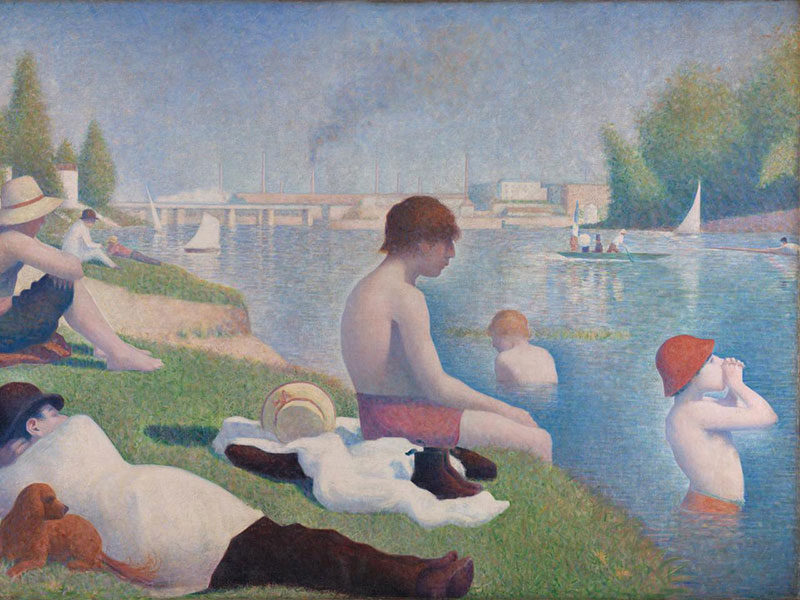
Major collections housing Seurat’s work now span the globe. The Art Institute of Chicago’s ownership of “La Grande Jatte” made it an American pilgrimage site for art lovers, while the Musée d’Orsay in Paris displays “Bathers at Asnières” as a centerpiece of 19th century French art.
Important retrospectives have continued to reshape our understanding of his achievement:
- The Museum of Modern Art’s landmark 1991 exhibition reassessed his drawing technique
- The Metropolitan Museum’s 2004 show examined connections between science and art
- The Courtauld Gallery’s 2015 exhibition revealed new technical analysis of his methods
Conservation challenges of pointillist works create ongoing research. The unique surface of densely packed dots requires specialized preservation approaches.
Art conservation teams monitor his paintings for pigment changes, with some colors (particularly certain greens) proving less stable over time.
The continued interest of museum collections and art historians ensures Seurat’s legacy remains vibrant nearly 130 years after his death.
His artistic innovation transformed how we understand color perception and established a bridge between traditional representation and modern abstraction that continues to inspire contemporary artists worldwide.
FAQ on Georges Seurat
What is Pointillism and how did Georges Seurat develop it?
Pointillism is a painting technique using small, distinct dots of color applied in patterns to form an image.
Seurat developed this method through scientific study of optical color mixing and perception.
He formalized the approach through systematic experimentation, applying color theory principles from Michel Eugène Chevreul and Ogden Rood to create chromoluminarism, where colors blend in the viewer’s eye rather than on canvas.
What are Georges Seurat’s most famous paintings?
Seurat’s most celebrated works include:
- “A Sunday Afternoon on the Island of La Grande Jatte” (1884-1886)
- “Bathers at Asnières” (1884)
- “The Circus” (1890-91)
- “Young Woman Powdering Herself” (1889-90)
- “The Channel of Gravelines” series
- “Le Chahut” (1889-90)
- “The Eiffel Tower” (1889)
These masterpieces showcase his pointillist technique and attention to compositional harmony.
How long did Georges Seurat live?
Seurat lived a remarkably short life of just 31 years (1859-1891). Despite this abbreviated career, the French Post-Impressionist created revolutionary painting techniques and completed approximately 40 canvases and 500 drawings.
His young death from diphtheria cut short what many art historians consider one of the most promising artistic careers of the 19th century.
Where can I see Georges Seurat’s paintings today?
Seurat’s works are housed in prestigious museum collections worldwide:
- “A Sunday Afternoon on the Island of La Grande Jatte” at The Art Institute of Chicago
- “Bathers at Asnières” at Musée d’Orsay, Paris
- “The Circus” at Musée d’Orsay
- Various works at Metropolitan Museum of Art, New York
- Several pieces at National Gallery, London
Art conservation efforts ensure these pointillist masterpieces remain accessible.
What scientific principles influenced Seurat’s artwork?
Seurat’s approach was heavily influenced by optical science and color theory. He applied principles of color perception, particularly how complementary colors intensify each other when placed side-by-side.
The scientific approach to color from Michel Eugène Chevreul, Ogden Rood, and Charles Blanc guided his systematic art approach, fundamentally changing how light and color could be represented in painting.
How did Georges Seurat influence other artists?
Seurat’s divisionism technique directly spawned the Neo-impressionism movement.
Paul Signac became his primary disciple, while Henri-Edmond Cross adapted the approach with brighter colors.
His scientific approach to color influenced Post-Impressionism, early Cubism, and later abstraction.
Even contemporary artists like Chuck Close have adapted pointillist principles for pixel-based portraiture.
What was Georges Seurat’s personality like?
Seurat maintained a reserved nature and private persona. Unlike many of his contemporaries, he avoided public attention and kept his personal life-including his relationship with Madeleine Knobloch-largely secret.
First-hand accounts describe him as methodical, disciplined, and intensely focused on his work, reflecting the same systematic approach evident in his painting technique.
What materials and techniques did Seurat use?
Seurat utilized fine-weave canvas with smooth surfaces ideal for precise dotwork.
He applied paint with specialized small brushes and custom tools, maintaining thicker pigment consistency that would hold dot shapes.
His color selection followed optical theory principles, placing pure pigments side-by-side rather than mixing on the palette. His detailed brushwork required extraordinary patience.
Did Seurat have formal artistic training?
Yes, Seurat received academic training at École des Beaux-Arts in Paris, providing him with traditional techniques and foundation.
However, he soon departed from conventional approaches, incorporating scientific color theories into his work.
is studio practice evolved from academic drawing technique toward his innovative pointillist method that revolutionized the approach to light and color.
What makes Seurat’s work still relevant today?
Seurat’s relevance endures through his pioneering fusion of science and art. His systematic approach to color relationships influenced generations of artists and anticipated digital imagery’s pixel-based structure.
His innovative color theory applications still inform contemporary painting practice.
The balance he achieved between analytical precision and aesthetic harmony continues to resonate in modern artistic practice.
Conclusion
Georges Seurat stands as an extraordinary figure in French art history-a pioneering spirit whose brief life yielded revolutionary approaches to visual expression.
His stippling technique transformed how artists approach form and light.
Through meticulous dot placement and scientific understanding of pigment studies, Seurat created works that continue to captivate museum collections worldwide.
The Neo-impressionist movement he launched demonstrates his lasting influence. His impact extends far beyond the 19th century art scene:
- His divisionism technique anticipated aspects of digital imagery
- His geometric frameworks influenced Cubism’s analytical approach
- His scientific approach to color informed countless subsequent artists
- His masterpiece at The Art Institute of Chicago remains a pilgrimage site
Though his short career ended tragically with a young death, Seurat’s artistic legacy thrives through careful art conservation efforts and continued scholarly interest.
The Parisian artist’s systematic methodology forged new paths for creative expression, proving that precision and emotion can brilliantly coexist on canvas.