Norman Rockwell captured America’s soul through his brush, creating images that still resonate decades after his death.
His work appeared on over 300 Saturday Evening Post covers during a career spanning six decades. From heartwarming holiday scenes to powerful civil rights commentary, Norman Rockwell most famous paintings defined how generations of Americans saw themselves.
This guide explores the iconic illustrations that made Rockwell a household name. You’ll discover the stories behind his celebrated works, from the patriotic Four Freedoms series to controversial paintings that challenged racial segregation.
Each painting reveals not just technical mastery of realism and composition, but also the changing values of mid-century American culture.
Norman Rockwell Most Famous Paintings
Freedom from Want

What It Depicts
A multi-generational family gathers around a Thanksgiving dinner table as the grandmother presents a golden roasted turkey.
Sunlight streams through a window, illuminating white plates on a white tablecloth. The technical mastery of white-on-white painting makes this artwork stand out.
Every person at the table looks at each other rather than the food. Their smiles and warm glances show family togetherness more than hunger.
When It Was Created
November 1942 to early 1943, with final publication on March 6, 1943 in The Saturday Evening Post.
Part of the Four Freedoms series inspired by Franklin D. Roosevelt’s 1941 State of the Union address.
Where You Can See It
Norman Rockwell Museum in Stockbridge, Massachusetts holds the original oil on canvas (45.75 by 35.5 inches).
Prints and reproductions appeared on over 2.5 million wartime posters for war bond drives in 1943.
Why It Matters
This painting became America’s definitive image of Thanksgiving. It captured the idea of abundance and family during wartime scarcity.
The work helped raise over $132 million in war bonds and stamps when touring with the Four Freedoms series.
While Americans embraced the image, Europeans found it tone-deaf during their wartime hardships.
The Story Behind It
All the people were friends and family from Arlington, Vermont. Not actual relatives at a real dinner.
Rockwell’s mother Nancy and wife Mary appear in the scene. The family cook, Mrs. Thaddeus Wheaton, serves the turkey.
Each person was photographed individually then painted into the composition.
Visual Details
The perspective lines converge on the central figures, framed by a window. An echo of Leonardo da Vinci’s Last Supper composition.
Creases in the tablecloth mirror those in the cloth covering Christ’s table in the Leonardo painting.
One man at bottom right breaks the fourth wall, glancing directly at viewers. A Renaissance technique using a figure to invite observers into the scene.
Green wallpaper with botanical prints and fresh vegetables symbolize growth and plenty. Brown tones in rounded shapes suggest fullness.
The Problem We All Live With

What It Depicts
Six-year-old Ruby Bridges walks to school on November 14, 1960, escorted by four U.S. federal marshals.
She wears a clean white dress and carries school supplies. Behind her, a wall shows racist graffiti including a racial slur and “KKK” letters.
A splattered tomato marks where protesters threw produce at the child. The marshals’ heads are cropped at shoulders, making Ruby the only fully visible person.
When It Was Created
1964, appearing as a centerfold in the January 14 issue of Look magazine.
Created three years after Ruby’s historic walk to William Frantz Elementary School in Louisiana.
Where You Can See It
Norman Rockwell Museum owns the original oil on canvas (36 inches by 58 inches).
President Barack Obama displayed it in a White House hallway near the Oval Office from July to October 2011.
Why It Matters
One of the most iconic images of the Civil Rights Movement. It confronted Americans with the reality of racism and school segregation.
Rockwell left The Saturday Evening Post to create this work. The magazine’s policies had previously forced him to remove African-American figures or show them only in service roles.
The painting sparked both fury and praise when published. It marked Rockwell’s transformation from nostalgic illustrator to political artist.
The Story Behind It
Ruby Bridges never met Rockwell. He used local girl Lynda Gunn as the model.
The 1954 Brown v. Board of Education ruling declared school segregation unconstitutional, but Louisiana schools refused to comply for six years.
Ruby was the sole Black student at William Frantz Elementary. After white parents withdrew their children, she spent the year in a classroom alone with her teacher.
In 2011, Ruby Bridges and President Obama viewed the painting together. Obama told her: “If it hadn’t been for you guys, I might not be here.”
Visual Details
Ruby’s bright white dress and sneakers emphasize her innocence against the offensive graffiti.
The marshals wear lighter suits than historically accurate to create contrast with Ruby’s dark skin, pushing her face into focus.
Cropping the marshals’ heads makes them anonymous symbols of law enforcement everywhere. Their yellow armbands identify them as federal agents.
The viewer stands at Ruby’s height, seeing the scene from her perspective. The tomato appears in front of viewers as if they stand beside the person who threw it.
Triple Self-Portrait
What It Depicts
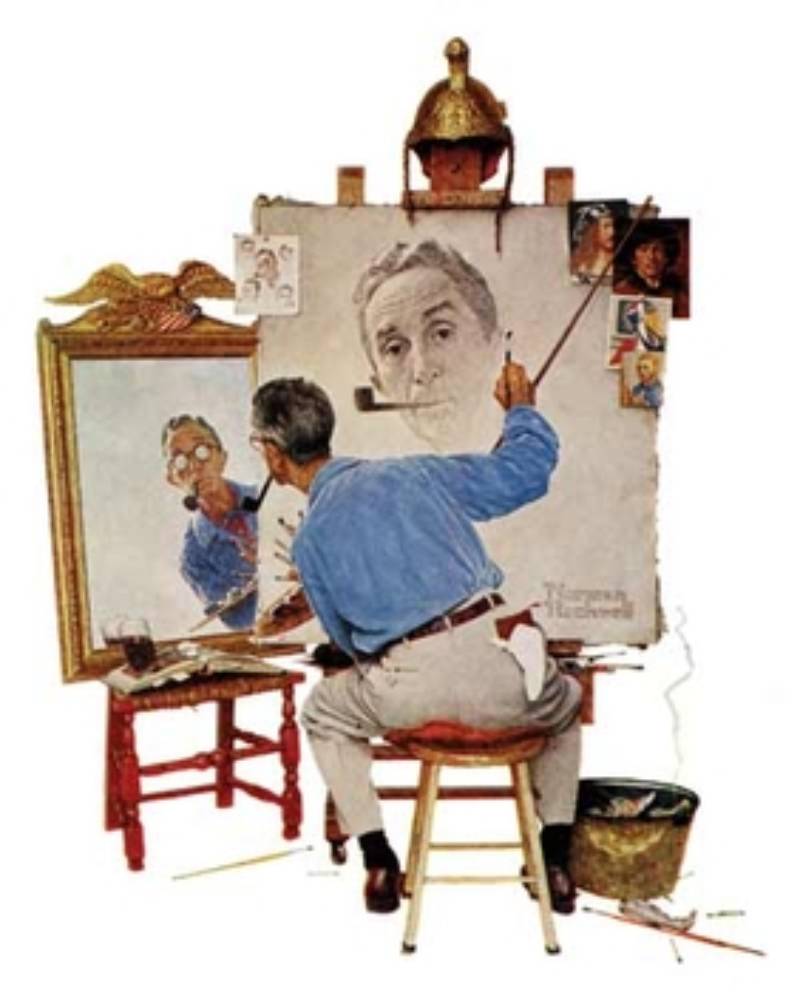
Rockwell sits at an easel with his back to viewers, painting an idealized self-portrait while looking in a mirror.
Three versions of the artist appear: the real figure from behind, the reflection in the mirror, and the polished portrait on canvas.
Small reproductions of famous self-portraits by Albrecht Durer, Rembrandt, Vincent van Gogh, and Pablo Picasso are pinned to the upper right.
When It Was Created
1960, appearing on the February 13 Saturday Evening Post cover.
Created to announce the first installment of Rockwell’s autobiography in the magazine.
Where You Can See It
Norman Rockwell Museum in Stockbridge, Massachusetts holds the oil on canvas (44.5 by 34.75 inches).
The work is displayed in the museum’s central gallery alongside other major pieces.
Why It Matters
One of the most famous self-portraits in American art. A rare personal reveal from an artist who typically illustrated others’ stories.
The painting appeared during The Saturday Evening Post’s peak circulation of 6.9 million subscribers in 1960.
It represents the artist’s three selves: the painter, the observer, and the public person.
The Story Behind It
Rockwell explained his fogged glasses in the mirror: “I couldn’t actually see what I looked like, a homely, lanky fellow, and therefore could stretch the truth just a bit.”
The canvas shows him looking more suave and debonair than reality.
A note at the top of the easel reminds him not to be taken in by appearances.
All four master self-portraits shown were painted by Rockwell himself, not reproductions.
Visual Details
The image in the mirror doesn’t look back at the seated artist. It looks directly at viewers, making them the second mirror needed to produce the image.
Rockwell’s pipe, painting supplies, and scattered objects around the easel show his actual working space.
The white void background keeps focus entirely on the artist and his creative process.
Deliberate brushwork creates intricate detail in clothing textures and materials.
Rosie the Riveter
What It Depicts
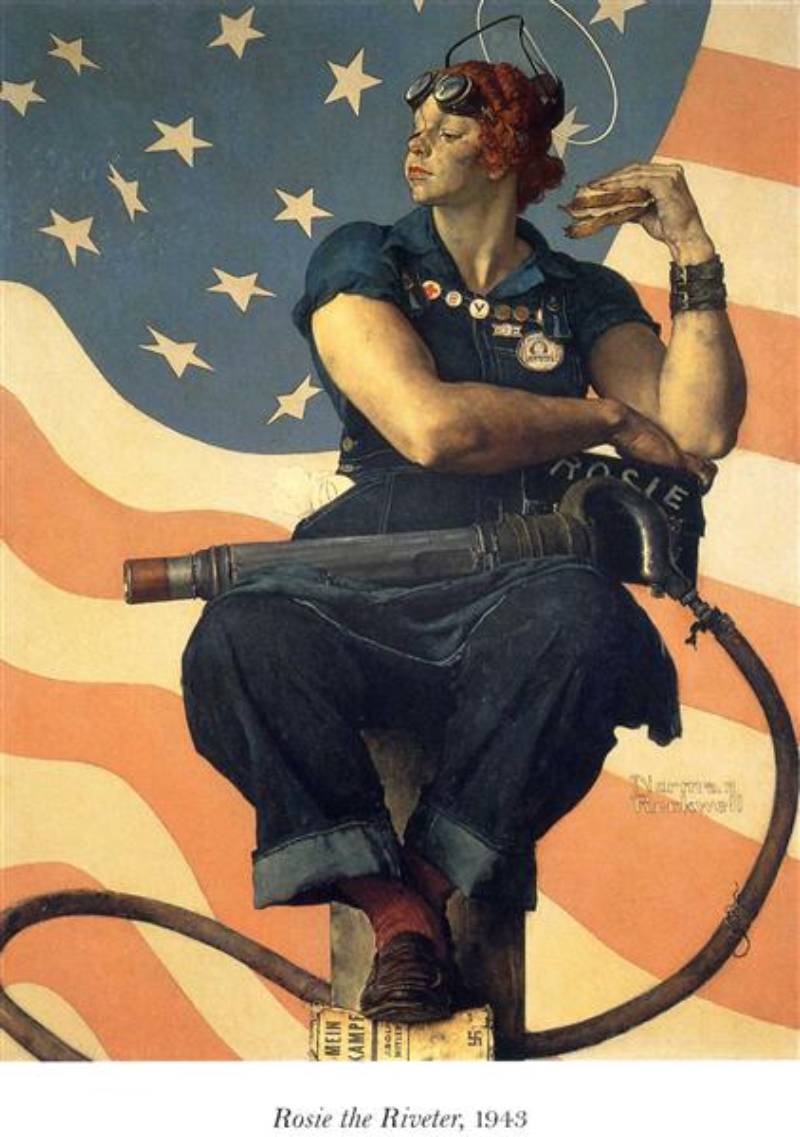
A muscular woman takes her lunch break, sitting with a rivet gun across her lap.
She eats a ham sandwich while her feet rest on a copy of Hitler’s Mein Kampf. A lunch pail labeled “Rosie” sits beside her.
She wears work overalls with multiple badges: Red Cross blood donor button, V for Victory button, Blue Star Mothers pin, and service awards.
When It Was Created
1943, published on the Saturday Evening Post cover for Memorial Day, May 29.
Created during World War II when millions of women joined the workforce to replace men serving overseas.
Where You Can See It
Crystal Bridges Museum of American Art in Bentonville, Arkansas acquired the painting in 2009.
It sold at Sotheby’s in 2002 for nearly $5 million, the highest price for a Rockwell painting at that time.
Why It Matters
Became the iconic symbol of women’s wartime contributions to American industry.
Helped recruit over 20 million women into the workforce by 1944.
The painting toured the country with the Four Freedoms series, raising over $132 million for war bonds.
The Story Behind It
Mary Doyle Keefe, a 19-year-old telephone operator from Vermont, was the model. Not an actual riveter.
Mary weighed 110 pounds. Rockwell painted her as much larger and more muscular, then called to apologize.
She posed twice because her white blouse in the first session wasn’t right. She was paid $10 total (equivalent to $138 in 2016).
The pose matches Michelangelo’s prophet Isaiah from the Sistine Chapel ceiling.
Visual Details
An American flag waves behind Rosie, creating a patriotic backdrop.
A halo effect around her head references the prophet Isaiah composition. Rockwell viewed these working women as heroic.
Her massive forearms show physical strength. The rivet gun was actually a lightweight fake for the photo session.
A white handkerchief and compact peek from her pocket. “She may be a factory worker but she’s still a woman.”
Freedom of Speech
What It Depicts
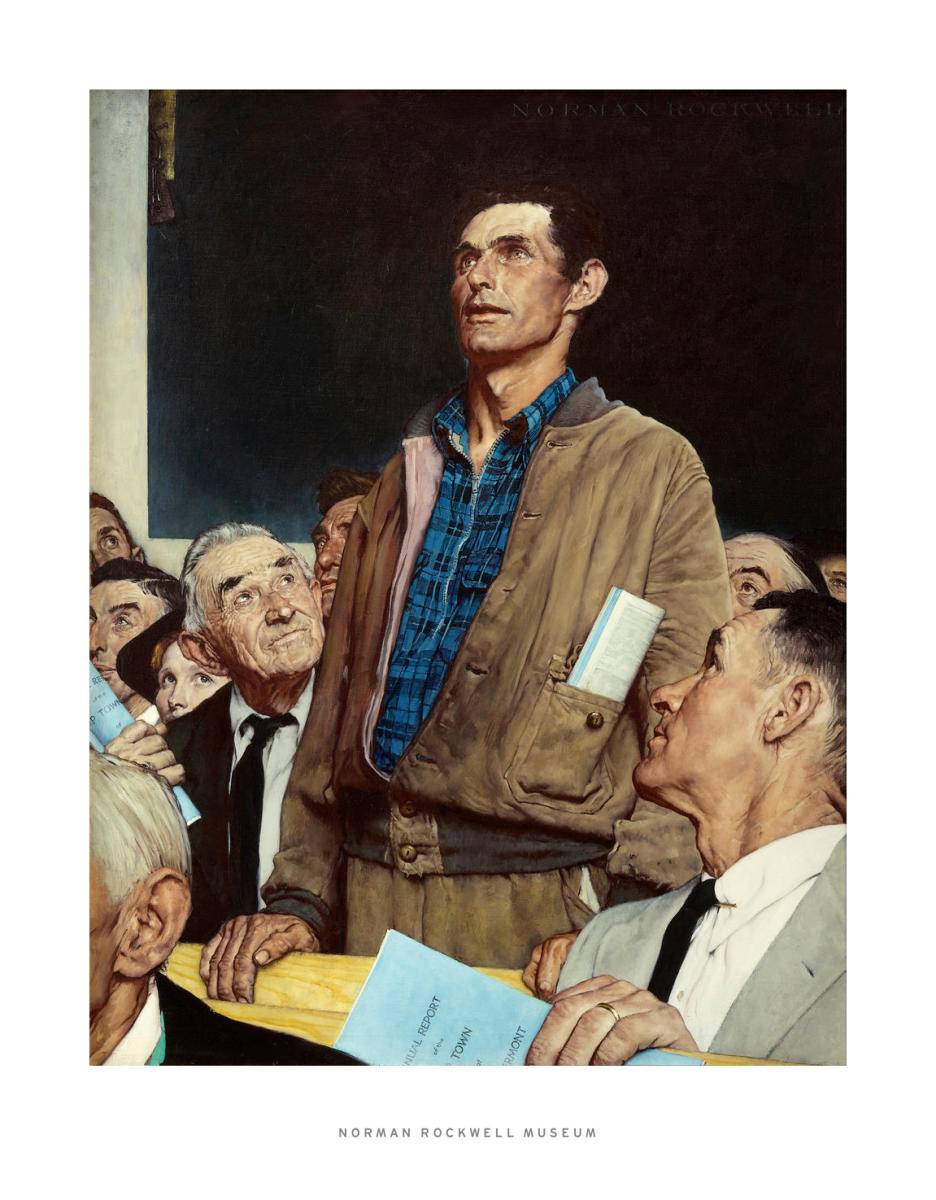
A working-class man stands at a town meeting, expressing his opinion while better-dressed neighbors listen respectfully.
He wears a plaid flannel shirt and leather jacket. Others around him wear suits and dresses.
The composition shows democratic participation regardless of social class or appearance.
When It Was Created
Early 1943, published February 20, 1943 in The Saturday Evening Post.
First painting in the Four Freedoms series inspired by Roosevelt’s 1941 address.
Where You Can See It
Norman Rockwell Museum in Stockbridge, Massachusetts (45.75 by 35.5 inches).
The painting toured extensively during the 1943-44 War Bond Show.
Why It Matters
Captured the essence of American democracy and the right to speak freely.
The Four Freedoms series collectively raised over $132 million in war bonds.
25 million people eventually bought prints of the Four Freedoms paintings.
The Story Behind It
The standing man was based on Carl Hess, a neighbor from Arlington, Vermont.
Rockwell initially pitched the Four Freedoms to the War Department in May 1942. They declined.
The Office of War Information rejected him too, saying they wanted “real artists” not illustrators.
Saturday Evening Post editor Ben Hibbs embraced the idea. The magazine’s circulation and the paintings’ success proved the government wrong.
Visual Details
Strong vertical directional lines draw the eye upward to the speaker’s face.
Warm lighting creates a sense of community and shared purpose.
The respectful expressions on listeners’ faces show democratic ideals in action.
Girl at Mirror
What It Depicts
A young girl sits on a red stool, studying her reflection in a hand mirror propped on a chair.
On the floor: a vintage doll, open lipstick tube, comb, and brush. On her lap: a magazine photo of Jane Russell, Hollywood’s 1950s sex symbol.
She wears a white slip, her feet are bare, and her expression shows contemplation.
When It Was Created
1954, published as a Saturday Evening Post cover.
Created during Rockwell’s Arlington, Vermont period before moving to Stockbridge.
Where You Can See It
Norman Rockwell Museum in Stockbridge, Massachusetts.
One of the most analyzed and controversial works in the museum’s collection.
Why It Matters
Follows a long artistic tradition of females contemplating reflections, seen in works by Edouard Manet and Pablo Picasso.
The painting explores themes of growing up, self-image, and the transition to womanhood.
It’s one of Rockwell’s most psychologically complex works, open to multiple interpretations.
The Story Behind It
Mary Whalen Leonard was Rockwell’s favorite female model during this period.
The painting represents her anxiousness about approaching womanhood and fear she’s not ready.
Some critics find deeper themes including sexuality and self-doubt. The juxtaposition of childhood doll and adult glamour photo creates tension.
Visual Details
The focal point is the girl’s face in reflection, where her eyes study her own features.
Soft lighting creates an intimate, private moment.
The discarded doll symbolizes childhood being left behind.
Jane Russell’s photo represents adult femininity and beauty standards the girl measures herself against.
Saying Grace

What It Depicts
An elderly woman and young boy bow their heads in prayer at a crowded restaurant table.
Other diners pause to watch them. Some show respect, others curiosity.
The scene captures a moment of quiet faith in a busy public space.
When It Was Created
1951, appearing as a Saturday Evening Post Thanksgiving cover.
Created during Rockwell’s prime years with the magazine.
Where You Can See It
Private collection after selling for $46 million in 2013, setting a record for American painting at auction.
It was the highest price ever paid for a Rockwell work.
Why It Matters
Captures traditional American values and religious faith during the post-war era.
The painting resonated with audiences who appreciated its gentle reminder about gratitude.
It became one of Rockwell’s most reproduced and beloved images.
The Story Behind It
Set in an automat-style restaurant, showing everyday Americans from different backgrounds.
The grandmother and grandson maintain their tradition despite the public setting and onlookers.
Rockwell used friends and neighbors from his Vermont community as models.
Visual Details
Warm interior lighting creates an inviting atmosphere.
The composition centers on the praying figures while surrounding diners frame them.
Details like coffee cups, plates, and restaurant furnishings add authenticity.
Facial expressions range from reverent to bemused, showing various reactions to public prayer.
Breaking Home Ties

What It Depicts
A young man sits beside his father on a running board, waiting for a train.
The son wears new college clothes and looks toward his future. The father, in work clothes, looks down with mixed emotions.
A dog sits between them. Luggage waits nearby.
When It Was Created
1954, published as a September Saturday Evening Post cover.
Created during the post-war era when college education became more accessible.
Where You Can See It
Norman Rockwell Museum in Stockbridge, Massachusetts.
The painting appeared in major touring exhibitions including Norman Rockwell: Pictures for the American People (1999-2002).
Why It Matters
Captures the emotional moment of a child leaving home for the first time.
Resonated with post-war families experiencing social mobility through education.
The painting became a symbol of the American dream and generational progress.
The Story Behind It
Represents the changing American family in the 1950s when higher education became more common.
The father’s work clothes contrast with the son’s new collegiate attire, showing class transition.
Rockwell portrayed the bittersweet nature of children growing up and moving away.
Visual Details
Body language shows the emotional distance despite physical proximity.
The son leans forward, eager for the future. The father slumps slightly, facing loss.
The loyal dog between them represents what will remain behind.
Muted colors create a nostalgic, contemplative mood.
The Runaway
What It Depicts
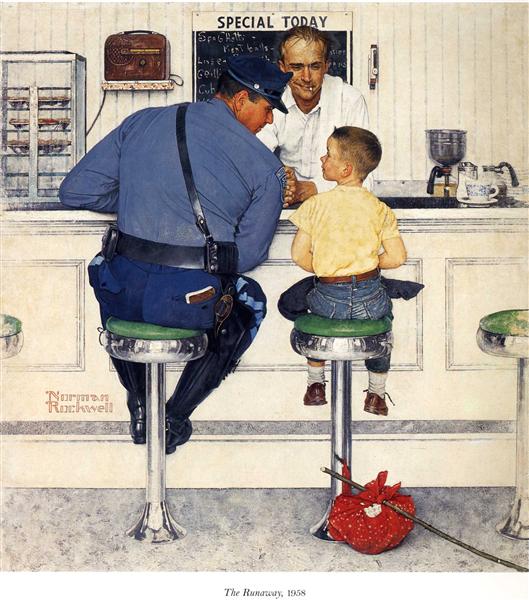
A young boy sits on a diner stool between a state trooper and a friendly counterman.
He carries a bindle stick. His posture shows he’s been caught running away from home.
The trooper and counterman lean in, talking to the boy with understanding rather than anger.
When It Was Created
1958, published as a Saturday Evening Post cover.
Created during Rockwell’s later Post years before switching to Look magazine.
Where You Can See It
Norman Rockwell Museum in Stockbridge, Massachusetts.
Frequently featured in exhibitions about Rockwell’s depictions of childhood.
Why It Matters
Shows adult compassion and understanding toward a child’s mistake.
Captures the idealized relationship between law enforcement and community in 1950s small-town America.
The painting became an enduring image of American childhood and second chances.
The Story Behind It
Set in a typical American diner with chrome stools and a lunch counter.
The scene shows authority figures as protectors rather than punishers.
Rockwell used local models from his Vermont and Massachusetts communities.
Visual Details
The triangular composition with three figures creates balance.
The boy’s small size between two adults emphasizes his vulnerability.
Warm diner lighting creates a safe, welcoming environment.
Details like coffee cups, pie case, and chrome fixtures add period authenticity.
Stockbridge Main Street at Christmas
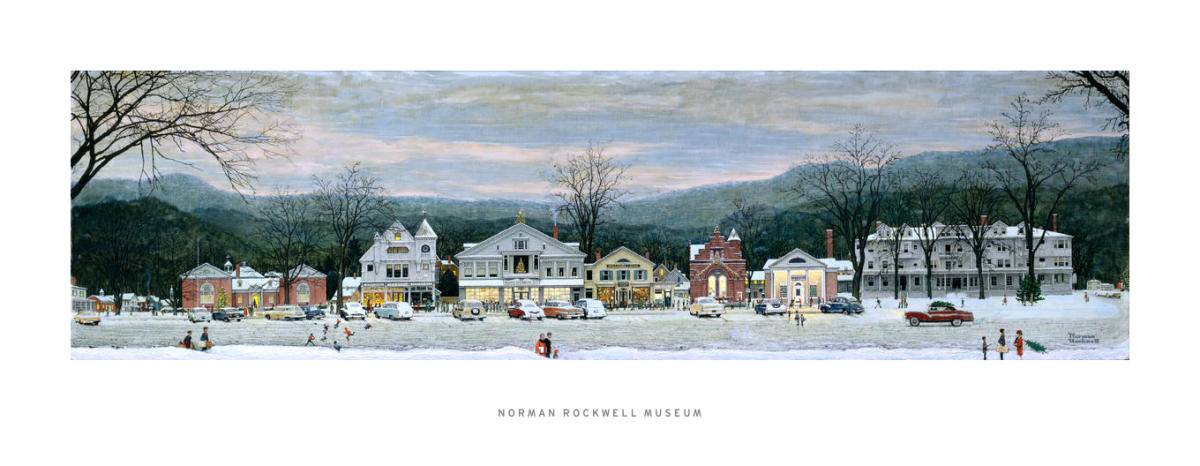
What It Depicts
A snowy New England town at twilight during the Christmas season.
Main Street shows decorated storefronts, vintage cars, and townspeople going about their holiday errands.
Snow covers the street and buildings. Warm lights glow from shop windows.
When It Was Created
1967, one of Rockwell’s later works.
Created after he had lived in Stockbridge, Massachusetts for 14 years.
Where You Can See It
Norman Rockwell Museum in Stockbridge, Massachusetts.
The actual Main Street depicted still exists and looks remarkably similar today.
Why It Matters
Became the quintessential image of small-town American Christmas.
Captures the essence of New England holiday traditions.
The painting epitomizes Rockwell’s ability to create nostalgic, idealized scenes that feel authentic.
The Story Behind It
Rockwell moved to Stockbridge in 1953 and lived there until his death in 1978.
The town provided him with a perfect subject for depicting small-town American life.
He painted his adopted hometown to represent Christmas celebrations across the country.
Visual Details
Twilight sky creates a magical atmosphere with deep blues contrasting warm shop lights.
Snow-covered buildings use white tones to reflect holiday purity and peace.
Period cars and storefronts show 1960s small-town America.
The atmospheric perspective draws viewers down the street into the heart of town.
FAQ on Norman Rockwell Most Famous Paintings
What is Norman Rockwell’s most famous painting?
Freedom from Want is often considered his most iconic work. The 1943 Thanksgiving scene became the definitive image of American family gatherings.
Part of the Four Freedoms series, it helped raise over $132 million in war bonds during World War II.
How many paintings did Norman Rockwell create?
Rockwell produced over 4,000 original works during his six-decade career. He created 323 Saturday Evening Post covers alone.
His prolific output included magazine illustrations, advertisements, calendars, and book illustrations for titles like Tom Sawyer.
Where can I see Norman Rockwell’s original paintings?
The Norman Rockwell Museum in Stockbridge, Massachusetts holds the world’s largest collection. Crystal Bridges Museum owns Rosie the Riveter.
Major works occasionally travel for exhibitions at museums nationwide.
What painting technique did Norman Rockwell use?
Rockwell worked primarily in oil on canvas. He photographed models individually, then used a projector to trace images onto canvas.
His detailed realism involved multiple layers and frequent repainting to achieve perfection.
Why is The Problem We All Live With so important?
This 1964 painting depicting Ruby Bridges became an iconic Civil Rights Movement image. It marked Rockwell’s shift from nostalgic scenes to social commentary.
President Obama displayed it in the White House in 2011 when he met the adult Ruby Bridges.
How much are Norman Rockwell paintings worth?
Saying Grace sold for $46 million in 2013, setting a record. Rosie the Riveter fetched nearly $5 million at Sotheby’s in 2002.
Prices vary widely based on subject matter, size, and historical significance of individual works.
What was Norman Rockwell’s relationship with The Saturday Evening Post?
Rockwell created 323 covers for the magazine over 47 years (1916-1963). His illustrations defined the Post’s visual identity.
He left in 1963 due to editorial restrictions on political content, moving to Look magazine for more creative freedom.
Did Norman Rockwell paint from photographs?
Yes. Rockwell directed photographers to capture posed scenes with models. He then projected photos onto canvas and traced them.
This method allowed precise composition and helped him work faster while maintaining extraordinary detail.
What makes Triple Self-Portrait unique?
The painting shows three versions of Rockwell: from behind, in a mirror, and on canvas. Small reproductions of master self-portraits by Durer, Rembrandt, Van Gogh, and Picasso appear.
Created for his 1960 autobiography announcement in the Saturday Evening Post.
Are Norman Rockwell paintings considered fine art?
Critics initially dismissed Rockwell as merely an illustrator. His reputation evolved after creating powerful civil rights paintings in the 1960s.
Today, museums worldwide recognize him as a significant American artist whose narrative work captured 20th-century culture.
Conclusion
Norman Rockwell most famous paintings continue to captivate audiences decades after their creation, bridging nostalgic Americana with powerful social commentary.
From the Four Freedoms series that rallied wartime patriotism to The Problem We All Live With depicting civil rights struggles, his work transcends simple illustration.
Each piece demonstrates mastery of oil painting techniques, narrative composition, and profound understanding of human emotion. The Saturday Evening Post covers established his artistic legacy.
Museum collections worldwide preserve these cultural treasures. Whether depicting Thanksgiving gatherings, working women during World War II, or children facing adversity, Rockwell’s paintings remain visual touchstones of 20th-century American life.
His ability to capture both idealized moments and harsh realities ensures his artistic influence endures for future generations.