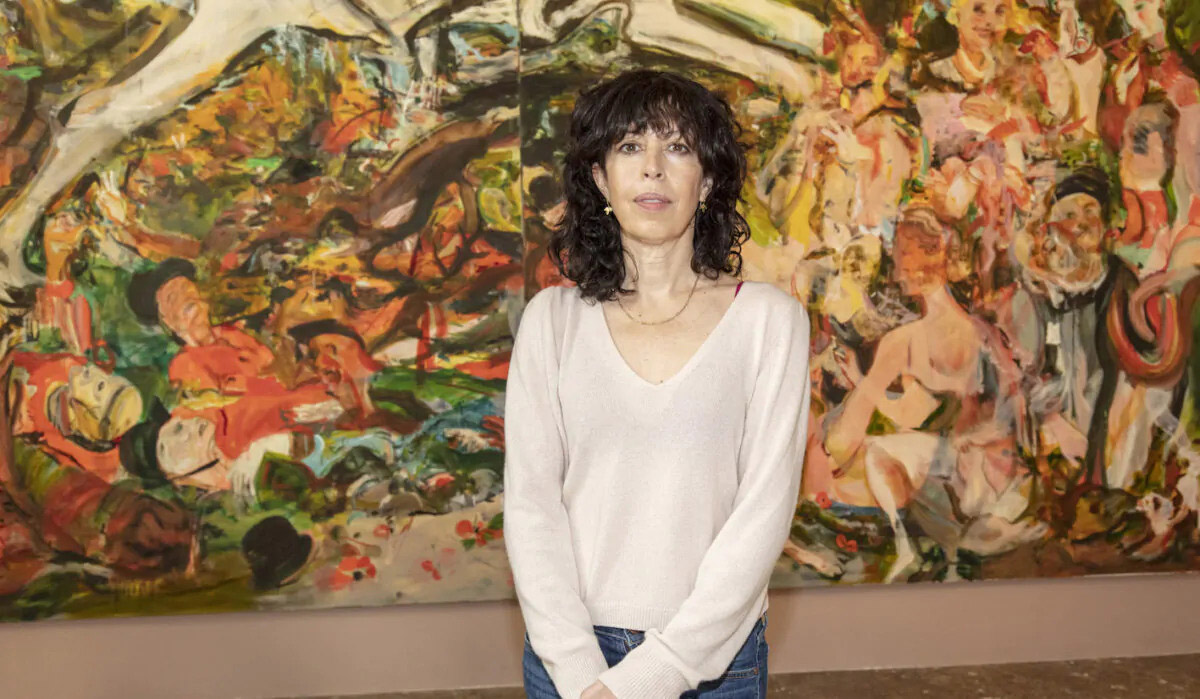

A canvas explodes with fragmented bodies, flesh dissolving into pure chromatic energy. Cecily Brown stands among contemporary art’s most compelling figures, transforming oil painting into something between representation and chaos.
Born in London in 1969, this British painter relocated to New York in 1994 and immediately challenged the art world’s assumptions. While installations and new media dominated the mid-1990s scene, Brown insisted on traditional painting mediums with radical results.
Her work draws from Willem de Kooning, Francis Bacon, and baroque masters while creating something entirely her own. The varnished surfaces shimmer with erotic undertones and mortality themes that shift between abstraction and figuration.
This article examines Brown’s techniques, influences, major works, and market trajectory. You’ll understand what makes her gestural brushwork distinctive and why collectors pay millions for her canvases.
Identity Snapshot
Name: Cecily Brown
Born: 1969, London, England
Nationality: British
Primary roles: Painter, Printmaker
Current base: New York City
Movements: Abstract Expressionism, Contemporary Figurative Abstraction
Mediums: Oil on linen, oil on canvas, monotypes, etchings, ink, watercolor
Signature traits: Vigorous gestural brushwork, wet-in-wet application, lush color saturation, varnished surfaces, knife-applied impasto
Iconography / motifs: Fragmented bodies, erotic forms, rabbits, shipwrecks, vanitas themes, nature morte elements
Education: B-TEC Diploma, Epsom School of Art (1985-87), BA Fine Arts, Slade School of Art (1993)
Mentors: Maggi Hambling, Francis Bacon (friendship influence)
Parents: Shena Mackay (novelist), David Sylvester (art critic)
Collections: Museum of Modern Art, Solomon R. Guggenheim Museum, Whitney Museum, Metropolitan Museum of Art, Tate Modern, Louisiana Museum, Brooklyn Museum, Glenstone Museum
Gallery representation: Gagosian Gallery, Paula Cooper Gallery, Thomas Dane Gallery
Market signals: Auction record $6.8 million (2018), typical large-scale works 80-150 inches, secondary market strong for 1997-2001 paintings
What Sets The Artist Apart

Brown transforms paint into something between flesh and atmosphere. Her canvases pulse with an energy that makes Willem de Kooning‘s work look controlled.
She occupies a space where figuration dissolves into abstraction then reconstitutes. No clean boundaries. Bodies emerge from chromatic chaos only to disappear again under the next stroke. This constant flux defines her entire practice.
Unlike male Abstract Expressionists who dominated the movement, Brown brings a different gaze to erotic content. Her work subverts the masculine tradition while using its visual language. The irony shows in her titles (borrowed from musicals and films) which undercut the paintings’ intensity.
What really separates her? The varnished surfaces. That glossy finish distances viewers while the subject matter pulls them close. You’re always a voyeur, never a participant.
Origins & Formation
Early Life (1969-1985)
Born in Surrey to a literary and critical household. Art surrounded her from age three when she decided on painting as vocation.
Two artist uncles and her grandmother encouraged this early commitment. Friendship with Francis Bacon began during her teenage years through gallery visits.
Art Education (1985-1993)
Left traditional academics at sixteen for Epsom School of Art. Studied under Maggi Hambling in London while taking drawing and printmaking at Morley College.
Cleaned houses to survive. The physical labor didn’t stop studio practice.
Graduated Slade School of Fine Art with First Class Honors (1993). Won First Prize in National Competition for British Art Students. The London art scene felt wrong though. Young British Artists dominated with installations and new media. That conceptual focus didn’t match her material interests.
New York Move (1994)
Relocated permanently at age 25. Exchange student visit in 1992 had already shown her the city’s energy. The Abstract Expressionist legacy still hung in the air there.
First solo exhibition at Deitch Projects (1997) brought immediate attention. Charles Saatchi purchased work. Career ignited fast.
Movement & Context
Positioning

Brown emerged when painting felt unfashionable. Mid-1990s art world favored multimedia, performance, conceptual work.
She insisted on traditional painting mediums during this period. That contrarian choice made her visible.
Her link to Abstract Expressionism is obvious but incomplete. Yes, she shares gestural energy with de Kooning and Joan Mitchell. But she fragments figures differently.
Comparative Analysis
vs. Willem de Kooning: De Kooning’s women appear monstrous, aggressive, angular. Brown’s figures dissolve into suggestion rather than confrontation. His edges stay hard even when forms blur. Hers fluctuate between soft atmospheric passages and sudden sharp definition. Both use high-key color but Brown’s palette leans warmer with more flesh tones, pinks, oranges.
vs. Joan Mitchell: Mitchell worked toward pure abstraction from landscape memory. Brown moves opposite, starting abstract then pulling figuration through. Mitchell’s strokes stay separate, readable. Brown’s merge, overlap, create density that obscures as much as reveals. Mitchell avoided human form. Brown can’t escape it.
vs. Francis Bacon: Bacon isolated figures in void-like spaces with geometric frames. Brown embeds bodies within overall fields where figure-ground relationships collapse. His surfaces stay matte and raw. She glosses everything with varnish. Both explore flesh and violence but Bacon’s horror feels existential while Brown’s registers as sensual excess.
Movement Relationship

She’s been grouped with late-1990s painters like Lisa Yuskavage, Sue Williams, Amy Sillman. All challenged gendered assumptions about painting.
But Brown stands apart through scale (consistently works larger) and through her engagement with Old Masters. She references Peter Paul Rubens, Nicolas Poussin, Francisco Goya as much as 20th century precedents.
Materials, Techniques, and Process
Supports
Primary surface: linen canvas (preferred over cotton for tooth and absorbency). Works occasionally on aluminum panels for different surface resistance.
Canvas sizes typically monumental: 80 x 100 inches to 150 x 200 inches for major works. Recent years included “Neurotic paintings” series at much smaller scale (under 20 inches), testing containment.
Grounds and Mediums
Traditional gesso priming. Uses oil painting techniques inherited from centuries of practice.
Linseed oil as primary medium. The wet-in-wet approach requires careful timing between layers.
Brushwork Taxonomy
- Wet-in-wet blending: Colors merge on canvas rather than palette
- Scumbling: Dry-brush dragging that creates broken, textured passages
- Loaded brush application: Heavy paint deposited in single confident strokes
- Knife work: Palette knife used for scraping back and applying paint in thick swaths
Her brushwork shifts from transparent washes to opaque impasto within single compositions. No consistent application method. The variety creates spatial ambiguity.
Palette Architecture
Dominant hues: Flesh pinks, oranges, reds, deep blacks, occasional acid greens and blues
Value distribution: Mostly mid-to-high key with strategic darks for anchoring
Temperature bias: Warm overall with cool accents for spatial push-pull
Color mixing: Often occurs on canvas surface rather than palette, creating optical blending effects
She uses color for both representation (flesh, landscape elements) and pure chromatic energy simultaneously.
Studio Practice
Non-linear approach: Works on 15-20 canvases at once. Allows paint to dry between sessions while rotating through pieces.
No underdrawing: Starts directly with paint. Forms emerge through process rather than plan.
Layering system: Builds paintings over multiple days or weeks. Early layers often completely obscured by later work. This creates depth through physical accumulation.
Alla prima moments: Some passages painted wet in single session for immediate gestural punch
Varnish application: Final gloss varnish seals and intensifies colors while creating reflective surface
Surface Qualities
The varnish creates problematic viewing conditions (intentionally). Gallery lights reflect. Viewers must move to see different areas clearly.
Paint handling ranges from thin staining to quarter-inch ridges. The texture variation maps spatial relationships without traditional perspective.
Themes, Subjects, and Iconography
Erotic Content (1995-2005)
Early work featured explicit sexual imagery drawn from pornography and erotica. Bodies entangled, isolated body parts, sexual acts rendered through painterly abstraction.
The “Bunny Paintings” series anthropomorphized rabbits in hedonistic scenes. These referenced both Playboy culture and historical vanitas traditions.
After 2005, eroticism became more implied than explicit. Suggestion replaced depiction.
Compositional Schemes
All-over composition: No single focal point. Attention scatters across entire surface.
Centrifugal structure: Energy radiates outward from multiple centers rather than organizing around one.
Baroque density: Recalls Rubens and baroque hunting scenes in overall fullness and movement.
Symbol Sets
Rabbits: Fertility, sexuality, consumption, vanitas
Shipwrecks: Disaster, mortality, sublime destruction (referenced after 2015)
Flowers and fruit: Traditional vanitas symbols updated through fractured presentation
Bodies: Vessels for desire, sites of pleasure and decay
Socio-Historical Triggers
Late 1990s sex-positive feminism influenced her embrace of explicit content. She painted sexual subjects during moment when such work by women remained controversial.
Her 2020 Blenheim Palace exhibition engaged directly with English history and national identity at moment of Brexit. The “broken England” theme addressed contemporary political rupture through historical painting formats.
Recent work (2020-present) has darkened considerably. Mortality themes dominate. The pandemic and personal loss shaped this tonal shift toward death imagery and vanitas subjects.
Notable Works
“Suddenly Last Summer” (1999)
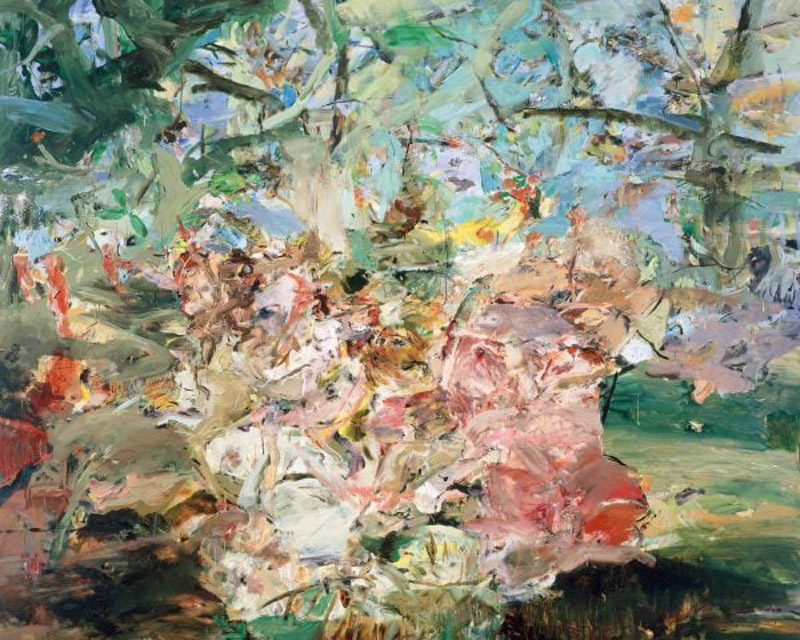
Medium: Oil on linen | Size: 90 x 84 inches
Location: Private collection (sold Sotheby’s 2018 for $6.7 million)
Visual signature: Explosive chromatic field with fragmented bodies emerging through hot pinks, oranges, reds. Brushwork varies from transparent washes to thick impasto ridges. No clear figure-ground separation.
Why it matters: Set auction record. Represents peak of early erotic work. Title references Tennessee Williams play, adding literary layer to visual excess.
“Figures in a Landscape 1” (2001)
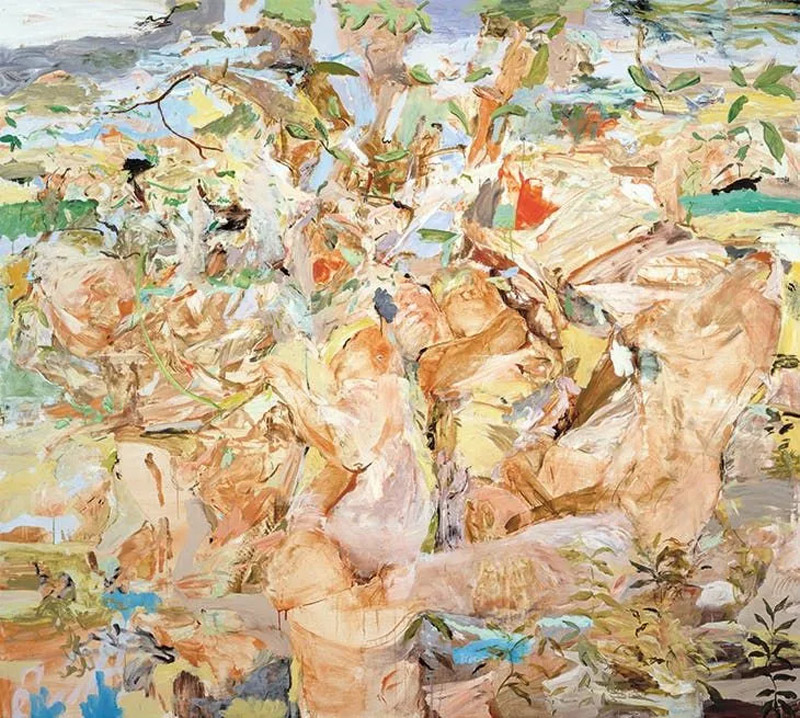
Medium: Oil on linen | Size: Approximately 84 x 120 inches
Location: Private collection (sold through Gagosian 2020 for $5.5 million)
Visual signature: Transitional work showing shift from explicit figuration toward suggestion. Bodies dissolve into landscape elements. Greens and earth tones dominate rather than flesh colors.
Why it matters: Marks stylistic evolution. High secondary market price confirmed market strength for early 2000s production.
“Trouble in Paradise” (2000)
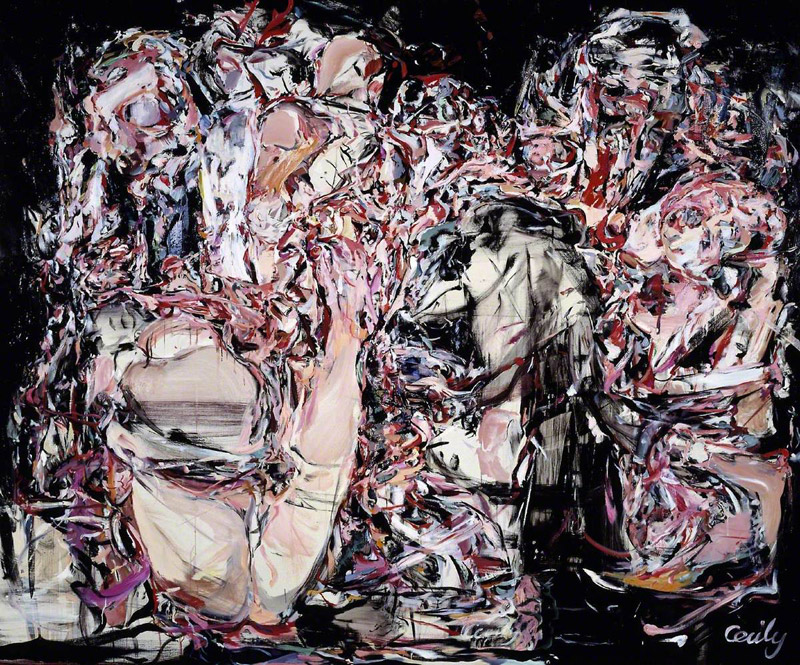
Medium: Oil on linen | Size: Large-scale
Location: Private collection
Visual signature: Chaotic blanket of color with anatomical fragments. Loose brushwork suggests rather than describes forms. Male gaze represented through disembodied face in upper corner.
Why it matters: Demonstrates Brown’s more elusive approach to representation. Shifts from literal depiction to painterly implication.
“The Sleep Around and the Lost and Found” (2014)
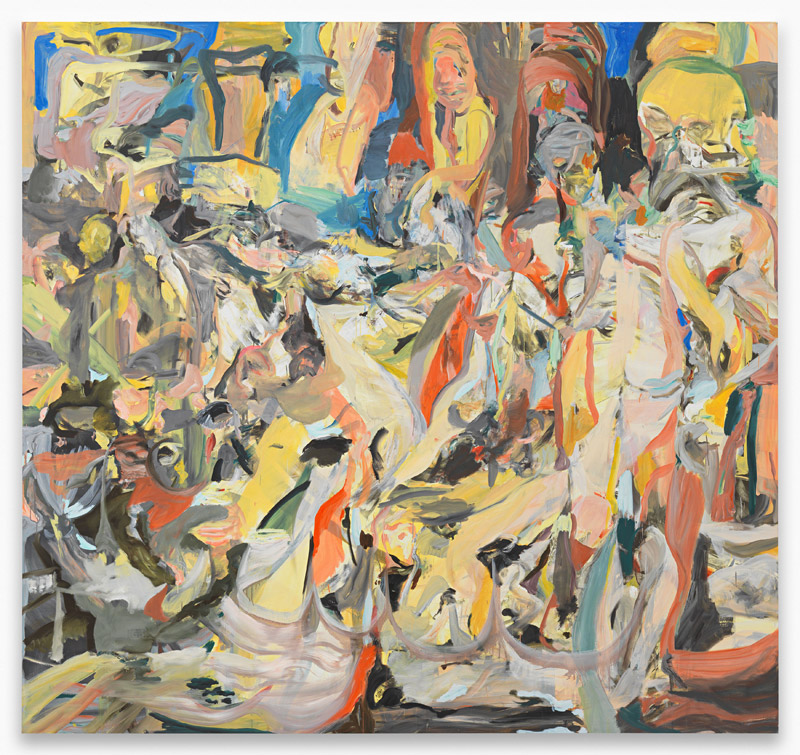
Medium: Oil on linen | Size: Large-scale
Location: Public collection
Visual signature: References Goya’s “Black Paintings” through dark palette and disturbing undercurrent. Anxiety-inducing color choices replace earlier hedonistic brightness.
Why it matters: Shows darker turn in later work. Engages with Old Master precedents more explicitly than earlier paintings.
“There’ll Be Bluebirds” (2019)
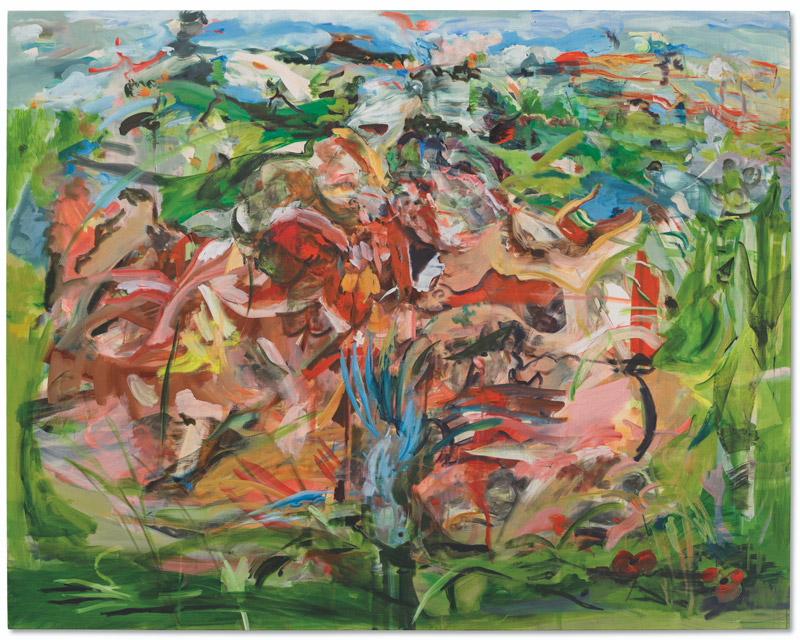
Medium: Oil on linen | Size: Large-scale
Location: Sold Christie’s 2021 for $4.8 million
Visual signature: Recent work showing continued evolution. More atmospheric than earlier paintings while maintaining gestural energy.
Why it matters: Only post-2015 work in top auction results, proving market interest extends beyond early production.
“Death and the Maid” series (2023)
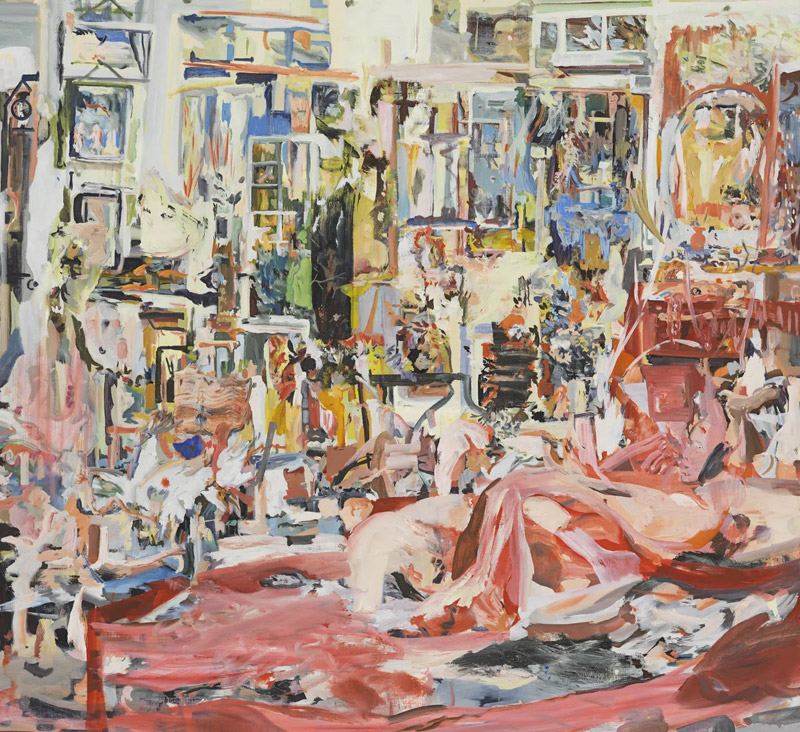
Medium: Oil on linen | Various sizes
Location: Featured in Metropolitan Museum survey
Visual signature: Dark tonality, explicit mortality themes, vanitas imagery. Represents most recent stylistic development.
Why it matters: Title series for first major New York museum survey. Consolidates career-spanning themes while pushing toward new territory.
Exhibitions, Collections, and Provenance Highlights
Major Solo Exhibitions
1997: “Spectacle,” Deitch Projects, New York (career launch)
2002: “Directions: Cecily Brown,” Hirshhorn Museum, Washington D.C.
2004: Museo Nacional Centro de Arte Reina Sofia, Madrid
2006: Mid-career retrospective, Museum of Fine Arts, Boston
2016: “Rehearsal,” The Drawing Center, New York (drawing focus)
2018: “Where, When, How Often and with Whom,” Louisiana Museum, Denmark
2018-19: “If Paradise Were Half as Nice,” Instituto Tomie Ohtake, Sao Paulo
2020: Blenheim Palace, Oxfordshire (engagement with English heritage)
2022: Pinakothek der Moderne, Munich
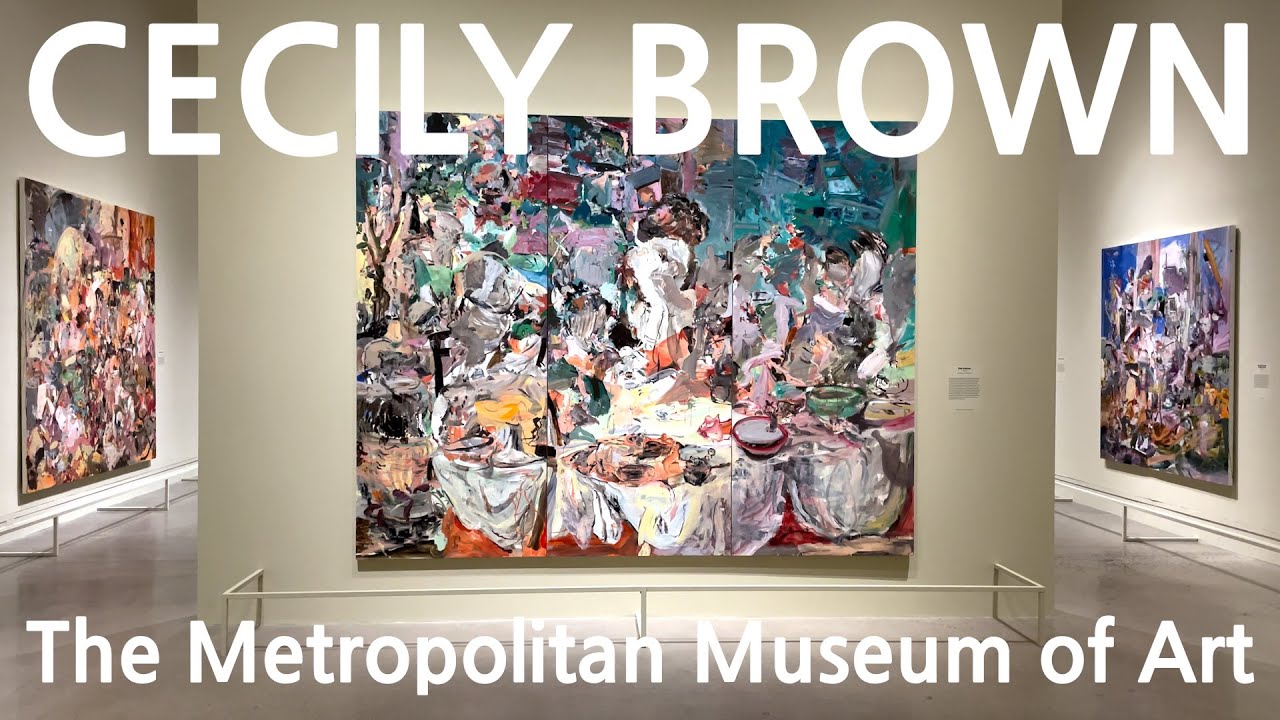
2023: “Death and the Maid,” Metropolitan Museum of Art (first full New York survey)
2025: Barnes Foundation exhibition examining relationship to Chaim Soutine and de Kooning
Museum Holdings (3+ works)
- Museum of Modern Art, New York
- Solomon R. Guggenheim Museum, New York
- Whitney Museum of American Art
- Brooklyn Museum
- Metropolitan Museum of Art
- Tate Modern, London
- Louisiana Museum, Denmark
- Dallas Museum of Art
Provenance Patterns
Early collectors: Charles Saatchi purchased work in 1995, providing career momentum
Celebrity collectors: Elton John, Michael Ovitz among notable buyers
Gallery trajectory: Started with Deitch Projects, moved to major galleries (Gagosian, Paula Cooper, Thomas Dane)
Auction presence: Regular secondary market activity since 2007. Peak year 2021 with $35.5 million total sales.
Critical Reception Shifts
Initial celebration (late 1990s) focused on sexual content and bold female voice in painting.
Mid-career criticism questioned necessity and character (Adrian Searle in Guardian 2011 called work “lackluster”).
Recent reassessment (2020s) emphasizes historical engagement and sustained evolution rather than provocative content.
Feminist readings remain contested. Some see her as challenging masculine tradition. Others argue against overtly feminist interpretation of her practice.
Market & Reception
Auction Performance
Record: $6.8 million for “Suddenly Last Summer” (1999), Sotheby’s New York, May 2018
Seven-figure threshold: First crossed $1 million in 2007. Has sold at seven figures 47+ times since.
Price bands by period:
- Early work (1997-2001): $1-6.8 million range for major canvases
- Mid-period (2002-2010): $400,000-$2 million typical
- Recent work (2015-present): $1-4.8 million for large paintings
Print market: Strong demand for unique monotypes. Record $250,000 for six-part monotype (2017). Seventeen prints sold above $10,000.
Market trajectory: Slowed during 2014-15 (broader young painter bubble). Returned strong in 2017. Peak year 2021 with $35.5 million total auction sales.
Authentication
Works authenticated through gallery records. No catalogue raisonne yet published.
Signature placement varies. Early works often signed verso. Later paintings may include signature on recto.
Condition Patterns
Varnished surfaces protect from environmental damage but can yellow over time. Proper UV filtration recommended.
Heavy impasto areas susceptible to cracking if canvases not properly supported. Some early works show minor craquelure.
Linen support generally stable. Works on aluminum show different aging characteristics.
Influence & Legacy
Upstream Influences
Direct mentors:
- Maggi Hambling (technique, confidence)
- Francis Bacon (psychological intensity, distorted figures)
Art historical precedents:
- Willem de Kooning (gestural application, figure-abstraction tension)
- Joan Mitchell (all-over composition, chromatic intensity)
- Peter Paul Rubens (baroque fullness, flesh rendering)
- Nicolas Poussin (compositional structure)
- Francisco Goya (“Black Paintings” darkness)
- Edgar Degas (cropped compositions, voyeuristic framing)
- William Hogarth (narrative complexity, moral ambiguity)
- Hieronymus Bosch (fantastical imagery, chaos)
Contemporary context:
- Lucian Freud (flesh obsession)
- Pablo Picasso (figure deconstruction)
Downstream Impact
Direct influence limited (younger painters reference her less than might be expected given market success)
Institutional validation: Museum acquisitions and exhibitions legitimize large-scale gestural painting for emerging artists
Market effects: Her auction results helped establish viable market for contemporary female painters working at monumental scale
Gender discourse: Work prompted ongoing discussion about female artists using traditionally masculine painting modes
Cross-Domain Echoes
Photography: Her fragmented bodies parallel work of fashion photographers like Nick Knight
Design: The chaos-to-clarity visual strategy appears in graphic design exploring legibility thresholds
Cinema: The dissolved figure-ground relationships evoke experimental film techniques
Contemporary Positioning
Sits between older Abstract Expressionists (whose prices dwarf hers) and younger representational painters. Chronologically Gen X but aesthetically connected to postwar precedents.
Grouped with “return to painting” movement of late 1990s. That categorization now feels dated as painting never actually left.
How to Recognize a Cecily Brown at a Glance
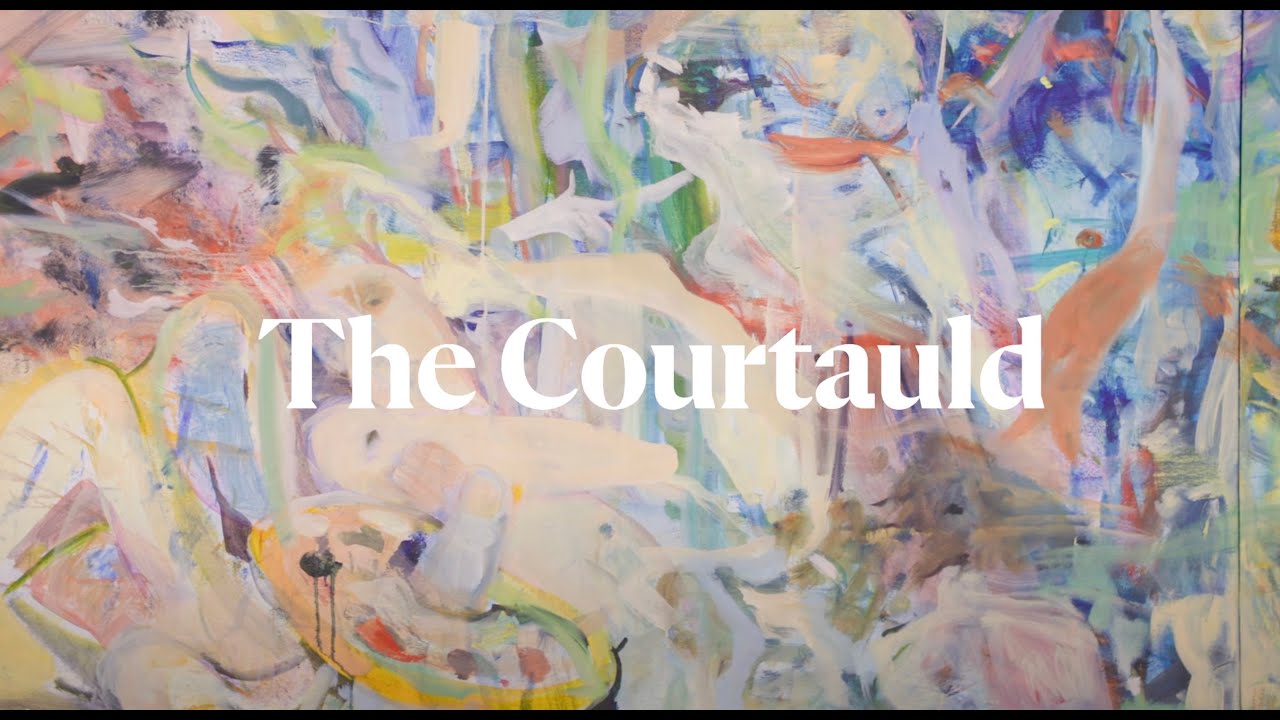
Diagnostic checklist:
- Varnished surface with high gloss finish (almost always present, especially post-2000)
- Monumental scale (typical works exceed 80 inches in at least one dimension)
- Pink-orange-red flesh tone dominance in figural areas even when forms dissolve
- Wet-in-wet blending creating soft edges between color zones
- Strategic impasto ridges contrasting with thin washed passages
- No clear focal point with attention distributed across entire surface
- Fragmented anatomical suggestions (body parts emerging then dissolving back into paint)
- Baroque compositional fullness with little negative space
- Oil on linen as standard support (occasionally aluminum but rarely raw canvas)
- Titled after films, musicals, or literary sources creating ironic distance from subject matter
FAQ on Cecily Brown
What is Cecily Brown known for?
Cecily Brown is known for large-scale oil paintings that blur figuration and abstraction. Her gestural brushwork transforms bodies into fragmented forms with intense color saturation and erotic undertones, challenging masculine Abstract Expressionist traditions.
What painting style does Cecily Brown use?
Brown works in Abstract Expressionism with figurative elements. Her style combines vigorous gestural marks, wet-in-wet blending, and varnished surfaces. She references Willem de Kooning and baroque masters while creating all-over compositions without clear focal points.
Where does Cecily Brown live and work?
Brown lives and works in New York City. Born in London in 1969, she relocated permanently to New York in 1994 after studying at Slade School of Art. She maintains a studio where she works on 15-20 canvases simultaneously using non-linear methods.
What materials does Cecily Brown use?
Brown primarily uses oil on linen for paintings. She also creates monotypes, etchings, and works on paper using ink and watercolor. Her painting mediums include linseed oil, and she applies final gloss varnish to seal surfaces and intensify colors.
How much are Cecily Brown paintings worth?
Brown’s auction record is $6.8 million for “Suddenly Last Summer” (1999). Large-scale works from 1997-2001 typically sell for $1-6 million. Recent paintings command $1-4 million. Her unique monotypes reach $250,000, with strong secondary market demand across all periods.
Who influenced Cecily Brown’s art?
Willem de Kooning, Francis Bacon, and Joan Mitchell shaped her gestural approach. Old Masters like Peter Paul Rubens, Francisco Goya, and Edgar Degas influenced her compositional structures and flesh rendering techniques.
What are Cecily Brown’s most famous paintings?
“Suddenly Last Summer” (1999) holds her auction record. “Figures in a Landscape 1” (2001) sold for $5.5 million. “Trouble in Paradise” (2000) demonstrates her shift toward suggestion. The “Death and the Maid” series (2023) represents her recent mortality-focused work at Metropolitan Museum.
What is unique about Cecily Brown’s technique?
Brown’s varnished surfaces create reflective viewing conditions. She works wet-in-wet, allowing colors to merge on canvas rather than palette. Her brushwork shifts from transparent washes to thick impasto within single compositions, creating spatial ambiguity and textural variation.
Where can I see Cecily Brown’s work?
Brown’s paintings hang in Museum of Modern Art, Solomon R. Guggenheim Museum, Whitney Museum, Metropolitan Museum of Art, and Tate Modern. Her 2023 “Death and the Maid” exhibition at the Met marked her first full New York survey, with major holdings in multiple institutions.
What themes does Cecily Brown explore?
Brown explores sexuality, mortality, and desire through fragmented bodies. Early work featured explicit erotic content and “Bunny Paintings” series. Recent paintings address vanitas themes, shipwrecks, and death imagery. She consistently references art history while maintaining contemporary urgency and psychological intensity.
Conclusion
Cecily Brown redefined contemporary painting by refusing to choose between figuration and abstraction. Her lush surfaces and fragmented forms challenge decades of masculine dominance in gestural painting.
From early erotic canvases to recent mortality themes, she’s maintained technical mastery while evolving thematically. The varnished texture and color intensity create viewing experiences that shift with each glance.
Her auction results ($6.8 million record) reflect serious collector interest across institutions and private holdings. Major museums from the Met to Tate Modern recognize her contribution to painting styles that bridge historical precedent and contemporary urgency.
Brown’s influence extends beyond individual works. She proved that traditional oil painting could remain relevant when the art world dismissed it, opening paths for subsequent generations of painters working at monumental scale.