Lee Ufan is a Korean-born minimalist painter, sculptor, and philosopher who helped shape post-war Japanese contemporary art. His work sits at the intersection of Eastern aesthetics and Western phenomenology.
As a founding theorist of the Mono-ha movement (meaning “School of Things”) in the late 1960s, he rejected Western representation. Instead, he focused on raw materials and the relationships between objects, viewers, and space.
Born in 1936 in Haman-gun, South Korea, Lee studied philosophy at Nihon University in Tokyo. He has worked across painting, sculpture, installation, and art criticism for over five decades. His contributions to the Dansaekhwa (Korean monochrome painting) movement further cemented his position in contemporary Asian art history. Look, the guy basically wrote the rulebook for an entire artistic era.
Identity Snapshot
- Full Name: Lee Ufan (Korean: 이우환; Hanja: 李禹煥)
- Also Known As: Yi U-hwan, Li Yuhuan
- Lifespan: Born June 24, 1936 (age 88)
- Primary Roles: Painter, Sculptor, Philosopher, Art Critic, Academic
- Nationality: South Korean (active in Japan and France)
- Movements: Mono-ha, Dansaekhwa (Korean Monochrome Painting)
- Mediums: Mineral pigment with animal-skin glue on canvas, oil and acrylic on canvas, stone and steel sculptures
- Signature Traits: Fading brushstrokes (yohaku), single gestures, repeated marks, gradation through pigment depletion
- Iconography: Points, lines, natural stones, industrial steel plates, empty space as active element
- Geographic Anchors: Haman-gun (birthplace), Tokyo, Kamakura, Paris, Arles
- Mentors: Trained in calligraphy and inkbrush painting as a child; influenced by Heidegger, Nishida Kitaro, Merleau-Ponty
- Key Relationships: Nobuo Sekine (Mono-ha collaborator), Tadao Ando (architect of his museums)
- Collections: Guggenheim Museum, MoMA, Centre Pompidou, Tate Modern, Hirshhorn Museum, National Museum of Modern Art Tokyo
- Market Signals: Auction record of approximately $2.66 million (East Winds, 1984, sold at Seoul Auction 2021); active secondary market with works regularly appearing at Christie’s, Sotheby’s, and Phillips
What Sets Lee Ufan Apart
Lee Ufan paints with controlled restraint. A single brushstroke can take minutes of meditative breathing before execution.
He mixes ground mineral pigment with animal-skin glue, creating a shimmering blue mixture that gradually depletes as it moves across the canvas. The technique comes from traditional nihonga painting, but the application is entirely his own.
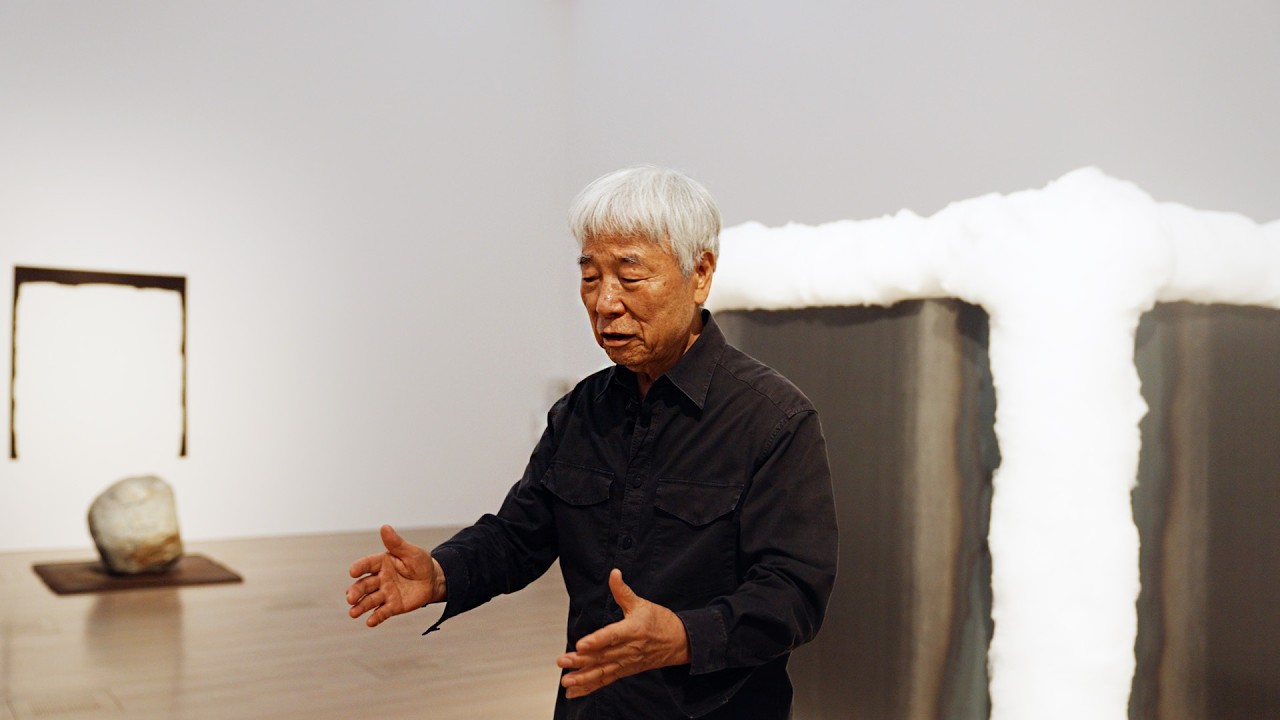
His sculptures pair unworked natural stones with polished industrial steel. Nothing is carved or altered. The stone arrives as the earth made it.
Where minimalism in the West often feels cold and industrial, Lee’s work breathes. There is warmth in the empty spaces he leaves untouched. Actually, those empty spaces might be the point. He calls this yohaku, the art of emptiness.
The Korean monochrome painters (Dansaekhwa) shared some of his concerns about repetition and process. But Lee pushed further into philosophy. He wanted viewers to experience the encounter between material and void, not just look at a pretty surface.

Origins and Formation
Early Training
Lee grew up in a traditional Confucian household during the Japanese occupation of Korea. His grandfather taught him calligraphy and inkbrush painting. Poetry and classical texts were part of daily life.
He briefly attended Seoul National University’s art program before leaving for Japan in 1956. There, he enrolled in the philosophy department at Nihon University.
Philosophical Foundation
His philosophy degree (completed 1961) shaped everything that followed. He read Nietzsche, Rilke, Heidegger, and Merleau-Ponty. The Kyoto School thinkers, especially Nishida Kitaro, offered a bridge between Eastern and Western thought.
I think this background explains why his art criticism feels so different from typical artist statements. He actually knows what he is talking about.
The Mono-ha Moment
In 1968, Lee met Nobuo Sekine in Shinjuku, Tokyo. Sekine had just created “Phase, Mother Earth,” a hole dug into the ground with the excavated earth compacted into a matching cylinder beside it.
Lee recognized something significant. He wrote “Beyond Being and Nothingness: A Thesis on Sekine Nobuo” in 1969, which became the theoretical foundation for Mono-ha.
His first solo exhibition happened at Sato Gallery, Tokyo, in 1967. By 1969, he won the Art Critic’s Prize from Bijutsu Shuppan-Sha for his writing.
Movement and Context
Within Mono-ha

Mono-ha rejected the heroic ego of abstract expressionism. No grand gestures. No drama. Just materials placed in relationship to space and each other.
The movement included Nobuo Sekine, Kishio Suga, Susumu Koshimizu, Koji Enokura, and others. Lee served as both practitioner and spokesperson, translating their intuitions into theoretical language.
Comparative Position
Compared to Mark Rothko, Lee works with specific marks rather than atmospheric fields. Rothko’s edges blur into one another. Lee’s edges appear and disappear through pigment depletion.
Against Jackson Pollock, the contrast is even sharper. Pollock threw paint with physical abandon. Lee applies a single stroke while holding his breath, concentration absolute.
Yayoi Kusama, a Japanese contemporary, uses repetition obsessively to create immersive infinity. Lee uses repetition to mark time and presence, each mark distinct from the last.
His sculptural practice shares territory with Arte Povera in its use of humble materials. But where Arte Povera often feels rough and confrontational, Lee’s stone and steel arrangements achieve a quiet tension. The relationship matters more than the objects.
Materials, Techniques, and Process
Painting Supports and Grounds
Lee works primarily on stretched canvas, primed white. Canvas dimensions tend toward the large, often exceeding 180 x 220 cm. The blank ground is not background. It functions as an active participant.
Pigment Preparation
For the From Point and From Line series, he mixed ground mineral pigment with animal-skin glue. This recipe comes from traditional nihonga practice. The result is a gritty, shimmering surface with high friction against the brush.
Later works (Dialogue series) use acrylic mixed with mineral pigment. The shift allowed for larger brushmarks and different drying characteristics.
Brushwork Taxonomy
Lee’s technique borrows from Japanese calligraphy’s principle of ikkaisei (irreversibility). Each stroke is final. No corrections.
In From Line, vertical strokes cascade from top to bottom. The brush starts loaded, creating a dense ridge of color. As the pigment depletes, the stroke fades toward invisibility.
From Point works similarly but with discrete dabs. Each row begins with a fresh brush load, progressing left to right until the paint runs out.
The Dialogue series features single, often squared brushstrokes. These marks look simple but result from repeated layering.
Studio Practice
“Before working, I calm my breathing, correct my posture, and hold my brush quietly.” That quote sums up his approach. Meditation precedes action. The canvas sits horizontal during application, then rotates 90 degrees for viewing.
He positions his body over the canvas, sweeping the brush in one controlled breath. The synchronization of breath and stroke transforms painting into a ritualistic process.
Themes, Subjects, and Iconography
Recurring Motifs
Points and lines. That is it, mostly. But within that limitation, infinite variation occurs through spacing, gradation, and arrangement.
Natural stones appear throughout his sculptures. He selects them personally, sometimes traveling to quarries or riverbanks. The stones remain uncarved.
Industrial steel plates provide counterpoint to organic stone. The manufactured precision contrasts with geological chance.
Compositional Schemes
Most paintings feature centered or off-center brushwork against expansive white ground. The surrounding space is not empty. It resonates.
Sculptures use asymmetrical balance. A heavy stone might rest against a tilted steel plate. Or multiple stones create implied lines across a gallery floor.
Philosophical Triggers
The rapid industrialization of 1960s Japan provoked Mono-ha’s emergence. Lee saw artists responding to a world increasingly dominated by manufactured objects.
Eastern philosophy underlies everything. Zen Buddhism’s emphasis on emptiness. Taoist ideas about the uncarved block. The space between things mattering as much as the things themselves.
European phenomenology, especially Merleau-Ponty’s writings on perception, gave Lee a vocabulary to articulate what he intuited.
Notable Works
Relatum (1968/Ongoing)

Medium: Stone, steel plates, various dimensions
Current Locations: Tate Modern, Dia Beacon, Guggenheim, Lee Ufan Museum Naoshima, and many others
Visual Signature: Unworked natural stones paired with flat industrial steel. Minimal intervention. Site-specific arrangements.
Why It Matters: Lee renamed all past and future sculptures Relatum in 1972. The title refers to things in relationship. These works defined Mono-ha’s sculptural approach and continue to influence installation practice worldwide.
From Line No. 790372 (1979)

Medium: Oil and mineral pigment on canvas, 135.2 x 166.8 cm
Visual Signature: Thirty-two vertical blue lines cascading down the canvas. Each stroke begins densely and fades as pigment depletes.
Why It Matters: This painting exemplifies the mature From Line technique. The rhythm of appearance and disappearance creates a meditative texture.
From Point (1980)

Medium: Glue and stone pigment on canvas, 181.7 x 227 cm
Current Location: Private collection; frequently exhibited
Visual Signature: Rows of dots moving left to right, each row beginning with a fresh brush load. Staggered starting points create rhythmic patterns.
Why It Matters: The From Point series reduced painting to its most basic element. Time becomes visible through sequential marks.
East Winds (1984)

Medium: Oil and mineral pigment on canvas
Visual Signature: Broader, more calligraphic strokes than earlier series. Movement and breath visible in the sweeping gestures.
Why It Matters: This painting set the auction record for a living South Korean artist at approximately $2.66 million (Seoul Auction, 2021). It represents the transition from systematic repetition toward expressive spontaneity.
Dialogue (2018)

Medium: Acrylic on canvas, 161.9 x 130 cm
Visual Signature: Single squared brushstroke, gray-blue against white. Multiple layers create depth within apparent simplicity.
Why It Matters: The Dialogue series (2006 onward) represents Lee’s current practice. Single marks contain entire worlds of process and intention.
Relatum – The Arch of Versailles (2014)

Medium: Stainless steel and two stones, 1,113 x 1,500 x 200 cm
Current Location: Created for Palace of Versailles exhibition
Visual Signature: Monumental steel arc with boulder-scale stones. Site-specific response to historic architecture.
Why It Matters: This work demonstrated Lee’s ability to operate at architectural scale while maintaining the intimate tension of his smaller sculptures.
Exhibitions, Collections, and Provenance
Key Exhibitions
- 1967: First solo exhibition, Sato Gallery, Tokyo
- 1971: Paris Biennale (representing Korea)
- 1977: Documenta VI, Kassel, Germany
- 2011: “Lee Ufan: Marking Infinity,” Guggenheim Museum, New York (first major US retrospective)
- 2014: Palace of Versailles (seventh guest artist in contemporary program)
- 2018: Serpentine Galleries, London
- 2019: “Lee Ufan: Open Dimension,” Hirshhorn Museum, Washington D.C.
- 2022: National Art Center, Tokyo (major retrospective)
- 2024: “Lee Ufan: Quiet Resonance,” Art Gallery of New South Wales, Sydney
Permanent Museum Spaces

- Lee Ufan Museum, Naoshima, Japan (2010): Designed by Tadao Ando at Benesse Art Site
- Lee Ufan Arles, France (2022): 17th-century Hotel Vernon renovated by Tadao Ando, 1,347 square meters
- Space Lee Ufan, Busan Museum of Art, Korea (2014)
Major Collections
His work appears in the Museum of Modern Art (New York), Centre Pompidou (Paris), Tate Modern (London), Guggenheim Museum, Hirshhorn Museum, National Museum of Modern Art (Tokyo and Kyoto), Samsung Museum of Art (Seoul), and Dia Art Foundation (Beacon). That list barely scratches the surface.
Market and Reception
Auction Performance
Lee’s auction record stands at approximately $2.66 million for “East Winds” (1984), achieved at Seoul Auction in 2021. This made him the highest-selling living South Korean artist at the time.
Works regularly appear at Christie’s, Sotheby’s, Phillips, and Seoul Auction. Paintings from the From Line and From Point series command strong prices, typically ranging from $200,000 to over $1 million depending on size and provenance.
Prints and works on paper remain more accessible, often selling between $5,000 and $50,000.
Gallery Representation
Pace Gallery, Lisson Gallery, Kamel Mennour, Kukje Gallery, and Blum and Poe represent his work internationally.
Authentication Considerations
Works are typically signed “L. Ufan” with the year on the reverse. The Galleries Association of Korea provides authentication services.
Given his stature, fakes exist. Buyers should verify provenance carefully and seek documentation from established galleries or auction houses.
Influence and Legacy
Upstream Influences
His Confucian upbringing introduced classical Chinese philosophy (Lao Tzu, Chuang Tzu). Traditional inkbrush training shaped his understanding of the single, committed stroke.
Western phenomenology, particularly Heidegger and Merleau-Ponty, provided theoretical frameworks. The Kyoto School philosopher Nishida Kitaro bridged Eastern and Western thought.
Downstream Impact
Lee taught at Tama Art University from 1973 to 2007. Photographer Yoshio Itagaki studied under him from 1989 to 1991.
His writings influenced how contemporary art is discussed in both Japan and Korea. The theoretical vocabulary he developed for Mono-ha continues to shape criticism of installation and material-based art.
Artists like Anish Kapoor and Park Seo-Bo have cited his influence. Architect Tadao Ando collaborated on two museum buildings dedicated to his work.
Cross-Domain Echoes
His emphasis on negative space resonates with contemporary architecture and design. Japanese minimalist interiors owe something to the sensibility he articulated.
The slow, deliberate process he advocates connects to broader movements around mindfulness and contemplative practice in art-making.
How to Recognize a Lee Ufan at a Glance
- Fading brushstrokes: Marks that begin densely and gradually disappear as pigment depletes
- Expansive white ground: Large areas of untouched canvas functioning as active composition elements
- Mineral pigment sheen: Slightly gritty, shimmering surface quality from ground stone pigment
- Blue-gray palette: Dominant cool blues and grays, occasionally warm ochres in later work
- Single or repeated gestures: Either one isolated mark or systematic rows of marks
- Large canvas sizes: Typically 180 x 220 cm or larger for major paintings
- Signature placement: Signed “L. Ufan” with year, usually on verso
- Stone and steel sculptures: Unworked natural stones paired with flat industrial metal
- Site-specific awareness: Sculptures placed to respond to architectural context
- Absence of framing: Paintings displayed without frames to maintain edge integrity
FAQ on Lee Ufan
Who is Lee Ufan?
Lee Ufan is a Korean-born minimalist painter and sculptor, born in 1936 in Haman-gun, South Korea. He became the leading theorist of the Mono-ha movement in Japan during the late 1960s. He now divides his time between Kamakura, Paris, and New York.
What is the Mono-ha movement?
Mono-ha translates to “School of Things” in Japanese. This avant-garde movement (1968-1975) rejected Western representation. Artists used raw materials like stone, steel, and wood with minimal intervention. Lee Ufan wrote the theoretical texts that defined the movement’s philosophy.
What is Lee Ufan best known for?
He is known for his Relatum sculptures and his From Point and From Line painting series. His work emphasizes the encounter between natural and industrial materials. The empty space in his paintings functions as an active element, not mere background.
Where can I see Lee Ufan’s artwork?
Two museums are dedicated to his work: the Lee Ufan Museum on Naoshima Island, Japan, and Lee Ufan Arles in France. Both were designed by architect Tadao Ando. Major collections include the Guggenheim, Centre Pompidou, and Tate Modern.
What is the Relatum sculpture series?
Relatum refers to all of Lee’s three-dimensional works, renamed in 1972. These sculptures pair unworked natural stones with industrial steel plates. The title means “things in relationship.” Each installation responds specifically to its site and surrounding pictorial space.
How much are Lee Ufan paintings worth?
His auction record is approximately $2.66 million for “East Winds” (1984). Paintings from the From Line and From Point series typically range from $200,000 to over $1 million. Prints and works on paper sell between $5,000 and $50,000.
What is the From Point painting series?
From Point (1973-1984) features rows of dots applied with a single brush load. Each row begins densely and fades as pigment depletes. The series reduces painting to its most basic shape while making time visible through sequential marks.
What is the From Line painting series?
From Line (1973-1984) consists of vertical strokes cascading down the canvas. Lee loads his brush once per stroke, pulling from top to bottom until the value fades completely. The technique comes from traditional nihonga painting and calligraphy practice.
What materials does Lee Ufan use?
For paintings, he mixes ground mineral pigment with animal-skin glue or acrylic. His sculptures use uncarved natural stones and polished steel plates. He selects stones personally from quarries. The materials remain in their original state with no alteration.
What is Dansaekhwa and how does Lee Ufan relate to it?
Dansaekhwa is the Korean monochrome painting movement that emerged in the 1970s. Lee contributed to this movement alongside his Mono-ha work. His repetitive brushwork and meditative process align with Dansaekhwa’s emphasis on form, material presence, and bodily gesture.
Conclusion
Lee Ufan transformed how we understand the relationship between art, space, and viewer. His encounter philosophy continues to shape contemporary installation practice worldwide.
From the Relatum sculptures at Benesse Art Site Naoshima to the meditative brushwork of the Dialogue series, his influence spans continents. The Praemium Imperiale award and dedicated museums in Japan and France confirm his lasting impact.
His art asks us to slow down. To notice the harmony between stone and steel, mark and void.
Few artists bridge Eastern contemplative traditions and Western conceptual practice so effectively. That bridge remains his greatest contribution.