A French painter who never grew up riding horses now commands the contemporary Western art scene.
Mark Maggiori paints cowboys, desert landscapes, and monumental skies that sell for six figures at auction. His path to Western art started at fifteen during a cross-country road trip, but he didn’t pick up a brush to paint the American West until age 36.
Between art school in Paris and his first cowboy painting, Maggiori fronted a metal band signed to Sony Records, directed music videos, and worked for Disney Animation Studios.
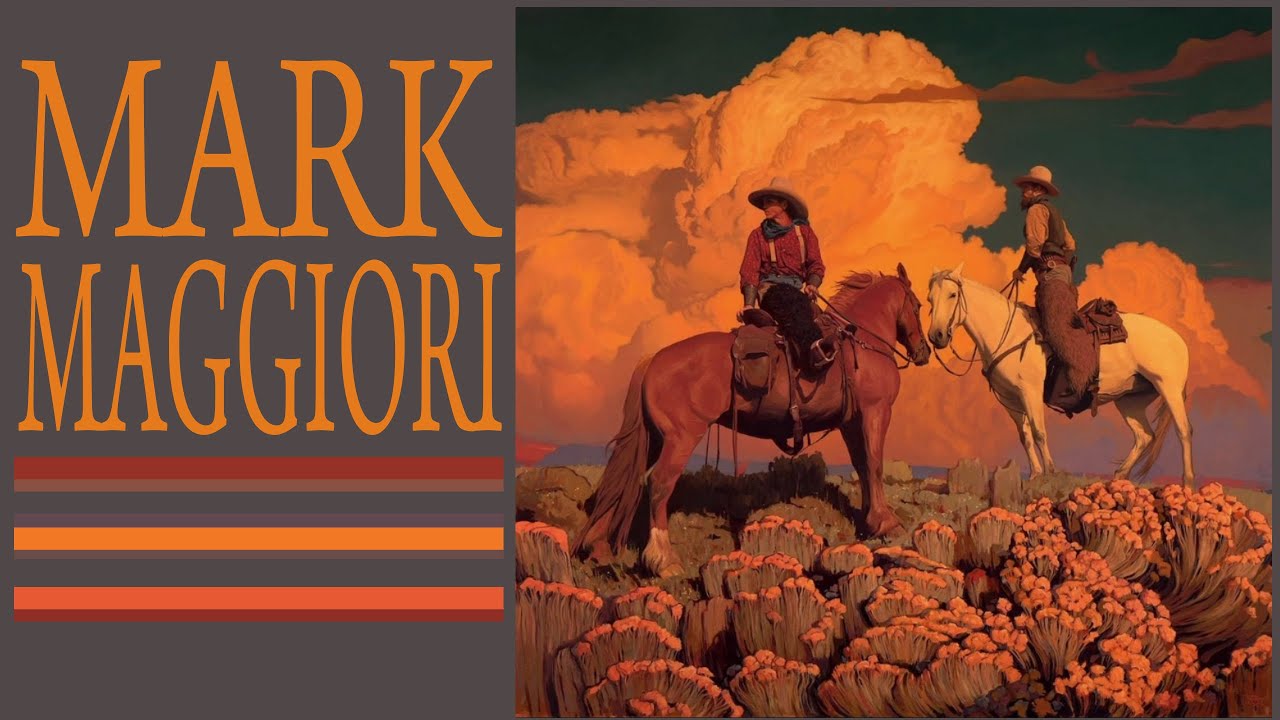
This isn’t your grandfather’s Western art. Maggiori’s oil paintings blend French academic training with frontier mythology, creating dramatically lit scenes where clouds dominate and cowboys become tiny silhouettes against electric skies.
You’ll discover how an outsider perspective transformed traditional Western painting, what makes his technique instantly recognizable, and why collectors wait in digital lines for his limited edition print releases.
Identity Snapshot
Full Name: Mark Maggiori
Born: June 16, 1977 (age 48)
Birthplace: Fontainebleau, France
Nationality: French-American
Primary Roles: Painter, graphic designer, draftsman, musician, music video director
Active Period: 2014-present (Western art)
Movements: Contemporary Western art, modern realism
Training: Academie Julian, Paris
Mediums: Oil on canvas, oil on linen, graphite, watercolor
Signature Traits: Layered cloud structures, cinematic composition, dramatic atmospheric lighting, knife-applied impasto in sky sections
Iconography: Cowboys on horseback, Native Americans, buffalo, desert mesas, vast horizons, sunset skies, lone riders
Geographic Anchors: Fontainebleau (birth), Paris (training), Los Angeles, Kingman (Arizona), Taos (New Mexico, current residence)
Key Relationships: Father Robert Maggiori (philosopher/journalist); wife Petecia Le Fawnhawk (artist); former Pleymo bandmate
Collections: Briscoe Western Art Museum (San Antonio), Eiteljorg Museum (Indianapolis), Autry Museum of the American West (Los Angeles), Maxwell Alexander Gallery, Couse-Sharp Historic Site
Market Signals: Record auction $275,000 (Morning Above the Canyon, 2023); typical range $40,000-$108,900; limited edition prints $270-$680
What Sets This Artist Apart

Maggiori paints the American West through European eyes.
His clouds dominate canvases like textural monuments. They dwarf cowboys and magnify emptiness at once. The technique mixes academic French training with frontier mythology, creating what critics call “impossible detail” in atmospheric effects.
Most Western painters grew up riding horses. Maggiori saw his first desert at fifteen during a road trip from New York to San Francisco.
That distance shows. His work romanticizes what locals take for granted. Cowboys become silhouettes against electric skies. Buffalo transform into spiritual symbols rather than livestock.
The composition follows cinematic framing (his Disney animation background). Horizon lines sit low. Skies consume two-thirds of each canvas. Figures occupy minimal space but maximum emotional weight.
He works fast when inspired. Some paintings finish in days. Others sit for months until “it’s finished when it’s good,” not when the calendar says so.
Origins & Formation
Early Training (1995-2000)
Maggiori enrolled at Academie Julian without knowing he could draw.
The prestigious Paris institution drilled academic fundamentals. Life drawing. Anatomy. Classical perspective. He absorbed French realist traditions while punk rock played in his headphones.
His father, a philosopher and journalist, questioned the art school decision. France in the 1990s dismissed figurative painting as outdated. Abstraction ruled galleries.
Disney Period (2000-2001)
Fresh from Julian, Disney Animation Studios Paris offered an Art Director position.
He declined.
Music videos and band posters paid worse but felt more authentic. The Pleymo years (1997-2007) as lead vocalist and visual designer took priority. Sony Records signed them in 2001. Ten years of global touring followed.
Self-Teaching Oil Paint (2004-2013)
Between tours, Maggiori taught himself oil painting techniques. Joaquin Sorolla and John Singer Sargent became obsessions.
He painted portraits of friends. Paris galleries ignored figurative work. Music videos continued funding life.
Wife Petecia Le Fawnhawk changed everything in 2008. During an Oklahoma visit to her father, she suggested the National Cowboy & Western Heritage Museum. One Jim Reynolds painting triggered an epiphany.
Remington. Russell. Reynolds. The walls showed his childhood road trip dreams rendered in paint.
Migration to the West (2013-2014)
Fall 2013: The couple moved to Kingman, Arizona.
At age 36, Maggiori painted his first cowboy.
Within months, Maxwell Alexander Gallery (Los Angeles) and Gerald Peters Gallery (Santa Fe) offered representation. Two of America’s most respected Western art dealers signed a French painter who’d never owned a horse.
Movement & Context
Within Contemporary Western Art
Maggiori sits outside traditional Western art lineages yet gets compared to Frederic Remington and Frank Tenney Johnson constantly.
The comparison makes sense visually. Not historically.
Remington documented actual frontier life in the 1890s. Johnson painted working cowboys he knew personally. Maggiori paints a West filtered through childhood dreams and French romanticism.
His clouds separate him from predecessors:
Remington: Hard-edged, descriptive clouds, minimal atmospheric perspective
Johnson: Nocturnes with simple gradient skies, tenebrism lighting
Maggiori: Sculptural cloud masses, theatrical color saturation, impasto texture in atmospheric sections
Comparative Attributes Against Contemporaries
vs. Logan Maxwell Hagege (fellow contemporary Western painter):
- Hagege: Warm earths dominate, figures larger, tight cropping
- Maggiori: Cool atmosphere priority, tiny figures, expansive framing
vs. Kyle Polzin (modern Western landscape specialist):
- Polzin: Subtle tonal shifts, intimate scale (often 16×20)
- Maggiori: High contrast drama, monumental formats (40×60 common)
vs. Traditional plein air painters:
- Most Western plein air: Direct observation, natural light recording
- Maggiori (post-2017): Plein air studies in New Mexico/Arizona/Wyoming, but studio compositions synthesize multiple references into idealized scenes
European Influence in American Genre
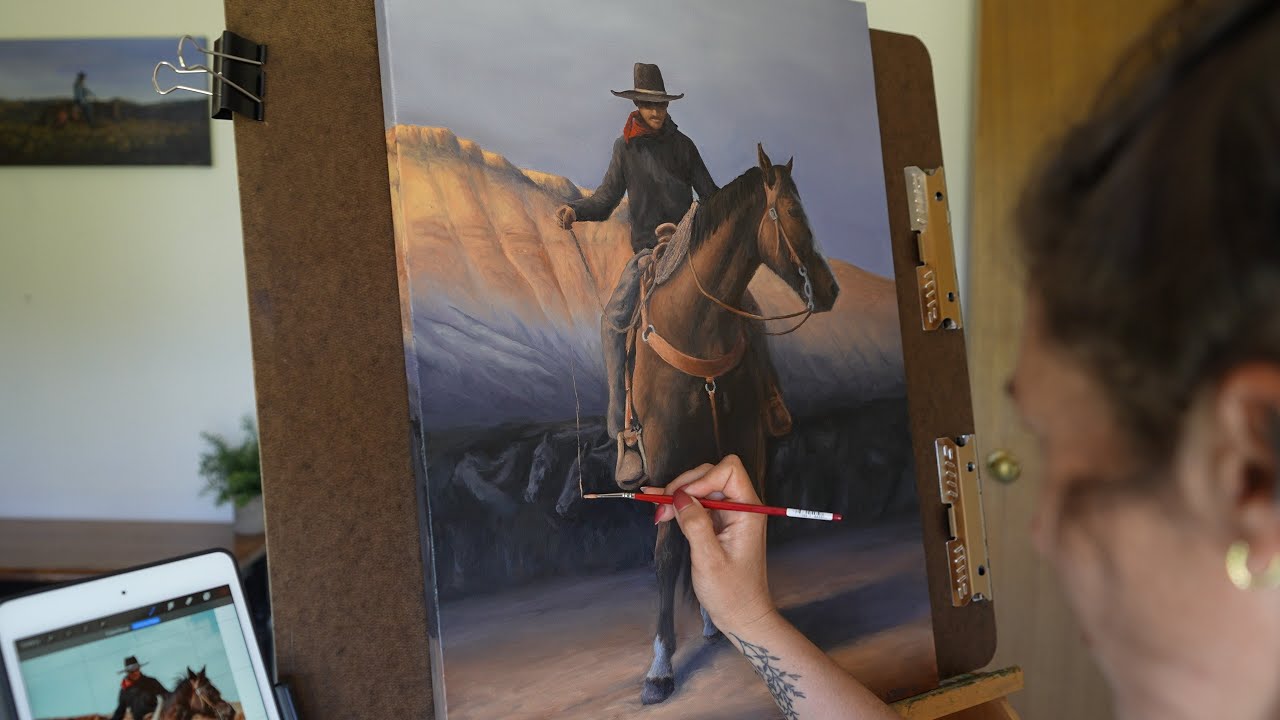
His French training shows in:
- Atmospheric perspective technique borrowed from Monet’s haystack series
- Color theory using complementary colors (orange desert against purple shadows)
- Academic figure construction despite minimal figure size
- Romantic narrative approach similar to Eugene Delacroix‘s exotic subjects
American galleries initially questioned whether a Frenchman could authentically represent the West. His outsider perspective became the selling point. Fresh eyes on tired subject matter.
Materials, Techniques, and Process
Supports & Grounds
Primary surfaces:
- Belgian linen (preferred for larger works 30×40 and up)
- Cotton canvas for studies and mid-size pieces
- Oil-primed linen panels for plein air sessions
- Occasional canvas board for quick studies
Preparation: Commercial oil ground with additional gesso layer. He wants tooth for initial charcoal underdrawing. Some canvases get toned with transparent raw umber wash.
Paint Application & Mediums
Palette composition: Leans heavily toward warm/cool atmospheric splits. Typical primary colors expanded with:
- Yellows: Cadmium Yellow Light, Naples Yellow (frequent in dust and sunlit edges)
- Blues: Ultramarine, Cerulean, Prussian Blue for deep shadows
- Reds: Cadmium Red, Alizarin Crimson (sunset underpaintings)
- Earth tones: Raw Umber, Burnt Sienna, Yellow Ochre (desert base)
- Whites: Titanium White (heavy use in clouds)
Mediums: Minimal. Sometimes linseed oil for initial washes. Prefers painting directly from tube consistency for texture in sky sections.
Brushwork Taxonomy
Skies (his signature element):
- Knife application for dramatic cloud build-up
- Heavy impasto in highlight sections
- Wet-in-wet blending at cloud edges
- Scumbling for atmospheric haze layers
- Occasional dry-brush for wispy high clouds
Landscape sections:
- Flatter application, less texture than skies
- Broken color technique in desert vegetation
- Smooth gradations in distant mesas using atmospheric perspective
Figures:
- Economical brushwork
- Contour definition with minimal internal modeling
- Often silhouetted against bright backgrounds
- Reflected light under hat brims and horse bellies
Color Strategy
Temperature bias: Cool-dominant with strategic warm accents
Value distribution: Extreme contrast between sky luminosity and ground shadows. His value scale runs from pure white (cloud highlights) to near-black (figure silhouettes).
Hue intervals: Large jumps between adjacent areas. Orange desert abruptly meets purple shadow. No subtle transitions. Theatrical color relationships.
Color saturation: Pushed beyond natural observation. Skies hit maximum chroma. Sunsets use pure pigment straight from tube.
Studio Practice
Process sequence:
- Photography sessions with real cowboys, Native American models, actual locations
- Charcoal composition studies (hundreds per final painting)
- Underdrawing directly on canvas
- Thin underpainting establishing value structure
- Direct painting building from background to foreground
- Sky sections painted last despite dominating composition
- Final figure details and signature
Alla prima sections: Skies often completed in single session while wet. Desert sections built over multiple days.
Plein air integration (post-2017): Field studies in New Mexico, Arizona, Wyoming inform studio work but paintings rarely done entirely outdoors. Studies capture light effects. Studio painting constructs idealized composition.
Work speed: Variable. Simple compositions finish in days. Complex multi-figure narratives take months. “It’s finished when it’s good” philosophy rejects arbitrary deadlines.
Themes, Subjects, and Iconography
Core Motifs
The Lone Rider: Appears in 60% of his work. Single cowboy on horseback against vast landscape. Symbolizes independence, nostalgia, American individualism. Often riding away from viewer (mysterious departure) or toward distant horizon (journey metaphor).
Monumental Clouds: Not background elements but primary subjects. Clouds as characters. They dwarf human figures. Represent forces beyond human control. Bridge earth and heaven visually.
The Open Range: Empty desert expanses. Minimal vegetation. Emphasis on horizontal distance rather than vertical drama. Creates feeling of freedom and isolation simultaneously.
Native American Figures: Started painting Native subjects around 2020. Treats them with dignity missing from historical Western art. Often shows them in traditional dress but contemporary settings. Avoids stereotypical “vanishing race” tropes.
Buffalo/Bison: Symbol of American wilderness. Often painted in golden light. Spiritual weight. Connection to Native American heritage and ecological history.
Compositional Schemes
Low Horizon Strategy: Horizon line typically falls in bottom third. Sky dominates. Creates emphasis on atmospheric drama over terrestrial detail. Space and balance weighted toward upper canvas.
Rule of Thirds Variation: Figures rarely centered. Usually placed at intersection points. But Maggiori pushes them smaller than traditional compositional advice suggests. Figures occupy 5-10% of total canvas area.
Directional Lines: Cloud formations create diagonal movements. Horizon provides stabilizing horizontal. Figure placement and gaze direction guide eye through composition.
Asymmetrical balance: Large empty spaces balanced by small, dark figures. Weight distributed through value and color intensity rather than physical mass.
Symbol Sets & Meanings
Objects:
- Horse: partnership between human and animal, working relationship versus pet
- Saddle/tack: craftsmanship, tradition, practical beauty
- Hat: icon of Western identity, practical tool, cultural marker
- Dust clouds: movement, transience, connection between earth and sky
Time Periods: Focuses on 1860-1910 era. “Before corporations and plastic.” Romanticizes pre-industrial West. Ignores uncomfortable historical realities (violence, displacement, hardship).
Atmospheric Conditions:
- Golden hour (most common): nostalgia, idealized past, beauty of fleeting moments
- Storm clouds: drama, nature’s power, uncertainty
- Clear skies (rare): simplicity, stark reality versus romantic interpretation
Socio-Historical Context
French Outsider Perspective: Never lived in the West historically. Paints imagined West rather than documented West. This distance allows romantic interpretation without guilt or complicated relationship to actual frontier history.
Post-9/11 American Nostalgia: His career (2014-present) coincides with increased American yearning for “simpler times.” His work provides escape into mythological past. Offers comfort during contemporary uncertainty.
Instagram Era Art Marketing: Built following through social media rather than traditional gallery relationships. His dramatic, high-contrast images reproduce well digitally. Print releases sell thousands via online drops.
Notable Works
Morning Above the Canyon (2017)

Medium: Oil on canvas
Size: 40 x 60 inches
Location: Private collection (sold Coeur d’Alene Art Auction, 2023)
Sale Price: $275,000 (artist’s auction record)
Visual Signature: Massive sky section with layered clouds in orange, pink, purple gradations. Canyon rim occupies lower 20% of canvas. Single rider visible as tiny silhouette on ridge. Extreme scale contrast between human and landscape.
Why It Matters: Established his auction market. Demonstrates his signature cloud technique at peak complexity. Shows influence of J.M.W. Turner‘s atmospheric landscapes combined with Western subject matter.
Technical Notes: Heavy impasto in cloud highlights. Palette knife application visible in sky sections. Desert floor painted much thinner. This texture difference creates visual hierarchy.
The Prophecy (2020s, exhibited 2026)

Medium: Oil on canvas
Size: 70 x 45 inches (vertical orientation, unusual for his work)
Location: Artist’s collection, scheduled exhibition 2026
Visual Signature: Buffalo as central subject. Vertical composition emphasizes spiritual dimension. Sky and earth meeting point placed at buffalo’s eye level. Symbolic rather than documentary approach.
Why It Matters: Represents shift toward Native American themes and wildlife subjects. Vertical format breaks from his typical horizontal landscapes. Artist describes as “a painting I had inside my soul.”
Print Release: Multiple edition sizes released June 2024. Canvas prints range 51×33 to 62×39.5 inches. Limited edition of 100 for largest canvas size.
Riders in the Storm (2017)

Medium: Oil on canvas
Size: 34 x 46 inches
Location: Private collection
Sale Price: $108,900 (Coeur d’Alene Art Auction)
Visual Signature: Multiple riders (unusual, as he typically paints solitary figures). Storm clouds in dark purple and grey. Dramatic chiaroscuro effects. Rain suggested through vertical brushstrokes in sky section.
Why It Matters: Shows his range beyond sunny golden-hour scenes. Demonstrates ability to paint dramatic weather conditions. Movement and urgency rare in his typically contemplative work.
Night Chase (2014)

Medium: Oil on canvas
Size: 18 x 24 inches
Location: Private collection
Sale Price: $78,650
Why It Matters: Early work from first year of Western painting. Shows his style already fully formed. Small size demonstrates that his dramatic effects don’t require monumental formats.
Related Works: Part of 2014 series that launched his career. Exhibited at Maxwell Alexander Gallery in first solo show.
Moonlight Solitaire (2017)

Medium: Oil on canvas
Size: 24 x 24 inches (square format)
Sale Price: $108,900
Visual Signature: Nocturne composition. Blue-purple moonlit landscape. Lone rider silhouetted against lighter sky. Tenebrism technique with single light source (moon).
Technical Notes: Square format creates different tension than rectangles. Balance achieved through asymmetrical placement of figure and moon.
I Am the Mountain (2021)
Medium: Oil on board
Size: 30 x 40 inches
Sale Price: $70,000
Why It Matters: Title suggests spiritual dimension. Board support indicates possible plein air origin or study elevated to finished work. Mountain personification ties to Native American spiritual concepts.
Exhibitions, Collections, and Provenance
Major Museum Exhibitions
Autry Museum of the American West (Los Angeles):
- Masters of the American West (2019, 2020, 2021)
- Won Don B. Huntley Spirit of the West Award
- Recurring presence in annual exhibition
Briscoe Western Art Museum (San Antonio):
- Night of Artists (2017, ongoing)
- Won Sam Houston Award (2017)
- Won William B. Travis Award for Patron’s Choice
- Permanent collection acquisition: “Once Upon A Time” study (2020)
Eiteljorg Museum (Indianapolis):
- Featured in American Indians and Western Art exhibitions
- Represents contemporary Western art movement
Couse-Sharp Historic Site (Taos, New Mexico):
- Solo exhibition (2021)
- Local significance after relocating to Taos (2019)
Gallery Representation
Maxwell Alexander Gallery (Los Angeles): First major gallery representation (2014). Regular solo and group exhibitions. Focuses on California collectors.
Gerald Peters Gallery (Santa Fe): Signed 2014. Prestigious Western art dealer. Connected him to serious collectors and museums.
Medicine Man Gallery (Tucson): Regular exhibitions. Strong sales in Arizona market.
Trailside Galleries (Jackson, Wyoming): Mountain West collector base. Annual exhibitions.
Collections With Depth
Private collections dominate his market. Few museums hold multiple works due to recent career start and high demand.
Briscoe Western Art Museum: Multiple works including permanent collection study.
Corporate collections: Limited information available. Some works in Western-themed hospitality spaces.
Provenance Patterns
Primary market strength: Most works sell through galleries directly to collectors. Rarely reach auction immediately.
Print market: Biannual print releases through Static Medium partnership. Editions of 100-1835 depending on size and format. Sell out within hours. Robust secondary market on eBay and collector forums.
Authentication: Artist signature typically lower left or right. Verso inscriptions common with title, date, location. Later works sometimes note exhibition destination.
Market & Reception
Auction Performance
Record: $275,000 for “Morning Above the Canyon” (2023, Coeur d’Alene Art Auction)
Price Ranges by Format:
- Large oils (40×60): $108,900-$275,000
- Medium oils (24×36): $40,000-$78,650
- Small oils (18×24): $44,625-$78,650
- Studies (graphite, watercolor): $5,000-$15,000
- Limited edition prints: $270-$680 (retail)
Recent Performance: Average auction price in past 12 months: $16,680. Strong upward trajectory since 2017 career launch.
Market Velocity: Original works sell quickly through galleries. Waiting lists common. Auction appearances rare because collectors hold onto pieces. Print releases sell out in minutes.
Authentication & Signatures
Signature variations:
- “M. Maggiori” (early works)
- “MARK MAGGIORI” (block capitals, later works)
- “MM” (small studies)
Signature location: Lower left most common. Lower right occasional. Size correlates with painting scale.
Verso documentation: Title, date, location, exhibition notes often inscribed on canvas backs. Helps establish provenance chain.
Forgery risk: Low currently due to recent career. Technical difficulty of his cloud technique discourages copies. Print market well-controlled through official channels.
Condition Patterns
Age factors: Works only 10 years old. Minimal condition issues.
Common problems:
- Canvas prints (not artist-created) sometimes confused with originals
- Framing choices affect preservation (direct sunlight fading risk in Southwest climate)
- Impasto sections in skies vulnerable to impact damage during shipping
Conservation notes: Oil painting on proper supports with commercial grounds shows excellent stability. Expected lifespan centuries if properly stored.
Critical Reception
Forbes, Flaunt, Southwest Art, Western Horseman: Featured articles position him as contemporary Western art leader.
Art establishment criticism: Some traditional critics question whether romanticized, non-authentic Western imagery represents genuine contribution. French outsider perspective both strength and weakness.
Collector enthusiasm: Strong following among Western art collectors, cowboy culture enthusiasts, Instagram generation. Print releases function like sneaker drops (limited availability, immediate sellout, secondary market inflation).
Museum validation: Awards from Autry and Briscoe museums provide institutional legitimacy. Permanent collection acquisitions establish him beyond commercial success.
Influence & Legacy
Upstream Influences
Direct artistic influences:
- Joaquin Sorolla: Spanish light, loose brushwork, luminosity
- John Singer Sargent: Bravura technique, economy of stroke
- Frederic Remington: Subject matter template, Western authenticity goal
- Frank Tenney Johnson: Nocturnes, atmospheric perspective
- Jim Reynolds: Epiphany painting at Oklahoma museum, direct inspiration for career shift
- Claude Monet: Atmospheric perspective, serial approach to sky conditions
- J.M.W. Turner: Dramatic skies as primary subject
Conceptual influences:
- French Romanticism: Emotional landscape interpretation
- Disney animation: Narrative clarity, cinematic framing
- Music video directing: Dramatic visual impact, emphasis on memorable imagery
Downstream Influence
Contemporary Western painters: Too early to assess full impact. But younger painters now emphasizing sky drama over ground detail. His Instagram success showed Western art could reach beyond traditional gallery audiences.
Print market transformation: His limited edition drop model influenced how Western artists release prints. Scarcity marketing. Social media announcements. Direct-to-collector sales bypassing traditional print publishers.
Subject matter revival: Made cowboy imagery relevant to younger collectors. Instagram aesthetic made Western art “cool” beyond traditional demographics.
Cross-Domain Echoes
Photography: Western landscape photographers now emphasizing his compositional approaches (low horizons, sky drama, tiny human elements).
Fashion: His imagery appears on Western wear brands. Cowboy aesthetic revival partly attributed to visual romanticization his work represents.
Interior Design: His paintings (originals and prints) appear in contemporary Western-themed spaces. Bridges rustic ranch aesthetic with modern design sensibility.
Film/Television: “Yellowstone” era TV Western revival shares his romantic interpretation of contemporary West. Mutual influence difficult to track but thematic overlap clear.
How to Recognize a Maggiori at a Glance

Quick diagnostic checklist:
Compositional tells:
- Horizon line in bottom third (sky dominates 60-70% of canvas)
- Tiny figures (5-10% of total area) create extreme scale relationships
- Single figure or small group (rarely crowds)
- Asymmetrical balance with large empty spaces
Sky characteristics:
- Heavily textured clouds with visible palette knife work
- Dramatic color saturation (not naturalistic)
- Layered cloud structures (three-dimensional quality)
- Complementary color relationships (orange/purple, yellow/blue)
Figure treatment:
- Often silhouetted (backlit positioning)
- Minimal internal detail
- Cowboys in traditional gear (1860-1910 styling)
- Horses painted with economy (suggestive rather than photographic)
Color signatures:
- Naples Yellow in dust and sunlit edges
- Cerulean and Ultramarine Blue dominating skies
- Burnt Sienna and Raw Umber in desert floor
- Pure Cadmium pigments in sunset sections
- Cool-dominant overall temperature
Surface qualities:
- Smooth desert sections with minimal texture
- Heavy impasto in sky highlights
- Texture contrast between sky (thick) and ground (thin)
- Canvas weave sometimes visible in darkest shadows
Typical formats:
- Horizontal rectangles (4:3 or 3:2 ratio most common)
- Large scale preferred (30×40, 40×60 inches frequent)
- Occasional squares (24×24)
- Rare verticals
Signature location:
- Lower left or lower right corners
- Block capitals “MARK MAGGIORI” or “M. Maggiori”
- Sometimes dated alongside signature
Subject matter limits:
- No urban scenes
- No modern technology visible (trucks, fences, power lines avoided)
- No winter scenes (prefers golden desert light)
- Minimal vegetation (sparse desert plants, occasional cottonwood)
Painting on canvas: Almost exclusively oil on canvas or linen. Rare oils on panel. Studies in graphite or watercolor.
Temporal cues: If it shows cowboys in 1860-1910 clothing against theatrical skies with sculptural clouds, tiny figures in vast landscapes, cool-warm color temperature drama, and signature knife-textured sky sections – it’s likely a Maggiori or someone directly copying his style.
FAQ on Mark Maggiori
Where is Mark Maggiori from?
Mark Maggiori was born in Fontainebleau, France on June 16, 1977. He graduated from the prestigious Academie Julian in Paris before eventually moving to the United States, where he now lives in Taos, New Mexico.
When did Mark Maggiori start painting Western art?
Maggiori painted his first cowboy in 2014 at age 36. Before that, he spent ten years as lead vocalist for the metal band Pleymo and worked directing music videos, despite formal training in oil painting techniques.
What is Mark Maggiori’s painting style?
His style blends contemporary Western art with French academic realism. Maggiori creates dramatically lit landscape paintings featuring monumental clouds, tiny cowboy figures, and theatrical atmospheric perspective borrowed from European romantic traditions.
How much do Mark Maggiori paintings cost?
Original oils range from $40,000 to $275,000 at auction. His record sale was “Morning Above the Canyon” for $275,000 in 2023. Limited edition prints sell for $270-$680 and typically sell out within hours of release.
What techniques does Mark Maggiori use?
Maggiori works primarily in oil on canvas or linen. He applies heavy impasto with palette knives in cloud sections while keeping desert areas smoother. His composition places horizons low, letting skies dominate 60-70% of each canvas.
Why are Mark Maggiori’s clouds so dramatic?
His clouds use layered, textural brushwork with palette knife application. The technique combines influences from J.M.W. Turner and Claude Monet, creating what critics call “impossible detail” through extreme color saturation and sculptural paint build-up.
Does Mark Maggiori paint plein air?
Since 2017, Maggiori works en plein air in New Mexico, Arizona, and Wyoming. However, most finished paintings are studio compositions that synthesize multiple field studies and photographs into idealized scenes rather than direct observation.
What museums show Mark Maggiori’s work?
His paintings appear in the Autry Museum of the American West, Briscoe Western Art Museum, Eiteljorg Museum, and Couse-Sharp Historic Site. He won the Don B. Huntley Spirit of the West Award and Sam Houston Award from major institutions.
How can I buy Mark Maggiori prints?
Official prints release twice yearly through his website in timed drops. Editions range from 100 to 1,835 depending on size. Past editions aren’t available for purchase. Secondary market sales occur on eBay and collector forums at inflated prices.
What inspires Mark Maggiori’s Western paintings?
His childhood road trip across America at age 15 sparked his fascination with the Southwest. Maggiori romanticizes the 1860-1910 frontier era, painting what he calls “the good old times, before corporations and plastic” through a European outsider’s perspective.
Conclusion
Mark Maggiori proved that outsiders can redefine American traditions.
His journey from French art student to Sony-signed rockstar to contemporary Western painter defies every career path template. Yet his work resonates precisely because he paints the frontier through European eyes, blending academic technique with romantic mythology.
The dramatic skies, tiny cowboys, and golden desert light create what collectors recognize instantly. His atmospheric perspective borrows from Impressionism while his chiaroscuro effects echo Old Masters.
Whether you’re studying painting techniques or collecting Western art, Maggiori’s rise shows how fresh perspectives breathe life into established genres.
His auction records and sold-out print releases suggest this French-American painter isn’t just participating in the Western art revival. He’s leading it.