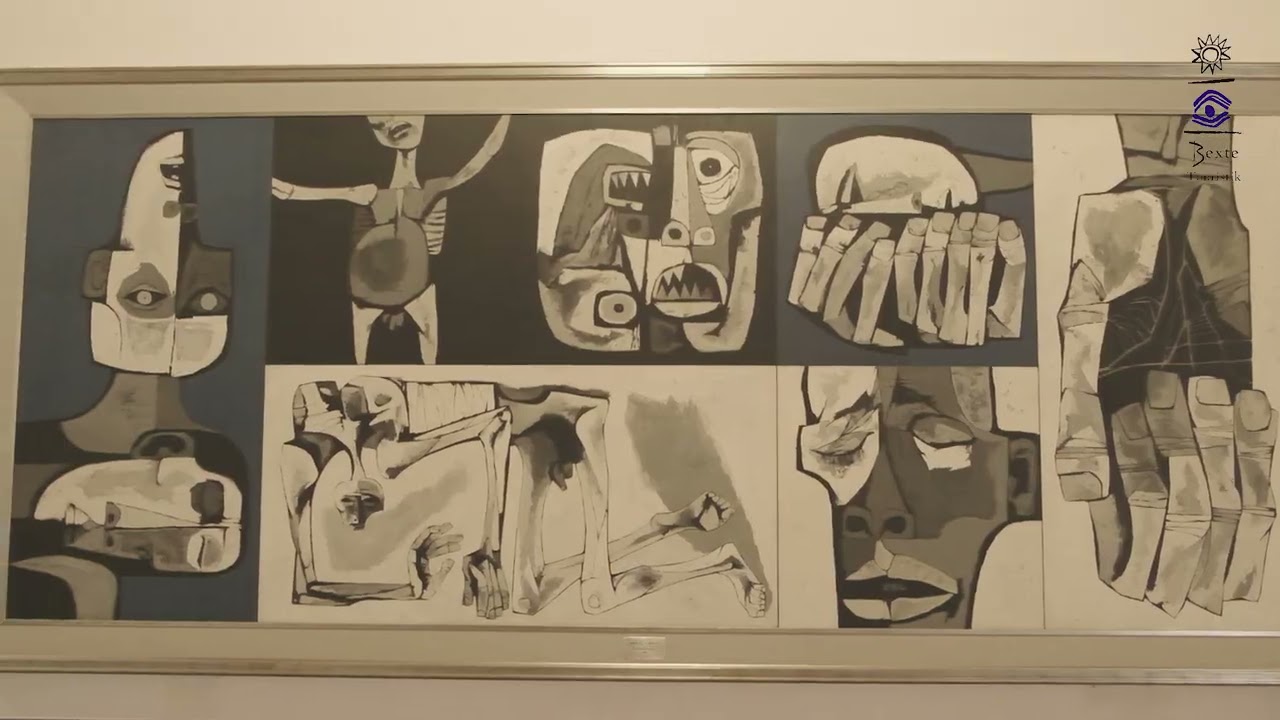
Skeletal hands reach across canvas, fingers impossibly long, gripping nothing but air and anguish. This is how Oswaldo Guayasamín painted human suffering.
The Ecuadorian master transformed indigenous trauma into visual testimony that museums worldwide still can’t ignore. Born into poverty in 1919 Quito, he witnessed his best friend shot during worker demonstrations, then spent six decades documenting colonial violence through expressionism and cubism.
His three major series (Huacayñán, La Edad de la Ira, La Edad de la Ternura) chronicle Latin America’s darkest chapters alongside rare moments of maternal tenderness.
You’ll discover how Guayasamín’s distorted figures and earth-tone palette created a visual language for the oppressed. We’ll examine his techniques, major works, political controversies, and why UNESCO awarded him their peace prize despite painting nothing peaceful.
Identity Snapshot
Full Name: Oswaldo Guayasamín Calero
Also Known As: The Picasso of Latin America
Lifespan: July 6, 1919 – March 10, 1999
Primary Roles: Painter, muralist, sculptor, printmaker
Nationality: Ecuadorian
Heritage: Kichwa and Mestizo descent
Movements: Social realism, expressionism, Latin American indigenism
Mediums: Oil on canvas, acrylic, gouache, fresco, lithography, etching
Signature Traits: Distorted elongated figures, skeletal hands, mask-like faces, angular forms, somber palette punctuated by ochres and earth tones
Iconography: Hands in protest, weeping mothers, indigenous prisoners, martyred children, resistance symbols
Geographic Anchors: Quito (birthplace and studio), Bellavista district, Mexico City, Havana
Mentors: José Clemente Orozco (Mexican muralist)
Influenced By: Diego Rivera, David Alfaro Siqueiros, Pablo Picasso, El Greco, Francisco Goya
Patrons: Nelson Rockefeller, UNESCO, Ecuadorian government
Major Collections: Fundación Guayasamín (Quito), Museum of Modern Art (New York), Art Museum of the Americas (Washington, D.C.), L’Hermitage Museum (St. Petersburg), Irish Museum of Modern Art (Dublin)
Market Signals: Six-figure auction results, certificates from Fundación Guayasamín authenticate works
UNESCO Prize: Awarded for “an entire life of work for peace” (1992)
What Sets Guayasamín Apart
Guayasamín carved human anguish into visual permanence through a distinct fusion of cubism and Latin American expressionism.
His figures don’t just occupy canvas space. They confront viewers with skeletal angularity and distorted proportions that amplify emotional intensity beyond photographic truth.
Where European expressionists like Käthe Kollwitz documented suffering, Guayasamín weaponized it as testimony against colonial oppression and political violence. His palette leaned heavily on burnt siennas, raw umbers, and sulfurous yellows that evoke both earth and decay.
Hands dominate his compositions. Not delicate hands, but colossal, bone-exposed appendages that dwarf faces and torsos.
Unlike Diego Velázquez‘s courtly precision or Claude Monet‘s atmospheric dissolution, Guayasamín’s brushwork is aggressive, direct, unforgiving. Paint applied with urgency, sometimes scraped back to reveal raw canvas.
His three major series (Huacayñán, La Edad de la Ira, La Edad de la Ternura) function as a triptych documenting humanity’s capacity for both cruelty and love.
Origins & Formation
Early Years (1919-1932)
Born into poverty in Quito’s indigenous quarters on July 6, 1919.
Eldest of ten children. Father José Miguel worked as carpenter, taxi driver, truck driver. Mother Dolores Calero died prematurely, leaving permanent scars on young Oswaldo’s psyche.
Started drawing at six. Watercolor painting experiments followed quickly. By age ten, he’d switched to oils, selling tourist paintings in Plaza de la Independencia for two sucres each.
Barely learned to read. School expelled him six times for drawing caricatures of teachers instead of completing assignments.
School of Fine Arts (1932-1941)
Enrolled at thirteen against his father’s wishes during Ecuador’s Four Days War (1932).
Witnessed best friend Manjares killed by stray bullet during worker demonstrations. This trauma produced his first major work, Los Niños Muertos (The Dead Children, 1941), depicting naked corpses piled in streets.
Graduated with honors in 1941 as both painter and sculptor, also studying architecture.
Won Mariano Aguilera Prize and Caspicara Prize while still student.
First Exhibition & Rockefeller Connection (1942)
Solo exhibition at age 23 shocked Quito’s art establishment.
Gallery opened by Eduardo Kingman featured El Silencio, which depicted indigenous suffering with raw directness critics found confrontational.
American magnate Nelson Rockefeller, visiting on State Department business, purchased several works and extended invitation to United States (1942-1943).
Mexican Period (1943)
Seven months in U.S. museums studying Renaissance masters, then pivotal journey to Mexico.
Met José Clemente Orozco, studied fresco technique under him. Orozco’s tortured figures, Christian iconography, and social commentary became template Guayasamín would remix with indigenous themes.
Also encountered Diego Rivera and David Alfaro Siqueiros, absorbing Mexican muralism’s belief that art must serve political purpose.
Latin American Journey (1944-1946)
Traveled Peru, Bolivia, Chile, Argentina, Uruguay, Brazil with sketchbook.
Documented indigenous poverty, labor exploitation, cultural erasure. These drawings became foundation for Huacayñán series.
Movement & Context
Latin American Indigenism

Guayasamín emerged as leading figure in Ecuador’s indigenist art movement, which rejected European academic traditions in favor of pre-Columbian visual vocabularies and mestizo cultural identity.
Where Mexican muralists focused on revolution, Guayasamín centered indigenous suffering specifically. His subject matter was more ethnically focused than Orozco’s universal humanism or Rivera’s Marxist dialectics.
Comparative Analysis
vs. José Clemente Orozco: Both used distorted anatomy and Christian imagery, but Orozco’s edges were harder, his figures more architectural. Guayasamín’s brushwork shows more gestural emotion. Orozco painted revolution; Guayasamín painted its victims.
vs. Pablo Picasso: Guernica‘s influence obvious in Guayasamín’s angular fragmentation and monochromatic severity. But where Picasso flattened pictorial space into simultaneous viewpoints, Guayasamín maintained shallow illusionistic depth. Picasso’s cubism was analytical; Guayasamín’s was emotional.
vs. Frida Kahlo: Both Mexican-trained painters addressing indigenous identity and physical suffering. Kahlo turned inward to autobiography and symbolism. Guayasamín turned outward to collective trauma and social witness.
vs. Fernando Botero: Contemporary Colombian painter Botero inflated figures into voluminous mockery of bourgeois excess. Guayasamín did opposite: starved figures down to skeletal essence, stripping away everything except pain.
Positioning Within Expressionism

German Expressionism dealt with alienation and psychological dread. Latin American expressionism addressed material oppression and colonial violence.
Guayasamín’s work sits at intersection: personal trauma (mother’s death, friend’s murder) channeled into political denunciation. Unlike abstract expressionists like Jackson Pollock, Guayasamín never abandoned figuration. Human form remained central, though increasingly distorted.
Materials, Techniques, and Process
Supports & Grounds
Primarily worked on cotton canvas stretched over standard stretcher bars.
Occasionally used linen for major commissions requiring archival permanence.
Canvas texture ranged from medium to coarse weave, providing tooth for aggressive brushwork.
Applied traditional gesso grounds, though sometimes left portions raw for tonal contrast.
Murals executed on prepared plaster walls using fresco technique learned from Orozco.
Painting Mediums
Oil painting dominated easel work. Mixed pigments with linseed oil, occasionally adding stand oil for slower drying.
Acrylic entered practice in 1960s for faster-drying applications, especially in later Edad de la Ira works.
Gouache and watercolor for preliminary studies and smaller works.
No evidence of damar varnish use. Preferred matte, unvarnished surfaces that absorbed rather than reflected light.
Brushwork Taxonomy
Impasto applications rare despite emotional intensity. Paint layers remained relatively thin.
Scumbling used frequently to create atmospheric hazes around figures, especially in Tenderness series.
Dry-brush technique dragged across canvas texture produced skeletal, almost charcoal-like marks defining ribs, fingers, facial structure.
Alla prima approach for gestural passages. No evidence of extensive underpainting or preparatory glazing.
Knife work minimal. When used, palette knife scraped back wet paint to create texture variation and reveal underlayers.
Directional lines often converged on hands or faces, creating focal points through stroke orientation rather than detail density.
Palette Archetype
Dominant hues: Ochres, burnt umbers, raw siennas, iron oxides, sulfur yellows.
Earth tones reference both Andean soil and human flesh under stress. Temperature bias leans warm despite somber mood.
Secondary colors: Prussian blues and viridians appear in shadows, particularly in Ira series. Occasionally cadmium reds for blood imagery.
Value distribution: High contrast between light and dark, though not full chiaroscuro. Mid-tones compressed to narrow range, pushing figures toward graphic simplicity.
Tenderness series introduced brighter palette: cadmium yellows, cerulean blues, warmer pinks. Still maintained earth-tone foundation but lifted key value by two to three stops.
Studio Practice
No systematic underdrawing visible in technical analysis. Gestural blocking with thin paint established proportions, then built up directly.
Layered approach for backgrounds: thin washes establishing atmospheric tone, then opaque passages for figures.
Wet-in-wet blending minimal. Preferred hard edges between shape zones, though softened selectively for emotional effect.
Glazing absent from practice. Opacity and directness valued over translucent depth.
Worked from photographs occasionally, but primarily from memory and imagination after initial sketch phase.
Large canvases (up to 244 x 122 cm for major works) required scaffolding in Bellavista studio overlooking Quito.
Themes, Subjects, and Iconography
Hands as Primary Motif

Oversized, skeletal hands dominate compositional hierarchy in Edad de la Ira series (1961-1990).
Twelve-painting Las Manos subseries presents hands in isolation: clenched in protest, clasped in prayer, twisted in agony, open in supplication.
Elongated fingers reference both El Greco’s Mannerist distortions and pre-Columbian textile patterns.
Hands symbolize labor (peasant work), resistance (raised fist), maternal protection (cradling gesture), and suffering (arthritic contortion).
Mother-Child Dyads
Recurring throughout career, intensifying in La Edad de la Ternura (Age of Tenderness, 1988-1999).
Mothers depicted with faces hidden behind protective hands or turned away, never making eye contact with viewer.
Children shown as vulnerable, often wrapped in geometric textile patterns recalling Andean weaving traditions.
Homage to artist’s own mother Dolores, who died young, leaving permanent maternal absence.
Indigenous Prisoners & Laborers

Huacayñán series (1946-1952, 103 paintings plus mural) documented indigenous poverty across Latin America.
Figures shown in cramped spaces with slanted walls creating claustrophobic perspective.
Prisionero (1949) exemplifies this: skeletal figure in cell with angular architecture emphasizing confinement.
Faces mask-like, referencing pre-Columbian ceremonial masks while suggesting dehumanization under oppression.
War & Political Violence
Edad de la Ira (Age of Wrath, 1961-1990, 250+ paintings) addresses global atrocities:
- Los Mutilados (The Mutilated, six oils): Hiroshima bombing victims
- Reunión en el Pentágono (Pentagon Meeting, five oils): Critique of American imperialism
- Ríos de Sangre (Rivers of Blood, three oils): Genocide documentation
- Las Lloronas (Weeping Women, seven oils): Maternal grief
- La Espera (The Waiting, eleven oils): Anticipation of violence
Each subseries maintains consistent iconography while varying compositional structure.
Compositional Schemes
Triangular composition common in mother-child works: maternal figure forms apex, child forms base, creating stable but protective geometry.
Vertical compression: Figures often elongated to fill vertical canvas dimension, heads reaching upper edge, feet barely visible. Creates monumental presence.
Frontal presentation: Most figures address viewer directly or turn away entirely. Rare three-quarter views. Binary relationship: confrontation or rejection.
Minimal backgrounds: Negative space treated as void rather than environment. No atmospheric perspective or spatial recession. Figure isolated against emptiness.
Symbol Sets
Yellow backgrounds: Sulfurous, apocalyptic quality. Neither natural sunlight nor artificial illumination. Suggests contamination, decay, toxic atmosphere.
Blue shadows: Not naturalistic. Symbolic rather than observational. References Andean sky, Pacific depths, melancholy.
Geometric textiles: When clothing appears, rendered as flat pattern rather than draped fabric. Connects figures to pre-Columbian weaving traditions, specifically Kichwa heritage.
Clenched fists: Resistance symbol borrowed from leftist iconography but made visceral through skeletal rendering.
Socio-Historical Triggers
- Four Days War (1932): Friend’s death during demonstrations
- Latin American poverty tours (1944-1946): Direct witness to indigenous suffering
- Vietnam War (1965-1973): American imperialism critique
- Chilean coup (1973): Allende’s overthrow and Pinochet dictatorship
- Hiroshima anniversary commemorations: Nuclear violence documentation
- CIA operations in Latin America: Operation Condor exposures
Notable Works
Los Niños Muertos (The Dead Children)

1941, Oil on canvas, dimensions variable, Fundación Guayasamín
First major political work. Piled naked bodies in street setting reference friend’s death during 1932 demonstrations.
Figures rendered without individualization, creating mass of anonymous victims. Limbs intertwine impossibly, suggesting both violence and forced intimacy of mass graves.
Palette restricted to grays, browns, siennas. No color relief.
Why it matters: Established Guayasamín’s rejection of religion in favor of art as witness. Launched career trajectory focused on political testimony.
Prisionero (Prisoner)
1949, Oil on canvas, dimensions variable, Fundación Guayasamín
Part of Huacayñán series. Indigenous man in cell with slanted angular walls creating spatial compression.
Skeletal anatomy rendered through dry-brush technique. Hands and shoulders particularly emphasized through hard-edge definition.
Cubist influence apparent in geometric wall planes that tilt inward, physically pressing on figure.
Why it matters: Demonstrates synthesis of cubist spatial manipulation with social realism subject matter. Shows Orozco’s influence while developing distinct voice.
Related works: Other Huacayñán paintings depicting rural poverty, La Vieja (The Old Woman, 1941)
Las Manos series (The Hands)

1963-1965, Twelve oils on canvas, typically 244 x 122 cm each, Various collections
Monumental hand paintings where appendages fill entire canvas, dwarfing any visible faces or bodies.
Each painting explores single emotional state through hand gesture: Las Manos de la Protesta (Hands of Protest) shows clenched fists, Las Manos de la Súplica (Hands of Supplication) presents open palms upward.
Impasto minimal despite large scale. Paint application remains thin but gestural, with visible brushstrokes creating nervous energy.
Why it matters: Reduced human suffering to single body part, creating icon that transcends language and cultural barriers. Influenced protest art globally.
Related works: Las Lloronas (Weeping Women), Los Mutilados (The Mutilated)
Lágrimas de Sangre (Tears of Blood)

1973, Oil on canvas, dimensions variable, Fundación Guayasamín
Response to Pinochet’s coup in Chile and Allende’s assassination.
Face dominates canvas, eyes closed, single red tear (only bright red in otherwise muted palette) trails down elongated cheek.
Background reduced to flat yellow-ochre void. No spatial context, no architectural reference. Figure exists in emotional rather than physical space.
Why it matters: Created immediately after political event, functioning as visual journalism. Demonstrates how Guayasamín responded to current events throughout career.
Madre y Niño variations

Various dates 1988-1992, Oil on canvas, typically 81 x 81 cm, Multiple collections
Square format unusual in Guayasamín’s work, creating centered balance rather than vertical compression.
Mother’s face typically hidden behind hand or turned away. Child visible but not individualized.
Palette brightens significantly from Ira series: yellows move toward cadmium brightness, blues become cerulean, ochres warm.
Why it matters: Represents Tenderness series’ attempt at reconciliation without abandoning formal vocabulary developed over forty years. Shows range beyond protest art.
Related works: La Madre (The Mother), Los Niños (The Children)
Congressional Mural (Ecuador)
1988, Fresco on plaster, Monumental scale, Ecuadorian Congress Building, Quito
Commissioned by Ecuador’s Congress to depict national history.
Controversial figure: man in Nazi helmet with “CIA” lettering, referencing American intelligence operations in Latin America.
U.S. government protested publicly. Guayasamín refused to alter composition.
Why it matters: Demonstrates artist’s willingness to risk diplomatic consequences for political statement. Mural remains in place despite ongoing controversy.
El Grito series (The Cry)

1983 onwards, Oil on canvas, typically 130 x 90 cm, Fundación Guayasamín
Faces with mouths open in silent screams. No sound depicted, only visual evidence of vocal strain.
References Edvard Munch’s The Scream but rendered in Guayasamín’s angular, skeletal style rather than Munch’s undulating curves.
Dramatic shapes and intense color psychology combine to create visceral emotional impact.
Why it matters: Universal symbol of anguish that transcends specific political context while remaining rooted in Latin American suffering.
Exhibitions, Collections, and Provenance
Early Recognition (1940s-1950s)
1942: First solo exhibition, Quito (age 23). Controversial reception from academic establishment.
1943: San Francisco Museum of Modern Art exhibition arranged through Rockefeller connection.
1948: First prize, Ecuadorian Salón Nacional de Acuarelistas y Dibujantes.
1952: Huacayñán series premiere exhibition, Quito.
1955: First prize, Third Hispano-American Biennial of Art, Barcelona.
1957: Named Best South American Painter, Fourth Bienal de São Paulo.
International Period (1960s-1980s)

1966: Rome exhibition of Edad de la Ira series. Major European breakthrough.
1968: Palacio de Bellas Artes, Mexico City.
1972: Museo Español de Arte Contemporáneo, Madrid.
1973: Musée d’Art Moderne de la Ville de Paris. Régis Debray wrote influential essay positioning Guayasamín within Latin American cultural resistance.
1982: L’Hermitage Museum, St. Petersburg, Russia. Cold War cultural exchange despite artist’s anti-imperialist stance.
1985: Museo Nacional Palacio de Bellas Artes, Havana. Honored by Cuban government and Fidel Castro personally.
Late Career Recognition (1990s)
1992: Palais du Luxembourg, Paris. Personally inaugurated by artist.
1995: Palais de Glace, Buenos Aires. Final exhibition opened by Guayasamín before declining health.
1996: Began construction of Capilla del Hombre (Chapel of Man), architectural project in Quito.
1999: Death on March 10 in Baltimore during medical treatment. José Martí Prize awarded posthumously.
Major Collections (by depth)
Fundación Guayasamín, Quito (250+ works): Artist donated entire estate in 1976. Includes all three major series, preliminary studies, sculptures, personal collection of pre-Columbian and colonial art.
Capilla del Hombre, Quito (completed 2002): Purpose-built museum designed by Guayasamín but completed after death. Houses late works and functions as monument to Latin American suffering and resilience.
Museum of Modern Art, New York (6 works): Primarily Edad de la Ira paintings acquired through various donors.
Art Museum of the Americas, Washington D.C. (8 works): Strong representation from Huacayñán period.
Irish Museum of Modern Art, Dublin (4 works): Acquired during 1990s international exhibitions.
L’Hermitage Museum, St. Petersburg (3 works): Remained in Russian collection after 1982 exhibition.
Museum of Latin American Art, Long Beach, California (5 works): Focus on mother-child imagery from Tenderness series.
Provenance Patterns
Gallery representation: Initially Galería Caspicara (Quito), later major galleries in Mexico City, Madrid, Paris.
Auction presence: Works appear regularly at Sotheby’s and Christie’s Latin American art sales. Six-figure prices common for major works (48 x 48 inches or larger from Ira series).
Authentication: Fundación Guayasamín issues certificates signed by Pablo Guayasamín (son). Essential for market acceptance.
Dealer network: Prominent Latin American art specialists in New York, Miami, Madrid handle primary market sales.
Notable collectors: Nelson Rockefeller (early patron), various Latin American heads of state, UNESCO headquarters collection.
Catalogues Raisonnés
No complete catalogue raisonné published as of artist’s death. Over 4,500 paintings and 150 sculptures documented by Foundation but not systematically catalogued.
Foundation maintains photographic archive and authentication services.
Market & Reception
Auction Records
Record price: $500,000+ for large-scale Edad de la Ira works at major auction houses (2010s).
Typical ranges by medium:
- Large oils (48 x 48 inches+): $150,000-$500,000
- Medium oils (30 x 30 inches): $75,000-$150,000
- Works on paper (gouache, watercolor): $10,000-$50,000
- Prints (lithographs, etchings): $2,000-$10,000
Market factors:
- Subject matter: Hands and mother-child themes command premium
- Series: Edad de la Ira works most valuable, followed by Ternura
- Provenance: Direct Foundation provenance increases value 20-30%
- Exhibition history: Works shown in major retrospectives valued higher
Authentication Issues
Signature variants: Typically signed “Guayasamín” in lower right or left corner. Sometimes includes date.
Forgery risks: High. Popular tourist market in Ecuador produced countless copies and misattributions. Foundation certificate essential.
Technical markers authentic works display:
- Characteristic dry-brush skeletal rendering
- Specific ochre/umber palette mixing
- Thin paint application despite large scale
- Particular hand elongation proportions (approximately 1.5x natural length)
Condition Patterns
Canvas issues: Cotton canvases from early period (1940s-1950s) show expected age-related tension loss. Generally stable.
Ground failures: Rare. Traditional gesso grounds well-adhered.
Paint layer condition: Thin application means minimal craquelure. Some darkening of linseed oil medium in shadows of works stored in high humidity (Quito’s elevation but tropical climate creates conservation challenges).
Restoration concerns: Over-cleaning removes subtle tonal transitions. Conservative approach recommended.
Framing: Many works originally exhibited unframed or in simple wood frames. Gallery framing often changes. Original presentation rare.
Critical Reception Evolution
1940s-1950s: Ecuadorian critics divided. Academics found work crude; progressives celebrated political engagement.
1960s-1970s: International recognition as Cold War cultural ambassador for non-aligned movement despite Cuban connections.
1980s: Compared to Picasso, called “Michelangelo of Latin America” by Spanish art historian José Camón Aznar. Hyperbolic but indicative of elevated status.
1990s-Present: Recognized as major 20th-century Latin American artist alongside Diego Rivera, Frida Kahlo, Fernando Botero. Work contextualized within post-colonial studies and indigenous rights movements.
Influence & Legacy
Upstream Influences (Who Shaped Guayasamín)
José Clemente Orozco (direct mentor): Fresco technique, Christian iconography repurposed for political critique, distorted anatomy as emotional amplifier.
Diego Rivera: Muralism’s public function, indigenous subject matter, rejection of easel painting as elitist form.
Pablo Picasso: Guernica‘s angular fragmentation, monochromatic severity, anti-war imagery. Blue Period’s melancholic palette and skeletal figures.
El Greco: Elongated proportions, spiritual intensity channeled through physical distortion, vertical compression of figures.
Francisco Goya: The Disasters of War etchings as precedent for art as political witness. Dark palette and unflinching violence documentation.
Pre-Columbian art: Andean textile geometry, ceremonial mask traditions, indigenous color symbolism (particularly earth tones and cosmic blues).
Downstream Influence (Who Guayasamín Shaped)
Latin American political art movement (1970s-1990s): Established template for protest art combining indigenous iconography with expressionist distortion. Artists throughout Central and South America adopted hands-as-protest motif.
Ecuadorian contemporary artists: Entire generation emerged from Guayasamín’s shadow. Some rejected his style as too dominant; others extended his vocabulary into new media (photography, installation, video).
Street art and muralism: Influence visible in political murals from Chile to Mexico. Simplified, bold imagery designed for public spaces rather than galleries.
Human rights visual culture: Hand imagery became universal symbol for protest movements globally. Amnesty International and similar organizations borrowed visual vocabulary.
Cross-Domain Echoes
Photography: Sebastião Salgado’s documentation of labor and migration shows compositional similarities (vertical compression, dramatic lighting, focus on hands).
Graphic design: Political poster design throughout Latin America adopted Guayasamín’s high-contrast, limited-palette aesthetic for maximum visual impact.
Cinema: Latin American cinema’s treatment of indigenous subjects influenced by Guayasamín’s dignified but unflinching portrayal. Films by Jorge Sanjinés (Bolivia) particularly resonant.
Literature: Visual equivalent to Pablo Neruda’s Canto General and Gabriel García Márquez’s documentation of violence. Cross-pollination between literary and visual chronicling of Latin American trauma.
Institutional Legacy
Fundación Guayasamín (founded 1976): Maintains three museums in Quito: pre-Columbian collection (3,000+ pieces), colonial art (800+ pieces), contemporary art (250+ Guayasamín works plus other modern Ecuadorian artists).
Capilla del Hombre (opened 2002): Architectural tribute to humanity designed by Guayasamín, completed three years after death. Functions as both museum and meditation space. Tree of Life sculpture in courtyard contains artist’s remains.
Educational programs: Foundation runs workshops teaching Guayasamín’s techniques to young Ecuadorian artists. Emphasis on painting mediums and social engagement.
Diplomatic role: Work continues to represent Ecuador in cultural exchanges. Prints gifted to visiting heads of state. Postage stamps feature his imagery.
Political Controversies
Cuban Revolution support: Close friendship with Fidel Castro created Cold War tensions. Painted multiple Castro portraits. U.S. government restricted artist’s travel at times.
CIA criticism: 1988 congressional mural depicting Nazi-helmeted figure labeled “CIA” caused diplomatic incident. U.S. government formally protested. Mural remains unchanged.
Communist affiliations: Open support for leftist movements throughout Latin America made him controversial in right-wing governments. Celebrated in Cuba, Russia, China; viewed suspiciously in U.S. diplomatic circles.
UNESCO Prize paradox: Received “entire life of work for peace” award (1992) despite confrontational imagery and political militancy. UNESCO’s recognition legitimized activist art in institutional contexts.
How to Recognize a Guayasamín at a Glance

Diagnostic checklist for quick identification:
- Skeletal elongation: Figures stretched vertically, particularly hands and fingers. Natural proportions abandoned for emotional effect.
- Mask-like faces: Features flattened, eyes often closed or downcast, mouths either sealed or open in silent scream. Minimal facial detail despite emotional intensity.
- Dominant hands: When visible, hands occupy disproportionate canvas space, often 30-40% of composition. Fingers impossibly long, joints emphasized.
- Earth-tone palette dominance: Ochres, umbers, siennas as primary colors. Yellow skews toward sulfurous rather than sunny. Blues appear in shadows as symbolic rather than natural color.
- Thin paint application: No heavy impasto despite large scale and emotional subject. Paint handling remains controlled even in gestural passages.
- Frontal orientation: Figures face viewer directly or turn completely away. Rare profile or three-quarter views. Binary relationship: confrontation or rejection.
- Minimal backgrounds: Negative space treated as void. No atmospheric perspective, no environmental context. Figure isolated against emptiness.
- Angular geometry: Cubist influence apparent in shape construction. Shoulders, elbows, knees rendered as geometric planes rather than organic curves.
- Signature placement: “Guayasamín” typically lower right or left corner. Sometimes includes date. Handwriting distinctive: angular, compressed, matching painting style.
- Canvas dimensions: Common formats include 244 x 122 cm (monumental hands), 81 x 81 cm (square mother-child works), 130 x 90 cm (vertical portraits). Consistent sizing within series.
- Subject matter limitations: Almost exclusively human figures. No still life, no pure landscape. When environment appears, it serves symbolic rather than descriptive function.
- Political resonance: Even works without explicit protest imagery (mother-child paintings) carry undertone of social critique. Tenderness exists as counterpoint to violence, not escape from it.
FAQ on Oswaldo Guayasamín
What painting style is Oswaldo Guayasamín known for?
Guayasamín worked in expressionism fused with cubism and social realism. His distorted figures, skeletal hands, and earth-tone palette documented indigenous suffering and political violence. Pablo Picasso‘s Guernica and José Clemente Orozco’s muralism heavily influenced his angular, emotionally charged approach.
What are Guayasamín’s three major series?
Huacayñán (Trail of Tears, 1946-1952) documented Latin American indigenous poverty. La Edad de la Ira (Age of Wrath, 1961-1990) addressed global atrocities and war. La Edad de la Ternura (Age of Tenderness, 1988-1999) explored maternal love and reconciliation.
Where can I see Guayasamín’s work?
Fundación Guayasamín and Capilla del Hombre in Quito house his largest collections. Museum of Modern Art (New York), Art Museum of the Americas (Washington D.C.), L’Hermitage Museum (St. Petersburg), and Irish Museum of Modern Art also display his paintings.
What mediums did Guayasamín use?
Oil on canvas dominated his practice, later incorporating acrylics. He executed murals in fresco, created lithographs and etchings, and used watercolor and gouache for preliminary studies. Preferred thin paint application over impasto despite emotional subjects.
Why are hands so prominent in Guayasamín’s paintings?
Hands symbolized labor, resistance, prayer, and suffering. His Las Manos series (1963-1965) featured oversized skeletal hands filling entire canvases. Elongated fingers referenced both El Greco’s Mannerism and pre-Columbian textile patterns, creating universal protest imagery beyond language barriers.
What influenced Guayasamín’s art?
Personal trauma (mother’s death, friend’s murder during 1932 demonstrations), Mexican muralists Diego Rivera and José Clemente Orozco, Picasso‘s angular fragmentation, Goya‘s war documentation, and extensive Latin American travels witnessing indigenous poverty shaped his visual language and political commitment.
What is the Capilla del Hombre?
Chapel of Man is an architectural monument Guayasamín designed in Quito to honor humanity’s suffering and resilience. Begun 1996, completed 2002 after his death. Houses major late works and functions as museum and meditation space. Artist’s remains buried in courtyard’s Tree of Life sculpture.
How much are Guayasamín paintings worth?
Large Edad de la Ira oils reach $150,000-$500,000 at auction. Medium works sell for $75,000-$150,000. Works on paper range $10,000-$50,000. Prints typically $2,000-$10,000. Fundación Guayasamín certificates essential for authentication due to widespread forgeries in Ecuador’s tourist markets.
Did Guayasamín have political controversies?
Yes. His 1988 congressional mural depicted a Nazi-helmeted figure labeled “CIA,” causing U.S. diplomatic protests. Close friendship with Fidel Castro, communist sympathies, and anti-imperialist stance made him controversial. Despite this, UNESCO awarded him their peace prize in 1992.
What technique did Guayasamín learn from Orozco?
Fresco painting technique learned during 1943 Mexican period under José Clemente Orozco. This involved applying pigment to wet plaster for permanent wall murals. Also absorbed Orozco’s approach to distorted anatomy, Christian iconography repurposed for social critique, and belief that art must serve political purpose.
Conclusion
Oswaldo Guayasamín spent 80 years translating pain into paint. His legacy extends beyond the 4,500 paintings and 150 sculptures catalogued by Fundación Guayasamín.
He gave indigenous suffering a visual vocabulary that transcended language barriers. Skeletal hands clenched in protest became universal symbols adopted by human rights movements globally.
His oil painting technique fused expressionism with pre-Columbian iconography, creating distinctly Latin American social realism. Where Frida Kahlo turned inward to autobiography, Guayasamín turned outward to collective trauma.
The Capilla del Hombre stands in Quito as testament to his belief that art must witness, document, denounce. His earth-tone palette and angular forms continue influencing contemporary political art from Santiago to Mexico City.