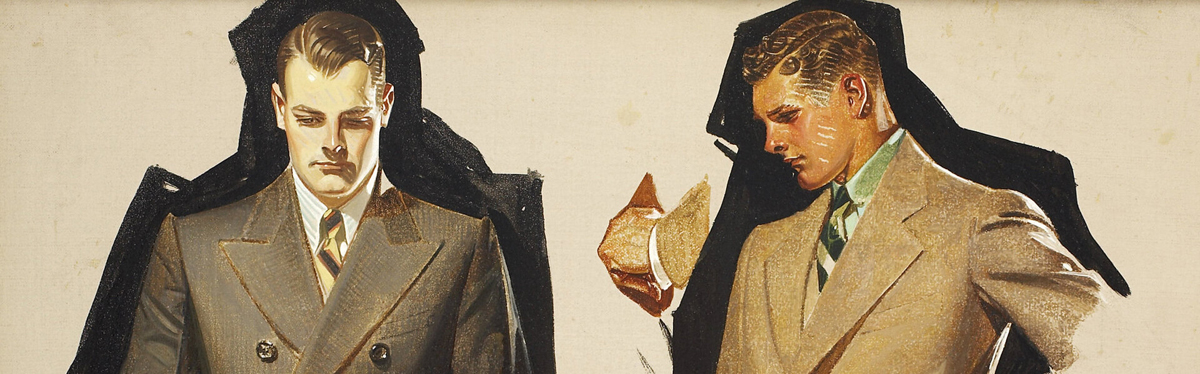

Before Norman Rockwell became America’s favorite illustrator, another artist held that throne for three decades. Joseph Christian Leyendecker created the Arrow Collar Man, invented modern magazine cover design, and painted 322 Saturday Evening Post covers with a technique so precise that his diagonal brushstrokes still puzzle painters today.
Most people recognize his work without knowing his name.
His red-suited Santa Claus, his New Year’s Baby, his chiseled masculine ideals shaped American visual culture from 1895 through 1951. Yet Leyendecker remains overshadowed by the protégé he mentored, working in relative historical obscurity despite commanding the highest fees in commercial art during the Golden Age of American Illustration.
This article examines Leyendecker’s distinctive painting techniques, his coded imagery, and his lasting influence on contemporary illustration. You’ll discover why his original paintings now sell for over four million dollars and how his partnership with model Charles Beach created advertising’s most iconic masculine archetype.
Identity Snapshot
Joseph Christian Leyendecker (J.C., Joe)
Lifespan: 1874-1951
Primary roles: Illustrator, Commercial Artist, Painter
Nationality: German-American
Movements: Golden Age of American Illustration, Art Nouveau
Mediums: Oil on canvas, gouache, board
Signature traits: Diagonal slash brushwork, pochet hatching, crisp hard edges, sculptural forms, thin transparent shadows with thick impasto highlights
Iconography: Arrow Collar Man, New Year’s Baby, red-suited Santa Claus, athletic heroes, fashionable men, cherubic children
Geographic anchors: Montabaur Germany (birth), Chicago Illinois, Paris France (Academie Julian), New York City, New Rochelle New York
Mentors: John H. Vanderpoel, Adolphe Bouguereau, Jean-Paul Laurens, Benjamin Constant
Students: Norman Rockwell (protege)
Key patrons: Saturday Evening Post, Cluett Peabody & Company (Arrow Collars), B. Kuppenheimer & Co., Kellogg Company, Collier’s Weekly
Collections: National Museum of American Illustration Newport RI, Haggin Museum Stockton CA, Smithsonian American Art Museum, Norman Rockwell Museum, private collections
Market signals: Football Hero (1914) sold for $4,121,250 at auction. Typical canvas size 20×30 inches to 30×40 inches, roughly twice reproduction size
What Sets The Artist Apart
Leyendecker carved geometry into flesh.
His figures snap with angular precision, built from controlled diagonal brushstrokes that function like drawn hatchwork. Where his teacher Bouguereau blended everything smooth, Leyendecker left visible paint architecture. Those slashing marks define planes while creating movement, turning oil into graphic punch.
He painted commercial dreams with museum technique. The Arrow Collar Man wasn’t just advertising, it was a cultural icon that received fan mail and marriage proposals. Leyendecker understood restraint better than any Golden Age peer. He knew exactly what to include and, more critically, what to leave out.
Before Rockwell became America’s illustrator, Leyendecker held that throne for three decades. He produced 322 Saturday Evening Post covers (one more than Rockwell), invented modern magazine design, and popularized Santa’s red suit, the New Year’s Baby, and Thanksgiving football. His technique merged French academic training with American speed, creating images that read instantly at the newsstand yet rewarded close study in original form.

Origins & Formation
Early Chicago Years (1874-1895)
Born March 23, 1874 in Montabaur, a village eighteen kilometers east of the Rhine.
The Leyendecker family immigrated to Chicago in 1882, where Elizabeth’s uncle was vice president of McAvoy Brewing Company. At age sixteen, Joseph apprenticed at J. Manz & Company, a Chicago engraving firm. His first major commission came at seventeen: sixty Bible illustrations for Powers Brothers Company.
Chicago Art Institute Training (1895-1896)
Studied drawing and anatomy under John H. Vanderpoel. Developed foundational skills in figure construction and classical proportion. Earned enough money to fund Paris training for himself and younger brother Frank.
Academie Julian, Paris (1898-1899)
Enrolled at Academie Julian with Frank. Studied under Bouguereau, Jean-Paul Laurens, and Benjamin Constant. Absorbed neoclassical training but rejected its blended finish.
Encountered poster work by Jules Cheret, Alphonse Mucha, and Toulouse-Lautrec. The Parisian poster aesthetic, with its flat color areas and graphic economy, influenced his emerging commercial style more than academic painting.
Return and First Success (1899-1900)
Returned to Chicago, established studio in Chicago Stock Exchange building with Frank.
May 20, 1899: received first Saturday Evening Post cover commission. This began a forty-four-year relationship with America’s most popular magazine. Early covers showed tight rendering with hints of the diagonal stroke system he’d develop later.
Moved to New York City in 1900, then the epicenter of American commercial art and publishing.
Movement & Context
Golden Age Positioning
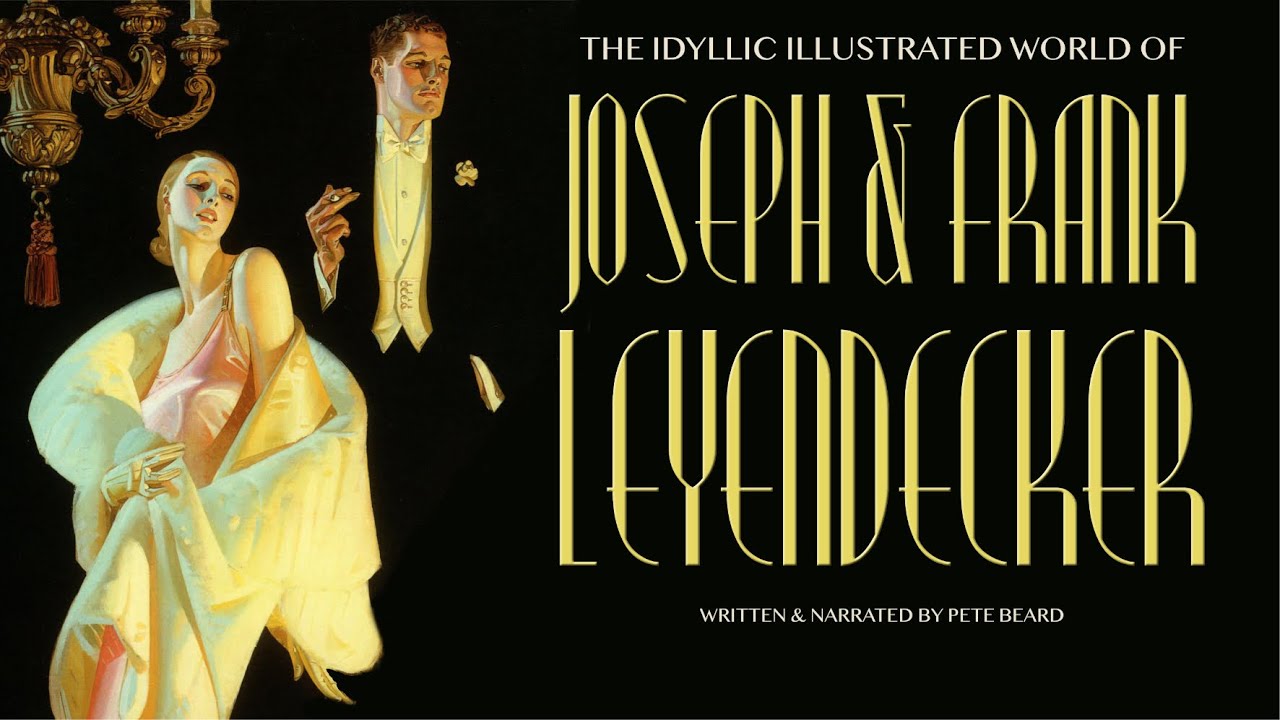
Leyendecker sat at the peak of American illustration’s commercial dominance (1895-1930s). Where Howard Pyle emphasized narrative storytelling and Maxfield Parrish created romantic otherworlds, Leyendecker captured contemporary American aspiration through idealized figures.
Comparative Analysis
vs. Norman Rockwell: Rockwell painted documentary sentiment with soft edges and warm earth tones. Leyendecker constructed iconic types with hard edges and cool sophistication. Rockwell’s figures exist in specific moments; Leyendecker’s exist as templates. Canvas aspect ratios similar (both favored vertical formats for Post covers), but Leyendecker used more dramatic cropping and poster-like silhouettes.
vs. J.C.’s brother Frank Xavier Leyendecker: Both knew the family medium formula (stand oil, turpentine, linseed oil). Frank painted with similar subjects but softer, more conventional brushwork. J.C. pushed further into geometric stylization and angular form definition. Frank’s edge control remained academic; J.C. made edges part of the design language.
vs. John Singer Sargent: Both used visible confident brushwork and transparent shadows. Sargent worked alla prima with looser immediacy; Leyendecker built through methodical stages with tighter control. Sargent captured elite society as it was; Leyendecker constructed idealized masculinity for mass consumption. Sargent’s stroke length varies organically; Leyendecker’s diagonal slashes maintain consistent angle and width for graphic cohesion.
Art Nouveau Influence
Leyendecker absorbed Art Nouveau’s emphasis on decorative line, flat pattern, and stylized natural forms during his Paris years. His figures curve with the same elegant simplification seen in Mucha’s posters. Clothing folds become ornamental zig-zags rather than naturalistic drapery. This decorative impulse separated him from purely academic realists.
Materials, Techniques, and Process
Support & Ground
Worked primarily on linen canvas, occasionally cotton canvas. Standard sizes ranged from 20×30 inches to 30×40 inches, approximately twice final reproduction size. Used smooth-primed canvas with minimal texture, allowing his brushwork to define surface rather than relying on canvas tooth.
Also worked on illustration board for smaller studies.
Secret Medium Formula
Mixed fresh daily: turpentine, stand oil, and linseed oil in specific proportions (exact ratios never documented).
This proprietary blend produced thin, slippery consistency that showed minimal texture on canvas. Paint flowed like liquid, creating porcelain-smooth areas when desired but maintaining crisp edges for slash strokes. The medium allowed both delicate glazing and bold opaque marks in single painting session.
Brushwork Taxonomy
Pochet (crosshatched oil strokes): His signature technique. Hard-edged parallel brushstrokes applied in hatching fashion, typically diagonal. These strokes define form through directional marks rather than blending, functioning like drawn lines in painted medium.
Slash strokes: Bold diagonal marks, often in highlights. Applied with confidence, each stroke placed once without reworking. Created dynamic visual energy and graphic snap.
Transparent shadows: Kept shadow areas thin and vibrant, allowing underpainting to show through. Built with glazing technique using round or flat sable brushes.
Thick light application: Applied paint more heavily in lighted areas as work progressed. Used larger flat bristle brushes for heavier impasto passages, adding poppy oil or linseed oil when necessary.
Background treatment: Long, straight, intersecting strokes of white in backgrounds, allowing board or underpainting to show through. Created poster-like flatness that pushed figures forward.
Palette & Color Strategy
Temperature bias: Cool greys balanced against warm flesh tones. Often used Auburn reds for hair, tan beige creams for skin, pink whites for backgrounds.
Value distribution: Strong contrast between light and dark masses. Maintained transparent darks against opaque lights for maximum luminosity.
Skin tone playfulness: Experimental with flesh colors, incorporating unexpected violets, greens, and blues within naturalistic range. Angular marks of light (white, cream, pink) activate nose, lips, cheeks, chin.
Habitual pigments: Preference for Naples Yellow, various earth tones, crisp whites, deep transparent darks.
Studio Practice
Worked in methodical stages, never starting final canvas without extensive preparation:
- Thumbnail sketches: Filled sketch pads with 2×3 inch roughs, comparing multiple compositions at glance
- Design selection: Chose composition with clearest story and most interesting design
- Scale-up: Enlarged via grid method to magazine cover size, adding detail and color
- Live model studies: Created multiple pencil or charcoal studies from life
- Color studies: Painted selected poses on sketch canvas in full color (oil or watercolor) with detail
- Final painting: Worked entirely from studies, never working directly from model for final piece
Started with round or flat sable using thin wash with turpentine as medium. Progressed from thin transparent passages to thicker opaque application. Applied quick-drying retouching varnish when dry.
Avoided photography when possible, preferring direct drawing from life. This distinguished him from later illustrators who relied on photographic reference.
Edge Control Philosophy
Mastered “finding the straight within the curved.” His figures possess sharp, geometric structure beneath organic surfaces. Edges vary from knife-hard (where forms turn against light) to soft-lost (where forms merge into shadow), but hard edges dominate for graphic clarity.
Themes, Subjects, and Iconography
Masculine Idealization
The Arrow Collar Man represented early twentieth-century masculine perfection: chiseled jaw, broad shoulders, confident posture, impeccable dress. These figures projected aspiration rather than reality. Model Charles Beach provided the physical template, appearing in hundreds of illustrations from 1903 to 1930.
Athletes, soldiers, sailors, and business executives embodied active masculinity. Football players, golfers, and crew teams suggested vitality and competitive spirit. Many art historians note homoerotic undertones in these depictions, though commercial context kept imagery safely mainstream.
Holiday Iconography
New Year’s Baby: Leyendecker’s recurring cherub, often wearing top hat and diaper, became synonymous with New Year celebrations. The character appeared annually on Saturday Evening Post covers, evolving through various situations, mischief, and symbolic transitions.
Santa Claus: His pudgy, red-suited, white-bearded Santa helped standardize the modern American image of Father Christmas (though Coca-Cola’s later campaigns often receive credit).
Mother’s Day flowers: May 30, 1914 Post cover featuring bellhop carrying hyacinths commemorated President Wilson’s declaration of Mother’s Day as official holiday.
Thanksgiving football: Popularized the association between turkey day and gridiron action.
Fourth of July: Firecrackers, flags, and patriotic celebration became Leyendecker visual territory.
Fashion Advertising Subjects
Elegantly dressed men dominated his commercial work. Suits, collars, shirts, socks, and underwear required depicting fabric movement, drape, and texture. Leyendecker’s brushwork made clothing tangible, capturing weight of wool, crispness of cotton, sheen of silk through calculated stroke networks.
Pinstripes, plaids, and patterns became tours de force. Black pinstripes over white shirts demonstrated his ability to layer painted elements while maintaining clarity.
Children & Domestic Scenes
Beginning 1912, Kellogg’s commissioned series of cherubic children eating Corn Flakes. These wholesome images targeted mothers, showing winsome kids and adolescents in everyday situations. His children possess round faces, bright eyes, and expressive gestures that conveyed innocence and energy.
Military & Patriotic Imagery
World War I recruitment posters showed heroic soldiers, sailors, and marines in dramatic poses. “Hailing You for the U.S. Navy” (1918) and similar images combined patriotic messaging with Leyendecker’s signature stylization. Also created war bonds posters for U.S. government.
Compositional Schemes
Single figure dominance: Most covers featured one central figure, often cropped dramatically. This created instant recognition and poster-like impact.
Triangular stability: Figures frequently arranged in pyramid or triangle formations, providing classical balance.
Serpentine curves: Used S-curve poses for elegant movement, particularly in fashion illustrations.
Grid-based structure: Underlying geometric armature organized complex compositions, though final image appeared spontaneous.
Symbol Sets & Meanings
Football helmets = youth, competition, American sport culture Top hats = sophistication, New Year celebration, formal occasions Flowers = Mother’s Day, romance, seasonal celebration Military uniforms = patriotism, duty, heroism Crisp collars = success, modernity, aspiration Golf clubs, tennis rackets = leisure class, athletic masculinity
Socio-Historical Context
Leyendecker’s career paralleled America’s emergence as consumer society. His illustrations didn’t just reflect culture; they shaped it. The idealized men in his ads established standards for masculine appearance and behavior that persisted through mid-century.
His work navigated early twentieth-century tensions around sexuality and identity. While his partnership with Charles Beach was lifelong and documented, his public imagery remained coded rather than explicit. This allowed mainstream acceptance while providing visual language recognizable to gay audiences.
Notable Works
Football Hero (1914)
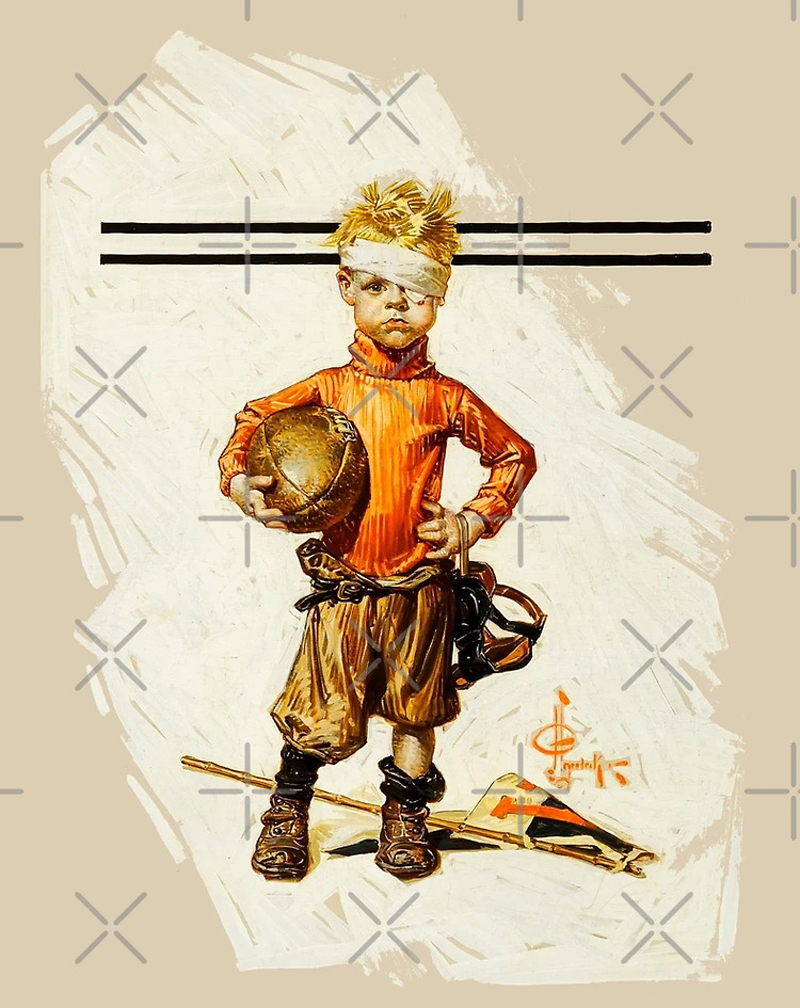
Medium: Oil on canvas Size: 30 x 21 inches Original location: Saturday Evening Post cover, November 21, 1914
Visual signature: Beat-up boy wearing orange turtleneck, baggy brown shorts tied with rope, sturdy shoes with baggy socks. White bandage covers forehead and left eye. Football helmet held in one hand. Single figure against minimal background, demonstrating Leyendecker’s mastery of focal point and restraint.
Why it matters: Exemplifies his ability to convey narrative through single figure. The boy’s disheveled appearance tells complete story without additional elements. Sold for $4,121,250 at auction, setting record for Leyendecker work and confirming his status among greatest American illustrators.
Brushwork: Staccato painting style with visible diagonal strokes defining fabric wrinkles and form planes. Transparent shadows in clothing folds, opaque highlights on bandage and skin.
Arrow Collar Man Series (1907-1930)
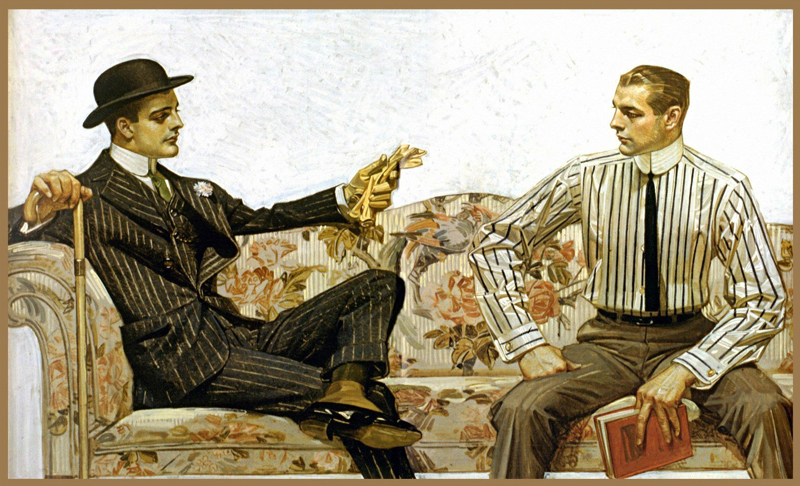
Medium: Oil on canvas, various sizes Original use: Magazine advertisements, billboards
Visual signature: Chiseled features, strong jaw, confident gaze. Impeccably dressed in white collar and fashionable attire. Hard-edged brushwork creates sculptural quality. Backgrounds often white with characteristic slash strokes.
Why it matters: Created defining image of early twentieth-century American masculinity. The character became cultural phenomenon, receiving fan mail and inspiring Broadway musical. Model Charles Beach provided physical basis for most iterations.
Related works: Hundreds of variations for Arrow collars, Kuppenheimer suits, Interwoven socks. Each maintained consistent idealized male type while varying poses and settings.
Couple in Boat (1912)
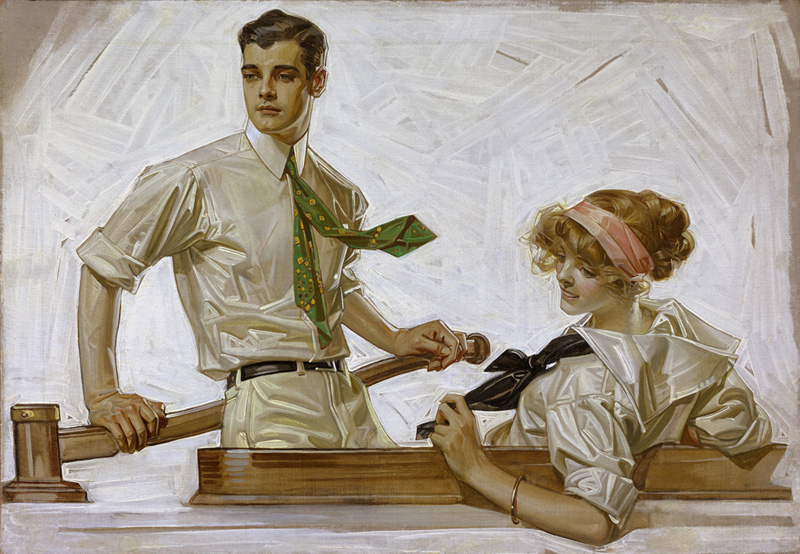
Medium: Oil on canvas Size: 20.5 x 29.5 inches Original use: Arrow Collar Advertisement
Visual signature: Man and woman in white clothing, seated in boat. White fabric assembled from networks of strokes that sculpt drapery with precision. Figures exist as two-dimensional presences with sharp, arresting patterns. Demonstrates Leyendecker’s equation of clothing with leisure culture.
Why it matters: Shows his ability to paint fabric as sensual material while maintaining commercial purpose. The white garments nearly distract from narrative, becoming primary subject through painterly virtuosity.
Bellhop with Hyacinths (1914)
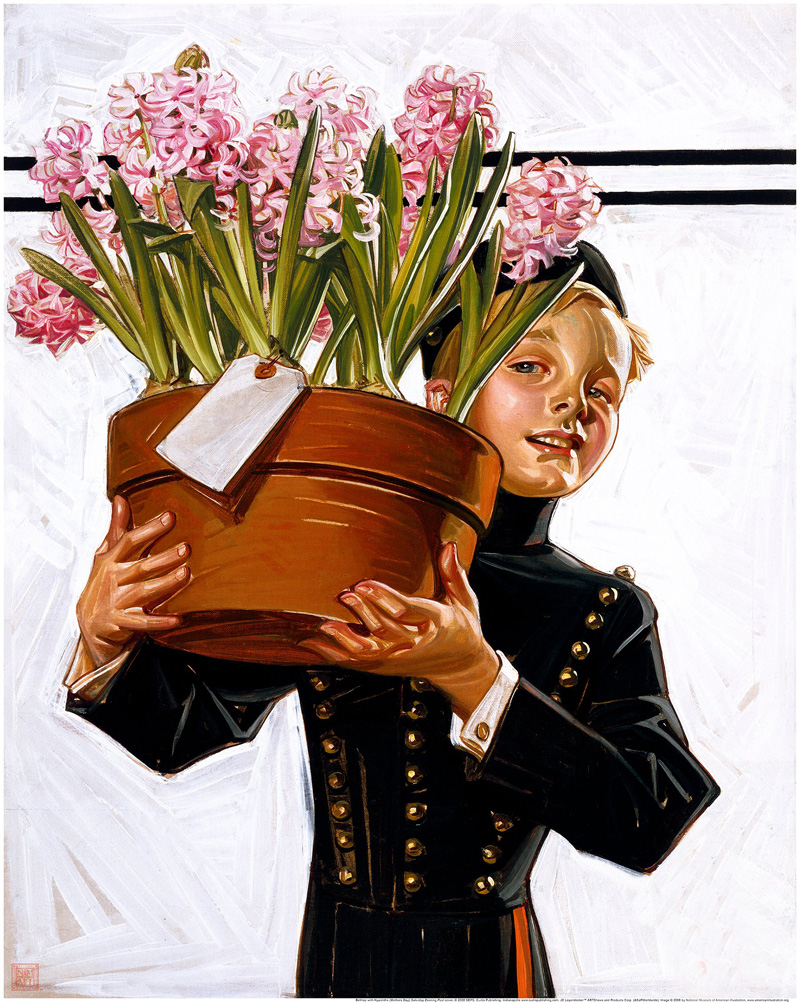
Medium: Oil on canvas Size: 28 x 20 inches Original location: Saturday Evening Post cover, May 30, 1914
Visual signature: Young bellhop carrying pot of hyacinths. Single figure composition with minimal background. Commemorates President Wilson’s declaration of Mother’s Day as official holiday.
Why it matters: Established visual tradition of Mother’s Day flower giving. Demonstrates his influence on American cultural practices beyond pure advertising. Shows his skill with children subjects, capturing innocence and charm.
U.S. Marines Recruitment Poster (1917)
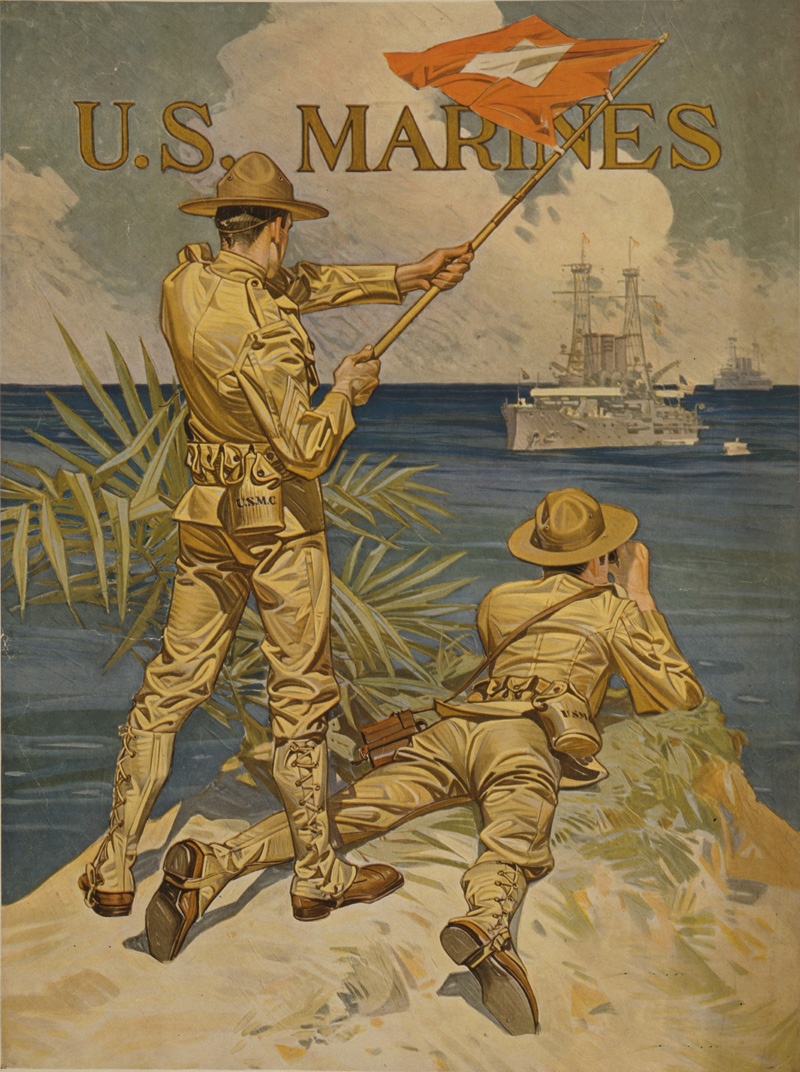
Medium: Oil on canvas Original use: World War I military recruitment
Visual signature: Heroic marine in uniform, dramatic pose suggesting action and duty. Bold colors, strong value contrast, poster-like clarity. Demonstrates how his magazine cover skills translated to patriotic messaging.
Why it matters: Part of government effort to inspire enlistment. Combined commercial illustration techniques with propaganda purposes. Shows his range beyond fashion and lifestyle subjects.
New Year’s Baby Series (1908-1943)
Medium: Oil on canvas, various sizes Original location: Saturday Evening Post covers, annually
Visual signature: Cherubic infant, often wearing top hat and diaper, engaged in symbolic year-end or year-beginning activities. Character aged, misbehaved, cleaned up, and represented American hopes and anxieties through decades.
Why it matters: Created lasting American tradition of New Year’s Baby imagery. Appeared regularly for over three decades, making it one of most recognized recurring characters in magazine illustration history.
Exhibitions, Collections, and Provenance Highlights
Major Public Collections
National Museum of American Illustration, Newport RI: Largest collection of Leyendecker originals. Includes major Arrow Collar advertisements, Saturday Evening Post covers, and personal studies.
Haggin Museum, Stockton CA: Significant collection of original paintings. Features multiple Post covers, advertising illustrations, and preparatory studies.
Norman Rockwell Museum, Stockton MA: Holdings include Post covers and comparative displays with Rockwell’s work. 2015 exhibition “The Art of J.C. Leyendecker” featured rarely-seen originals from private collections.
Smithsonian American Art Museum: Select works in permanent collection representing Golden Age illustration.
Important Exhibitions
“Under Cover: J.C. Leyendecker and American Masculinity” (New-York Historical Society): Examined his depictions of masculine ideals and cultural impact. Addressed coded imagery and relationship to early twentieth-century gay culture.
Norman Rockwell Museum retrospective (2015): Comprehensive survey acknowledging his influence on Rockwell and American illustration.
Various traveling exhibitions: Works appear in Golden Age illustration surveys and early American advertising retrospectives.
Provenance Patterns
After Leyendecker’s death in 1951, Charles Beach and sister Augusta inherited estate including hundreds of original canvases. Beach held auction on New Rochelle property grounds, selling many originals for minimal prices (estate sale context, pre-illustration art market boom).
Works scattered to private collectors, many remaining unknown until recent decades.
1970s: Judy Goffman Cutler and Laurence S. Cutler began systematically collecting Leyendecker originals, eventually forming National Museum of American Illustration.
Contemporary market: Major works appear at Heritage Auctions, Sotheby’s, and specialized illustration art dealers. Prices have increased dramatically as Golden Age illustration gained art historical recognition.
Notable Collectors
Alex Chasky collection (New York) Mort Walker collection (cartoonist) William Hargreaves collection The Kelly Collection of American Illustration The Eisenstat Collection of Illustration Multiple anonymous private collections
Authentication Considerations
Signed lower right: “JCLeyendecker” (sometimes with periods: “J.C.Leyendecker”) Reverse inscriptions often include Post assignment numbers or client codes Original canvases show his characteristic thin paint application and proprietary medium effects Studies and color sketches exist in smaller formats, sometimes unsigned
Market & Reception
Auction Records
Football Hero (1914): $4,121,250 (record for artist)
Typical price ranges:
- Major Post covers: $100,000-$500,000+
- Arrow Collar advertisements: $50,000-$300,000
- Smaller studies and sketches: $10,000-$50,000
- Lesser-known commercial work: $5,000-$25,000
Market has grown substantially since 1990s as Golden Age illustration entered serious collecting sphere. Early originals sold at estate sale for hundreds of dollars now command six-figure prices.
Period by Subject
1900-1920 work (peak commercial period): highest demand, strongest prices 1920s work (stylistic apex): premium for iconic subjects 1930s-1940s work (later career): lower prices, less iconic imagery
Medium affects value: oil on canvas commands premium over gouache or preliminary studies.
Authentication Risks
Forgeries rare due to technical difficulty replicating his brushwork and medium effects.
Signature variants exist (with/without periods, spacing variations) but documented through period publications.
Greater risk: misattribution of student work or contemporary artists working in similar style. His influence on illustration means many later artists adopted similar techniques.
Condition Patterns
Craquelure: His thin medium application sometimes resulted in fine cracking networks, generally accepted as characteristic age pattern.
Ground failures: Rare, as he used quality supports and proper priming.
Varnish yellowing: Retouching varnish mentioned in his documented method sometimes darkened over decades. Professional restoration can address without damaging original paint layer.
Edge wear: Magazine covers sometimes trimmed or mounted, affecting borders. Uncut examples command premium.
Fading: His palette generally stable, though some organic pigments show minor shifts. Works stored in dark conditions retain original color saturation.
Critical Reception Through Decades
1900s-1920s: Widely celebrated as America’s premier illustrator. Commanded highest fees in field. Cultural impact undeniable.
1930s-1940s: Declining commissions as photographic illustration gained favor and editorial preferences shifted. Still respected but considered somewhat old-fashioned.
1950s-1970s: Relative obscurity following death. Rockwell overshadowed him in public memory. Original paintings sold cheaply.
1980s-2000s: Scholarly reassessment began. Exhibitions explored his technical mastery and cultural significance. LGBTQ+ historians examined coded imagery and Beach relationship.
2000s-present: Full recognition as major American artist. Museum exhibitions, auction records, academic study. Acknowledged influence on contemporary illustration, animation, and graphic design.
Influence & Legacy
Upstream Influences
Academic training: Bouguereau’s figure construction and tonal modeling (though rejected his blended finish)
French poster artists: Cheret, Mucha, Toulouse-Lautrec taught him graphic economy and flat pattern design
John Singer Sargent: Confident brushwork and transparent shadow approach
Art Nouveau movement: Decorative line quality, stylized forms, integration of text and image
Downstream Impact
Norman Rockwell: Direct mentorship. Rockwell called Leyendecker “my god” and learned from his Saturday Evening Post covers. Rockwell adopted methodical staging process, though developed warmer, more sentimental approach.
Other Golden Age illustrators: Dean Cornwell, J.C.’s brother Frank, and entire generation of magazine illustrators adopted aspects of his technique and compositional strategies.
Mid-century advertising: His Arrow Collar Man established template for idealized masculinity in advertising that persisted through 1960s.
Animation and gaming: His angular stylization and graphic clarity influenced character design. Team Fortress 2 video game explicitly references his aesthetic. The Dagger of Amon Ra adventure game borrowed his visual approach.
Contemporary illustration: Artists studying Golden Age techniques return to his brushwork methods. Digital painters attempt to replicate his slash stroke effects.
Fashion illustration: His clothing depiction techniques, particularly fabric rendering through directional brushwork, remain instructional.
Cross-Domain Echoes
Film and television: Period dramas set in early twentieth century reference his imagery for costume and styling. Interview with the Vampire series (2022) explicitly used Leyendecker illustrations as costume design inspiration, drawing parallel between Louis/Lestat’s hidden relationship and Leyendecker/Beach partnership.
Photography: Commercial photographers studying composition and lighting analyze his work for dramatic single-light setups and figure placement.
Graphic design: Modern designers studying typography integration and image-text relationships examine his magazine covers as early examples of integrated visual communication.
LGBTQ+ art history: Scholars studying coded imagery and queer representation in mainstream commercial art cite his work as significant case study. Recent exhibitions and documentaries (Coded, 2021) explore this dimension.
Cultural Legacy
Defined visual language of American aspiration during nation’s emergence as global power.
Created iconography (New Year’s Baby, modern Santa Claus, Arrow Collar Man) that persists over century later.
Demonstrated that commercial art could achieve museum-quality technique while serving advertising purposes.
His relationship with Charles Beach, while carefully coded during his lifetime, now recognized as important example of same-sex partnership in early twentieth century America.
How to Recognize a Leyendecker at a Glance

Diagonal slash brushwork: Hard-edged parallel strokes, typically at consistent angle, defining form through directional marks rather than smooth blending.
Sculptural figures: Bodies possess geometric architecture, “straight within the curved,” with angular planes defining musculature and bone structure.
Transparent darks, opaque lights: Shadows thin and vibrant, highlights thick and sculptural. Strong value contrast throughout.
White backgrounds with visible strokes: Long intersecting marks in backgrounds, allowing canvas or board to show through, creating poster flatness.
Idealized masculine figures: Chiseled jaws, broad shoulders, confident postures. Even when depicting children or women, forms possess architectural strength.
Fabric as subject: Clothing rendered with virtuoso brushwork, pinstripes and patterns layered with clarity, folds becoming decorative zig-zags.
Typical canvas sizes: 20×30 inches to 30×40 inches for finished paintings, approximately twice magazine reproduction size.
Signature placement: Lower right corner, “JCLeyendecker” or “J.C.Leyendecker” in relatively small, neat script.
Cool palette bias: Preference for cool greys, blues, and whites balanced against warm flesh tones. Auburn reds for hair common.
Minimal backgrounds: Restraint in setting details. Focus on central figure(s) with suggestion rather than elaboration of environment.
Poster-like silhouettes: Figures read as strong shapes against backgrounds, designed for instant recognition at distance (newsstand impact).
FAQ on Joseph Christian Leyendecker
Who was Joseph Christian Leyendecker?
Joseph Christian Leyendecker was a German-American illustrator who dominated commercial art from 1895 to 1951. He created 322 Saturday Evening Post covers, invented the Arrow Collar Man, and established visual traditions including the New Year’s Baby and modern Santa Claus imagery during the Golden Age of American Illustration.
What painting technique did Leyendecker use?
Leyendecker used a proprietary oil painting medium mixing turpentine, stand oil, and linseed oil. His signature pochet technique featured diagonal slash brushstrokes that created hard-edged hatching effects. He kept shadows transparent while building thick impasto in highlights, working methodically from studies rather than directly from models.
How much are Leyendecker paintings worth?
His most famous work, Football Hero (1914), sold for $4,121,250 at auction. Major Saturday Evening Post covers typically range from $100,000 to $500,000. Arrow Collar advertisements command $50,000 to $300,000, while smaller studies sell for $10,000 to $50,000 depending on subject and condition.
What was Leyendecker’s relationship with Charles Beach?
Charles Beach was Leyendecker’s life partner, business manager, and favorite model for nearly 50 years (1903-1951). Beach provided the physical template for the Arrow Collar Man and appeared in hundreds of illustrations. Their relationship, while coded during their lifetimes, is now recognized as a significant same-sex partnership.
How did Leyendecker influence Norman Rockwell?
Norman Rockwell called Leyendecker “my god” and learned from his Saturday Evening Post covers before developing his own style. Leyendecker mentored Rockwell, teaching him methodical staging processes and composition strategies. Rockwell served as pallbearer at Leyendecker’s funeral, acknowledging this lasting debt.
Where can I see original Leyendecker paintings?
The National Museum of American Illustration in Newport, Rhode Island holds the largest collection. The Haggin Museum in Stockton, California features significant holdings. The Norman Rockwell Museum and Smithsonian American Art Museum also display his work. Many originals remain in private collections.
Why did Leyendecker’s career decline?
After 1930, editorial changes at the Saturday Evening Post reduced his commissions. The Great Depression decreased advertising budgets, and color photography began replacing painted illustrations. His last Post cover appeared in 1943. Changing aesthetic preferences favored photographic realism over stylized illustration.
What is the Arrow Collar Man?
The Arrow Collar Man was Leyendecker’s creation for Cluett Peabody & Company (1907-1930). This idealized masculine figure with chiseled features and impeccable dress became a cultural icon, receiving fan mail and marriage proposals. Charles Beach modeled for most iterations, establishing early twentieth-century standards for masculine appearance.
Did Leyendecker study in Paris?
Yes, Leyendecker and his brother Frank enrolled at Academie Julian in Paris (1898-1899). He studied under Bouguereau, Jean-Paul Laurens, and Benjamin Constant, absorbing neoclassical training. Paris also exposed him to poster work by Jules Cheret, Alphonse Mucha, and Toulouse-Lautrec, influencing his graphic commercial style.
What materials did Leyendecker work with?
Leyendecker primarily used oil on canvas, working on smooth-primed linen in sizes approximately twice reproduction dimensions (typically 20×30 to 30×40 inches). He also used gouache and illustration board for studies. His secret medium formula produced thin, slippery paint consistency with minimal surface texture.
Conclusion
Joseph Christian Leyendecker revolutionized commercial illustration through technical mastery and cultural vision. His diagonal slash brushwork and transparent shadow techniques created instantly recognizable images that shaped American visual identity during the early twentieth century.
The Arrow Collar Man established masculine ideals that persisted for generations.
His methodical studio practice, working from multiple studies rather than direct observation, allowed unprecedented control over composition and design. This approach influenced countless illustrators, particularly his protégé Norman Rockwell, who adopted similar staging methods while developing a warmer aesthetic.
Today, Leyendecker’s original paintings command millions at auction. Museums recognize his contributions to American art history, and contemporary illustrators study his brushwork techniques for their graphic clarity and painterly sophistication.
His partnership with Charles Beach, once hidden, now represents an important chapter in LGBTQ+ art history, adding depth to understanding his coded imagery and cultural impact.