Skulls grin from black canvases. Confederate flags tangle with Native American headdresses. Death imagery collides with spiritual mantras.
Wes Lang creates paintings that excavate America’s darkest cultural symbols and hold them up to unforgiving light. The contemporary artist learned his craft not through art school but through handling masterworks at the Guggenheim Museum, absorbing lessons from Basquiat, Twombly, and Guston while developing a visual language rooted in tattoo culture and underground aesthetics.
His work now hangs in MoMA and commands six-figure auction prices. But the path from Brooklyn studio to museum walls reveals more than a career trajectory.
This article maps Lang’s artistic evolution, technical methods, and the iconography that makes his work instantly recognizable. You’ll discover how tattoo flash sheets meet abstract expressionism, why death imagery functions as life affirmation, and what distinguishes his mark-making from proximate contemporary artists.
Identity Snapshot
Full Name: Wes Lang (Wesley Lang)
Born: 1972, Chatham, New Jersey, United States
Primary Roles: Painter, printmaker, sculptor, illustrator
Nationality: American
Movements: Contemporary street art, lowbrow art, urban contemporary, post-pop Americana
Mediums: Acrylic painting, oil painting, encaustic wax, oil stick, colored pencil, graphite, paper collage, cast bronze sculpture, fabric, glass, precious metals
Supports: Canvas (cotton and linen), paper, wood panel, hotel stationery, found materials
Signature Traits: Frenetic mark-making, hand-drawn graphic style, dense layering, bold outlines, monochromatic and limited color palettes, aggressive brushwork, text integration
Iconography: Skulls, skeletons, grim reapers, horses, birds (especially eagles and ravens), Native American headdresses, Confederate flags, cowboys, roses, weapons, religious symbols
Geographic Anchors: Chatham, New Jersey (birthplace); Brooklyn, New York (studio); Los Angeles, California (current studio); Montauk, New York (residency)
Key Influences: Jean-Michel Basquiat, Philip Guston, Cy Twombly, Franz Kline, Joan Mitchell, Francis Bacon, Mike Kelley, Martin Kippenberger
Collections: Museum of Modern Art (MoMA), National Gallery of Denmark, DESTE Foundation for Contemporary Art, Murderme Collection (Damien Hirst), Edward F. Albee Foundation
Market Signals: Auction record $252,000 USD for “The Unity Within” (2022, Phillips New York); typical canvas sizes range from 24 x 24 inches to monumental 11’4″ x 48′ works; price range $225-$252,000 USD
Studio Practice: Compulsive, manic working method; often works in series; employs both spontaneous mark-making and meticulous rendering
Spiritual Framework: Taoism (Tao Te Ching), Ram Dass lectures, acceptance of mortality as creative driver
Commercial Collaborations: Kanye West (Yeezus tour merchandise, 2013), The Grateful Dead, Harley-Davidson, Rolex, AMIRI fashion, The Great Frog jewelry
What Sets The Artist Apart

Lang’s work lives in the hot space between tattoo flash sheets and abstract expressionism. He’s an autodidact who learned painting through art handling at the Guggenheim Museum.
The work carries a humid darkness. Skulls grin from black grounds. Confederate flags tangle with Native headdresses. It’s American history viewed through cracked glass.
His line quality switches gears constantly. One moment it’s tight and controlled like vintage tattoo art. The next it’s wild and scrappy.
Text fragments scatter across surfaces. “Thank You God.” “Following the light.” Taoist mantras crash into biker bar imagery.
Where Andy Warhol celebrated consumer America, Lang excavates its bones. Where Basquiat channeled street poetry, Lang channels outlaw mythology.
Origins & Formation
Early Background (1972-1990s)
Born in Chatham, New Jersey in 1972. Grew up surrounded by American iconography that would later define his visual vocabulary.
Sticker books, monster imagery, and Americana from youth became core reference material. No formal art education.
Guggenheim Years (1990s-2000s)
Worked as art handler at the Guggenheim Museum. This became his art school.
Direct contact with masterworks. Studied painting techniques up close. Absorbed lessons from Twombly’s gestural marks, Guston’s cartoonish gravity, Kline’s bold structures.
The job put canonical art in his hands daily. Different kind of education than any MFA program could provide.
First Visual Language (2000-2005)
Early work combined tattoo aesthetics with fine art ambitions. Showed at ZieherSmith in New York.
“The Promised Land” (2005) established core themes. American totems mixed with death imagery. Cowboys, skulls, flags, horses.
Exhibited “Skulls and Shit” collaboration with Donald Baechler (2006, Galleri Loyal, Stockholm). The title captured his raw approach.
Edward F. Albee Residency (2001)
Montauk, New York residency provided focused studio time. Refined techniques. Developed confidence in hand-drawn style.
Movement & Context
Post-Pop Position
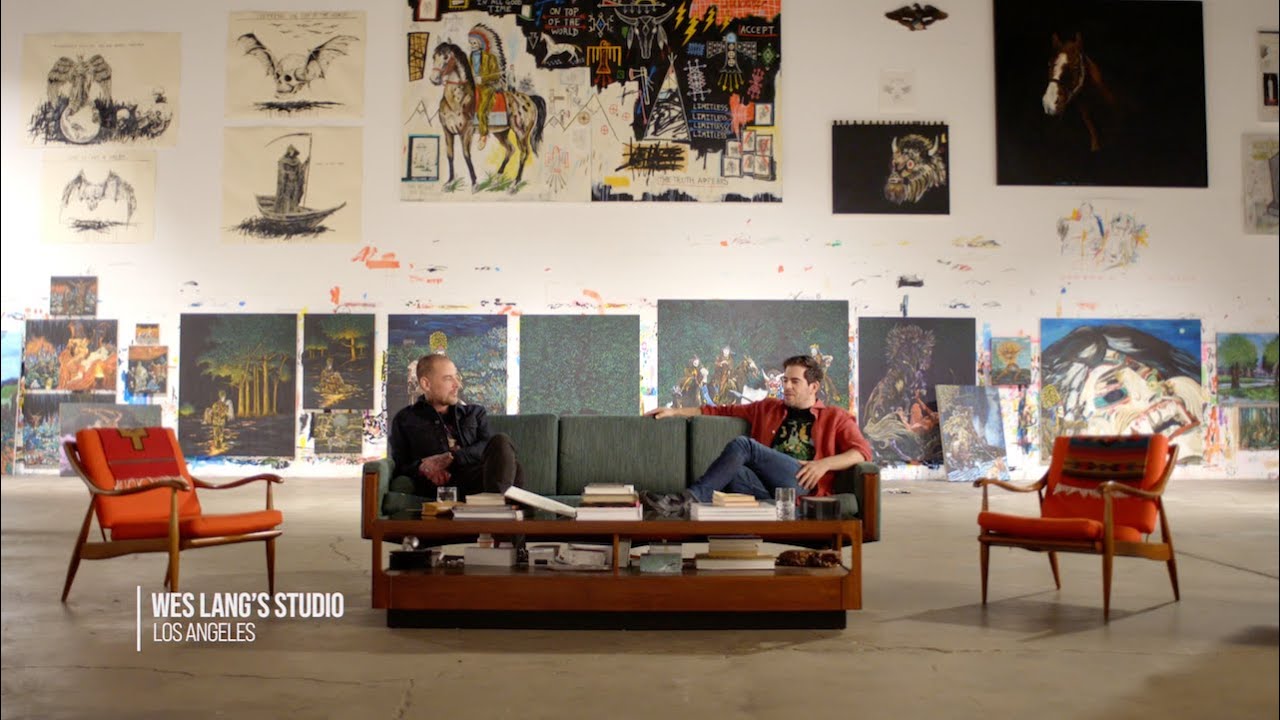
Lang mines post-pop American landscape but rejects pop art’s cool irony. His work burns hot. Angry, spiritual, conflicted.
Where pop art embraced consumer surfaces, Lang digs for buried cultural trauma.
Street Art Connections

Shares DNA with street art but operates primarily in fine art context. Bold graphics. Outlaw subjects. DIY aesthetic.
Not a street artist in practice. Gallery and museum career from the start. But the attitude matches underground culture.
Comparison to Proximate Artists
Versus Basquiat: Both use text, skulls, and frenetic energy. But Lang’s edges are harder. More tattoo flash, less graffiti tag. Basquiat’s surfaces feel hot and immediate. Lang’s feel premeditated, even when wild.
Versus Raymond Pettibon: Both tackle dark Americana. Pettibon uses narrative illustration and text. Lang leans abstract, letting symbols float. Pettibon’s line is looser. Lang’s has tattoo precision beneath the chaos.
Versus Mike Kelley: Both interrogate American culture’s underbelly. Kelley used found objects and institutional critique. Lang stays with painting and drawing. Kelley was conceptual. Lang is visceral.
Lowbrow/Outsider Position

Fits uneasily in lowbrow art movement. Has the tattoo culture connection. Embraces “low” subjects.
But technique and art historical awareness push beyond lowbrow boundaries. Studio practice is rigorous. References are high and low simultaneously.
Materials, Techniques, and Process
Supports & Grounds
Canvas: Cotton and linen, stretched. Sizes from intimate 24 x 24 inches to monumental multi-panel works.
Paper: Heavy watercolor paper, hotel stationery, found book covers. Allows spontaneous work.
Wood Panels: Unprimed and primed. Direct surface contact.
Painting Mediums
Acrylic: Primary medium for decades. Fast-drying. Allows rapid layering. Creates flat, poster-like surfaces in early work.
Oil Paint: Recent shift (2020 forward). Richer pictorial space. Figures suspend in deep black grounds. More atmospheric than acrylic work.
Encaustic Wax: Hot wax mixed with acrylic. Adds texture and weight. Creates physical depth.
Oil Stick: Direct application. Greasy, immediate. Combines drawing with painting.
Crayon: Adds raw mark-making. Childlike but controlled.
Application Methods
Direct Brushwork: Aggressive, confident strokes. Little hesitation visible.
Layering: Builds surfaces through multiple passes. Acrylic allows rapid accumulation. Oil creates luminous depth.
Collage: Paper elements embedded in surfaces. Newspaper clippings, found images, pornographic magazines, text fragments.
Drawing Integration: Colored pencil, graphite, ink directly on painted surfaces. Blurs painting/drawing boundary.
Color Strategies
Black Grounds: Signature approach in recent work. Deep, flat black creates void space. Figures and symbols emerge from darkness.
Limited Palettes: Often works with 3-5 colors per piece. Red, white, black, yellow, blue dominate.
Monochrome Phases: “The Black Paintings” series (2024). Minimal color. Maximum contrast.
Color Psychology: Red for violence and passion. White for death and purity. Black for void and potential.
Mark-Making Taxonomy
Hard-Edge Graphic: Tattoo-style outlines. Clean borders around symbols.
Gestural Scribble: Rapid, nervous marks. Fills backgrounds. Creates energy fields.
Text Integration: Hand-lettered phrases. Sometimes clear, sometimes degraded. Mantras and fragments.
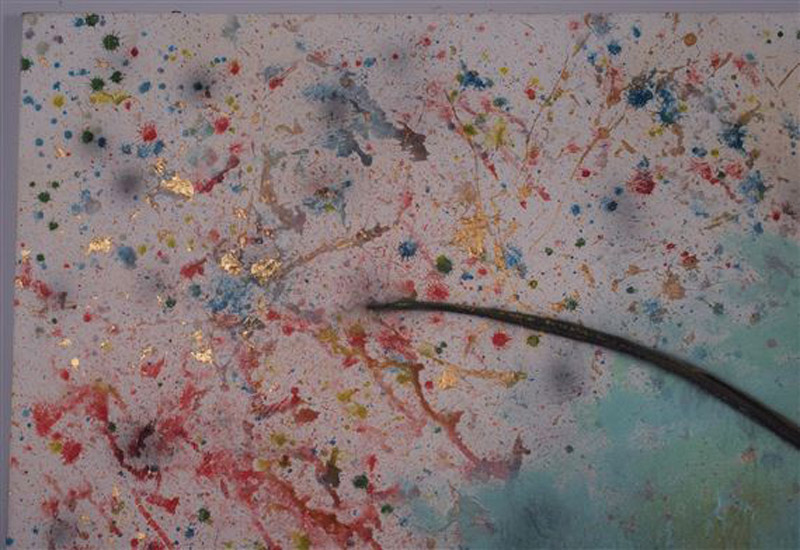
Drips & Splatters: Controlled accidents. Adds spontaneity to planned compositions.
Studio Practice
Compulsive Output: Works daily. Multiple pieces simultaneously. Series-based thinking.
Alla Prima & Layered: Some pieces direct and fast. Others built over weeks through glazing and reworking.
No Underdrawing (Usually): Attacks canvas directly. Sketches exist separately but don’t often transfer.
Painting Over: Frequently destroys and rebuilds. “I painted over everything for the last time and these things started really clicking.”
Technical Signature
Viewers can identify Lang work by:
- Hard-edge outlines surrounding loosely filled areas
- Text that feels both carefully placed and spontaneously added
- Black grounds with suspended imagery
- Tension between control (outlines) and chaos (fill)
- Tattoo precision meeting abstract gesture
Themes, Subjects, and Iconography
American Mythology Deconstruction
Cowboys, Native Americans, eagles, flags. Lang takes national symbols and shows their darkness.
“I like to take American history and then completely ignore it. I come at it visually, taking images and telling my own story.”
The Confederate flag appears repeatedly. Not celebrating it. Examining it as cultural wound.
Death as Life Affirmation
Skulls, skeletons, grim reapers dominate. Not nihilistic despite appearances.
Tao Te Ching influence: “Acceptance of death is the only way to be completely alive and present.”
Death imagery functions as memento mori. Reminder to live fully now.
Masculine Iconography
Motorcycles, guns, tattoos, whiskey. Outlaw culture. Biker aesthetic.
But complicated. These aren’t celebrations. More like autopsy of American masculinity.
Spiritual Seeking
Ram Dass references. Taoist philosophy woven through. Text fragments function as mantras.
“Thank You God” repeated across works. Gratitude practice meets visual art.
Horses and birds often symbolize freedom and transcendence.
Self-Reflection Through Symbols
“Sometimes the skeletons and the reapers are me.”
Personal autobiography embedded in American iconography. His story told through cultural symbols.
Compositional Schemes
Centered Mandala: Single figure or symbol commanding middle ground. Radial energy.
All-Over Scatter: Multiple elements floating in black void. No clear hierarchy.
Diptych/Triptych: Large works split into panels. Narrative or thematic relationships between parts.
Text + Image: Words and pictures share equal weight. Neither dominates.
Notable Works
“The Unity Within” (2020)
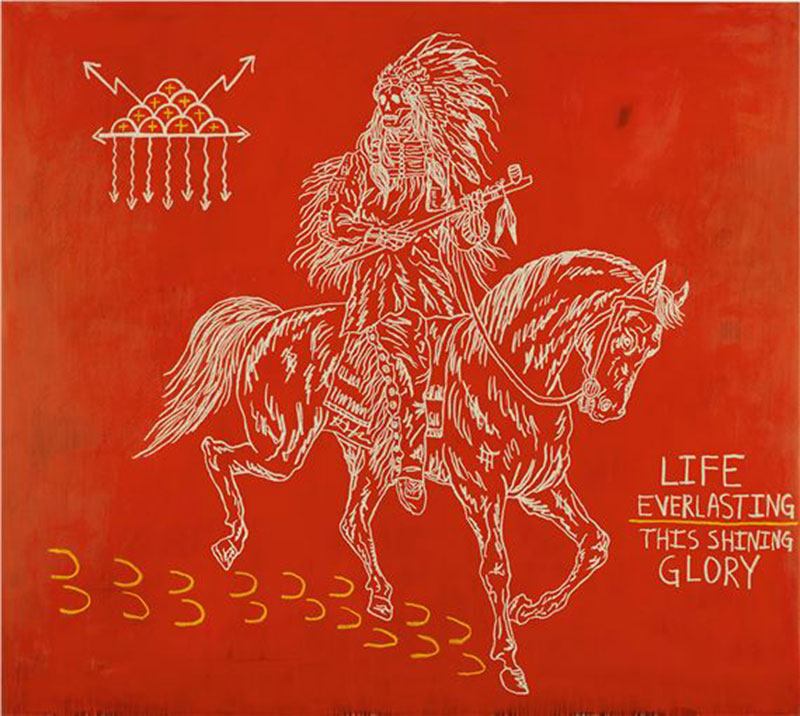
Medium: Acrylic on canvas
Size: Large-scale
Current Location: Private collection
Sale: $252,000 USD, Phillips New York, 2022 (artist’s auction record)
Visual Signature: Dense layering, symbolic imagery, text integration
Why It Matters: Established Lang’s auction market. Represents mature style merging all signature elements.
Related Works: Part of broader series exploring unity and duality themes
“Glory Be…” (2020)
Medium: Oil on canvas
Size: 11’4″ x 48′ (monumental sprawl)
Current Location: Almine Rech
Visual Signature: Exclusive use of oil paint (departure from acrylic). Black ground with suspended figures. Minimal color saturation. No text (unusual for Lang).
Why It Matters: Centerpiece of Almine Rech Paris exhibition. Charts visual narrative from birth to proposed afterlife. Marks stylistic evolution toward oil painting. Most ambitious single work by scale and scope.
Related Works: “We Worship The Good” series from same period
“I’d Like to Buy the World a Coke” (2009)
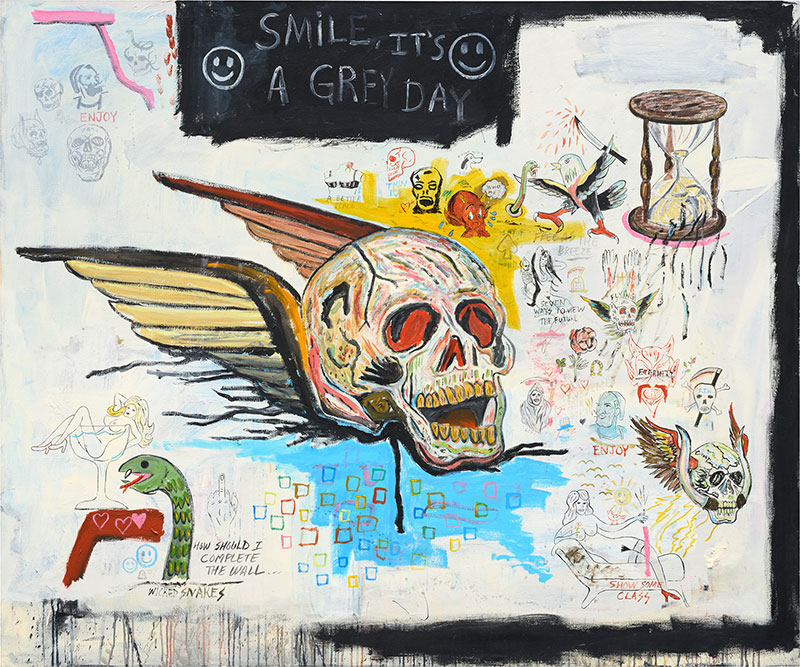
Medium: Acrylic on canvas
Size: 152.4 x 182.9 cm (60 x 72 inches)
Sale: $57,100 USD, Phillips New York (below estimate)
Visual Signature: Appropriation of Coca-Cola advertising. Critique of consumer capitalism mixed with earnest longing.
Why It Matters: Early work showing pop culture engagement before full abstract turn.
“Time Will Tell” (2011)
Medium: Acrylic and ink on paper
Size: Medium-scale works on paper
Current Location: Various collections
Visual Signature: Bird illustrations reminiscent of vintage wildlife plates. Meticulous rendering contrasts with typical frenetic style.
Why It Matters: Shows technical range. Demonstrates ability to work tightly when desired.
Related Works: Part of bird imagery series that continues throughout career
“The Black Paintings” Series (2024)
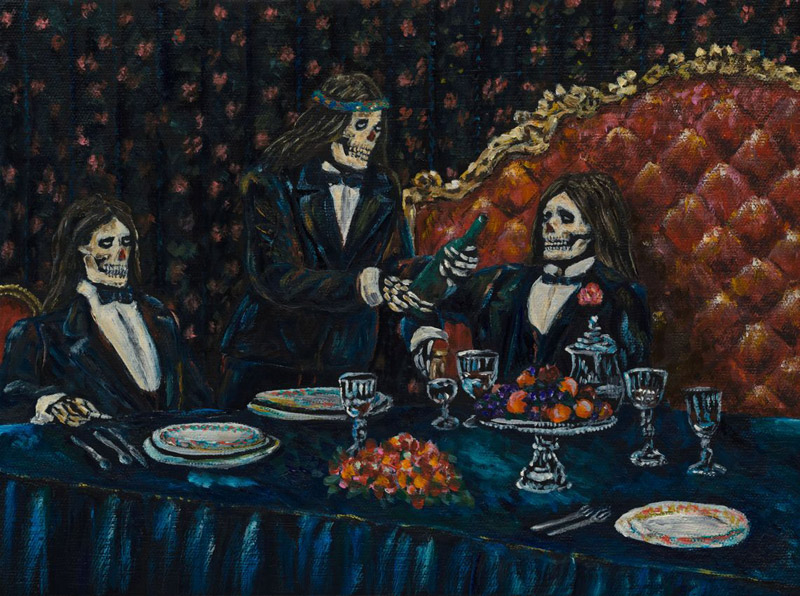
Medium: Acrylic on canvas and linen; acrylic, crayon, pencil on paper
Size: Range from 27 x 34.8 cm to 248.6 x 279 cm (framed)
Current Location: 96 paintings + 96 works on paper premiered at Newport Street Gallery (Damien Hirst) and HENI Gallery, London
Visual Signature: Strict black grounds. Minimal color. Suspended imagery. No text in many pieces.
Why It Matters: Most cohesive series to date. 192 works created specifically for two-venue exhibition. Marks new level of art world validation (Hirst’s gallery).
Related Works: HENI also released “The Black Drawings” as limited edition prints (8 designs, editions of 25 + 6 APs)
“Double Happiness” (2019)
Medium: Acrylic, encaustic, and crayon on canvas in custom red frame
Size: Diptych: 51 x 61 cm and 183 x 153 cm; Overall: 232 x 268 cm
Current Location: V1 Gallery
Visual Signature: Two-panel composition. Encaustic wax adds physical depth. Text and imagery balanced.
Why It Matters: Demonstrates diptych format. Custom frame integration shows attention to presentation.
Yeezus Tour Merchandise (2013)
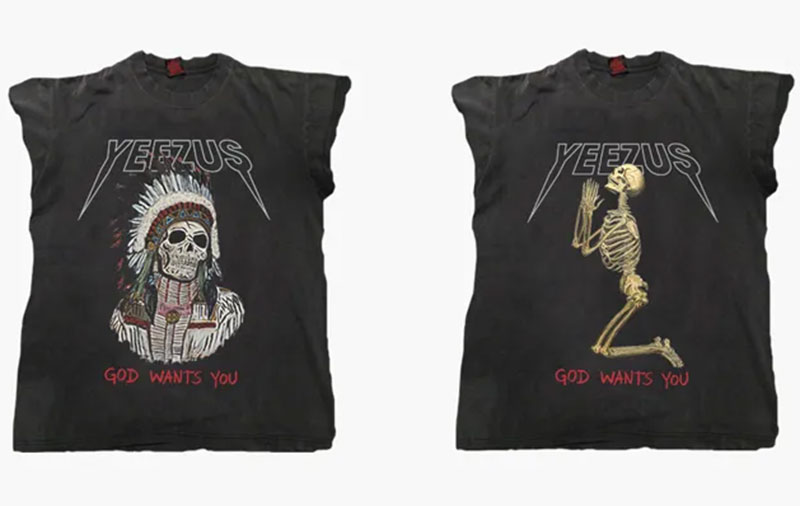
Medium: Screen-printed graphics on apparel
Collaboration: Kanye West
Visual Signature: Skeletons in Confederate flags, skulls with roses, Indian headdresses. Controversial imagery intentionally provocative.
Why It Matters: Brought Lang’s work to massive audience. Blurred fine art/commercial design. Created collectible merchandise that functions as wearable art.
Impact: Elevated concert merchandise to art object status. Shirts became sought-after beyond music context.
Chateau Marmont Hotel Stationery Series (2010s)
Medium: Acrylic, pencil, ink on hotel stationery
Visual Signature: Multiple themes: bird illustrations like vintage wildlife plates, meticulously rendered nudes, hotel logo replications, morbid imagery (skeletons, skulls).
Why It Matters: Shows range. Intimate scale. Found surface becomes support. Drawings function as diary entries.
“Wait a Little Longer, There’s a Good Time Coming Boys” (2007)
Medium: Acrylic on canvas
Size: 81 x 108 inches
Visual Signature: Young African-American boy riding chicken. Confronts racial imagery in American culture.
Why It Matters: Early engagement with controversial historical imagery. Sets pattern for cultural critique through appropriation.
Exhibitions, Collections, and Provenance Highlights
Institutional Debut

“The Studio” (2014)
- ARoS Aarhus Museum of Art, Denmark
- First museum solo exhibition
- 60 works spanning career
- Recreated actual Los Angeles studio environment
- Included sketches, furniture, personal objects
- Established institutional credibility
Major Solo Exhibitions
2024: “The Black Paintings,” Newport Street Gallery (Damien Hirst), London; “The Black Drawings,” HENI Gallery, London
2020: Almine Rech, Paris (oil painting debut show)
2019: “Taking Off For Other Dimensions,” Eighteen, Copenhagen
2016: “The Believer,” Eighteen, Copenhagen; “13,” V1 Gallery, Copenhagen
2015: “The Longest Night of the Year,” Milk Studios Gallery, Los Angeles
2013: “Blue Dream,” V1 Gallery, Copenhagen; “Blessings,” Half Gallery, New York; “Purple Diary” with Andre Saraiva, Chateau Marmont, Los Angeles
2012: “69,” IKON Ltd, Santa Monica; “Here Comes Sunshine,” Half Gallery, New York
2011: “Sittin’ On A Rainbow,” Chateau Marmont, Hollywood; “Life and How To Live It,” V1 Gallery, Copenhagen
2010: “Smile, It’s A Grey Day,” ZieherSmith, New York
2009: “Going All The Way For The U.S.A.,” V1 Gallery, Copenhagen
2008: “Are You Ready For the Country?” ZieherSmith, New York
2006: “Skulls and Shit” with Donald Baechler, Galleri Loyal, Stockholm
2005: “The Promised Land,” ZieherSmith, New York; “I Shall Be Released,” Bucket Rider, Chicago; “American Beauty,” Galleri Loyal, Stockholm
Key Group Exhibitions
2021: “Salon de Peinture,” Almine Rech, New York; “Un Hiver a Paris,” Almine Rech, Paris
2020: “Vampires: The Evolution of the Myth,” Caixa Forum, Madrid
2019: “Vampires,” La Cinematheque Francaise, Paris; “The Birds,” CHART Art Fair, Copenhagen
2018: “No Man is an Island: The Satanic Verses,” ARoS Aarhus Kunstmuseum
2014: “Tattoo: Contemporary Art and Tattoo Culture,” Brandt Museum of Art, Odense, Denmark
2012: “Tonight We Won’t Be Bored: Ten Years of V1 Gallery,” Copenhagen; Market Art Fair, Stockholm
Museum Collections
- Museum of Modern Art (MoMA), New York
- National Gallery of Denmark, Copenhagen
- DESTE Foundation for Contemporary Art, Athens
- Murderme Collection (Damien Hirst private collection)
- Edward F. Albee Foundation, Montauk
Gallery Representation
Current:
- Almine Rech (worldwide)
- V1 Gallery (Copenhagen)
- Eighteen (Copenhagen)
Previous:
- ZieherSmith (New York)
- Half Gallery (New York)
- Galleri Loyal (Stockholm)
Notable Provenance Patterns
Works often pass from artist directly to collectors. Gallery representation stabilized mid-career.
Collaborations with fashion (AMIRI) and music (Kanye West) expanded collector base beyond traditional art world.
Damien Hirst acquisition and exhibition at Newport Street Gallery represents major validation from art world heavyweight.
Market & Reception
Auction Performance
Record: $252,000 USD for “The Unity Within” (2022, Phillips New York)
Price Range: $225 to $252,000 USD depending on size, medium, period
Typical Range: Works on paper: $1,000-$10,000; mid-size canvases: $20,000-$60,000; large canvases: $60,000-$150,000; monumental works: $150,000+
Market Trend: Steady growth since 2015. Institutional validation (ARoS, Newport Street Gallery) strengthening secondary market.
Size & Period Variables
Small works on paper (under 20 inches): $1,000-$5,000
Medium canvases (24 x 24 to 60 x 72 inches): $20,000-$60,000
Large canvases (72+ inches): $60,000-$150,000
Monumental works (over 100 inches): $150,000+
Early work (2000-2010): Generally lower prices. Raw energy but less refined.
Mid-career (2010-2018): Peak of acrylic period. Strong collector interest.
Recent work (2018-present): Oil paintings command premium. Market recognition growing.
Authentication Considerations
Works are signed on reverse. Often titled and dated on verso as well.
Early works less consistently documented. Later works have gallery records and exhibition history.
Studio authentication available for provenance verification.
Text integration and specific iconographic combinations help identify authentic works.
Condition Patterns
Acrylic works: Generally stable. Fast-drying medium resists cracking. Some surface dust accumulation in textured areas.
Encaustic works: Wax vulnerable to heat. Should not be stored above 70°F. Surface can develop bloom (white haze) if stored cold. Easily restored with gentle heat.
Oil paintings: Recent works still curing. Standard oil paint preservation applies.
Works on paper: Vulnerable to light damage. Should be framed under UV-protective glazing.
Collage elements: Paper inclusions can yellow or become brittle. Archival concerns for long-term preservation.
Forgery Risk
Growing market creates incentive for forgeries. Key authentication markers:
- Specific brushwork patterns (tattoo-precise outlines + gestural fill)
- Characteristic text integration style
- Verso signatures and documentation
- Provenance from known galleries
- Period-appropriate materials
- Studio confirmation for high-value works
Influence & Legacy
Upstream Influences (Who Shaped Lang)
Jean-Michel Basquiat: Text + image integration. Raw energy. Cultural critique through symbols. Street credibility meeting fine art context.
Philip Guston: Late-period Guston’s cartoon brutality. KKK hoods, cigarettes, raw subjects rendered with unexpected tenderness.
Cy Twombly: Gestural mark-making. Text as visual element. Classical references filtered through graffiti energy.
Franz Kline: Bold black structures. Aggressive brushwork. Balance of control and spontaneity.
Joan Mitchell: Layered gestures. Color intervals. Emotional intensity without representation.
Francis Bacon: Dark psychological spaces. Bodies and symbols suspended in void. Existential weight.
Mike Kelley: Underground culture as fine art. Critical distance meets genuine affection for low subjects.
Tattoo Culture: Ed Hardy, Sailor Jerry, traditional American flash. Bold outlines, limited palettes, symbolic vocabulary.
Punk Rock Aesthetics: DIY ethos. Aggressive presentation. Anti-establishment attitude maintaining integrity.
Downstream Influence (Who Lang Shaped)
Younger Street Artists: Demonstrates path from underground culture to museum context without selling out.
Tattoo Artists Entering Fine Art: Lang proved tattoo aesthetics work at gallery scale. Opened doors for Robert Ryan, Scott Campbell, Thomas Hooper.
Post-Internet Painters: His symbol-dense, reference-heavy approach influences younger painters navigating cultural overload.
Fashion Collaborators: AMIRI collection shows how contemporary art can inform luxury fashion without becoming mere decoration.
Cross-Domain Echoes
Fashion: AMIRI Men’s Fall 2022 collection directly integrated Lang artwork. Hand-painting, abstract jacquard, embroidery translating paintings to garments.
Music Merchandise: Yeezus tour elevated concert merch to collectible art. Changed expectations for musician/artist collaborations.
Tattooing: Feedback loop. Lang influenced by tattoo culture, now young tattoo artists reference his work.
Photography: His composition strategies (symbols floating in black voids) appearing in contemporary photography.
Contemporary Dialogue Partners
George Condo: Both remix art history. Condo through fractured portraiture, Lang through American iconography.
Raymond Pettibon: Parallel investigations of dark Americana. Different visual languages, similar concerns.
KAWS: Commercial culture meeting fine art. Both navigate street credibility and institutional recognition.
Takashi Murakami: East/West cultural hybridity. Both work across fine art and commercial contexts.
Legacy Considerations (Early Assessment)
Too early for full legacy evaluation. Career still developing.
Strengths:
- Established unique visual voice
- Successfully navigated underground and institutional contexts
- Museum collections ensure long-term visibility
- Influenced fashion, music, contemporary tattooing
Questions:
- Will oil painting shift expand market reach?
- Can momentum continue beyond hype cycles?
- How will critical discourse develop around the work?
How to Recognize a Wes Lang at a Glance

Black Grounds: Deep, flat black creating void space. Imagery suspended rather than sitting on surface.
Tattoo-Style Outlines: Hard-edge borders around symbols. Clean, controlled perimeters containing looser interiors.
Death Imagery: Skulls, skeletons, grim reapers appear in 70%+ of works. Not decorative. Central to meaning.
American Iconography: Eagles, flags, cowboys, Native American imagery. Examined critically, not celebrated.
Text Integration: Hand-lettered phrases. Sometimes clear, sometimes degraded. Feels both planned and spontaneous.
Horses and Birds: Recurring motifs. Usually symbolize freedom, transcendence, or spiritual seeking.
Limited Color Palettes: Often 3-5 colors maximum. Red, white, black, yellow, blue dominate.
Mark Variety: Single work combines tight rendering and loose gesture. Tension between control and chaos.
Scale Contrasts: Tiny details next to bold gestures. Micro and macro in same picture.
Paper Collage: Newspaper, pornography, text fragments embedded in paint layers.
Verso Signatures: Signed on back. Often includes title and date.
Canvas Sizes: Frequently 24 x 24 inches (intimate), 60 x 72 inches (mid-range), or 96+ inches (monumental).
Spiritual Phrases: “Thank You God,” “Following the light,” Taoist references appear in text.
Custom Frames: Recent works often in artist-designed frames. Integral to presentation.
FAQ on Wes Lang
Who is Wes Lang?
Wes Lang is a contemporary American artist born in 1972 in Chatham, New Jersey. He’s known for paintings and works on paper that blend tattoo aesthetics with abstract expressionism, exploring dark Americana through skulls, flags, and cultural symbols.
What art movement is Wes Lang associated with?
Lang operates within urban contemporary art and lowbrow movements, though his work transcends easy categorization. His practice connects street art culture, tattoo traditions, and post-pop Americana while maintaining dialogue with abstract expressionism and contemporary painting.
Where did Wes Lang study art?
Lang is autodidactic with no formal art education. He learned through working as an art handler at the Guggenheim Museum, where direct contact with masterworks by Basquiat, Twombly, and Guston became his education.
What materials does Wes Lang use?
Lang primarily works with acrylic paint on canvas, though recent work emphasizes oil painting. He also uses encaustic wax, oil stick, colored pencil, and paper collage. Supports include cotton and linen canvas, paper, and wood panels.
What is Wes Lang’s most expensive artwork?
“The Unity Within” holds Lang’s auction record at $252,000 USD, sold at Phillips New York in 2022. His works typically range from $225 to $252,000 depending on size, medium, and period, with recent oil paintings commanding premium prices.
What themes does Wes Lang explore?
Lang examines American cultural mythology through death imagery, Native American iconography, Confederate flags, cowboys, and skulls. His work balances cultural critique with spiritual seeking, influenced by Taoism and Ram Dass lectures about mortality and presence.
Where can I see Wes Lang’s work?
Lang’s work is in Museum of Modern Art (MoMA), National Gallery of Denmark, and DESTE Foundation collections. He’s represented by Almine Rech worldwide and V1 Gallery in Copenhagen, with major exhibitions at Newport Street Gallery in London.
Did Wes Lang work with Kanye West?
Yes. Lang designed the controversial Yeezus tour merchandise in 2013, featuring skeletons in Confederate flags and skull imagery. The collaboration brought his visual language to massive audiences and elevated concert merchandise to collectible art status.
What influences Wes Lang’s artistic style?
Lang draws from tattoo culture, punk rock aesthetics, and painters like Philip Guston, Franz Kline, and Jean-Michel Basquiat. Taoist philosophy, American folk legends, and underground culture shape his iconography and spiritual framework.
How can you identify a Wes Lang painting?
Look for black grounds with suspended imagery, tattoo-style hard-edge outlines, death symbols (skulls, reapers), integrated hand-lettered text, limited color palettes, and American iconography. The tension between controlled outlines and gestural fills is signature.
Conclusion
Wes Lang stands at the intersection where tattoo flash meets museum walls, where outlaw culture confronts fine art discourse. His journey from Guggenheim art handler to contemporary artist with institutional recognition proves that authentic voices don’t require traditional credentials.
The bold graphics and death imagery might shock at first glance. But underneath the skulls and Confederate flags lies serious engagement with American identity, mortality, and spiritual seeking through painting techniques that bridge multiple traditions.
His work belongs in conversations about contemporary painting, street art evolution, and cultural critique. Whether working in acrylic or oil, on canvas or hotel stationery, Lang maintains his distinctive visual language.
The black grounds aren’t nihilistic voids. They’re spaces where American mythology gets examined, where death reminds us to live fully, where graphic design becomes fine art without apology.