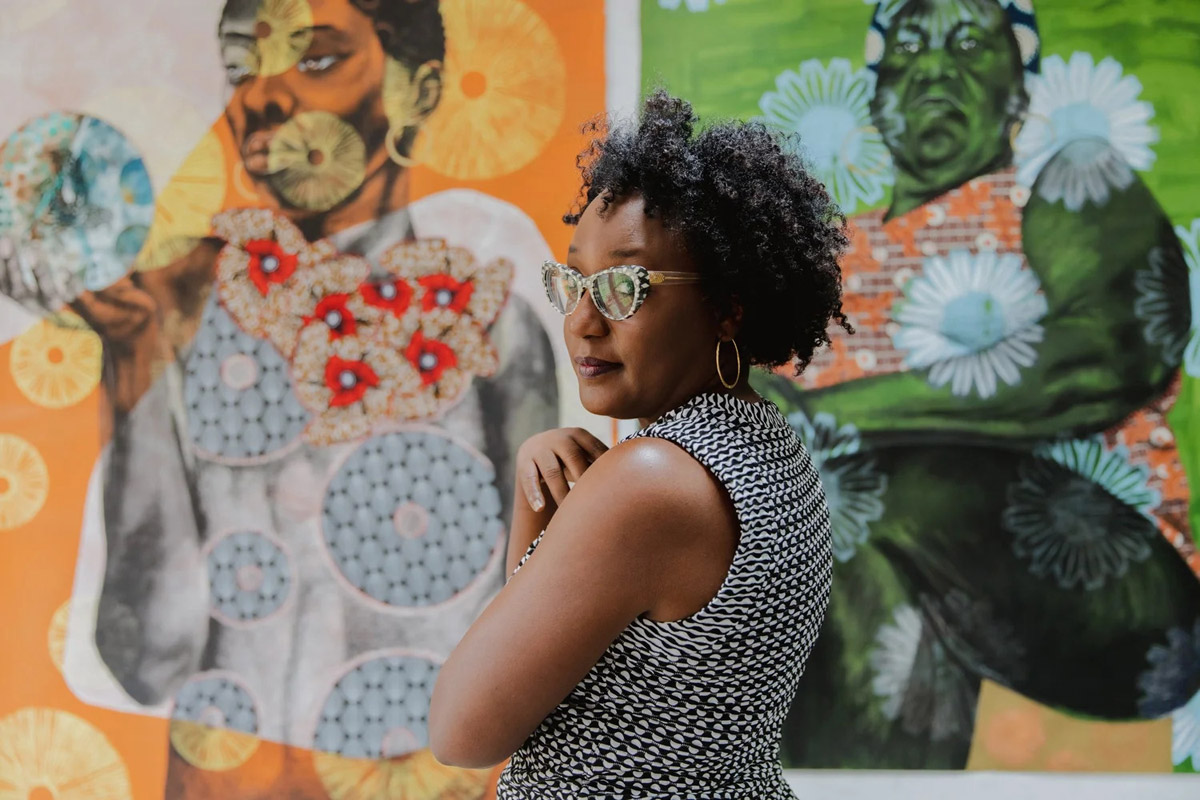

Delita Martin stitches together worlds that most people never see.
Her prints don’t just hang on walls. They pulse with ancestral spirits, shadow figures, and the kind of spiritual power that makes you stop mid-stride in a gallery.
This Houston-based master printmaker layers relief printing, charcoal, hand-stitching, and collage into portraits that claim space for Black women in ways Western art never bothered to. Her work appeared at the Venice Biennale, toured with Crystal Bridges Museum, and earned a solo show at the National Museum of Women in the Arts.
But Martin’s path from a creative family in Conroe, Texas to international recognition wasn’t straightforward.
This article examines her technical mastery across multiple printmaking processes, the spiritual iconography driving her mixed media practice, and why her layered approach to contemporary printmaking matters beyond the art world.
Identity Snapshot
Born: 1972, Conroe, Texas
Also Known As: None documented
Primary Roles: Printmaker, Mixed-Media Artist, Draftswoman
Nationality: American
Movements: Contemporary African American Art, Afrocentric Art
Mediums: Relief printing, monotype printing, lithography, collagraph, acrylic, charcoal, hand-stitching, collage
Signature Traits: Layered processes combining multiple printmaking techniques with drawing and stitching; vibrant patterns and decorative papers; spiritual iconography; portraits of Black women; West African motifs; circular symbols representing moon and wholeness
Iconography / Motifs: Masks, birds (representing spirits and ancestors), circles/moons (totality and feminine power), coneflowers (strength and healing), shadow figures (ancestral spirits), geometric patterns, floral decorations
Geographic Anchors: Conroe, Texas (birthplace); Houston, Texas (formative years); Little Rock, Arkansas (teaching period 2008-2012); Huffman, Texas (current studio location)
Mentors / Influences: John T. Biggers (mentor, father’s teacher), Elizabeth Catlett (printmaking influence), Charles White (compositional influence), Bettye Saar (collage/assemblage inspiration), Viktor Lowenfeld (indirect influence through Biggers)
Studio: Black Box Press, Huffman, Texas (founded 2008)
Collections & Museums: National Museum of Women in the Arts, Crystal Bridges Museum of American Art, Minneapolis Institute of Art, Library of Congress, Museum of Fine Arts Houston, Brooklyn Museum of Art, Bradbury Art Museum, Fort Wayne Museum of Art, David Driskell Center
Market Signals: First solo museum exhibition in 2020 (National Museum of Women in the Arts); work sizes typically range from 40×50 inches to monumental 79×102 inches; works often include hand-stitching creating soft creases considered acceptable by the artist
What Sets The Artist Apart

Delita Martin builds bridges between the physical and spiritual through printmaking that refuses to stay flat.
Her portraits don’t just sit on paper. They’re constructed through relief printing, charcoal marks, acrylic washes, collaged decorative papers, and thread that pierces through multiple layers. This isn’t mixed media for decoration’s sake.
Each technique adds a separate voice to the conversation. The carved linoleum creates bold outlines. Charcoal brings atmospheric depth. Hand-stitching literally binds the physical materials to spiritual intent.
What makes her work distinct? She’s reconstructing identity by claiming space for Black women in visual art through a specifically African American lens filtered through West African spirituality. But it’s the technical execution that sets her apart from other contemporary printmakers working with similar themes.
Martin layers printing processes the way quilters layer fabric. Relief, lithography, monotype, collagraph – sometimes four or five processes in a single piece. Most printmakers specialize in one or two techniques. She’s fluent in all of them and uses that fluency to create what she calls “veilscapes” where patterns and textures create dimensional portals between worlds.
Origins & Formation
Early Creative Environment
Martin grew up as the youngest of nine children in a family where making things was “as natural as drinking water.”
Her father was an oil painter and furniture maker who studied with John T. Biggers at Texas Southern University. Her mother and siblings included quilters, poets, storytellers, and writers. The house functioned like an informal art school.
At age five, her mother began introducing her as “the artist.” By twelve, her father gathered her drawings and drove 44 miles to Houston for her first critique with John Biggers himself.
Biggers told her: “Don’t ever miss an opportunity to uplift your people through your work.”
That sentence became the measuring stick for every piece she’s made since.
Academic Foundation
Texas Southern University (BFA in Drawing, 2002)
Biggers had retired long before Martin enrolled, but his presence saturated the campus.
She studied drawing, not printmaking. TSU didn’t offer enough printmaking courses to form a regular class. But one day while retrieving a sketchbook, she witnessed Biggers signing a reopened edition of prints alongside Charles Criner, Earlie Hudnall Jr., and Harvey Johnson.
Watching them work with chemicals and materials to pull lithographs felt like witnessing a magical dance. The seed was planted.
Purdue University (MFA in Printmaking, 2009)
Martin arrived at Purdue without printmaking background. The learning curve was steep.
She attended undergraduate printmaking courses during the day to learn basic processes. At night and on weekends, she applied those lessons to her graduate work. The immersion was total and exhausting.
But the lack of formal undergraduate training might have been an advantage. She wasn’t bound by hierarchies about which printmaking processes were “better.” She approached relief, lithography, and monotype as equal tools in a larger kit.
First Professional Steps
After completing her MFA, Martin joined the fine arts faculty at University of Arkansas at Little Rock (2008-2012).
She founded Black Box Press in 2008, initially as a working studio. Teaching provided stability while she built her practice and reputation.
Her early exhibitions included group shows at the Houston Museum of African American Culture and Museum of Fine Arts Houston’s “Houston Collects” (2008).
The ROUX collective formed during this period – a printmaking group with Ann Johnson, Rabea Ballin, and Lovie Olivia that explored collaborative processes and shared themes around cultural identity.
Movement & Context
Positioning in Contemporary African American Art

Martin sits at the intersection of several artistic lineages but doesn’t fit neatly into any single movement.
Her work shares DNA with the social realism of John Biggers and Charles White – the commitment to representing Black life with dignity and complexity. Like Elizabeth Catlett, she uses printmaking as a tool for cultural assertion and identity reconstruction.
But Martin’s work isn’t primarily about protest or social commentary in the way those earlier generations approached art. She’s working in a different emotional register – one focused on spiritual connection, ancestral presence, and what she calls “magical realism.”
The closest contemporary comparison might be Kara Walker, another artist using silhouettes and historical imagery to explore Black identity. But where Walker’s work tends toward provocation and historical critique, Martin’s leans into affirmation and spiritual communion.
Technical Comparisons
Versus Traditional Printmakers
Most master printmakers specialize. They become known for exceptional lithography or remarkable relief work.
Martin is unusual in her technical range. She moves between relief printing, lithography, monotype, and collagraph with equal facility – often combining three or four processes in a single work.
This multi-process approach creates layered compositions with visual depth that single-process prints can’t achieve. Each technique contributes different textural and visual qualities.
Versus Mixed-Media Artists
Mixed-media artists like Romare Bearden or Bettye Saar built reputations on collage and assemblage.
Martin insists she’s primarily a printmaker, even though her finished works include drawing, painting, collage, and hand-stitching. The print process remains foundational. Other media augment and extend the printed image rather than replacing it.
Her use of pattern differs from purely decorative approaches. The decorative papers, fabrics, and geometric designs function as cultural markers and spiritual symbols rather than aesthetic flourishes.
Edge Quality and Mark-Making
Martin’s edges vary dramatically within single works. Hard-edge relief prints create bold outlines. Soft charcoal passages add atmospheric transitions. Hand-stitching introduces linear elements that literally pierce through the picture plane.
This edge variety creates visual rhythm and prevents the heavily patterned surfaces from feeling flat or static.
Her mark-making combines the aggressive energy of Jim Dine’s printmaking with the careful observation of Charles White’s drawings. You can feel the hand pressure in her charcoal passages and see the knife cuts in her relief blocks.
Materials, Techniques, and Process
Supports and Grounds
Paper Selection
Martin works primarily on heavy printmaking paper that can withstand multiple processes and hand-stitching.
The paper needs enough weight to hold up through relief printing pressure, lithography transfers, acrylic applications, and thread piercing without tearing or excessive warping.
Occasionally she incorporates softer creases from the hand-stitching process. These aren’t considered flaws but intrinsic parts of the work’s creation.
Size Considerations
Her works range from moderate (40×50 inches) to monumental (79×102 inches).
Larger works require planning multiple print passes and careful registration. The scale allows figures to command presence and creates room for dense pattern work without feeling crowded.
Printmaking Processes
Relief Printing (Primary Foundation)
Martin uses battleship gray linoleum, which she’s worked with since graduate school. The surface cuts smoothly and holds up for multiple impressions.
She carves with Essdee lino cutters, which are portable enough to work outside the studio.
The relief process creates bold contours and establishes the foundational structure. Hard edges from relief printing provide anchor points for softer media added later.
Monotype and Monoprint
Martin uses gel plates extensively for monotype work. They allow printing without a press and clean up easily.
She applies soft rubber brayers to spread ink evenly across plates. The brayers work for both printmaking and painting applications.
Each monotype is unique. She might create several variations exploring slightly different compositions or color relationships within a series.
Lithography
Lithographic processes add different textural qualities than relief printing. The chemistry of lithography creates subtle tonal gradations.
Martin sometimes combines lithography with relief printing in single works, layering the processes to create visual complexity.
Collagraph Printing
Collagraphs involve building textured plates from collaged materials sealed with acrylic medium.
The textured surfaces print with rich variation. Martin uses collagraph to introduce specific pattern elements or textural passages.
Drawing and Painting Media
Charcoal Application
Charcoal creates atmospheric depth and soft transitions between patterned areas.
Martin uses both vine charcoal for light passages and compressed charcoal for darker, more forceful marks. The charcoal integrates with printed elements, sometimes obscuring and sometimes revealing underlying patterns.
Acrylic Paint
Acrylic washes add color and bind different layers together.
She applies acrylic in transparent washes rather than opaque coverage, allowing printed patterns to show through. The acrylic also prepares surfaces for additional printing or collage layers.
Colored Pencil
Colored pencil adds details and refinements. Small marks, highlights, or specific pattern elements get rendered in pencil after larger processes are complete.
Collage Elements
Decorative Papers
Martin collects decorative papers, fabric patterns, and photographs of clothing from the street.
These papers carry cultural associations. Patterns reference African textiles, vintage wallpapers, or contemporary design elements. Their inclusion isn’t random – each pattern adds semantic meaning.
The papers are collaged onto works after printing but before hand-stitching, creating additional layers that contribute to the overall composition.
Hand-Stitching Process
Thread as Line and Connection
Martin pierces finished or near-finished works with needle and thread.
The stitching serves multiple functions. Visually, it creates linear elements and draws attention to specific areas. Structurally, it binds collaged elements. Conceptually, it references quilting traditions and the labor of Black women’s hands.
Stitching patterns might follow figure contours, create independent linear compositions, or connect separate pattern areas.
Material Integration
The needle holes and thread lines become permanent parts of the work. Unlike purely additive collage, stitching physically alters the paper support.
This irreversible mark-making carries weight. Once stitched, the work can’t be unstitched without leaving evidence.
Studio Practice and Workflow
Layered Process Approach
Martin doesn’t work in linear fashion. She might begin with relief printing, add charcoal, print a lithograph, collage papers, paint, and then stitch – but the order varies by piece.
Some works require weeks of layering. She returns to pieces repeatedly, adding elements as compositions develop.
Tools and Equipment
Beyond standard printmaking presses and carving tools, Martin uses gel plates for monotype work, soft rubber brayers for even ink application, and various needles for hand-stitching.
The studio contains hundreds of printing tools, stored artwork, fabrics, vintage dolls, and collected patterns – all potential source material.
Working from Reference
Early works combined multiple women into composite figures. More recently, she photographs specific models – often family members or women whose spirits interest her.
She’s not pursuing traditional portraiture. The goal is capturing spiritual presence rather than photographic likeness.
Themes, Subjects, and Iconography
Primary Subject: Black Women as Spiritual Beings
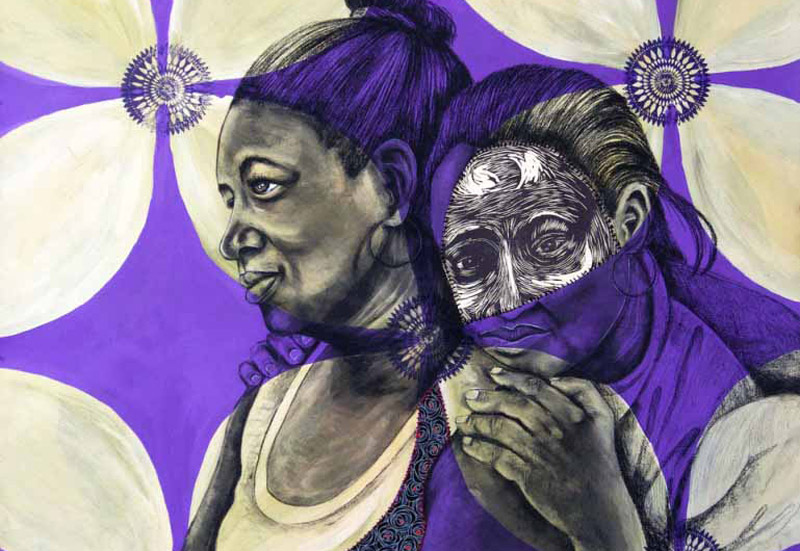
Martin’s central project is creating imagery that represents Black women as spiritually powerful, connected to ancestral wisdom, and existing between visible and invisible worlds.
This directly counters historical absences in Western art where Black women appear primarily as servants, objects, or marginal figures.
Her subjects face viewers directly, occupy center stage, and command space through both physical scale and spiritual presence.
Spiritual Iconography
Masks
West African masks appear frequently, signifying connection to ancestral spirits and indicating figures who have transitioned into spiritual realms.
Masks signal transformation – the wearer has moved beyond ordinary consciousness into communion with unseen forces.
Shadow Figures
Silhouetted forms represent ancestors and spirits surrounding the primary figure.
These shadows aren’t threatening presences but protective, guiding forces. They visualize the African American spiritual tradition that ancestors remain present and active in descendants’ lives.
Birds
Birds symbolize spirits, ancestors, and the ability to move between earthly and spiritual dimensions.
They represent freedom, transcendence, and messages from beyond. Bird imagery connects to both African spiritual traditions and African American folk beliefs.
Circles and Moons
Circular forms recur throughout Martin’s work – as moons, as decorative elements, as compositional structures.
In West African cosmology, the circle represents wholeness, totality, and the infinite. The moon specifically connects to feminine power and cycles.
Coneflowers
Coneflowers (echinacea) carry meanings from both Native American and African American healing traditions.
They represent strength, healing, and resilience. Martin featured coneflowers prominently in her first public artwork, “The Gathering” (2021), installed at Rice University.
Pattern and Decoration as Meaning
Cultural Coding
The heavy pattern work in Martin’s pieces isn’t purely decorative. Patterns reference African textiles, African American quilting traditions, and contemporary Black visual culture.
Each pattern carries associations. Geometric designs might reference traditional African art. Floral patterns might connect to Southern folk traditions. The layering of multiple patterns creates visual richness while encoding multiple cultural references.
Creating “Veilscapes”
Martin describes her patterned backgrounds as “veilscapes” – liminal spaces between physical and spiritual realities.
The dense patterns create atmospheric environments where normal rules of space and time don’t fully apply. Figures emerge from or dissolve into these patterned grounds, suggesting constant movement between worlds.
Compositional Strategies
Triangular Structures
Many works organize around triangular compositions – either explicit triangles formed by figure positioning or implied triangles created through visual hierarchy.
Triangular compositions create stability while directing eye movement through the work.
Trinity References
Martin notes that her compositions often divide into three elements: the spiritual, the physical, and the transitional.
This trinity structure reflects spiritual beliefs about multiple planes of existence and the constant negotiation between visible and invisible realities.
Centralized Figures
Primary subjects typically occupy center positions, facing forward, making direct eye contact with viewers.
This frontal positioning creates confrontation and demands acknowledgment. The viewer can’t passively observe but must engage with the figure’s presence and gaze.
Narrative and Storytelling
Oral Tradition Influence
Martin draws from oral storytelling traditions – family stories, folk tales, spiritual narratives passed through generations.
Her works don’t illustrate specific stories but create visual equivalents of storytelling’s rhythms and structures. The layered processes mirror how stories accumulate details and meanings through multiple tellings.
Personal and Collective Memory
She works from vintage photographs, family images, and collected objects that trigger memories.
Individual memories become portals to collective experiences. A single grandmother’s face might represent generations of Black women’s strength. A specific mason jar might evoke entire systems of folk knowledge and survival strategies.
Reconstructing Identity
Martin describes her project as “reconstruction of identities, offering different and more positive images of African American women.”
This isn’t about creating idealized or romanticized representations. It’s about complexity, dignity, spiritual depth, and the kind of multi-dimensional humanity typically reserved for white subjects in Western art history.
Notable Works
“The Soaring Hour (Self-Portrait)” (2018)
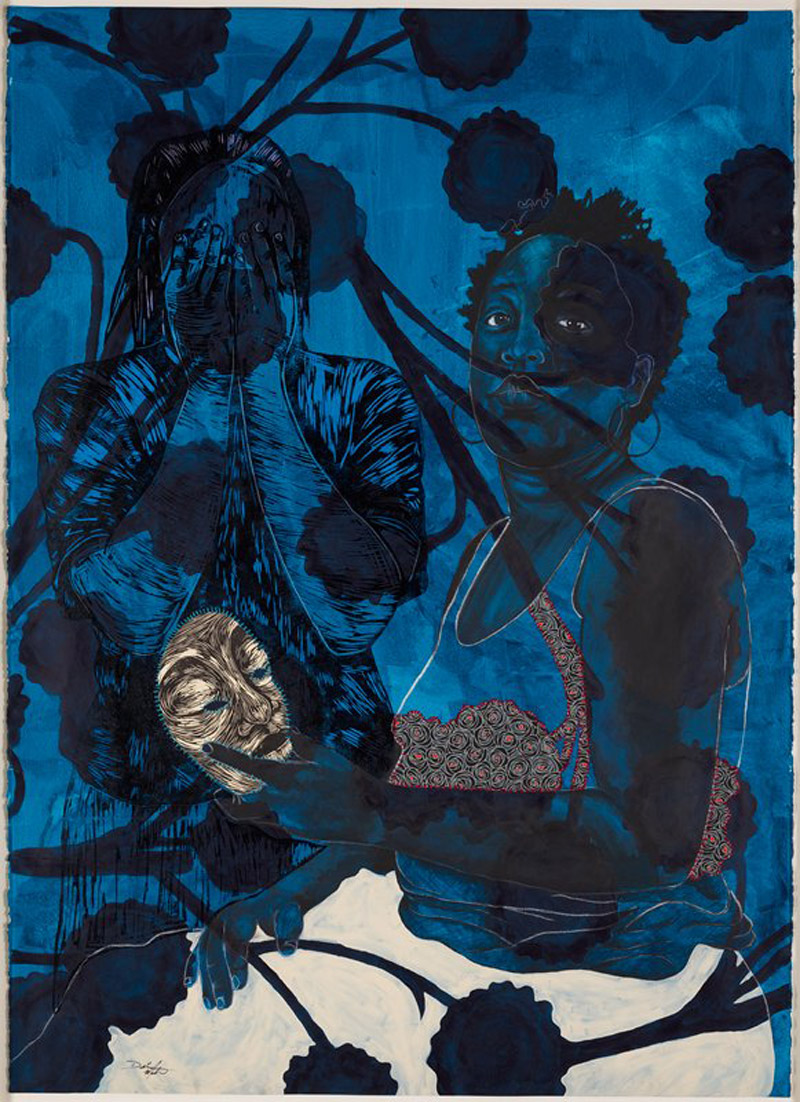
Medium: Relief printing, charcoal, acrylic, colored pencil, decorative paper, hand-stitching on paper
Size: Dimensions not specified in available sources
Collection: Minneapolis Institute of Art
Visual Signature: Multi-process layering combining relief print foundation with charcoal atmospheric effects, acrylic color washes, precise colored pencil details, collaged decorative patterns, and hand-stitched linear elements
Why It Matters: Demonstrates Martin’s full technical range in a self-portrait context. The work reveals how she sees herself – not just as physical presence but as spiritual being connected to ancestral forces. The title references flight and elevation, suggesting transcendence and the ability to move between realms.
Related Works: Part of ongoing exploration of self-representation within spiritual contexts
“Believing in Kings” (2018)
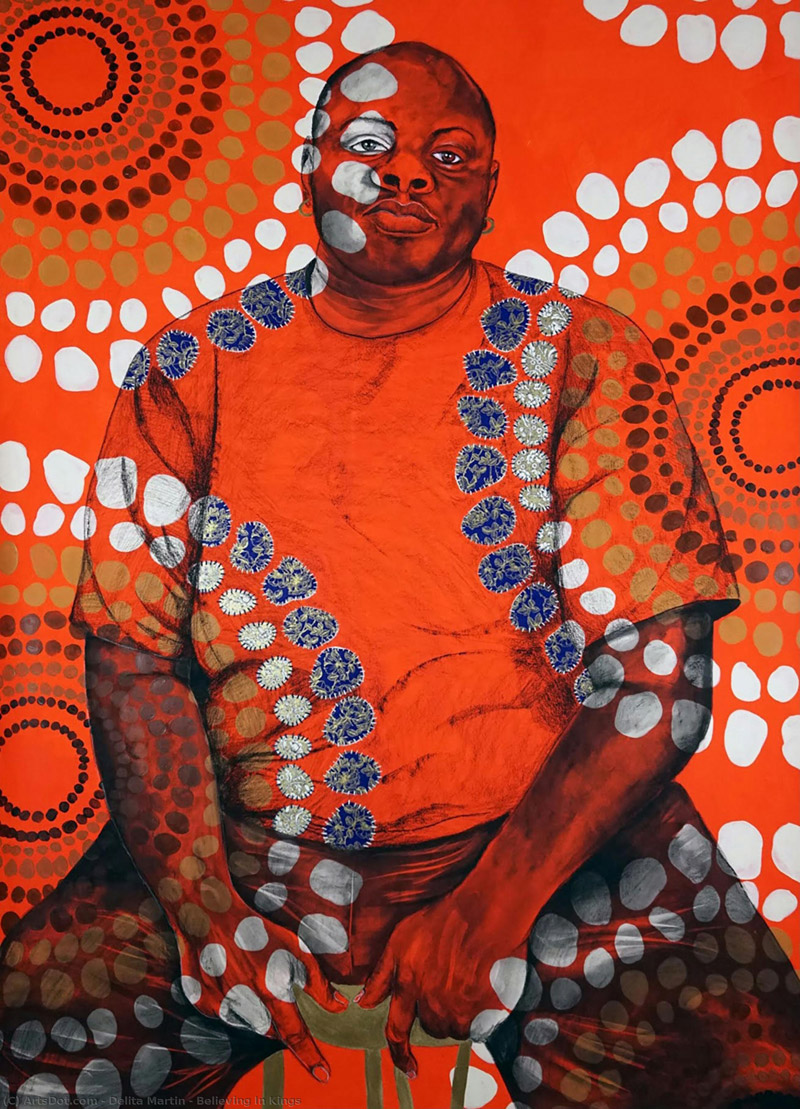
Medium: Acrylic, charcoal, relief printing, decorative papers, hand-stitching, liquid gold leaf on paper
Size: 71.5 x 51 inches
Collection: National Museum of Women in the Arts (museum purchase, Belinda de Gaudemar Acquisition Fund)
Visual Signature: Bold relief-printed contours establishing figure structure; rich charcoal modeling; jewel-like acrylic color; decorative paper patterns creating veilscape environment; gold leaf accents adding literal and symbolic luminosity; intricate hand-stitching binding elements
Why It Matters: Acquired by NMWA for permanent collection, indicating institutional recognition. The title suggests both self-sovereignty and connection to ancestral royalty. Gold leaf usage adds precious material while referencing traditional religious icon-making.
Related Works: Shown in “Calling Down the Spirits” exhibition
“The Moon and the Little Bird” (2018)
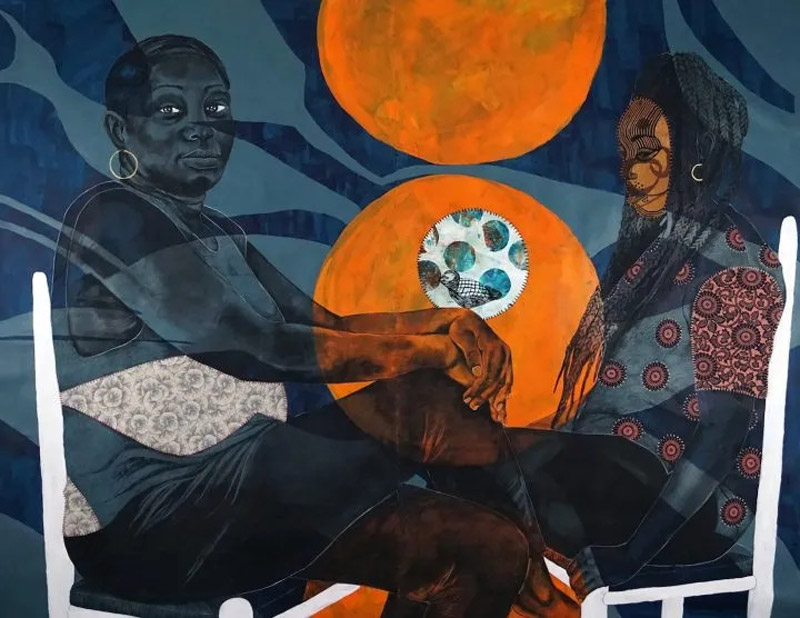
Medium: Acrylic, charcoal, gelatin printing, collagraph printing, relief printing, decorative papers, hand-stitching, liquid gold leaf on paper
Size: 79 x 102 inches (monumental scale)
Collection: Artist’s collection (courtesy of Galerie Myrtis)
Visual Signature: Largest scale work combining five distinct printmaking processes; bird and moon iconography prominent; extensive pattern work creating immersive veilscape; gold leaf accents; complex hand-stitching throughout
Why It Matters: Demonstrates Martin’s ability to work at monumental scale while maintaining intricate detail. Combines her primary spiritual symbols (moon representing feminine power, bird representing ancestral spirits) in single composition. Featured prominently in NMWA exhibition.
Related Works: Title and imagery relate to ongoing exploration of spiritual communication
“New Beginnings” (2017)
Medium: Acrylic, relief printing, lithography, charcoal, decorative paper, hand-stitching on paper
Size: 74 x 54 inches
Collection: Collection of Sheila C. Johnson
Visual Signature: Combines relief and lithographic processes for varied textural effects; charcoal creates atmospheric depth; decorative papers add cultural pattern references; hand-stitching integrates elements
Why It Matters: Collected by prominent collector Sheila C. Johnson. The title suggests transformation and renewal – themes connecting to Martin’s overall project of identity reconstruction. Featured in NMWA exhibition.
Related Works: Part of body of work exploring transformation and spiritual renewal
“Soul Keeper” (2016)
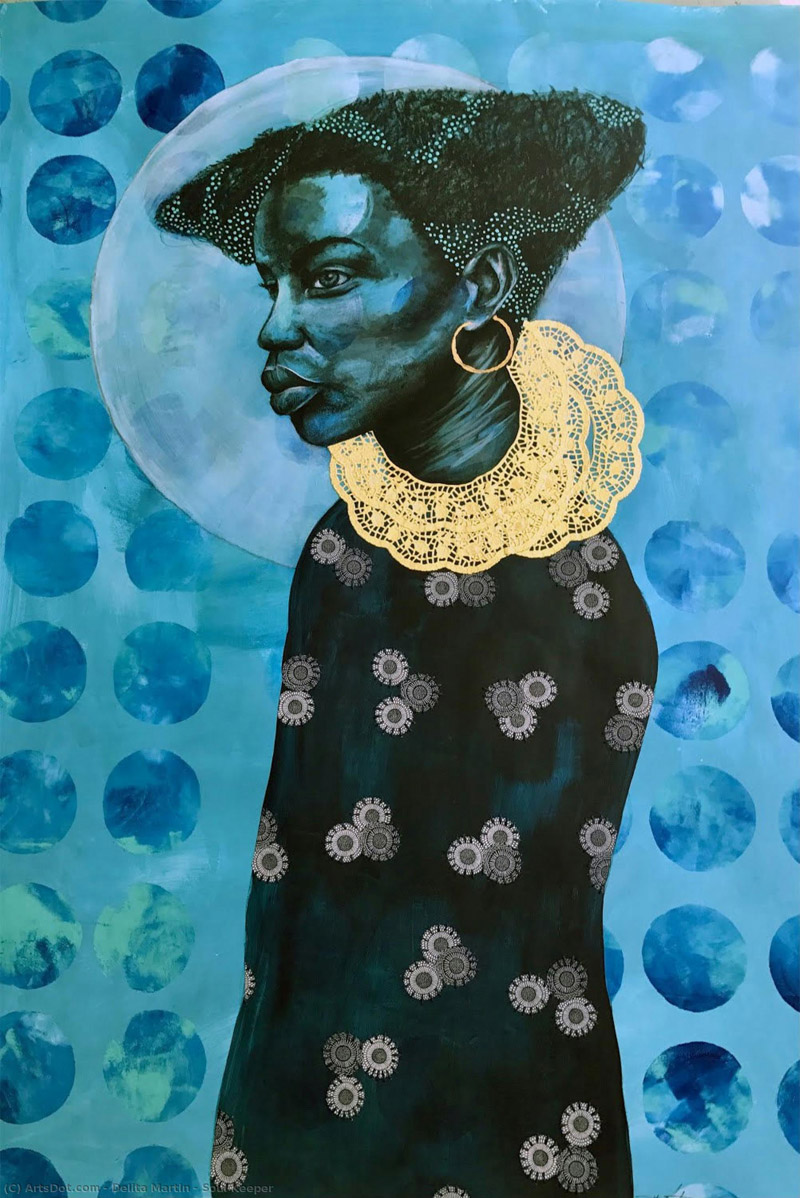
Medium: Gelatin printing, acrylic, conte crayon, hand-stitching, decorative papers on paper
Size: 52 x 41 inches
Collection: Private collection
Visual Signature: Gelatin printing creates unique textural base; conte crayon adds different drawing quality than charcoal; acrylic washes unify layers; decorative papers and hand-stitching complete multi-layered surface
Why It Matters: The title directly addresses spiritual preservation and protection. “Soul Keeper” suggests both guardian and container – someone who holds and protects spiritual essence. Featured in NMWA exhibition.
Related Works: Part of ongoing series exploring spiritual guardianship
“Among Shadows” (2020)
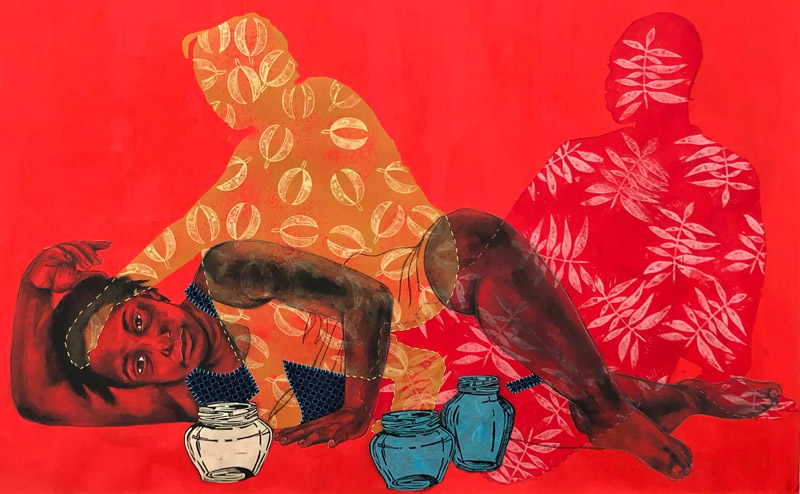
Medium: Relief printing, charcoal, acrylic, decorative papers, hand-stitching on paper
Size: Dimensions not specified
Collection: Not specified
Visual Signature: Bold relief-printed foundation; dramatic charcoal work creating shadow effects; acrylic color; decorative pattern integration; hand-stitching throughout
Why It Matters: The title explicitly references shadow figures that appear throughout Martin’s work – ancestral spirits and protective presences surrounding primary subjects. Demonstrates how technical choices (relief printing for figure, charcoal for shadows) align with conceptual intent.
“Mirror Mirror” (2020)
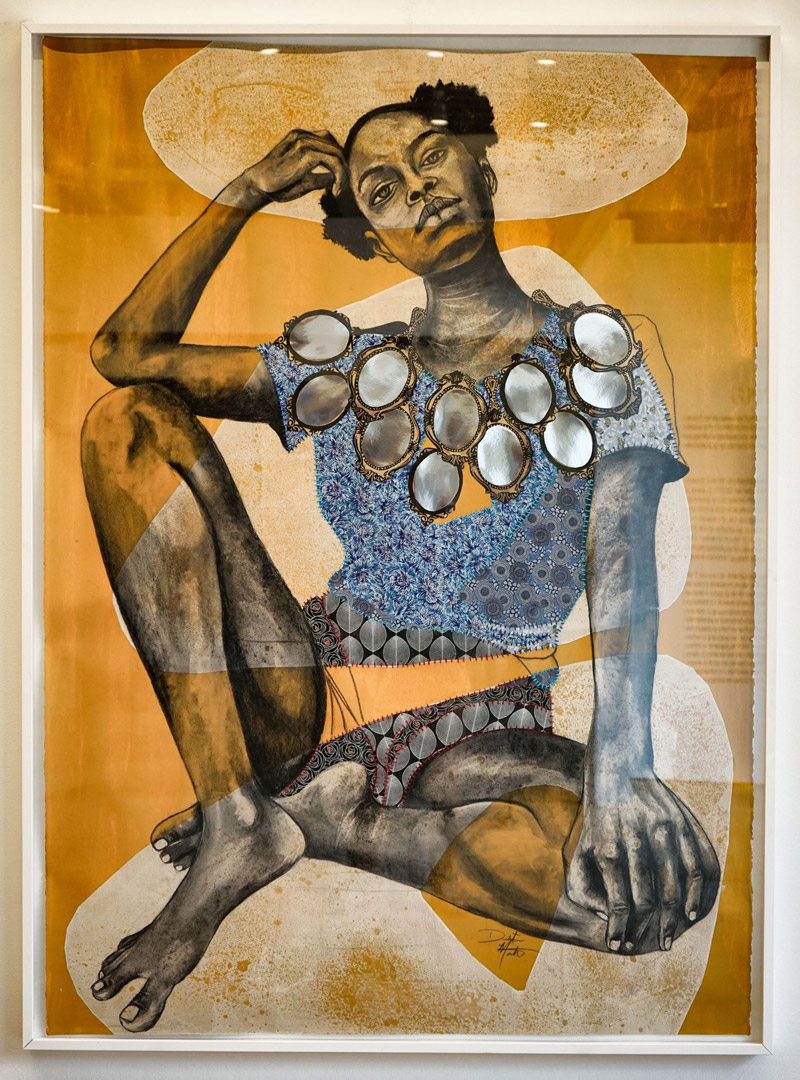
Medium: Charcoal, acrylic, decorative papers, hand-stitching on paper
Size: Dimensions not specified
Collection: Not specified
Visual Signature: Notable for not including relief printing as foundation; charcoal takes primary structural role; rich decorative pattern work; extensive hand-stitching
Why It Matters: The title references fairy tale and self-reflection while questioning traditional beauty standards. Shows Martin’s flexibility in process – not every work requires relief printing foundation.
Exhibitions, Collections, and Provenance Highlights
Major Solo Exhibitions

“Calling Down the Spirits” (2020) National Museum of Women in the Arts, Washington, D.C. Martin’s first solo museum exhibition
Featured seven large-scale works with audio commentary by the artist. The exhibition title became synonymous with Martin’s practice – her work literally calls spiritual presences into visible form. NMWA acquired “Believing in Kings” for permanent collection during this exhibition.
“Night Women” (2017) Bradbury Art Museum, Arkansas State University, Jonesboro (traveled to other venues)
Explored nocturnal imagery and connection between darkness, mystery, and spiritual access. The title references women who navigate invisible realms.
“I Come from Women Who Could Fly” (2017) Ohr-O’Keefe Museum of Art, Biloxi, Mississippi
Title references African American folk belief in flying Africans – enslaved people who retained power to fly back to Africa. Connected Martin’s work to specific folk traditions while asserting spiritual transcendence.
“Beyond Layers” (2014-2015) South Dallas Cultural Center (traveled to other venues)
Early major exhibition focusing on Martin’s multi-layered technical processes. The title emphasized both physical layering of materials and metaphorical layers of meaning.
“Conjure” (Date not specified) Union for Contemporary Art, Omaha, Nebraska
Focused on conjuring – the practice of calling spirits and creating magical effects. Emphasized color, patterning, decoration, and spiritual exploration.
“Gathering the Bones” (Date not specified) Print Association Bentlage Residency Showcase, Kloster Bentlage, Rheine, Germany
Solo exhibition following European residency. Title suggests both ancestral remembrance and reconstruction.
Significant Group Exhibitions
“State of the Art: Discovering American Art Now” (2014) Crystal Bridges Museum of American Art, Bentonville, Arkansas Traveled nationally 2016-2017
Major survey including 101 artists from across United States. Martin’s inclusion marked national recognition. The exhibition aimed to capture snapshot of contemporary American art-making across diverse practices and geographies.
“The Afro-Futurist Manifesto: Blackness Reimagined” (2022) Venice Biennale, Personal Structures exhibition
Martin among eight African American artists exploring Black futurity and reimagined possibilities. International platform at prestigious Venice Biennale.
“The Roux” (2011) Houston Museum of African American Culture
Exhibition by ROUX collective (Rabea Ballin, Ann Johnson, Delita Martin, Lovie Olivia) exploring collaborative printmaking and shared themes around African American women’s experiences.
“Houston Collects” (2008) Museum of Fine Arts, Houston
Early exhibition showing Houston collectors’ acquisitions. Martin’s inclusion while still early in career indicated local recognition.
Additional International Venues: Havana Biennial, Art Basel Miami, exhibitions in India and Denmark
Public Art
“The Gathering” (2021) Rice University, Houston, Texas (Moody Center for the Arts)
Martin’s first public artwork. Two-part installation featuring coneflower imagery (strength and healing symbols) digitally reproduced on tent structure, plus hand-painted platform created with Rice students. Commissioned during COVID-19 pandemic as community gathering space emphasizing healing and connection.
“Blue is the Color We See Before We Die” (Date not specified) ARRAY commission by filmmaker Ava DuVernay
Mural serving as visual eulogy dedicated to Yvette Smith. Commissioned work connecting Martin’s practice to social justice and commemorative purposes.
Collections (Selected)
Major Museum Holdings:
- National Museum of Women in the Arts, Washington, D.C.
- Crystal Bridges Museum of American Art, Bentonville, Arkansas
- Minneapolis Institute of Art
- Library of Congress, Washington, D.C.
- Museum of Fine Arts, Houston
- Brooklyn Museum of Art, New York
- Bradbury Art Museum, Arkansas State University
- Fort Wayne Museum of Art, Indiana
- David Driskell Center
- C.N. Gorman Museum
- Minnesota Museum of American Art
- New York Public Library
Private Collections: Collection of Sheila C. Johnson, Petrucci Family Foundation, Thrivent Financial, and numerous private collectors
Gallery Representation
- Galerie Myrtis, Baltimore, Maryland
- McClain Gallery, Houston, Texas
- Nicole Longnecker Gallery, Houston, Texas
- Highpoint Center for Printmaking, Minneapolis, Minnesota (editions)
Recognition and Features
2015: International Review of African American Art – named one of sixteen “African American Artists to Watch” gaining national and international recognition
2016: Oxford American Magazine, Issue 95 (Winter) featured artist
2017: The Black Scholar, Volume 47, Issue 4 (Winter) – cover art
2018: Pressing Matters Magazine, Issue 03 (United Kingdom) – “Black Womanhood & The Creative Process”
2020: Hyperallergic article “Images of Black Women as Avatars of Spiritual Agency” by cultural critic Angela Carroll reviewing NMWA exhibition
2020: Wicked Flesh: Black Women, Intimacy, and Freedom in the Atlantic World (publication including Martin’s work)
Professional Affiliations
Black Women of Print: Founding member (established 2018). Printmaking collective for Black women artists providing community, support, and exhibition opportunities.
ROUX Collective: Founding member alongside Ann Johnson, Rabea Ballin, and Lovie Olivia. Collaborative printmaking group exploring shared themes.
Southern Graphics Council International: Active member of professional printmaking organization
Black Box Press Foundation
In 2020, Martin established Black Box Press Foundation as nonprofit organization supporting artists whose work inspires activism and social change.
The foundation provides “Art as Activism” grants funding artist exhibitions and projects. This extends Martin’s commitment to uplifting communities through art – the directive John Biggers gave her at age twelve.
Market & Reception
Auction and Sales
Limited public auction data available for Martin’s work, typical for mid-career contemporary printmakers still actively producing.
Works appear more frequently in gallery sales and private transactions than major auction houses.
Price Factors
Medium and Process Complexity Works combining multiple printmaking processes with hand-stitching command premium pricing due to labor intensity and technical expertise required.
Scale Monumental works (70+ inches) priced higher than moderate-sized pieces (40-50 inches).
Collection History Works with exhibition history or featured in major shows carry enhanced value.
Institutional Recognition
Martin’s market strengthened significantly following:
- 2020 NMWA solo exhibition and museum purchase
- 2014-2017 Crystal Bridges traveling exhibition
- 2022 Venice Biennale inclusion
- Multiple museum acquisitions
Institutional validation from major museums supports primary market pricing and indicates long-term collecting potential.
Authentication Considerations
Signature Placement Martin typically signs works on verso (back) or discreetly within composition.
Documentation Works from gallery exhibitions accompanied by gallery documentation. Museum exhibition pieces have comprehensive provenance records.
Hand-Stitching Evidence Authentic works show actual needle holes and thread penetrating paper support. This cannot be replicated in reproductions or prints.
Process Evidence Genuine works show physical evidence of multiple printmaking processes, collage layers, and hand-applied media visible under examination.
Conservation Issues
Paper Stability Heavy printmaking paper generally stable but requires proper storage away from moisture and extreme temperatures.
Hand-Stitching Considerations Thread can loosen over time. Occasional soft creases from stitching process considered acceptable by artist.
Collage Adhesion Decorative papers require monitoring for lifting edges. Professional conservation can address adhesion issues.
Charcoal Fixation Charcoal passages require proper fixative application and protection under glazing to prevent smudging.
Media Compatibility Multiple media layers (acrylic, charcoal, pencil, ink) generally stable when properly fixed but require appropriate framing with UV-protective glazing.
Influence & Legacy
Upstream Influences
John T. Biggers (1924-2001) Primary mentor and philosophical guide. Biggers’s directive to “uplift your people through your work” became Martin’s guiding principle. His incorporation of West African symbols, focus on African American community representation, and commitment to cultural dignity shaped Martin’s approach.
Biggers’s compositional strategies and use of symbolic systems provided templates Martin adapted to her own purposes.
Elizabeth Catlett (1915-2012) Major influence on Martin’s printmaking approach, particularly relief carving techniques and focus on Black women’s experiences.
Catlett’s combination of technical mastery with social commitment demonstrated how printmaking could serve both aesthetic and cultural purposes. Martin studied Catlett’s carving methods and compositional strategies.
Charles White (1918-1979) Influenced Martin’s draftsmanship and approach to figure representation.
White’s large-scale works depicting dignity and fortitude of Black people in history provided precedent for Martin’s monumental portraits. His mastery of charcoal technique particularly influenced her drawing practice.
Bettye Saar (b. 1926) Saar’s collage and assemblage work incorporating found objects, vintage materials, and cultural symbols influenced Martin’s use of collected patterns, decorative papers, and symbolic objects.
Saar’s exploration of spiritual themes and connection to African diaspora traditions resonated with Martin’s interests.
Jim Dine (b. 1935) Influenced Martin’s aggressive mark-making and energetic approach to printmaking.
Dine’s willingness to combine printmaking with painting and drawing validated Martin’s multi-process approach.
Kiki Smith (b. 1954) Smith’s use of found objects, 3D installation elements, and exploration of feminine spirituality influenced Martin’s practice.
Smith demonstrated how printmaking could expand beyond traditional boundaries into installation and mixed-media territory.
Viktor Lowenfeld (1903-1960) Indirect influence through Biggers. Lowenfeld’s art education philosophy emphasizing cultural identity and addressing racism through art shaped the pedagogical environment where Biggers trained.
African Aesthetic Traditions West African mask traditions, textile patterns, spiritual practices, and cosmological systems provide ongoing inspiration.
The “African Imaginary” – African retentions surviving Middle Passage, slavery, and colonialism – forms conceptual foundation for Martin’s symbolic language.
African American Folk Traditions Quilting practices, storytelling rhythms, spiritual beliefs about ancestors and flying Africans, folk healing knowledge – all feed Martin’s imagery and approach.
Downstream Influence
Emerging Black Women Printmakers Martin’s success and visibility provide model for younger Black women entering printmaking.
Her technical range demonstrates printmaking’s expressive possibilities beyond traditional editions and single-process works.
Black Women of Print Collective As founding member, Martin helped create institutional support and community for Black women printmakers.
The collective provides exhibition opportunities, professional development, and sense of community that didn’t exist when Martin began her career.
Students and Workshop Participants Martin taught at University of Arkansas at Little Rock (2008-2012) and conducts workshops internationally.
She invites artists into her studio for collaborative print projects, documented as part of Black Box Press activities. This mentorship continues the lineage she received from Biggers and Catlett.
Contemporary Mixed-Media Practices Martin’s seamless integration of multiple printmaking processes with drawing, painting, collage, and hand-stitching demonstrates technical possibilities.
Younger artists working in similar multi-process approaches cite Martin’s work as validation and inspiration.
Spiritual Themes in Contemporary Art Martin’s explicit engagement with African and African American spiritual traditions provides framework for other artists exploring similar territory.
Her work demonstrates how spiritual content can function in contemporary art without veering into illustration or dogma.
Cross-Domain Influence
Fiber Arts and Textiles Martin’s hand-stitching and incorporation of textile patterns creates dialogue with contemporary fiber artists.
Her work bridges printmaking and fiber arts, traditionally separate disciplines.
Installation and Public Art “The Gathering” (2021) at Rice University demonstrated how Martin’s studio practice translates to public scale.
Her first public artwork opened possibilities for future large-scale commissions and installations.
Film and Documentation Ava DuVernay’s ARRAY commission connected Martin’s practice to film and social justice documentation.
The NMWA exhibition included video documentation, showing how Martin’s process translates to moving image.
Publishing and Book Arts Martin’s work appears on book covers (The Black Scholar, Wicked Flesh) and in publications, extending influence beyond gallery contexts.
Cultural Impact
Representation of Black Women Martin contributes to expanding visual vocabulary for representing Black women beyond stereotypes and limited historical roles.
Her portraits assert complexity, dignity, spiritual depth, and connection to ancestral wisdom.
Printmaking Accessibility Martin’s prominence demonstrates printmaking’s continuing relevance in contemporary art.
Her work shows prints can compete with painting and sculpture for museum wall space and critical attention.
Regional Art Scenes Martin strengthens Texas and Arkansas art communities through her practice, teaching, and Black Box Press activities.
Her success demonstrates artists can build significant careers outside major coastal art centers.
Black Box Press Foundation The foundation’s Art as Activism grants directly support emerging artists whose work addresses social issues.
This institutional legacy will outlast Martin’s individual practice, creating ongoing impact.
Academic and Critical Reception
Scholarly Attention Martin’s work appears in academic discussions of contemporary African American art, printmaking, and feminist art practices.
Cultural critic Angela Carroll’s Hyperallergic article positioned Martin’s work within broader discussions of Black women’s agency and spiritual representation.
Museum Validation NMWA solo exhibition and permanent collection acquisition provide institutional validation typically reserved for more established, late-career artists.
Crystal Bridges inclusion in major survey exhibition positioned Martin within contemporary American art narrative.
International Recognition Venice Biennale participation and exhibitions in Germany, India, and Denmark extend Martin’s influence beyond United States.
European residencies and exhibitions expose international audiences to African American printmaking traditions.
How to Recognize a Delita Martin at a Glance

Multi-Process Evidence Look for physical evidence of multiple printmaking techniques combined with drawing and painting. You’ll see relief-printed hard edges, softer lithographic passages, monotype textures, and collage layers all in single work.
Hand-Stitching Actual needle holes and thread penetrating paper distinguish Martin’s works from other mixed-media pieces. The stitching isn’t decorative surface application but structural element binding layers.
Scale and Ambition Martin works large. Moderate pieces start around 40×50 inches. Monumental works reach 79×102 inches or larger. The scale allows complex pattern work and commanding figure presence.
Pattern Density Expect heavy decorative patterning creating what Martin calls “veilscapes.” Multiple pattern types layer over each other – geometric designs, floral motifs, textile references, decorative papers.
Circular Motifs Circles appear throughout – as moons, as decorative elements, as hooped earrings, as compositional organizing structures. These reference wholeness, feminine power, and infinite cycles.
West African Symbols Masks indicating spiritual presence or transformation. Bird imagery suggesting ancestral spirits or communication between worlds. Shadow figures surrounding primary subjects.
Frontal Positioning Central figures typically face forward, making direct eye contact with viewers. Subjects command space and demand acknowledgment rather than offering passive observation.
Color Relationships Rich, saturated colors with symbolic associations. Blues indicating spiritual qualities and calm. Greens representing nature and growth. Gold leaf adding precious materials and religious icon references.
Charcoal Modeling Vigorous charcoal work creating atmospheric effects and dimensional modeling. Charcoal passages show hand pressure and gestural energy rather than purely mechanical application.
Paper Quality Heavy printmaking paper capable of withstanding multiple processes. Works feel substantial rather than fragile. Occasional soft creases from hand-stitching considered acceptable.
Subject Matter Black women as primary subjects. Not portraits in traditional sense but explorations of spiritual identity and ancestral connection. Subjects project strength, dignity, and connection to unseen forces.
Signature Placement Typically signed on verso (back) or discreetly within composition rather than prominently in corner. Martin doesn’t want signature competing with imagery.
Layered Surface Quality Stand close and you’ll see actual dimensional variation from collaged papers, relief printing embossing, thread creating linear elements, and built-up media applications. The surface has genuine texture rather than purely optical effects.
Houston/Texas Connections Works often reference Texas cultural elements, Southern folk traditions, and Houston’s specific African American community. Knowledge of regional context enriches reading but isn’t required for appreciation.
FAQ on Delita Martin
What type of art is Delita Martin known for?
Martin creates mixed media printmaking combining relief printing, lithography, monotype, charcoal, acrylic, collage, and hand-stitching. Her large-scale portraits of Black women integrate West African spiritual symbols, decorative patterns, and ancestral imagery across layered surfaces.
Where did Delita Martin study art?
Martin earned her BFA in drawing from Texas Southern University in Houston (2002) and her MFA in printmaking from Purdue University (2009). She had no undergraduate printmaking training, learning techniques during graduate school through undergraduate courses.
What is Delita Martin’s artistic style?
Martin’s style fuses realism, abstraction, and symbolism through multi-process printmaking. She creates “veilscapes” – patterned atmospheric environments where spiritual and physical worlds intersect. Her work celebrates African American women’s strength through cultural iconography.
Who influenced Delita Martin’s work?
John T. Biggers served as primary mentor, teaching her to “uplift your people through your work.” Elizabeth Catlett influenced her printmaking techniques. Charles White shaped her compositional approach. Bettye Saar inspired her collage methods and spiritual themes.
What materials does Delita Martin use?
Martin uses battleship gray linoleum for relief printing, gel plates for monotype work, heavy printmaking paper, charcoal, acrylic paint, decorative papers, vintage fabrics, and thread for hand-stitching. She works with soft rubber brayers and various carving tools.
What do the symbols in Delita Martin’s art mean?
Masks represent spiritual transformation and ancestral connection. Birds symbolize spirits moving between worlds. Circles and moons signify wholeness and feminine power. Shadow figures represent protective ancestors. Coneflowers indicate strength and healing in African American traditions.
Where is Delita Martin’s work exhibited?
Her work appears at the National Museum of Women in the Arts, Crystal Bridges Museum, Minneapolis Institute of Art, Museum of Fine Arts Houston, and Brooklyn Museum. She had solo exhibitions at NMWA (2020) and participated in Venice Biennale (2022).
What is Black Box Press?
Black Box Press is Martin’s studio in Huffman, Texas, founded in 2008. In 2020, she established Black Box Press Foundation, providing Art as Activism grants supporting artists whose work inspires social change and addresses community issues.
How large are Delita Martin’s artworks?
Martin’s works range from moderate scale (40×50 inches) to monumental pieces reaching 79×102 inches. The large scale allows commanding figure presence and complex pattern work. Her public installation at Rice University exceeded traditional print dimensions.
What printmaking techniques does Delita Martin combine?
Martin combines relief printing, lithography, monotype, collagraph, gelatin printing, drawing, painting, collage, and hand-stitching in single works. This multi-process approach creates visual depth impossible with single-technique printmaking, distinguishing her from traditional printmakers who specialize in one method.
Conclusion
Delita Martin reconstructs identity through processes most artists would consider too labor-intensive. Relief printing, lithography, charcoal drawing, collage, and hand-stitching all converge in single works.
Her portraits don’t ask permission to exist.
They demand recognition through sheer technical accomplishment and spiritual depth. From her studio in Huffman, Texas, Martin continues the lineage John Biggers started – uplifting communities through visual art that honors African American cultural heritage.
Her work appears in major museum collections not because it follows contemporary art trends but because it creates new visual language for representing Black women’s complexity.
The veilscapes she constructs bridge visible and invisible worlds, making space for ancestors, spirits, and futures Western art tried to erase.