Rashid Johnson is an American multimedia artist whose work spans sculpture, photography, painting, installation, video, and film. Born in 1977 in Evanston, Illinois, he creates conceptual works that explore African American identity, cultural history, personal narratives, and collective anxiety. Johnson first gained national recognition in 2001 when his photographs appeared in the landmark “Freestyle” exhibition at the Studio Museum in Harlem, curated by Thelma Golden.
His practice sits at the intersection of conceptualism and abstract traditions. Johnson became a defining voice in what’s been termed “post-black art,” a term Golden coined to describe artists who resist reductive categorization while engaging fully with their cultural backgrounds.
He has produced major bodies of work over a 25-year career, including the widely recognized “Anxious Men” and “Cosmic Slop” series. His current retrospective “A Poem for Deep Thinkers” at the Solomon R. Guggenheim Museum (2025) marks a significant career survey.
Identity Snapshot
Full name: Rashid Johnson
Lifespan: Born September 25, 1977 (active)
Primary roles: Sculptor, Painter, Photographer, Installation Artist, Filmmaker
Nationality: American
Associated movements: Post-Black Art, Contemporary Conceptualism, Afrofuturism
Mediums: Black soap and wax on ceramic tile, mixed-media assemblage, branded red oak flooring, steel structures, photography (including historical processes like Van Dyke Brown), video, film
Signature materials: Shea butter, African black soap, microcrystalline wax, mirrored tile, live tropical plants, books, vinyl records, oyster shells
Iconography and motifs: Anxious faces, palm trees, African masks, grid structures, plant-filled shelving systems
Geographic anchors: Chicago (birthplace), Brooklyn, New York (current studio)
Mentors and teachers: Gregg Bordowitz (SAIC), influenced by mother Cheryl Johnson-Odim (African history scholar)
Gallery representation: Hauser & Wirth, David Kordansky Gallery
Collections: MoMA, Whitney Museum of American Art, Solomon R. Guggenheim Museum, Museum of Contemporary Art Chicago, Fondation Louis Vuitton, Tate
Market signals: Auction record $3 million (Surrender Painting “Sunshine,” Christie’s New York, 2022)
What Sets Johnson Apart
Johnson builds meaning through materials that carry their own cultural weight. Shea butter comes from African shea trees. Black soap derives from burned plantain and cocoa pods. These aren’t symbolic choices made in a studio vacuum. They’re objects from his childhood home, items his Afrocentric parents kept around.
The distinction is specificity. He doesn’t illustrate Black identity. He constructs environments where materials, books, plants, and surfaces become physical archives of cultural memory.
His “Anxious Men” faces, scratched into waxy surfaces through what he calls “drawing through erasure,” reject the macho heroism he sees in American art history. The figures look worried. Vulnerable. Sometimes grimacing. They aren’t performing strength.
Where expressionism artists of the 20th century channeled inner turmoil through bold gesture, Johnson channels collective anxiety through a method that removes material rather than adding it. The faces emerge from digging into black soap and wax, a subtractive process that feels more like confession than declaration.
Origins and Formation
Family Background
Johnson’s mother, Cheryl Johnson-Odim, was a professor of African history at Northwestern University. His stepfather introduced him to James Baldwin, Henry Miller, and James Joyce. The household celebrated Kwanzaa and spoke Swahili. Dashikis hung in closets. Black soap and shea butter were everyday items.
Then, around age 13, the family stopped being Afrocentric. Johnson has described this sudden shift as similar to being Jewish your whole life and then not being Jewish after your bar mitzvah.
That rupture became creative fuel.
Education
He intended to become a filmmaker. Before starting at Columbia College Chicago, he read extensively about photography and post-1950s abstract painting and sculpture.
At Columbia, he mimicked Robert Frank, Henri Cartier-Bresson, and Ansel Adams in his coursework. He earned his BFA in Photography in 2000.
His MFA came from the School of the Art Institute of Chicago in 2005, where he studied under artist Gregg Bordowitz and was introduced to critical theory through film and video.
Early Photography
His “Seeing in the Dark” series (1998-1999) used 19th-century photographic techniques, including gelatin silver and Van Dyke Brown printing processes, to make painterly portraits of homeless men in downtown Chicago.
These weren’t documentary images. He treated his subjects with compositional dignity, naming each work after its sitter. The antiquated processes added a historical gravity to contemporary subjects.
An unexpected gallery show came from this work while he was still an undergraduate. That early success set a pattern.
Breakthrough Exhibition
In 2001, at age 24, Johnson was included in “Freestyle” at the Studio Museum in Harlem. Curator Thelma Golden gathered 28 emerging Black artists whose work resisted easy categorization. She called their approach “post-black,” a term that stuck.
Johnson’s career accelerated from there.
Movement and Context
Post-Black Position

The “post-black” label can mislead. It doesn’t mean “after” or “beyond” Blackness. It signals a refusal to be reduced to a single identity marker while still engaging fully with cultural particularity.
Johnson doesn’t reject his background. He investigates it. And he does so while maintaining a fluent dialogue with Western art history, from minimalism to conceptualism.
Comparative Positioning
Versus David Hammons: Both use materials freighted with Black cultural significance. Hammons employed hair, bottle caps, and coal. Johnson uses shea butter and black soap. But where Hammons often works with found street objects and engages guerrilla interventions, Johnson builds more formal, museum-scaled structures. The gesture is less spontaneous, more architecturally considered.
Versus Theaster Gates: Gates transforms buildings, archives, and urban spaces. His scale is often civic or communal. Johnson works within gallery and museum frameworks, even when creating large installations. The materials might overlap (both use salvaged wood, cultural artifacts), but Johnson maintains tighter control over the viewing experience.
Versus Kara Walker: Walker cuts silhouettes that expose historical trauma through direct narrative imagery. Johnson avoids that kind of illustrative explicitness. His faces are archetypal, stripped of individual features. He suggests rather than recounts.
Materials, Techniques, and Process
Signature Materials
Black soap: Made from ash of burned plant matter like plantain and cocoa pods. Traditionally used in West Africa. Johnson melts it down with microcrystalline wax, creating a pourable substance he applies to ceramic tile or other flat supports.
Shea butter: Extracted from African shea tree nuts. Used as armoring by Ashanti warriors in Ghana. Johnson saw this firsthand at age 18 during a trip to West Africa. In his work, it appears molded into forms, slathered on surfaces, or placed in oyster shells.
Microcrystalline wax: Combined with black soap. He pours the viscous mixture onto planar bases, then manipulates the cooling surface.
Ceramic tiles: Usually white. Gridded arrangements. The tile grid references Sol LeWitt’s modular forms and Agnes Martin’s compositions while serving as a neutral field for Johnson’s marks.
Mirrored tiles: Appear in mosaic works. They catch light and reflect viewers back at themselves. A confrontation is embedded in the surface.
Working Process
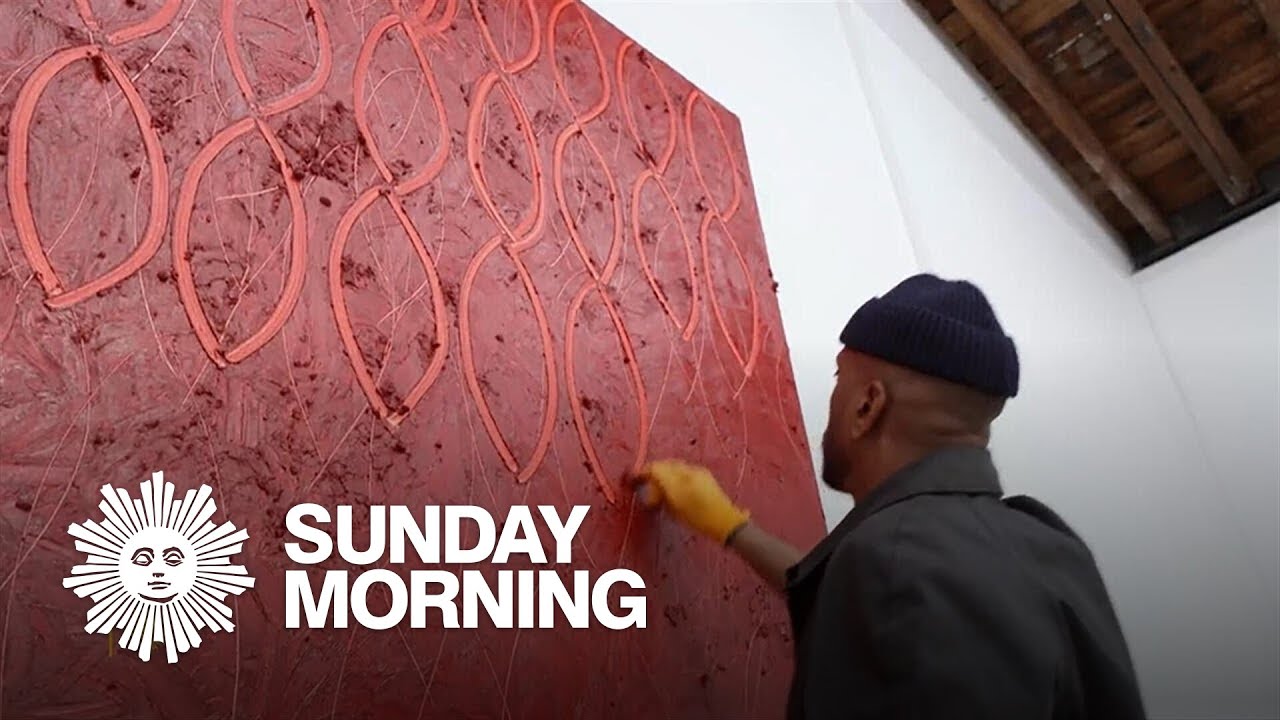
For the “Cosmic Slop” and “Anxious Men” series, Johnson pours black soap and wax onto flat surfaces and allows it to settle. The runs and drips record gravity’s work. As the material moves from liquid to solid, irregular organic forms develop.
He then cuts, digs, scratches, and etches into the dried surface using tools he sometimes makes himself. The faces in his “Anxious Men” series emerge through this subtractive process. Digging reveals the white tile beneath the black wax.
For his large-scale installations (the “shelf” works), he constructs welded steel scaffolding, fills the shelves with live plants, books, CB radios, vinyl records, and mounds of shea butter. The plants change daily. They flower, die, transform the space.
Supports and Surfaces
Branded red oak flooring: Johnson uses branding irons to mark the wood with symbols and patterns. The act of branding carries historical weight.
Ceramic tile panels: Large-scale grids. The tiles create a modular structure that can be assembled and scaled.
Steel structures: Welded frameworks for installations. His “Antoine’s Organ” (2016) featured black steel scaffolding displaying plants, books, and shea butter sculptures.
Themes, Subjects, and Iconography
The Anxious Face

The “Anxious Men” faces are crude, archetypal, confrontational. Bulbous eyes. Gritted teeth. Small, tensed necks. They fill the frame.
Johnson started these as self-portraits of his own anxiety. He quickly realized they spoke more broadly to Black male experience during a time of police violence and mass incarceration.
People have told Johnson they feel “saved or seen” by these works. The vulnerability is their strength.
Escapism and Afrofuturism
Sun Ra believed he was from Mars. He created a parallel universe because this one felt too limiting.
Johnson doesn’t claim extraterrestrial origin. But the impulse toward escape, toward imagining alternatives, runs through his work. His invented institution, “The New Negro Escapist Social and Athletic Club,” humorously upends expectations of historical influence.
Palm trees recur as symbols of escape. “As a kid I remember thinking that if you could actually live in a place with palm trees, if you could get away from the city and the cold, that meant you’d definitely made it.”
Healing and Care
Shea butter and black soap are healing substances. They moisturize, protect, clean. Including them in his work embeds a discourse about care and self-maintenance into the viewing experience.
His video “Me, Tavis Smiley and Shea Butter” (2004) shows Johnson in his bathroom, applying shea butter while listening to NPR. Self-care as ritual. Mundane and meaningful at once.
Compositional Strategies
His tile works often deploy pattern and grids that reference modernist precedents while remaining accessible. The rhythm of repeated elements, whether faces or tiles, creates visual unity while allowing for variety in individual marks.
The anxious faces, scattered across large panels, establish a kind of crowd dynamic. Some spaces are left empty, compelling viewers to consider who is missing.
Notable Works
Black Steel in the Hour of Chaos (2008)

Medium: Steel
Dimensions: 136.5 x 126 x 24 inches
Location: Whitney Museum of American Art, New York
The title references Public Enemy. The work features graphic-design-inspired trim lines and gun-scope references. It confronts power dynamics directly, perhaps too directly for some critics who find it overly literal.
Currently installed outside the Guggenheim Museum as part of Johnson’s 2025 retrospective.
Cosmic Slop (2008-ongoing series)

Medium: Black soap and wax on panel
Signature: Poured, organic surfaces with irregular patterns
The series title comes from Parliament Funkadelic. These paintings launched Johnson’s investigation of black soap and wax as primary painting materials. The surfaces resemble skin, geological formations, or the remnants of ritual processes.
Antoine’s Organ (2016)

Medium: Black steel, grow lights, plants, wood, shea butter, books, monitors, rugs, piano
Scale: Monumental installation
A gridded steel structure houses hundreds of live plants in ceramic vessels Johnson hand-built. Hidden within the structure is an upright piano that local musicians played during scheduled performances.
The work changes daily. Plants flower. Plants die. The living element makes the work inherently unstable.
Untitled Anxious Audience (2016-ongoing)

Medium: White ceramic tile, black soap, wax
Scale: Large panels, often containing dozens of faces
Crowds of anxious faces scratched into wax surfaces on tile grids. During periods of political instability (the 2016 election, the pandemic, George Floyd protests), these works read as history paintings for contemporary times.
Surrender Painting “Sunshine” (2022)

Medium: Mixed media on panel
Auction record: $3 million at Christie’s New York, 2022
Part of the “Surrender” series, evolving from the earlier “Anxious Men” works. Distinguished by sinuous white patterns resembling ghostly faces. The grand scale evokes the sun’s radiance.
The work was auctioned to benefit the Right of Return Fellowship.
The Crisis (2021)

Medium: Monumental steel sculpture
Location: First shown at Storm King Art Center, New York
An outdoor sculpture continuing Johnson’s engagement with steel and geometric form in a landscape context.
Exhibitions, Collections, and Provenance
Major Solo Exhibitions
“A Poem for Deep Thinkers” (2025): Solomon R. Guggenheim Museum, New York. Career survey organized by Naomi Beckwith. Travels to Modern Art Museum of Fort Worth and Museum of Contemporary Art Chicago.
“The Chorus” (2021): The Metropolitan Opera, New York. Large mosaic works for the performance venue.
“The Hikers” (2019): Touring exhibition at Aspen Art Museum, Museo Tamayo (Mexico City), and Hauser & Wirth New York.
“Message to Our Folks” (2012-2013): Originated at Museum of Contemporary Art Chicago.
“Anxious Men” (2015): The Drawing Center, New York. The debut of his “Anxious Men” series.
Group Exhibitions
“Freestyle” (2001): Studio Museum in Harlem. The defining group show of his early career.
Venice Biennale (2011): International pavilion.
“Grief and Grievance: Art and Mourning in America” (2021): New Museum, New York. Conceived by Okwui Enwezor.
Museum Collections

Whitney Museum of American Art (12 works), MoMA, Solomon R. Guggenheim Museum (4 works), Museum of Contemporary Art Chicago, Art Institute of Chicago, Brooklyn Museum, High Museum of Art, Los Angeles County Museum of Art, Fondation Louis Vuitton, Louisiana Museum of Modern Art, Astrup Fearnley Museet, Tate.
Market and Reception
Auction Performance
Record: $3 million for “Surrender Painting Sunshine” (Christie’s New York, 2022)
Price range: $387 to $3 million, depending on size and medium
Most sought-after works: “Anxious Men” series, “Bruise Paintings,” “Surrender” series
In 2021, his market reached a record $12 million in total sales. That year, his auction record was broken twice at Christie’s.
His market joined Hauser & Wirth in 2011. Prices climbed 96.1% in four years following the gallery partnership.
Recent Volatility
A May 2025 auction at Phillips saw one work sell for $292,100, representing a 72% loss for its consignor who had bought it for $816,500 in 2022. This coincided with his Guggenheim survey, a pattern that has affected other artists with major museum retrospectives, including Christopher Wool, Richard Prince, and Alex Katz.
Critical Reception
Generally positive. Some critics, like Alan G. Artner of the Chicago Tribune, have described earlier works as “lacking complexity or depth.” Most responses praise his material intelligence and ability to make conceptual work emotionally accessible.
Influence and Legacy
Upstream Influences
David Hammons: Culturally charged materials, conceptual strategies, and attention to African American identity.
Joseph Beuys: Use of symbolic materials (fat, felt). Johnson’s black soap and wax have been compared to Beuys’s ritualistic approach.
Carl Andre: Minimalist grid structures. Johnson’s tile works echo Andre’s modular floor pieces.
Sun Ra: Afrofuturist escape narratives. Johnson has spoken about Sun Ra’s influence on his thinking about alternative realities.
Richard Tuttle: Johnson cites seeing a Tuttle cloth piece at the Art Institute of Chicago as a formative moment, recognizing how humble materials could carry artistic weight.
Writers: Toni Morrison, Paul Beatty, Amiri Baraka (the title of his Guggenheim show comes from Baraka).
Downstream Impact
Younger artists working with found objects, culturally weighted materials, and themes of race, masculinity, and mental health have adopted similar strategies. His “Anxious Men” opened space for direct expressions of psychological vulnerability in contemporary art about Black experience.
His hybrid approach, blending conceptualism with material expressiveness, has influenced how post-black art is understood and practiced.
Cross-Domain Echoes
Film: Johnson directed an adaptation of Richard Wright’s “Native Son” (2019), shot in Cleveland. It premiered at Sundance and was released on HBO.
Public commissions: Large mosaic works for the Metropolitan Opera, LaGuardia Airport, and Doha International Airport.
Jewelry: A 2020 collaboration with LizWorks translated his “Anxious Men” into gold, titanium, and ruby jewelry pieces.
How to Recognize a Rashid Johnson at a Glance

- White ceramic tile grids serving as backgrounds for scratched or painted imagery
- Black, wax-like surfaces with faces or abstract forms dug into them
- Anxious faces with bulging eyes, gritted teeth, and tense necks, rendered through scratching rather than drawing
- Shea butter visible as yellowish mounds, often placed in oyster shells or on shelves
- Branded red oak flooring with burned-in patterns
- Live tropical plants incorporated into steel structures or installations
- Books, vinyl records, and CB radios arranged on shelf-like sculptures
- Mirror tiles integrated into mosaic compositions, reflecting viewers
- Palm tree imagery collaged onto surfaces, often with spray paint and wallpaper
- Large scale: panels frequently exceed six feet in any dimension
FAQ on Rashid Johnson
Who is Rashid Johnson?
Rashid Johnson is an American multimedia artist born in 1977 in Evanston, Illinois. He works across sculpture, photography, painting, installation, and film. His practice explores African American identity, cultural history, and collective anxiety through unconventional materials.
What materials does Rashid Johnson use?
Johnson uses shea butter, African black soap, microcrystalline wax, ceramic tiles, mirrored tiles, and branded red oak flooring. He also incorporates live plants, books, vinyl records, and oyster shells. These materials carry personal and cultural significance from his Afrocentric upbringing.
What is the Anxious Men series?
The “Anxious Men” series features crude, archetypal faces scratched into black soap and wax on white ceramic tile. Johnson calls this “drawing through erasure.” The works express personal and collective anxiety, particularly addressing the Black male experience in America.
Where can I see Rashid Johnson’s art?
His work is in major collections including MoMA, the Whitney Museum, and the Guggenheim. His 2025 retrospective “A Poem for Deep Thinkers” is at the Solomon R. Guggenheim Museum, traveling to Fort Worth and Chicago.
How much does Rashid Johnson’s art cost?
Auction prices range from under $1,000 for prints to $3 million for major paintings. His record was set in 2022 with “Surrender Painting Sunshine” at Christie’s. The “Anxious Men” and “Bruise Paintings” series command the highest prices.
What movement is Rashid Johnson associated with?
Johnson is linked to post-black art, a term coined by curator Thelma Golden. This describes artists who engage with Black identity without being reduced to it. His work also connects to conceptualism and Afrofuturism.
What is Rashid Johnson’s most famous work?
His “Anxious Men” series is the most recognized. “Antoine’s Organ” (2016), a steel structure filled with plants and cultural objects, is a landmark installation. “Cosmic Slop” paintings established his signature black soap and wax technique.
Where did Rashid Johnson study art?
Johnson earned a BFA in Photography from Columbia College Chicago in 2000. He completed his MFA at the School of the Art Institute of Chicago in 2005, studying under artist Gregg Bordowitz and learning critical theory.
What themes does Rashid Johnson explore?
His work addresses racial and cultural identity, escapism, healing, and mental health. He examines Afrofuturism and the Black intellectual tradition. Personal anxiety and collective trauma appear throughout, especially in his figurative works on ceramic tile.
Has Rashid Johnson made any films?
Yes. Johnson directed an adaptation of Richard Wright’s novel “Native Son” in 2019. The film was shot in Cleveland, premiered at the Sundance Film Festival, and was released on HBO. He continues working in video and film.
Conclusion
Rashid Johnson has built a practice where materials carry meaning before brush ever touches surface. Shea butter, black soap, ceramic tile, and live plants become vehicles for cultural memory and personal history.
His “Anxious Men” gave visual form to vulnerability. The scratched faces on white tile grids speak to collective unease without needing explanation.
From his Chicago roots to a Guggenheim retrospective, Johnson has proven that conceptual rigor and emotional resonance can coexist. His multimedia work continues to shape contemporary conversations about identity, healing, and what American art can hold.