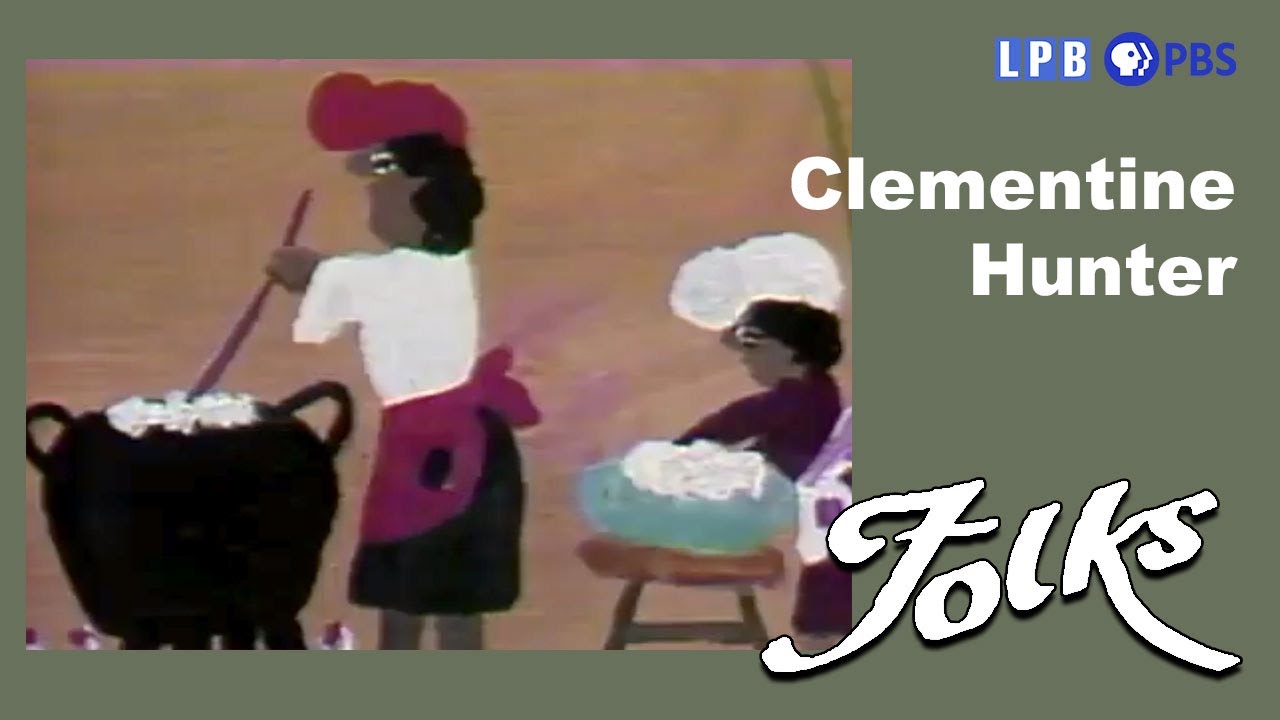
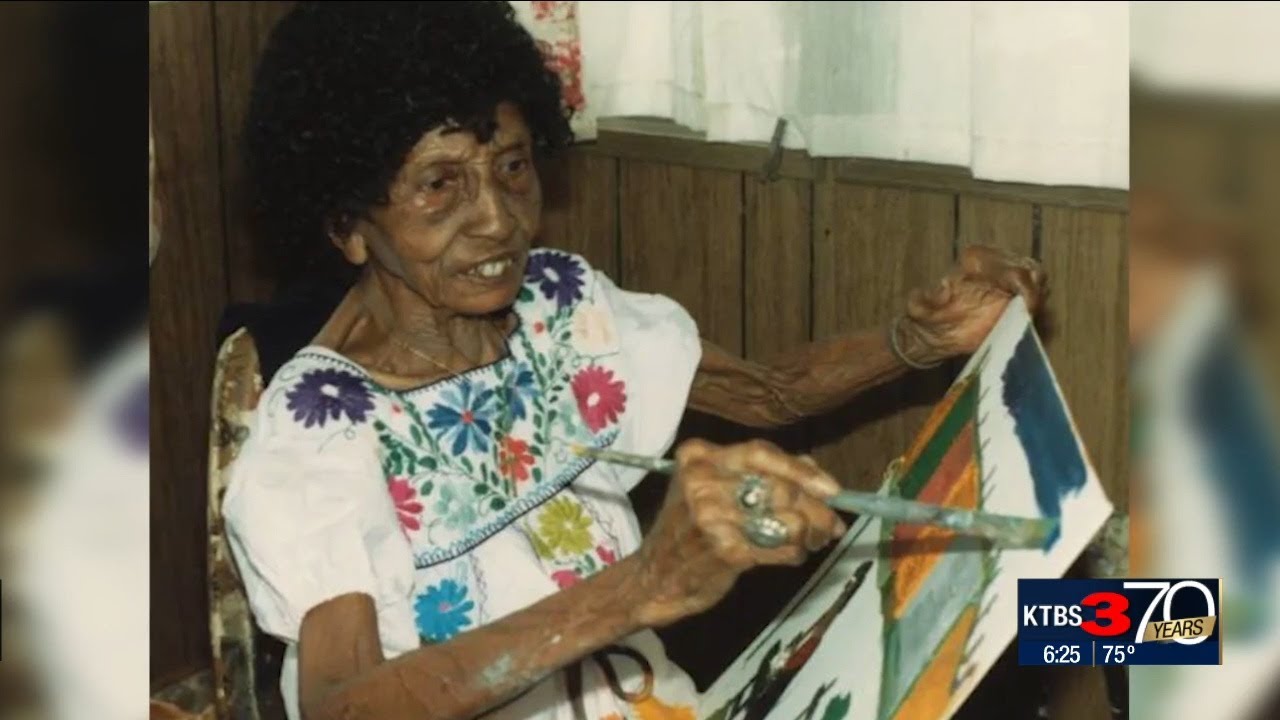
Clementine Hunter was a self-taught Black folk artist from Louisiana who spent most of her 101 years living and working on Melrose Plantation in Natchitoches Parish. She began painting in her fifties using discarded materials left behind by visiting artists. Her work documented Black Southern life in the early 20th century through memory paintings of cotton picking, baptisms, funerals, wash days, and religious scenes.
Hunter produced between 5,000 and 10,000 paintings in her lifetime. She became the first African American artist to have a solo exhibition at the New Orleans Museum of Art in 1955. Her paintings now hang in the Smithsonian American Art Museum, the American Folk Art Museum, the High Museum of Art, and the Oprah Winfrey Collection.
Identity Snapshot
- Full Name: Clementine Reuben Hunter (pronounced Clementeen)
- Also Known As: Clemence (birth name), the Black Grandma Moses
- Lifespan: Late December 1886 or early January 1887 – January 1, 1988
- Primary Role: Painter, quiltmaker
- Nationality: American (Louisiana Creole)
- Movement: Folk art, outsider art, naive art, memory painting
- Mediums: Oil on board, oil on canvas, oil on found objects (bottles, gourds, window shades)
- Signature Traits: Flat planes of color, deliberate disregard for perspective, bold palette, shifts in scale based on importance
- Iconography: Cotton fields, zinnias, baptism scenes, wash day, funeral processions, honky tonks
- Geographic Anchors: Hidden Hill Plantation (birthplace), Melrose Plantation, Cane River region, Natchitoches Parish
- Key Patrons: Francois Mignon, James Register, Cammie Henry, Tom Whitehead
- Major Collections: Smithsonian American Art Museum, New Orleans Museum of Art, American Folk Art Museum, Dallas Museum of Fine Art, High Museum of Art, Minneapolis Institute of Arts, Ogden Museum of Southern Art
- Market Signals: Record auction sale of $85,400 for “Early Funeral” (2021), average auction price $7,823 (2024)
What Sets Clementine Hunter Apart
Hunter painted from memory, not observation. Every scene came directly from her mind. She captured daily life on Louisiana plantations with a directness that trained artists rarely achieve.
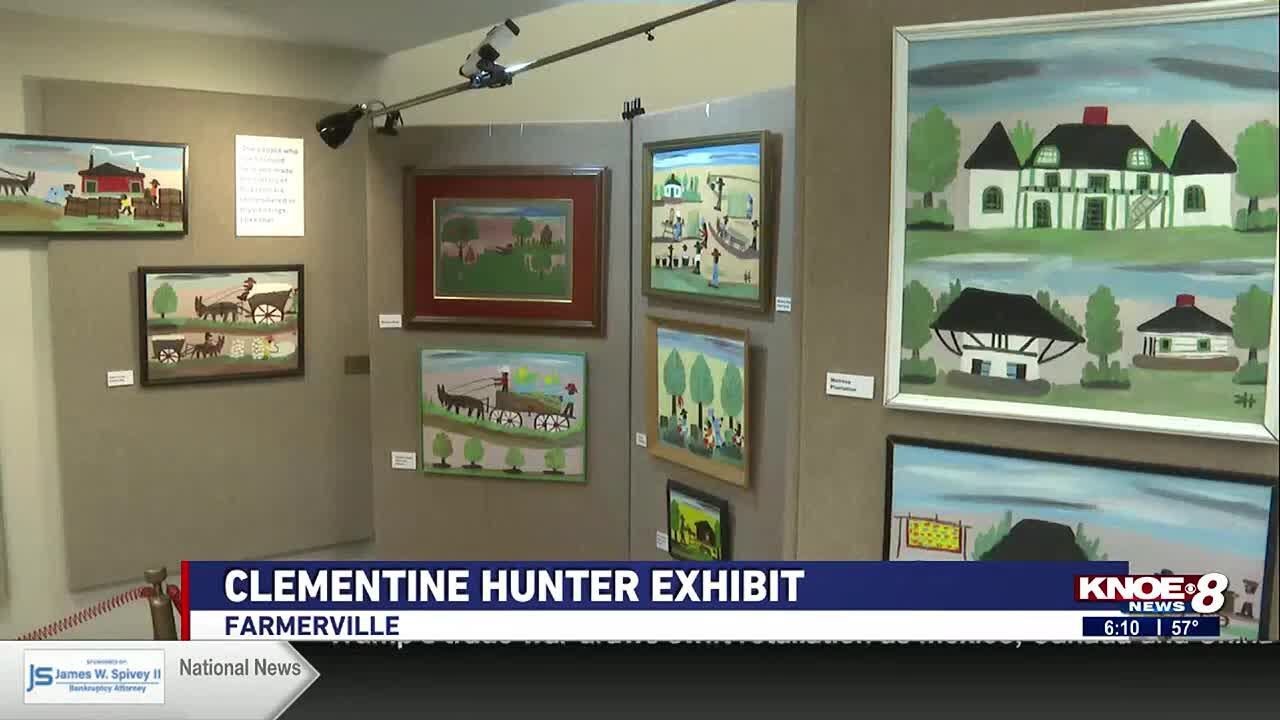
Her figures vary in size according to their importance in the scene, not according to traditional linear perspective rules. The largest figures catch your eye first. Colors sit flat and bold on the surface, with no shading to speak of.
While artists like Grandma Moses painted nostalgic rural scenes from a comfortable distance, Hunter documented her own lived experience. She picked the cotton she painted. She attended the baptisms and funerals she depicted. That firsthand knowledge shows.
Her work functions as cultural documentation. Historians use her paintings to understand sharecropper communities in the Cane River region. The tight-knit Creole communities she portrayed, a mixture of Spanish, French, African American, and Native American peoples, largely dispersed after World War II.
Origins and Formation
Early Life
Hunter was born on Hidden Hill Plantation near Cloutierville, Louisiana. Some sources say late December 1886, others early January 1887. Church records show she was christened on March 19, 1888.
Her mother, Mary Antoinette Adams, descended from Virginian slaves. Her father, Janvier “John” Reuben, had Irish and Native American heritage. She was the eldest of seven children.
Move to Melrose
Around age 14, Hunter’s family moved to Melrose Plantation. She never attended school for more than ten days and never learned to read or write.
She worked in the cotton fields alongside her parents. These experiences would later fuel her detailed depictions of rural life and field work. She also harvested pecans in autumn.
Transition to Domestic Work
In the late 1920s, Hunter moved from field labor to cooking and housekeeping for Cammie Henry, the plantation owner. She became known for adapting traditional Creole recipes and sewing intricate clothes, dolls, and quilts.
First Paintings
Melrose had become an artists’ colony by the 1930s. Writers and painters like Lyle Saxon, Alberta Kinsey, and Richard Avedon visited regularly.
In 1939, when Hunter was around 52, she picked up discarded paint tubes left by visiting artists. Francois Mignon, the plantation’s writer-in-residence and literary assistant, encouraged her to try painting.
Her first painting depicted a Cane River baptism on a window shade. She sold it for 25 cents.
Movement and Context
Position Within Folk Art

Hunter sits firmly within the American folk art tradition, alongside self-taught artists who worked outside academic training and gallery systems. Critics have called her a primitive artist, a memory painter, and a cultural historian.
The label “outsider art” fits her circumstances. She never traveled more than 100 miles from Melrose. She couldn’t attend her own 1955 Northwestern State College exhibition because of segregation. She had to be snuck in through the back.
Comparisons to Other Artists
Robert Bishop, director of the Museum of American Folk Art, called Hunter “the most celebrated of all Southern contemporary painters.”
Grandma Moses: Both women started painting late in life and depicted rural scenes from memory. But Moses painted from nostalgic recollection of a disappearing New England. Hunter painted her ongoing reality as a plantation worker.
Horace Pippin: Another self-taught African American painter working from memory. Pippin served in World War I and painted war scenes and domestic life. Hunter focused exclusively on Louisiana plantation culture.
Bill Traylor: Born into slavery, Traylor began drawing at age 85 in Alabama. His figures are more abstracted and isolated. Hunter’s compositions are densely populated with narrative relationships.
Technique Distinctions
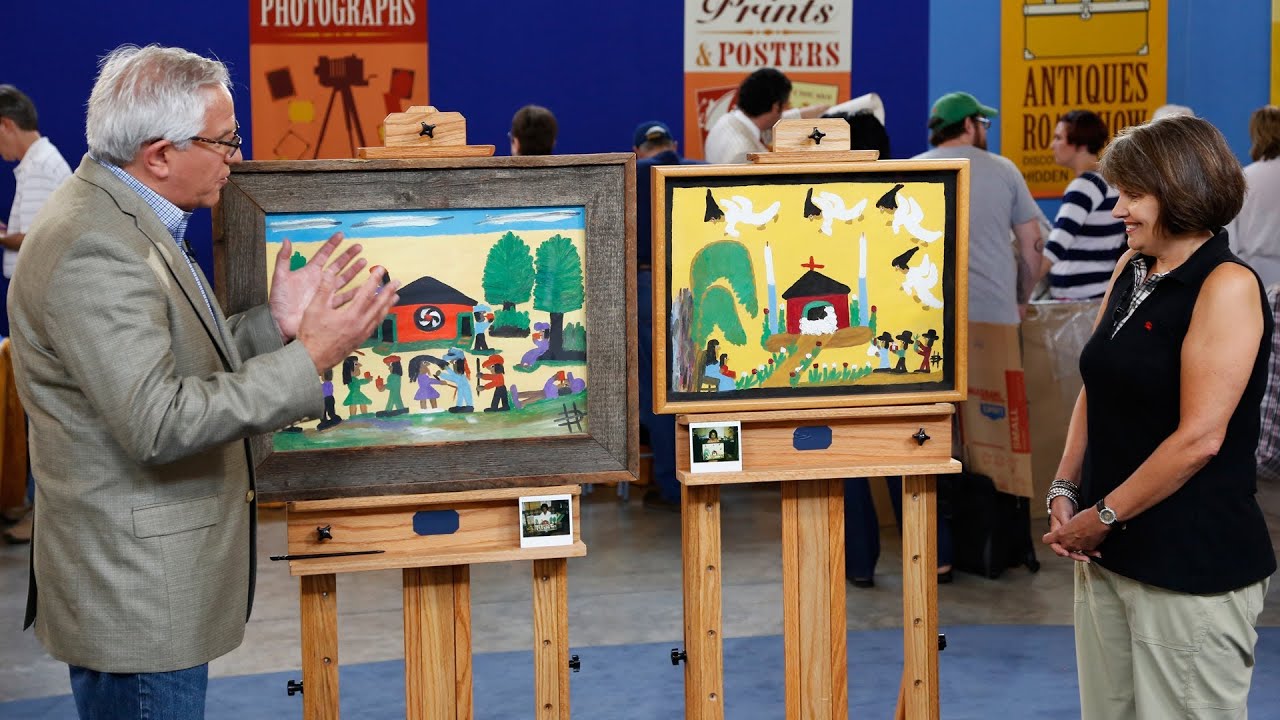
Hunter’s figures are stiffly posed with minimal facial detail. She communicates individuality through activity and relationship rather than expression.
Unlike academic painters who use chiaroscuro for volume, Hunter kept her colors flat. No modeling, no gradients. Just bold hues sitting next to each other.
Materials, Techniques, and Process
Supports and Surfaces
Hunter painted on whatever she could find. Window shades, cardboard, paper bags, scrap wood, snuff boxes, cutting boards, wine bottles, gourds, iron pots, plastic milk jugs, canvas boards.
She never bought art supplies herself. Patrons and visitors brought her materials. When she had nothing else, she used house paint on found objects.
Her largest works, the African House murals, were painted on plywood panels.
Medium
Oil paint became her primary medium. Scientific analysis of her paintings confirmed consistent use of oil-based paints throughout her career.
She mixed oils with turpentine by kerosene lamp light, painting at night after working all day on the plantation.
Brushwork and Application
Hunter marked her compositions first with pencil. This preliminary drawing is something forgers often failed to replicate.
Her brushwork was direct. No hesitation. Experts describe her signatures as having “motion, motion, motion” with no stopping or uncertainty.
She applied paint in flat areas without blending. The lack of traditional value transitions gives her work its characteristic boldness.
Palette
Hunter favored saturated primary colors and secondary colors. Greens for grass and foliage. Blues for sky and water. Warm earth tones for figures and buildings.
Her zinnias, a recurring subject, burst with reds, pinks, yellows, and oranges against neutral backgrounds.
Studio Practice
Hunter had no studio. She painted in her small cabin after working hours. A sign on the outside read: “Clementine Hunter, Artist. 25 cents to Look.”
She painted prolifically, sometimes completing multiple works in a single evening. Her output over nearly 50 years reached somewhere between 5,000 and 10,000 paintings.
Themes, Subjects, and Iconography
Plantation Life
Cotton picking scenes dominate her work. Figures bend over in fields, dragging long sacks. These weren’t romanticized depictions. They documented backbreaking sharecropper labor.
Wash day appears repeatedly. Women scrub clothes in large tubs while children play nearby. The pecan harvest shows seasonal rhythms of plantation work.
Religious Scenes
Baptisms in the Cane River feature processions from St. Augustine Catholic Church down to the water. Figures in white or green wade into the current.
Funeral scenes show coffins being carried to church. Nativity paintings place the holy family in Louisiana settings. Crucifixion paintings include local details.
Community Gatherings
Weddings show couples before preachers, surrounded by flowers and cake. Saturday nights at the honky tonk depict drinking, dancing, and fighting outside local bars.
Hunter titled one painting “Saturday Night at the Honky Tonk” and another “Something Saturday Night.” These works show the release after six days of labor.
Floral Studies
Zinnias became her signature flower. Bowls of zinnias in bright colors against simple backgrounds. Her first documented oil painting was “Bowl of Zinnias.”
She painted from memory mostly, but friend Tom Whitehead watched her paint a vase of spider lilies from life on at least one occasion.
Compositional Schemes
Hunter arranged figures across horizontal bands. Ground at bottom, sky at top, action in between. This straightforward composition approach served her narrative purposes.
She scaled figures by importance rather than distance. Main subjects loom large while secondary figures shrink, regardless of their position in space.
Notable Works
African House Murals (1955)

Medium: Oil on plywood, nine panels, each approximately 6.5 feet wide by 4 feet high
Location: African House, Melrose Plantation, Natchitoches, Louisiana
Visual Signature: Panoramic scenes wrapping around the second-floor interior, depicting complete cycles of plantation life
Why It Matters: Her largest and most ambitious work. Francois Mignon suggested the project when Hunter was 68. She had never seen a mural but said she would “set her mind to it.” Completed in seven weeks. The murals show cotton picking, a Baptist church, cotton harvest, wedding, funeral, baptism, wash day, honky tonk scenes, pecan harvest, and a self-portrait of Hunter painting.
A local newspaper headline upon completion read: “A 20th Century Woman of Color Finishes a Story Begun 200 Years Ago by an 18th Century Congo-Born Slave Girl, Marie-Therese.”
Baptism (1950s)

Medium: Oil on board, 18 x 24 inches
Location: Crystal Bridges Museum of American Art
Visual Signature: Procession from church to river, candidates in green, clergymen in yellow, figures sized by importance
Why It Matters: Her very first painting depicted a similar Cane River baptism. This theme recurs throughout her career. The painting shows her characteristic scale distortions and flat color application.
Harvesting Gourds near the African House and Wash Day Near Ghana House, Melrose Plantation (1959)

Medium: Oil on board, 73 x 66.5 inches
Location: New Orleans Museum of Art
Visual Signature: Large-scale mural with white fence stretching across composition, decorative gourd border framing the scene
Why It Matters: One of her rare monumental works outside the African House. Acquired by NOMA in 2018. Demonstrates her site-specific approach to murals, responding to architectural context.
Melrose Quilt (circa 1960)

Medium: Fabric, pieced and appliqued
Location: Smithsonian American Art Museum
Visual Signature: Abstract arrangement showing plantation layout including Melrose House, African House, Yucca House
Why It Matters: Demonstrates Hunter’s textile skills predated her painting. Some critics compare its abstract qualities to work by Robert Rauschenberg. Shows she was producing narrative work in textiles before taking up oils.
Bowl of Zinnias (circa 1940)

Medium: Oil on board
Visual Signature: Simple floral arrangement against plain background, bold warm colors
Why It Matters: Documented as her first oil painting. Photographed with Hunter by Clarence John Laughlin for Look magazine in 1953. Establishes zinnias as her signature subject.
Exhibitions, Collections, and Provenance
Major Exhibitions
1949: First exhibition, hosted by Francois Mignon in the African House at Melrose Plantation
1949: New Orleans Arts and Crafts Show
1955: First solo museum exhibition, Delgado Museum (now New Orleans Museum of Art). First African American artist to exhibit solo at this institution.
1955: Northwestern State College exhibition. Hunter could not attend with white patrons due to segregation.
1970s: Major exhibitions at Museum of American Folk Art (New York) and Los Angeles County Museum of Art brought national recognition
1985: “A New Orleans Salute to Clementine Hunter’s Centennial” at New Orleans Museum of Art
2024: Whitney Museum of American Art, “Edges of Ailey”
2025-2026: “Sunday Call to Church: The Art of Clementine Hunter” at African American Museum, Dallas
Museum Collections
Smithsonian American Art Museum, Washington D.C.
American Folk Art Museum, New York
New Orleans Museum of Art
High Museum of Art, Atlanta
Dallas Museum of Fine Art
Minneapolis Institute of Arts
Ogden Museum of Southern Art, New Orleans
Louisiana State Museum
National Museum of Women in the Arts
Crystal Bridges Museum of American Art
Oprah Winfrey Collection, Chicago
Documentation and Catalogues
No formal catalogue raisonne exists given her prolific output and the prevalence of forgeries. Tom Whitehead’s authentication work provides the closest thing to an authoritative record.
Key publications include “Clementine Hunter: Her Life and Art” (2012) by Art Shiver and Tom Whitehead, and “Clementine Hunter: The African House Murals” (2005).
Market and Reception
Price History
Hunter sold her first paintings for 25 cents. By the time of her death, dealers sold her work for thousands.
Record auction price: $85,400 for “Early Funeral” at Neal Auction Company (2021)
Current average auction price: approximately $7,823 (2024)
Retail prices range from $4,800 to $27,200 depending on subject, size, and period.
Her earliest works from the 1940s, signed “Clemence,” command higher prices. Later works from the 1980s are more common and less valued.
Authentication Concerns
Forgery has plagued the Hunter market for decades. Tom Whitehead estimates thousands of fakes circulate.
Major forgery operations exposed include William and Beryl Toye, who produced fakes for over 35 years. Robert Lucky Jr. sold their forgeries through his Natchitoches shop. All three were prosecuted by the FBI in 2011.
Joseph M. Henry and wife Juanita created fakes in the 1970s-80s. They would pay Hunter a dollar to pose with their forgeries, then attach the photograph as false provenance.
Authentication Markers
Genuine Hunters show pencil underdrawing beneath the paint. Forgers often skip this step.
Her signature evolved: early works signed “Clemence,” later works marked with interlocking backwards C and H.
Scientific analysis reveals consistent materials in genuine works. Forgeries often contain anachronistic pigments or binders.
Expert authentication by Tom Whitehead is noted on many auction lots.
Condition Patterns
Paintings on found materials (cardboard, paper bags) often show deterioration. Works on canvas board survive better.
The African House murals required professional conservation. Insect frass, bird droppings, and flaking paint needed treatment before their 2016 restoration.
Influence and Legacy
Upstream Influences
Hunter had no formal training and claimed few artistic influences. Her quilting tradition predated her painting. Story quilts used fabric patterns to tell family history.
She observed visiting artists at Melrose but developed her style independently. Alberta Kinsey’s leftover paints provided materials, not instruction.
Downstream Impact
Hunter legitimized folk art as serious cultural documentation. Her FBI forgery case helped establish that self-taught artists deserve the same legal protections as academically trained painters.
Contemporary muralist Mikayla Magee created an interpretation of Hunter’s work for the 2025 African American Museum Dallas exhibition, demonstrating ongoing artistic dialogue.
Cultural Recognition
Northwestern State University granted her an honorary Doctor of Fine Arts in 1986, 31 years after refusing her entry to her own exhibition.
Louisiana Governor Edwin Edwards named her an honorary colonel in 1987.
President Jimmy Carter invited her to the White House. She declined, preferring to stay near Melrose.
Robert Wilson’s opera “Zinnias: The Life of Clementine Hunter” premiered at Montclair State University in 2013.
Shinnerrie Jackson’s musical “Ain’t I a Woman?” honors Hunter alongside other influential African American women.
Louisiana declared Clementine Hunter Day in 2019.
Documentary Record
Radcliffe College included Hunter in its Black Women Oral History Project (1980). Interviews are held at Harvard University’s Schlesinger Library.
“Clementine Hunter’s World” (2017), directed by Art Shiver, documents her life through photographs, oral histories, and the restored African House murals.
How to Recognize a Clementine Hunter at a Glance
- Perspective absent: Figures sized by importance, not distance. No vanishing points or recession.
- Flat color application: No shading, blending, or value gradients. Colors sit bold and unmodulated.
- Pencil underdrawing: Visible marks beneath paint surface. Forgers often skip this.
- Stiff figure posing: Bodies are rigid, facial features minimal. Identity comes from activity and context.
- Louisiana subject matter: Cotton picking, Cane River baptisms, zinnias, wash day, funeral processions, honky tonks.
- Signature evolution: “Clemence” on early works, interlocking backwards C and H on later pieces.
- Unusual supports: Look for work on cardboard, window shades, bottles, gourds, cutting boards, canvas board.
- Small scale: Most paintings are under 20 x 30 inches. Large murals are rare.
- Warm palette bias: Saturated greens, blues, reds, yellows. Earth tones for figures and buildings.
- Horizontal banding: Ground at bottom, sky at top, action in middle zone. Simple, readable compositions.
Clementine Hunter was a self-taught Black folk artist from Louisiana who spent most of her 101 years living and working on Melrose Plantation in Natchitoches Parish. She began painting in her fifties using discarded materials left behind by visiting artists. Her work documented Black Southern life in the early 20th century through memory paintings of cotton picking, baptisms, funerals, wash days, and religious scenes.
Hunter produced between 5,000 and 10,000 paintings in her lifetime. She became the first African American artist to have a solo exhibition at the New Orleans Museum of Art in 1955. Her paintings now hang in the Smithsonian American Art Museum, the American Folk Art Museum, the High Museum of Art, and the Oprah Winfrey Collection.
Identity Snapshot
- Full Name: Clementine Reuben Hunter (pronounced Clementeen)
- Also Known As: Clemence (birth name), the Black Grandma Moses
- Lifespan: Late December 1886 or early January 1887 – January 1, 1988
- Primary Role: Painter, quiltmaker
- Nationality: American (Louisiana Creole)
- Movement: Folk art, outsider art, naive art, memory painting
- Mediums: Oil on board, oil on canvas, oil on found objects (bottles, gourds, window shades)
- Signature Traits: Flat planes of color, deliberate disregard for perspective, bold palette, shifts in scale based on importance
- Iconography: Cotton fields, zinnias, baptism scenes, wash day, funeral processions, honky tonks
- Geographic Anchors: Hidden Hill Plantation (birthplace), Melrose Plantation, Cane River region, Natchitoches Parish
- Key Patrons: Francois Mignon, James Register, Cammie Henry, Tom Whitehead
- Major Collections: Smithsonian American Art Museum, New Orleans Museum of Art, American Folk Art Museum, Dallas Museum of Fine Art, High Museum of Art, Minneapolis Institute of Arts, Ogden Museum of Southern Art
- Market Signals: Record auction sale of $85,400 for “Early Funeral” (2021), average auction price $7,823 (2024)
What Sets Clementine Hunter Apart
Hunter painted from memory, not observation. Every scene came directly from her mind. She captured daily life on Louisiana plantations with a directness that trained artists rarely achieve.
Her figures vary in size according to their importance in the scene, not according to traditional linear perspective rules. The largest figures catch your eye first. Colors sit flat and bold on the surface, with no shading to speak of.
While artists like Grandma Moses painted nostalgic rural scenes from a comfortable distance, Hunter documented her own lived experience. She picked the cotton she painted. She attended the baptisms and funerals she depicted. That firsthand knowledge shows.
Her work functions as cultural documentation. Historians use her paintings to understand sharecropper communities in the Cane River region. The tight-knit Creole communities she portrayed, a mixture of Spanish, French, African American, and Native American peoples, largely dispersed after World War II.
Origins and Formation
Early Life
Hunter was born on Hidden Hill Plantation near Cloutierville, Louisiana. Some sources say late December 1886, others early January 1887. Church records show she was christened on March 19, 1888.
Her mother, Mary Antoinette Adams, descended from Virginian slaves. Her father, Janvier “John” Reuben, had Irish and Native American heritage. She was the eldest of seven children.
Move to Melrose
Around age 14, Hunter’s family moved to Melrose Plantation. She never attended school for more than ten days and never learned to read or write.
She worked in the cotton fields alongside her parents. These experiences would later fuel her detailed depictions of rural life and field work. She also harvested pecans in autumn.
Transition to Domestic Work
In the late 1920s, Hunter moved from field labor to cooking and housekeeping for Cammie Henry, the plantation owner. She became known for adapting traditional Creole recipes and sewing intricate clothes, dolls, and quilts.
First Paintings
Melrose had become an artists’ colony by the 1930s. Writers and painters like Lyle Saxon, Alberta Kinsey, and Richard Avedon visited regularly.
In 1939, when Hunter was around 52, she picked up discarded paint tubes left by visiting artists. Francois Mignon, the plantation’s writer-in-residence and literary assistant, encouraged her to try painting.
Her first painting depicted a Cane River baptism on a window shade. She sold it for 25 cents.
Movement and Context
Position Within Folk Art
Hunter sits firmly within the American folk art tradition, alongside self-taught artists who worked outside academic training and gallery systems. Critics have called her a primitive artist, a memory painter, and a cultural historian.
The label “outsider art” fits her circumstances. She never traveled more than 100 miles from Melrose. She couldn’t attend her own 1955 Northwestern State College exhibition because of segregation. She had to be snuck in through the back.
Comparisons to Other Artists
Robert Bishop, director of the Museum of American Folk Art, called Hunter “the most celebrated of all Southern contemporary painters.”
Grandma Moses: Both women started painting late in life and depicted rural scenes from memory. But Moses painted from nostalgic recollection of a disappearing New England. Hunter painted her ongoing reality as a plantation worker.
Horace Pippin: Another self-taught African American painter working from memory. Pippin served in World War I and painted war scenes and domestic life. Hunter focused exclusively on Louisiana plantation culture.
Bill Traylor: Born into slavery, Traylor began drawing at age 85 in Alabama. His figures are more abstracted and isolated. Hunter’s compositions are densely populated with narrative relationships.
Technique Distinctions
Hunter’s figures are stiffly posed with minimal facial detail. She communicates individuality through activity and relationship rather than expression.
Unlike academic painters who use chiaroscuro for volume, Hunter kept her colors flat. No modeling, no gradients. Just bold hues sitting next to each other.
Materials, Techniques, and Process
Supports and Surfaces
Hunter painted on whatever she could find. Window shades, cardboard, paper bags, scrap wood, snuff boxes, cutting boards, wine bottles, gourds, iron pots, plastic milk jugs, canvas boards.
She never bought art supplies herself. Patrons and visitors brought her materials. When she had nothing else, she used house paint on found objects.
Her largest works, the African House murals, were painted on plywood panels.
Medium
Oil paint became her primary medium. Scientific analysis of her paintings confirmed consistent use of oil-based paints throughout her career.
She mixed oils with turpentine by kerosene lamp light, painting at night after working all day on the plantation.
Brushwork and Application
Hunter marked her compositions first with pencil. This preliminary drawing is something forgers often failed to replicate.
Her brushwork was direct. No hesitation. Experts describe her signatures as having “motion, motion, motion” with no stopping or uncertainty.
She applied paint in flat areas without blending. The lack of traditional value transitions gives her work its characteristic boldness.
Palette
Hunter favored saturated primary colors and secondary colors. Greens for grass and foliage. Blues for sky and water. Warm earth tones for figures and buildings.
Her zinnias, a recurring subject, burst with reds, pinks, yellows, and oranges against neutral backgrounds.
Studio Practice
Hunter had no studio. She painted in her small cabin after working hours. A sign on the outside read: “Clementine Hunter, Artist. 25 cents to Look.”
She painted prolifically, sometimes completing multiple works in a single evening. Her output over nearly 50 years reached somewhere between 5,000 and 10,000 paintings.
Themes, Subjects, and Iconography
Plantation Life
Cotton picking scenes dominate her work. Figures bend over in fields, dragging long sacks. These weren’t romanticized depictions. They documented backbreaking sharecropper labor.
Wash day appears repeatedly. Women scrub clothes in large tubs while children play nearby. The pecan harvest shows seasonal rhythms of plantation work.
Religious Scenes
Baptisms in the Cane River feature processions from St. Augustine Catholic Church down to the water. Figures in white or green wade into the current.
Funeral scenes show coffins being carried to church. Nativity paintings place the holy family in Louisiana settings. Crucifixion paintings include local details.
Community Gatherings
Weddings show couples before preachers, surrounded by flowers and cake. Saturday nights at the honky tonk depict drinking, dancing, and fighting outside local bars.
Hunter titled one painting “Saturday Night at the Honky Tonk” and another “Something Saturday Night.” These works show the release after six days of labor.
Floral Studies
Zinnias became her signature flower. Bowls of zinnias in bright colors against simple backgrounds. Her first documented oil painting was “Bowl of Zinnias.”
She painted from memory mostly, but friend Tom Whitehead watched her paint a vase of spider lilies from life on at least one occasion.
Compositional Schemes
Hunter arranged figures across horizontal bands. Ground at bottom, sky at top, action in between. This straightforward composition approach served her narrative purposes.
She scaled figures by importance rather than distance. Main subjects loom large while secondary figures shrink, regardless of their position in space.
Notable Works
African House Murals (1955)
Medium: Oil on plywood, nine panels, each approximately 6.5 feet wide by 4 feet high
Location: African House, Melrose Plantation, Natchitoches, Louisiana
Visual Signature: Panoramic scenes wrapping around the second-floor interior, depicting complete cycles of plantation life
Why It Matters: Her largest and most ambitious work. Francois Mignon suggested the project when Hunter was 68. She had never seen a mural but said she would “set her mind to it.” Completed in seven weeks. The murals show cotton picking, a Baptist church, cotton harvest, wedding, funeral, baptism, wash day, honky tonk scenes, pecan harvest, and a self-portrait of Hunter painting.
A local newspaper headline upon completion read: “A 20th Century Woman of Color Finishes a Story Begun 200 Years Ago by an 18th Century Congo-Born Slave Girl, Marie-Therese.”
Baptism (1950s)
Medium: Oil on board, 18 x 24 inches
Location: Crystal Bridges Museum of American Art
Visual Signature: Procession from church to river, candidates in green, clergymen in yellow, figures sized by importance
Why It Matters: Her very first painting depicted a similar Cane River baptism. This theme recurs throughout her career. The painting shows her characteristic scale distortions and flat color application.
Harvesting Gourds near the African House and Wash Day Near Ghana House, Melrose Plantation (1959)
Medium: Oil on board, 73 x 66.5 inches
Location: New Orleans Museum of Art
Visual Signature: Large-scale mural with white fence stretching across composition, decorative gourd border framing the scene
Why It Matters: One of her rare monumental works outside the African House. Acquired by NOMA in 2018. Demonstrates her site-specific approach to murals, responding to architectural context.
Melrose Quilt (circa 1960)
Medium: Fabric, pieced and appliqued
Location: Smithsonian American Art Museum
Visual Signature: Abstract arrangement showing plantation layout including Melrose House, African House, Yucca House
Why It Matters: Demonstrates Hunter’s textile skills predated her painting. Some critics compare its abstract qualities to work by Robert Rauschenberg. Shows she was producing narrative work in textiles before taking up oils.
Bowl of Zinnias (circa 1940)
Medium: Oil on board
Visual Signature: Simple floral arrangement against plain background, bold warm colors
Why It Matters: Documented as her first oil painting. Photographed with Hunter by Clarence John Laughlin for Look magazine in 1953. Establishes zinnias as her signature subject.
Exhibitions, Collections, and Provenance
Major Exhibitions
1949: First exhibition, hosted by Francois Mignon in the African House at Melrose Plantation
1949: New Orleans Arts and Crafts Show
1955: First solo museum exhibition, Delgado Museum (now New Orleans Museum of Art). First African American artist to exhibit solo at this institution.
1955: Northwestern State College exhibition. Hunter could not attend with white patrons due to segregation.
1970s: Major exhibitions at Museum of American Folk Art (New York) and Los Angeles County Museum of Art brought national recognition
1985: “A New Orleans Salute to Clementine Hunter’s Centennial” at New Orleans Museum of Art
2024: Whitney Museum of American Art, “Edges of Ailey”
2025-2026: “Sunday Call to Church: The Art of Clementine Hunter” at African American Museum, Dallas
Museum Collections
Smithsonian American Art Museum, Washington D.C.
American Folk Art Museum, New York
New Orleans Museum of Art
High Museum of Art, Atlanta
Dallas Museum of Fine Art
Minneapolis Institute of Arts
Ogden Museum of Southern Art, New Orleans
Louisiana State Museum
National Museum of Women in the Arts
Crystal Bridges Museum of American Art
Oprah Winfrey Collection, Chicago
Documentation and Catalogues
No formal catalogue raisonne exists given her prolific output and the prevalence of forgeries. Tom Whitehead’s authentication work provides the closest thing to an authoritative record.
Key publications include “Clementine Hunter: Her Life and Art” (2012) by Art Shiver and Tom Whitehead, and “Clementine Hunter: The African House Murals” (2005).
Market and Reception
Price History
Hunter sold her first paintings for 25 cents. By the time of her death, dealers sold her work for thousands.
Record auction price: $85,400 for “Early Funeral” at Neal Auction Company (2021)
Current average auction price: approximately $7,823 (2024)
Retail prices range from $4,800 to $27,200 depending on subject, size, and period.
Her earliest works from the 1940s, signed “Clemence,” command higher prices. Later works from the 1980s are more common and less valued.
Authentication Concerns
Forgery has plagued the Hunter market for decades. Tom Whitehead estimates thousands of fakes circulate.
Major forgery operations exposed include William and Beryl Toye, who produced fakes for over 35 years. Robert Lucky Jr. sold their forgeries through his Natchitoches shop. All three were prosecuted by the FBI in 2011.
Joseph M. Henry and wife Juanita created fakes in the 1970s-80s. They would pay Hunter a dollar to pose with their forgeries, then attach the photograph as false provenance.
Authentication Markers
Genuine Hunters show pencil underdrawing beneath the paint. Forgers often skip this step.
Her signature evolved: early works signed “Clemence,” later works marked with interlocking backwards C and H.
Scientific analysis reveals consistent materials in genuine works. Forgeries often contain anachronistic pigments or binders.
Expert authentication by Tom Whitehead is noted on many auction lots.
Condition Patterns
Paintings on found materials (cardboard, paper bags) often show deterioration. Works on canvas board survive better.
The African House murals required professional conservation. Insect frass, bird droppings, and flaking paint needed treatment before their 2016 restoration.
Influence and Legacy
Upstream Influences
Hunter had no formal training and claimed few artistic influences. Her quilting tradition predated her painting. Story quilts used fabric patterns to tell family history.
She observed visiting artists at Melrose but developed her style independently. Alberta Kinsey’s leftover paints provided materials, not instruction.
Downstream Impact
Hunter legitimized folk art as serious cultural documentation. Her FBI forgery case helped establish that self-taught artists deserve the same legal protections as academically trained painters.
Contemporary muralist Mikayla Magee created an interpretation of Hunter’s work for the 2025 African American Museum Dallas exhibition, demonstrating ongoing artistic dialogue.
Cultural Recognition
Northwestern State University granted her an honorary Doctor of Fine Arts in 1986, 31 years after refusing her entry to her own exhibition.
Louisiana Governor Edwin Edwards named her an honorary colonel in 1987.
President Jimmy Carter invited her to the White House. She declined, preferring to stay near Melrose.
Robert Wilson’s opera “Zinnias: The Life of Clementine Hunter” premiered at Montclair State University in 2013.
Shinnerrie Jackson’s musical “Ain’t I a Woman?” honors Hunter alongside other influential African American women.
Louisiana declared Clementine Hunter Day in 2019.
Documentary Record
Radcliffe College included Hunter in its Black Women Oral History Project (1980). Interviews are held at Harvard University’s Schlesinger Library.
“Clementine Hunter’s World” (2017), directed by Art Shiver, documents her life through photographs, oral histories, and the restored African House murals.
How to Recognize a Clementine Hunter at a Glance
- Perspective absent: Figures sized by importance, not distance. No vanishing points or recession.
- Flat color application: No shading, blending, or value gradients. Colors sit bold and unmodulated.
- Pencil underdrawing: Visible marks beneath paint surface. Forgers often skip this.
- Stiff figure posing: Bodies are rigid, facial features minimal. Identity comes from activity and context.
- Louisiana subject matter: Cotton picking, Cane River baptisms, zinnias, wash day, funeral processions, honky tonks.
- Signature evolution: “Clemence” on early works, interlocking backwards C and H on later pieces.
- Unusual supports: Look for work on cardboard, window shades, bottles, gourds, cutting boards, canvas board.
- Small scale: Most paintings are under 20 x 30 inches. Large murals are rare.
- Warm palette bias: Saturated greens, blues, reds, yellows. Earth tones for figures and buildings.
- Horizontal banding: Ground at bottom, sky at top, action in middle zone. Simple, readable compositions.
Conclusion
Clementine Hunter transformed her lived experience into a visual archive of the Cane River region. No formal training. No gallery connections. Just paint on whatever surface she could find.
Her African House murals and plantation paintings preserve a world that mechanization and migration erased. Sharecropper communities, Creole traditions, Saturday night honky tonks.
Museums from Dallas to the Smithsonian now collect the work she once sold for quarters. That trajectory, from cotton fields to cultural icon, makes her story as compelling as her art.
The primitive painter outlasted everyone who doubted her.