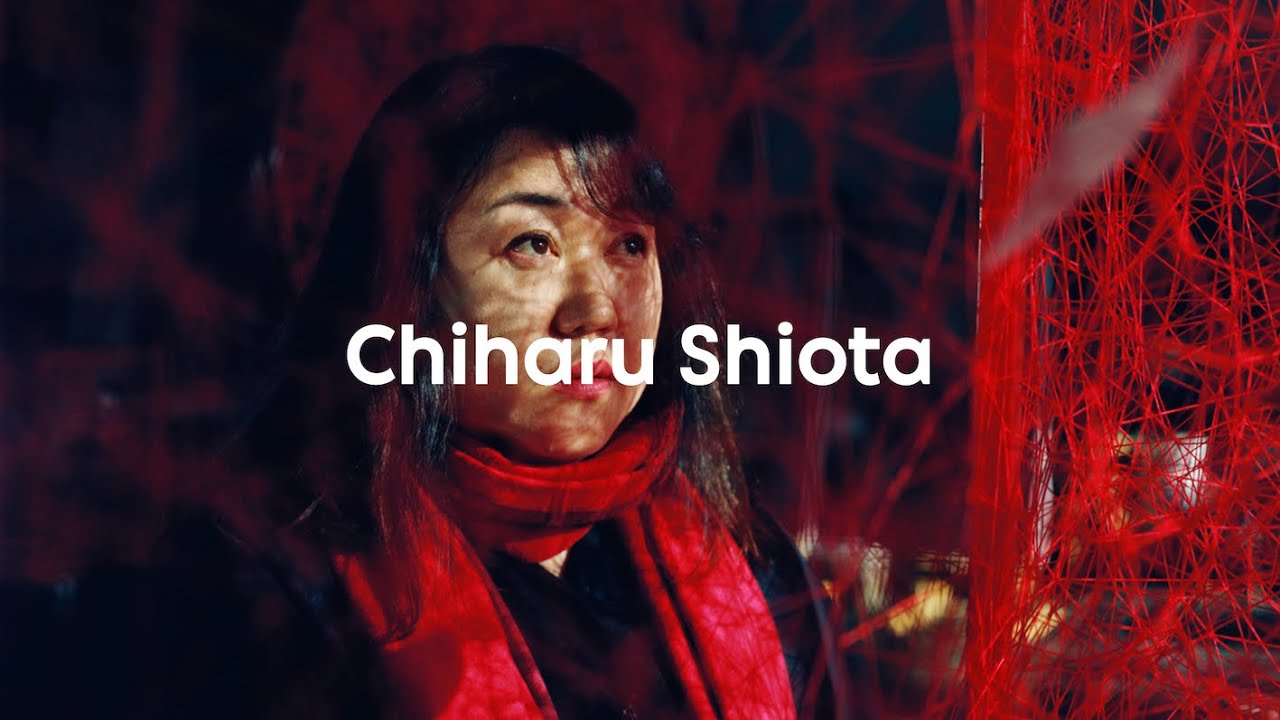
Chiharu Shiota creates massive thread installations that transform gallery spaces into immersive environments. Born in 1972 in Osaka, Japan, she has lived and worked in Berlin since 1996.
Her practice sits at the intersection of performance art, sculpture, and installation. She weaves intricate webs of red, black, and white yarn around everyday objects like keys, shoes, dresses, and boats.
These site-specific installations explore memory, existence, and the concept of presence in absence. Shiota represented Japan at the 56th Venice Biennale in 2015 with “The Key in the Hand,” which featured over 50,000 keys suspended from clouds of red thread.
Her work has been shown at major museums worldwide, including the Mori Art Museum in Tokyo, Smithsonian in Washington DC, and the Gropius Bau in Berlin.
Identity Snapshot
- Full Name: Chiharu Shiota (塩田千春)
- Born: 1972, Osaka, Japan
- Based: Berlin, Germany (since 1996)
- Primary Roles: Installation artist, performance artist, sculptor
- Nationality: Japanese
- Movement: Contemporary installation art
- Primary Medium: Thread (wool, yarn), found objects, mixed media
- Signature Traits: Room-spanning thread webs, monochromatic color schemes (red, black, white), integration of personal objects
- Recurring Motifs: Keys, boats, dresses, shoes, windows, beds, pianos
- Key Locations: Osaka (birthplace), Berlin (residence), Venice (career milestone)
- Mentors: Marina Abramovic, Rebecca Horn, Saburo Muraoka
- Representation: Galerie Templon (Paris), Anna Schwartz Gallery, Kenji Taki Gallery
- Major Collections: Mori Art Museum, 21st Century Museum of Contemporary Art Kanazawa, National Museum of Modern Art Tokyo, Hoffmann Collection Berlin
- Auction Record: $603,263 for “Skin” (2018) at Cuppar Auction, China
What Sets Chiharu Shiota Apart
Shiota does not paint on canvas. She draws in three-dimensional space with thread.
While other artists work with similar materials, her large-scale installations achieve a particular density and emotional weight. The sheer quantity of yarn (sometimes hundreds of kilometers in a single work) creates environments that feel organic and almost biological.
Her thread networks mimic veins, neural pathways, and cobwebs simultaneously. The result hovers between beauty and unease.
Unlike artists who use thread for decorative purposes, Shiota loads her materials with autobiographical meaning. Red signifies blood, human relationships, and the Japanese legend of the red thread of fate. Black represents the universe, night sky, and abstract truth. White embodies the cycle of life and death.
The objects suspended within her webs carry their own histories. They belonged to other people before Shiota collected them. She sees the trace of human existence in absence.
Her work connects to the body-centered performance legacy of Yayoi Kusama and Louise Bourgeois while maintaining a distinct visual vocabulary. The installations demand physical engagement. You walk through them, around them, under them.
Origins and Formation
Early Life in Osaka
Shiota grew up in a family that manufactured fish boxes. Her parents produced a thousand wooden boxes daily.
She decided to become an artist at twelve years old. Her parents worried but did not stop her.
A childhood memory shaped her entire practice. When she was nine, the house next door burned down in the middle of the night. The next morning, a charred piano sat among the debris. That image never left her.
Academic Training
She enrolled at Kyoto Seika University in 1992 to study oil painting. The program ran until 1996.
Traditional painting frustrated her. She felt disconnected from color on canvas.
In 1993, an exchange program at the Canberra School of Art in Australia changed everything. She created “Becoming Painting” (1994), covering her body in red enamel paint. The performance caused burns on her skin but felt liberating.
She later called it her first real piece of work.
Move to Germany
Shiota relocated to Germany in 1996. She studied at Hochschule fur Bildende Kunste in Braunschweig from 1997 to 1999.
There she encountered Marina Abramovic. The Serbian performance artist pushed students to test their physical limits through fasting and endurance exercises.
From 1999 to 2002, Shiota studied under Rebecca Horn at Universitat der Kunste in Berlin. Horn’s kinetic sculptures and body extensions influenced her thinking about objects in space.
An artist residency at Akademie Schloss Solitude in Stuttgart followed.
First Recognition
Her installations gained international attention in 2000 through a group exhibition at Ludwig Forum in Aachen, Germany. The 2001 Yokohama Triennale brought her wider visibility.
Berlin became her permanent home. The city’s post-reunification atmosphere, with abandoned buildings and discarded materials, provided both inspiration and raw materials.
Movement and Context
Position Within Contemporary Art

Shiota operates outside traditional painting movements. Her practice merges installation, performance, and textile arts.
She shares conceptual ground with artists who explore memory and loss through accumulated objects. Christian Boltanski, whom she cites as an influence, similarly works with personal artifacts and absence.
Her thread-based practice connects to the fiber art tradition established by Magdalena Abakanowicz, whose 1991 exhibition at the Museum of Modern Art in Shiga first showed Shiota that art could be more than something to look at.
Comparative Analysis
Versus Yayoi Kusama
Both Japanese women artists create immersive environments. But Kusama uses polka dots and mirrors for infinite repetition. Shiota uses thread for interconnection and fragility.
Kusama’s work feels exuberant. Shiota’s feels haunted.
Versus Louise Bourgeois
Bourgeois explored similar themes of memory, trauma, and the feminine through spider imagery. Her Maman sculptures use rigid steel.
Shiota’s webs are soft, temporary, site-specific. They cannot be permanently installed in the same way.
Versus Ernesto Neto
Neto also creates immersive textile environments. His biomorphic forms invite touch and smell through stretched fabric and spices.
Shiota’s thread webs discourage touch. They appear delicate and fragile. The viewer remains visually immersed but physically separated.
Materials, Techniques, and Process
Primary Materials
Wool yarn and thread form the core of her practice. She began using wool in 1996.
The material comes in three primary colors: red, black, and white. Each carries symbolic weight.
Found objects include keys, window frames, dresses, shoes, boats, beds, chairs, suitcases, and pianos. Many come from donations or construction sites.
Recent works incorporate thin plastic tubing filled with blood-like liquid. This material suggests umbilical connections and the body’s internal systems.
Installation Process
She uses scissor lifts to reach high ceilings. Teams of three or four assistants help attach and knot yarn strands.
The process takes days or weeks depending on scale. Her installation “Absence Embodied” (2018) used 1,800 balls of wool, each 133 meters long. That equals roughly 239 kilometers of string.
“The Key in the Hand” at Venice used approximately 400 kilometers of red yarn.
She compares the work to painting with thread in space rather than on canvas.
Color System
- Red: Blood, human relationships, the Japanese red thread legend, lineage and ancestry
- Black: Universe, night sky, abstract truth, mystery, infinity
- White: Beginnings and endings, life and death cycles, purity
The choice depends on each installation’s theme. Her approach to color remains consistent across decades.
Studio Practice
She maintains a studio in Berlin but creates most major installations on-site. Each venue requires fresh construction.
Previous installations cannot simply be reinstalled elsewhere. The work responds to specific architectural conditions.
Smaller sculptural works (the “State of Being” series) use metal frames with thread-wrapped objects. These can be collected and resold.
Themes, Subjects, and Iconography
Memory and Existence
Every installation deals with memory in some form. Personal memories. Collective memories. The memories embedded in objects.
She calls this “presence in absence.” Objects that once belonged to people carry traces of their existence even after they are gone.
The Body
Early performances used her own body as canvas. Later work removed her physical presence but retained bodily references through thread (veins, nerves) and objects (dresses as second skin, beds as sites of birth and death).
Her understanding of form relates directly to the human figure, even when abstracted.
Recurring Objects
- Keys: Protection, memory, access to the unknown, trust
- Boats: Uncertain journeys, life as voyage, vulnerability
- Dresses: Second skin, feminine identity, cultural boundaries
- Windows: Boundaries between inside and outside, Berlin’s divided history
- Beds: Sleep, dreams, birth, death, illness
- Shoes: Paths through life, individual journeys, accumulated steps
- Pianos: Silence, trauma, childhood memory, loss of voice
Compositional Approach
Thread lines radiate from central objects or architectural anchor points. The density increases toward the core and thins at the edges.
Her sense of composition creates implied movement through static materials. Viewers perceive flow even in frozen structures.
The installations often use asymmetrical balance, with thread concentrations heavier on one side than the other.
Notable Works
The Key in the Hand (2015)

- Medium: Red wool, 180,000 keys, two Venetian boats
- Location: Japan Pavilion, 56th Venice Biennale
- Scale: Room-filling installation, approximately 400 kilometers of yarn
This work established her international reputation. Keys were collected from the public worldwide, each carrying personal memories and associations.
The boats sat beneath a ceiling-spanning cloud of red thread with keys suspended at varying heights. Visitors walked among them.
Curator Hitoshi Nakano organized the exhibition. It received critical acclaim and extensive media coverage.
In Silence (2002, ongoing versions)

- Medium: Burnt grand piano, burnt chairs, black wool (later versions in Alcantara thread)
- First shown: 2002, later versions at Centre Pasquart Biel, Art Basel 2013, Mori Art Museum 2019
This work stems from childhood trauma. The burned piano references the neighbor’s fire she witnessed at age nine.
Black thread covers the charred instrument and surrounding seats. The soundless piano plays visual music.
The work addresses silence, trauma, and the loss of voice. It has been recreated in multiple venues with different configurations.
Uncertain Journey (2016)

- Medium: Metal boat frames, red wool
- First shown: Blain Southern, Berlin
Abstract boat skeletons emerge from dense red thread networks. The boats have no hulls, only wireframe structures.
The installation suggests life’s unpredictable path. Red thread evokes both blood vessels and the connections between people.
House of Windows (2005)

- Medium: Approximately 200 discarded window frames
- Shown: Haus am Lutzowplatz Berlin, 3rd Fukuoka Asian Art Triennale
Shiota collected windows from construction sites in former East Berlin over several years. The assembled structure forms a fragile house shape.
Windows represent the boundary between inside and outside, the skin separating private life from the public world. The work reflects Berlin’s Cold War divisions.
Where Are We Going? (2017/2019)

- Medium: White wool, wire, rope, 65 suspended boats
- Shown: Mori Art Museum, Tokyo
Sixty-five boats hang from an 11-meter ceiling. White thread creates a sense of eternity and passage.
The installation greeted visitors entering “The Soul Trembles” exhibition at Mori Art Museum.
Accumulation: Searching for the Destination (2014/2025)

- Medium: Vintage suitcases, motors, red rope
- Shown: Multiple venues including ICA Boston 2025
Dozens of suitcases hang from red ropes, occasionally shaking with motorized tremors. The suitcase symbolizes new journeys and departures.
Shiota brought only one suitcase when she moved from Japan to Berlin in 1996.
Exhibitions, Collections, and Provenance
Major Solo Exhibitions

- The Soul Trembles (2019-2025): Mori Art Museum Tokyo, then toured to Taipei, Shanghai, Brisbane (QAGOMA), Grand Palais Paris, MAO Turin. Her largest retrospective.
- The Unsettled Soul (2024-2025): Kunsthalle Praha, Prague
- Home Less Home (2025): Institute of Contemporary Art, Boston
- Two Home Countries (2024-2026): Japan Society, New York
- Me Somewhere Else: Blain Southern London
- Beyond Memory (2019): Gropius Bau, Berlin
International Biennials
- 56th Venice Biennale (2015) – Japan Pavilion representative
- 20th Biennale of Sydney (2016)
- Aichi Triennale (2022)
- Gwangju Biennale
- Yokohama Triennale (2001) – breakthrough exhibition with “Memory of Skin”
- Echigo-Tsumari Art Triennale (2009)
Permanent Collections
Her work is held by 21st Century Museum of Contemporary Art in Kanazawa, National Museum of Modern Art Tokyo, Hoffmann Collection Berlin, Leopold Private Collection Vienna, and numerous other institutions.
Gallery Representation

Galerie Templon (Paris/Brussels/New York), Kenji Taki Gallery (Nagoya/Tokyo), and Anna Schwartz Gallery (Melbourne/Sydney) represent her work.
Market and Reception
Auction Performance
Her auction record stands at $603,263 for “Skin” (2018), a thread-on-canvas work sold at Cuppar Auction in China.
Since 2013, over 31 sculptures have sold at auction. The market shows strong Asian collector interest, particularly in Hong Kong.
A 2021 Christie’s sale of “State of Being” (2016), containing over 5,000 keys in red thread, sold for approximately $396,000. The work was too large for Christie’s preview rooms.
Price Bands
Smaller “State of Being” sculptures (metal frames with thread-wrapped objects) sell in the tens of thousands range. Unique drawings and works on paper command lower prices.
Major installations are typically commissioned or acquired directly through galleries.
Authentication Notes
Works are signed on metal frames or accompanying documentation. The distinctive visual style makes attribution relatively straightforward for major pieces.
Influence and Legacy
Upstream Influences
- Marina Abramovic: Performance methodology, bodily endurance, psychological intensity
- Rebecca Horn: Kinetic elements, body extensions, mechanical objects
- Christian Boltanski: Accumulated personal objects, absence and memory
- Magdalena Abakanowicz: Fiber art as spatial practice
- Louise Bourgeois: Feminine themes, spider imagery, trauma processing
Downstream Impact
She has become a reference point for artists exploring intangible states through material means. Her use of thread as both structural and narrative medium expanded the vocabulary of installation art.
A generation of practitioners working at the intersection of body, space, and emotion cite her influence.
Her work contributes to the rise of experiential aesthetics in contemporary practice. Museums now regularly commission immersive environments.
Cross-Disciplinary Reach
Shiota has created stage designs for theatrical and operatic productions, including Daniel Karasek’s “Tristan and Isolde” at Theater Kiel. Collaborations with choreographers Sasha Waltz and composer Toshio Hosokawa extend her practice into performing arts.
Her visual language influences fashion, interior design, and architectural installation.
How to Recognize a Chiharu Shiota at a Glance

- Thread everywhere: Dense networks of yarn filling entire rooms, not small sections
- Monochromatic color: Either red, black, or white (rarely mixed in single works)
- Found objects suspended: Keys, shoes, dresses, boats, suitcases trapped in thread webs
- Site-specific scale: Work responds to ceiling height and architectural features
- Organic density: Thread concentrations mimic natural forms like veins, neural networks, cobwebs
- Emotional weight: Themes of memory, loss, absence, journey
- Objects with history: Items clearly pre-owned, showing wear and personal traces
- Central focal points: Boats, pianos, or architectural structures anchor the thread radiations
- Walkthrough potential: Major installations allow viewer passage through or beneath
- Temporary nature: Large installations exist only for exhibition duration, then are dismantled
If you see a room filled with kilometers of colored thread wrapping abandoned objects in a web-like structure that feels simultaneously beautiful and unsettling, you are likely looking at a Chiharu Shiota.
FAQ on Chiharu Shiota
Who is Chiharu Shiota?
Chiharu Shiota is a Japanese contemporary artist born in Osaka in 1972. She creates large-scale thread installations that fill entire gallery spaces.
She has lived and worked in Berlin since 1996. Her immersive environments explore memory, existence, and human connection.
What is Chiharu Shiota best known for?
She is famous for room-spanning webs of yarn that wrap around everyday objects like keys, boats, and dresses.
Her 2015 Venice Biennale installation “The Key in the Hand” brought international recognition. It featured 180,000 keys suspended in red thread.
What materials does Chiharu Shiota use in her art?
Wool yarn in red, black, or white forms the foundation of most installations. She also incorporates found objects with personal histories.
Common materials include old keys, window frames, suitcases, shoes, and burned pianos. Recent works use plastic tubing with blood-like liquid.
What does the red thread symbolize in her work?
Red represents blood, human relationships, and the Japanese legend of the red thread of fate. This myth says invisible threads connect destined souls.
Black signifies the universe and abstract infinity. White embodies life and death cycles.
Where can I see Chiharu Shiota’s installations?
Her touring exhibition “The Soul Trembles” has appeared at Mori Art Museum Tokyo, Grand Palais Paris, and QAGOMA Brisbane.
Current shows include Japan Society New York and ICA Boston through 2025. Major museums worldwide regularly commission her site-specific work.
Did Chiharu Shiota study under Marina Abramovic?
Yes. She studied with Marina Abramovic at Hochschule fur Bildende Kunste in Braunschweig, Germany from 1997 to 1999.
Abramovic’s performance methodology influenced Shiota’s early body-based work. She also studied under sculptor Rebecca Horn in Berlin.
What was “The Key in the Hand” about?
This installation represented Japan at the 56th Venice Biennale in 2015. Over 50,000 keys hung from 400 kilometers of red yarn above two wooden boats.
Keys symbolize protection, memory, and trust. Each was donated by someone worldwide, carrying personal significance.
What themes does Chiharu Shiota explore?
Her work addresses memory and existence, presence in absence, and the traces humans leave behind. Personal experiences of displacement inform her practice.
Recurring subjects include dreams, anxiety, identity, life, death, and interconnection between people across time and space.
How much does Chiharu Shiota’s art cost?
Her auction record is $603,263 for “Skin” (2018), sold at Cuppar Auction in China.
Smaller “State of Being” sculptures typically sell for tens of thousands. Major installations are commissioned directly through galleries like Galerie Templon.
Is Chiharu Shiota’s work permanent or temporary?
Large thread installations are temporary and site-specific. They respond to each venue’s architecture and must be dismantled after exhibitions close.
Smaller sculptures using metal frames with thread-wrapped objects can be collected permanently. These appear regularly at art fairs and auctions.
Conclusion
Chiharu Shiota has spent three decades transforming spaces with yarn, found objects, and accumulated personal artifacts. Her Berlin-based practice bridges Japanese and European artistic traditions.
The work feels both intimate and monumental. Kilometers of thread create emotional architecture that visitors can walk through and experience physically.
She proves that textile-based art can carry the weight of existential questions. Dreams, trauma, displacement, and human connection all find form in her webs.
Few contemporary installation artists achieve this level of experiential depth while maintaining such a consistent visual language.