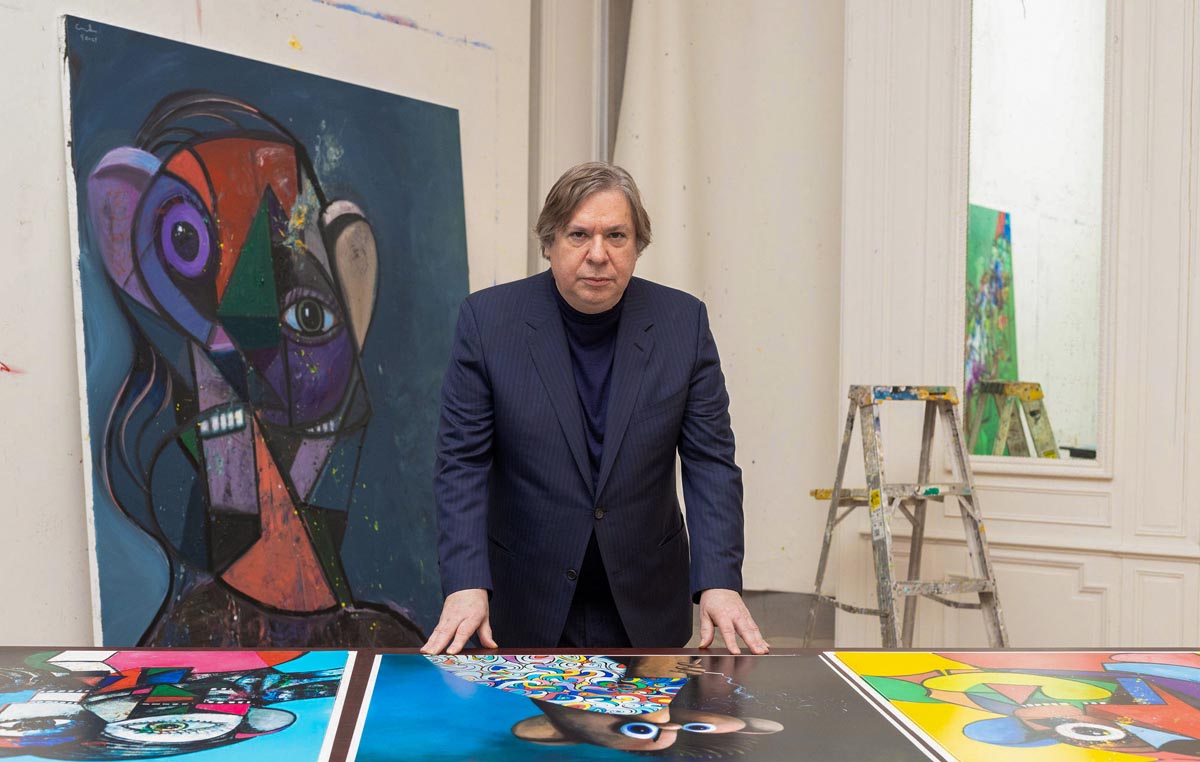

George Condo paints faces that scream and laugh simultaneously, bulging eyes that migrate across canvases, and psychological states compressed into single grotesque portraits. Since the early 1980s, this American contemporary artist has occupied a strange territory between Old Master precision and cartoon violence.
He coined the term “artificial realism” to describe his approach. The realistic representation of that which is artificial.
His work hangs in MoMA, the Guggenheim, and Tate Modern. Auction records exceed $6 million. But commercial success doesn’t explain why his distorted figures feel so uncomfortably familiar.
This profile examines Condo’s techniques, influences, and market position. You’ll understand how he fuses cubism with pop art, why critics call him the missing link between Picasso and contemporary painting, and what makes his psychological portraits so distinctly American.
Identity Snapshot
George Condo
Born: 1957, Concord, New Hampshire
Primary roles: Painter, printmaker, sculptor, draftsman
Nationality: American
Movements: Neo-Expressionism, postmodern figuration
Mediums: Oil painting, acrylic painting, charcoal, bronze, aluminum with gold leaf
Signature traits: Psychological fragmentation, grotesque composition, aggressive brushwork, cartoonish distortion merged with Old Master techniques
Iconography/motifs: Distorted faces, composite heads, clown imagery, fragmented psychological states, hybrid human-cartoon characters
Geographic anchors: Concord (birthplace), New York City (primary studio), Paris (1985-1995), Cologne
Mentors/influences: Andy Warhol (Factory experience), Jean-Michel Basquiat (close friend), Keith Haring (collaborator), Pablo Picasso (major influence), Willem de Kooning, Francis Bacon
Collections & museums: MoMA (New York), Metropolitan Museum of Art, Guggenheim Museum, Whitney Museum, Tate Modern, Centre Georges Pompidou, The Broad, National Gallery of Art (Washington D.C.), Louisiana Museum of Modern Art
Market signals: Record auction $6.85 million (Force Field, 2010, Christie’s Hong Kong, 2020), typical canvas sizes 51-67 inches height, strong secondary market demand
What Sets Condo Apart
Condo invented “artificial realism,” which he defines as the realistic representation of that which is artificial.
This isn’t abstract art pretending to be real. It’s deliberate fakery rendered with Old Master precision.
Where Picasso fractured objects across multiple viewpoints, Condo fractures psychology across a single grotesque face. He calls this “psychological cubism,” painting different emotional states layered on top of each other like translucent nightmares.
The work sits uncomfortably between high European tradition and lowbrow American cartoon culture. Think Rembrandt painting Bugs Bunny, or Velázquez rendering a melting clown.
His figures bulge, collapse, multiply. Eyes migrate across faces. Mouths scream and laugh simultaneously.

Origins & Formation
Early Training (1976-1980)
Studied art history and music theory at University of Massachusetts, Lowell (1976-1978). A Baroque and Rococo painting course changed everything.
Left school after two years. Moved to Boston, worked in a silkscreen shop, played bass in proto-punk band The Girls.
New York Arrival (1979-1983)
Met Basquiat in 1979 when his band opened for The Girls at Tier 3 nightclub. Basquiat convinced him to move to New York.
Relocated to Ludlow Street in 1980. Worked briefly at Warhol’s Factory applying diamond dust to the Myths series. Absorbed Warhol’s fusion of high art and commercial aesthetics but rejected pure appropriation.
East Village scene, 1981-1983. First public exhibitions at various downtown galleries.
First Breakthrough
The Madonna (1982) marked his arrival. Twenty inches high, built with alternating oil paint layers and transparent glazes. Scraped back with a ruler to create Bacon-like blur. Placed in thrift shop antique frame.
“It really did look like an Old Master painting, but with a modern edge.”
European Period (1983-1995)
First solo show: Ulrike Kantor Gallery, Los Angeles (1983). Sold The Adoration of the Sacred Cow to first private collector.
Moved to Cologne, Germany (1984). Connected with Mulheimer Freiheit group, including Walter Dahn and Jiri Georg Dokoupil.
First European solo: Monika Sprüth Gallery, Cologne (1984).
Met dealer Barbara Gladstone in Europe. Simultaneous two-gallery New York debut: Pat Hearn and Barbara Gladstone Galleries (1984).
Relocated to Paris (1985). Spent decade absorbing French classical traditions while maintaining New York connections.
Coined term “artificial realism” during 1980s East Village period.
Movement & Context
Neo-Expressionist Position

Condo emerged alongside 1980s figurative revival that challenged minimalism and conceptualism’s dominance. But he rejected pure expressionism‘s emotional spontaneity for calculated technical precision.
Holland Cotter called him the “missing link” between historical figuration (Rembrandt, Picasso, Bacon) and contemporary painters (John Currin, Glenn Brown, Dana Schutz).
Comparative Positioning
vs. Basquiat: Basquiat worked raw, gestural, street-influenced. Condo worked refined, technically complex, museum-aware.
Basquiat’s surfaces crackled with immediacy. Condo’s surfaces accumulated through methodical layering and glazing techniques borrowed from 17th-century Dutch masters.
vs. Keith Haring: Haring simplified forms into graphic symbols. Condo complicated forms into psychological tangles.
Haring’s line quality stayed consistent, cartoon-clean. Condo’s line quality shifts violently within single compositions, lurching between tight rendering and loose scumbling.
vs. Julian Schnabel: Both used historical references, but Schnabel applied thick impasto and broken plate surfaces. Condo built smooth, glazed surfaces that reference Old Master finish quality.
Schnabel’s canvases announce their materiality. Condo’s canvases hide their construction beneath refined surfaces.
Pop Art Relationship
Worked at Warhol’s Factory but rejected Warhol’s detachment. Where Warhol reproduced images mechanically, Condo handcrafts every grotesque invention.
Shares pop art‘s interest in cartoon imagery but injects psychological violence absent from Lichtenstein’s cool appropriations.
Materials, Techniques, and Process
Supports
Canvas preference: Primarily linen, occasionally cotton. Stretched canvas, 51-67 inch height typical for major works.
Occasionally works on panel for smaller studies. Prefers traditional stretched canvas for exhibition pieces.
Grounds & Mediums
Uses traditional gesso grounds. Builds surfaces through alternating opaque and transparent layers.
Oil painting mediums: linseed oil, stand oil for slow-drying glazes. Occasionally mixes acrylic with oil techniques in later works.
Brushwork Taxonomy
Glazing: Multiple transparent oil layers build luminosity, technique learned from Old Master study in Los Angeles (early 1980s).
Scumbling: Dry-brush applications create broken texture, especially in background areas and clothing.
Wet-in-wet: Direct painting for gestural passages, particularly in abstracted backgrounds.
Impasto: Selective thick paint application, often scraped back with ruler or palette knife for Bacon-like blur effects.
Stippling: Occasional dotted applications for textural variation.
Palette Archetype
Color temperature: Alternates hot neon passages with cool neutral grounds. Not committed to single temperature scheme.
Hue range: Full spectrum, but favors acid yellows, bubblegum pinks, electric blues against neutral flesh tones.
Value distribution: High contrast between light flesh and dark shadows, using chiaroscuro principles.
Saturation shifts: Moves between hyper-saturated cartoon areas and desaturated atmospheric zones within single compositions.
Studio Practice
Layered approach: Not alla prima. Builds paintings over multiple sessions with drying time between layers.
Underdrawing: Sometimes visible charcoal or pencil structure, but often paints directly without preliminary drawing.
Drawing practice: Extensive works on paper using charcoal, pencil, ink, pastels. Drawing paintings series blurs line between drawing and painting mediums.
Sculpture process: Bronze and aluminum with gold leaf for three-dimensional translations of painted figures.
Themes, Subjects, and Iconography
Recurring Motifs
Distorted portraits: Primary subject. Faces fragment, multiply, collapse. Features migrate across surfaces.
Clown imagery: Not circus clowns but psychological jesters. Makeup becomes existential mask.
Composite heads: Multiple psychological states compressed into single visage. One eye screams while the other eye laughs.
Cartoon-human hybrids: Bugs Bunny rendered in Rembrandt’s techniques. Mickey Mouse treated with Velázquez seriousness.
Religious figures: Cardinals, priests, madonnas filtered through grotesque lens. Maintains iconographic structure while corrupting content.
Compositional Schemes
Frontal confrontation: Figures face viewer directly. No averted gazes or profile views.
Shallow pictorial space: Compressed depth, figures pushed forward against flat or minimally articulated backgrounds.
Centered focal points: Single large head dominates canvas center. Occasional multi-figure compositions but rare.
Grid structures: Some works use underlying geometric armature borrowed from cubism.
Symbol Sets
Musical instruments: References his music theory background. Instruments appear as still life elements or character attributes.
Bottles and glasses: Markers of debauchery, psychological states, social dysfunction.
Crowns and halos: Authority symbols corrupted, bent, made ridiculous.
Feathers and wings: Angel imagery twisted into demonic or absurd forms.
Socio-Historical Triggers
1980s corporate culture: Excess, superficiality, psychological fragmentation of Reagan-era America.
Art market boom: Responding to commodification of painting during 1980s speculation.
AIDS crisis: Close friends Haring and Basquiat died. Work carries undertones of mortality and bodily corruption.
Pop culture saturation: American cartoon imagery as psychological landscape, not childhood nostalgia.
Notable Works
The Madonna (1982)
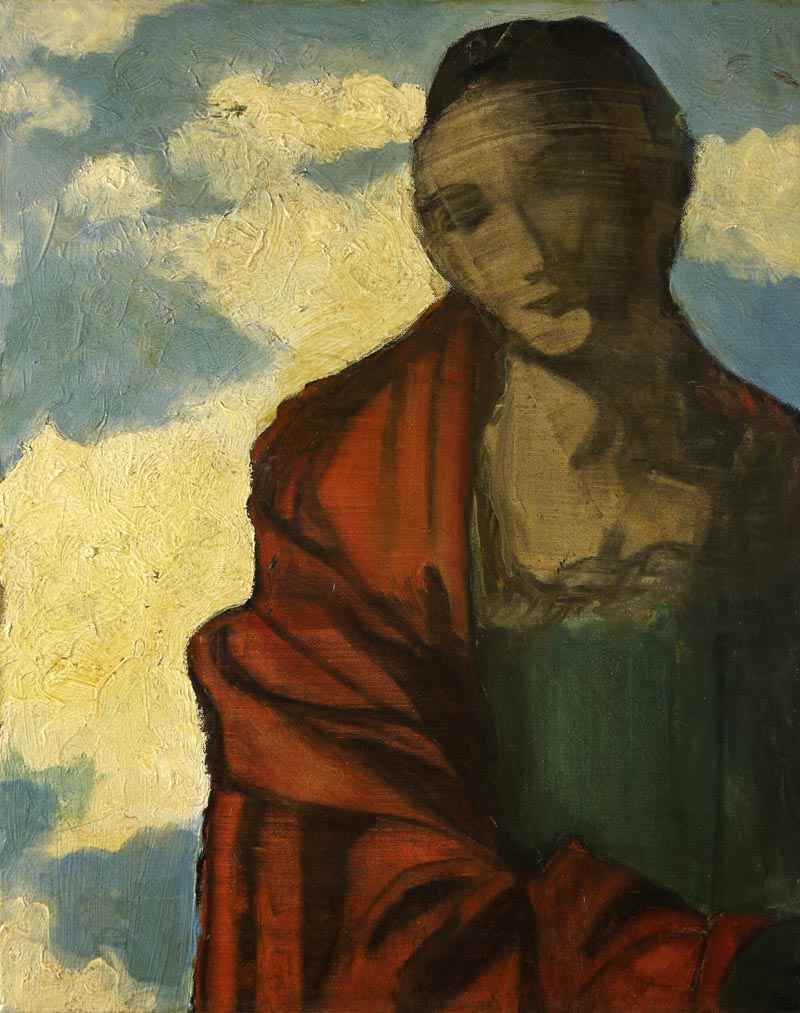
Medium: Oil on canvas Size: 20 x 16 inches Location: Private collection
Visual signature: Multiple transparent glazes built up then scraped back with ruler. Blurred Bacon-like effect over Virgin Mary iconography. Angular face, red robes, white cloud background. Placed in antique frame.
Why it matters: First successful fusion of Old Master technique and contemporary edge. Established artificial realism approach.
Related works: Other early religious icon studies (1982-1983).
Surrealist Landscape (1983)
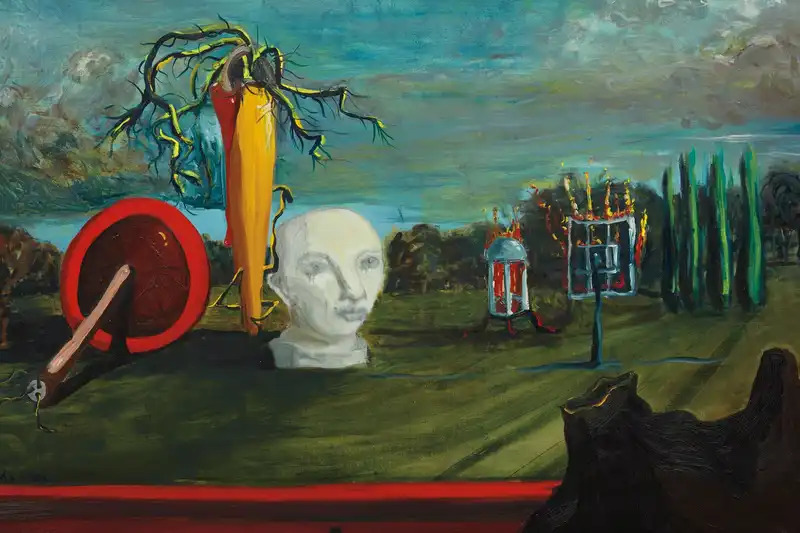
Medium: Oil on canvas Current location: Private collection
Visual signature: Bizarre foreground objects reminiscent of Salvador Dalí‘s melting forms. Precedes Paris move by two years.
Why it matters: Early experimentation with discrete art historical styles before developing mature synthesis method.
Dancing to Miles (1985-86)
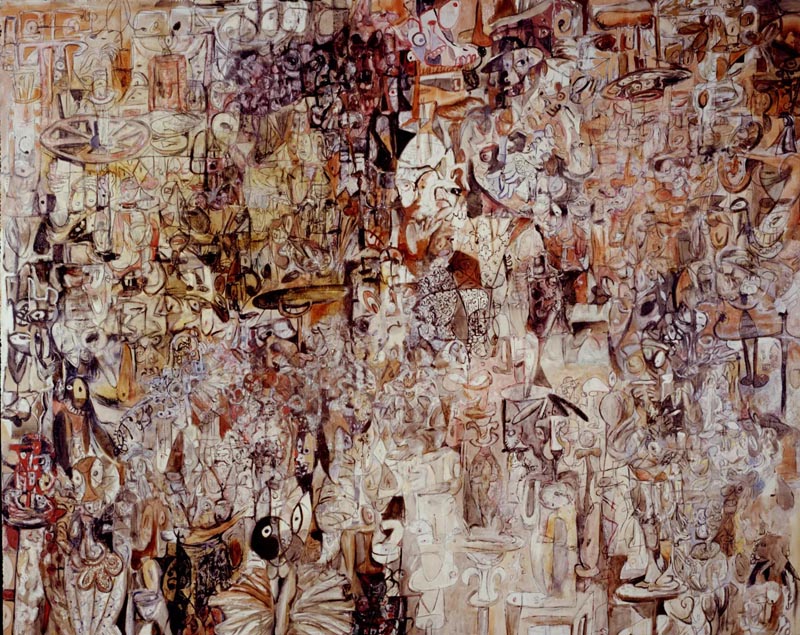
Medium: Oil on canvas Location: Keith Haring Estate
Visual signature: Musical tribute to Miles Davis. Created for Haring’s studio. Gestural passages reference jazz improvisation.
Why it matters: Demonstrates “visual choreography” concept, translating music into painted form.
The Secretary (2002)
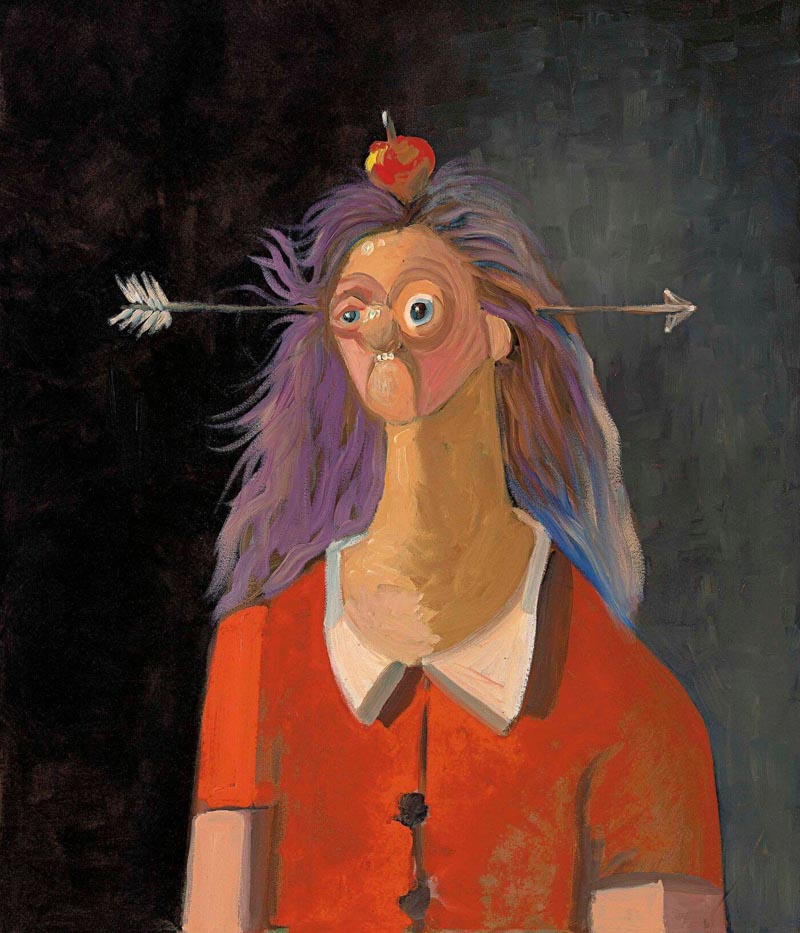
Medium: Oil on canvas Location: Private collection
Visual signature: Psychological cubism fully developed. Professional woman’s face fragments across multiple emotional states simultaneously.
Why it matters: Mid-career consolidation of artificial realism and psychological cubism techniques.
Noble Woman (2009)
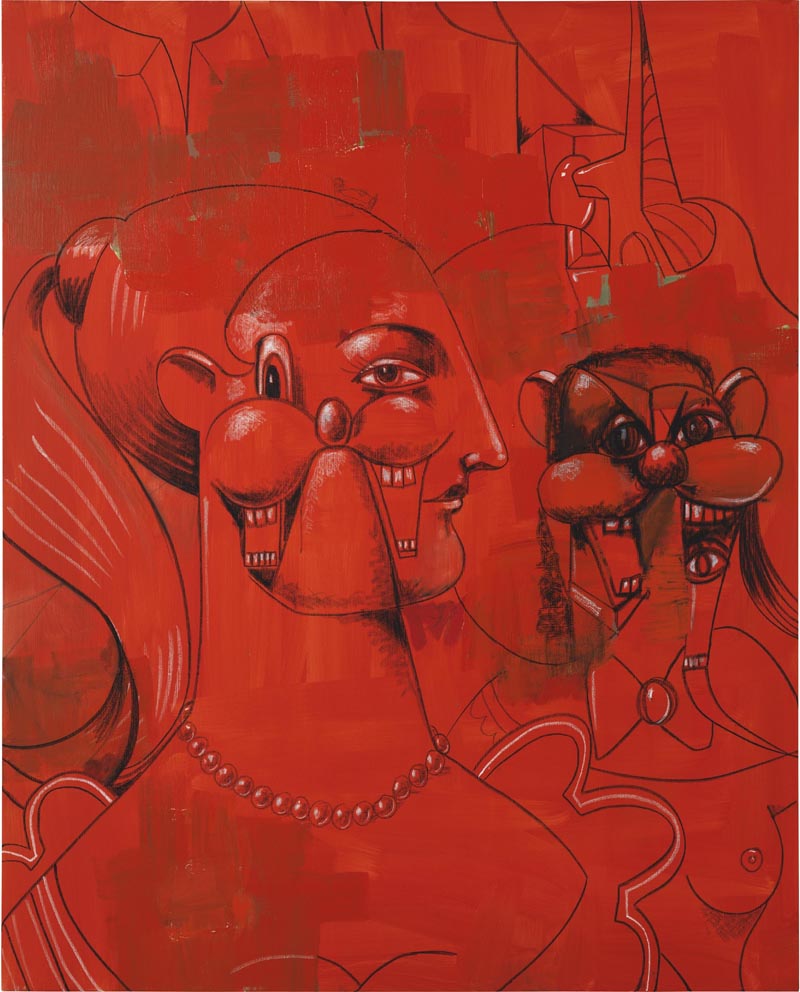
Medium: Oil on canvas Location: Private collection
Visual signature: Aristocratic portrait conventions corrupted. Regal bearing maintained while features distort grotesquely.
Why it matters: Old Master portraiture tradition completely inverted while maintaining structural references.
Force Field (2010)
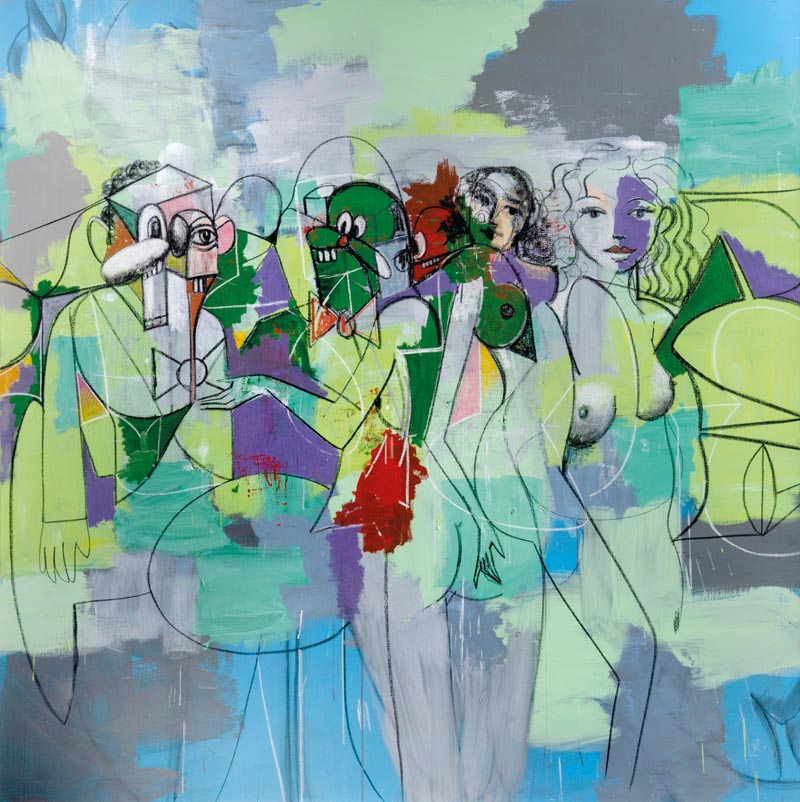
Medium: Oil on canvas Size: Large-scale Location: Private collection
Visual signature: Neon-pastel hues drizzled across neutral ground. Gestural improvisations create rhythmic visual field. Sensuous female figures traverse composition, in and out of picture plane.
Why it matters: Record auction price $6.85 million (Christie’s Hong Kong, 2020). Created year of Kanye West collaboration. Marks beginning of decade-long Drawing Paintings series dedication.
Frankenstorm (2012)
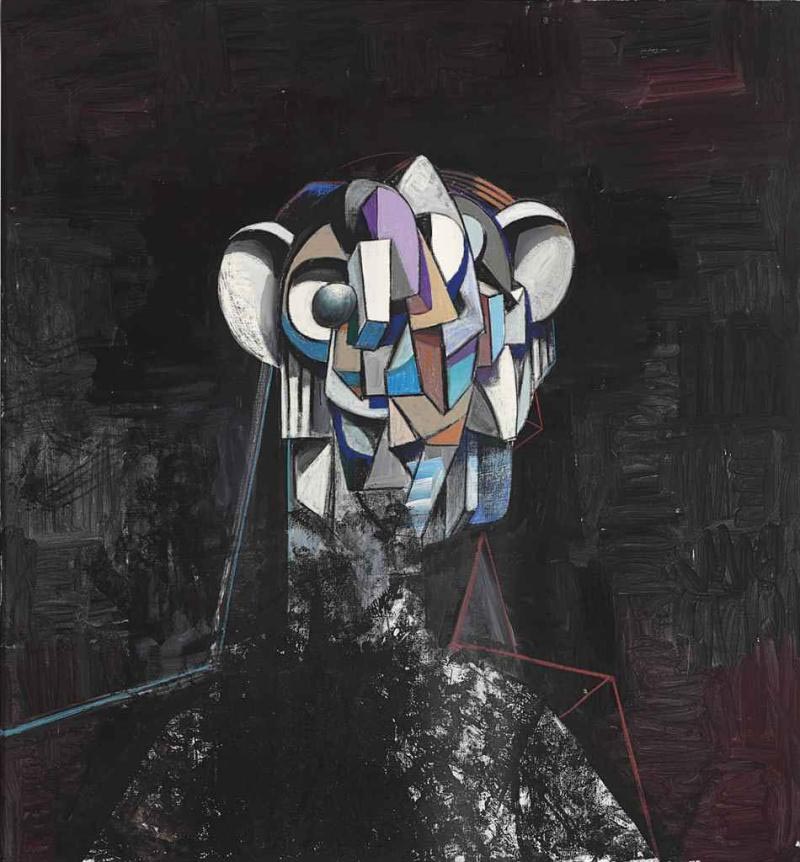
Medium: Oil on canvas Location: Private collection
Visual signature: “Invented” character combines classical portraiture conventions with cubist and pop art elements. Fractured face, bulging features, aggressive color palette.
Why it matters: Exemplifies postmodern repurposing rather than invention. Demonstrates how psychological cubism captures multiplicity.
Exhibitions, Collections, and Provenance
Major Solo Exhibitions
1983: Ulrike Kantor Gallery, Los Angeles (debut)
1984: Monika Sprüth Gallery, Cologne (first European solo); Pat Hearn Gallery and Barbara Gladstone Gallery, New York (simultaneous two-gallery show)
2005: George Condo: One Hundred Women, Museum der Moderne Salzburg and Kunsthalle Bielefeld (co-organized, curated by Thomas Kellein)
2009: The Lost Civilization, Musée Maillol, Paris (paintings, drawings, sculpture 2003-2008)
2011: Mental States, New Museum, New York (mid-career retrospective, called “sensational” by Holland Cotter, New York Times)
2016: Confrontation, Museum Berggruen, Berlin (Condo alongside Cézanne, Picasso, Matisse, Klee, Giacometti)
2017: The Way I Think, The Phillips Collection, Washington D.C. (works on paper retrospective, traveled to Louisiana Museum of Modern Art, Denmark)
2021: The Picture Gallery, Long Museum, Shanghai (largest Asian solo exhibition to date, 200+ paintings, sculptures, drawings)
2023: Humanoids, Nouveau Musée National de Monaco
Museum Collections (≥3 works)
Museum of Modern Art, New York
Metropolitan Museum of Art, New York
Solomon R. Guggenheim Museum, New York
Whitney Museum of American Art, New York
Tate Modern, London
Centre Georges Pompidou, Paris
The Broad, Los Angeles
National Gallery of Art, Washington D.C.
Astrup Fearnley Museum of Modern Art, Oslo
Moderna Museet, Stockholm
Biennale Participation
Venice Biennale: 2013, 2019
Whitney Biennial: 1987, 2010
Gwangju Biennale: 2014
Biennale de Lyon: 2015
Corcoran Biennial: 2005
Gallery Representation

Hauser & Wirth
Sprüth Magers
Pace Gallery
Simon Lee Gallery
Provenance Patterns
Strong blue-chip collector base. Works rarely return to market. Rubell Family Collection holds multiple pieces. Broad Collection major institutional holder.
Barbara Gladstone represented artist from 1984 onwards, establishing early collector relationships.
European collectors acquired heavily during Paris period (1985-1995).
Market & Reception
Auction Records
Global record: Force Field (2010), HK$53.1 million ($6.85 million), Christie’s Hong Kong, 2020
Previous records:
- The Fool, $6.16 million, Christie’s New York, 2017
- Antipodal Reunion, $4.97 million, Sotheby’s London, 2015
- Confrontation, $4.6 million, Christie’s New York, 2017
Recent sales:
- Green and Purple Head Composition (2018), £1 million ($1.28 million), Phillips London, 2024
- Young Girl with Blue Dress (2007), HK$12.1 million ($1.5 million), Phillips Hong Kong, 2017
Price Bands
Oil paintings (2020-2025): Average $675,847
Works on paper (2020-2025): Average $70,844
Market trajectory: Steady appreciation since 2000. Strong Asian market interest post-2017.
Critical Reception
Calvin Tomkins (New Yorker): Noted Condo “used the language of his predecessors, their methods and techniques, and applied them to subjects they would never have painted.”
Holland Cotter (New York Times): Called Mental States retrospective “sensational” and identified Condo as “missing link” between historical and contemporary figuration.
Laura Hoptman (MoMA curator): “George opened the door for artists to use the history of painting in a way that was not appropriation.”
Roberta Smith (1988): Described early works as “artifacts, signs of another time and place, layered thickly with talent and nostalgia.”
Authentication
Works signed and dated by artist. Major paintings often carry gallery labels and exhibition history.
Catalogues raisonnés in development. Authentication typically requires gallery provenance verification.
Influence & Legacy
Upstream Influences
Direct mentors: Andy Warhol (Factory experience taught commercial-fine art fusion), Jean-Michel Basquiat (encouraged New York move), Keith Haring (lifelong friendship until 1990)
Art historical references: Pablo Picasso (cubist fragmentation), Rembrandt (glazing techniques, chiaroscuro), Diego Velázquez (aristocratic portraiture), Francis Bacon (psychological distortion, scraped surfaces), Willem de Kooning (gestural violence)
Surrealism: Salvador Dalí (bizarre object juxtapositions), René Magritte (conceptual play)
Music influence: Studied music theory. Jazz improvisation (Miles Davis) informs compositional spontaneity.
Downstream Impact
Direct influence on: John Currin (technical precision applied to grotesque subjects), Glenn Brown (Old Master manipulation), Lisa Yuskavage (psychologically charged figuration), Nigel Cooke (layered complexity), Sean Landers (self-aware art historical play), Dana Schutz (distorted figuration)
Broader contribution: Legitimized historical reference without appropriation. Opened path for painters to use past techniques while maintaining contemporary relevance.
Neo-Expressionist revival: Instrumental in 1980s figuration comeback alongside Basquiat, Haring, Schnabel, Salle.
Cross-Domain Impact
Album covers: Kanye West (My Beautiful Dark Twisted Fantasy, 2010, controversial censored version), Phish (The Story of the Ghost, 1998), Danny Elfman (Serenada Schizophrana, 2006), Anthony Roth Costanzo (ARC, 2018)
Book covers: Jack Kerouac (Book of Sketches, Penguin Poets, 2006, also wrote introduction)
Collaborations: William S. Burroughs (Ghost of Chance, 1991, illustrated with soft-ground etchings), Travis Scott (ongoing dialogue between visual and hip-hop artists)
Fashion: Adam Kimmel x Barneys New York t-shirt (2010), Hermès Birkin Bag painted for Kanye West (gifted to Kim Kardashian)
Academic Recognition
Awards:
- American Academy of Arts and Letters Award (1999)
- Francis J. Greenburger Award (2005)
- International Artist Award, Anderson Ranch Arts Center (2008)
Teaching: Harvard University, six-month course “Painting Memory” (2004)
Lectures: Columbia University, Yale University, Pasadena Art Center, San Francisco MOMA, Guggenheim Museum, New Museum
How to Recognize a Condo at a Glance
Diagnostic checklist:
- Frontal face dominates canvas center – figures rarely shown in profile or averted gaze
- Psychological fragmentation visible – one eye expresses different emotion than the other eye, features multiply or migrate across face
- Cartoon-Old Master fusion – refined glazing techniques applied to grotesque, bulbous, distorted subjects
- High contrast value structure – dramatic light-dark shifts using chiaroscuro principles
- Smooth surface finish – not heavy impasto, but layered glazes create refined surface quality
- Neon-pastel color accents – acid yellows, bubblegum pinks, electric blues against neutral grounds
- Shallow pictorial space – figures compressed forward, minimal atmospheric depth
- Canvas sizes 51-67 inches height – typical major work dimensions
- Signature placement lower right or lower left – dated alongside signature
- Multiple emotional states simultaneously – screaming-laughing mouths, bulging-deflating features, terror-joy expressed at once
FAQ on George Condo
What is George Condo known for?
George Condo is known for psychological portraits that blend Old Master painting techniques with grotesque, cartoon-like distortions. He invented “artificial realism” and “psychological cubism,” terms describing his fusion of classical European traditions with American pop culture aesthetics. His distorted faces and fragmented figures occupy major museum collections worldwide.
What is George Condo’s art style?
Condo’s style combines cubism, surrealism, and pop art with traditional oil painting methods. He calls it artificial realism. Faces fragment across multiple psychological states simultaneously. Refined glazing techniques borrowed from Rembrandt apply to subjects resembling mutated cartoons. Think Velázquez painting Bugs Bunny.
How much are George Condo paintings worth?
Condo’s auction record is $6.85 million for Force Field (2010), sold at Christie’s Hong Kong in 2020. Oil paintings average $675,847, while works on paper average $70,844. Prices vary by size, period, and provenance. Major works from the 2000s-2010s command highest prices at auction.
Where can I see George Condo’s art?
MoMA, Metropolitan Museum of Art, Guggenheim Museum, and Whitney Museum in New York hold his works. Internationally: Tate Modern (London), Centre Georges Pompidou (Paris), The Broad (Los Angeles), and National Gallery of Art (Washington D.C.). Hauser & Wirth and Sprüth Magers galleries represent him commercially.
Did George Condo work with Kanye West?
Yes. Condo created cover artwork for Kanye West’s 2010 album My Beautiful Dark Twisted Fantasy. He painted five different versions. The final cover depicted West with a demonic phoenix figure and was censored by iTunes. Condo later distanced himself from West in interviews.
What techniques does George Condo use?
Condo builds paintings through multiple transparent glazes over opaque layers, using linseed and stand oil. He applies paint wet-in-wet for gestural passages, then scrapes back with rulers or palette knives for blurred effects. Traditional chiaroscuro creates dramatic light-dark contrasts across distorted faces.
Who influenced George Condo?
Pablo Picasso influenced his cubist fragmentation. Willem de Kooning and Francis Bacon shaped his gestural violence. Diego Velázquez and Rembrandt taught glazing techniques. Andy Warhol showed him commercial-fine art fusion. Jean-Michel Basquiat and Keith Haring were close friends and collaborators.
What is psychological cubism?
Psychological cubism is Condo’s term for painting multiple emotional states layered onto single faces. Where Picasso showed objects from different viewpoints, Condo shows psychological conditions simultaneously. One eye screams while the other laughs. Features multiply and fragment across surfaces, capturing internal chaos rather than external perspectives.
Where did George Condo study art?
Condo studied art history and music theory at University of Massachusetts, Lowell (1976-1978). A Baroque and Rococo painting course changed his direction. He left after two years, moved to Boston, then relocated to New York in 1980. He briefly worked at Warhol’s Factory before establishing his painting career.
What is artificial realism in art?
Artificial realism is Condo’s invented term: “the realistic representation of that which is artificial.” He applies Old Master techniques to invented, grotesque subjects rather than observed reality. Transparent glazes and refined brushwork render cartoon-like figures with museum-quality craftsmanship. It’s fake content painted with real skill.
Conclusion
George Condo bridges four decades of contemporary art by refusing to choose between technical mastery and conceptual provocation. His artificial realism doesn’t apologize for being fake.
The painting mediums he employs come straight from 17th-century Dutch studios. The subjects come from American cartoon nightmares.
This tension makes the work hold up. Museum collections keep adding pieces because the psychological fragmentation feels more relevant now than in 1985.
His influence on younger figurative painters like John Currin and Glenn Brown proves technique still matters. You can reference expressionism, cubism, and baroque traditions without appropriating them.
The grotesque portraits will keep selling at auction. But the real legacy is showing painters how to use history without being buried by it.