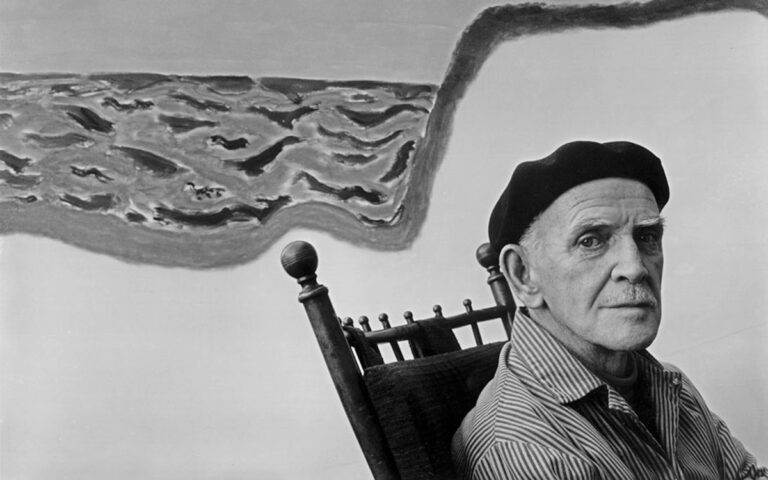
Etel Adnan squeezed paint straight from the tube onto canvas with a knife. No brushes. No blending.
This Lebanese-American artist didn’t gain international recognition until age 87, yet she spent six decades creating thousands of luminous paintings that distilled landscapes into pure color blocks. Born in Beirut in 1925, Adnan moved fluidly between poetry, philosophy, and visual art, becoming one of the most celebrated voices of Arab-American culture.
Her work hangs in MoMA, the Guggenheim, and the Centre Pompidou.
This article traces Adnan’s journey from philosophy professor to internationally acclaimed painter. You’ll discover her unique palette knife technique, the obsession with Mount Tamalpais that defined her practice, and how she transformed personal and political upheaval into transcendent abstract landscapes. We’ll examine her materials, decode her iconography, and reveal what separates her knife-edge geometry from other postwar abstractionists.
Identity Snapshot
Etel Adnan (Arabic: إيتيل عدنان)
Born: February 24, 1925, Beirut, Lebanon
Died: November 14, 2021, Paris, France
Primary roles: Painter, poet, essayist, visual artist
Nationality: Lebanese-American
Movements: Abstract expressionism, postwar abstraction, lyrical abstraction
Mediums: Oil painting (direct from tube), tapestry, watercolor, ink, leporellos
Signature traits: Palette knife application, firm decisive swipes, unblended pigment blocks
Iconography: Red squares (suns), Mount Tamalpais, horizontal bands (sea/sky/land), geometric abstraction
Geographic anchors: Beirut (birthplace), Paris (Sorbonne, final years), Sausalito/San Rafael (California Bay Area, 1958-1972), Damascus (father’s origin), Smyrna/Izmir (mother’s origin)
Education: Sorbonne (philosophy), UC Berkeley, Harvard University
Teaching: Dominican University of California, San Rafael (philosophy of art, 1958-1972)
Partner: Simone Fattal (artist, publisher, met 1972)
Collections: MoMA New York, Centre Pompidou, Guggenheim Museum, Whitney Museum, British Museum, Tate Modern, M+ Hong Kong, Mathaf Doha, Institut du Monde Arabe Paris, National Museum for Women in the Arts
Major exhibitions: Documenta 13 (2012), Whitney Biennial (2014), MASS MoCA retrospective (2018), Guggenheim retrospective (2021)
Awards: France-Pays Arabes Award (1977), Ordre de Chevalier des Arts et des Lettres (2014), Griffin Poetry Prize (2020)
Market signals: Auction record $567,034 USD (2024, Sotheby’s London); paintings average $114,942 USD; typical canvas dimensions 7×9 to 24×20 inches
What Sets The Artist Apart
Adnan compressed cosmic experience into book-sized paintings.
Her knife-applied oil blocks create what critics call “soulscapes”–neither pure abstraction nor literal landscape but memory crystallized through color. She squeezed paint straight from the tube. No mixing. No blending. The pigment hits canvas in its most saturated state, which she called “metaphysical beings.” This directness separates her from color field painters who stained or poured. Her strokes have edges. They declare themselves.
She never depicted human figures.
Only earth, water, sky, sun. The political resided in her refusal to illustrate violence directly–her paintings during Lebanon’s civil war showed mountains, not rubble. This restraint amplified her novels and poems, which confronted war head-on. The duality defined her: brutal honesty in language, transcendent serenity in paint.

Origins & Formation
Early Years (1925-1950)
Born to a Greek Orthodox mother from Smyrna and a Syrian Muslim father who served as Ottoman officer. Father became what Adnan called “unemployable” after empire’s collapse; mother’s hometown burned in 1922 Greek-Turkish conflicts.
Spoke Arabic and Greek at home. Attended French Catholic schools in Beirut where French became dominant language.
This linguistic fracture–speaking one language privately, another publicly–later drove her toward painting as a universal tongue.
Academic Training (1950-1955)
Studied philosophy at Sorbonne, Paris. Focus on aesthetics and phenomenology.
Moved to United States in 1955 for graduate work at UC Berkeley and Harvard. Philosophy, not art, consumed these years.
First Paintings (1958-1964)
Started painting at 33 while teaching philosophy at Dominican College, San Rafael. Ann O’Hanlon, art department head, questioned how she could teach philosophy of art without making art.
Adnan’s response: “My mother said I was clumsy.” O’Hanlon’s counter: “And you believed her?”
First experiments used crayons on paper scraps. Then leftover oil paint tubes from art department, applied with knife.
The Algerian War (1954-1962) triggered her shift from French to visual language–painting became resistance to colonial linguistics.
Perception Workshops (1960s)
Joined Ann and Richard O’Hanlon’s artist collective at Mount Tamalpais base. Participated in “Perception Workshops”–gatherings of poets, musicians, experimental artists.
Richard O’Hanlon had assisted Diego Rivera on 1931 San Francisco Art Institute mural. This circle included Vietnam War protest poets; Adnan wrote her first English poems here.
First solo exhibition 1961 at O’Hanlons’ Mill Valley gallery.
Movement & Context
Postwar Abstraction Position

Adnan emerged alongside but distinct from American abstract expressionism‘s dominant voices.
Where Jackson Pollock dripped and Mark Rothko stained, she sliced. Her knife-edge blocks share Rothko’s transcendent ambitions but reject his soft boundaries.
Compared to Wassily Kandinsky: both treated color as spiritual entity. But Kandinsky’s forms dance and collide; Adnan’s rest in measured stillness.
Attribute Contrasts
Adnan vs. Nicolas de Staël:
- Stroke length: Adnan = 2-6 inch horizontal bands; de Staël = 8-12 inch gestural blocks
- Edge hardness: Adnan = knife-cut crisp; de Staël = brush-softened
- Tonal range: Adnan = high-key saturated primaries; de Staël = mid-value greys and earth tones
- Canvas aspect ratios: Adnan = 4:5 to 1:1 (near-square); de Staël = 3:4 to panoramic
- Subject framing: Both suggest landscape; Adnan’s horizons bisect precisely; de Staël’s forms float ambiguously
Adnan vs. Paul Klee:
- Scale: Both worked small (Klee 12×16 inches typical; Adnan 7×9 to 12×16 inches)
- Media range: Both used watercolor, oil, mixed media, prints
- Symbolic systems: Klee employed arrows, eyes, architectural signs; Adnan limited to square/circle/band
- Surface treatment: Klee = layered transparent washes; Adnan = opaque impasto blocks
- Philosophical roots: Both investigated perception; Klee through Bauhaus pedagogy, Adnan through phenomenology
Adnan vs. Helen Frankenthaler:
- Application method: Frankenthaler = poured stain; Adnan = knife-applied paste
- Canvas preparation: Frankenthaler = raw unprimed; Adnan = primed stretched
- Color saturation: Both high-chroma but Frankenthaler achieves through dilution, Adnan through concentration
- Spatial ambiguity: Frankenthaler’s stains penetrate surface; Adnan’s blocks sit atop, declaring materiality
Cultural Position
Adnan stood outside Western art market until age 87 (Documenta 13, 2012). She represents postwar abstraction’s overlooked international dimension–Arab diaspora, multilingual, female, working in California’s margins.
MoMA’s 2017 “Making Space: Women Artists and Postwar Abstraction” positioned her alongside Lee Krasner, Yayoi Kusama, placing small 1965-66 canvas at exhibition entry.
Materials, Techniques, and Process
Supports
Primary: Pre-stretched cotton canvas, commercially prepared Dimensions: Predominantly 7×9, 9×11, 12×16, 18×24, 24×20 inches Aspect ratios: Near-square to 4:5 horizontal Mounting: Hung traditionally; occasionally laid flat during viewing
Secondary supports:
- Japanese paper (leporellos, accordion books)
- Loose canvas rolls (later stretched)
- Wood panels (rare, early works)
Grounds & Primers
Gesso-primed commercial canvas. No visible toning or colored grounds.
White preparation allowed maximum color luminosity–she wanted pigment intensity undiluted.
Paint Application
Method: Direct tube-to-canvas via palette knife
Squeezed pigment onto knife. Applied in single decisive swipe. No reworking. No blending.
Canvas laid flat on table, not vertical on easel. Worked sitting, like writing position.
Stroke characteristics:
- Length: 1.5 to 6 inches typical
- Width: 0.5 to 3 inches
- Thickness: 1-3mm impasto
- Direction: Predominantly horizontal; occasional vertical or diagonal
- Edges: Knife-cut sharp, no feathering
Palette
Dominant hues:
- Cadmium red (sun, square motif)
- Cobalt blue / ultramarine (sky, sea)
- Naples yellow / cadmium yellow (light, horizon)
- Viridian / sap green (mountain, vegetation)
- Burnt sienna / raw umber (earth)
- Mars black (shadows, rare)
- Titanium white (clouds, light modulation)
Temperature bias: Warm-dominant in California period; cooler greys in Paris late work
Value distribution: High-key (75% of value scale range 5-9), minimal darks
Saturation: Near-maximum straight from tube; occasional greying in late work
Brushwork Taxonomy
None. Knife only.
Occasional exceptions: watercolors used round brush for fluid washes in leporellos.
Studio Practice
Alla prima exclusively. Each painting completed in single session, typically under one hour. No underpainting. No preparatory drawing.
Speed essential to capture “immediate beauty of colour.”
Working posture: Seated at table, canvas horizontal Lighting: Natural north light (California studio); artificial (Paris apartment) Music: Classical, contemporary experimental Interruptions: Minimal; worked in concentrated bursts
Completed thousands of paintings over six decades–exact count unknown, but estimated 3,000-5,000 canvases.
Technical Innovations
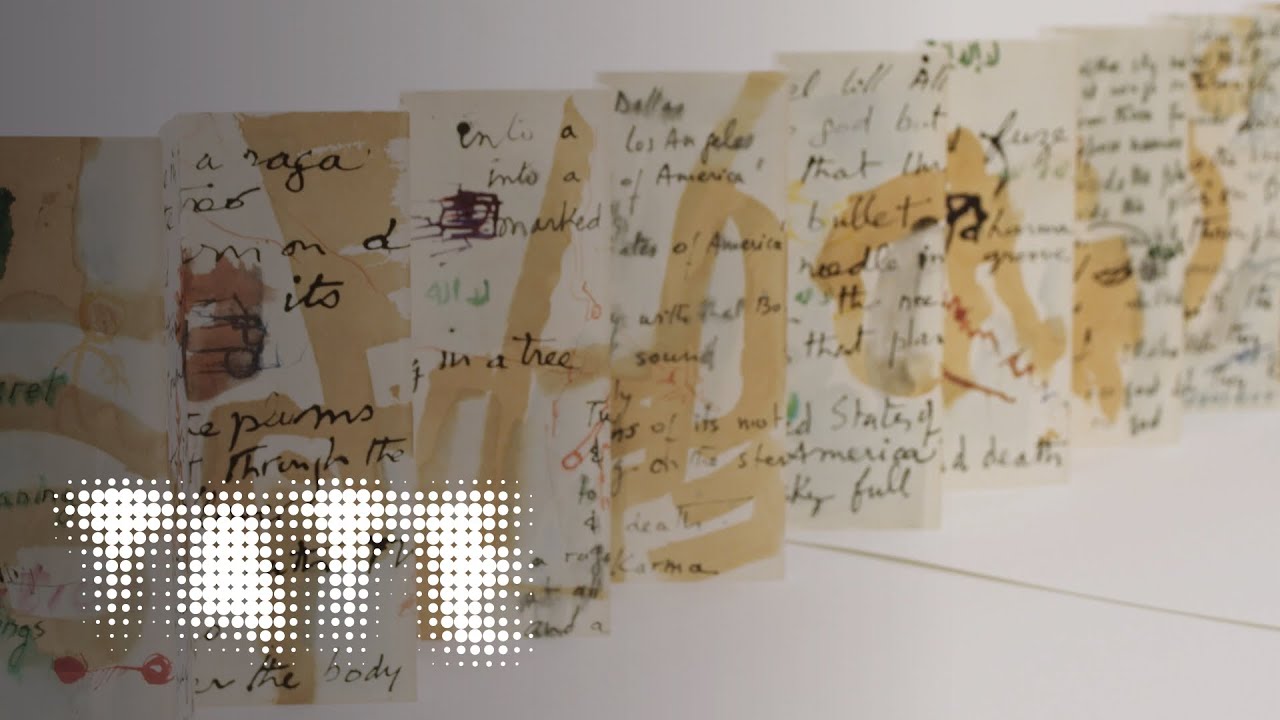
Leporellos (1964-onward):
Accordion-folded Japanese paper books. Combined watercolor painting with handwritten poetry. Extended to 8-20 feet when unfolded.
Inspired by Japanese emaki scrolls and Persian miniature traditions.
Tapestries (1960s-2000s):
Translated paintings into wool. Designed patterns; woven by artisans. Maintained color intensity and geometric composition from canvases.
Themes, Subjects, and Iconography
Mount Tamalpais (1970s-2021)

Central obsession after settling Sausalito. Painted the mountain hundreds of times across five decades.
The peak appears as:
- Triangular green/blue block
- Horizontal stacked bands
- Single rising form against sky
- Remembered silhouette (Paris period, working from memory)
Not topographical accuracy but spiritual presence. “I am making the mountain as people make a painting,” she wrote.
Compositional Schemes
Horizontal tripartite:
- Sky band (top third)
- Mountain/land (middle third)
- Sea/ground (bottom third)
Squares and circles:
- Red square = sun (ambiguous–also pure color declaration)
- Yellow/orange circle = cosmic body
- Black circle = eclipse, void (rare)
Grid patterns (tapestries): Regular geometric tessellations. Persian carpet influence meets minimalism.
Symbol Systems
Objects:
- Sun (red square, yellow circle)
- Mountain (triangular or horizontal bands)
- Sea (blue horizontal bands)
- Sky (lighter blue, white-streaked bands)
- Horizon line (sharp division between zones)
Meanings:
- Sun = life force, cosmic eye, color’s purest expression
- Mountain = permanence, witness, spiritual anchor
- Sea = change, fluidity, unconscious
- Horizon = boundary between earth and transcendence
No animals. No flora details. No architecture. Pure elemental forms.
Socio-Historical Triggers
Lebanese Civil War (1975-1990):
Fled Beirut 1976. Wrote Sitt Marie Rose (1977) in Paris–brutal account of sectarian violence.
Paintings during this period: no war imagery. Increased luminosity, as if compensating for horror through beauty.
Algerian War (1954-1962):
Stopped writing in French (language of colonizer). Shifted creative energy to painting and English-language poetry.
Vietnam War (1960s):
Joined poets’ antiwar movement. Began writing English poems while painting accelerated.
California landscapes:
Mount Tamalpais represented freedom from Mediterranean trauma. American West light–sharp, unambiguous–contrasted with Beirut’s haze.
Notable Works
Untitled (1984)

Medium: Oil on canvas Size: Approximately 24 x 30 inches Current location: Private collection
Visual signature: Seafoam, aqua, velvet green blocks form geometric mountain. Dark sky with white flickers (clouds or fog). Vertical green stack lower right threatens to slide into blue water.
Why it matters: Captures transitional moment–mountain emerging, sky threatening. Demonstrates her ability to convey impermanence through static geometry.
Related works: Mount Tamalpais series (1970s-1990s), hundreds of variations
Mount Tamalpais (1985)

Medium: Oil on canvas Size: 148 x 125 cm (58 x 49 inches) Current location: Sursock Museum, Beirut
Visual signature: Larger than typical Adnan scale. Bold horizontal bands in blues, greens, earth tones. Red square sun prominent upper register.
Why it matters: One of her larger Mount Tamalpais depictions. Demonstrates how motif scales while maintaining knife-edge technique.
Related works: Journey to Mount Tamalpais book (1986) features this period’s works
Five Senses for One Death (1969)

Medium: Ink and watercolor on paper (leporello) Size: 11 x 255 inches (extends to 21+ feet) Current location: Private collection; exhibited Whitney Biennial 2014
Visual signature: Accordion-folded book combining gestural watercolor marks, hieroglyphic symbols, English poem. Black ink calligraphic elements reference Arabic script without being legible text.
Why it matters: Early fusion of visual and literary practice. Title references Vietnam War protest poetry.
Related works: Leporello series (1964-2000s), dozens of unique books
Arizona (1964-1965)

Medium: Oil on canvas Size: Approximately 24 x 30 inches Current location: M+ Hong Kong
Visual signature: Ochre foundation, deep red upper portion. Staggered lines define color segments. Suggests illuminated earth and sky.
Why it matters: Early work showing architectural influence before Mount Tamalpais obsession. Nicolas de Staël comparison point.
Related works: Early abstractions (1960-1964), pre-landscape period
Untitled (2010)

Medium: Oil on canvas Size: 24 x 20 inches Current location: Mudam Luxembourg
Visual signature: Tessellated blocks of pure pigment. Circles suggest sun, lines divide sea and sky. Cadmium against cobalt, Naples yellow against grey.
Why it matters: Late work demonstrating sustained intensity into 85th year. “Metaphysical beings” color philosophy fully realized.
Related works: Paris apartment series (2010-2020), final paintings
Sitt Marie Rose (1977)

Medium: Novel (text, not painting–but critical to understanding visual work) Published: Paris, 1977 Award: France-Pays Arabes Award
Why it matters: Account of Lebanese teacher kidnapped and killed by Phalangists for supporting Palestinians. Based on true story of Marie Rose Boulo.
Demonstrates Adnan’s parallel practice: paintings offered beauty as resistance; novels confronted atrocity directly.
Champs de Petrol / Oilfields (tapestry, 2013)

Medium: Wool tapestry Size: Large-scale (specific dimensions vary) Current location: Exhibited Whitney Biennial 2014
Visual signature: Geometric color blocks translated into textile. Persian carpet influence meets California color field.
Why it matters: Connects childhood memory (Persian rugs) with adult aesthetic. Title references Middle East oil politics without literal depiction.
Related works: Tapestry series (1960s-2010s)
Exhibitions, Collections, and Provenance
Premiere Shows

1961: First solo exhibition, O’Hanlon Gallery, Mill Valley, California
1960s: Small California venues, primarily Bay Area
1972-1976: Beirut exhibitions while working as cultural editor for Al Safa and L’Orient Le Jour
2012: Documenta 13, Kassel, Germany (breakthrough international recognition at age 87)
2014: Whitney Biennial, Whitney Museum of American Art, New York
2014: “Etel Adnan In All Her Dimensions,” Mathaf: Arab Museum of Modern Art, Doha (curated by Hans Ulrich Obrist, 580-page catalogue)
2015: Sharjah Biennial 12, United Arab Emirates
2016: Serpentine Sackler Gallery, London
2016: Institut du Monde Arabe, Paris
2017: “Making Space: Women Artists and Postwar Abstraction,” MoMA, New York
2018: “A yellow sun A green sun a yellow sun A red sun a blue sun,” MASS MoCA retrospective
2018: San Francisco Museum of Modern Art
2018: Zentrum Paul Klee, Bern
2021: “Light’s New Measure,” Solomon R. Guggenheim Museum, New York (posthumous)
2021: “Women in Abstraction,” Centre Pompidou, Paris
2022: “Etel Adnan/Vincent van Gogh,” Van Gogh Museum, Amsterdam
2023: “Action, Gesture, Paint: Women Artists and Global Abstraction 1940-1970,” Whitechapel Gallery, London
Museums with Depth (3+ works)
- Centre Pompidou, Paris
- Guggenheim Museum, New York
- MoMA, New York
- Whitney Museum of American Art, New York
- M+ Hong Kong
- Mathaf: Arab Museum of Modern Art, Doha
- Sursock Museum, Beirut
- Institut du Monde Arabe, Paris
- British Museum, London
- Tate Modern, London
- SFMOMA, San Francisco
- Mudam Luxembourg
- National Museum for Women in the Arts, Washington DC
Provenance Patterns
Early period (1960s-1990s): Primarily Bay Area collectors, personal relationships
Galleries:
- Sfeir-Semler Gallery, Beirut/Hamburg (primary representation)
- Galerie Lelong & Co., New York/Paris
- Callicoon Fine Arts, New York
- White Cube, London
- Anthony Meier Fine Arts, San Francisco
Estate: Managed by partner Simone Fattal and galleries post-2021
Auction presence: Increased dramatically post-Documenta 13; major uptick after death in 2021
Catalogues Raisonnes
No complete catalogue raisonne published as of 2025.
580-page Mathaf catalogue (2014) most comprehensive documentation. Organized by Hans Ulrich Obrist with Simone Fattal, Daniel Birnbaum, Kaelen Wilson-Goldie contributions.
Market & Reception
Auction Records
Record price: $567,034 USD, Untitled, Sotheby’s London, 2024
Price bands by period:
- Early works (1960s-1970s): $50,000-$150,000
- Mount Tamalpais paintings (1980s-2000s): $80,000-$300,000
- Late works (2010-2020): $100,000-$400,000
- Leporellos: $18,000-$70,000
- Tapestries: $50,000-$90,000
- Prints: $2,000-$8,000
Market trajectory: Pre-2012: Occasional sales, $5,000-$30,000 2012-2021: Steady climb, $40,000-$200,000 average Post-2021: Significant appreciation, six-figure norm
Authentication
Primary authentication: Simone Fattal (partner, estate)
Signature variants:
- Lower edge: “Adnan” or “E. Adnan”
- Verso: Title (if any), date, signature
- Some works unsigned (authenticated by provenance)
Forgery risks: Moderate Simple technique makes imitation tempting, but knife-stroke decisiveness and color relationships difficult to replicate precisely.
Condition Patterns
Common issues:
- Canvas edge wear (small formats handled frequently)
- Surface dust accumulation in impasto valleys
- Minimal craquelure (oil applied thick, dried slowly)
Ground stability: Generally excellent (commercial primers)
Fading: Rare (high-quality tube pigments, minimal binder dilution)
Conservation notes: Knife-applied impasto creates durable paint film. Cleaning requires care–texture traps particulates.
Influence & Legacy
Upstream Influences
Adnan cited Klee as “most important early influence.” Shared: small formats, multiple media, philosophical investigation of perception.
Klee’s 1914 Tunisia watercolors–geometric color blocks–anticipate Adnan’s method.
Both conceived color as spiritual entity, not mere retinal stimulus. Kandinsky’s Concerning the Spiritual in Art informed Adnan’s “metaphysical beings” concept.
Cezanne’s Mont Sainte-Victoire obsession parallels Adnan’s Mount Tamalpais. Both painted single motif hundreds of times.
Nicolas de Staël:
French-Russian abstractionist’s landscape-suggestions and palette knife technique. Adnan’s edges harder, blocks smaller, but kinship evident.
Van Gogh Museum’s 2022 pairing recognized shared: intense color, landscape spirituality, letter-writing eloquence. Adnan wrote about Van Gogh: “He writes on his canvas, he is writing a landscape.”
Persian miniatures & Arabic calligraphy:
Childhood exposure to Islamic geometric art. Leporellos incorporate calligraphic gesture without literal text.
Japanese aesthetics:
Leporellos inspired by emaki scrolls. Appreciation for small format, portability, book-as-art-object.
Downstream Influences
Contemporary Arab diaspora artists:
Adnan opened door for Middle Eastern artists working in Western abstraction. Legitimized cultural hybridity, multilingual practice.
Poet-painters:
Demonstrated successful parallel literary and visual practice without hierarchy.
Small-format painting advocates:
Rejected monumental scale trend (1960s-2000s). Proved intimacy and portability could carry philosophical weight.
Feminist art historians:
Late-career recognition narrative became case study for overlooked women artists.
Young colorists:
2010s-2020s painters rediscovering high-chroma color theory cite Adnan.
Cross-Domain Echoes
Music:
Composers Tania Leon, Gavin Bryars, Henry Threadgill, Annea Lockwood, Zad Moultaka set Adnan’s poems to music.
Theater:
Robert Wilson incorporated Adnan’s text into The French Part of Civil Wars (multilanguage opera). Plays adapted from novels, staged internationally.
Cinema:
Marie Valentine Regan documentary (2025) chronicles final five years.
Photography:
Adnan cited Ansel Adams and Edward Weston’s ability to “instantaneously capture moments” as painting influence–reversal of typical photo-to-painting direction.
How to Recognize an Adnan at a Glance
Diagnostic checklist:
- Scale: Predominantly 7×9 to 24×20 inches (book-sized to small poster)
- Surface: Visible impasto, knife-edge boundaries between color zones
- Palette: High-chroma cadmiums, cobalts, Naples yellow; minimal earth tones
- Composition: Horizontal bands or geometric blocks; persistent horizon line bisecting canvas
- Motifs: Red/yellow squares or circles (sun), triangular forms (mountain), blue bands (water/sky)
- Stroke direction: Predominantly horizontal; decisive single-pass application
- Edge quality: Sharp, unblended color transitions (knife-cut, not brushed)
- Subject absence: No figures, no architecture, no narrative detail
- Texture: Uniform impasto thickness (1-3mm); occasional bare canvas (rare)
- Signature placement: Lower edge or verso; sometimes absent
- Canvas aspect: Near-square to 4:5 horizontal; rarely vertical orientation
- Color mixing: Minimal to none; pigments applied pure from tube
Common lookalikes & distinctions:
- vs. de Staël: Adnan’s edges sharper, scale smaller, hue more saturated
- vs. Diebenkorn: Adnan’s geometry simpler, no pentimenti or visible reworking
- vs. Rothko: Adnan’s edges hard, forms smaller, no soft-edge veils
- vs. Klee: Adnan’s symbols fewer, scale larger per motif, less linear detail
Material clues:
- Tube oil paint, not acrylic or diluted medium
- Commercial cotton canvas, occasionally linen
- Standard stretcher bars, rarely custom
- Frame or no frame (artist indifferent to presentation)
Authentication red flags:
- Blended color transitions (Adnan never blended)
- Visible brushstrokes (she used knife exclusively)
- Large scale (over 36 inches rare, over 48 inches nearly impossible)
- Detailed representational elements (she painted memory, not topography)
- Glossy varnish (she left surfaces matte)
FAQ on Etel Adnan
What was Etel Adnan known for?
Etel Adnan was a Lebanese-American artist and poet known for vibrant abstract landscapes painted with a palette knife. She gained international recognition for her Mount Tamalpais paintings, literary works including Sitt Marie Rose, and leporellos combining visual art with poetry.
What painting technique did Etel Adnan use?
Adnan applied oil paint directly from the tube onto canvas using a palette knife, never brushes. She worked with canvas laid flat on a table, creating decisive horizontal swipes of unblended pigment in single sessions, typically completing paintings in under an hour.
Why did Etel Adnan paint Mount Tamalpais so often?
Mount Tamalpais in California became Adnan’s spiritual anchor after settling in Sausalito. She painted the mountain hundreds of times from the 1970s through 2021, treating it not as topographical study but as meditation on permanence, memory, and the transcendent beauty of nature.
When did Etel Adnan start painting?
Adnan began painting in 1958 at age 33 while teaching philosophy at Dominican University of California. Art department head Ann O’Hanlon encouraged her to practice art, not just teach its philosophy. The Algerian War also prompted her shift from French writing to visual expression.
What is the red square in Etel Adnan’s paintings?
The red square in Adnan’s work represents the sun, though she resisted singular interpretations. She called colors “metaphysical beings” and viewed the square as simultaneously cosmic body, pure color declaration, and symbol of life force radiating through her geometric landscapes.
Where can I see Etel Adnan’s work?
Adnan’s paintings are in major museum collections including MoMA, the Guggenheim Museum, Centre Pompidou, Whitney Museum, British Museum, Tate Modern, and M+ Hong Kong. The 2021 Guggenheim retrospective “Light’s New Measure” showcased her diverse practice extensively.
What are leporellos in Etel Adnan’s art?
Leporellos are accordion-folded artist books that Adnan created starting in 1964. Inspired by Japanese emaki scrolls, these works combine watercolor paintings with handwritten poetry, extending up to 20 feet when unfolded, merging her literary and visual practices seamlessly.
How much do Etel Adnan paintings cost?
Adnan’s paintings range from $80,000 to $400,000 depending on size and period. Her auction record is $567,034 (2024). Leporellos sell for $18,000-$70,000, tapestries $50,000-$90,000, and prints $2,000-$8,000. Prices increased significantly after her 2021 death.
What influenced Etel Adnan’s artistic style?
Paul Klee was Adnan’s primary influence, particularly his small-format philosophical investigations of perception. She also drew from Wassily Kandinsky’s color spirituality, Paul Cezanne’s obsessive landscape repetition, Persian miniatures, Arabic calligraphy, and California’s intense light that shaped her vibrant palette.
Did Etel Adnan paint with brushes?
No. Adnan exclusively used palette knives to apply oil paint, creating her signature knife-edge boundaries between color blocks. This technique produced firm, decisive strokes with sharp edges and visible impasto texture, distinguishing her work from brush-based abstract expressionists like Rothko or Frankenthaler.
Conclusion
Etel Adnan proved that artistic recognition has no expiration date. Her late-career breakthrough at 87 challenges assumptions about when creative impact matters most.
The knife-applied blocks of saturated pigment she laid down over six decades now hang in the world’s most prestigious institutions. From Beirut to California to Paris, her cosmopolitan perspective shaped a visual language that transcended cultural boundaries.
Her abstract landscapes offer something rare in contemporary art: accessibility without simplification. Anyone can grasp the mountain, sea, and sky. Yet each painting contains philosophical depth earned through decades studying perception and phenomenology.
The Lebanese Civil War, multiple languages, constant displacement between continents-none of it stopped her. Adnan transformed every upheaval into radiant geometry, proving beauty itself can be resistance.
Her legacy extends beyond canvases to inspire poets, painters, and anyone creating against the odds.