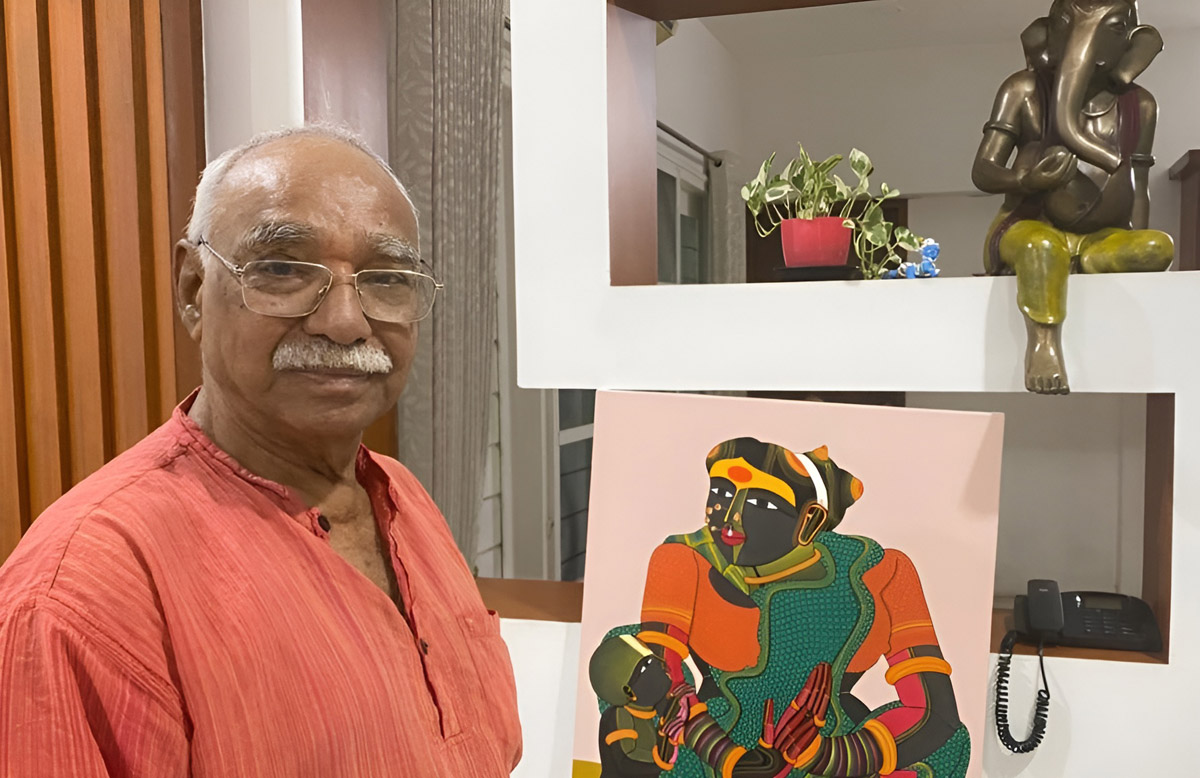

Dark-skinned women draped in saffron saris stare back from the canvas with absolute authority. No apologies, no Western beauty standards.
Thota Vaikuntam refuses to paint anything he can’t find in Telangana village life. His palette consists strictly of reds, oranges, and yellows because mixed colors “don’t exist in nature.” This ideology produced one of contemporary Indian art’s most recognizable signatures.
Born in rural Burugupalli in 1942, this Telangana painter spent decades perfecting a visual language that celebrates rural women as goddesses. His auction record hit $345,712 in 2025. Collectors from Mumbai to Silicon Valley compete for his work.
This article explores Vaikuntam’s techniques, iconic subjects, market position, and artistic legacy. You’ll learn how to identify his paintings instantly, understand his strict primary colors philosophy, and discover why his flat, decorative style challenged both traditional realism and Western modernism.
Identity Snapshot
Full Name: Thota Vaikuntam (Telugu: తోటా వైకుంఠం)
Also Known As: T. Vaikuntam
Lifespan: 1942 – Present
Primary Roles: Painter, Printmaker, Serigraphist
Nationality: Indian
Movements: Contemporary Indian art, Indian figurative painting, Post-independence modernism
Primary Mediums: Acrylic painting, watercolor painting, charcoal on paper, tempera, screen printing (serigraphs)
Signature Traits: Bold controlled lines, flat application, strict primary colors palette (red, saffron, orange), minimal shading, knife-edge contour work
Iconography & Motifs: Telangana women with vermilion bindis, Sircilla saris, ornate jewelry, flute players, temple rituals, paddy fields, village celebrations, toddy pots
Geographic Anchors: Born in Burugupalli (Karimnagar district, Telangana), educated in Hyderabad and Baroda, lives and works in Hyderabad
Mentors: Prof. K.G. Subramanyan (M.S. University, Baroda)
Key Influences: Laxma Goud, Suryaprakash (senior contemporaries)
Collections & Museums: National Gallery of Modern Art (Delhi), Art Alive Gallery, Gallerie Ganesha, private collections across India, US, UK, Dubai
Market Signals: Auction record $345,712 USD (2025, Untitled – Temple Wedding). Average painting prices $36,510 USD. Common formats: 36 x 24 inches, 48 x 36 inches on canvas
Awards: Padma Shri, National Award for Painting (1993), Bharat Bhavan Biennale Award (1988-89), National Award for Art Direction (Film: Daasi, 1988), Lalit Kala Akademi Fellowship (1971)
What Sets This Artist Apart

Vaikuntam’s art refuses composite hues. Period.
He applies only pure reds, saffrons, oranges straight from the tube. This isn’t stylistic preference, it’s ideology. Mixed colors don’t exist in village surroundings, so they don’t exist on his canvas. His women aren’t delicate. They’re monumental, dark-skinned, filling small formats with unapologetic presence.
The line work cuts sharp. No soft edges, no atmospheric blur. Every boundary stays crisp, controlled, definitive.
His figures echo temple friezes but flatten into contemporary pictorial space without illusionistic depth. Backgrounds stay monochrome, pushing decorated bodies forward. Think Matisse’s flat planes meeting Kalighat painting’s bold declarations, but rooted in Telangana soil.
Nobody else paints rural Indian women this way. Not as victims, not as symbols of tradition. As goddesses with heavy lips, turmeric foreheads, absolute self-possession.
Origins & Formation
Early Exposure (1942-1960s)
Born 1942, Burugupalli village. Father ran a grocery shop.
Childhood saturated with traveling theater troupes performing all-night mythological dramas. Male actors impersonating female characters in elaborate costumes left permanent impressions. Young Vaikuntam sketched Bhima, Hanuman from memory, refined drawings against temple pillars.
Formal Training
College of Fine Arts and Architecture, Hyderabad (1964-1970)
Father initially refused funding. “What will you earn making paintings?”
Vaikuntam enrolled anyway. Seniors included Laxma Goud, Suryaprakash. Daily practice: sketch at railway stations, public gardens. Drawing improved massively within two years. Diploma completed 1970.
M.S. University, Baroda (1971-1972)
Lalit Kala Akademi Fellowship secured. Studied under K.G. Subramanyan, who pushed him away from Western imitation toward cultural roots. Brief flirtation with abstraction ended quickly. Printmaking and painting techniques expanded but village subjects remained central.
Struggle Years (1970s-1980s)
No job for ten years. Lived in one small room. Salary as Bal Bhavan art teacher: Rs. 150.
Wife supported the practice. Senior artist Suryaprakash organized exhibitions, creating first sales opportunities. Recognition arrived around age 45. Confidence built slowly. Real income from art camps came after 50.
Breakthrough (1980s forward)
At 42, iconography crystallized. Focus shifted entirely to Telangana women and men. Earlier work completely different, more exploratory. The mature style emerged from deliberate concentration on human figures over landscapes or abstractions.
First solo exhibition: Kala Bhavan, Hyderabad, 1973. Regular shows followed in Mumbai, Delhi, Kolkata, Bangalore.
Movement & Context
Position Within Contemporary Indian Art
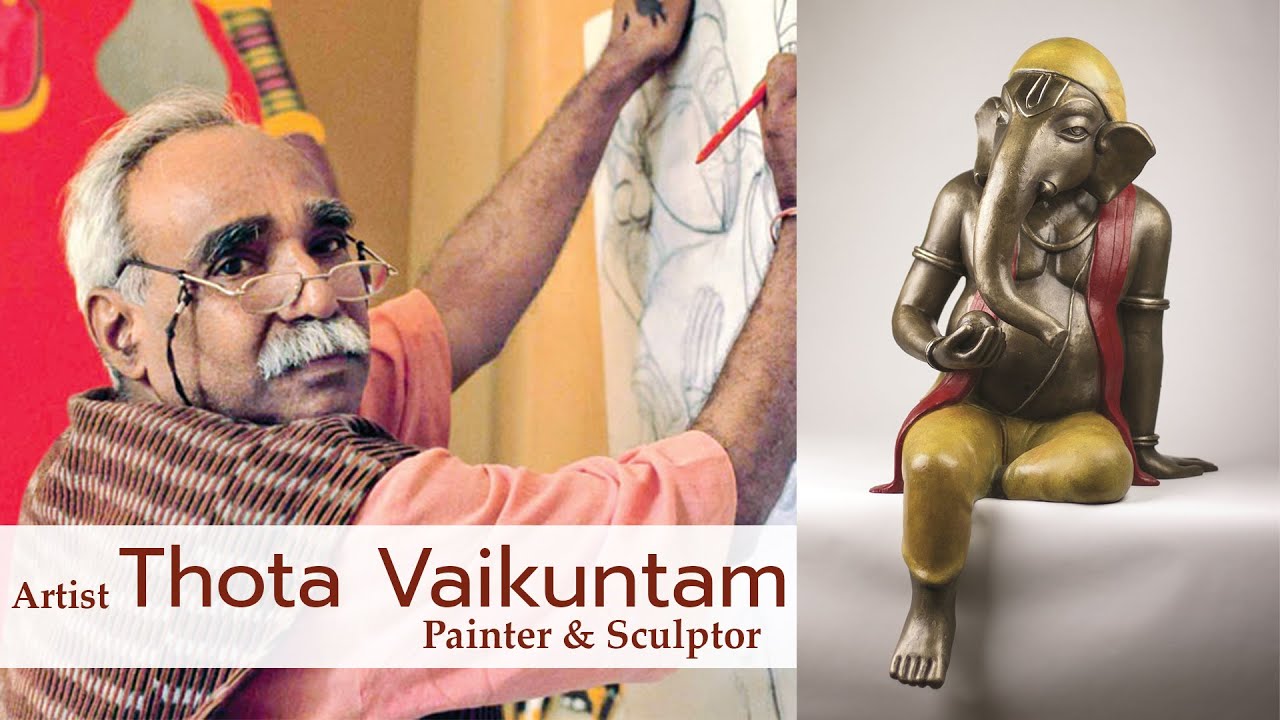
Vaikuntam occupies unique territory. Post-independence Indian modernists like M.F. Husain fractured forms. Progressive Artists’ Group pursued international vocabularies. Vaikuntam did neither.
He flattened form deliberately but retained figuration. His palette stayed Indian while technique modernized. Neither folk revivalist nor Western derivative.
Comparative Attributes
vs. Laxma Goud (contemporary)
Goud: etching-heavy, sexual tension explicit, urban anxieties visible
Vaikuntam: paint-dominant, sensuality implicit through pose/costume, rural celebration emphasized
Both depict Telangana subjects but Vaikuntam’s women command space. Goud’s figures often struggle within it.
vs. Jamini Roy (predecessor)
Roy: Bengali folk vocabulary, Kalighat-derived simplification, earthy ochres
Vaikuntam: Telangana temple art reference, similar flattening strategy, hot primary spectrum
Edge treatment differs. Roy’s contour lines flow calligraphically. Vaikuntam’s cut with architectural precision.
vs. Bhupen Khakhar (contemporary)
Khakhar: narrative complexity, urban middle-class subjects, ironic distance
Vaikuntam: iconic simplicity, rural lower-caste subjects, celebratory intimacy
Canvas aspect ratios: Vaikuntam prefers vertical portraits (36 x 24 standard). Khakhar worked horizontal narratives. Stroke length: Vaikuntam’s controlled, short. Khakhar’s looser, variable.
Distinctive Technical Position

Refuses gradation. Won’t model value to suggest volume. Instead, uses pattern density and jewelry detail to convey presence without traditional chiaroscuro.
This puts him outside both academic realism and abstract expressionism. Closest Western analog might be Alex Katz’s flat portrait style, but Vaikuntam’s decorative density and cultural specificity diverge completely.
Materials, Techniques, and Process
Supports & Grounds
Primary support: Cotton canvas, occasionally linen for larger commissions
Panel work: Wood supports for smaller charcoal pieces (10 x 8 inches common)
Paper: Heavy watercolor paper (300 gsm+) for charcoal and transparent wash works
Priming: standard acrylic gesso, sometimes double-coated for extra smoothness. Wants texture to come from application, not surface.
Mediums & Binders
Acrylic: Primary medium after 1980s. Fast-drying suits his alla prima approach. No extended wet-in-wet blending. Each color area applied decisively in single session.
Watercolor: Used for early charcoal works, partial coloration experiments. Transparent washes over drawings. Less frequent in mature work.
Tempera: Occasional use, referenced in early catalogues. Water-based, egg tempera likely for specific matte finish requirements.
Charcoal: Willow or vine charcoal, often stark black without tonal gradation. Sharp edges maintained. Sometimes finished with fixative, sometimes left raw.
Brushwork Taxonomy
Vaikuntam’s stroke vocabulary stays limited by choice:
- Flat blocking: Large areas filled with even tone, no visible directional brushwork
- Edge defining: Controlled line work where form meets ground, executed with fine rounds or liners
- Pattern rendering: Tight, repetitive marks for sari borders, jewelry designs. Smallest brushes for intricate ornament
- No scumbling, no impasto, no visible under-drawing in finished acrylics
Think sign-painting precision more than painterly gesture. Every mark intentional, decorative function clear.
Palette Architecture
Core hues:
- Cadmium red (dominant)
- Saffron/orange (cadmium orange, possibly mixed with yellow)
- Ochre yellow
- Burnt sienna (skin tones)
- Raw umber (hair, deep accents)
- White (bindis, jewelry highlights)
Avoided:
- Blues (rare, occasional sky)
- Greens (composite, deemed unnatural)
- Purples, violets (composite)
- Neutral grays
Value distribution: High-key. Even dark skin tones rendered warm, never approaching black values. Deepest darks reserved for hair, eye pupils. Background fields often single mid-value hue.
Temperature bias: Warm-dominant across entire body of work. Cool tones virtually absent except architectural or distant elements.
Studio Practice & Process
Methodology: Direct painting (alla prima). No visible underpainting stages in acrylics. For charcoal works, drawing IS the finished piece.
Sketch dependency: Obsessive. “For painting, life is a sketch. Whoever has a good sketch will be successful in life.” (Artist statement)
Preliminary drawings extensive. Railway stations, temples, village observations translated to paper before canvas work begins.
Compositional approach: Central figure dominance. Rarely solitary (even single figures imply community). Figures fill frame edge-to-edge. Minimal negative shape around bodies.
Scale consistency: Prefers smaller formats for intimacy. 36 x 24 inches standard. Large paintings (48 x 36, 60 x 40) less common but commissioned for institutional collections.
Themes, Subjects, and Iconography
Primary Motifs
Telangana Women (80% of oeuvre)
Not generic rural subjects. Specific caste markers, regional dress codes, jewelry indicating community status. Heavy silver anklets, nose rings, elaborate bindis signal identity. Dark skin celebrated, not lightened or exoticized. Static poses echo classical hasta mudras from temple sculpture.
Vaikuntam traces fascination to childhood theater performances where male actors embodied feminine grace. Also cites mother’s influence, her bright saris and large bindis.
Male Figures
Calmer than female subjects. Often musicians (flute players common), farmers with toddy pots. Less decorative detail, more narrative function. Occasionally Krishna-Radha pairings blending devotional themes with village life.
Celebratory Contexts
Festivals dominate even quiet portraits. “All my paintings are festive,” Vaikuntam states. Figures prepare for, participate in, or rest from celebration. Connection to soil, community, seasonal rituals permeates work. Bhatukamma goddess (goddess of life) referenced as spiritual parallel to his women.
Compositional Schemes
Triangular stability: Many portraits build on triangle base (wide sari hem tapering to head). Classical composition principle adapted to Indian dress silhouettes.
Frontal presentation: Subjects rarely in profile. Direct eye contact or three-quarter view. Engagement with viewer assumed, not avoided.
Stacked planes: No atmospheric perspective. Background, middle ground, foreground distinguished by color change, not size diminution. Figures exist on picture plane, not in illusionistic depth.
Grid-like patterning: Sari designs, jewelry arrangements create internal geometric structures. Repetitive elements establish rhythm across surface.
Symbol Sets
Objects:
- Bindi (vermilion dot, forehead): Married status, auspiciousness
- Sircilla sari: Regional textile pride, Telangana identity
- Nose ring (large, ornate): Caste/community marker
- Anklets, bangles: Sonic element of female presence (cultural reference)
- Parrot: Companion figure, domesticity, folk tale reference
- Flute: Krishna mythology, pastoral life, male creativity
- Toddy pot: Agricultural labor, local economy
Colors’ symbolic loads:
- Red: Vitality, fertility, earth itself
- Saffron/orange: Sacred associations, turmeric applications, bridal contexts
- Yellow ochre: Sun, harvest, ripeness
No overt political messaging. Social commentary embedded in subject choice (lower-caste rural women given monumental treatment) but delivered through celebration, not critique.
Socio-Historical Triggers
Post-independence identity formation: Born five years after independence, Vaikuntam’s generation negotiated what “Indian” meant beyond colonial/Orientalist frameworks. His strict primary palette and temple-art references assert indigenous aesthetic autonomy.
Telangana regional identity: Painted Telangana subjects decades before 2014 statehood. Work now read as cultural preservation during period of marginalization within larger Andhra Pradesh state.
Urban-rural divide: Living in Hyderabad while painting village life creates productive distance. Not documentary realism but memory-infused iconography. Responds to rapid urbanization by memorializing what changes.
Notable Works
“Telangana Woman” (Multiple versions, 1990s-2020s, Acrylic on canvas, typically 36 x 24 inches)
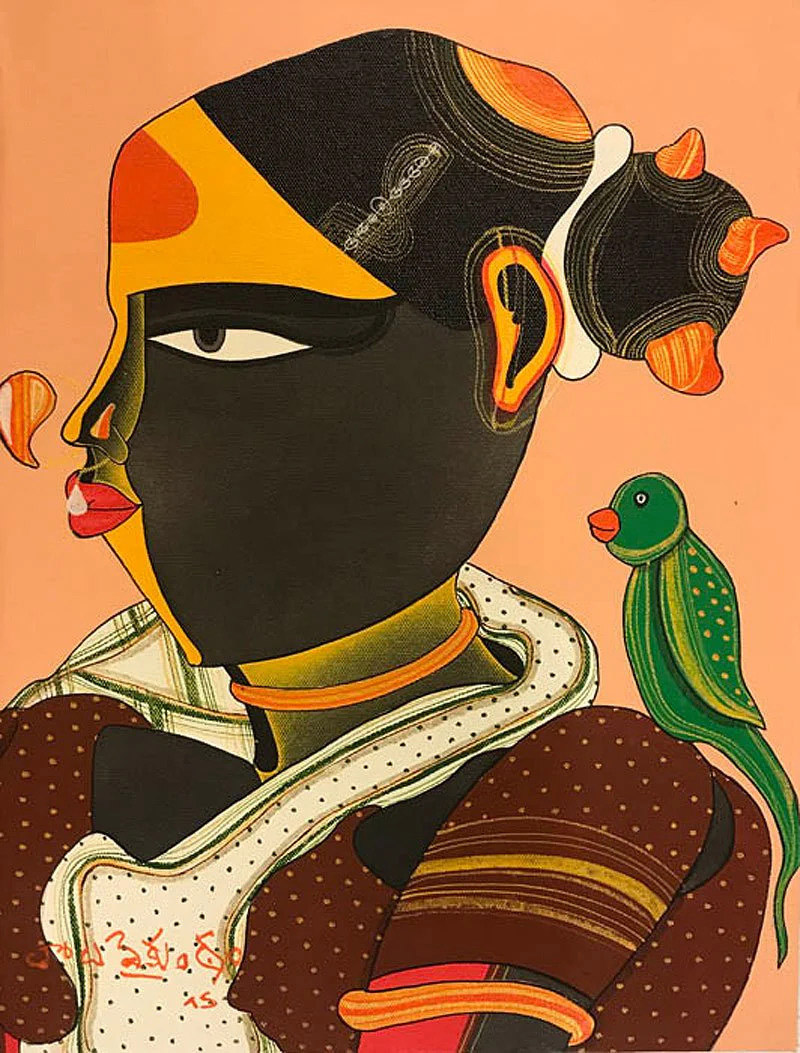
Current locations: Various private collections, Art Alive Gallery inventory
Visual signature: Single female figure, frontal pose, hands in hasta mudra position (often one hand raised, one resting). Red or saffron sari with geometric border patterns. Oversized bindi, nose ring, multiple bangles. Dark brown skin tone consistent. Monochrome background (burnt sienna or yellow ochre). Absolutely flat application, zero modeling on face or limbs. Contour lines define all edges sharply.
Why it matters: Signature work, most reproduced. Establishes template for 80% of subsequent paintings. Collectors recognize “a Vaikuntam” instantly from this iconography. Challenges mainstream Indian art’s preference for lighter skin tones in female subjects.
Related works: “Mother and Child” series extends composition to two-figure groupings with same formal language.
“Gossip” (2000s, Acrylic on canvas, 36 x 24 inches, TV49)

Current location: Private collection
Visual signature: Two women in close proximity, heads inclined toward each other. Intimate body language. Both in decorative saris, bindis prominent. Shared decorative field suggests conversation’s warmth. Minimal negative shape between figures.
Why it matters: Depicts community intimacy, female friendship. Moves beyond solo iconic portrait to social interaction. Maintains formal rigor while suggesting narrative.
Related works: Other multi-figure compositions like “Celebration,” “Women Gossiping” (serigraph version).
“Flute Player” (2000s, Acrylic on canvas, 36 x 48 inches)
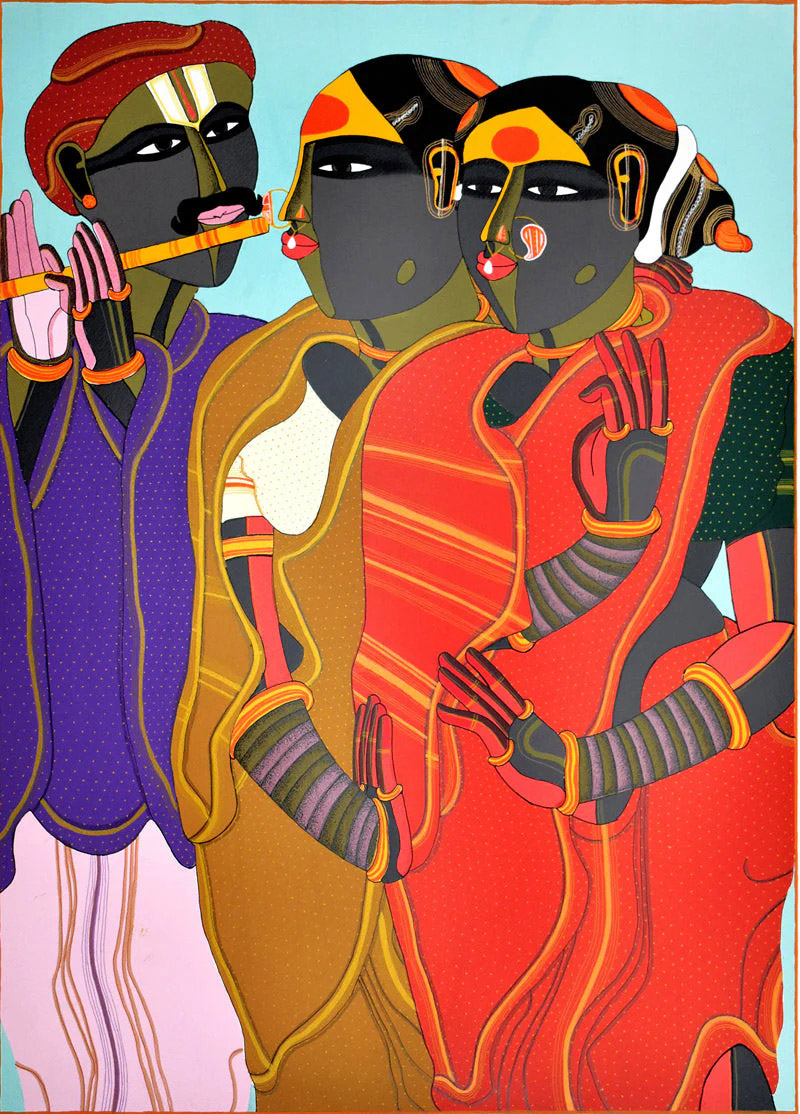
Current location: Private collection
Visual signature: Male figure with flute, often accompanied by female listener. Krishna mythology referenced but dressed in contemporary village clothing. Horizontal format accommodates musical gesture. Warm palette, less red than female-centered works.
Why it matters: Demonstrates male subject treatment. Connects mythological themes (Krishna) to everyday village culture. Musical theme runs through multiple paintings, suggesting autobiographical content (Vaikuntam interested in music).
Related works: “Krishna Radha” (TV41) makes mythological connection explicit.
“Celebration” (2000s, Acrylic on canvas, 36 x 48 inches)
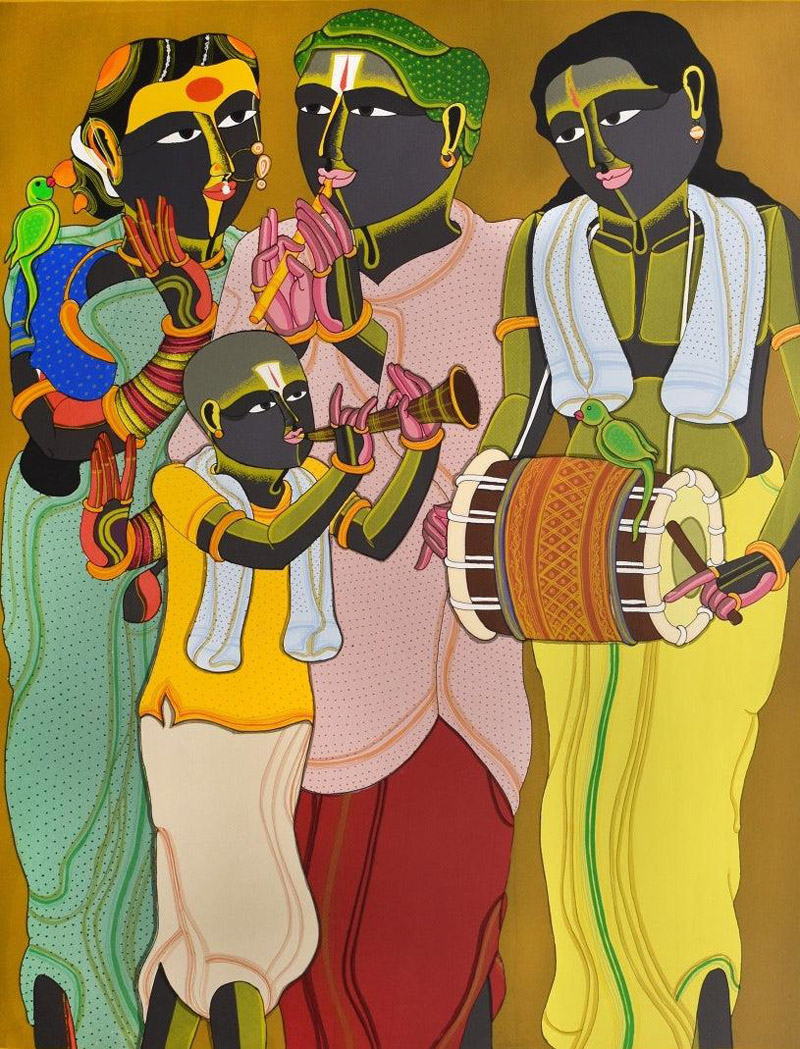
Current location: Private collection
Visual signature: Multiple figures, festive context clear from decorative density, bright palette. Compositional balance through distributed weights across canvas. Each figure retains individual presence despite group context.
Why it matters: “All my paintings are festive” made literal. Shows communal joy, not individual isolation. Compositional challenge of maintaining clarity with multiple focal points.
Related works: Various untitled celebration scenes, temple ritual depictions.
“Mother and Child” series (Multiple versions, 1990s-2020s, Acrylic on canvas, various sizes)
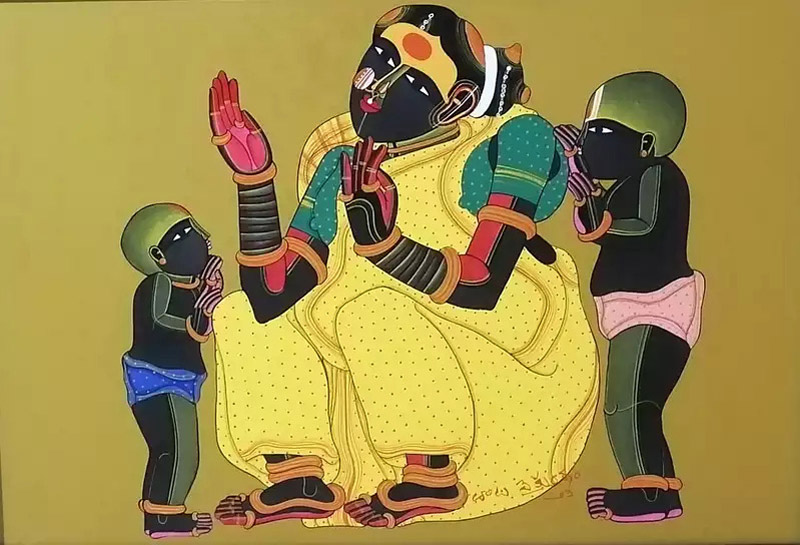
Current locations: Distributed across private collections, gallery inventory
Visual signature: Female figure with child (often infant). Maternal pose but not sentimental. Same decorative treatment applied to both figures. Child rendered with adult gravitas, not cuteness. Composition stacks vertically, mother’s body providing architectural support.
Why it matters: Universal theme filtered through Telangana-specific visual language. Connects to goddess imagery (Vaikuntam equates village women with Bhatukamma goddess). Available as both original paintings and serigraph editions, increasing market accessibility.
Related works: Numerous charcoal versions, serigraph edition “Mother and Child – III” (30 x 40 inches, image size 22 x 32 inches).
“Untitled (Temple Wedding)” (Date unknown, Medium/size unknown, Auction record holder)
Current location: Unknown (sold at auction 2025)
Market significance: Realized $345,712 USD at AstaGuru Auction House 2025. Artist’s auction record. Temple context suggests ritual subject, likely multiple figures, ceremonial dress.
Why it matters: Establishes Vaikuntam’s position in contemporary Indian art market hierarchy. Record price places him alongside recognized modernist masters for collector investment purposes.
Exhibitions, Collections, and Provenance Highlights
Major Solo Exhibitions

Early career:
- 1973: Kala Bhavan, Hyderabad (debut solo)
Mature period:
- 2006: “Mukham,” Sanskriti Art Gallery, Kolkata
- 2007: “Telangana: Inheritance of a Dream Lost,” Art Alive, New Delhi
- 2007: “Yes, I am He,” India Fine Art, Jehangir Art Gallery, Mumbai
- 2015: “The Telangana Icons,” Grosvenor Gallery (with Art Alive Gallery), London
- 2024: “Redefining The Cultural Gaze,” Art Alive Gallery, New Delhi (retrospective spanning 1980s-2024, with documentary film release)
Regular shows at galleries in Hyderabad, Bangalore, Delhi, Kolkata, Mumbai throughout 1990s-2020s.
Selected Group Exhibitions
- 2000: “Ignition,” Crimson Art Gallery, Mumbai
- 2001: Saffronart exhibitions, Los Angeles and Hong Kong
- 2002: “Tradition and Change,” Arts India, New York
- 2006: “6 Artists Show,” 1×1 Gallery, Dubai
- 2008: “Post Independence Masters,” Aicon Gallery, New York
- 2009: “The Root of Everything,” Gallery Mementos, Bangalore
- 2009: “Indian Harvest,” Crimson (Art Resource), SG Private Bank, Singapore
- VII Triennale, Delhi (year unknown)
International presence in New York, London, Dubai, Birmingham, Kassel established through gallery partnerships and auction house attention.
Museum & Institutional Collections
Confirmed holdings (3+ works):
- National Gallery of Modern Art, Delhi
- Art Alive Gallery (representing gallery, extensive inventory)
- Gallerie Ganesha
- Various regional Indian museums (specifics unconfirmed)
Private collections significantly outnumber institutional holdings. Work particularly strong in US collections (Bay Area, New York), UK, Dubai, Singapore.
Provenance Patterns
Gallery representation: Long-term relationship with Art Alive Gallery, Delhi (primary representative). Also works with Laasya Art (Palo Alto, California for US market), ArtFlute, Gallerie Nvya, Studio3 India, others.
Auction presence: Regular appearances at:
- Saffronart (Indian auction house)
- AstaGuru Auction House (record price 2025)
- Smaller regional auctions (Ashvita’s, Helios Auctions, Greenwich Auction, Antique Arena)
Auction estimates typically $2,000-$10,000 for smaller works, $10,000-$50,000 for mid-size canvases. Record price ($345,712) represents exceptional outlier.
Collector profile: Upper-middle-class Indian diaspora (US, UK particularly strong). Collectors attracted to cultural identity themes, decorative appeal, investment stability. Silicon Valley tech community notable buyers through Laasya Art gallery.
Catalogues Raisonnés & Publications
- “Thota Vaikuntam – Art Alive Master Series Books”
- “Rustic Ragas: Inner Melodies of Thota Vaikuntam”
- “A Retrospective Book: Thota Vaikuntam”
- “Thota Vaikuntam: The Man and His Women”
- 2024 documentary film (title unknown, released alongside “Redefining The Cultural Gaze” exhibition)
No comprehensive catalogue raisonné published. Multiple monographs exist but systematic numbering system absent. Authentication relies on artist signature (Telugu script), gallery provenance, stylistic analysis.
Market & Reception
Auction Records & Price Bands
Record sale: $345,712 USD, “Untitled (Temple Wedding),” AstaGuru Auction House, 2025
Current market bands (2024-2025 data):
- Paintings: Average $36,510 USD
- Small format (12 x 8 to 24 x 18 inches): $2,000-$8,000
- Medium format (36 x 24 inches, standard): $10,000-$40,000
- Large format (48 x 36 inches+): $30,000-$100,000
- Exceptional works/provenance: $100,000-$350,000
- Sculptures: Average $23,750 USD (limited production)
- Serigraphs (limited edition prints):
- Edition size typically 100-150
- Hand-signed, numbered
- Price range: $1,500-$5,000 depending on image size, edition number
- Retain value better than typical prints due to artist’s market position
Historical price range: $336 USD (low-end auction result, likely damaged/questionable attribution) to $345,712 USD (record)
Market trajectory: Steady appreciation since 2000s. Recognition of Telangana statehood (2014) coincided with increased interest. Not speculative bubble but consistent collector demand.
Authentication & Signature Variants
Primary signature: Telugu script, lower right corner (most paintings). Occasionally lower left or verso for prints.
English signature: “T. Vaikuntam” or “Thota Vaikuntam” appears on some works, gallery labels, certificates.
Authentication risks:
- Forgery concerns: Popular style invites imitation. Flat application technique relatively reproducible compared to complex brushwork styles.
- Red flags: Mixed/composite colors (artist never uses), soft edges, anatomical incorrectness beyond stylization, wrong script in signature, lack of provenance documentation.
- Certificate of authenticity: Gallery-issued COAs standard for legitimate sales. Artist willing to verify works directly through gallery contacts.
Print reproductions: Unauthorized poster prints exist. Legitimate serigraphs always hand-signed, numbered (e.g., “15/100”), on archival paper, accompanied by COA.
Condition Patterns
Acrylic works: Generally stable. Acrylics don’t yellow like oils. Cracking rare unless improperly stored.
Common issues:
- Surface dust accumulation on flat matte areas
- Minor edge damage from unframed storage
- Stretcher bar denting on verso (cosmetic)
Charcoal works: More fragile. Fixative application quality varies. Smudging risk if unframed. Requires professional conservation for restoration.
Canvas failures: Rarely reported. Artist uses quality supports. Ground adhesion issues minimal.
Color fading: Low risk. Cadmium pigments highly stable. Avoid direct sunlight regardless.
Influence & Legacy
Upstream Influences (Who Influenced Vaikuntam)
Direct mentorship:
- K.G. Subramanyan (1924-2016): Most significant. Teaching at M.S. University Baroda redirected Vaikuntam from Western abstraction toward indigenous content. Subramanyan’s own work merged folk vocabularies with modernist approaches, modeling path Vaikuntam extended.
Peer influence:
- Laxma Goud: Senior contemporary at Hyderabad College. Both explore Telangana subjects but different formal strategies. Mutual awareness, distinct voices.
- Suryaprakash: Organized early exhibitions, provided practical support, artistic camaraderie during struggle years.
Historical sources:
- Temple sculpture: Direct influence acknowledged. Static poses, hasta mudras, frontal presentation echo Chola bronzes, Vijayanagara temple friezes.
- Kalighat painting: Bengali tradition of bold outline, flat color areas, iconic presentation. Formal similarities though regional content differs.
- Traveling theater: Childhood exposure to male actors performing female roles. Theatrical exaggeration of feminine markers (costume, gesture, makeup) informs his heightened decorative approach.
Western art: Minimal conscious influence. Brief Baroda exposure to modernist principles but rejected stylistic adoption. If anything, Henri Matisse‘s flat planes and decorative intensity share formal DNA, but Vaikuntam arrived independently through Indian sources.
Downstream Influence (Who Vaikuntam Influences)
Regional followers: Younger Telangana artists adopt similar subjects (rural women, village festivals) but rarely match his formal discipline. Risk of pastiche significant. Market saturation with “Vaikuntam-style” works by lesser artists dilutes but also confirms his iconic status.
Contemporary Indian art discourse: Helped legitimize overtly regional, culturally specific subject matter in era when international art world pressured homogenization. Proved market viability of uncompromising local content.
Diaspora artists: Indian-American, Indo-British painters cite Vaikuntam as model for cultural authenticity without exoticism. Shows how contemporary technique can honor traditional subjects.
Printmaking in India: Serigraph production quality and market acceptance benefited from his successful limited edition strategy. Demonstrated fine art prints could maintain value in Indian context.
Cross-Domain Echoes
Film & Cinema:
- Art direction for “Daasi” (1988) won National Award. Visual approach influenced costume design, color grading in Telugu cinema’s rural-themed films.
- Documentary “Rangula Kala” (date unknown) profiled his emerging practice.
- 2024 documentary released alongside retrospective exhibition.
Fashion & Textile Design: Sircilla sari weavers reference his paintings in new patterns. Circular influence: he depicts traditional textiles, which then evolve based on his stylizations.
Theatre & Performance: Some Telangana folk theater troupes incorporate his visual style in set design, costume choices. Returns influence to source that originally inspired him.
Photography: Contemporary Indian photographers shooting rural subjects sometimes emulate his compositional structures (frontal presentation, decorative density, monochrome backgrounds).
Graphic Design: Poster artists, book cover designers borrow flat color blocking, bold outlines for work requiring “Indian identity” signifiers.
How to Recognize a Vaikuntam at a Glance
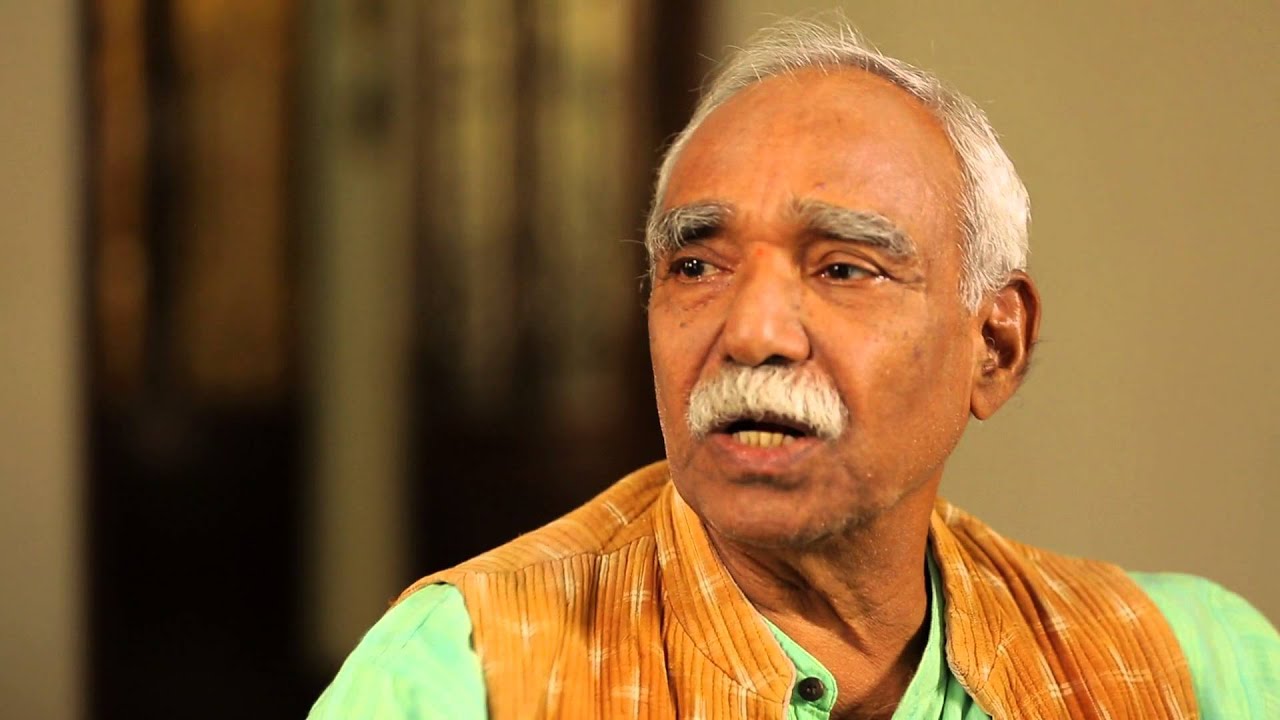
Diagnostic checklist for instant identification:
- Strict primary palette: Red, saffron, orange dominant. If you see greens, purples, or grayed tones, it’s not Vaikuntam.
- Vermilion bindi: Oversized, perfectly circular red dot on forehead. If female subject lacks this or has small bindi, question attribution.
- Dark skin tones: Deep brown, never lightened. If skin appears pale or pinkish, not his work.
- Flat application: Zero brushstroke texture visible. If you see impasto, scumbling, or painterly gesture, it’s not him.
- Sharp contours: Every edge crisp. Soft transitions between form and ground absent.
- Heavy jewelry rendering: Nose rings large, anklets detailed, bangles multiple. Ornament detail matches figure detail. If jewelry sketchy or minimal, unlikely Vaikuntam.
- Signature format: 36 x 24 inches vertical most common for paintings. Deviation doesn’t disqualify but increases scrutiny need.
- Monochrome backgrounds: Single-color fields (ochre, burnt sienna, occasionally red). No landscape elements, architectural details, or patterned grounds.
- Telugu script signature: Lower right corner standard. English signature rare in original paintings (more common on prints/documentation).
- Frontal or three-quarter poses: Rarely profile views. Eye contact direct or gaze slightly averted but face forward-facing.
Bonus indicators:
- Sircilla sari patterns (geometric borders, specific regional motifs)
- Static, dance-like poses (hasta mudra references)
- Festive mood even in quiet portraits
- Canvas size under 48 inches (larger works commissioned exceptions)
- Acrylic medium post-1980 (charcoal and watercolor mostly pre-1980 or preparatory)
Forgery tells:
- Mixed secondary colors (color theory violations)
- Soft/blurred edges anywhere
- Light or varied skin tones
- Complex backgrounds
- Visible brushwork texture
- Small or absent bindis
- Minimal jewelry detail
- Weak line quality
FAQ on Thota Vaikuntam
Who is Thota Vaikuntam?
Thota Vaikuntam is a contemporary Indian artist from Telangana born in 1942. He’s renowned for painting rural women in bold primary colors using strict acrylic painting techniques.
His work celebrates village life through flat, decorative portraits with sharp contour lines and zero shading.
What is Thota Vaikuntam known for?
Vaikuntam’s signature style features Telangana women with oversized vermilion bindis, dark skin, and colorful Sircilla saris. He uses only reds, saffrons, and oranges because mixed colors “don’t exist in nature.”
His paintings combine temple sculpture influences with contemporary figurative art approaches.
Where was Thota Vaikuntam born?
Born in Burugupalli village, Karimnagar district, Telangana (then Andhra Pradesh) in 1942. His rural upbringing directly shaped his artistic subjects.
He currently lives and works in Hyderabad while maintaining deep connections to village culture and traditions throughout his career.
What painting medium does Thota Vaikuntam use?
Vaikuntam primarily works with acrylic painting on cotton canvas for finished works. Early career involved charcoal drawings and watercolor painting experiments.
He also produces limited edition serigraphs (screen prints) hand-signed and numbered for collectors seeking accessible investment-grade artwork.
Why does Vaikuntam only use primary colors?
Vaikuntam believes composite colors are artificial and unnatural. His philosophy: only pure reds, oranges, and yellows exist in rural surroundings.
This strict color theory approach creates his distinctive palette and separates his work from other contemporary Indian painters using broader color ranges.
How much are Thota Vaikuntam paintings worth?
His auction record reached $345,712 USD in 2025 for “Untitled (Temple Wedding).” Standard 36 x 24 inch paintings average $10,000-$40,000.
Serigraphs range $1,500-$5,000. Market trajectory shows steady appreciation since 2000s, particularly among diaspora collectors in US and UK markets.
What awards has Thota Vaikuntam received?
Major honors include Padma Shri, National Award for Painting (1993), Bharat Bhavan Biennale Award (1988-89), and National Award for Art Direction for film “Daasi” (1988).
He received Lalit Kala Akademi Fellowship in 1971, enabling advanced studies at M.S. University, Baroda under K.G. Subramanyan.
Where can I see Thota Vaikuntam’s work?
National Gallery of Modern Art in Delhi holds permanent collection works. Art Alive Gallery in New Delhi represents him with regular exhibitions.
International showings occurred in New York, London, Dubai, Birmingham. Private collections strongest in US (Silicon Valley, New York), UK, Singapore markets.
What influences Thota Vaikuntam’s art?
Childhood exposure to traveling theater troupes where male actors impersonated female characters sparked lifelong fascination. Temple sculpture and Kalighat painting traditions inform his flat composition approach.
Mentor K.G. Subramanyan redirected him from Western abstraction toward indigenous cultural roots during Baroda training years.
How can I identify an authentic Thota Vaikuntam painting?
Look for strict primary palette (red, saffron, orange only), oversized vermilion bindis, dark skin tones, absolutely flat application without brushwork texture.
Telugu script signature appears lower right. Sharp edges, monochrome backgrounds, and heavy jewelry detailing distinguish authentic works from forgeries or imitations.
Conclusion
Thota Vaikuntam carved a singular path through contemporary Indian art by refusing compromise. No mixed colors, no soft edges, no Western beauty standards diluting Telangana identity.
His women don’t apologize for dark skin or village origins. They fill canvases with decorative authority that collectors worldwide recognize instantly.
The market validates this vision. Auction records climbing past $300,000 prove authentic cultural content resonates beyond regional boundaries. His strict adherence to painting mediums like pure acrylics and specific painting styles created investment-grade consistency.
From struggling Hyderabad teacher earning Rs. 150 monthly to Padma Shri recipient, Vaikuntam’s trajectory demonstrates patience. Recognition arrived after 50, but the work never wavered.
His legacy lives in every younger Indian artist who chooses local subjects over international trends. Authenticity compounds value over time.