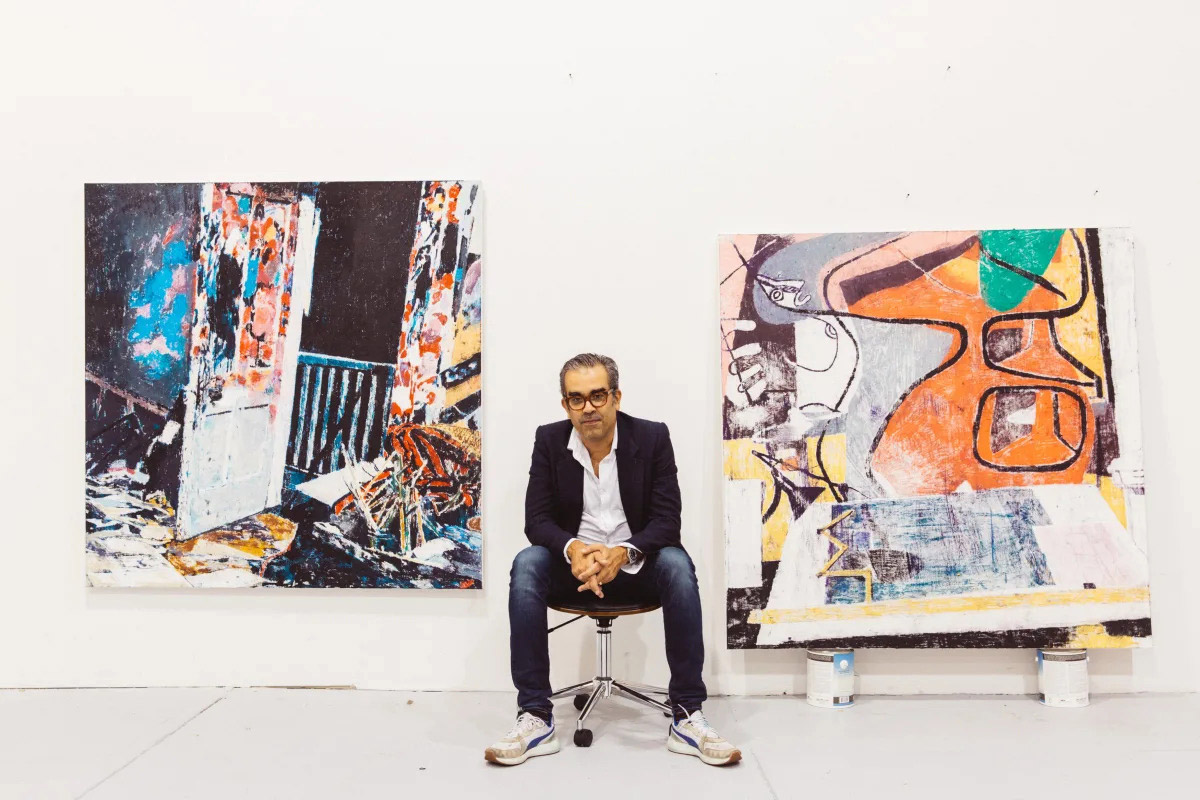

Enoc Perez transforms modernist skyscrapers into glowing memories of forgotten optimism. Born in San Juan in 1967, this Puerto Rican contemporary artist spent two decades painting without brushes, inventing a transfer technique that makes buildings shimmer like heat mirages.
His work sits in the Metropolitan Museum of Art and Whitney Museum, yet many collectors still don’t know his name. That’s changing.
This article maps Perez’s evolution from art critic’s son to New York painter redefining architectural imagery. You’ll discover his unique oil stick transfer method, understand why he painted the Lever House and Seagram Building as utopian monuments, and learn how his Caribbean heritage shapes every canvas.
We’ll examine his notable works, trace his influence from Andy Warhol to contemporary practice, and show you exactly how to recognize a Perez painting at auction or in a gallery.
Identity Snapshot
Name: Enoc Perez
Born: 1967, San Juan, Puerto Rico
Primary role: Painter, Printmaker
Nationality: Puerto Rican-American
Movement: Contemporary art, Abstract figuration
Primary mediums: Oil painting, oil stick, lithography
Signature traits: Transfer technique, vibrant color saturation, architectural subjects, brushless mark-making (1990-2010)
Iconography: Modernist buildings, tropical resorts, rum bottles, interiors, nudes
Geographic anchors: San Juan (birthplace), New York City (studio), Long Island City, East Hampton
Education: BFA Pratt Institute (1990), MFA Hunter College (1992)
Key influences: Andy Warhol, Jackson Pollock, Jasper Johns, Robert Rauschenberg
Museum collections: Metropolitan Museum of Art, Whitney Museum, MoMA, British Museum, Yale University Art Gallery, San Francisco Museum of Modern Art, Corcoran Gallery, Museum of Contemporary Art North Miami
Market signals: Auction record $374,500 (2012, Havana Riviera Hotel), typical canvas sizes 40×60″ to 106×86″
Gallery representation: Ben Brown Fine Arts, Acquavella Galleries, Galerie Nathalie Obadia, Leila Heller Gallery
What Sets The Artist Apart

Perez invented a reverse-printing method that defined his work for two decades. He applied oil stick to paper backs, then pressed and rubbed the sheets onto canvas, building images through layered color separations.
The technique mimics commercial printing but retains painterly accidents. Transfer marks create ghost edges and registration shifts that make buildings vibrate optically.
His architectural subjects aren’t documentation. They’re nostalgic portraits of utopian ambition, capturing mid-century optimism through saturated, almost tropical palettes that resist photorealism.
After 2010, he reintroduced brushes. The shift didn’t abandon his visual language but loosened it, letting direct paint application coexist with his transfer marks.
Origins & Formation
Early Training
Perez started painting at eight. His father, an art critic, took the family on museum tours across countries during vacations.
This childhood exposure embedded art history into his visual vocabulary before formal training.
Academic Path
1986: Moved to New York, enrolled at Pratt Institute.
1990: Completed BFA at Pratt.
1992: Earned MFA from Hunter College.
At Hunter, faculty criticized his work as “overly seductive” and “decorative.” The program favored conceptual approaches over aesthetic pleasure.
Perez rejected this criticism. He maintained that beauty and sensuality were legitimate artistic goals, not failures of rigor.
First Stylistic Inflections
Early 1990s work included interpretations of Jean-Michel Basquiat. But Perez recognized he needed a distinct approach, particularly as a Puerto Rican artist navigating New York’s art world.
He studied how Warhol and Rauschenberg blurred painting and printmaking. This research led to his transfer method around 1995-1996.
Pivotal Moment
Working at his sister’s Ralph Lauren office, he examined a color copier’s mechanics. The four-color separation process (cyan, magenta, yellow, black) became his painting system.
He translated CMYK printing into handmade color layering on canvas.
First Exhibitions
1993: White Columns, New York (debut)
1999: Bronwyn Keenan Gallery, “Winter”
2001: Galerie Michael Janssen, Cologne, “The Secret”
Early work mixed nudes, still lifes, and architectural experiments. Critics noted the Warhol-like surfaces but recognized something more handmade, more tactile.
Movement & Context
Perez operates between Pop Art legacy and contemporary painting’s material investigations. His work references Warhol’s seriality but rejects mechanical reproduction for hand-pressed transfers.
Positioning Within Contemporary Art

He emerged during the 1990s painting revival but avoided both neo-expressionist gestures and minimalist reduction.
Felix Gonzalez-Torres influenced his thinking about placement. Gonzalez-Torres appeared in contemporary auctions, not Latin American sales. Perez wanted the same crossover, refusing ethnic categorization.
Comparative Analysis
vs. Andy Warhol:
Warhol used silkscreen’s mechanical repeatability. Perez’s transfers produce unique variations, each pressure application creating different mark densities.
Warhol embraced commercial aesthetics. Perez adds romantic longing for architectural utopianism.
vs. Richard Estes (Photorealism):
Estes painted buildings with camera-derived precision. Perez abstracts architecture through color shifts and registration errors.
Estes used airbrush for glass reflections. Perez builds surfaces through accumulated transfer impressions.
vs. Wayne Thiebaud:
Both use heightened, unnatural color. Thiebaud’s pastries glow with commercial appeal; Perez’s buildings shimmer with nostalgic longing.
Thiebaud applied thick, creamy paint. Perez (pre-2010) avoided brushes entirely, creating flatter, more graphic surfaces.
Attribute Contrasts

Stroke length: Short, rubbed marks (transfer method) vs. long brush drags (post-2010)
Edge quality: Soft, doubled contours from registration shifts
Tonal range: High-key palettes, minimal use of deep blacks
Canvas aspect ratios: Often horizontal for architectural vistas, occasional vertical for tower subjects
Materials, Techniques, and Process
The Transfer Method (1995-2010)
Perez worked from photographs, postcards, or his own images. He made preparatory drawings of the composition, creating separate versions for each color layer.
On drawing backs, he applied oil stick (Sennelier or similar brands). He laid paper against canvas, then retraced lines on the front, pressing pigment through to the canvas surface.
Each color required a new drawing. He built paintings through multiple transfers, layering cyan, magenta, yellow, sometimes adding custom mixed hues.
The method produced:
- Ghost images from incomplete transfers
- Double edges when registration shifted
- Varied mark density based on pressure
- Matte, almost fresco-like surfaces
Supports
Primary: Linen canvas, medium-weight weave
Stretched canvases in standard formats (40×60″, 60×80″, up to 106×86″ for major works)
Occasionally canvas-mounted panel for smaller studies
Grounds
Traditional gesso priming. The smooth surface was necessary for clear transfer impressions.
Too much texture would interrupt the rubbed mark’s continuity.
Color Theory & Palette
Perez thinks in printer’s color logic but executes with painter’s intuition.
Dominant hues: Intense pinks, electric blues, violets, hot oranges
Temperature bias: Generally warm, even when depicting night scenes
Value distribution: Mid-to-high key; he avoids murky darks, preferring saturated shadows
Signature combinations:
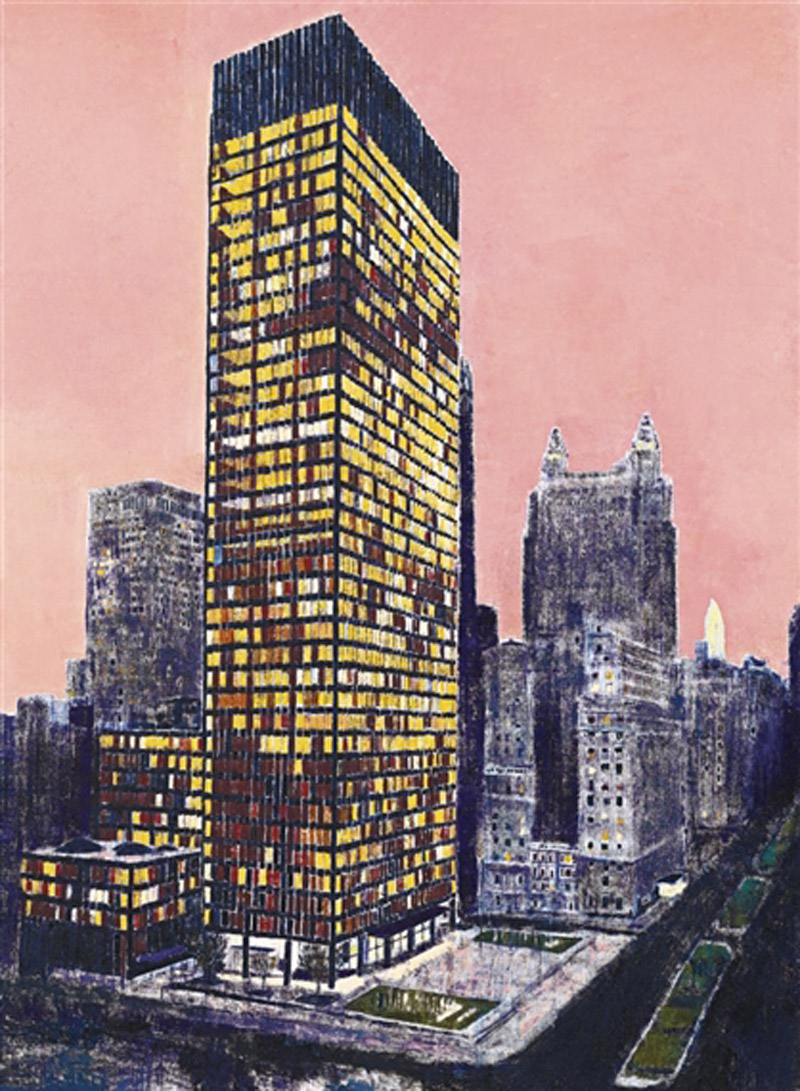
- Purple buildings against pink skies
- Orange windows in blue facades
- Red monochromes for Caribbean subjects
His palette references vintage advertising, tropical light, and 1960s graphic design more than observed reality.
Studio Practice (Post-2010 Shift)
In 2010, Perez reintroduced brushes after 17 years. He described it as “burning down your own house to create something new.”
Current work combines transfer passages with direct brush application. Some areas retain the printed quality; others show gestural, wet-in-wet painting.
He uses oil paint (likely professional grade: Winsor & Newton, Old Holland, or similar) with minimal medium. The goal is saturated color, not transparency.
Underdrawing
Early works had precise graphite underdrawing visible through transfers. Recent paintings sometimes skip this, working more intuitively with brushes.
Working Size
Small studies: 12×16″ to 18×24″
Mid-range: 40×60″ (most common exhibition size)
Large statements: 60×80″ to 106×86″
Monumental: “Grand Lisboa” series exceeded 200cm width
Themes, Subjects, and Iconography
Modernist Architecture
The core subject. Buildings become stand-ins for lost optimism.
He paints Le Corbusier projects, Mies van der Rohe towers, Eero Saarinen’s TWA Terminal, Oscar Niemeyer’s curves. These structures embodied post-war faith in rational design solving social problems.
Perez sees them as Duchampian ready-mades. They’re already aesthetic objects; he reframes them as paintings.
Key architectural series:
- Lever House (multiple versions, including 2007 lobby installation)
- Seagram Building
- United Nations Headquarters
- Hearst Tower
- One World Trade Center
- Marina Towers, Chicago
- SAS Royal Hotel, Copenhagen
- Vitra Fire Station (Zaha Hadid)
Post-9/11 Resonance
The World Trade Center’s destruction changed how Perez read skyscraper permanence. Buildings he painted as symbols of strength became fragile.
This subtext runs through later architectural work, though he doesn’t make it explicit.
Caribbean & Tropical Subjects
Hotels and resorts:
- Caribe Hilton
- Dorado Hilton
- Fontainebleau Miami Beach
- Havana Riviera Hotel
These paintings mix personal memory with advertising imagery. The luxury hotels represent both aspiration and colonialism’s glamorous face.
Beach scenes: Condado Beach, Luquillo Beach, generic tropical pools
These works are more loosely painted, emphasizing leisure and escape.
Rum Bottles
Don Q, Ron Bacardi, Ronrico appear as still-life subjects and self-portraits. Puerto Rican rum brands carry cultural identity.
The bottles reference product photography and bar lighting. Perez treats them with the same formal seriousness as buildings.
Nudes & Figures
Less frequent but persistent theme. Early nudes (1990s) were more figurative. Recent works overlay painted cutout shapes on appropriated images, creating playful censorship.
These collage-paintings comment on social media, voyeurism, and representation.
Interior Portraits
“The Cinematic Self” series (2019) depicted spaces owned by famous figures:
- Francis Bacon’s London studio
- David Bowie’s unmade bed (1973 Trans-Siberian trip)
- Elvis Presley’s Jungle Room at Graceland
- Gianni and Marella Agnelli’s Roman palazzo
- Jacques Doucet’s Paris home
Interiors function as surrogate portraits. The absent inhabitants are defined by their aesthetic choices.
Compositional Schemes
Centered monumentality: Single buildings occupy most of the frame
Off-register doubling: Ghost images create movement and instability
Flat pictorial space: Minimal atmospheric perspective; buildings as graphic planes
Horizontal bands: Sky, building, reflection (for waterfront subjects)
Notable Works
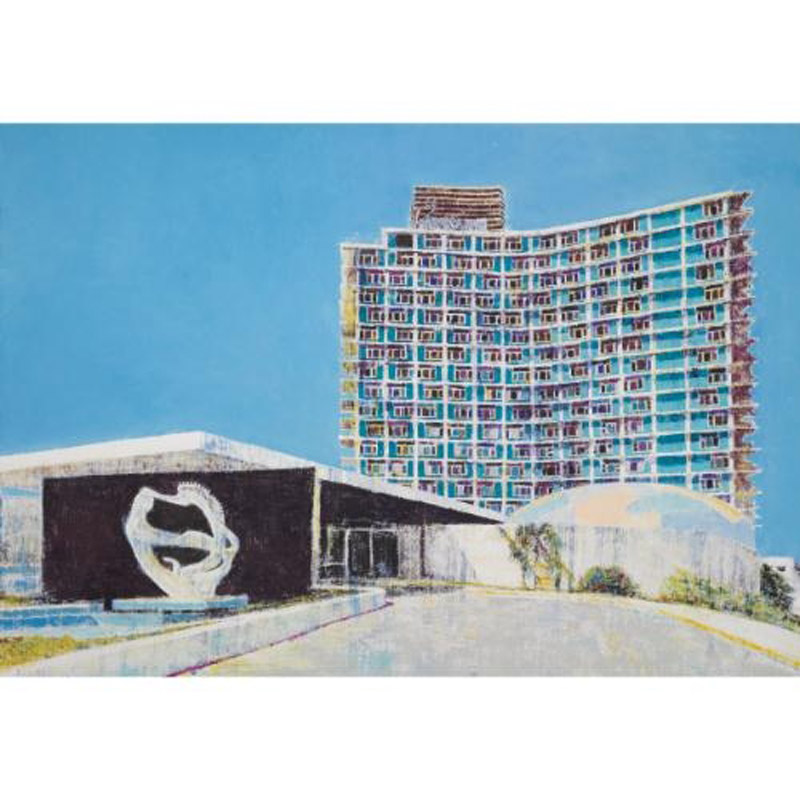
Havana Riviera Hotel, La Havana, Cuba (2012)
Medium: Oil on canvas
Size: Large format (exact dimensions vary by version)
Location: Private collection (sold Sotheby’s 2012 for $374,500)
Visual signature: Pink and purple facade against turquoise sky, soft double edges from transfer misregistration
Why it matters: Auction record. Captures Cuban modernist architecture’s decay and glamour. The hotel, built 1957, symbolizes pre-revolutionary optimism.
Related works: Multiple Cuban hotel paintings, Caribbean resort series
Lever House Series (2007)
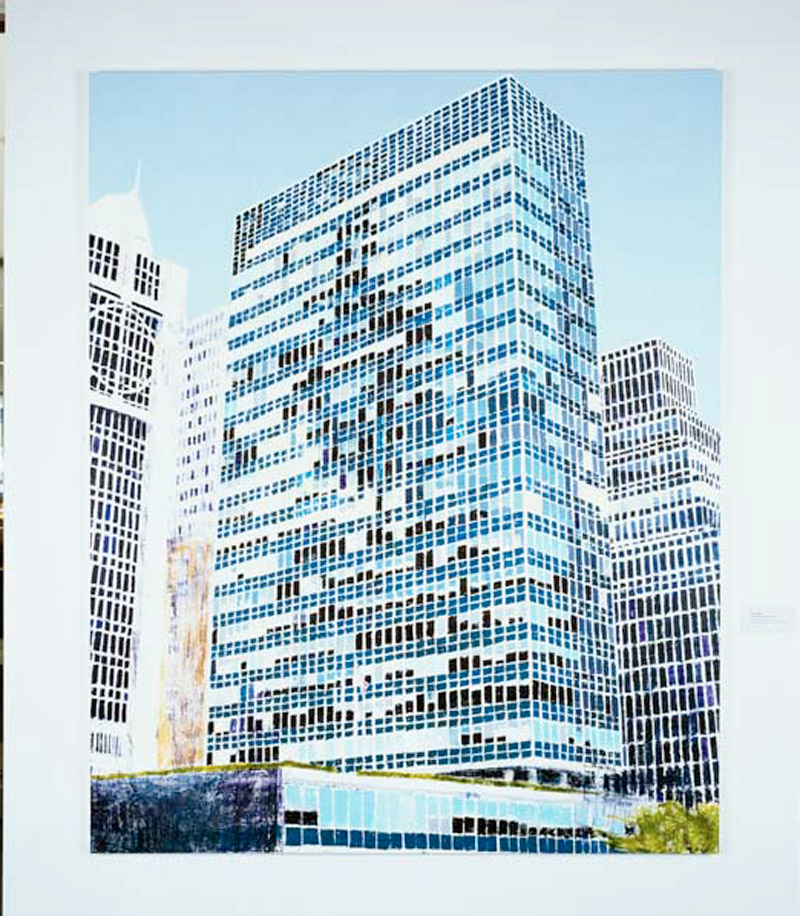
Medium: Oil on canvas, screenprints
Size: Varies; major canvases approximately 60×80″
Location: Five paintings exhibited in Lever House lobby; screenprint suite at Lower East Side Printshop
Visual signature: Architectural grid in vibrant color variations (indigo, purple, red, silver). Building dissolves at top into sky, bottom into darkness.
Why it matters: Site-specific exhibition in the depicted building. Commissioned screenprint led to hand-printed variations exploring color drama.
Related works: Multiple Seagram Building paintings, other Gordon Bunshaft/SOM structures
One World Trade Center (2015)
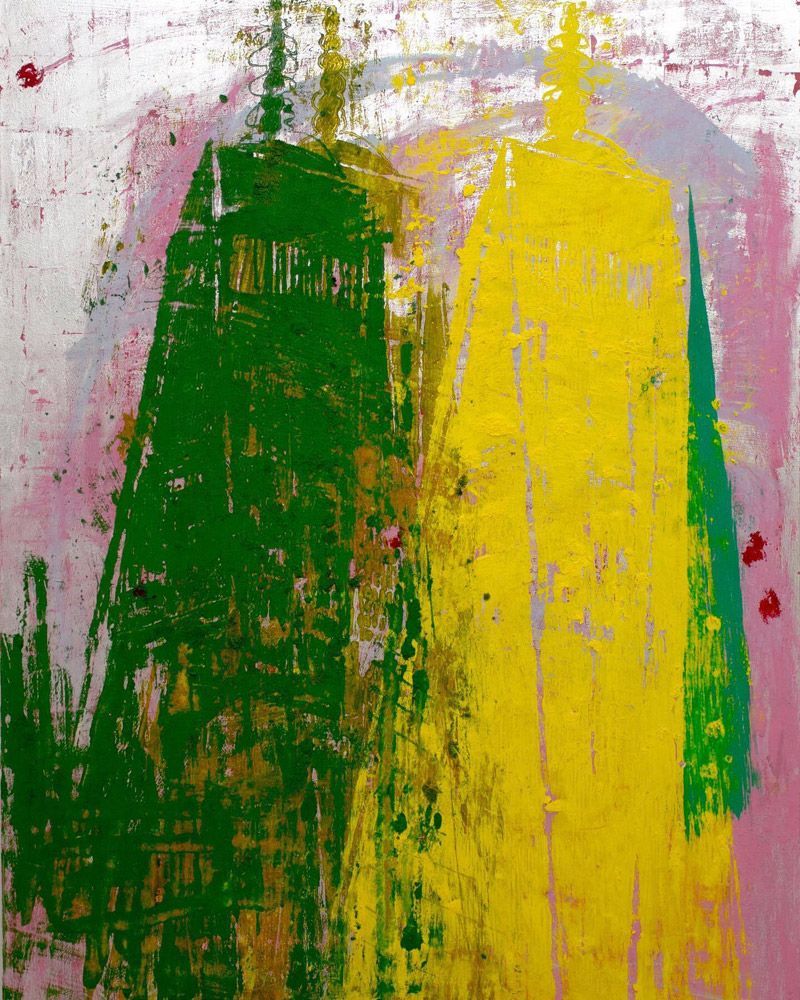
Medium: Oil on canvas
Size: 61×45.75 cm (24×18″)
Location: Private collection, Florida; exhibited Galerie Nathalie Obadia, Paris
Visual signature: Vertical composition, building ascending through vibrant blues and pinks
Why it matters: Addresses post-9/11 rebuilding and skyline transformation. More hopeful than elegiac.
Related works: World Trade Center memorial paintings, lower Manhattan series
Teatro Popular, Niteroi (2010)
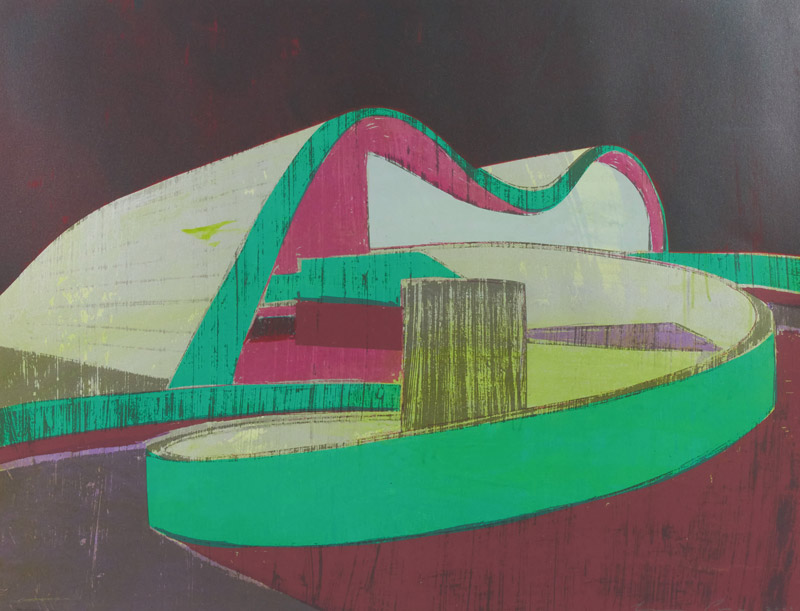
Medium: Oil on canvas
Size: 42×60″
Location: Exhibition at Acquavella Galleries
Visual signature: Oscar Niemeyer’s curved forms under vigorously brushed electric midnight blue sky. Marked Perez’s return to brush painting after 17 years.
Why it matters: Transitional work showing combined transfer and brush techniques. Brazilian modernism meeting Caribbean sensibility.
Related works: Other Niemeyer buildings, modernist South American architecture
Don Q Series (2006-present)
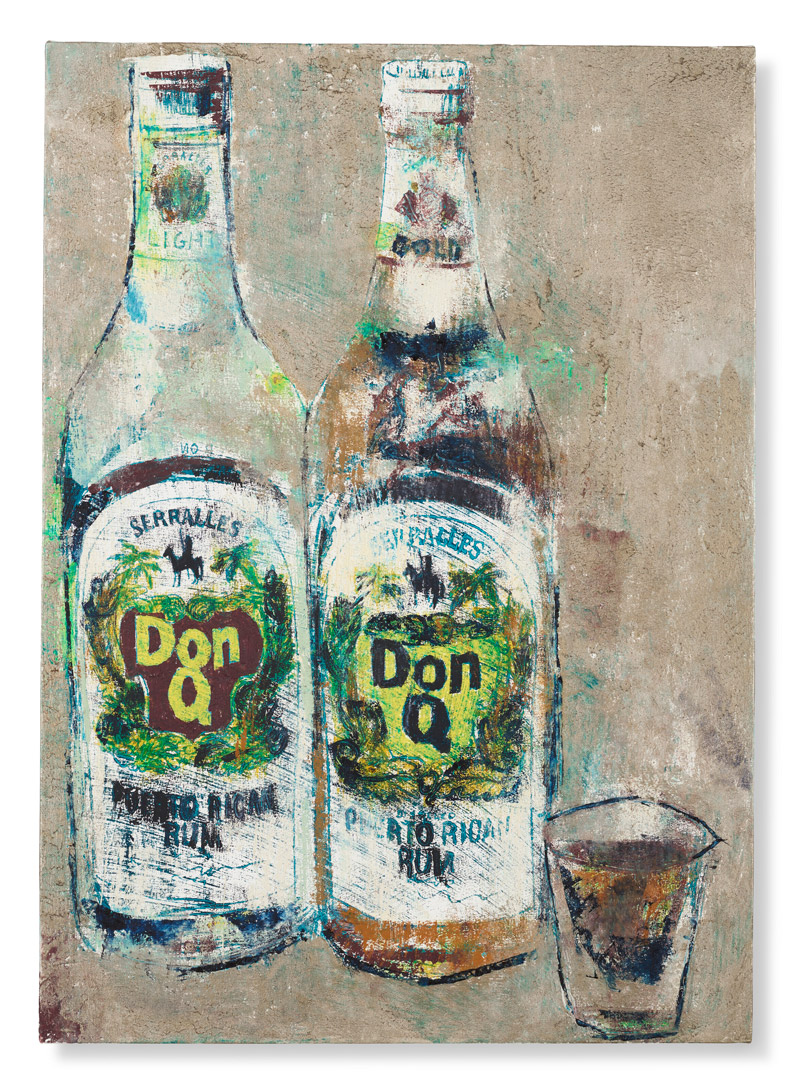
Medium: Oil on canvas, various sizes
Size: Ranges from 40×30″ to 60×80″
Location: Various collections; exhibited at Danziger Gallery, Acquavella, Ben Brown
Visual signature: Puerto Rican rum bottles rendered in off-register layers, drippy paint, discordant palettes
Why it matters: Artist compared these to self-portraiture. Cultural identity through consumer products.
Related works: Ron Bacardi paintings, Ronrico bottles, tropical drink still lifes
Met Life Building, New York (2006)
Medium: Oil on canvas
Size: 106×86″ (269.2×218.4 cm)
Location: Private collection (sold Sotheby’s)
Visual signature: Monumental scale, building in saturated tones with typical Perez vibration effects
Why it matters: Major scale demonstrates technique’s power at large dimensions. Controversial Pan Am Building rebranded as Met Life.
Related works: Other Midtown Manhattan towers, corporate architecture series
Exhibitions, Collections, and Provenance Highlights
Major Solo Exhibitions
2019: “The Cinematic Self,” Ben Brown Fine Arts, London (first UK show in decade)
2018: Dallas Contemporary, Texas
2017: UTA Artist Space, Los Angeles, “Embassies”
2015: Galerie Nathalie Obadia, Paris; Philip Johnson Glass House, “Lipstick”
2013: Acquavella Galleries, New York, “The Good Days”
2012: Corcoran Gallery, Washington DC, “Utopia”
2007: Museum of Contemporary Art North Miami; Lever House Lobby Gallery, New York
2005: Faggionato, London, “Deluxe”
2002: Kunstverein Heilbronn, Germany, “Holiday”
Museums With Depth (3+ works)
Metropolitan Museum of Art, New York
Whitney Museum of American Art, New York
Museum of Contemporary Art, North Miami
British Museum, London
Yale University Art Gallery, New Haven
San Francisco Museum of Modern Art
Pennsylvania Academy of Fine Arts, Philadelphia
Corcoran Gallery of Art, Washington DC
Museum of Contemporary Art, San Juan, Puerto Rico
RISD Museum of Art
Hammer Museum, UCLA
Provenance Patterns
Primary dealers: Mitchell-Innes & Nash (early career), Acquavella Galleries, Ben Brown Fine Arts, Galerie Nathalie Obadia, Peter Blum Gallery, Leila Heller Gallery
Auction houses: Active secondary market through Sotheby’s, Christie’s, Phillips
Private collectors: Strong following among architecture enthusiasts, Latin American collectors, contemporary art institutions
Critical Reception Turning Points
1993: White Columns debut established downtown credentials
2002: “Dear Painter, paint me…” group show (Centre Pompidou, Kunsthalle Wien) validated figurative painting’s return
2007: Lever House site-specific show brought public visibility
2012: Acquavella representation elevated market position
2019: London solo show (Ben Brown) expanded European presence
Market & Reception
Auction Performance
Record: $374,500 (Havana Riviera Hotel, 2012, Sotheby’s New York)
Price bands by medium:
- Major oils (60×80″ and larger): $50,000-$375,000
- Mid-size oils (40×60″): $10,000-$50,000
- Works on paper: $5,000-$15,000
- Prints/multiples: $3,000-$10,000
Market activity: 200+ auction lots since 2006. Active secondary market with steady appreciation.
Period value variations:
- 1990s works: $5,000-$20,000 (rarer, smaller scale)
- 2000s architectural paintings: $15,000-$100,000 (peak transfer technique)
- 2010s+ brush paintings: $20,000-$150,000 (current production)
Authentication Considerations
Signature placement: Typically verso, often with title and date. Some works signed on edge.
Transfer technique verification: Pre-2010 works should show characteristic rubbed marks, ghost edges, registration shifts visible under magnification.
Brush period: Post-2010 works mix techniques; some areas show direct application alongside transfers.
Documentation: Works from major galleries (Acquavella, Nathalie Obadia, Ben Brown) have solid provenance. Early pieces may lack certificates.
Condition Patterns
Oil stick transfers are generally stable. Minimal craquelure due to relatively thin application and recent creation dates.
Watch for:
- Surface abrasion (matte finish shows scuffs easily)
- Frame pressure marks on canvas edges
- Fading in bright light (intense colors may shift over decades)
Most works are in excellent condition due to recent production and institutional/collector care.
Influence & Legacy
Upstream Influences
Andy Warhol: Printmaking-as-painting, architectural subjects (Empire State Building time-lapse film), commercial aesthetics
Jackson Pollock: Alternative mark-making methods, working beyond brushes
Jasper Johns: Encaustic transfer techniques, American iconography
Robert Rauschenberg: Combined processes, transfer drawings
Felix Gonzalez-Torres: Conceptual rigor with aesthetic pleasure, avoiding ethnic categorization
Richard Estes: Architectural subjects (though Perez rejected photorealist precision)
Downstream Influence
Perez’s career coincided with painting’s renewed legitimacy (post-1990s “death of painting” debates). His work validated:
Decorative beauty: Arguing against minimalist austerity or conceptual dryness
Hybrid techniques: Showing painting could borrow from printmaking without becoming illustration
Architectural subjects: Helping revive building paintings as contemporary subject matter
Caribbean modernism visibility: Brought Puerto Rican architectural heritage into art world focus
Artists Working in Related Territories
Tomma Abts: Abstract paintings using complex color layering (different subjects, similar process intensity)
Jules de Balincourt: Contemporary painter mixing architectural/landscape elements with saturated color
Jonas Wood: Interior/architectural paintings with graphic flatness and bold patterns
Yvonne Jacquette: Aerial city views with architectural subjects (more observational than Perez)
Cross-Domain Echoes
Photography: Andreas Gursky’s monumental architectural images share Perez’s interest in modernist structures as cultural symbols
Graphic design: Perez’s work influenced commercial approaches to vintage modernist aesthetics in branding and editorial design
Architecture discourse: His paintings appear in architectural publications, exhibitions, validating buildings as art subjects
How to Recognize a Perez at a Glance

Color saturation: Unnaturally vivid hues, especially pinks, purples, electric blues. Rarely uses muted tones.
Double edges: Look for ghost outlines offset from main contours. Transfer misregistration creates optical vibration.
Flat space: Buildings sit on picture plane, minimal depth illusion. Sky and architecture feel like stacked color zones.
Matte surface: Pre-2010 works have dry, almost fresco-like finish. Post-2010 paintings may show brush gloss in passages.
Subject matter: If it’s a mid-century modernist building (especially International Style) in tropical colors, consider Perez.
Mark quality: Pre-2010: Short, rubbed strokes with varied density. Post-2010: Mix of transfer marks and direct brush drags.
Signature: Usually verso with title and date in handwriting. Check under “Enoc Perez” format (sometimes just surname).
Canvas size: Commonly 40×60″ or 60×80″ for architectural subjects. Smaller (18×24″) for studies or still lifes.
Architectural framing: Buildings often centered, occupying 70-80% of the canvas. Minimal foreground or sky beyond structure.
Windows as rhythm: Repeated window patterns create visual rhythm through color contrast variations within architectural grid.
FAQ on Enoc Perez
What is Enoc Perez known for?
Enoc Perez is best known for his vibrant paintings of modernist architecture. He depicts buildings like Lever House and the Seagram Building using a unique transfer technique that makes structures shimmer with nostalgic color, capturing mid-century utopian optimism.
What painting technique did Enoc Perez invent?
For twenty years, Perez applied oil stick to paper backs, then pressed sheets onto canvas, retracing drawings to transfer pigment. This printmaking-inspired method created ghost edges and registration shifts without using brushes until 2010.
Where was Enoc Perez born?
Perez was born in San Juan, Puerto Rico in 1967. His father worked as an art critic, taking the family on museum visits across countries. He moved to New York in 1986 to study at Pratt Institute.
Which museums own Enoc Perez paintings?
Major collections include the Metropolitan Museum of Art, Whitney Museum of American Art, Museum of Modern Art, British Museum, Yale University Art Gallery, San Francisco Museum of Modern Art, and Pennsylvania Academy of Fine Arts.
What buildings does Enoc Perez paint?
He paints International Style landmarks: Lever House, UN Headquarters, Hearst Tower, Marina Towers, TWA Terminal, and Caribbean hotels like Caribe Hilton and Fontainebleau Miami Beach. These modernist buildings represent lost architectural optimism and tropical luxury.
How much do Enoc Perez paintings cost?
His auction record is $374,500 for “Havana Riviera Hotel” (2012). Major oils (60×80″) sell for $50,000-$150,000. Mid-size works (40×60″) range $10,000-$50,000. Prints and works on paper cost $3,000-$15,000.
Who influenced Enoc Perez’s art?
Andy Warhol‘s silkscreens inspired his transfer method. Jackson Pollock, Jasper Johns, and Robert Rauschenberg influenced his alternative mark-making approaches. Felix Gonzalez-Torres shaped his thinking about contemporary art categorization and aesthetic pleasure.
Does Enoc Perez still use his transfer technique?
After 2010, Perez reintroduced brushes following seventeen years without them. Current work combines transfer passages with direct brush application, creating hybrid surfaces that mix both methods. He described the shift as “burning down your own house.”
What subjects besides architecture does Perez paint?
He paints Puerto Rican rum bottles (Don Q, Ron Bacardi), tropical beach scenes, sensuous nudes, and celebrity interiors. His “Cinematic Self” series depicted Francis Bacon’s studio, David Bowie’s unmade bed, and Elvis Presley’s Jungle Room at Graceland.
Where does Enoc Perez live and work?
Perez lives and works in New York City, maintaining a studio in Long Island City since 1997. He also has a working space in East Hampton with a pool, allowing him to paint while his family is nearby.
Conclusion
Enoc Perez bridges Caribbean identity with modernist architecture through saturated color and invented technique. His paintings aren’t documentation but emotional portraits of buildings that once symbolized progress.
The transfer method he pioneered created a visual language distinct from both photorealism and abstract expressionism. Museum collections from the Whitney to MoMA validate his contribution to contemporary painting.
His auction record approaching $400,000 reflects growing market recognition. But the work matters beyond price.
Perez proved that architectural subjects could carry personal history, that decorative beauty wasn’t aesthetic failure, and that a Puerto Rican artist could define contemporary art without ethnic limitation. His studio practice continues pushing boundaries, mixing brushwork with his signature rubbed transfers.
The buildings he paints may be aging, but the utopian longing they represent remains achingly current.