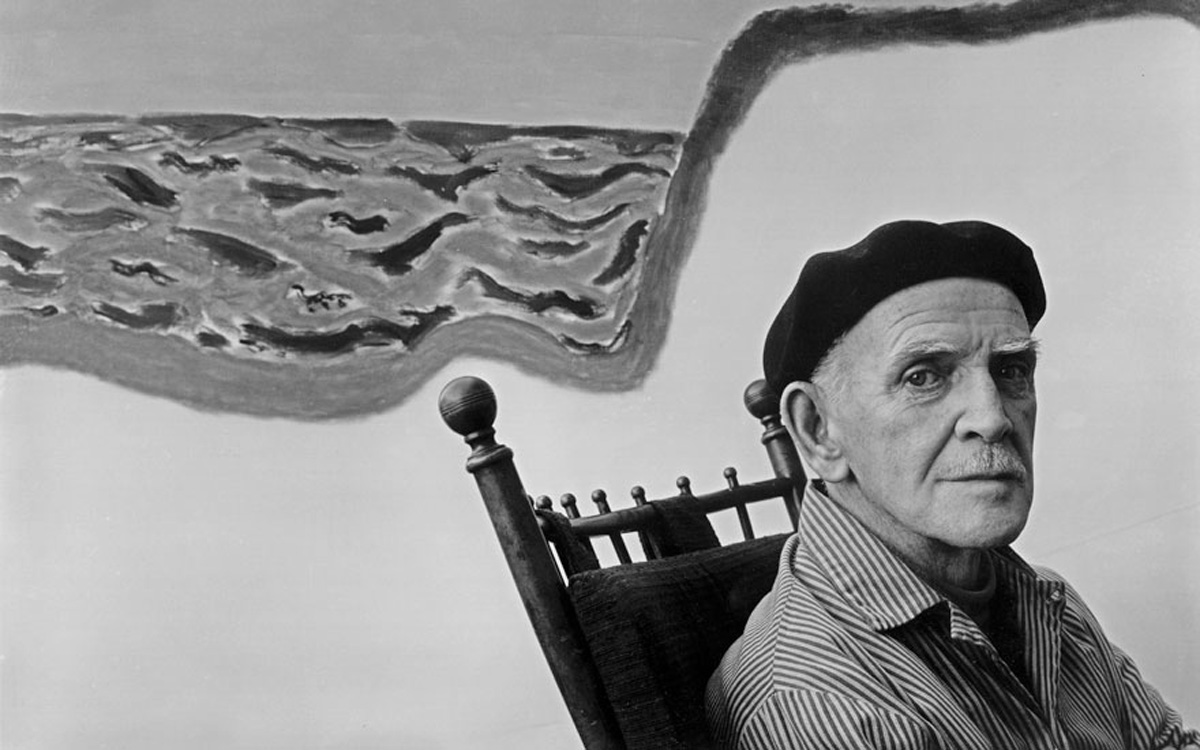

Milton Avery was an American modern painter who worked primarily in oils and watercolors. He created simplified figurative and landscape compositions that bridge Impressionism and Color Field painting.
Born in 1885 in Altmar, New York, Avery spent five decades producing landscapes, seascapes, and domestic scenes. His approach to color and flattened forms influenced Abstract Expressionists like Mark Rothko and Adolph Gottlieb.
Avery produced around 1,000 oil paintings and thousands of works on paper. His pieces hang in the Whitney Museum of American Art, the Museum of Modern Art, the Phillips Collection, and the National Gallery of Art.
Identity Snapshot
Full Name: Milton Clark Avery
Lifespan: March 7, 1885 – January 3, 1965
Primary Roles: Painter, printmaker, draftsman
Nationality: American
Movements: American Modernism, transitional figure between Impressionism and Abstract Expressionism
Mediums: Oil on canvas, watercolor, gouache, monotype, woodcut, drypoint
Signature Traits: Flat color planes, thinned pigments, simplified shapes, muted tonal harmonies, soft-edge contours
Recurring Motifs: Seascapes, beaches, domestic interiors, family portraits, birds, coastal landscapes
Geographic Anchors: Altmar (NY), Hartford (CT), New York City, Provincetown (MA), Gloucester (MA), Vermont, Maine, Gaspe Peninsula (Quebec)
Key Relationships: Sally Michel Avery (wife, artist), March Avery (daughter, artist), Mark Rothko, Adolph Gottlieb, Barnett Newman, Roy Neuberger (collector/patron)
Major Collections: Whitney Museum of American Art, Museum of Modern Art, Phillips Collection, National Gallery of Art, Tate Gallery, Brooklyn Museum, Wadsworth Atheneum
Market Signals: Record auction sale of $6,069,500 for “The Letter” (1945) at Sotheby’s New York, 2022
What Sets Milton Avery Apart
Avery was called the “American Matisse.” But that label only tells part of the story.
He stripped his paintings down to bare essentials. Color, shape, the suggestion of a place or a person. Nothing more.
Where Henri Matisse radiated sensuality and hedonism, Avery worked with a quieter, almost ascetic restraint. His wife Sally said it best: “Matisse was a hedonist and Milton was an ascetic.”
He occupied an awkward position in the American art world for decades. Too abstract for the Regionalists. Too representational for the Abstract Expressionists.
Avery never fit. And he never tried to.
“I never have any rules to follow. I follow myself,” he said in 1952.
His pictorial space flattened into interlocking color fields. Figures became silhouettes. Landscapes reduced to three or four zones of close-valued hues.
This simplification anticipated Color Field painting by decades. Rothko credited Avery’s color sense directly. So did Gottlieb and Barnett Newman.

Origins and Formation
Early Years in Connecticut
Avery left school at 16. He worked factory jobs for the next decade: assembler, latheman, mechanic.
His father died in 1905. His brother-in-law died in 1915. Avery became the sole provider for nine female relatives.
He started art classes at the Connecticut League of Art Students around 1905. Originally enrolled for lettering. The school’s director, Charles Noel Flagg, convinced him to switch to life drawing.
Transition to Professional Practice
By 1917, Avery worked night jobs so he could paint during the day. He needed the natural light.
He won top honors in portrait and life drawing at the School of the Art Society of Hartford in 1919.
Starting in 1920, Avery spent summers painting in Gloucester, Massachusetts. The coastal light there would shape his entire career.
Meeting Sally Michel
He met Sally Michel at Gloucester in 1924. She was a young painter from Brooklyn.
They married in 1926 and moved to New York City. Sally worked as a freelance illustrator so Milton could paint full-time.
“The struggle to survive was sometimes a little grim,” Sally later recalled. “But my firm belief in Milton’s talent buoyed us over the dark days.”
Their daughter March was born in 1932. She appeared frequently in her father’s paintings.
First Recognition
The Phillips Collection purchased Winter Riders in 1929. It was the first museum acquisition of his work.
His first solo show opened at Valentine Gallery in 1935.
Collector Roy Neuberger bought over 100 Avery paintings, starting with Gaspe Landscape. He donated them to museums worldwide. This rotation through major institutions built Avery’s reputation steadily through the 1940s.
Movement and Context
Position Within American Art

Avery worked during a turbulent period. American Impressionism faded. Social Realism and Regionalism dominated the Depression years. Then Abstract Expressionism took over after World War II.
He fit none of these movements. His work stayed consistently representational but increasingly simplified.
Avery approached painting like a factory worker. His daughter March remembers him painting from breakfast until 5pm every day. One painting per day, sometimes more.
“Why talk when you can paint?” was his standard response to questions about his art.
Comparison to Peers
Avery vs. Edward Hopper: Both painted American scenes. But where Hopper used stark light and shadow to create psychological tension, Avery dissolved drama into soft color harmonies. Avery’s world contained no loneliness, no anxiety.
Avery vs. Rothko: Rothko pushed Avery’s color fields into pure abstraction. Avery always kept a reference to the visible world. Rothko’s edges blurred and bled. Avery’s shapes stayed distinct, interlocking like puzzle pieces.
Avery vs. Matisse: Both flattened space and used bold color. Matisse’s brushwork stayed more active and visible. Avery thinned his paint until it stained the canvas, leaving almost no visible texture.
Materials, Techniques, and Process
Supports and Grounds
Avery worked primarily on canvas, though he also used board and cardboard when money was tight.
During the Depression, he used whatever surfaces he could find. Bird and Sandspit (1961) was painted on card.
Paint Application
Early work (1920s): Thick impasto applied with palette knife. Enamel-like surfaces influenced by American Impressionists.
Mature work (1930s onward): Drastically thinned pigment with turpentine. Paint applied as stain rather than built-up surface. Raw canvas often visible through thin washes.
He developed a “wet over dry” technique. Subtly brushed dry grounds followed by wet staccato gestures for contour.
Working Process
Avery sketched outdoors, often in pencil and watercolor. He carried small canvases into the countryside or to beaches, working en plein air in his early years.
Later, he developed watercolor studies on location, then translated them to oil in his studio. Sometimes years passed between the original sketch and the finished painting.
His sketchbooks became visual diaries. Portraits of friends, domestic scenes, travel observations.
Palette Characteristics
Early palette: Sun-drenched, high-key colors influenced by American Impressionists. Blue-green dominance.
s palette: Darker, more muted. Close-valued hues with occasional accent colors.
Late palette: Subtle, unexpected color combinations. Non-naturalistic choices. Pinks against browns. Blacks beside warm taupes.
He treated negative shapes as positive forms. Background and subject carried equal visual weight.
Themes, Subjects, and Iconography
Recurring Subjects
Avery never invented imagery. Everything came from direct observation.
Domestic life: His living room, Sally reading, March playing, friends visiting.
Coastal scenes: Beaches, waves, dunes, boats. Provincetown, Gloucester, Maine.
Portraits: Sally appeared constantly. Friends posed. But likeness mattered less than shape and color arrangement.
Birds: Flying birds, shore birds, bird silhouettes against sky.
Compositional Approaches
Three-zone compositions dominated his seascapes. Sky, sea, sand. Or sea, wave, shore.
He used a “worm’s eye view” perspective in many works. Low horizon lines, figures seen from below.
Shapes interlocked like jigsaw puzzles. No element existed independently.
Emotional Register
Art historian Barbara Haskell noted that “serenity and harmony” characterized all of Avery’s work.
No war. No Depression misery. No anxiety. His paintings present a world of “low-key emotions from which anger and anxiety were absent.”
This wasn’t denial. It was deliberate selection. He eliminated everything unnecessary from both his art and his life.
Notable Works
Artist’s Wife (1945)

Medium: Oil on canvas
Location: National Gallery of Australia, Canberra
Significance: Demonstrates Avery’s mature approach to portraiture. Sally appears as color and form rather than detailed likeness. Tender color arrangements over literal representation.
Black Sea (1959)
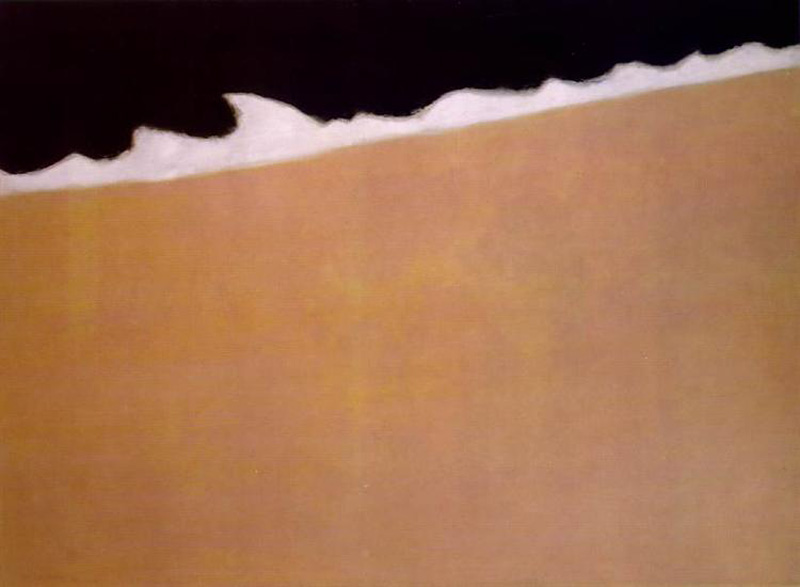
Medium: Oil on canvas
Size: Large scale
Location: Phillips Collection, Washington D.C.
Visual signature: Three horizontal bands. Inky black sea at top, narrow white wave band, warm taupe sand below. No figures.
Significance: One of Avery’s most abstracted works. Near-total elimination of detail. Only title confirms landscape reference. Monumental scale reflects influence of Abstract Expressionist contemporaries.
The Letter (1945)
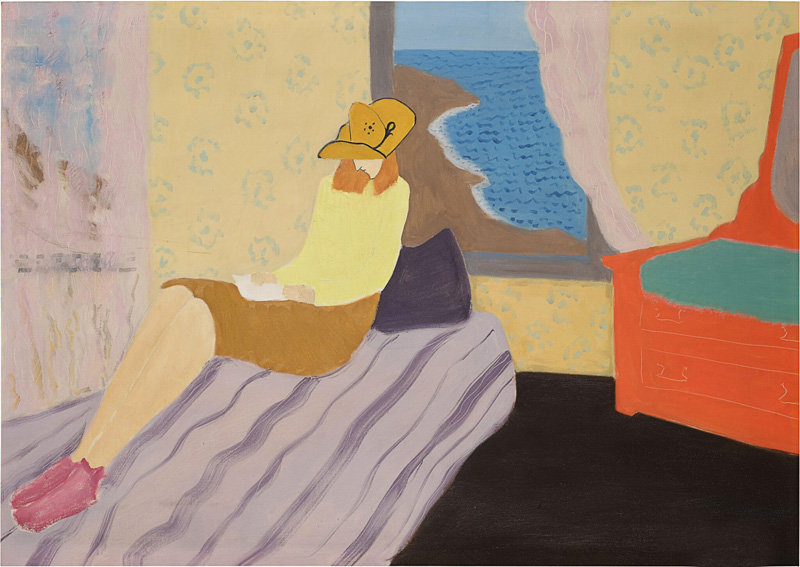
Medium: Oil on canvas
Location: Private collection
Market note: Set auction record of $6,069,500 at Sotheby’s New York in 2022.
Significance: Interior domestic scene representing Avery’s mature figurative style at its most refined.
Gaspe Landscape (1938)
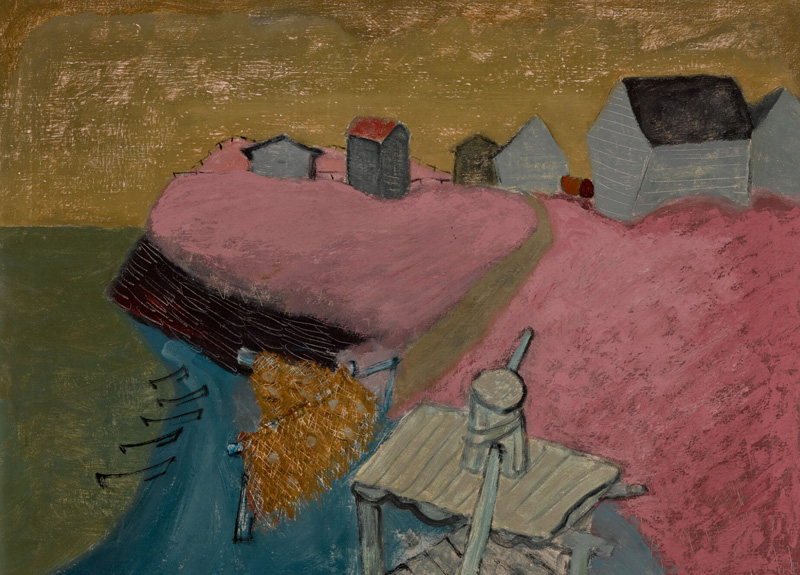
Medium: Oil on canvas
Significance: First Avery painting purchased by collector Roy Neuberger. Began the systematic promotion that built Avery’s museum presence.
Green Sea (1954)

Medium: Oil on canvas
Significance: Exemplifies Avery’s increasingly abstract late style. Referenced by artnet as showing his “increasingly abstract style.”
Exhibitions, Collections, and Provenance
Milestone Exhibitions
1927: First public exhibition at Opportunity Gallery group show (with Mark Rothko)
1935: First solo show, Valentine Gallery, New York
1944: First solo museum exhibition, Phillips Collection, Washington D.C.
1952: First large-scale retrospective, Baltimore Museum of Art (85 works). Traveled to Washington D.C., Hartford, Boston.
1960: Retrospective, Whitney Museum of American Art
2021-2022: Major retrospective organized by Royal Academy of Arts, London. Traveled to Modern Art Museum of Fort Worth and Wadsworth Atheneum.
Museum Collections with Depth
Phillips Collection (Washington D.C.): First museum to acquire his work. Multiple holdings.
Whitney Museum of American Art: Significant collection, hosted 1960 retrospective.
Museum of Modern Art (New York): Multiple works across career periods.
National Gallery of Art (Washington D.C.): Extensive print collection including gift from Avery family.
Wadsworth Atheneum (Hartford): Homecoming venue. Avery took first art classes nearby.
Brooklyn Museum, Tate Gallery, Hirshhorn Museum, Art Institute of Chicago, Los Angeles County Museum of Art.
Gallery Representation

Historical: Valentine Gallery, Paul Rosenberg Gallery, Durand-Ruel Galleries, Grace Borgenicht Gallery, DC Moore Gallery
Current: Karma (US), Victoria Miro (London), Xavier Hufkens (Brussels)
Estate and Archives
Personal papers donated to Archives of American Art, Smithsonian Institution by Sally Avery after his death.
No catalogue raisonne exists. Estate estimates approximately 1,000 oil paintings and several thousand works on paper.
Market and Reception
Auction Performance
Record sale: $6,069,500 for The Letter (1945), Sotheby’s New York, 2022
Price range: Realized prices from $15 to over $6 million depending on medium, size, and period.
Recent averages: Paintings average around $102,312. Works on paper average around $18,184.
Critical Reception History
s-40s: Admired by fellow artists but commercially marginal. Too abstract for Social Realism era.
Early 1950s: Eclipsed by Abstract Expressionism. Considered too representational.
Late 1950s: Critical support increased. Sales improved.
s-present: Recognized as bridge figure between representational and abstract traditions. Increasing market interest.
Authentication and Identification
Milton Avery Trust manages authentication.
Signature typically lower left or right, often with date.
Early works show thicker impasto. Later works show characteristic thinned paint with visible canvas ground.
Influence and Legacy
Upstream Influences
American Impressionists: John Henry Twachtman, Ernest Lawson (plein air practice, light effects)
European Modernists: Henri Matisse (flattened space, bold color), Pablo Picasso (simplified forms)
Fauvism and German Expressionism: Early work resembles Ernst Ludwig Kirchner
Paul Cezanne: Use of hue to express form and space
Downstream Influence
Mark Rothko: Absorbed Avery’s color sense through regular studio visits. Wrote the most vivid summation of Avery’s achievement after his death.
Adolph Gottlieb: Close friend from late 1920s. Credited Avery’s color approach.
Barnett Newman: Part of Avery’s circle. Influenced by his chromatic experiments.
Alex Katz and Wolf Kahn: Formal inventions trace directly to Avery.
Katherine Bradford: Contemporary painter adopting aspects of Avery’s brushwork and aquatic themes.
Gary Hume: Told curator Edith Devaney that “Avery taught me everything I know about colour.”
Broader Cultural Impact
Color Field painting emerged partly from Avery’s experiments with flat, uniform washes of color.
Hans Hofmann said in 1952: “Avery was one of the first to understand colour as a creative means. He was one of the first to relate colours in a plastic way.”
The Milton and Sally Avery Arts Foundation gives hundreds of thousands of dollars annually in arts education grants.
How to Recognize a Milton Avery at a Glance

Flattened picture plane: No illusion of depth. Shapes sit on surface like cutouts.
Interlocking forms: Figures and backgrounds fit together like puzzle pieces. Negative space has equal weight.
Thinned paint: Later works show raw canvas through diluted pigment. Almost watercolor effect in oils.
Close-valued hues: Colors of similar value placed side by side. Subtle rather than high-contrast.
Soft edges: No hard outlines. Forms defined by color meeting color.
Simplified silhouettes: Figures reduced to essential shapes. Details eliminated.
Horizontal banding: Seascapes often divide into three or four horizontal zones.
Low horizon lines: “Worm’s eye view” perspective in many compositions.
Earthy palette base: Raw sienna, burnt sienna, ochre, muted greens. Occasional high-chroma accents.
Signature placement: Usually lower left or right corner, often with date.
FAQ on Milton Avery
Who was Milton Avery?
Milton Avery (1885-1965) was an American modern painter known for simplified forms and bold tonal harmonies. He worked in New York City and became a bridge between American Impressionism and abstract painting movements.
What is Milton Avery best known for?
Avery is celebrated for his flattened landscapes, seascapes, and domestic scenes. His unique approach to color theory and tonal relationships influenced Color Field painters. He stripped subjects to essential shapes and muted palettes.
What style did Milton Avery paint in?
Avery developed a personal style blending representational subjects with near-abstract simplification. His painting style combined Fauvist color with flattened picture planes. He never fully committed to any single movement.
How did Milton Avery influence other artists?
Mark Rothko, Adolph Gottlieb, and Barnett Newman visited Avery’s studio regularly. They absorbed his color sense and flat composition techniques. His work directly shaped Color Field painting’s development in America.
What are Milton Avery’s most famous paintings?
Black Sea (1959), The Letter (1945), and Green Sea (1954) rank among his best-known works. His Gaspe Landscape launched collector Roy Neuberger’s campaign to place Avery in major museum collections.
Where can I see Milton Avery’s artwork?
The Whitney Museum of American Art, Phillips Collection, Museum of Modern Art, and National Gallery of Art hold significant collections. The Tate Gallery, Brooklyn Museum, and Wadsworth Atheneum also display his paintings and prints.
How much are Milton Avery paintings worth?
Prices range from under $1,000 for prints to millions for major oils. His auction record stands at $6,069,500 for The Letter (Sotheby’s, 2022). Works on paper average around $18,000 at recent sales.
What techniques did Milton Avery use?
Avery thinned oil paint with turpentine until it stained canvas like watercolor. He eliminated texture and detail, using close-valued hues to create soft contrasts. Early work featured palette knife impasto.
Why is Milton Avery called the American Matisse?
Both artists flattened space and prioritized color over realistic depiction. But Avery worked with quieter restraint. His wife Sally noted: “Matisse was a hedonist and Milton was an ascetic.” The comparison has limits.
Did Milton Avery have family members who were artists?
His wife Sally Michel Avery was a painter and illustrator who supported the family financially. Their daughter March Avery became a painter too. Both appeared frequently as subjects in Milton’s domestic scenes.
Conclusion
Milton Avery carved out a singular path through 20th century American art. He refused to follow trends.
His flat color planes and simplified forms created a visual language that spoke to generations of painters after him. The quiet serenity in his coastal landscapes and domestic interiors feels just as fresh now as it did decades ago.
Avery proved that representational painting could push toward minimalism without losing emotional resonance. His influence on hue relationships and balance in composition remains visible in contemporary art today.
Sometimes the quietest voices leave the longest echo.