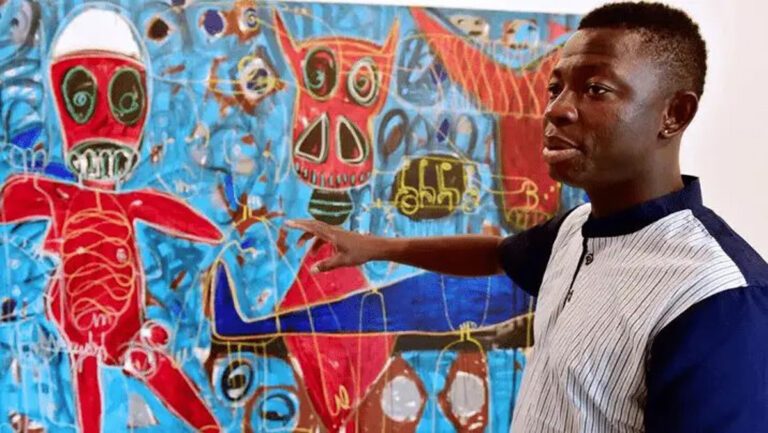
Slawn is a British-Nigerian artist who merges street art with abstract expressionist sensibilities. Born Olaolu Akeredolu-Ale in Lagos, Nigeria, in 2000, he rose from skate culture roots to become one of the most talked-about young creatives in London’s contemporary art scene.
His work sits at the intersection of graffiti, large-scale canvases, and provocative social commentary. Cartoon-like caricatures. Bold spray paint applications. Vivid color explosions.
The art world took notice fast. In 2023, Slawn became the youngest person ever to design the Britannia statuette for the BRIT Awards. He was also the first Nigerian-born artist to receive that commission. His trajectory from handing out paintings at parties to selling work at Sotheby’s happened in just a few years.
Identity Snapshot
- Full Name: Olaolu Akeredolu-Ale
- Known As: Slawn, Olaolu Slawn
- Born: October 24, 2000, Lagos, Nigeria
- Primary Roles: Painter, Designer, Street Artist
- Nationality: British-Nigerian
- Movements: Neo-Expressionism, Street Art, Abstract Expressionism
- Mediums: Spray paint on canvas, oil stick, acrylic, ink, mixed media
- Signature Traits: Caricature figures, exaggerated facial features, bold color palettes, cartoon-like forms
- Recurring Motifs: Distorted faces, pop culture references, minstrel imagery reappropriation
- Geographic Anchors: Lagos (birthplace), London (primary studio)
- Key Mentors/Connections: Virgil Abloh (recognition), Skepta (collaborator)
- Collections: Private collections globally, Saatchi Yates representation
- Auction Record: $40,218 USD for “Alara, Ajero and Orangun” at Sotheby’s London (2024)
What Sets Slawn Apart
He refuses to call himself an artist. This is not false modesty. It is a stance.
Slawn operates outside traditional gallery systems while simultaneously being courted by them. His work carries the raw energy of graffiti murals but addresses weighty subjects like race, identity, and colonial legacy. The playful surface masks serious inquiry.
Where Jean-Michel Basquiat channeled raw emotional intensity through text-heavy canvases, Slawn delivers his punch through distorted, cartoon-inflected faces. Both share that urgency. That refusal to polish away rough edges.
His irreverence extends to distribution. Fight clubs where fans brawl for free artwork. Paintings delivered in plastic bags, unstretched. Mass giveaways on Instagram. This approach inverts the scarcity model that drives most art market value.
The controversial element cannot be ignored. He deliberately reappropriates imagery associated with historical racist caricatures, particularly minstrel-era depictions. His intent is reclamation, not reinforcement. Taking something hateful and wrestling control of its meaning.

Origins and Formation
Lagos Beginnings
Slawn grew up in Lagos, Nigeria. His creative path started at Wafflesncream, Nigeria’s first skate shop. He worked there in his late teens, making designs, skating, filming with friends.
This was not formal art education. It was immersion in skate culture, streetwear, and DIY creative practice.
Motherlan and Early Recognition
With friends Leo and Onyedi, he co-founded Motherlan, a streetwear apparel brand. The label gained traction in Nigeria. Virgil Abloh noticed. That recognition from one of fashion’s most influential figures signaled something significant was happening.
Move to London
In 2018, Slawn relocated to London. He enrolled at Middlesex University in 2019 to study graphic design.
Then the pandemic hit.
Lockdown Transformation
COVID-19 lockdowns pushed him toward painting. He started handing artwork to people at parties. Built a social media following. The audience grew organically.
His first exhibition came in September 2021 at Truman Brewery. That show revealed his approach: playful visuals layered over serious social analysis.
Movement and Context
Between Street Art and Fine Art
Slawn’s work oscillates between street art traditions and expressionism. He does not fit neatly into either category.
The graffiti lineage is clear. Keith Haring, Banksy, and Basquiat all used street art as a vehicle for social commentary. Slawn continues that thread but filters it through his Nigerian-British identity and Yoruba heritage.
Comparative Positioning
Versus Keith Haring: Both use bold outlines and accessible imagery. Haring’s lines were cleaner, more graphic. Slawn’s marks are rougher, more chaotic. Haring worked during the AIDS crisis; Slawn addresses race and identity in the social media age.
Versus KAWS: Both engage with cartoon iconography and consumer culture. KAWS refines and stylizes. Slawn distorts and provokes. KAWS emerged from commercial design; Slawn from skate culture.
Versus Basquiat: The most frequent comparison. Both are Black artists working in raw, expressive modes. Basquiat layered text and symbols; Slawn relies more on figurative distortion. Basquiat’s palette was often darker; Slawn uses more saturated, vivid hues.
The Anti-Art Stance

His rejection of the artist label positions him in a lineage of anti-art movements. Dadaism questioned what art could be. Pop art blurred high and low culture.
Slawn takes this further by questioning whether he belongs in the conversation at all, even while major institutions court his work.
Materials, Techniques, and Process
Primary Mediums
Spray paint dominates. He combines it with oil stick, acrylic, and ink. Mixed media applications are common. One notable work, “Alara, Ajero and Orangun,” was executed on wax-print cotton cloth rather than traditional canvas.
Surface Approach
Canvas sizes range from small A4 formats (as in his 1,000 Canvases exhibition) to large-scale works exceeding 170 cm. He has painted on unconventional surfaces: double-decker buses, helicopters, a Cessna airplane, a Mercedes G-wagon, Bentley vehicles, and a Lancia Delta Integrale.
Application Style
Fast. Direct. The work often appears unpolished by design. Drips are left visible. Lines are loose. This is not sloppiness but a deliberate rejection of technical refinement as a measure of value.
Color Approach
His color choices lean saturated and bold. Vivid reds, electric blues, bright yellows. The palette creates visual impact at scale. Contrast is high. Subtlety is not the goal.
Signature Elements
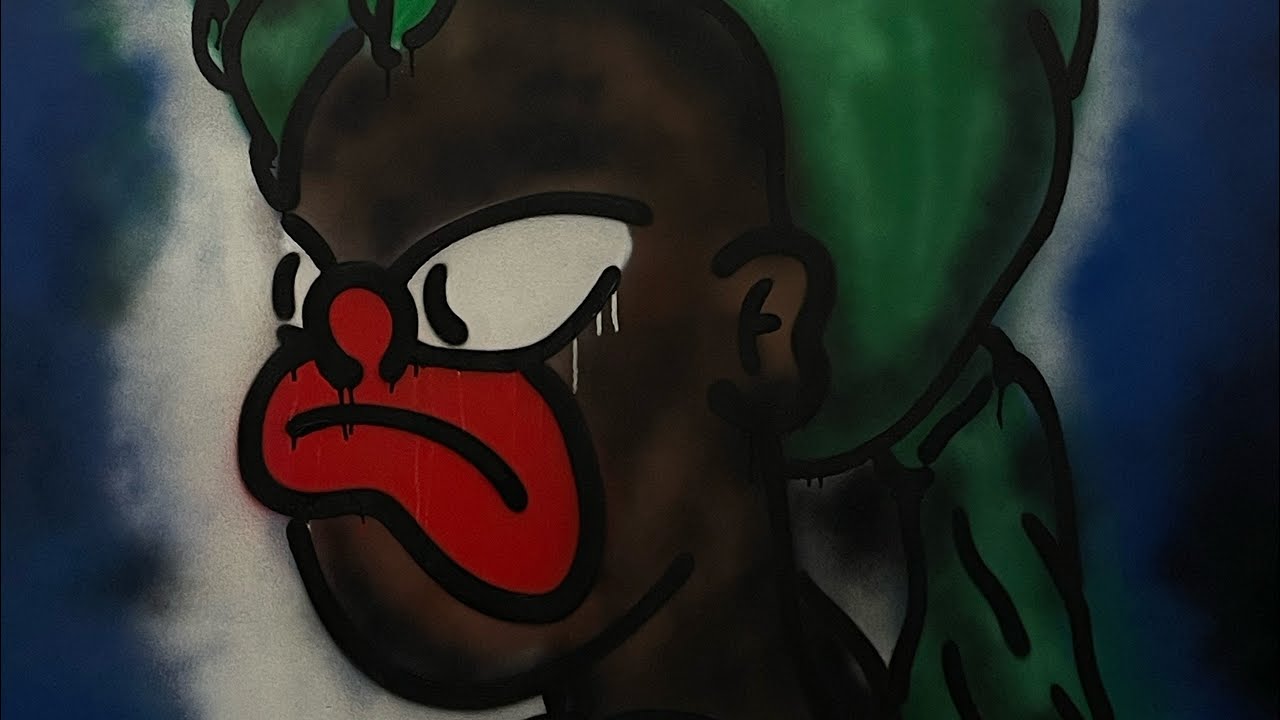
Exaggerated lips. Wide eyes. Distorted facial proportions. These recurring shapes and features form his visual vocabulary. The cartoon quality makes the work immediately recognizable.
Themes, Subjects, and Iconography
Race and Identity
Central to his practice. Slawn directly engages with anti-Black imagery, particularly caricatures from minstrel-era depictions. His figures echo the exaggerated features used historically to demean Black people. But he claims ownership of these forms, subverting their original intent.
This is reappropriation as artistic strategy.
Pop Culture Integration
Distorted Mickey Mouse figures appear. References to cartoons and popular media surface throughout. Like Andy Warhol and Roy Lichtenstein before him, Slawn pulls from mass culture. But where they maintained a cool distance, Slawn’s engagement feels more confrontational.
Nigerian Heritage

Yoruba mythology and Nigerian cultural references appear. “Alara, Ajero and Orangun” references three Yoruba triplets from mythology who founded important kingdoms. His heritage is not decoration but foundation.
Self-Portraiture
Self-portraits recur. Portraits of his son Beau appear. Family and personal identity anchor many works.
Compositional Tendencies
Figures often occupy the center. Backgrounds may be gestural and abstract or feature linear patterns resembling graffiti tags. The focal point is typically the face. Everything else supports that central distorted visage.
Notable Works
Bobo n Jarrad Go To Church (2022)

- Medium: Mixed media on canvas
- Auction: Sotheby’s “Contemporary Curated” sale, 2022
- Result: Sold for £27,720 (4x high estimate of £7,000)
- Significance: Auction debut. Curated by Skepta. Established market viability.
Alara, Ajero and Orangun (2023)

- Medium: Spray paint, oil stick, ink, acrylic on wax-print cotton cloth
- Size: 100 x 100 cm
- Auction: Sotheby’s London, 2024
- Result: $40,218 USD (auction record for artist)
- Subject: References Yoruba mythology of three kingdom-founding triplets
- Inscriptions: “My Nigerian Hell…Love Yourself Hate Myself… Amen…”
OKKK (2024)

- Exhibited: Saatchi Yates Gallery, 2024
- Subject: Caricatures of KKK gathering
- Significance: Demonstrates willingness to engage directly with racist imagery as subject matter
American Ice (2024)

- Exhibited: Saatchi Yates Gallery, 2024
- Subject: Simpsons-esque female figure against American flag
- Style: Pop culture meets political commentary
1,000 Canvases Installation (2024)
- Format: 1,000 individual A4-sized canvases
- Price: £1,000 each
- Venue: Saatchi Yates Gallery
- Concept: Democratized access to original work; each canvas features spray-painted face
Exhibitions, Collections, and Provenance
Solo Exhibitions
- 2021: Debut exhibition, Truman Brewery, London
- 2023: The Art Kiosk, Flannels collaboration
- 2024: “I present to you, Slawn” (also titled “Slawn: 1,000 Canvases”), Saatchi Yates Gallery, Bury Street, London (September 12 – October 20)
- 2024: GONE?, CIRCA screens, Piccadilly Circus and global locations
Major Auction Appearances
- 2022: Sotheby’s “Contemporary Curated” (auction debut, curated by Skepta)
- 2024: Sotheby’s Modern and Contemporary African Art sale
Representation
Saatchi Yates Gallery, London. Efie Gallery, Dubai.
Notable Commissions
- 2023 BRIT Awards statuette and set design
- 2024 FA Cup trophy redesign (with Thomas Lyte)
- Louis Vuitton collaboration (championed by Virgil Abloh)
- Dr. Martens partnership
- Wingstop collaboration
- Custom Rolex pieces
Market and Reception
Auction Performance
Record price: $40,218 USD for “Alara, Ajero and Orangun” at Sotheby’s London, 2024.
First auction result: £27,720 for “Bobo n Jarrad Go To Church,” which sold for four times its high estimate in 2022.
Average recent auction price: approximately $1,467 USD (past 12 months).
Price Bands
Small works (A4 canvases): £1,000 each at 2024 exhibition.
Medium spray paint on canvas works: Estimates typically £5,000 – £9,000 at auction.
Major works on unconventional supports: Higher estimates, stronger results.
Collector Base
Celebrity collectors include A$AP Rocky, Skepta, Central Cee, Wizkid, Tremaine Emory, and Mia Khalifa. Virgil Abloh was an early champion before his death.
Controversy
His appropriation of minstrel imagery draws criticism. Some view it as reclamation; others question the approach. The 2024 Sotheby’s sale of “Alara, Ajero and Orangun” sparked debate about race and racism in the art world.
In 2025, Slawn posted imagery suggesting a collaboration with KAWS. KAWS publicly denied involvement, calling the post misleading. Slawn later clarified the works were personal tributes, not a formal collaboration.
Influence and Legacy
Upstream Influences
Jean-Michel Basquiat: Raw expressionism, street-to-gallery trajectory, engagement with Black identity.
Keith Haring: Bold outlines, accessible imagery, public art distribution.
Kenny Scharf: Art car tradition, painting on vehicles, cartoon influences.
KAWS: Pop figure distortion, crossover between art and commercial culture.
Yoruba Visual Culture: Heritage influences subject matter and titles.
Downstream Impact
Too early to fully assess. But his model, building audience through Instagram, using fight clubs and giveaways, rejecting artist identity while operating in galleries, offers a template for emerging artists navigating the social media age.
His success signals appetite for work that is provocative, visually immediate, and rooted in specific cultural identity.
Cross-Domain Echoes
Fashion: Louis Vuitton, Dr. Martens, Dover Street Market collaborations.
Sports: FA Cup trophy redesign, BRIT Awards statuette.
Automotive: Art car projects with Lancia Delta Integrale, Bentley Continental GT, and other vehicles.
Hospitality: BeauBeau’s Cafe in East London, opened 2023, named after his son.
How to Recognize a Slawn at a Glance

- Distorted faces with exaggerated features, particularly enlarged lips and wide eyes
- Spray paint application with visible drips and loose handling
- Saturated, bold colors: electric blues, vivid reds, bright yellows
- Cartoon-like quality that appears playful on surface
- Caricature style echoing (and reclaiming) historical racist imagery
- Raw, unpolished finish: deliberate roughness in execution
- Centered figures with gestural or tag-like backgrounds
- Mixed media: spray paint combined with oil stick, acrylic, ink
- Signature placement: typically signed “Slawn” with date on reverse
- Unconventional supports: may appear on wax-print cloth, vehicles, or other non-canvas surfaces
FAQ on The Slawn
Who is Slawn?
Slawn is a British-Nigerian artist born in Lagos in 2000. He creates large-scale canvases, graffiti murals, and caricature paintings using spray paint. His work blends street art with abstract expressionist approaches while addressing race, identity, and politics.
What is Slawn’s real name?
His full name is Olaolu Akeredolu-Ale. He goes by Slawn or Olaolu Slawn professionally. The name Slawn has become synonymous with his bold, cartoon-like aesthetic and provocative social commentary in the contemporary art scene.
Where is Slawn from?
Born in Lagos, Nigeria, Slawn moved to London in 2018. He studied graphic design at Middlesex University. His Yoruba heritage and Nigerian upbringing directly influence his subject matter, titles, and visual approach to painting.
What type of art does Slawn create?
Slawn produces spray paint canvases, mixed media works, and murals. His style features distorted caricature faces with exaggerated features. He also paints vehicles, including a Lancia Delta Integrale, helicopters, and luxury cars as art car projects.
Why does Slawn refuse to call himself an artist?
He views it as respectful to formally trained painters. Slawn has no academic art education. He started painting during the 2020 lockdown, handing work to people at parties. The anti-art stance aligns with his outsider approach to the gallery system.
What is Slawn’s fight club?
Slawn hosts events where followers physically compete for free artwork. Winners walk away with original paintings. These viral art giveaways reject traditional scarcity models. The concept gained massive attention on Instagram and built his cult following.
What is Slawn best known for?
Designing the 2023 BRIT Awards Britannia statuette. He was the youngest and first Nigerian-born artist to receive that commission. He also redesigned the FA Cup trophy in 2024 and has collaborated with Louis Vuitton.
How much does Slawn’s art cost?
Prices vary widely. His 1,000 Canvases exhibition sold A4 works at £1,000 each. At auction, his record is $40,218 USD for “Alara, Ajero and Orangun” at Sotheby’s London in 2024. Estimates typically range £5,000 to £9,000.
Where can you see Slawn’s artwork?
Saatchi Yates Gallery in London represents him. His work appears at Sotheby’s auctions and Efie Gallery in Dubai. CIRCA displayed his pieces on screens in Piccadilly Circus, Tokyo, Seoul, and other global locations during his GONE? exhibition.
What brands has Slawn collaborated with?
Major partnerships include Louis Vuitton (championed by Virgil Abloh), Dr. Martens, Flannels, Dover Street Market, and Wingstop. He created custom Rolex pieces and designed merchandise with eBay. Fashion and streetwear remain central to his practice.
Conclusion
Slawn represents something new in the contemporary art world. An outsider who built his audience through Instagram, fight clubs, and sheer audacity rather than traditional gallery pathways.
His neo-expressionist canvases challenge viewers. The distorted caricatures force uncomfortable conversations about race and reclamation.
From Motherlan streetwear in Lagos to Saatchi Yates representation in London, his trajectory defies convention. Celebrity collectors like A$AP Rocky and collaborations with Louis Vuitton confirm his cultural reach.
Whether you call it art or not, Slawn has made his mark. The art world had to make room.