Campbell’s Soup cans hanging in museums. Marilyn Monroe’s face repeated fifty times across a canvas.
These famous pop art paintings transformed everyday objects and celebrity portraits into museum-worthy masterpieces during the 1960s.
Artists like Andy Warhol and Roy Lichtenstein rejected abstract expressionism to celebrate consumer culture, comic books, and mass media. Their bold colors and screen printing techniques challenged what art could be.
This guide explores ten iconic works that defined the movement.
You’ll discover the stories behind each painting, the techniques artists used, and why these pieces continue to influence contemporary art and popular culture today.
Famous Pop Art Paintings
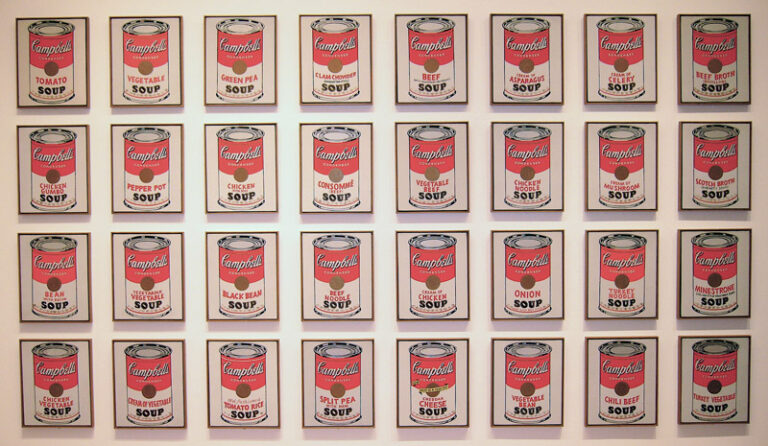
Campbell’s Soup Cans

Artist and Creation Year
Andy Warhol created this groundbreaking series between November 1961 and June 1962.
The work marks his transition from commercial illustration to fine art.
Current Location
Museum of Modern Art in New York acquired the complete 32-canvas set in 1996.
Irving Blum sold the collection for upwards of $15 million after purchasing it for just $1,000 in 1962.
Technique and Medium
Hand-painted with acrylic and metallic enamel on canvas.
Each canvas measures 20 x 16 inches. Despite appearing mass-produced, Warhol hand-stamped the fleur-de-lis pattern on each can’s base.
The series predates his famous silkscreen technique, which he adopted later in 1962.
Why It’s Iconic
First exhibited at Ferus Gallery in Los Angeles on July 9, 1962, the show transformed everyday objects into museum-worthy art.
The 32 canvases represented every soup flavor Campbell’s offered at the time. Warhol’s choice stemmed from personal connection: “I used to drink it. I used to have the same lunch every day for 20 years.”
The work challenged Abstract Expressionism, which dominated the art scene in the early 1960s.
Visual Elements
Classic red and white Campbell’s label design from 1898.
The cursive “Campbell’s” script resembled founder Joseph Campbell’s actual signature. Each canvas showed subtle variations despite appearing identical, with different flavors ranging from Tomato to Pepper Pot.
Color choices used Campbell’s signature palette plus the gold medallion won at the 1900 Paris Exposition.
Cultural Impact
Blurred boundaries between high art and commercial imagery.
The series sparked debates about what qualifies as art. Campbell’s Soup Company tacitly approved the work due to free marketing exposure.
Today, Campbell’s Soup Cans imagery appears on plates, mugs, neckties, and countless consumer products.
Market Value
Individual soup can paintings have sold for over $9 million.
The complete 32-canvas set’s $15 million sale in 1996 represented a 15,000% return on Blum’s original investment.
Marilyn Diptych

Artist and Creation Year
Andy Warhol completed this work in August 1962, just weeks after Marilyn Monroe’s death.
Created during a four-month period when Warhol made over 20 silkscreen paintings of the actress.
Current Location
Tate Modern in London houses this iconic portrait.
The work has been part of the Tate collection since acquisition and remains one of their most visited pieces.
Technique and Medium
Silkscreen print on canvas measuring 2054 x 1448 mm (over six feet by nine feet).
Warhol used a publicity photograph from Monroe’s 1953 film Niagara as the base image. The silkscreen process allowed him to reproduce the same image 50 times across two panels.
Left panel features 25 images in vibrant color. Right panel shows 25 images in black and white with progressive fading.
Why It’s Iconic
The work fuses two of Warhol’s recurring themes: death and celebrity culture.
The diptych format references Byzantine Christian paintings depicting saints. This elevated Monroe to saintly, immortal status while simultaneously commenting on her mortality.
First major work where Warhol used assembly-line silkscreen technique for art production.
Visual Elements
Five-by-five grid of Monroe’s face creates rigid composition.
Left side bursts with unrealistic colors: orange background, unnatural yellow hair, bright red lips, turquoise eyebrows. Monroe’s face appears as a mask with simplified features.
Right side fades from crisp black and white to nearly invisible, suggesting mortality and media oversaturation.
Each image shows slight variations due to the quasi-mechanical printing process.
Cultural Impact
Challenged notions of artistic authorship by using mechanical reproduction.
The repetition reduced Monroe to a consumer product, commenting on how celebrity images are commodified. Warhol’s approach influenced generations of artists exploring fame, media, and mass production.
Became one of the most recognizable works whether viewers know about pop art or not.
Market Value
While the original Marilyn Diptych is not for sale, related Warhol Monroe works command tens of millions at auction.
The 1967 Marilyn Monroe screenprint portfolio regularly sells for seven figures.
Whaam!

Artist and Creation Year
Roy Lichtenstein painted this work in 1963.
First exhibited at Leo Castelli Gallery in New York from September 28 to October 24, 1963.
Current Location
Tate Modern in London, where it has been on permanent display since 2006.
The Tate Gallery purchased the work in 1966, sparking heated debate among trustees and the public.
Technique and Medium
Acrylic and oil paint on canvas diptych.
Measures 173 x 406 cm (approximately 5.7 x 13.3 feet). Lichtenstein used an opaque projector to transfer comic imagery, then hand-painted using his signature methods.
Ben-Day dots created through pushing oil paint through holes in homemade aluminum stencils with a scrubbing brush.
Why It’s Iconic
Based on a panel from DC Comics’ All-American Men of War (1962 issue).
Lichtenstein transformed commercial imagery into large-scale fine art. The work appeared just before heavy U.S. involvement in Vietnam, potentially serving as war commentary.
Regarded for temporal, spatial, and psychological integration across its two panels.
Visual Elements
Left panel: Fighter plane with number 23 and American star insignia flying through clouds.
Yellow text bubble reads “I pressed the fire control…” Right panel: Explosive “WHAAM!” lettering in yellow dominates as enemy aircraft disintegrates in fiery burst.
Stereotyped imagery in bright primary colors with thick black outlines. Lichtenstein’s signature Ben-Day dots create texture and shading throughout.
Cultural Impact
Challenged boundaries between high and low art by elevating comic book imagery.
Created ambiguous commentary on war-celebrating action-movie thrills while potentially critiquing the dehumanization of violence. The work questions Cold War propaganda and romanticized war imagery in popular media.
Part of Lichtenstein’s broader exploration of consumer culture and mass media.
Market Value
As a Tate collection piece, not available for sale.
Comparable Lichtenstein war paintings from the 1960s have sold for tens of millions at auction.
Drowning Girl

Artist and Creation Year
Roy Lichtenstein created this work in 1963.
One of the most iconic works from his comic book series.
Current Location
Museum of Modern Art in New York.
The painting has become one of MoMA’s most recognized pieces.
Technique and Medium
Oil and synthetic polymer paint on canvas.
Measures 67 3/4 x 66 3/4 inches. Lichtenstein sourced the image from issue #83 of DC Comics’ Secret Hearts, illustrated by Tony Abruzzo.
He modified the original by removing background elements and changing the caption.
Why It’s Iconic
Features Lichtenstein’s signature Ben-Day dots for texture and gradients.
The melodramatic caption “I don’t care! I’d rather sink than call Brad for help!” became emblematic of pop art’s ironic approach to emotional content.
Perfectly captures the intersection of romance comics and fine art.
Visual Elements
Woman with stylized features being swept by a tumultuous wave.
Comic-book-style imagery with characteristic dots, thick outlines, and bold colors. All lines are diagonal, creating dynamic movement throughout the composition.
The simplified, flattened aesthetic reduces emotional complexity to graphic patterns.
Cultural Impact
Challenged traditional art world hierarchies by elevating commercial imagery.
Explored themes of female emotion in media through detached, mechanical techniques. The work became a defining symbol of 20th-century pop art.
Market Value
Part of MoMA’s permanent collection, not for sale.
Lichtenstein’s 1960s works regularly achieve eight-figure auction results.
Just What Is It That Makes Today’s Homes So Different, So Appealing?

Artist and Creation Year
Richard Hamilton created this collage in 1956.
Produced for the exhibition This Is Tomorrow at London’s Whitechapel Art Gallery.
Current Location
Kunsthalle Tübingen in Germany.
The work is recognized as one of the earliest pieces of British pop art.
Technique and Medium
Collage assembled from magazine clippings and advertisements.
Measures just 10.25 x 9.75 inches despite its monumental cultural impact.
Why It’s Iconic
Contains a lollipop with “POP” written on it, potentially giving the movement its name.
Hamilton defined pop art as “popular, transient, expendable, low-cost, mass-produced, young, witty, sexy, gimmicky, glamorous, and big business.” This collage embodied all those qualities.
Visual Elements
Muscular man holding oversized lollipop.
Pin-up woman on couch. Room filled with consumer products: television, tape recorder, vacuum cleaner, canned ham, Ford logo.
Comic book cover on wall. Every element sourced from American advertisements and magazines.
Cultural Impact
Launched pop art as a recognized movement before American artists adopted the style.
Critiqued post-war consumer culture and American materialism flooding Britain. Influenced both British and American pop artists who followed.
Market Value
Hamilton works from this period rarely appear at auction.
His influence on the movement makes this piece invaluable to art history.
A Bigger Splash

Artist and Creation Year
David Hockney painted this work in 1967.
Part of his swimming pool series created between 1964 and 1971 after moving to Los Angeles.
Current Location
Tate Gallery in London.
One of Hockney’s most celebrated California paintings.
Technique and Medium
Acrylic painting on canvas.
Hockney spent two weeks painting the splash alone, carefully rendering what appears to be a spontaneous moment.
Why It’s Iconic
Captures Southern California lifestyle and aesthetic.
The work freezes a fleeting moment of water movement with meticulous precision. Hockney explored representing water’s ever-changing surface across multiple pool paintings.
Visual Elements
Modernist house with palm trees and diving board.
Dramatic white splash against turquoise pool water. Clean geometric lines contrast with organic splash formation.
Flat planes of color create simplified, almost abstract composition.
Cultural Impact
Defined 1960s California cool in visual form.
Hockney’s related work Portrait of an Artist (Pool with Two Figures) sold for $90 million in 2018, setting a record for a living artist at the time.
Market Value
As a Tate collection piece, not available for purchase.
Hockney’s pool paintings rank among the most valuable works by living artists.
Look Mickey

Artist and Creation Year
Roy Lichtenstein created this painting in 1961.
Served as a bridge between his Abstract Expressionism work and his famous pop art pieces.
Current Location
National Gallery of Art in Washington, D.C.
Technique and Medium
Oil on canvas measuring 48 x 69 inches.
Based on an illustration from the children’s book Donald Duck: Lost and Found. First full use of all techniques Lichtenstein would employ for comic strip replicas.
First painting to feature Ben-Day dots for texture.
Why It’s Iconic
Donald Duck excitedly believes he caught a fish, but only hooked his own clothing.
Mickey Mouse chuckles secretly in the background. Critics regarded it as revolutionary for modern art and pop art culture.
Visual Elements
Bold primary colors with thick black outlines.
Comic book aesthetic with speech bubbles. Donald’s text reads “Look Mickey, I’ve hooked a big one!!”
Characteristic Ben-Day dots create shading and texture throughout.
Cultural Impact
Challenged distinctions between high and low culture by featuring Disney characters.
Demonstrated Lichtenstein’s playful engagement with themes of amusement and the everyday. Encouraged reconsideration of popular imagery’s value in the art world.
Market Value
Part of permanent museum collection, not for sale.
Lichtenstein’s early 1960s works command premium prices when available.
LOVE

Artist and Creation Year
Robert Indiana created the original design in 1966.
The image became one of the most reproduced artworks of the 20th century.
Current Location
Multiple versions exist in museums and public spaces worldwide.
The original painting is in the Indianapolis Museum of Art.
Technique and Medium
Various mediums including painting, sculpture, and prints.
The tilted “O” became Indiana’s signature element. Simple four-letter composition in bold sans-serif typeface.
Why It’s Iconic
Spelled out L-O-V-E in stacked format with the tilted “O”.
Created during the 1960s counterculture movement. The design appeared on an 8-cent U.S. postage stamp in 1973, selling over 300 million copies.
Visual Elements
Bold letters in red and blue against contrasting backgrounds.
Eye-popping text art reminiscent of highway signs and advertisements. Simple geometric composition with powerful visual impact.
Cultural Impact
Became an icon of the love generation and 1960s America.
Replicated in countless colors, media, and variations worldwide. The design transcended art world to become part of popular culture.
Market Value
Original paintings and sculptures sell for millions.
Prints and reproductions range from hundreds to tens of thousands of dollars.
Great American Nude Series

Artist and Creation Year
Tom Wesselmann created this series from 1961 to 1973.
Began after a dream featuring the phrase “red, white, and blue”.
Current Location
Works scattered across major museums and private collections worldwide.
Gagosian Gallery and Almine Rech represent the estate.
Technique and Medium
Mixed media including painting, collage, and assemblage.
Combined representational images with patriotic themes. Incorporated magazine clippings, billboard materials, and found objects.
Later works moved toward more graphic, stylized aesthetic.
Why It’s Iconic
Features reclining female nudes in interiors with red, white, and blue palette.
Integrated art historical references (especially Matisse) with pop culture. The series totaled 100 numbered works exploring sensuality and American identity.
Visual Elements
Flat, faceless female figures against patriotic colors.
Stars and stripes motifs throughout. Works often included collaged elements like American flags, portraits of founding fathers, and consumer products.
Bold, simplified forms with emphasis on composition over individual identity.
Cultural Impact
Challenged traditional nude painting by incorporating contemporary American imagery.
Wesselmann rejected the “pop artist” label but became central to the movement. The series explored intersection of sexuality, consumerism, and national identity.
Market Value
Individual Great American Nude paintings sell for millions at auction.
The complete series has never been sold as a set.
Flag

Artist and Creation Year
Jasper Johns painted this work between 1954 and 1955.
Created after Johns dreamed of painting an American flag.
Current Location
Museum of Modern Art in New York.
Gift of Philip Johnson in honor of Alfred H. Barr Jr.
Technique and Medium
Encaustic, oil, and collage on fabric mounted on plywood.
Measures 42 1/4 x 60 5/8 inches. Johns used cut-up newspaper extracts for the stripes, then painted over them with encaustic.
Text remains slightly visible beneath the paint surface.
Why It’s Iconic
One of the first works to blur boundaries between painting and object.
The flag is both a painting of a flag and a painted flag. Johns created numerous flag variations throughout his career.
Visual Elements
Accurate representation of the 48-star American flag.
Textured surface from encaustic technique and newspaper fragments. Patriotic red, white, and blue color scheme.
The flag fills the entire canvas with no background.
Cultural Impact
Challenged Abstract Expressionism’s dominance in the 1950s.
Transformed a familiar symbol into complex image loaded with political and cultural associations. Influenced development of pop art, minimalism, and conceptual art.
Market Value
Part of MoMA’s permanent collection.
Johns’ flag paintings rarely appear at auction; when they do, they command record prices exceeding $100 million.
FAQ on Famous Pop Art Paintings
What defines pop art paintings?
Pop art paintings use imagery from consumer culture, mass media, and advertising.
Artists like Andy Warhol and Roy Lichtenstein incorporated comic books, celebrities, and everyday objects. The style features bold colors, hard edges, and techniques like screen printing to challenge traditional fine art.
When did the pop art movement begin?
The movement emerged in Britain during the mid-1950s through the Independent Group.
It reached the United States by the late 1950s and peaked throughout the 1960s. Artists rejected Abstract Expressionism to celebrate popular culture and commercial imagery in their paintings.
Why did Andy Warhol paint Campbell’s Soup Cans?
Warhol chose Campbell’s Soup because of personal connection and visual appeal.
He said, “I used to drink it. I used to have the same lunch every day for 20 years.” The familiar imagery transformed everyday consumer products into museum-worthy art, challenging what qualified as fine art.
What techniques did pop artists use?
Screen printing, or silkscreen, became the signature method for mass-producing images.
Lichtenstein hand-painted Ben-Day dots through stencils to mimic comic book printing. Warhol adopted mechanical reproduction techniques to create assembly-line aesthetics. Artists also used collage, painting mediums, and bold graphic compositions.
How much are famous pop art paintings worth?
Original works by major artists command tens of millions at auction.
Warhol’s Campbell’s Soup series sold for over $15 million in 1996. Individual paintings routinely exceed $9 million. Hockney’s pool painting achieved $90 million in 2018, setting records for living artists.
What makes Marilyn Diptych iconic?
The work fuses Warhol’s themes of death and celebrity through 50 repeated images.
Created weeks after Monroe’s death in 1962, the diptych format references Byzantine saint paintings. Vibrant color panels contrast with fading black-and-white images, commenting on fame’s fleeting nature and media saturation.
Where can I see famous pop art paintings?
Museum of Modern Art in New York houses Warhol’s Campbell’s Soup Cans and Drowning Girl.
Tate Modern displays Whaam! and Marilyn Diptych. Major collections exist at Whitney Museum, Guggenheim, and galleries worldwide. Many iconic works remain in permanent museum collections.
How did pop art differ from Abstract Expressionism?
Pop art rejected emotional intensity and painterly gestures for detached, mechanical imagery.
Instead of inner feelings, artists depicted commercial culture and recognizable objects. The movement used hard edges and mass production techniques rather than spontaneous brushwork and personal symbolism characteristic of Abstract Expressionism.
What role did British artists play in pop art?
Richard Hamilton and Eduardo Paolozzi founded the movement through the Independent Group in 1952.
British pop art was more academic and ironic, examining American consumer culture from distance. Hamilton’s collage work potentially gave the movement its name through a lollipop labeled “POP.”
Why are pop art paintings still influential today?
The movement permanently changed how we view art’s relationship to popular culture.
Pop art techniques influence contemporary artists, advertising, and design. The questioning of boundaries between high and low art remains relevant. Celebrity portraits and commercial imagery continue dominating visual culture.
Conclusion
These famous pop art paintings represent a revolutionary moment when artists challenged traditional boundaries between high culture and mass media.
From Warhol’s silkscreen prints to Lichtenstein’s comic book imagery, each work transformed ordinary objects into cultural icons.
The movement’s exploration of color, repetition, and commercial aesthetics continues influencing contemporary artists today.
These masterpieces changed how we understand visual culture and artistic expression. Museums worldwide preserve these works as testaments to the 1960s artistic revolution.
Whether examining celebrity portraits or soup cans, pop art reminds us that beauty and meaning exist everywhere in modern life.
The bold colors and graphic techniques pioneered by these artists remain instantly recognizable decades later.