In 1999, Tracey Emin exhibited an unmade bed at Tate Modern and became the most talked-about artist in Britain overnight.
The installation included stained sheets, empty vodka bottles, used condoms, and cigarette butts. Critics called it outrageous. Some said it wasn’t art at all.
But that controversy launched one of the most significant careers in contemporary British art.
Tracey Emin transformed confessional art by turning intimate personal experiences into raw visual statements. Her autobiographical artwork spans acrylic painting, neon text installations, sewn applique, and provocative sculptures that challenge conventional boundaries.
This article examines Emin’s artistic evolution from Young British Artists movement provocateur to Royal Academy Dame. You’ll discover her distinctive techniques, major works, thematic obsessions, and lasting influence on feminist art and contemporary practice.
Identity Snapshot
Full Name: Dame Tracey Karima Emin DBE RA
Born: July 3, 1963, Croydon, Greater London, England
Primary Roles: Painter, Sculptor, Installation Artist, Printmaker, Filmmaker
Nationality: British (English mother, Turkish Cypriot father, British Romani heritage)
Movements: Young British Artists (YBA), Conceptual Art, Feminist Art, Confessional Art
Mediums: Acrylic painting, neon text, sewn applique, drawing, photography, film, sculpture
Signature Traits: Raw brushwork, exposed canvas, handwritten text integration, emotionally charged color choices (reds, blues, purples), loose figurative line
Iconography / Motifs: Unmade beds, female nudes, legs splayed open, vaginal imagery, handwritten confessions, tent structures, personal memorabilia
Geographic Anchors: Margate (childhood), London (studios), South of France (residence), Venice (2007 Biennale representation)
Mentors / Students / Patrons: Billy Childish (early partner), Sarah Lucas (collaborator), Jay Jopling (dealer), Charles Saatchi (collector), Elton John (collector), George Michael (collector)
Collections & Museums: Tate Modern, Museum of Modern Art New York, British Museum, Saatchi Collection, Scottish National Gallery of Modern Art, Pompidou Centre Paris
Market Signals: My Bed sold for £2.5 million (2014); Like A Cloud of Blood sold for £2.3 million (2022 record for painting); neon works typically £60,000-£378,000; common canvas sizes 72 x 72 inches to 80 x 110 inches
What Sets The Artist Apart

Emin turns bedroom detritus into cultural monuments.
Her confessional art practice strips away the protective membrane between private suffering and public display. While many contemporary artists reference autobiography, Emin doesn’t reference her life. She exhibits it. Unwashed sheets become sculpture. Handwritten diary entries become luminous neon declarations. The bed where she languished in alcoholic depression for four days becomes a Turner Prize nomination.
This isn’t expressionism filtered through aesthetic distance. It’s raw documentation with minimal mediation.
Emin produces work across multiple media including drawing, painting, sculpture, film, photography, neon text and sewn applique, but what separates her from both the YBA cohort and broader feminist art discourse is the unapologetic extremity of exposure. Her works are confessional, provocative, and transgressive, often portraying sexual acts and reproductive organs.
Where Frida Kahlo encoded personal pain in symbolic language, Emin literalizes it. Her paintings don’t suggest menstrual blood. They include it.
The artistic lineage runs through Egon Schiele’s graphic sexuality and Edvard Munch‘s psychological intensity, but Emin adds something neither male predecessor could: the lived experience of female vulnerability weaponized as aesthetic strategy. David Bowie once described Emin as “William Blake as a woman, written by Mike Leigh”.
Her neon works bend industrial signage toward intimate revelation. Hand-scrawled phrases like “I Promise To Love You” glow in candy-colored tubes, transforming the commercial medium of fairground advertising into emotional broadcast. The misspellings stay. The urgency reads authentic because it is.
Origins & Formation
Early Instability (1963-1980)
Emin and her twin brother Paul were born to an unwed mother, with their father married to someone else.
The family ran the Hotel International in Margate until financial collapse. Emin was raped at age 13, an event that influenced much of her later artwork.
She dropped out of school at 13, moved to London at 15, then returned to education at Medway College of Design (1980-82) to study fashion.
Artistic Awakening (1980-1989)
At Medway, she met expelled student Billy Childish and became associated with The Medway Poets. The punk poetry performance group shaped her raw confessional approach.
From 1983-86, printmaking studies at Maidstone College of Art. She graduated with a first-class degree in Printmaking.
1987: Moved to London for Royal College of Art. 1989: MA in painting.
Early work showed admiration for Schiele and Munch. Her first solo exhibition title, ‘My Major Retrospective 1963-1993’, included tiny photographs of art school paintings she’d destroyed, a ‘photographic graveyard’ revealing these influences.
Breakthrough Period (1993-1999)
1993: Opened The Shop with Sarah Lucas in Bethnal Green, selling handmade items and meeting future dealer Jay Jopling.
1994: “My Major Retrospective” at White Cube gallery. Exhibited personal artifacts including a pack of cigarettes an uncle was holding when he was killed in a car crash.
1995: Created “Everyone I Have Ever Slept With 1963-1995” – blue tent with appliqued names.
1997: Sensation exhibition at Royal Academy. Same year, drunkenly swore on live TV discussion program “The Death of Painting.”
1998: Created My Bed after four-day depressive episode.
1999: First US solo exhibition at Lehmann Maupin Gallery, entitled Every Part of Me’s Bleeding. Turner Prize nomination for My Bed.
Movement & Context
YBA Positioning

Emin came to prominence as one of the loose grouping of contemporary artists popularly referred to as YBAs (Young British Artists), alongside Damien Hirst, Sarah Lucas, and Angus Fairhurst.
But her trajectory diverged.
Damien Hirst: Cool conceptualism, industrial materials, death as abstraction. Tracey Emin: Hot emotionalism, personal materials, death as lived experience.
Sarah Lucas: Gendered provocation through found objects and crude visual puns. Tracey Emin: Gendered provocation through actual lived artifacts and written confession.
Where most YBAs embraced the ironic distance of pop art strategies, Emin rejected irony entirely. By casting herself as the primary star in her own psychodrama, she created a cathartic confessional scenario that spoke of love, pain and abandonment.
Technical Contrasts
Emin vs. Louise Bourgeois: Both mine trauma for material. Bourgeois transforms it through symbolic displacement (spiders for mother). Emin presents it as documentary evidence (the actual bed, the actual stains).
Emin vs. Kiki Smith: Smith depicts female bodies with clinical anatomical precision. Emin’s bodies dissolve into gestural abbreviation – three rushed lines suggest a torso, red scribbles become a face.
Emin vs. Carolee Schneemann: Schneemann’s body performances contextualize within art historical critique. Emin’s feel like emotional emergency broadcasts, art history be damned.
Feminist Art Discourse

Emin’s art has an immediacy and often sexually provocative attitude that firmly locates her oeuvre within the tradition of feminist discourse.
Yet she complicates easy feminist readings.
She doesn’t perform strength or reclamation. She performs vulnerability, neediness, romantic failure. At a time when it was still largely taboo to do so, Emin highlighted not only female sexual desire but female vulnerability.
This made her controversial even within feminist circles. Too messy. Too personal. Too much.
But that excess became the point.
Materials, Techniques, and Process
Canvas Work
Supports: Unprimed or lightly primed canvas, typically cotton. Large-scale works range from 60 x 72 inches to 80 x 110 inches. Smaller intimate pieces on canvas board.
Grounds: Minimal gesso application or raw canvas. Exposed fabric remains visible throughout finished work.
Medium: Primarily acrylic. Sometimes watercolor mixed with acrylic. Starting with the Purple Virgin (2004) acrylic watercolor series with their strong purple brush strokes depicting Emin’s naked open legs.
Brushwork Taxonomy
Linear abbreviation: Single confident strokes define entire limbs. No careful construction or anatomical precision. The essence captured, not the detail.
Wet-in-wet bleeding: Colors merge on canvas, creating soft atmospheric zones. Particularly evident in background washes.
Aggressive application: Emin wields her paintbrush like a tennis racquet, hitting the canvas with great, satisfying thuds, letting out short burst-like screams or grunts.
Drip retention: Allows paint runs to remain as marks of process. Vertical drips suggest temporal passage, emotional flux, bodily fluids.
Erasure gestures: Things are often scribbled over in Emin’s work. White paint obliterates previous marks, but ghost traces remain visible.
Palette Archetype
Dominant hues: Blood red, bruise purple, clinical white, shadow black, depression blue.
Value distribution: High-key whites dominate canvas field. Mid-value blues and grays create atmospheric depth. Low-value reds and blacks anchor figures.
Temperature bias: Cool backgrounds (whites, pale blues) contrast warm figure work (reds, flesh tones). This temperature opposition creates spatial separation without traditional modeling.
Color psychology drives choices. According to the artist, each neon has a different color that matches the feelings and message behind the work. Same principle applies to paintings.
Studio Practice
Process: Emin’s works can look simple or spontaneous, but are deeply layered with days or even months of overpainting.
She works at night, often alone with cats. No preparatory drawings on canvas. Direct application.
There is spontaneity in her application of paint, but the delineation between foreground and background suggests she revisits work, allowing the landscape to dry before responding to an urge to add figures.
Her longtime creative director Harry Weller will sometimes hide canvases to prevent her from overworking them.
Text integration: Handwritten phrases appear directly on canvas. Written last, after image completion. The words function as caption, confession, or contradiction to visual content.
Neon Technique
Emin starts by penning a phrase that best captures the sentiment she is feeling at that moment.
The handwriting remains exactly as written – left-handed, misspelled, urgent.
Pastel colored light tubes bent to mimic the artist’s handwriting spell out illuminated thoughts and feelings.
Industrial fabricators translate her script to bent glass tubing filled with neon or argon gas.
Colors chosen through synesthesia. “Some just can’t be pink and some can’t be white”.
Pink for tenderness, red for passion, blue for melancholy, white for purity or emptiness.
Textile Work
Sewn applique on blankets and tents. Hand-embroidered names, dates, phrases. The domestic craft technique (traditionally feminine, traditionally devalued) deployed for conceptual power rather than decorative purpose.
Fabric choices: cotton, felt, found textiles. Thread: whatever’s available. Stitching: irregular, visible, human-scaled labor evident in every mark.
Themes, Subjects, and Iconography
Recurring Motifs
The bed: In 1998 Emin spent several days languishing in bed as the result of depression. This became the origin point for her most famous work and an enduring symbol. Beds appear in paintings, installations, photographs. They represent intimacy, sexuality, vulnerability, depression, birth, death.
Female nude: Almost always self-portraiture. The woman she always paints is herself. Legs splayed, vagina visible, no modesty or classical idealization. The reclining nude tradition inverted from male gaze object to female subject’s self-documentation.
Handwritten text: Confessional phrases, love declarations, angry accusations, simple statements. The handwriting itself carries emotional weight – rushed, imperfect, immediate.
Margate: Seaside hometown appears constantly. Beach landscapes, pier structures, lighthouse images. Monoprints detailing her memories of Margate’s iconic buildings such as Margate Harbour, The Lido, and Light House.
Compositional Schemes
Centered isolation: Single figure occupies canvas center, surrounded by void. No environmental grounding beyond minimal bed or room suggestion.
Floating figures: Bodies untethered to ground plane. Ambiguous whether lying down (viewed from above) or floating in undefined space.
Edge dissolution: Figures fade at extremities. Hard edges reserved for core (torso, head). Limbs trail into atmospheric haze.
Symbol Sets & Meanings
Empty vodka bottles: Alcoholism, self-medication, destructive coping mechanisms
Condoms, pregnancy tests: Sexual activity, abortion, reproductive trauma
Cigarette packs: Addiction, working-class signifiers, her uncle’s death
Handwritten lists: Accounting, documentation, archive impulse
Birds: Freedom, flight, escape, soul, femininity
Cats: Companionship, independence, comfort
Thematic Clusters
Sexual identity: “Everyone I Have Ever Slept With 1963-1995” included everyone the artist had ever slept with – not just sexual partners but family, friends, anyone she’d shared a bed with. This complicated easy readings of promiscuity or confession.
Personal trauma expression: Recurring themes include rape and abortion, two experiences which she draws from her own life.
Female experience representation: Menstruation, pregnancy, abortion, sexual desire, heartbreak, aging – subjects traditionally excluded from fine art discourse.
Psychological depth: Depression, loneliness, neediness, romantic obsession. Emin describes her work as being about “rites of passage, of time and age, and the simple realisation that we are always alone”.
Notable Works
My Bed (1998)

Medium: Installation – box-frame bed, mattress, linens, pillows, various objects Size: Overall display dimensions variable (approximately 79 x 211 x 234 cm) Current location: Long-term loan to Tate from The Duerckheim Collection
Visual signature: The work consists of her bed with bedroom objects in a disheveled state, with bedsheets stained with bodily secretions and items from the artist’s room such as condoms, underwear with menstrual period stains, empty vodka bottles, slippers.
Why it matters: First created in 1998, it was exhibited at the Tate Gallery in 1999 as one of the shortlisted works for the Turner Prize. Though it lost to Steve McQueen, the work became a media sensation. It is perhaps the only artwork capable of challenging Damien Hirst’s The Physical Impossibility of Death in the Mind of Somebody Living as the most famous artwork to emerge from the YBA Movement.
Emin subjects to scrutiny one of the most abiding beliefs of art in Western modernism – the notion that art is always autobiographical, a reflection of the artist’s inner being.
Related works: Photographs of the artist trying to sleep (2019 exhibition), numerous paintings of beds and reclining figures.
Everyone I Have Ever Slept With 1963-1995 (1995)

Medium: Appliqued tent, mattress, light Size: 122 x 245 x 214 cm Current location: Destroyed in 2004 Momart warehouse fire
Visual signature: Blue tent structure with names stitched in applique inside. Viewers entered to read names illuminated by internal light.
Why it matters: Shown at Charles Saatchi’s Sensation exhibition held at the Royal Academy in London in 1997. The title’s sexual implication drew attention, but the work’s actual content was more nuanced – including family members, friends, and brief encounters.
Related works: The Tent (other tent structures), various embroidered blankets with names and dates.
I Promise To Love You (2007)

Medium: Neon Size: Heart-shaped, dimensions vary by installation Collections: Various editions, original sold for $220,000 at charity auction
Visual signature: Hand-scrawled text in red or pink neon forming heart shape.
Why it matters: Emin donated this red heart-shaped neon artwork for a charity auction to raise money for The Global Fund, which helps women and children affected by HIV/AIDS in Africa. The work sold for a record price $220,000.
Exemplifies her neon practice: intimate confession through commercial medium.
Related works: Love Is What You Want, I Want My Time With You (St Pancras Station, 2018), thousands of neon text pieces.
Like A Cloud of Blood (2022)

Medium: Acrylic on canvas Size: Large-scale (specific dimensions not publicly disclosed) Current location: Private collection
Visual signature: Post-cancer-treatment painting with raw emotional intensity. Limited palette, exposed canvas, gestural figure work.
Why it matters: Among the first paintings Emin made following her six-month recovery from cancer treatment, sold by the artist in October 2022 at Christie’s for £2,322,000 – a new record price for a painting by the artist.
Marks shift in practice following major health crisis. The vulnerability always present in her work became literal – bodily vulnerability, mortality, physical transformation.
Purple Virgin Series (2004-2005)

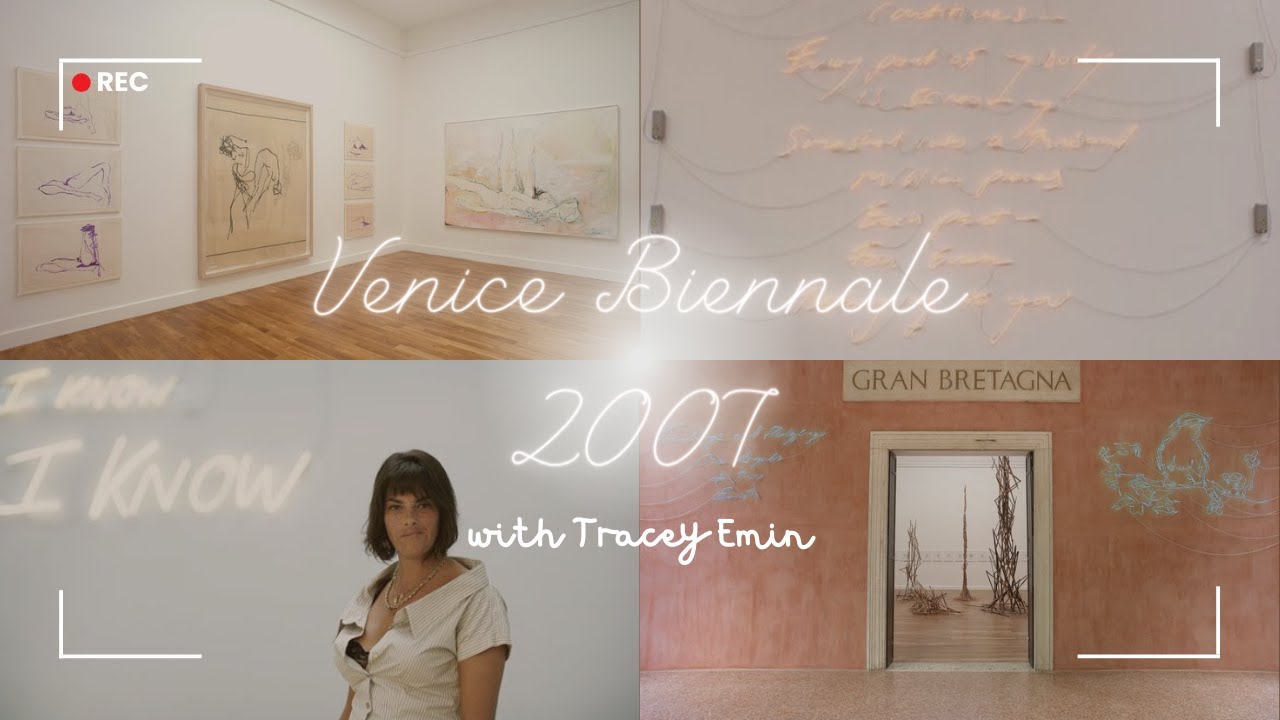
Medium: Acrylic and watercolor on canvas Size: Various, including large-scale works Current location: Six shown at Venice Biennale 2007, various collections
Visual signature: Strong purple brush strokes depicting her naked open legs. Minimal palette – primarily purples, whites, flesh tones.
Why it matters: Marked return to painting as primary medium after years focused on installation and neon. Led to paintings such as Asleep Alone With Legs Open (2005), the Reincarnation series and Masturbating (2006).
Established visual vocabulary for later figurative work: exposed canvas, loose brushwork, unapologetic sexuality.
Exhibitions, Collections, and Provenance Highlights
Major Solo Exhibitions
1994: “My Major Retrospective” – White Cube, London (ironically titled early-career show)
1999: “Every Part of Me’s Bleeding” – Lehmann Maupin Gallery, New York (first US solo)
2005: “When I Think About Sex” – White Cube, London
2007: British Pavilion – Venice Biennale (represented Great Britain)
2011: “Love Is What You Want” – Hayward Gallery, London (major retrospective)
2013: “Angel Without You” – Museum of Contemporary Art North Miami (first US museum solo, neon focus)
2020: “Tracey Emin/Edvard Munch: The Loneliness of the Soul” – Royal Academy of Arts, London
2023: “Lovers Grave” – White Cube, New York
2024: “I Followed You to the End” – White Cube, Bermondsey, London
Museums With Depth (3+ Works)
Tate Gallery, London: My Bed (on loan), multiple drawings, prints, videos
British Museum, London: Works on paper, prints
Scottish National Gallery of Modern Art, Edinburgh: Family Suite series consisting of 20 monoprints
Museum of Modern Art, New York: Multiple works including neon pieces
Saatchi Collection, London: Historically held major works including My Bed (sold 2014)
Pompidou Centre, Paris: Contemporary British art holdings
Hamburger Kunsthalle, Hamburg
San Francisco Museum of Modern Art
Provenance Patterns
Dealers: White Cube (primary), Lehmann Maupin (New York), Xavier Hufkens (Brussels)
Early collector: Charles Saatchi bought My Bed for £150,000 in 2000.
Celebrity collectors: Elton John collects Emin’s work, as did George Michael. Michael and his partner Kenny Goss acquired 25 works by Emin.
Current major collector: Count Christian Duerckheim purchased My Bed for £2.5 million in 2014, loaned to Tate for 10 years.
Catalogues Raisonnes
No comprehensive catalogue raisonne yet published. Works tracked through gallery archives, auction records, exhibition catalogues.
Neon works typically in editions of three plus two artist’s proofs.
Market & Reception
Auction Records
My Bed: Sold at auction by Christie’s in July 2014 for £2,546,500. David Maupin, Emin’s dealer in New York, described the £800,000 – £1.2 million estimate as too low.
Like A Cloud of Blood (2022): Sold for £2,322,000 – current record for painting.
Neon works: In June 2007, Emin’s neon work Keep Me Safe reached the highest price ever (at that time) made for one of her neon works of over £60,000. I Listen To The Ocean And All I Hear Is You (2018) sold for approximately £378,675 at Phillips in 2018, surpassing its presale estimate by more than double.
Embroidered blanket: In June 2007, Emin donated a handsewn blanket called Star Trek Voyager to be auctioned at Elton John’s White Tie & Tiara Ball. The piece sold for £800,000.
Price Bands by Medium
Large paintings (post-2010): £100,000-£500,000 primary market, £200,000-£2.3 million auction
Neon sculptures: £40,000-£150,000 primary market, £60,000-£378,000 auction
Works on paper (monoprints, drawings): £5,000-£50,000
Small paintings and gouaches: £15,000-£80,000
Limited edition prints: £1,000-£15,000
Bronze sculptures: £30,000-£120,000
Authentication & Condition Patterns
Authentication: Works must be verified through White Cube or Lehmann Maupin galleries. Artist maintains tight control over authentication.
Signature variants: Early works often unsigned or signed on verso. Later works signed on front in paint or marker. Neon works fabricated with documentation from artist’s studio.
Condition concerns for My Bed: Each time the work is exhibited, Tracey Emin always takes the time to recreate the installation herself, delicately placing the soiled tissues, K-Y Jelly, used condoms, slippers and fag butts. This performative reinstallation raises conservation questions about authenticity and degradation.
Textile degradation: Embroidered works subject to fading, fabric deterioration. Requires conservation expertise in textiles.
Neon fragility: Glass tubing breakable, gas charge depletes over decades requiring refilling.
Critical Reception Evolution
1990s: Tabloid sensation. Dismissed by conservative critics as publicity stunt. The Guardian’s Adrian Searle wrote the piece was an “endlessly solipsistic, self-regarding homage” and chided “Tracey, you are a bore”.
2000s: Growing institutional recognition. Turner Prize nomination legitimized practice. Venice Biennale representation solidified international standing.
2010s: Historical reassessment. Looking at My Bed now is like looking at the diary of a young woman one once knew. Feminist art history positioned her work as groundbreaking vulnerability documentation.
2020s: Elder stateswoman status. Once the enfant terrible of the art world, she was made a Dame in the King’s birthday honours list. In 2024, Tracey Emin was honoured with a damehood in the King’s Birthday Honours for her services to British art.
Post-cancer work received with new gravitas. The raw honesty remains but critical discourse shifted from scandal to admiration.
Influence & Legacy
Upstream Influences
Edvard Munch: She cites Edvard Munch and Egon Schiele as early inspirations for her expressive style of self-representation. Psychological intensity, existential loneliness, raw emotional content.
Egon Schiele: Emin’s figurative style inspired by Egon Schiele’s powerful handling of line. Graphic sexuality, contorted bodies, unflinching self-exposure.
Louise Bourgeois: Trauma as material, autobiography as legitimate subject, female experience as universal rather than particular.
Joseph Beuys: Personal mythology construction, life as art material, performance embedded in object-making.
Marcel Duchamp: Readymade strategy – though Emin’s readymades (the bed, the tent) carry autobiographical charge Duchamp’s lacked.
Confessional poets (Sylvia Plath, Anne Sexton): A subject that has been tackled head-on in the confessional poetry of Sylvia Plath and Anne Sexton but rather less by women artists. Direct emotional expression without aesthetic distance.
Downstream Influence
Contemporary confessional practice: Legitimized extreme personal disclosure as artistic strategy. Artists now reference mental health, trauma, sexuality with directness previously unavailable in fine art context.
Instagram art: Though predating platform, Emin’s diary-like documentation and emotional oversharing prefigured social media aesthetics.
Craft revival: Her use of embroidery and sewing elevated textile practices within contemporary art discourse.
YBA legacy: Like Damien Hirst and Sarah Lucas, she is considered one of the YBAs who came to prominence in the 1990s. But her emotional directness contrasted with their conceptual irony, offering alternative model for 1990s British art.
Feminist discourse expansion: Complicated easy feminist narratives by performing vulnerability rather than strength. Showed female desire, need, failure – expanding what feminist art could address.
Cross-Domain Echoes
Literature: Influenced confessional memoir boom. Vulnerability as currency, trauma as legitimate subject.
Photography: Nan Goldin‘s diary-like documentation shares similar territory, though developed independently. Both document intimate life without aesthetic distance.
Performance art: Though Emin’s early performances receive less attention than objects, the performative element persists. Installation of My Bed requires artist’s presence – the act of arrangement becomes performance.
Reality television: In the 1990s and noughts, there was the rise of reality TV, of social platforms, of crafting personas in a very personal way, suggesting that Emin’s work is not just autobiographical, but performative.
Public art: Emin unveiled her largest artwork to date, I Want My Time With You (2018), St Pancras International, London. Neon commissions bring intimate confessional mode to public architecture.
Institutional Impact
2007: Elected Royal Academician
2011: Appointed Professor of Drawing, Royal Academy of Arts
2013: Commander of the Most Excellent Order of the British Empire (CBE)
2023: Commissioned by the National Portrait Gallery to create The Doors, resulting in 45 female portraits cast in bronze covering the gallery’s three new entrance doors
2023: Founded TKE Studios in Margate – affordable artist studios and residency program
2024: Dame Commander of the Order of the British Empire (DBE)
How to Recognize a Tracey Emin at a Glance

Exposed canvas: Large areas of raw fabric visible, paint doesn’t cover entire surface
Three-color limit: Rarely uses more than three hues per painting. Red-white-black common. Blue-white-red frequent. Purple dominance in early 2000s work.
Loose figuration: Human forms suggested with 5-10 rapid brushstrokes. Anatomical accuracy abandoned for emotional immediacy.
Handwritten text: If text appears, it’s in her actual handwriting – left-handed, irregular, immediate
Bed motif: If furniture appears, it’s almost always a bed. Rarely chairs, tables, or other domestic objects.
Splayed legs: Female nudes with legs open, vagina visible or suggested. The pose recurs obsessively.
Drip marks: Vertical runs of paint left visible. Never cleaned up or corrected.
Edge dissolution: Figures fade at extremities. Hard edges reserved for core body mass.
Neon characteristics: If neon, handwritten script in single color. Misspellings left intact. Emotional declarations rather than formal statements.
Scale patterns: Paintings typically 60-80 inches on longest dimension. Neon works vary wildly based on text length.
Signature placement: Early works often unsigned. Post-2000 works signed front or back in paint or marker. Signature itself rushed, matching overall aesthetic of immediacy.
FAQ on Tracey Emin
What is Tracey Emin known for?
Tracey Emin is known for confessional artwork that exposes intimate personal experiences. Her most famous work, My Bed (1998), featured her unmade bed with stained sheets and personal items, becoming a cultural sensation after its Turner Prize nomination.
Why is My Bed controversial?
My Bed displayed stained underwear, empty vodka bottles, condoms, and cigarette butts surrounding Emin’s actual unmade bed. Critics questioned whether this documented depression qualified as art, while supporters praised its raw emotional honesty and feminist perspective.
What is Tracey Emin’s artistic style?
Emin’s style combines confessional art with multiple mediums including acrylic painting, neon text installations, and sewn applique. Her loose brushwork, exposed canvas, handwritten phrases, and sexually explicit imagery create emotionally charged autobiographical work influenced by expressionism.
Where can I see Tracey Emin’s work?
Emin’s work appears in Tate Modern, Museum of Modern Art New York, British Museum, and Saatchi Collection. My Bed is currently on long-term loan to Tate. Her neon installations appear in public spaces including St Pancras International station in London.
How much is Tracey Emin’s art worth?
My Bed sold for £2.5 million in 2014. Her painting Like A Cloud of Blood achieved £2.3 million in 2022, setting her auction record. Neon works typically sell for £60,000-£378,000, while paintings range from £100,000-£500,000 at primary market.
What art movement was Tracey Emin part of?
Emin emerged as part of the Young British Artists (YBA) movement in the 1990s alongside Damien Hirst and Sarah Lucas. The group became known for provocative, boundary-pushing contemporary art that challenged traditional British art establishment conventions.
What techniques does Tracey Emin use in her paintings?
Emin uses acrylic on canvas with minimal priming, leaving large areas exposed. Her brushwork features loose figuration, aggressive gestural application, drip retention, and erasure marks. She typically limits palettes to three colors, favoring reds, blues, purples, and whites.
What inspired Tracey Emin’s neon art?
Growing up in Margate surrounded by neon shop signs inspired Emin’s neon text installations. She subverts the commercial medium by bending colored lights into handwritten confessions. Each neon color matches the emotional content through synesthesia, creating intimate public declarations.
Has Tracey Emin won any major awards?
Emin was Turner Prize nominee in 1999, elected Royal Academician in 2007, appointed CBE in 2013, and received damehood in 2024. She served as Royal Academy Professor of Drawing from 2011 and represented Britain at Venice Biennale in 2007.
What themes appear in Tracey Emin’s work?
Emin explores female sexuality, personal trauma including rape and abortion, romantic failure, depression, and vulnerability. Recurring motifs include unmade beds, splayed legs, vaginal imagery, handwritten confessions, and Margate seaside references. Her feminist art confronts taboo subjects directly.
Conclusion
Tracey Emin transformed contemporary British art by weaponizing vulnerability as aesthetic strategy.
From her Turner Prize nomination with My Bed to her record-breaking auction prices, she proved confessional artwork could achieve both critical recognition and market success. Her neon text installations, textile-based pieces, and raw acrylic paintings expanded what feminist art could address.
The Young British Artists movement produced many provocateurs, but Emin’s emotional rawness outlasted the shock tactics of her peers.
Her influence extends beyond gallery walls. She legitimized extreme personal disclosure, paved the way for trauma-based practice, and elevated traditionally feminine craft techniques within fine art discourse.
Now a Royal Academy Dame with museum retrospectives and public commissions, Emin’s artistic legacy proves that unflinching honesty creates lasting cultural impact.