Daniel Arsham is an American contemporary artist who creates sculptures, installations, and architectural interventions that blur the line between past and future. Born in 1980 in Cleveland, Ohio, and based in New York City, he works primarily with geological materials like volcanic ash, selenite, quartz, and hydrostone to cast eroded versions of everyday objects.
His practice spans sculpture, architecture, film, and performance. Arsham positions himself as an “archaeologist of the future,” producing what he calls fictional archaeology.
He has exhibited globally at major institutions including PS1, The New Museum, and the Museum of Contemporary Art in Miami. His auction record stands at approximately $295,000 for Quartz Eroded Vogue Magazine 101 sold at Phillips Hong Kong in 2019.
Active since the early 2000s, Arsham has developed multiple series including the Future Relic collection (2013-2018) and numerous brand collaborations with Dior, Adidas, and Porsche.
Identity Snapshot
| Category | Details |
| Full Name | Daniel Lambert Arsham |
| Lifespan | 1980 – Present |
| Primary Roles | Sculptor, Installation Artist, Architect, Filmmaker |
| Nationality | American |
| Education | Cooper Union, New York (BFA 2003) |
| Movements | Contemporary Art, Conceptual Art, Pop Art |
| Primary Mediums | Volcanic ash, selenite, rose quartz, blue calcite, hydrostone, obsidian, bronze |
| Signature Traits | Monochromatic palette, crystalline erosion, “Fictional Archaeology” |
| Recurring Motifs | Obsolete technology, sports gear, luxury cars, classical sculptures |
| Geographic Anchors | Cleveland, Miami, New York City, Long Island |
| Key Collaborators | Alex Mustonen (Snarkitecture), Pharrell Williams, Kim Jones (Dior) |
| Gallery Rep | Galerie Perrotin, Friedman Benda, Pippy Houldsworth |
| Major Collections | Centre Pompidou, Walker Art Center, Perez Art Museum Miami |
| Auction Record | ~$295,549 for Quartz Eroded Vogue Magazine 101 (2019) |
What Sets Daniel Arsham Apart
Arsham treats contemporary objects like archaeological specimens from a civilization yet to collapse. His eroded sculptures of Walkmans, Polaroid cameras, and vintage keyboards look like they’ve been dug up a thousand years from now.
The work sits somewhere between nostalgia and prophecy.
His colorblindness shaped his visual language profoundly. He can perceive only about 20 percent of the color spectrum a typical person sees. This isn’t a limitation he hides. It’s actually the reason so much of his early output stayed white, grey, or black.
Material trumps color in his thinking. He gravitates toward volcanic ash and crystal not for their hues but for their texture and geological associations.
While artists like KAWS and Takashi Murakami engage with pop culture through saturated graphics, Arsham strips iconic objects down to ghostly relics. He makes the familiar look ancient. Or maybe futuristic. You can’t quite tell, and that’s the point.

Origins and Formation
Early Years
Born September 8, 1980, in Cleveland. His family relocated to Miami when he was young.
At 12, Hurricane Andrew destroyed his childhood home. This event keeps surfacing in his work. Themes of destruction, impermanence, architecture under stress.
Education
Attended Design and Architecture High School in Miami. Received a full scholarship to The Cooper Union in New York City.
Graduated with a BFA in 2003. Won the Gelman Trust Fellowship Award the same year.
First Steps
After graduation, he returned to Miami briefly. Co-founded an artist-run space called “The House” with friends.
Emmanuel Perrotin visited The House in 2004. By 2005, Galerie Perrotin in Paris was representing Arsham. Things moved fast after that.
Breakthrough Moment
Merce Cunningham invited Arsham to design the stage for eyeSpace in 2004. Arsham had zero training in stage design. He said yes anyway.
The premiere happened at the Adrienne Arsht Center in Miami in 2007. He was the youngest artist ever to collaborate with Cunningham. Also the last before Cunningham’s death in 2009.
The Walker Museum acquired Arsham’s first Cunningham set design for its permanent collection.
Movement and Context
Where He Sits

Arsham doesn’t slot neatly into one movement. He pulls from surrealism, conceptual art, and pop sensibilities without committing fully to any.
Some critics position him within the “post-internet” generation. Others see connections to minimalism through his monochromatic restraint. Neither label captures the full picture.
His fictional archaeology concept stands as his own invented framework.
Comparative Position
Versus Andy Warhol: Both fixate on consumer objects as cultural artifacts. Warhol celebrated surface and repetition. Arsham buries the same objects under geological time, suggesting decay rather than abundance.
Versus Robert Smithson: Smithson’s earthworks dealt with entropy on a massive, outdoor scale. Arsham brings similar themes inside the gallery, miniaturizing geological forces into handheld sculptures.
Versus Damien Hirst: Both artists engage with mortality and preservation. Hirst uses formaldehyde and vitrines. Arsham uses volcanic ash and crystal. Hirst’s work screams. Arsham’s whispers.
Materials, Techniques, and Process
Primary Materials
- Volcanic ash: Mixed with hydrostone for casting. Creates grey, fossilized surfaces.
- Selenite: Translucent crystal formations embedded into eroded surfaces.
- Rose quartz: Pink crystalline inclusions. Adds warmth to otherwise neutral sculptures.
- Blue calcite: Used prominently since 2016. Intense cobalt-blue formations.
- Hydrostone: Gypsum cement base for most casts. Dense, durable.
- Glacial rock dust: Sometimes mixed into casting compounds.
- Obsidian: Black volcanic glass embedded as accent.
- Crushed glass: Used in the Future Relic editions.
Casting Process
Arsham creates negative molds from existing objects. Phones, cameras, keyboards, basketballs, even full-scale Porsches.
He pours liquid casting compounds into the molds. After curing, he physically chips and erodes the surfaces.
Crystals get embedded into these eroded cavities. The final effect looks like geological formations growing from technological decay.
Surface Treatments
Surfaces remain deliberately rough. Tool marks and erosion patterns vary piece to piece.
No glazing or polishing. The raw material quality matters more than finish.
Color Evolution
Pre-2016: Almost exclusively white, grey, black. Materials dictated palette.
Post-2016: EnChroma glasses allowed Arsham to perceive broader color ranges. Blue calcite and rose quartz entered his vocabulary. Still uses color sparingly though.
Themes, Subjects, and Iconography
Core Themes
Technological obsolescence: Arsham gravitates toward outdated tech. VHS tapes. Rotary phones. Cassette players. Objects that defined eras but became irrelevant within decades.
Time collapse: His work refuses to sit in a single temporal frame. Ancient and futuristic blur together.
Impermanence: Everything decays. Even luxury goods. Even things we think will last.
Recurring Subjects
- Consumer electronics (cameras, phones, televisions, radios)
- Classical sculptures (Venus de Milo, Michelangelo’s Moses)
- Luxury goods (Porsche, Dior products, Rimowa luggage)
- Sports equipment (basketballs, soccer balls)
- Pop culture icons (Mickey Mouse, Pokemon characters)
- Human figures (hooded forms, seated figures)
Compositional Patterns
Most sculptures present objects frontally. Meant to be recognized immediately before the erosion effect registers.
Installations often use repetition. Walls filled with identical hourglasses. Rooms covered in amethyst spheres.
Scale varies dramatically. From palm-sized Future Relic editions to full-scale eroded automobiles.
Notable Works
Future Relic Series (2013-2018)

Medium: Plaster, crushed glass Editions: 400-500 per piece Current Location: Distributed globally through galleries and secondary market
Nine objects total: mobile phone, 35mm camera, clock, cassette tape, telephone, Polaroid, cassette player, radio, keyboard.
Each accompanied by a short film. James Franco starred in Future Relic 02. Juliette Lewis appeared in Future Relic 03.
Why it matters: Established Arsham’s core concept for broader audiences. Affordable editions introduced collectors to his work.
Paris, 3020 (2019-2020)

Medium: Blue calcite, rose quartz, selenite, hydrostone Size: Life-scale classical reproductions Current Location: Shown at Galerie Perrotin Paris
Arsham recreated Venus de Milo, Michelangelo’s Moses, and other classical sculptures using molds from the Reunion des Musees Nationaux.
A year spent inside their 200-year-old Parisian studio gathering scans and molds.
Why it matters: Extended his archaeological concept backward into actual antiquity. First major engagement with art-historical source material.
Hourglass Series

Medium: Sand, glass, steel, hydrostone Presentation: Wall-mounted installations Collections: High Museum of Art, private collections
Hundreds of functional hourglasses mounted in grids. Sand flows continuously.
Why it matters: Time becomes literal subject matter. Interactive and meditative.
Crystal Car (2014)

Medium: 1976 Chevrolet Opala, glass pellets (8 tons) Size: Full-scale automobile Shown: Baro Galeria, Sao Paulo
Wrecked vintage Chevy half-buried under blue glass. First Latin American solo exhibition.
Why it matters: Scaled up his concept dramatically. Automotive culture meets archaeological ruin.
Exhibitions, Collections, and Provenance
Major Solo Exhibitions
- 2024: Seoul 3024 (LOTTE Museum of Art), Phases (Fotografiska New York)
- 2023: 20 Years (Perrotin New York/Paris), Arsham Auto Motive (Petersen Automotive Museum)
- 2022: Relics in the Landscape (Yorkshire Sculpture Park)
- 2019-2020: Paris, 3020 (Perrotin Paris)
- 2016: Circa 2345 (Perrotin New York) – first exhibition using color
Institutional Collections
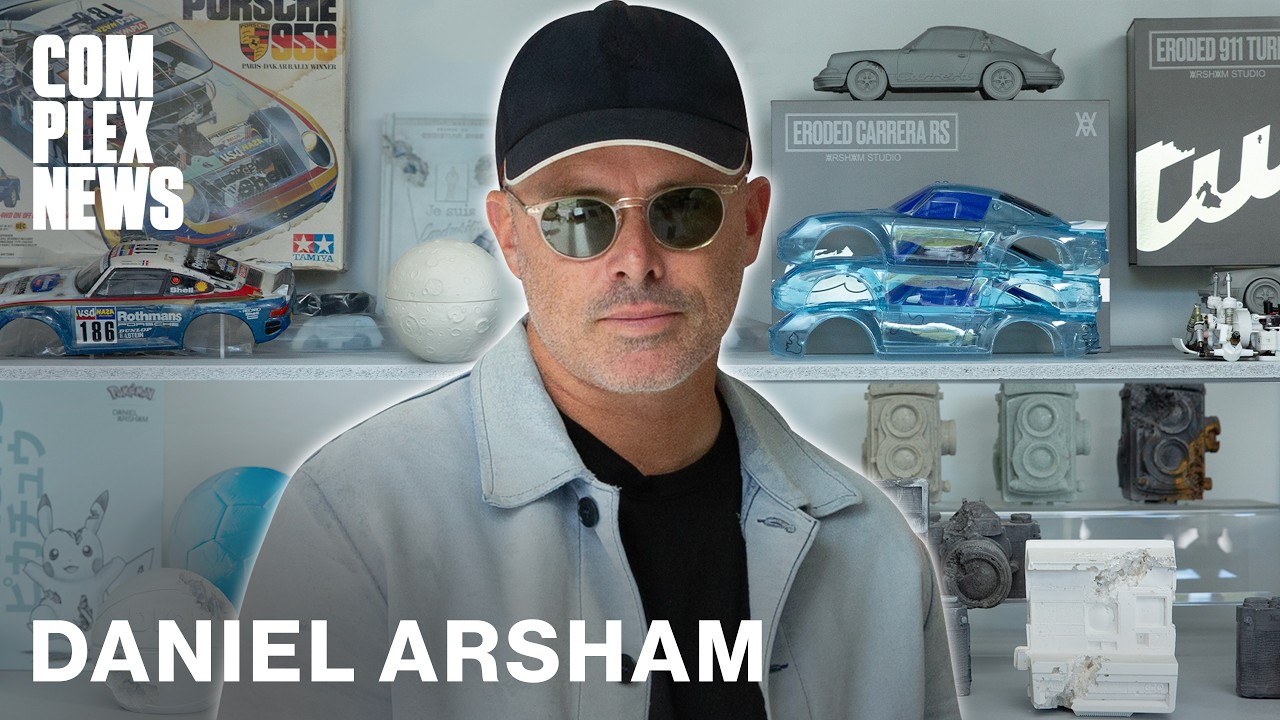
Centre Pompidou (Paris). Walker Art Center (Minneapolis). Perez Art Museum Miami. National Gallery of Victoria (Melbourne). Institute of Contemporary Art Miami. High Museum of Art (Atlanta).
Notable Art Fair Presence
Regular presence at Art Basel Miami Beach. Design Miami. Multiple Perrotin booth features across global fairs.
Market and Reception
Auction Performance
Record price: $295,549 for Quartz Eroded Vogue Magazine 101 (Phillips Hong Kong, November 2019)
Notable sales:
- Grey Selenite Eroded Porsche: $166,244 (Phillips Hong Kong, 2020)
- Teddy Bear (pink selenite/rose quartz): $100,543 (Sotheby’s Hong Kong, 2020)
- Pyrite and Selenite Teddy Bear (Large): $89,515 (Sotheby’s Hong Kong, 2020)
Price range: Editions start around $500-$2,000. Unique sculptures range from $5,000 to $475,000 depending on scale and materials.
Edition Strategy
Future Relic editions of 400-500 pieces created accessible entry points. Crystal Relic editions continue this model.
Limited editions packaged in custom boxes with gloves, authenticity labels, excavation journals. Presentation matters.
Secondary Market
Active resale through Phillips, Sotheby’s, Christie’s Hong Kong. Strong demand in Asia, UK, and US.
Sell-through rate approximately 33% at auction over past 36 months. Average work on paper: $55,000.
Influence and Legacy
Upstream Influences
Marcel Duchamp: Readymade concept and object recontextualization.
Robert Smithson: Entropy, geological time, earthworks.
Rene Magritte: Surreal displacement of familiar objects.
Merce Cunningham: Temporal experimentation, chance operations.
Downstream Impact
Inspired younger artists working across installation, design, and performance.
Choreographer Jonah Bokaer developed multiple stage works in collaboration with Arsham.
His “fictional archaeology” framework has influenced speculative design and material storytelling approaches.
Cross-Domain Echoes
Fashion: Dior SS20 collaboration with Kim Jones. Runway design, eroded accessories, Future Relics capsule collection.
Automotive: Eroded Porsche and Ferrari sculptures. Arsham Motorsport monograph (2025).
Sports: First artist Creative Director in NBA history (Cleveland Cavaliers, 2020). Logo redesigns, court designs, City Edition uniforms.
Consumer products: Collaborations with Adidas, Rimowa, Tiffany & Co., Pokemon, IKEA.
How to Recognize an Arsham at a Glance

- Palette: Predominantly white, grey, or single-color crystalline (blue calcite, rose quartz). Rarely more than one or two hues per piece.
- Surface: Eroded, crumbling patches revealing crystal formations beneath.
- Subject: Recognizable consumer objects or classical references rendered as ancient artifacts.
- Materials visible: Volcanic ash texture, hydrostone base, embedded selenite or quartz crystals.
- Temporal ambiguity: Cannot tell if object is ancient ruin or futuristic relic.
- Cast quality: Precise replication of original object before erosion treatment applied.
- Presentation: Often displayed on illuminated plinths or against stark white gallery walls.
- Edition packaging: Custom boxes, holographic labels, white handling gloves included.
- Size formats: Handheld editions around 10-15 inches, unique works up to life-scale automobiles.
- Signature placement: Labels on packaging rather than visible signatures on work surfaces.
FAQ on Daniel Arsham
Who is Daniel Arsham?
Daniel Arsham is an American contemporary artist born in 1980 in Cleveland, Ohio. He works across sculpture, architecture, film, and installation.
Based in New York City, he’s represented by Galerie Perrotin and Friedman Benda. His work appears in major museum collections worldwide.
What is Daniel Arsham known for?
Arsham is known for his fictional archaeology concept. He creates eroded sculptures of everyday objects cast in volcanic ash, selenite, and quartz crystals.
His pieces look like future relics unearthed centuries from now. Technology frozen in geological time.
What materials does Daniel Arsham use?
Primary materials include volcanic ash, hydrostone, selenite crystal, rose quartz, blue calcite, and obsidian. He casts objects using gypsum cement compounds.
Crushed glass appears in his Future Relic editions. Bronze and cast resin feature in newer works.
What is fictional archaeology?
Fictional archaeology is Arsham’s invented framework. He imagines contemporary objects discovered by future archaeologists, casting phones, cameras, and cars as crystallized relics.
The concept collapses past, present, and future into single objects. Time becomes ambiguous and layered.
Is Daniel Arsham colorblind?
Yes. Arsham has deuteranopia and sees roughly 20 percent of the typical color wheel. This shaped his early monochrome palette of whites, greys, and blacks.
Since 2016, EnChroma glasses helped him perceive broader ranges. Blue calcite sculptures followed.
What is the Future Relic series?
Future Relic (2013-2018) includes nine editioned sculptures: mobile phone, camera, clock, cassette tape, telephone, Polaroid, cassette player, radio, and keyboard.
Each cast in plaster and crushed glass. Short films accompany every piece. James Franco starred in one.
How much does Daniel Arsham art cost?
Prices range widely. Limited editions start around $500-$2,000. Unique sculptures sell from $5,000 to $475,000 at auction.
His record is $295,549 for Quartz Eroded Vogue Magazine 101 at Phillips Hong Kong in 2019.
What is Snarkitecture?
Snarkitecture is the design studio Arsham co-founded with Alex Mustonen in 2007. They create architectural installations and functional design objects.
Projects include KITH retail stores, Design Miami pavilions, and immersive environments blending sculpture with built space.
Where can I see Daniel Arsham’s work?
Major collections include Centre Pompidou, Walker Art Center, Perez Art Museum Miami, and National Gallery of Victoria.
Galerie Perrotin shows his work in Paris, New York, Hong Kong, and Seoul. Check current exhibition schedules online.
Who has Daniel Arsham collaborated with?
Brand partners include Dior, Adidas, Porsche, Rimowa, Tiffany & Co., and Pokemon. He designed Dior’s SS20 runway with Kim Jones.
Arsham served as Creative Director for the Cleveland Cavaliers. Pharrell Williams and Merce Cunningham are notable artistic collaborators.
Conclusion
Daniel Arsham has built a practice that turns everyday objects into eroded sculptures frozen between decay and rebirth. His crystal formations and architectural installations challenge how we think about time and material culture.
From Snarkitecture design projects to Dior runway collaborations, his reach extends far beyond traditional gallery walls.
The art market has responded. Collectors chase his limited editions while museums add his pieces to permanent collections.
Whether casting a Porsche in selenite or reimagining classical antiquities, Arsham keeps asking the same question: what will remain of us?