Aboudia is an Ivorian contemporary artist whose large-scale mixed media paintings capture the raw energy of street life in Abidjan. Born Abdoulaye Diarrassouba on October 21, 1983, he rose to international attention during the 2010-2011 Ivory Coast Civil War when his canvases documented the chaos unfolding outside his studio.
His work sits within the broader tradition of African neo-expressionism, though critics frequently draw connections to Jean-Michel Basquiat and Jean Dubuffet. The comparison makes sense visually but misses something important.
Aboudia’s imagery comes directly from the streets of West Africa. Graffiti, Nouchi slang, child figures, and Vodou iconography all blend together on canvases that can stretch up to four meters wide. He now works between studios in Abidjan and Brooklyn.
Identity Snapshot
- Full Name: Abdoulaye Diarrassouba
- Known As: Aboudia
- Born: October 21, 1983, Abidjan, Cote d’Ivoire
- Primary Roles: Painter, Mixed Media Artist, Muralist
- Nationality: Ivorian-American
- Movement: African Neo-Expressionism, Contemporary African Art
- Mediums: Acrylic, oil pastel, collage, charcoal, spray paint on canvas
- Signature Traits: Heavily layered surfaces, childlike figures, bold color against dark grounds, text integration
- Iconography: Street children, skulls, soldiers, AK-47s, Dan masks, Vodou symbols
- Geographic Anchors: Abidjan (Ivory Coast), Brooklyn (New York)
- Key Galleries: Jack Bell Gallery (London), Galerie Cecile Fakhoury (Abidjan/Paris), Ethan Cohen Gallery (New York)
- Collections: Saatchi Gallery, Jean Pigozzi Contemporary African Art Collection, Nevada Museum of Art, Frank Cohen Collection
- Market Signal: Bestselling artist by volume in 2022 (75 works sold at auction), record price $498,000 (Christie’s, 2022)
What Sets Aboudia Apart
Most contemporary African painters working in the West lean toward cleaner aesthetics. Aboudia goes the opposite direction.
His canvases look like they were dragged through the streets of Abobo before being hung on a gallery wall. That is not an accident.
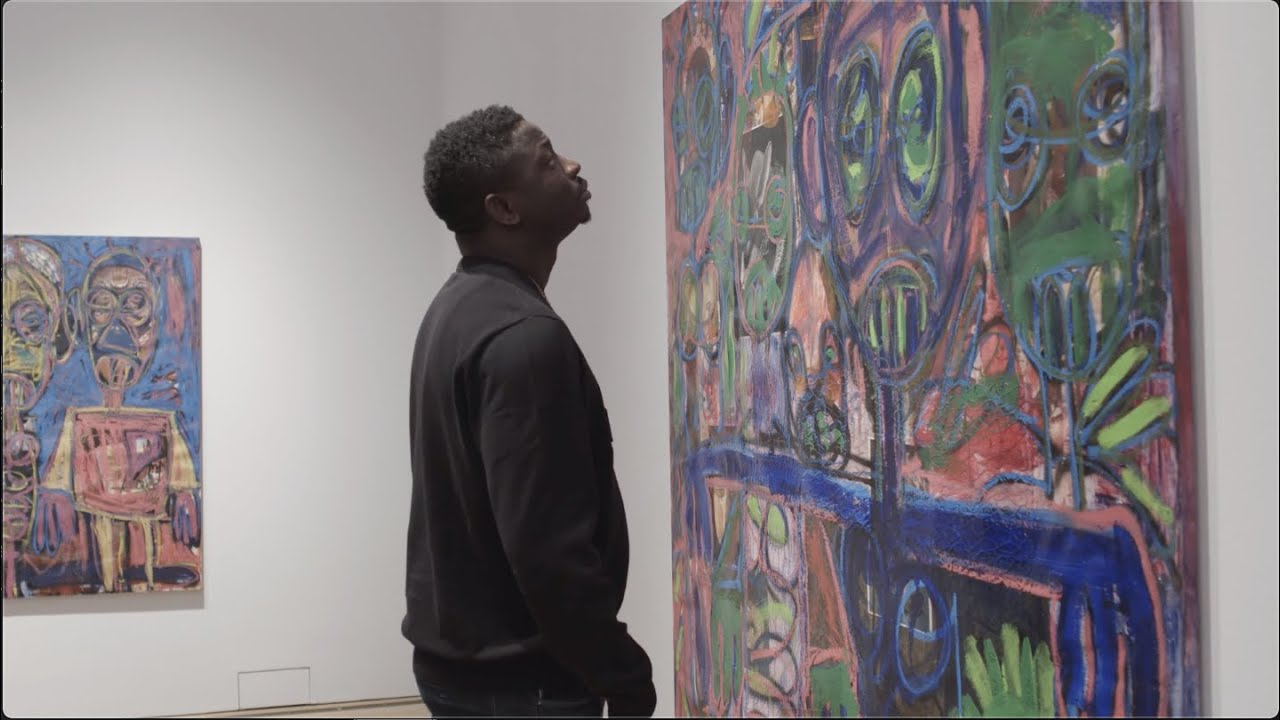
Layers of acrylic, newspaper clippings, cardboard scraps, and oil pastel build up surfaces that feel genuinely combustible. The childlike figures that populate his work are not naive or cute. They stare out with oversized eyes, surrounded by weapons, skulls, and scrawled text in Nouchi, the street slang of Abidjan.
Where Basquiat drew from the American urban experience and African diaspora, Aboudia pulls directly from West African street culture. The source material is local, but the visual language translates globally.
His use of color is worth noting. Despite documenting trauma and poverty, his palette often explodes with reds, yellows, and blues. He explained once that this is intentional. “You have to show that, despite the pain and the sadness and the suffering, these children are happy.”
Origins and Formation
Early Training
Aboudia graduated from the Centre Technique des Arts Appliques in Bingerville in 2003. Two years later, he completed studies at the Institut des Arts in Abidjan.
But he will tell you the real education happened on the streets.
First Influences
Childhood memories of charcoal drawings on village walls stuck with him. Matchstick figures, hairdressing placards, graffiti tags. These became his visual vocabulary.
His parents wanted him to pursue something stable. Teachers predicted he would become nothing more than a tag artist. He left home and lived alone.
The Abobo Railway Station
This became his informal studio and subject matter. Marginalized children gathered there, drawing on neighborhood walls to express what they could not say otherwise. Aboudia recognized himself in them.
First Exhibitions
Local galleries in Abidjan refused to represent his work. Too avant-garde, they said. Too rough.
His first shows came through the Centre Culturel Francais in Abidjan (2009) and Conakry, Guinea. Foreign collectors started buying while Ivorian galleries still dismissed him.
The 2011 Breakthrough
Everything changed during the post-electoral crisis. Aboudia’s studio sat next to the Golf Hotel, headquarters during the conflict. He heard bullets while painting.
When shooting got heavy, he hid in the cellar. As soon as things calmed, he went back upstairs and painted everything he had witnessed. Over several months, he produced 21 canvases ranging from 120 x 80 cm to 400 x 180 cm.
International media used his images to illustrate coverage of the conflict. Jack Bell Gallery in London gave him his first major international show that same year.
Movement and Context
Position Within African Contemporary Art
Aboudia operates in the space between street art and gallery expressionism. He is not alone in this territory, but his approach remains distinctive.
Critics have positioned him alongside other West African painters exploring urban life and post-colonial identity. But he resists the “war artist” label that was applied after 2011.
Comparative Analysis

Versus Basquiat: The comparison is unavoidable but incomplete. Basquiat worked from New York street culture and the African-American experience. Aboudia works from West African streets directly. Both use text integration and childlike figuration. Aboudia’s surfaces are more heavily layered, more physically textured.
Versus Dubuffet: Both embrace Art Brut aesthetics, raw mark-making, and figures that look untrained. Aboudia’s work carries more explicit social content and contemporary iconography.
Versus Armand Boua: Another Ivorian artist depicting Abidjan street children. Boua works with tar and more monochromatic palettes. Aboudia goes bigger, louder, more colorful.
Market Position
Among contemporary African artists, Aboudia has achieved unusual commercial success. In 2022, he sold more artworks at auction (75 lots) than any other contemporary artist globally, surpassing even Damien Hirst (73 lots).
Materials, Techniques, and Process
Supports
Large-scale canvas dominates his output. Typical dimensions range from 150 x 150 cm to 180 x 400 cm for major works. He also works on paper for smaller pieces and studies.
Mediums and Materials
Aboudia combines acrylic paint with oil pastels, charcoal, spray paint, and found materials. His practice incorporates whatever is available: cardboard fragments, magazine clippings, newspaper pages, fabric.
During the 2011 crisis, most shops were closed for months. He used “papers, cardboard, anything I can get my hands on.”
Layering Approach
Surfaces build through multiple passes. Paint goes down, then collage elements, then more paint, then pastel marks, then text. The texture becomes almost sculptural in places.
Mark-Making
His brushwork ranges from broad gestural strokes to scratchy, nervous lines. Oil pastel marks often outline or highlight figures. Text appears as scrawled words, phrases, sometimes readable, sometimes obscured by subsequent layers.
Palette Tendencies
Dark grounds (blacks, browns, dark greens) contrast with bright primaries. Reds appear frequently, often associated with violence or energy. Yellow and blue provide counterpoint. The overall effect is loud but not chaotic.
Studio Practice
Aboudia works in series, often returning to subjects repeatedly. He compares his process to journalism: “My work is similar to that of a journalist writing an article: I was simply describing a situation.”
Themes, Subjects, and Iconography
Street Children
This is his central subject. Not sentimental portraits but raw depictions of kids surviving on the margins. The Abobo railway station community appears repeatedly.
War and Conflict
Soldiers, weapons, tanks, skulls. These entered his work during the 2011 crisis and have not entirely left. But he insists his interest predates the war. Child soldiers appeared in his paintings before the conflict escalated.
Nouchi Culture
The street slang of Abidjan youth gives his work its title system. Words and phrases from this hybrid language (mixing French with various Ivorian languages) appear throughout his canvases.
African Traditional Forms
Dan masks from Liberia, Igbo masks from Nigeria, Vodou iconography. These references ground his work in West African visual traditions even as the overall aesthetic feels contemporary.
Urban Life
Cars, skyscrapers, TV sets. The chaos and energy of Abidjan as a modern African megapolis runs through his work.
Compositional Patterns
Figures crowd the picture space. There is rarely empty ground. Overlapping forms create dense, claustrophobic environments. Faces often stare directly outward.
Notable Works
Daloa 29 (2011)

- Medium: Acrylic and mixed media on canvas
- Dimensions: 180 x 400 cm
- Collection: Saatchi Gallery, London
- Visual Signature: Dense crowd of armed figures, dark palette with sharp color accents
- Significance: Created during the Battle for Abidjan, this work documents the violence firsthand. Multiple characters display weapons in a composition that feels both chaotic and controlled.
Le Couloir de la Mort (2011)

- Medium: Acrylic and mixed media on canvas
- Dimensions: 180 x 400 cm
- Collection: Saatchi Gallery, London
- Visual Signature: Child-faced figures march beneath oversized skulls, cave-dark background
- Significance: One of his most haunting civil war paintings. The title translates to “Death Row.”
Le Petit Chien Rouge (2018)

- Medium: Mixed media on canvas
- Visual Signature: Characteristic layered surface with street children imagery
- Significance: Representative of his mature style, focusing on homeless youth in Abidjan
Haut les mains (Hands up) (2020)

- Medium: Mixed media on canvas
- Sale: $498,000 at Christie’s (March 2022), current auction record
- Significance: Achieved during the dedicated “Noutchy in New York City” sale, demonstrating peak market interest
Cache Cache d’enfants (2013)

- Medium: Acrylic and mixed media on canvas
- Dimensions: 200 x 400 cm
- Collection: Saatchi Gallery
- Significance: Post-war work returning to childhood themes without explicit conflict imagery
Exhibitions, Collections, and Provenance
Key Solo Exhibitions

- “The Battle For Abidjan” – Jack Bell Gallery, London (2011)
- “Aujourd’hui je travaille avec mon petit-fils, Aboudia” (with Frederic Bruly Bouabre) – Galerie Cecile Fakhoury, Abidjan (2012)
- “African Dawn” – Ethan Cohen Gallery, New York (2014)
- “Nouchi City” – Galerie Cecile Fakhoury, Abidjan (2014)
- “Mogo Dynasty” – Galerie Cecile Fakhoury (2016)
- “Masquerade” – Galerie Cecile Fakhoury, Dakar (2019)
- “Noutchy in New York City” – Christie’s Online Sale (2022)
Major Group Shows
- “Pangaea: New Art From Africa and Latin America” – Saatchi Gallery, London (2014)
- “Pangaea II” – Saatchi Gallery, London (2015)
- 59th Venice Biennale, National Pavilion of Ivory Coast (2022)
- Dak’Art Biennale, Senegal (multiple years)
Museum Collections
- Saatchi Gallery, London
- Jean Pigozzi Contemporary African Art Collection (CAAC), Geneva
- Nevada Museum of Art, Reno
- Frank Cohen Collection, London
- Tiroche DeLeon Collection, Israel
- World Bank Art Collection
Gallery Representation
Jack Bell Gallery (now Larkin Durey) in London has represented him since 2011, hosting nine solo exhibitions. Galerie Cecile Fakhoury handles his African market presence. Ethan Cohen Gallery brought his work to American collectors starting in 2014.
Market and Reception
Auction Performance
Aboudia’s market has grown dramatically since 2013 when his first auction sales occurred at Bonhams. Two 2011 canvases sold for approximately $7,900 each.
By 2022, he topped global auction rankings by volume. The dedicated Christie’s sale “Noutchy in New York City” sold all 22 lots, with six works originally estimated at $10,000-12,000 reaching over $100,000 each.
Record Price: $498,000 for “Haut les mains” at Christie’s (March 2022)
Typical Range: Large canvases sell between $100,000-200,000 on the primary market. Works on paper start around $10,000.
Critical Reception
Western critics have praised his raw energy while sometimes defaulting to Basquiat comparisons. African critics have noted his international success came faster than local acceptance.
The “Basquiat of Africa” label follows him around. He has not explicitly rejected it but focuses interviews on his own sources: Abidjan streets, Nouchi culture, and the children he grew up alongside.
Authentication
The Aboudia Foundation issues certificates for authenticated works. Given the volume of his output and rising prices, authentication documentation has become increasingly important.
Influence and Legacy
Upstream Influences
Abidjan street graffiti and mural traditions form his foundation. Cy Twombly’s gestural mark-making appears in his line work. Jean Dubuffet’s Art Brut philosophy aligns with his embrace of “untrained” aesthetics.
Traditional West African carving, particularly Dan and Igbo mask forms, provides recurring visual references.
Downstream Impact
Aboudia has opened doors for younger Ivorian artists entering international markets. His commercial success demonstrated global appetite for West African contemporary work beyond established names like El Anatsui or Kehinde Wiley.
Collaborations
In 2012, he worked with legendary Ivorian artist Frederic Bruly Bouabre (born nearly six decades earlier) on a series of collaborative paintings. In 2017, he collaborated with British painter Christian Furr, producing works between New York, London, and Abidjan.
Cross-Domain Presence
His imagery has been used by international media to illustrate coverage of African conflicts and urban life. This visibility outside traditional art channels has contributed to name recognition beyond typical collector circles.
How to Recognize an Aboudia at a Glance
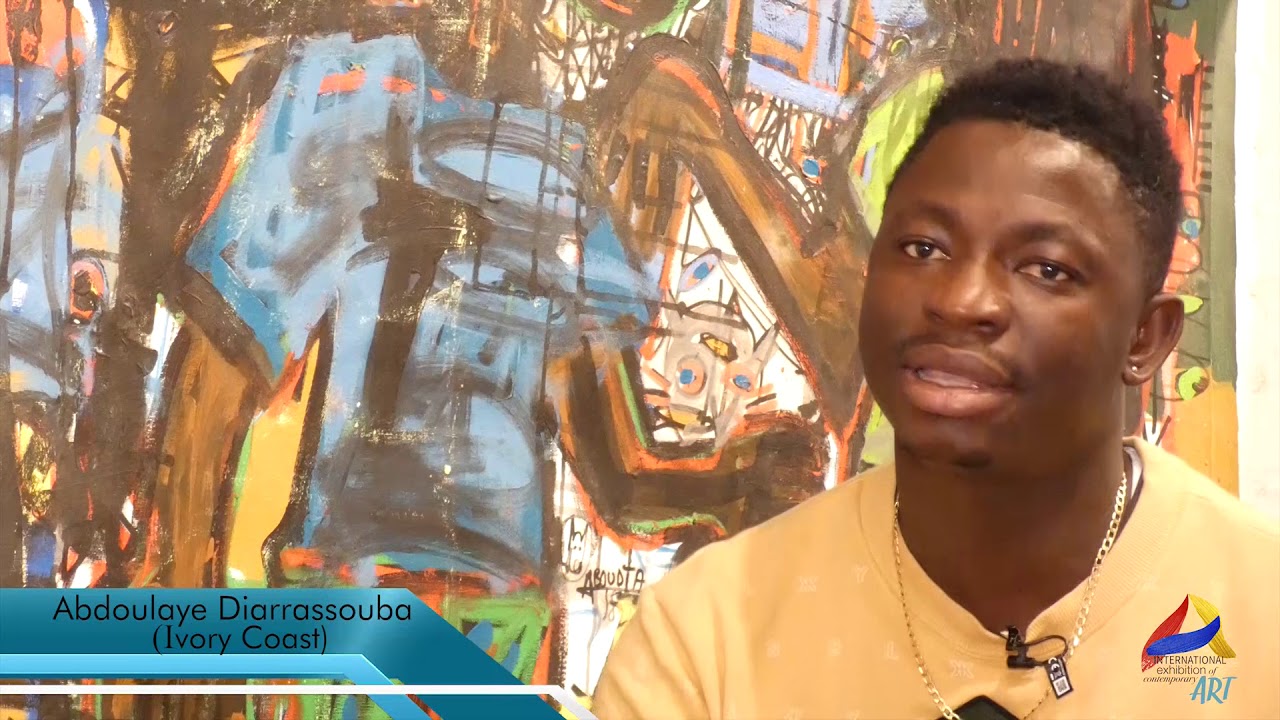
- Scale: Large canvases, often exceeding 150 cm in at least one dimension
- Surface: Heavily layered with visible collage elements, newspaper, cardboard
- Figures: Childlike with oversized heads and staring eyes, often crowded together
- Palette: Dark grounds (black, brown) with bright primaries (red, yellow, blue)
- Text: Scrawled words in French or Nouchi slang, sometimes partially obscured
- Motifs: Skulls, weapons, soldiers, Dan-style mask forms
- Mark-Making: Mix of broad acrylic strokes and scratchy oil pastel outlines
- Signature: Usually signed “ABOUDIA” in block letters, often lower center or lower right, sometimes with date
- Edge Quality: Figures often have hard outlines in contrasting colors
- Spacing: Minimal negative space, compositions feel dense and claustrophobic
FAQ on Aboudia
Who is Aboudia?
Aboudia is an Ivorian contemporary artist born Abdoulaye Diarrassouba in 1983. He creates large-scale mixed media paintings depicting street life in Abidjan. He gained international recognition during the 2010-2011 Ivory Coast Civil War and now works between Abidjan and Brooklyn.
What style does Aboudia paint in?
His work falls within African neo-expressionism, blending graffiti aesthetics with traditional West African visual elements. The style combines raw, childlike figuration with layered surfaces. Critics often place him alongside artists exploring urban chaos through bold, gestural mark-making.
What is Aboudia’s real name?
Abdoulaye Diarrassouba is his birth name. “Aboudia” became his professional identity early in his career. He was born October 21, 1983, in Abidjan, Cote d’Ivoire, and graduated from the Centre Technique des Arts Appliques in Bingerville.
How much are Aboudia paintings worth?
Large canvases sell between $100,000 and $200,000 on the primary market. His auction record stands at $498,000, achieved at Christie’s in 2022. Works on paper start around $10,000. In 2022, he sold 75 works at auction, more than any contemporary artist globally.
What materials does Aboudia use?
He works with acrylic, oil pastels, charcoal, spray paint, and found materials on canvas. Cardboard, newspaper clippings, and fabric get incorporated into heavily layered surfaces. This mixed media approach creates the textured, almost sculptural quality that defines his painting medium.
What themes appear in Aboudia’s work?
Street children of Abidjan remain his central subject. Skulls, soldiers, weapons, and Vodou iconography appear frequently. He draws from Nouchi street culture and post-war trauma. Despite dark subject matter, his bold color contrasts express resilience and joy.
Where can I see Aboudia’s art?
The Saatchi Gallery in London holds major works. The Jean Pigozzi Contemporary African Art Collection and Nevada Museum of Art also have pieces. Jack Bell Gallery (now Larkin Durey) in London and Galerie Cecile Fakhoury in Abidjan represent him.
Why is Aboudia compared to Basquiat?
Both artists use childlike figures, text integration, and raw mark-making. Both emerged from street art backgrounds. However, Aboudia draws directly from West African urban experience rather than the American context. The comparison is visually understandable but culturally incomplete.
What is Nouchi in Aboudia’s art?
Nouchi is the street slang spoken by Abidjan youth, mixing French with Ivorian languages. Aboudia incorporates Nouchi words and phrases into his canvases. He uses the term to describe his entire aesthetic approach, connecting his visual language to local street culture.
Is Aboudia self-taught?
Not entirely. He studied at the Centre Technique des Arts Appliques in Bingerville (graduated 2003) and Institut des Arts in Abidjan (graduated 2005). But he credits the streets of Abidjan as his real education. His distinctive compositional approach developed outside formal training.
Conclusion
Aboudia transformed personal witness into global recognition. His journey from rejected street artist in Abidjan to bestselling contemporary artist at international auction houses like Christie’s and Sotheby’s happened in just over a decade.
The work remains rooted in West African street culture. Nouchi language, child figures, and urban chaos still dominate his canvases.
Collectors in the African art market continue chasing his mixed media paintings. Whether prices hold or correct, his influence on emerging African artists is already secured.
The raw energy translates. That much is clear.