Jogen Chowdhury is an Indian contemporary painter known for his distorted human figures rendered in ink, pastel, and watercolor. His cross-hatching technique and unbroken line drawings have made him one of the most recognized figurative artists in modern Indian art.
He works within a tradition that blends Bengali folk art with post-independence Indian modernism. Think of him as a bridge between the Kalighat pat painters and the contemporary Santiniketan school.
Born in 1939 in Faridpur (now Bangladesh), Chowdhury has been active for nearly seven decades. His retrospective at Gallery Art Exposure in 2023 displayed over 300 works spanning from 1955 to the present.
Identity Snapshot
Canonical Name: Jogen Chowdhury (also spelled Jogen Choudhury)
Lifespan: Born February 19, 1939
Primary Roles: Painter, Draftsman, Printmaker, Writer, Art Curator
Nationality: Indian (born in present-day Bangladesh)
Schools: Government College of Art and Craft, Kolkata; Ecole Nationale Superieure des Beaux-Arts, Paris; Atelier 17 (William Hayter)
Movements: Indian Modernism, Figurative Expressionism, Post-Independence Bengali Art
Primary Mediums: Pen and ink on paper, pastel on paper, ink and pastel combined, watercolor, oil on canvas (less frequent)
Signature Traits: Cross-hatching for tonal variation, unbroken meandering lines, muted earthy palette (ochre, brown, green), dry brush technique, exaggerated anatomical distortion
Iconography: Sensuous female figures, couples in psychological tension, grotesque male forms, still life objects (fruits, bolsters, cloth), political satire, domestic interiors
Geographic Anchors: Faridpur (birthplace), Kolkata (education), Paris (formative study), Chennai/Madras (textile design years), New Delhi (curator role), Santiniketan (current residence since 1987)
Mentors: Prodosh Das Gupta, William Hayter
Key Associations: Calcutta Painters Group (1970), Gallery 26 and Artists’ Forum (co-founder, 1975), Art Today journal (co-founder, 1981)
Major Collections: National Gallery of Modern Art (Delhi), Victoria and Albert Museum (London), Glenbarra Art Museum (Japan), Singapore Art Museum
Market Signals: Record auction price of $548,164 for “Story of Woman” at Asta Guru (2021). Works on paper average around $11,000 in recent years. Serigraph prints widely available at lower price points.
What Sets Jogen Chowdhury Apart
His line never breaks. That sounds simple, but watch how the contour of a sagging belly flows into the curve of a thigh without lifting the pen.
Most Indian modernists of his generation were chasing either Western abstraction or revivalist traditionalism. Chowdhury did neither. He built something that feels both ancient and uncomfortable.
The figures bulge in wrong places. Flesh sags. Wounds appear on bodies without explanation.
Cross-hatching creates texture that reads almost like engraving. His surfaces have a tactile quality you want to touch, even when the subject repels you.
He draws darkness into daylight scenes. A woman caressing herself. A man curled with visible scars. Couples sitting together yet psychologically miles apart.
The Bengal influence runs deep, but he avoids nostalgia. His work critiques rather than celebrates.
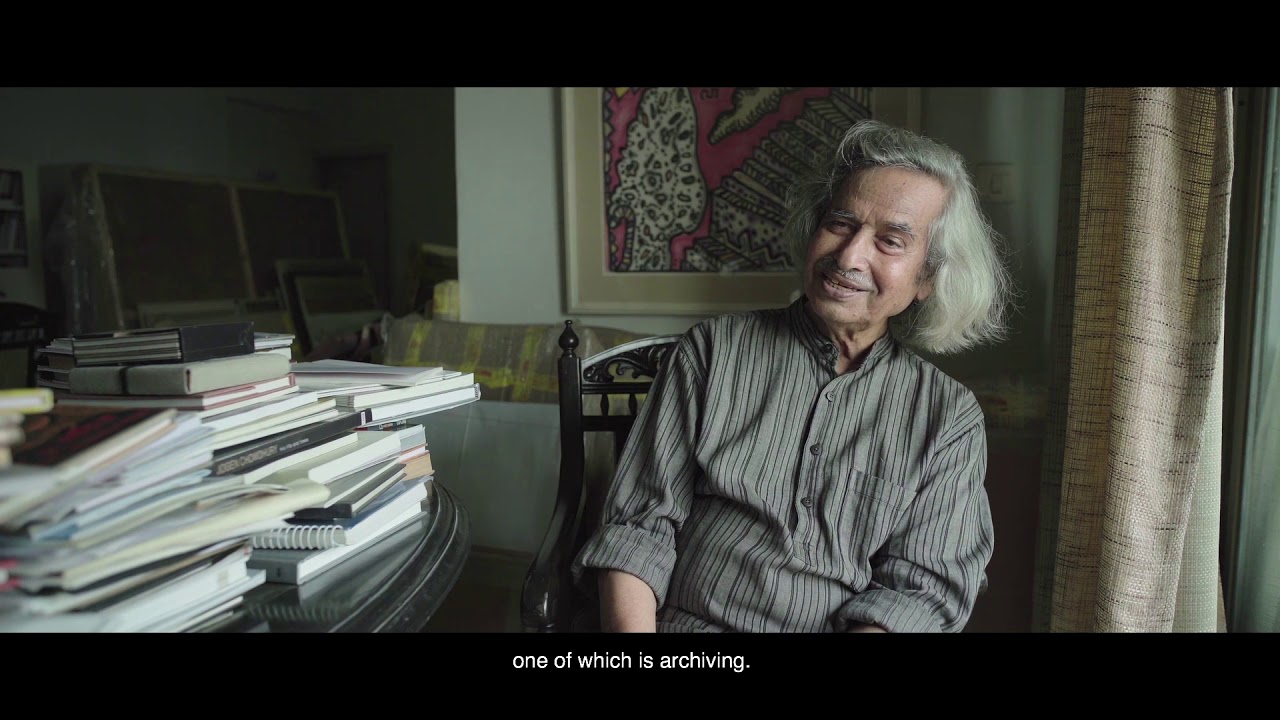
Origins and Formation
Early Life and Partition Trauma
Born in Daharpara Village, Faridpur district. His father Pramatha Nath Chowdhury was a Brahmin zamindar who painted Hindu mythological scenes.
His mother mastered Alpana drawings, those floor patterns made with rice paste during festivals. Jogen grew up watching her work.
The family split during Partition. Jogen and his father reached Calcutta first. The rest followed in 1948. They stayed cramped in an uncle’s quarters.
Here he painted his first work directly on a wall.
Academic Training (1955-1960)
Enrolled at Government College of Art and Craft, Kolkata at age 16. Studied under Prodosh Das Gupta.
Early works were academic, realistic, influenced by conventional figure studies. The college had no electricity at his home during these years. He drew under lamplight, which pushed him toward black ink work.
Graduated in 1960 with a foundation in Western academic techniques but an unresolved question about what Indian modern art should look like.
Paris Years (1965-1967)
Won a French government scholarship to study at Ecole Nationale Superieure des Beaux-Arts.
Trained at William Hayter’s Atelier 17, learning printmaking. Encountered works by Pablo Picasso, Paul Klee, and Henri Matisse firsthand.
1966 brought the Prix le France de la Jeune Peinture. Recognition at 27.
Paris gave him clarity: he would reject both Western imitation and Indian revivalism. The path forward meant building from personal experience.
Return and Style Crystallization (1968-1972)
Returned to India in early 1968. Took a job as textile designer at the Weavers’ Service Centre in Madras (now Chennai).
Met artists like KCS Paniker and Sultan Ali. Held first exhibitions in the city.
1969 marked the breakthrough. The series “Reminiscences of a Dream” used pen-and-ink black line drawings to depict childhood memories from East Bengal. Flora, fauna, and remembered spaces rendered in a surreal manner.
1970: joined the Calcutta Painters Group, aligning with artists who rejected both the Bengal School conventions and imported Western modernism.
Movement and Context
Position Within Indian Modernism
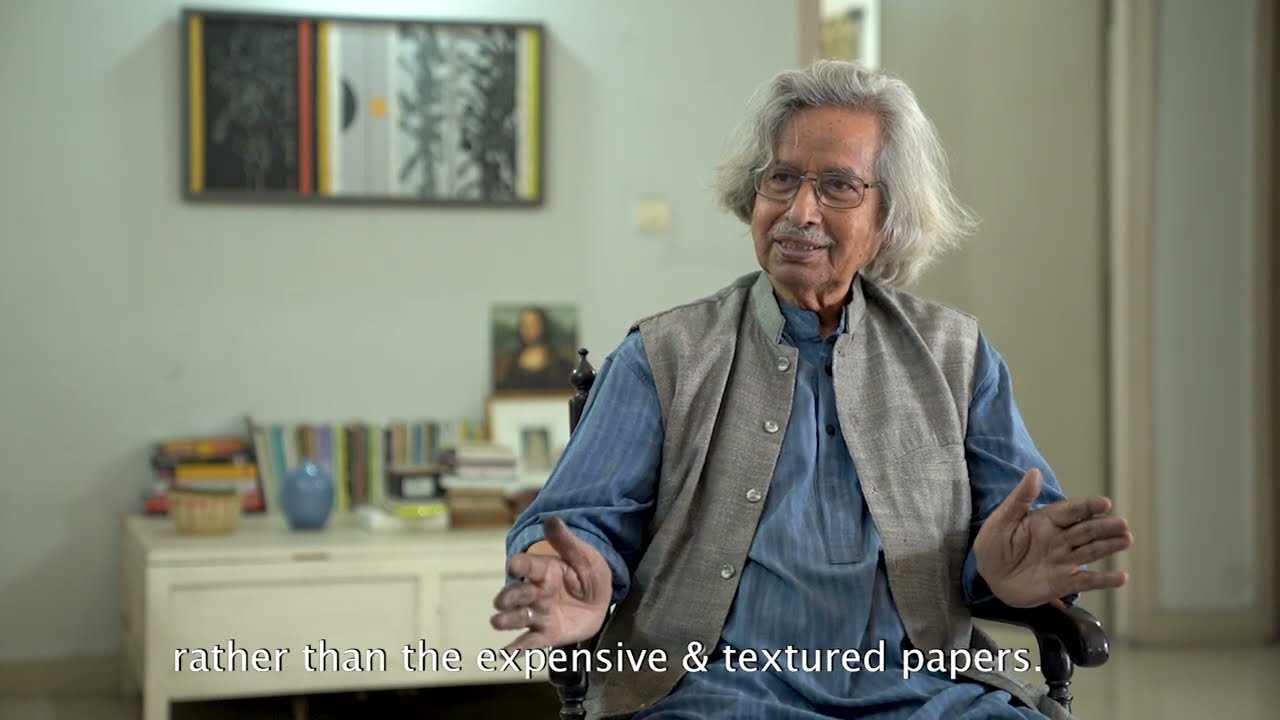
Chowdhury emerged alongside Bhupen Khakhar, Gieve Patel, Nalini Malani, Gulammohammed Sheikh, Nilima Sheikh, Sudhir Patwardhan, and Vivan Sundaram. This generation reshaped contemporary Indian art after independence.
He shares their commitment to figuration while diverging in technique. Where Khakhar used bright color and narrative clarity, Chowdhury works in muted tones and psychological ambiguity.
Comparative Analysis
Versus Bhupen Khakhar
- Khakhar: saturated hues, narrative scenes, homoerotic themes, flat picture planes
- Chowdhury: earthy palette, solitary or paired figures, heterosexual tension, volumetric forms via cross-hatching
Versus Ganesh Pyne
- Pyne: tempera on canvas, fantasy and myth, jewel-toned darks, dreamlike narrative
- Chowdhury: ink and pastel on paper, observed reality distorted, ochre-brown earthiness, psychological rather than narrative
Versus Francis Newton Souza
- Souza: thick impasto oils, aggressive frontal figures, Catholic imagery, violent brushwork
- Chowdhury: thin ink lines, figures in profile or three-quarter view, Hindu/secular imagery, controlled precision
Bengali Art Lineage
The Kalighat pat painters of 19th century Bengal used bold outlines and satirical subjects. Chowdhury inherited this DNA.
But he stripped away the folk art brightness. His palette comes from village earth, not bazaar paper.
Materials, Techniques, and Process
Preferred Supports
Paper dominates his output. Handmade paper, card, mount board. Canvas appears less frequently, mostly for larger oil works.
He favors paper because it accepts ink differently. The tooth holds cross-hatched marks. The surface breathes.
Primary Mediums
- Pen and ink: His core medium. Black ink applied with fine-nibbed pens. Creates the signature unbroken contours.
- Pastel: Layered over or alongside ink. Provides volume and tonal gradation. Often oil pastel for richer pigment deposit.
- Watercolor: Used for washes and transparent overlays. Less structural than his ink work.
- Oil on canvas: Occasional. Uses dry brush technique to minimize gloss. The result feels closer to pastel than typical oil painting.
Cross-Hatching Method
He developed this during college years. The technique creates mid-tones in black ink without wash.
Multiple passes of parallel lines at varying angles build density. Areas of high tonal contrast feel almost sculptural.
This gives his flat paper works a volumetric quality unusual for ink drawing.
Color Palette
Muted by design. Ochres, browns, olive greens, occasional muted reds. Cool grays appear in shadow areas.
He avoids saturated hues. The earthiness connects to Bengali village aesthetics, to terracotta goddesses and sun-baked walls.
Even skin tones feel organic, decomposing almost. There is deliberate decay in his color choices.
Working Process
Contour drawing comes first. The unbroken line establishes figure boundaries.
Cross-hatching builds internal volume. Then color (pastel or wash) adds weight.
Backgrounds remain minimal. Figures exist against bare paper or simple grounds. The human form carries everything.
Themes, Subjects, and Iconography
Human Figures
Bodies dominate. Sagging, distended, wounded, sensual.
Women appear caressing themselves, lost in private sensation. Men curl in pain or display raw wounds on their skin.
Couples sit together in psychological distance. Even in proximity, isolation persists.
The Couple Series
A recurring motif spanning decades. Man and woman, often on a sofa or bed, occupying the same pictorial space yet emotionally disconnected.
The domestic interior becomes a stage for marital tension. Bolsters, cushions, fabric folds all rendered with the same attention as flesh.
Political Commentary
“Tiger in the Moonlight” (1975-77) addressed the Emergency period under Indira Gandhi. Political allegory through animal symbolism.
The Abu Ghraib series (2005) depicted American torture of Iraqi prisoners. Direct engagement with global atrocity.
Communal riots, political killings in Bengal, state violence. These subjects appear without sentimentality.
Still Life
Fruits, vegetables, domestic objects. But even these feel bodily. A gourd resembles a stomach. A draped cloth echoes skin folds.
The boundary between organic and inanimate blurs deliberately.
Compositional Approaches
Figures in foreground, minimal background. The subject commands attention without environmental distraction.
Triangular arrangements for couples. Curved, organic outlines against angular furniture.
Negative space functions actively. The emptiness around figures creates psychological pressure.
Notable Works
Story of Woman
Year/Medium/Size: Work that achieved record auction price of $548,164 at Asta Guru in 2021
Visual Signature: Characteristic distorted female form, cross-hatched shading, muted earth tones
Why It Matters: Established a new price benchmark for Chowdhury’s market, confirming his position among top-tier Indian modern artists
Tiger in the Moonlight

Year/Medium: Created during India’s Emergency period (1975-77)
Current Location: Featured in major retrospectives and publications
Visual Signature: Allegorical animal imagery, nocturnal atmosphere, political undertones
Why It Matters: Demonstrates Chowdhury’s engagement with political commentary through symbolic figuration rather than direct representation
Situation ‘A’ (1993)

Medium/Size: Ink and pastel on paper pasted on mount board, 23.25 x 29.25 inches
Provenance: Exhibited at CIMA Kolkata (1993), sold at Saffronart (2021) for Rs 1,20,00,000 ($162,162)
Visual Signature: Domestic scene with psychological tension, characteristic line work and cross-hatching
Noti Binodi

Period: Delhi years (1972-1987)
Visual Signature: Figure study demonstrating mature technique, expressive distortion balanced with sensuality
Abu Ghraib Series (2005)

Medium: Pen and ink, pastel
Subject: American soldiers torturing Iraqi prisoners
Why It Matters: Shows Chowdhury’s willingness to address global political violence, extending beyond Indian subject matter
Exhibitions, Collections, and Provenance
Major International Exhibitions
- I, III, IV Triennales, Delhi (1972, 1975, 1978)
- 15th Sao Paulo Biennale (1979)
- II Havana Biennale (1986)
- Festival of India, Geneva (1989)
- International Exhibition, Cagnes-sur-Mer, France
- Gajah Gallery, Singapore
- Foundation for Indian Artists (FIA), Amsterdam
- Fine Art Resource, Berlin
- Indigo Blue Art, Singapore
Key Solo Exhibitions

- Singapore Art Museum (with National Gallery of Modern Art)
- Lalit Kala Akademi, New Delhi
- DAG, New Delhi
- Gallery Veda, Chennai
- Vadehra Art Gallery, New Delhi
- Pundole Art Gallery, Mumbai and New York
- Chitrakoot Art Gallery, Kolkata
- Gallery Art Exposure retrospective (2023, over 300 works from 1955-2023)
Museum Collections
- National Gallery of Modern Art, Delhi: Multiple works across periods
- Victoria and Albert Museum, London: Significant holdings of Indian modern art including Chowdhury
- Glenbarra Art Museum, Japan: Published “Jogen Chowdhury Enigmatic Visions” catalogue (2006)
- Museum of Art and Photography (MAP), Bengaluru: Includes “Girl” (c. 1989), ink on paper
Publications and Catalogues
- “Image and Imagination” (Mapin Publications) with essay by Geeti Sen
- “Jogen Chowdhury Enigmatic Visions” (Glenbarra Art Museum, 2006)
- “Ten Contemporary Artists of Bengal” (Pratikshan, 2003)
- “The Afterlife of Silence: Still Lifes of Jogen Chowdhury” by Anuradha Ghosh (Niyogi Books, 2020)
Market and Reception
Auction Performance
Record Sale: $548,164 for “Story of Woman” at Asta Guru (2021)
Works on Paper: Average around $11,000-12,000 in recent auctions. Smaller pen drawings range from $5,000-8,000.
Major Works: Significant ink and pastel pieces on mount board can reach $100,000-162,000
Serigraphs: Limited edition prints available at lower price points, making his work accessible to newer collectors
Primary Auction Houses
Saffronart handles the majority of his auction sales. Asta Guru, Pundole’s, and Christie’s South Asian sales also feature his work regularly.
Authentication Concerns
Signature variants exist. He signs in both English (“Jogen”) and Bengali script. Dating appears in upper corners or lower edges.
Certificates directly from the artist accompany many works. Provenance through major galleries (Vadehra, Pundole, Chitrakoot) provides additional verification.
Condition Patterns
Paper works require proper storage. Pastel can smudge without fixative. Light exposure fades certain pigments.
Works pasted on mount board tend to survive better than loose sheets.
Influence and Legacy
Upstream Influences
Kalighat Pat Painters: Bold outlines, satirical subjects, economical mark-making
Prodosh Das Gupta: Academic training foundation at Government College of Art
William Hayter: Printmaking techniques at Atelier 17, Paris
European Modernists: Exposure to Picasso, Matisse, and Klee during Paris years
Bengali Village Culture: Mother’s Alpana drawings, father’s mythological paintings, terracotta goddess forms
Downstream Impact
Younger Indian figurative artists cite his distortion techniques. The freedom to render the body as psychological landscape rather than anatomical accuracy.
His cross-hatching method influenced contemporary Indian draftsmen working in ink.
The Calcutta Painters Group legacy extends through artists who rejected both revivalism and Western copying.
Institutional Contributions
Rashtrapati Bhavan Art Gallery: Curator from 1972-1987, shaping national collection
Gallery 26 and Artists’ Forum: Co-founded in Delhi (1975), creating exhibition space for modern Indian artists
Art Today Journal: Co-founded with Shuvaprasanna Bhattacharjee (1981), providing critical discourse platform
Kala Bhavan, Santiniketan: Professor of painting from 1987, training next generation
Bharat Bhavan Biennale: Commissioner of the sixth edition
Recognition
Prix le France de la Jeune Peinture, Paris (1966). Award at II Havana Biennale (1986). International Print Biennale, Bhopal (1995). Kalidas Samman, Madhya Pradesh (2001). Honorary D.Litt. Banga Bibhushan Award. Zainul Samman.
Elected member of Rajya Sabha from Trinamool Congress (2014), bringing artist perspective to legislative body.
How to Recognize a Jogen Chowdhury at a Glance
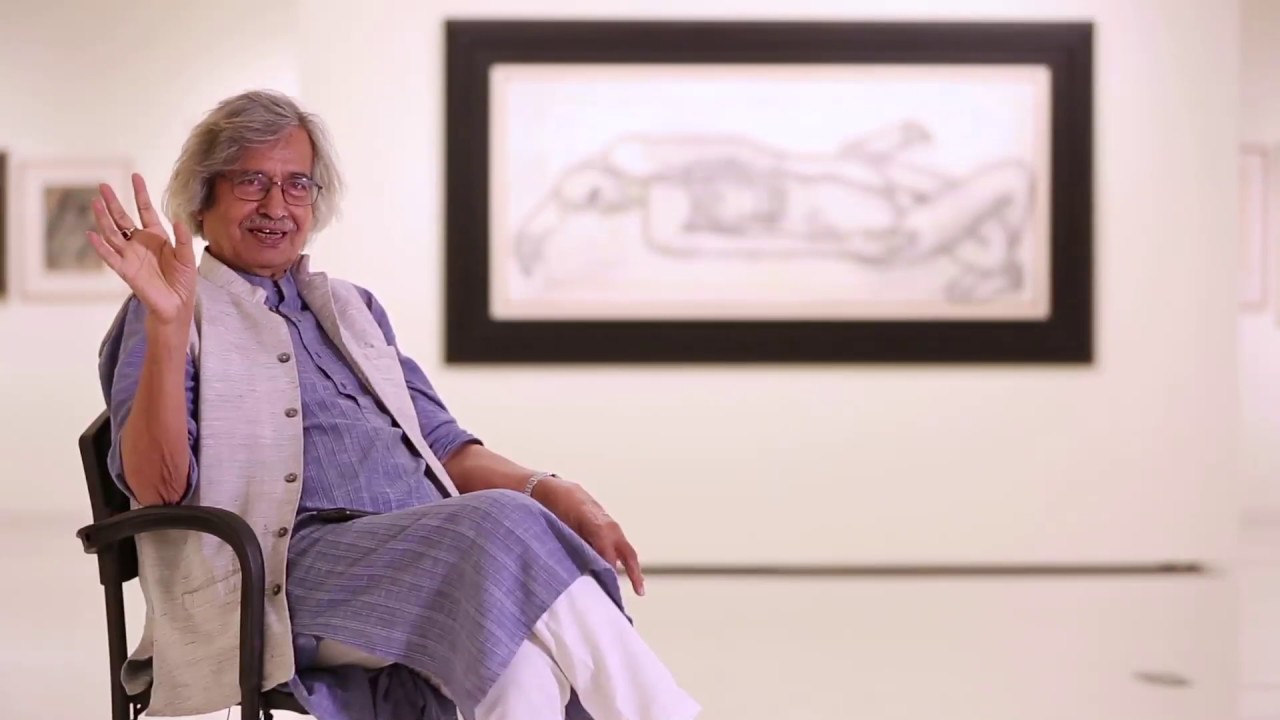
- Unbroken contour lines: The outline flows continuously around figures without lifting
- Cross-hatching for volume: Dense parallel line clusters create tonal mid-values
- Anatomical distortion: Sagging flesh, bulging bellies, exaggerated curves
- Muted earth palette: Ochre, brown, olive green, gray. No bright saturated colors.
- Figures against minimal backgrounds: Empty or simply rendered spaces behind subjects
- Psychological tension in couples: Two figures together yet emotionally isolated
- Sensual yet uncomfortable: Bodies that attract and repel simultaneously
- Signature placement: Upper corners or lower edges, often in both English and Bengali
- Paper support: Most works on paper or card rather than canvas
- Domestic subjects: Interiors with bolsters, sofas, cloth, still life objects rendered with bodily quality
FAQ on Jogen Chowdhury
Who is Jogen Chowdhury?
Jogen Chowdhury is an Indian contemporary painter born in 1939 in Faridpur, Bangladesh. He is known for his figurative expressionism, using ink, pastel, and watercolor. His distorted human figures and cross-hatching technique define modern Indian art.
What is Jogen Chowdhury famous for?
He is famous for his unbroken line drawings and cross-hatched ink works. His sensual yet grotesque human figures explore themes of isolation, decay, and domestic tension. The couple series paintings and political commentary works brought him international recognition.
What techniques does Jogen Chowdhury use?
Chowdhury uses pen and ink with fine cross-hatching to create tonal variations. He layers pastel over ink for volume. His dry brush method in oil painting minimizes gloss, giving works a matte, earthy finish.
Where did Jogen Chowdhury study art?
He studied at Government College of Art and Craft, Kolkata (1955-1960) under Prodosh Das Gupta. Later, he trained at Ecole Nationale Superieure des Beaux-Arts, Paris, and William Hayter’s Atelier 17 on a French government scholarship (1965-1967).
What art movement does Jogen Chowdhury belong to?
Chowdhury belongs to Indian Modernism and post-independence Bengali art tradition. He joined the Calcutta Painters Group in 1970. His style blends Kalighat pat influences with contemporary figuration, rejecting both Western imitation and revivalist approaches.
How much are Jogen Chowdhury paintings worth?
His auction record is $548,164 for “Story of Woman” at Asta Guru (2021). Works on paper average $11,000-12,000. Smaller pen drawings range from $5,000-8,000. Serigraph prints offer more accessible entry points for collectors.
Where can I see Jogen Chowdhury’s art?
His works are held at National Gallery of Modern Art (Delhi), Victoria and Albert Museum (London), and Glenbarra Art Museum (Japan). Galleries like Vadehra Art Gallery, Saffronart, and DAG regularly exhibit and auction his paintings.
What subjects does Jogen Chowdhury paint?
He paints distorted human figures, sensuous women, wounded men, and psychologically tense couples. Still life objects like fruits and cloth also appear. Political works address the Emergency period, communal riots, and Abu Ghraib torture.
Where does Jogen Chowdhury live and work?
He lives and works in Santiniketan, West Bengal, since joining Kala Bhavan as professor of painting in 1987. Before that, he worked in Chennai as a textile designer and in New Delhi as curator at Rashtrapati Bhavan Art Gallery.
What awards has Jogen Chowdhury received?
He won Prix le France de la Jeune Peinture, Paris (1966) and awards at II Havana Biennale (1986) and International Print Biennale, Bhopal (1995). The Kalidas Samman (2001), Banga Bibhushan, and honorary D.Litt. recognize his contributions.
Conclusion
Jogen Chowdhury built a visual language that belongs to no one else. His pen and ink drawings, layered with pastel, capture something uncomfortable about human existence.
The cross-hatching technique he developed at Government College of Art became his signature. Seven decades later, collectors still chase his couple series and socio-political works at Saffronart and Asta Guru auctions.
His legacy lives in museum collections from Delhi to London to Japan. More than that, it lives in every young Indian artist who learned that distortion can speak truth.
The Kala Bhavan professor proved that Bengali art tradition could grow without losing its roots.