The raw power of less. In the chaos of post-war America, a radical artistic vision emerged that stripped away excess and embraced the beauty of pure form. Minimalism wasn’t just an art movement-it was a revolution against convention.
Born in the 1960s, minimalist artists rejected narrative, metaphor, and emotional expression in favor of geometric abstraction and industrial materials.
Donald Judd’s pristine boxes, Agnes Martin’s ethereal grids, and Dan Flavin’s fluorescent light installations challenged viewers to experience art as physical presence rather than representation.
These pioneers worked with monochromatic color schemes and repetitive elements to create what Judd called “specific objects”-works existing between painting and sculpture that demanded a new kind of viewing experience.
This guide explores fifteen influential minimalist artists who redefined what art could be through their radical simplicity, mathematical precision, and architectural approach to space and balance.
Discover how their reduced forms and industrial materials created a new visual language that continues to influence contemporary art and design.
Minimalism Artists
Donald Judd (1928–1994)

Nationality: American
Art Movement(s): Minimalism, Post-painterly abstraction
Mediums: Sculpture, installation, furniture design, printmaking
Artistic Signature
Judd created precise geometric forms in industrial materials like steel, aluminum, and plexiglass. His works feature clean lines, mathematical repetition, and pristine surfaces that reject traditional artistic expression.
Recurring Themes & Motifs
His “specific objects” rejected illusionism and symbolism, focusing on physical presence, industrial fabrication, and the relationship between objects, space and balance within installations.
Influences & Training
Initially a painter, Judd studied at the Art Students League and Columbia University. His transition to three-dimensional work was influenced by constructivism and his disillusionment with painterly expression.
Notable Works
- Untitled (Stack) (1967) – Galvanized iron and lacquer
- 100 Untitled Works in Mill Aluminum (1982-1986) – Chinati Foundation, Marfa, Texas
- Untitled (Six Boxes) (1974) – Anodized aluminum, plexiglass
Role in Art History
Judd redefined sculpture by removing metaphor and narrative, focusing on “objecthood.” His theoretical writings and Marfa, Texas installations established him as minimalism’s intellectual cornerstone.
Agnes Martin (1912–2004)

Nationality: Canadian-American
Art Movement(s): Minimalism, Abstract Expressionism
Mediums: Oil painting, acrylic painting
Artistic Signature
Martin created delicate grid paintings with whisper-thin pencil lines and subtle washes of muted color. Her works achieve a meditative harmony through barely-there geometries and fragile precision.
Recurring Themes & Motifs
Her work explored transcendence, inner emotional states, and spiritual clarity through restrained visual language. Martin sought to capture moments of perfect happiness and universal beauty.
Influences & Training
Trained at Columbia University, Martin was influenced by Zen Buddhism, Taoism, and Abstract Expressionists. She rejected representation after moving to New Mexico, finding inspiration in desert landscapes.
Notable Works
- The Tree (1964) – Oil and pencil on canvas
- Friendship (1963) – Gold leaf and gesso on canvas
- Night Sea (1963) – Oil and gold leaf on canvas
- With My Back to the World (1997) – Acrylic and graphite on canvas
Role in Art History
Martin bridged Abstract Expressionism and Minimalism, proving that geometric abstraction could carry profound emotional depth. Her meditative approach influenced subsequent generations of artists exploring spirituality through abstraction.
Sol LeWitt (1928–2007)

Nationality: American
Art Movement(s): Minimalism, Conceptual Art
Mediums: Wall drawings, structures, printmaking, artist books
Artistic Signature
LeWitt created systematic works based on predetermined rules and mathematical concepts. His wall drawings used elementary forms, lines, and basic primary colors in logical, sequential arrangements.
Recurring Themes & Motifs
His works explored seriality, systems, and permutations. LeWitt emphasized the concept over execution, often creating detailed instructions for others to fabricate his pieces.
Influences & Training
Educated at Syracuse University, LeWitt worked as a graphic designer at Seventeen magazine. His early sculptural “structures” were influenced by architectural principles and Eadweard Muybridge’s sequential photography.
Notable Works
- Wall Drawing #122 (1972) – Colored pencil on wall
- Incomplete Open Cubes (1974) – Various materials
- Wall Drawing #1136 (2004) – Acrylic paint
- Complex Form series (1987) – Painted wood
Role in Art History
LeWitt transformed art-making by separating concept from execution and embracing collaborative creation. His instructions-based approach influenced conceptual art and expanded possibilities for installation and public art.
Dan Flavin (1933–1996)

Nationality: American
Art Movement(s): Minimalism, Light Art
Mediums: Fluorescent light installations, drawings
Artistic Signature
Flavin created luminous installations using standard commercial fluorescent tubes in limited color contrast and configurations. His works transform architectural spaces through light, shadow, and color.
Recurring Themes & Motifs
His work explored industrial materials, readymades, commercial standardization, and the immaterial qualities of light. Flavin embraced both the physical presence of fixtures and their ephemeral illumination.
Influences & Training
Briefly studied for priesthood before attending Columbia University. Influenced by Marcel Duchamp’s readymades and Russian constructivism, Flavin began working with electric light in 1963.
Notable Works
- Monument 1 for V. Tatlin (1964) – Cool white fluorescent light
- The Nominal Three (to William of Ockham) (1963) – White fluorescent lights
- Untitled (to Don Judd, colorist) (1987) – Colored fluorescent lights
- Untitled (in honor of Harold Joachim) (1977) – Pink, yellow, blue, and green fluorescent light
Role in Art History
Flavin expanded sculpture into environmental experience and helped define site-specific installation art. His work with industrial materials influenced institutional critique and light-based art practices.
Robert Morris (1931–2018)

Nationality: American
Art Movement(s): Minimalism, Process Art, Land Art
Mediums: Sculpture, installation, performance, film, drawing
Artistic Signature
Morris created simple geometric forms in industrial materials that respond to viewers’ bodies. His works evolved radically over time, exploring gravity, process, and bodily interaction with space.
Recurring Themes & Motifs
His minimalist phase focused on phenomenological experience and temporal awareness. Later works explored chance operations, disorder, and the physical involvement of viewers.
Influences & Training
Studied engineering, philosophy, and art at various institutions. Initially involved in dance and performance with Judson Dance Theater before creating minimalist sculptures influenced by Maurice Merleau-Ponty’s theories.
Notable Works
- L-Beams (1965) – Painted plywood
- Box with the Sound of Its Own Making (1961) – Walnut box, speaker, tape recording
- Untitled (Mirrored Cubes) (1965) – Mirror-clad plywood
- Continuous Project Altered Daily (1969) – Mixed materials
Role in Art History
Morris’s theoretical writings and shape-shifting practice helped define minimalism, process art, and earthworks. His phenomenological approach influenced installation art and institutional critique.
Carl Andre (1935–)

Nationality: American
Art Movement(s): Minimalism
Mediums: Sculpture, poetry
Artistic Signature
Andre arranges raw industrial materials like metal plates, bricks, and timber in simple geometric patterns directly on the floor. His works emphasize materiality, mass, and the relationship to architectural space.
Recurring Themes & Motifs
His sculptures explore gravity, horizontal composition, and unaltered industrial materials. Andre treats sculpture as “place” rather than form, creating works viewers can walk upon.
Influences & Training
No formal art education, but worked as railroad brakeman and with sculptor Constantin Brancusi. Early influence of Piet Mondrian led him to reduce sculpture to its elemental form.
Notable Works
- Equivalent VIII (1966) – Firebricks arranged in a rectangular formation
- 144 Lead Square (1969) – Lead plates laid in a square on floor
- Lever (1966) – 137 firebricks arranged in a line
- Cedar Piece (1964) – Western red cedar timbers
Role in Art History
Andre redefined sculpture by eliminating pedestals and embracing horizontality. His use of unaltered materials and non-hierarchical arrangements challenged traditional notions of artistic labor.
Frank Stella (1936–)

Nationality: American
Art Movement(s): Minimalism, Post-Painterly Abstraction, Op Art
Mediums: Painting, printmaking, sculpture
Artistic Signature
Stella began with geometric black paintings featuring regulated stripes, evolving into increasingly complex relief constructions. His work progressed from flat minimalism to baroque sculptural forms.
Recurring Themes & Motifs
Early work explored non-representational painting and “what you see is what you see” directness. Later works investigated spatial illusion, architectural forms, and color relationships.
Influences & Training
Educated at Princeton University, studying art history under William Seitz. Influenced by abstract expressionism, particularly Jasper Johns’s flag paintings and color field painting.
Notable Works
- The Marriage of Reason and Squalor, II (1959) – Enamel on canvas
- Harran II (1967) – Polymer and fluorescent paint on canvas
- Protractor series (1967–71) – Shaped canvases with rainbow bands
- Polish Villages series (1970-73) – Mixed media constructions
Role in Art History
Stella helped define post-painterly abstraction and minimal painting before pioneering the shaped canvas. His maxim “what you see is what you see” became minimalism’s rallying cry.
Ellsworth Kelly (1923–2015)

Nationality: American
Art Movement(s): Minimalism, Hard-edge painting, Color Field
Mediums: Painting, sculpture, printmaking
Artistic Signature
Kelly created large monochromatic shaped canvases and precise sculptural forms. His work features pure color, crisp edges, and simplified shapes often derived from observations of natural and architectural forms.
Recurring Themes & Motifs
His art distilled visual experience to essential contours and colors. Kelly explored figure-ground relationships, chance operations, and the contemplative power of monochromatic color schemes.
Influences & Training
Studied at School of the Museum of Fine Arts, Boston and École des Beaux-Arts in Paris. Influenced by Byzantine art, Henri Matisse, Jean Arp, and Piet Mondrian.
Notable Works
- Colors for a Large Wall (1951) – Oil on canvas
- Blue Green Yellow Orange Red (1966) – Oil on canvas
- White Curve (1974) – Painted aluminum
- Austin (2015) – Stone, glass, and wood building
Role in Art History
Kelly bridged European abstraction and American minimalism. His focus on perceptual experience and shaped canvases expanded painting beyond rectangular formats and influenced subsequent generations.
Robert Ryman (1930–2019)

Nationality: American
Art Movement(s): Minimalism, Monochrome Painting
Mediums: Painting
Artistic Signature
Ryman created predominantly white paintings exploring subtleties of texture, surface, and support. His work examines brushwork, material interactions, and painting as both process and object.
Recurring Themes & Motifs
His paintings investigate light, surface qualities, and how paint adheres to different supports. Ryman focused on revealing the essential qualities of painting materials rather than pictorial content.
Influences & Training
Self-taught artist who worked as a security guard at the Museum of Modern Art. Influenced by Mark Rothko and the jazz music he played as a saxophonist before becoming an artist.
Notable Works
- Bridge (1980) – Oil on fiberglass with steel
- Vector (1975) – Oil on linen with steel fasteners
- Standard (1967) – Oil on stretched cotton
- Pace (1984) – Oil on aluminum with steel fasteners
Role in Art History
Ryman pushed painting to its most fundamental elements, influencing process art and installation practices. His exploration of white and material interaction established new possibilities for non-representational painting.
Yayoi Kusama (1929–)

Nationality: Japanese
Art Movement(s): Minimalism, Pop Art, Environmental Art
Mediums: Painting, sculpture, installation, performance, film
Artistic Signature
Kusama creates immersive environments and objects covered in rhythmic patterns of dots and nets. Her work features obsessive repetition, mirrored spaces, and phallus-like protrusions across various media.
Recurring Themes & Motifs
Her art explores infinity, cosmic vastness, and psychological obsession. Kusama’s recurring dots and nets reflect her hallucinatory visions and desire for self-obliteration through pattern.
Influences & Training
Trained at Kyoto School of Arts and Crafts in traditional Japanese painting. Moved to New York in 1958, developing alongside Pop Art while creating distinct minimalist “Infinity Net” paintings.
Notable Works
- Infinity Nets series (1958–present) – Oil painting or acrylic
- Infinity Mirror Rooms (1965–present) – Mirror, lights, and various materials
- Accumulation sculptures (1962–present) – Soft sculpture with phallic protrusions
- Pumpkin (1994) – Yellow painted sculpture with black dots
Role in Art History
Kusama created a unique fusion of minimalist repetition, surrealist vision, and immersive environments. Her influence spans abstract painting, feminist art, installation, and contemporary experiential art.
Anne Truitt (1921–2004)

Nationality: American
Art Movement(s): Minimalism, Color Field
Mediums: Sculpture, painting
Artistic Signature
Truitt created meticulously hand-crafted wooden columns painted in layers of luminous color. Her sculptures unite minimalist form with emotional color relationships and personal memory.
Recurring Themes & Motifs
Her work explores color harmony, childhood memories, and lived experience. Truitt sought to embody emotional and psychological states in abstract three-dimensional form.
Influences & Training
Trained in psychology before studying sculpture at Institute of Contemporary Art in Washington, DC. Influenced by Barnett Newman‘s zip paintings and Ad Reinhardt’s abstractions.
Notable Works
- First (1961) – Painted wood
- A Wall for Apricots (1968) – Acrylic on wood
- Parva LIX (1973) – Acrylic on wood
- Morning Child (1973) – Acrylic on wood
Role in Art History
Truitt bridged color field painting and minimalist sculpture, introducing autobiographical content and emotional resonance to minimalism’s formal language.
John McCracken (1934–2011)

Nationality: American
Art Movement(s): Minimalism, Light and Space
Mediums: Sculpture, painting
Artistic Signature
McCracken created highly polished, monochromatic geometric forms that hover between painting and sculpture. His signature “planks” lean against walls, bridging floor and vertical space.
Recurring Themes & Motifs
His work explores perceptual experience, material perfection, and the interaction of object and space. McCracken was fascinated by color psychology and the metaphysical qualities of pure form.
Influences & Training
Educated at California College of Arts and Crafts. Influenced by Abstract Expressionism, hot rod culture, and Eastern philosophy.
Notable Works
- Black Plank (1967) – Polyester resin, fiberglass, and plywood
- Red Plank (1966) – Lacquer on wood
- Think Pink (1967) – Polyester resin and fiberglass
- Nine Planks V (1974) – Polyester resin, fiberglass, and plywood
Role in Art History
McCracken linked East and West Coast minimalism, combining industrial finish with handcrafted techniques. His works bridged painting, sculpture, and architectural space in innovative ways.
Richard Serra (1938–)

Nationality: American
Art Movement(s): Minimalism, Process Art
Mediums: Sculpture, video, drawing
Artistic Signature
Serra creates monumental steel sculptures that respond to and define specific sites. His works feature precarious balance, massive scale, curving forms, and rust-colored surfaces that engage the viewer’s body.
Recurring Themes & Motifs
His sculpture explores gravity, tension, and spatial disorientation. Serra focuses on the phenomenological experience of moving through space and the physical relationship between viewer, artwork, and site.
Influences & Training
Studied at University of California, Santa Barbara and Yale University. Worked in steel mills to support himself, influenced by the industrial processes that would later define his practice.
Notable Works
- Tilted Arc (1981) – Cor-Ten steel (removed 1989)
- The Matter of Time (1994–2005) – Weatherproof steel installation
- Torqued Ellipses series (1996–) – Weatherproof steel
- One Ton Prop (House of Cards) (1969) – Lead antimony
Role in Art History
Serra redefined sculpture through massive scale, site-specificity, and phenomenological experience. His work challenged institutional spaces and expanded minimalism into public settings.
Eva Hesse (1936–1970)

Nationality: German-American
Art Movement(s): Minimalism, Post-Minimalism, Process Art
Mediums: Sculpture, painting, drawing
Artistic Signature
Hesse created hanging, drooping forms using industrial materials like latex, fiberglass, and rope. Her work combines geometric abstraction with organic, body-like qualities and impermanence.
Recurring Themes & Motifs
Her sculptures explore asymmetrical balance, instability, and absurdity. Hesse transformed minimalism’s rigid geometry with references to the body, sexuality, and decay.
Influences & Training
Studied at Yale under Josef Albers. Initially a painter influenced by Abstract Expressionism before turning to sculpture after a transformative stay in Germany.
Notable Works
- Hang Up (1966) – Acrylic on cloth over wood, steel tube, and cord
- Contingent (1969) – Cheesecloth, latex, and fiberglass
- Right After (1969) – Fiberglass and polyester resin
- Accession II (1968) – Galvanized steel and vinyl
Role in Art History
Hesse humanized minimalism with bodily references and emotional resonance. Despite her short career, she pioneered post-minimalism and influenced feminist art practices.
Fred Sandback (1943–2003)

Nationality: American
Art Movement(s): Minimalism
Mediums: Sculpture, drawing, printmaking
Artistic Signature
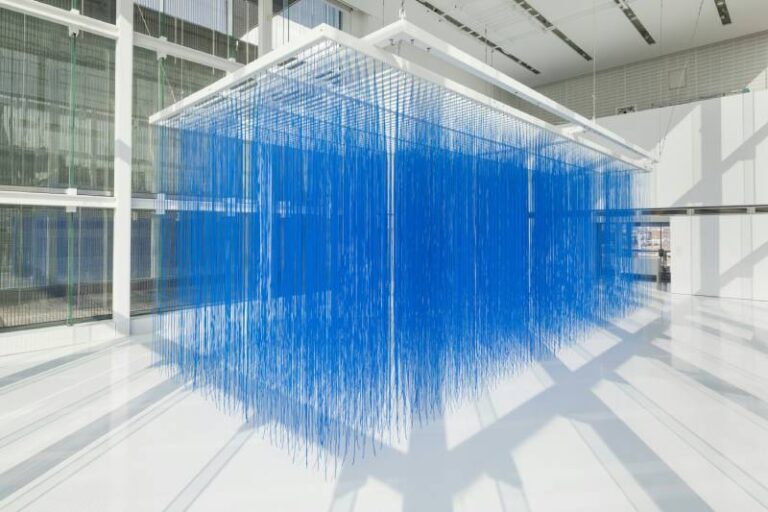
Sandback created ethereal installations using colored acrylic yarn stretched in geometric configurations. His barely-there sculptures define three-dimensional space with minimal physical presence.
Recurring Themes & Motifs
His work explores negative space, perceptual phenomenology, and architectural intervention. Sandback’s sculptures exist between drawing and form, challenging traditional notions of sculptural mass.
Influences & Training
Studied philosophy at Yale before attending sculpture classes with Donald Judd and Robert Morris. Influenced by phenomenology and the spatial experiments of Russian constructivists.
Notable Works
- Untitled (Sculptural Study, Seven-part Right-angled Triangular Construction) (1982/2010) – Yarn installation
- Broadway Boogie Woogie (Sculptural Study, Seventeen-part Vertical Construction) (1991) – Yarn installation
- Untitled (Sculptural Study, Four-part Construction) (1968/2007) – Yarn installation
Role in Art History
Sandback dematerialized sculpture to its most essential element: line in space. His “drawings in space” expanded minimalism’s interest in perception and phenomenological experience.
FAQ on Minimalism Artists
Who are the most influential minimalism artists?
The most influential minimalism artists include Donald Judd, Agnes Martin, Sol LeWitt, Dan Flavin, Carl Andre, Robert Morris, Frank Stella, and Ellsworth Kelly.
These pioneers created what Judd termed “specific objects” using industrial materials, geometric composition, and reduced forms to challenge traditional art concepts.
When did minimalism emerge as an art movement?
Minimalism emerged in the early 1960s in New York as a reaction against the emotional intensity of Abstract Expressionism.
The movement gained recognition through the 1966 “Primary Structures” exhibition at the Jewish Museum, reaching its peak influence through the late 1960s and early 1970s.
What materials did minimalist artists typically use?
Minimalist artists favored industrial and commercial materials that emphasized physical presence rather than representation.
Common materials included steel, aluminum, plexiglass, fluorescent lights, fiberglass, acrylic paint, and factory-fabricated components. These materials were often presented in their raw state with minimal artistic intervention.
What are the key characteristics of minimalist art?
Key characteristics include geometric abstraction, seriality and repetition, industrial materials, monochromatic color schemes, three-dimensional presence, and mathematical precision.
Minimalist works reject metaphor, narrative, and expressive brushwork in favor of literal objects with no hidden meaning.
How is minimalism different from abstract expressionism?
Minimalism rejected Abstract Expressionism‘s emotional intensity, gestural brushwork, and artist’s personal expression.
While Abstract Expressionists embraced spontaneity and psychological depth, minimalists pursued objectivity, precision, and “what you see is what you see” literalness.
Minimalism focused on physical presence rather than transcendent meaning.
Did any women play important roles in minimalist art?
Yes, women like Agnes Martin, Eva Hesse, Anne Truitt, and Yayoi Kusama made significant contributions to minimalism, often expanding its rigid definitions.
Their works incorporated emotional resonance, bodily references, and autobiographical elements that pushed minimalism beyond pure formalism toward what would later be called post-minimalism.
What philosophical ideas influenced minimalist artists?
Minimalist artists were influenced by phenomenology (particularly Maurice Merleau-Ponty’s theories on perception), Zen Buddhism’s emphasis on presence, and structuralist ideas about systems and seriality.
Many minimalists were also responding to contemporaneous ideas in music (John Cage, Steve Reich) and dance (Yvonne Rainer, Trisha Brown).
How did minimalism influence architecture and design?
Minimalism profoundly impacted architecture and design through its focus on geometric simplicity, industrial materials, and emphasis on space rather than ornament.
Architects like Ludwig Mies van der Rohe embraced the “less is more” principle, while designers applied minimalist harmony and reduction to everything from furniture to digital interfaces.
How did critics initially respond to minimalism?
Critics initially responded with skepticism or hostility. Michael Fried’s influential 1967 essay “Art and Objecthood” criticized minimalism as “theatrical” rather than properly artistic.
The movement’s industrial fabrication methods and rejection of artistic expression were controversial, though critical reception improved as minimalism’s influence grew.
Is minimalism still relevant in contemporary art?
Absolutely. Minimalism’s influence remains evident in contemporary installation art, digital art, architectural design, and conceptual practices.
Artists continue to explore minimalism’s core ideas about perception, presence, and space and balance, while museums regularly present minimalist works to new generations of viewers.
Conclusion
Minimalism artists transformed the artistic landscape through their radical simplicity and literal objecthood.
By stripping away narrative and embracing industrial fabrication, these pioneers created a new visual language that continues to resonate across creative disciplines today.
The geometric precision of Donald Judd’s boxes, the ethereal grids of Agnes Martin, and the luminous presence of Dan Flavin’s fluorescent installations challenged viewers to experience art as physical reality rather than illusion.
Their work with non-representational art and seriality continues to influence contemporary painting styles and three-dimensional work.
What began as a rejection of Abstract Expressionism‘s emotional excess evolved into a movement that redefined our relationship with objects, variety, and architectural space.
The mathematical rigor and phenomenological focus of minimalism opened new possibilities for experiencing art not as something to be interpreted, but as something to be encountered.
This legacy of specific objects and reduced forms continues to shape our understanding of what art can be.